At the World Economic Conference in 2021, the Armstrong Socrates model predicted that 2022 was going to be volatile and chaotic featuring a strong US dollar, a huge move in interest rates, a major bond market decline, fertilizer and food shortages, as well as escalating geopolitical tensions in Ukraine.
What now? Socrates forecast that 2023 will be more volatile and chaotic, featuring violent moves across all markets as monetary and geopolitical tensions and debt problems intensify.
At this year’s World Economic Conference, November 11-13, Martin Armstrong will talk about what’s next for the US dollar and other currencies, the liquidity/credit crisis, as well as price targets for oil, gold, stocks, bonds/interest rates, and stocks.
The National Retail Federation estimated that 172 million Americans spent $10.6 billion on Halloween this year, or $100 per person. Around $1.2 billion went into costumes for children, not to be outdone by adults spending $1.7 billion on their own costumes. Around $710 million was spent on pet costumes as well. Around 67% of consumers handed out candy, 51% decorated, 47% wore a costume, 44% carved pumpkins, and 26% participated in a Halloween party. Halloween spending is back to pre-pandemic levels, but inflation is to blame.
Food, candy, pumpkins, décor – all of these items cost significantly more in 2022, but Americans are still willing to spend. Candy alone is up 13.1% from last year, surpassing food inflation at 11.2%.
This is foreshadowing for the Christmas season, which historically is the most lucrative time for retailers and a big boost for overall GDP. Around 25% of all retail spending occurs in November and December each year, but many have already begun holiday shopping as stores are forced to offer more appealing sales. Retailers who fail to profit in the remaining months of 2022 will be forced to downgrade their forecasts and re-evaluate their businesses in the current economy. Layoffs and store closures are likely, and many retailers have already halted hiring. Americans do not have more disposable income to spend on the holidays, but those who can are willing to pay inflated prices to participate in age-old traditions.
Posted originally on the conservative tree house on October 26, 2022 | Sundance
A lot of people didn’t like Steven Mnuchin as Treasury Secretary, I did. Secretary Mnuchin was an inside player, a billionaire himself, who worked for the outside team. He already had a full bank account and carried ‘f**k-off’ money. That, combined with Wilbur Ross having the same ability, was exactly what we needed to execute the America-First MAGAnomic resurgence.
The U.S. middle-class saw and felt the benefits. Economic security is national security, at a nationwide and even individual level. Mnuchin, Ross and Lighthizer constructed that economic outcome guided by the larger strategy of President Donald J Trump.
RIYADH, Oct 26 (Reuters) – Former U.S. treasury secretary Steve Mnuchin said on Wednesday he believed the United States was in a recession and said this would continue.
Speaking at Riyadh’s flagship investment conference FII, he said: “I think we’ll probably see a peak of 4.5% 10-year rates.”
“I think you are going to see inflation in the U.S. begin to come under control, it will probably be a two-year period,” he added.
He said the U.S. and China must learn to co-exist. He added that the Middle East’s economic issues need to be dealt with regionally. (link)
Posted originally on the conservative tree house on October 14, 2022 | Sundance
Not that long ago, I would have said to allow the free market to decide if a merger or acquisition was valuable for the consumer. However, in the era where massive multinational corporations, investment groups and financial institutions have now used corporatism to merge their interests with government, the massive multinationals need scrutiny.
Two major food retailers, Kroger and Albertsons, have announced their intent to merge into one massive company in a deal valued at $24.6 billion. The majority stakeholders in Kroger are institutional investors Vanguard ($3.72 billion/11.29%) and Blackrock ($3.02 billion/ 9.17%). The majority stakeholder in Albertsons is institutional investment group Cerberus ($3.90 billion/28.54%).
In the past few years, food has surfaced as a growing national security issue. Foreign companies and large multinationals continue to expand their control over U.S. farm production and export U.S. farm products (Big Ag). A major retail level move like the merger of Kroger and Albertsons creates a weaker competitive environment and gives a larger potential footprint to price control.
CBS – […] Together, the companies will have more than 710,000 workers and operate nearly 5,000 stores, along with roughly 4,000 pharmacies. Kroger, based in Cincinnati, Ohio, operates 2,800 stores in 35 states, including brands like Ralphs, Smith’s and Harris Teeter. Alberstons, based in Boise, Idaho, operates 2,220 stores in 34 states, including brands like Safeway, Jewel Osco and Shaw’s.
“Albertsons Cos. brings a complementary footprint and operates in several parts of the country with very few or no Kroger stores,” Kroger CEO Rodney McMullen, who will lead the expanded company, said in a statement.
Kroger will pay $34.10 for each share of Albertsons stock, a 19% premium from the closing price on Thursday. As part of the purchase, Albertsons will issue a cash dividend of up to $4 billion to its shareholders, which the companies said is expected to be about $6.85 per share. (read more)
Sometimes bigger is just bigger and more controlling, not better.
That said, with economic volitivity continuing to increase, the food sector is a safe harbor for massive investment shifts.
Posted originally on the conservative tree house on June 16, 2022 | Sundance
Western sanctions against Russia have been used primarily to obfuscate the cause of western inflation and keep the citizen pitchforks from reaching various government offices. So far, the strategy -assisted by western media- has been mostly successful.
However, the International Energy Agency (IEA) is reporting that despite the western sanctions against Russia, the Russian energy sector is having no trouble finding customers for its oil sales. With global oil prices at their highest rates in years, in part driven by the energy policy of the same western leaders who triggered the sanctions, Russia is getting just as much economic benefit as it was before the sanctions regime was triggered.
(EU FINANCE) – Russia continued to rake in oil revenues in May despite a global boycott from companies and most countries following its invasion of Ukraine, a new report has shown.
The International Energy Agency (IEA) said the Kremlin’s oil-export revenues surged to around $20bn last month, an 11% increase from the month before, despite shipping lower volumes.
Its latest monthly report, published on Wednesday, said this takes Moscow’s total revenue for shipping oil and crude products roughly back to levels before the invasion of Ukraine. Russian exports fell by about 3% due to lower oil-product flows, the Paris-based agency estimates.
Meanwhile, crude shipped during the month grew by nearly 500,000 barrels a day compared to the start of the year, largely thanks to higher deliveries in Asia.
“China and India, which have both sharply increased crude oil purchases from Russia, are net product exporters and have no need to lift Russian products,” it said. (read more)
Posted originally on the conservative three house on April 13, 2022 | Sundance
Fed Governor Christopher Waller appeared on CNBC to announce we have reached peak inflation, and things will moderate from here. All of these fed moves are political moves, not monetary policy-based moves. Here’s the thing they will never admit to the non-institutional investor.
The fed has been painfully slow to raise interest rates on purpose. They did not make a mistake. The reason for their delay is they needed to wait for the beginning of the first 2021 inflation wave to cycle through before they raised interest rates. It’s a game of mirrors that almost no one sees. WATCH:
The rate of inflation will drop once the statistical year-over-year comparisons reach the same moment in the prior year. The fed will raise interest rates in May and then use the June inflation rate decline as a false talking point to highlight how their policy is working. They wait for May, because they need to wait for the calendar, nothing else. Inflation is measured as the percentage of change from the prior year. By waiting until the inflation is measured against the first wave of rising prices, it will give the illusion of a decline in inflation.
So that’s why they waited. But here’s the worse part….
All of these U.S. Fed monetary policymakers are in full ideological alignment with the global and central bankers. They are all following the same Build Back Better agenda and policy instructions.
All of bankers know the shift from ‘dirty energy’, coal, oil, natural gas, will create inflation. All of the bankers know there is no economic bridge within the plan to shift from oil to their unicorn dust. All of the bankers know that shutting down oil exploration as a matter of western unified policy will, as a factual matter, destroy the economic systems that rely on energy….. which is to say everything.
All of these bankers know the severity of the inflation crisis this energy shift creates. None of them do not know.
Everything they are doing is coordinated to assist the climate change agenda.
Posted originally on the conservative tree house on April 13, 2022 | Sundance
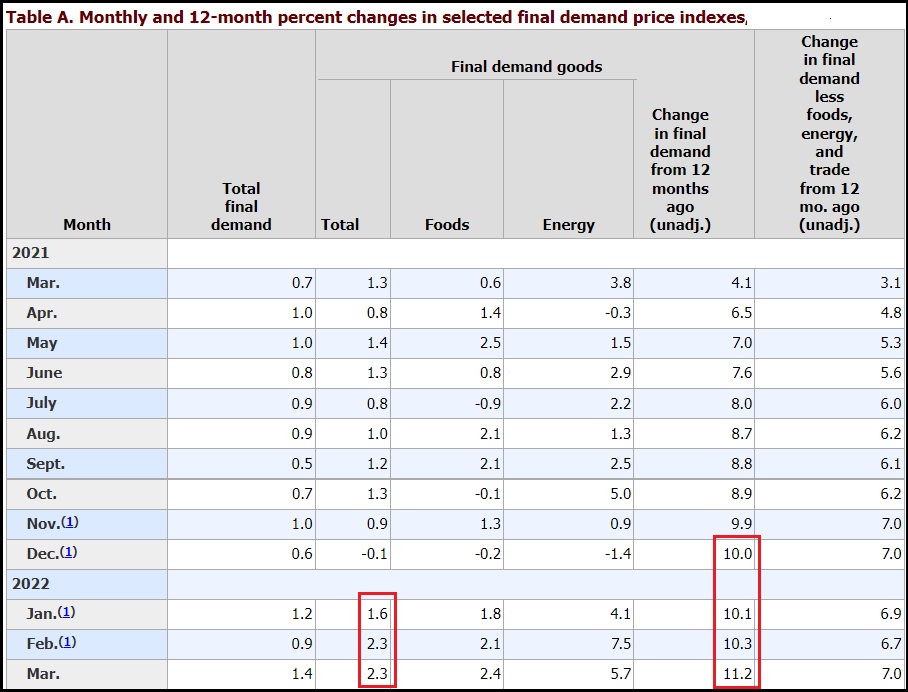
he “Producer Price Index” (PPI) is essentially the tracking of wholesale prices at three stages: Origination (commodity), Intermediate (processing), and then Final (to wholesale). Today, the Bureau of Labor and Statistics (BLS) released March price data [Available Here] showing a dramatic 11.2% increase year-over-year in Final Demand products at the wholesale level. This is the fifth consecutive month with the highest rate of inflation the PPI ever recorded.
The single month increase in wholesale prices of 2.3% was driven by inflation built into the supply chain at every level that shows up in the final wholesale price. Those price increases then get passed along to consumers along with the additional costs for warehousing, transportation and delivery. I modified Table-A (FINAL DEMAND) to take out some of the noise.
Wholesale prices of goods jumped 2.3 percent in March, and the wholesale price of food products jumped 2.4 percent. The total demand inflation compared to last year is 11.2 percent, the highest rate ever recorded since the PPI tracking was first started.
The total final demand monthly calculation (1.4%) is lower than the final demand goods (2.3%), because final demand services are offsetting. You may remember the discussion/analysis about prices beginning to stabilize after this month due to a contraction in demand for goods and services. I see support for that thesis within this data.
The three phases of wholesale product creation: (1) origination, (2) intermediate, and (3) final, cycle through the economic analysis in reverse chronological order. Roughly speaking, the flow of goods quantified is done in 30-day sequences. Final demand this month is comparing to final demand in March 2021. The intermediate demand goods this month will become final demand goods next month (April).
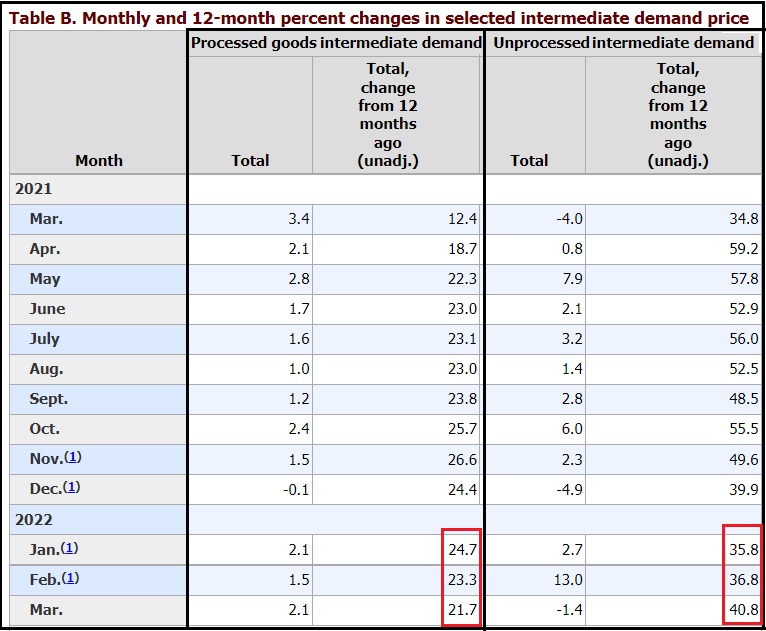
The rate of inflation behind this set of final demand goods is beginning to soften. See Table B, Intermediate goods. Again, modified to take out the noise:
While the yearly comparison for both processed and unprocessed intermedia goods is eye dropping, in the unprocessed intermediate demand goods, we are starting to see a lessening of monthly price increases.
In essence, prices have been rising so fast and for such an extended period of time, that we are now cycling through the rate of increase and starting to compare it to last year when the rate of increase was originally going high. As a consequence, the rate of price increase will likely lessen, even though the actual price may still keep climbing within the manufacturing process.
The price of raw materials, and the wholesale energy costs to process those materials into finished goods, are still rising. In addition to the consumer prices reported yesterday, this wholesale price data is showing the most recent increases (March) in fuel and transportation costs. For the next report these figures should now plateau.
♦ BOTTOM LINE – We have not yet reached PEAK INFLATION – However, the price increases from wholesalers to retailers are now at parity. The increased price of things coming into the supply chain are now at similar rates of increase when compared to the stuff on the shelves.
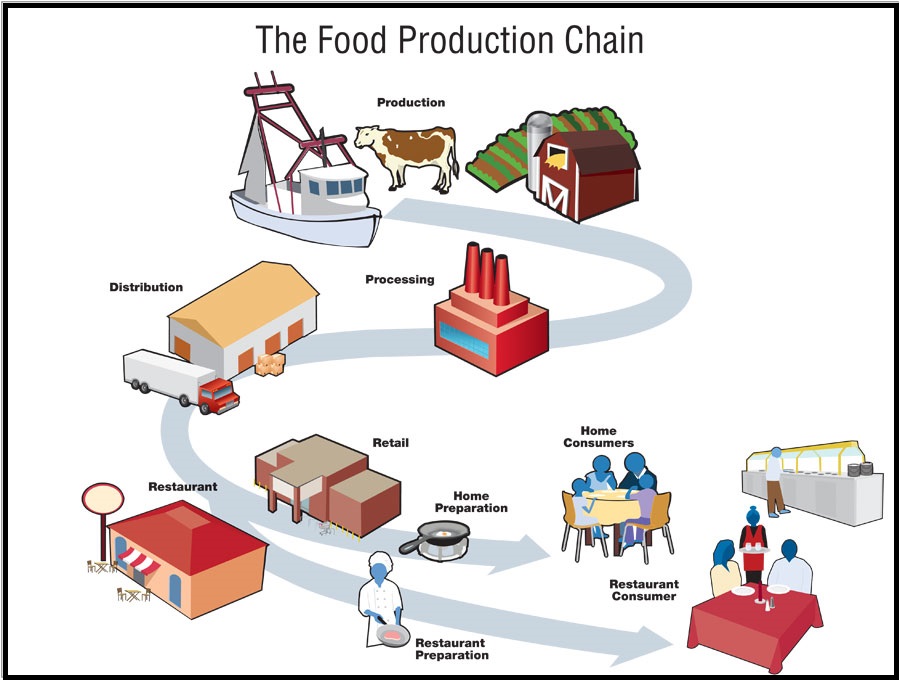
Inflation from field to fork is now fully matriculated and embedded in the total economy as a result of two massive price waves (July to October 2021 and November to March 2022). Those prices will never fall.
Highly consumable goods like food, fuel and energy will remain at approximately the price today for a period of around five months, then we will see the third wave kick in as the new higher harvest prices hit the processors in late summer.
The prices for non-essential durable goods, like cars, electronics, appliances etc. from this moment forth will now be determined by demand. Highly sought after goods will increase in price as more customers chase fewer products. However, ordinary or widely available durable goods will likely start to come down in price very soon as inventories climb because consumer spending has prioritized and dropped non essential goods from their shopping lists.
To put it more succinctly: The stuff we need will cost more. The stuff we don’t need will cost less.
COMMENT #1: Well, at least I got the decline accelerating in the Ruble correct and thanks to your models knew the war and commodity cycles were turning up. Getting the fundamentals correct ahead of time is a work in progress and definitely not easy.
But while watching the Ruble crashing into weakness going into the ECM, one could not reverse position and go long the RUB. Heck, nobody could even open new positions and definitely not buy the RUB. All that was allowed was closing already existing positions. And now the RUB was even removed from the trading platform altogether.
So my original trading strategy of shorting and then going long RUB got cut short and max profits throw out the window. So much for free markets.
EM
COMMENT #2: Marty you have proven your model and computer is the key to running governments for the future living with the cycle. It is easy to see why the CIA wanted your model pinpointing Ukraine almost 10 years in advance as the key spot for war. It is also interesting how others prefer not to ever mention you for your work is not opinion like everyone else. I really hope you succeed in securing Socrates for the world long-term. We all can learn so much.
All the best from Poland
and thanks for the conference that you did here in Warsaw
VA
REPLY: The free markets are not so free. During the Civil War, even President Lincoln went after trading gold and argued those people were making money off of every battle. The EU wanted to take trading the Euro away from London because of BREXIT. The people running these governments will NEVER honor the free markets when they go against them.
Yes, it was very nice to meet everyone in Warsaw. I had not been there before. I am doing my best to make sure Socrates continues beyond my shelf life. The problem is that the world is run by the seat of its pants and it is always based upon bias, prejudice, and power-plays driven by ego. I think some people just need to have an enemy and no matter what changes, they ignore that to keep the hatred ongoing.
There are people who still call China Communist even though there is private ownership which is the opposite of communism. They will continue to hate China no matter what and that in turn only invokes a response to counter that trend. Biases like that prevent us from ever moving forward and society is at times like a scratched record playing the same track over and over again.
The Federal Open Market Committee plans to taper its asset purchasing program by $30 billion per month. Starting in January, the central bank will begin buying $60 billion in bonds monthly, citing “inflation developments and the further improvement in the labor market.”
As for interest rates, the Fed is considering as many as three rate hikes in 2020, followed by two additional hikes in 2024. This comes after the Fed artificially lowered rates to near zero for the longest amount of time in the history of the Federal Reserve.
“With inflation having exceeded 2 percent for some time, the committee expects it will be appropriate to maintain this target range until labor market conditions have reached levels consistent with the committee’s assessments of maximum employment,” the central bank stated. Unemployment reached a post-pandemic low of 4.2% last month, but nearly 7 million Americans are still unemployed. “Supply and demand imbalances related to the pandemic and the reopening of the economy have continued to contribute to elevated levels of inflation,” the statement continued. Now, the central bank believes inflation will somehow reach 2.6% in 2020, with core inflation dropping to 2.7%.
The central bank sees reduced GDP growth this year, dropping the forecast to 5.5% from 5.9%. GDP in 2022 is now estimated to reach 4%, and 2.2% in 2023.
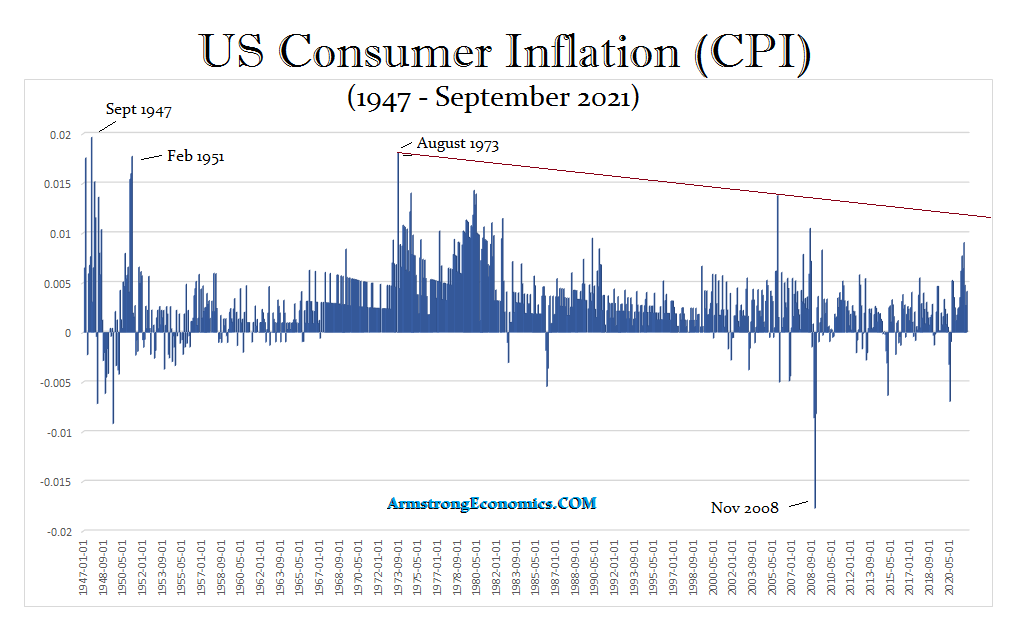
Inflation continued to surge, reaching 5.4% in September. Janet Yellen has never been right about anything and keeps calling this “transitory,” as if it will vanish in a few weeks. The Labor Department’s Consumer Price Index, which is supposed to measure a basket of goods and services as well as energy and food costs, came in at 5.4% in September from a year earlier, well beyond expectations. However, our model was projecting a rise in inflation into 2021 which is 13 years up from the November 2008 low. It is interesting how the COVID restrictions with lockdowns came in on target with our computer’s forecast. Curious how events seem to fulfill the forecast when it is done by a computer rather than human judgment.
Nevertheless, as you can see from the chart, inflation has bounced on a month/month basis, but it has not yet reached the Downtrend Line. The long-term forecast beyond a mere decade projects the historical high will be due in 2034, which should exceed all previous highs. A month/month number above 1.05% will signal that inflation is breaking out, and we will indeed make all-time record highs going into 2034.
I have created this site to help people have fun in the kitchen. I write about enjoying life both in and out of my kitchen. Life is short! Make the most of it and enjoy!
This is a library of News Events not reported by the Main Stream Media documenting & connecting the dots on How the Obama Marxist Liberal agenda is destroying America









 Centinel2012