Sunday Talks: NEC Chairman Larry Kudlow -vs- Chris Wallace


National Economic Council Chairman Larry Kudlow appears on Fox News for an interview with Chris Wallace discussing Trump administration trade positions.  Kudlow and Wallace were previously on the same team, and held the same positions, perspectives and outlooks.

In the face of four decades of results which cannot be refuted, Chairman Kudlow is modifying his position to align with President Trump and Main Street.  At the same time Kudlow is trying to convince Wall Street and GOPe Wallace-types to follow his lead.

.

[*side note* notice how no-one ever mentions MfN status?]

In some ways POTUS Trump’s selection of Kudlow is an interesting test to see if the functionally obsolescent Wall Street-minded economists have the capacity to retool decades of flawed thinking.

Central Banks are not All the Same


QUESTION: Hi Marty,

I am curious if you have a take on the BOJ. They own almost all of the JJB market and have stated explicitly they will buy it all. Now they own 77% of the Japanese ETF market.

Is it folly to suggest that the US gov’t or FED is not doing the exact thing?

Case in point, I know no one in managed money that is stupid. So, this morning why were stocks panic bid in the face of horrid payrolls and an all out bloodbath with China, especially considering that valuations are extreme. That was not delta hedging.

Have equity markets become weaponized for economic policy?

ANSWER: The Fed is nothing like the Bank of Japan (BoJ) or even the ECB. In the case of Japan, their debt has always been primarily held domestically. You could not issue even a private note in Japanese yen without prior approval of the Ministry of Finance. Japan has maintained a controlled economy. The ECB has followed that direction. It is illegal to short Eurozone bonds. In both cases, they believe if they control the financial markets they can prevent a crash and this support the political agenda.

The Fed is NOT reinvesting its bond purchases. When they mature, the balance sheet will be reduced. Always people bash the Fed and attribute what the BoJ and ECB do assuming the same will take place at the Fed. This is just not true.

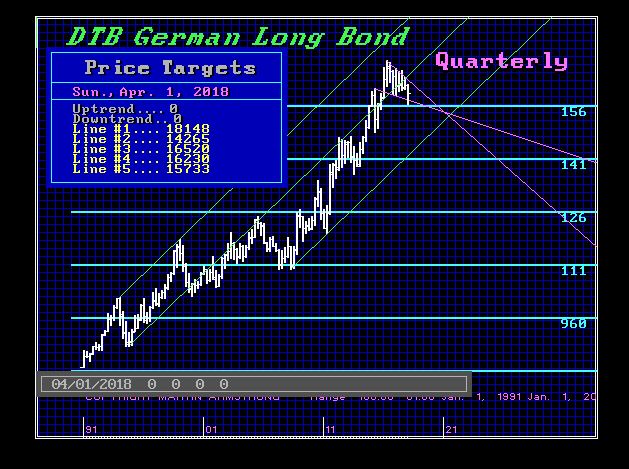
We just obtained the lowest quarterly closing on German bonds since the major high of June 2016.

Understanding the Markets


QUESTION: Mr. Armstrong; On your January 29 blog, you wrote “In the US Share Market, this is now a turning point we have reached. I have warned for months that exceeding the November high would lead to a January high. Now, the failure of February to make new highs warns of a March low. The support for a correction now lies at the 25637 level on a weekly closing basis (this is not a reversal). We will elaborate today on the Private Blog.” You warned that March could produce a high and keep the cycle inversion process in play. That proved correct since the Nasdaq made new highs and the Dow a reaction high. So that led to the drop into the first week of April. For the actual buy and sell signals, we should only do so on reversals and turning points. The January high you did with the turning point I assume and then the reversals kicked in. The buying opportunity I also assume we must wait for the turning point as was the case for the high. Correct?

PF

ANSWER: Correct. I have made it perfectly clear that NORMALLY one turning point is followed by the OPPOSITE event on the next. So a January high would traditionally produce a March low. However, I pointed out that we have been in a Cycle Inversion. September 2017, November 2017, and January 2018 followed by March 2018 were all the monthly sequential turning points. Normally, each would produce the opposite. That was not the case and each produced a high. This is the Cycle Inversion and it is also warning that we are still consolidating. March produced a high in the Nasdaq and only a reaction high in the Dow. This further warned that there was a shift from an international focus to domestic (Dow v Nasdaq). March also produced only a reactionary high the week of 03/12.

Far too many people expect a guru and want to act based solely upon a comment. Buy this or sell that and that person should always be correct. That is the dream of a fool for nobody can do that. They will ALWAYS quickly lose their money and then blame their pretend guru. That is a sure-fire way to go broke and if they are trying to trade short-term on such comments, they must be insane.

I have stated at the outset of this year that 2018 was a Panic Cycle. That means you test both directions! I further warned that we would see consolidation dominate the first part of 2018 so there was no reason to rush back in until we reach (1) turning point and (2) reversals. The closing of the first quarter was neutral in many markets once again showing that we are still in this consolidation mode. Buy or sell signals are on REVERSALS – never comments.

If you are trying to be a short-term trader and you think that will lower your risk, you are dead wrong. The best performance is to go with the trend and act ONLY on Weekly to Monthly signals – not commentary. January was a critical turning point. All our models were converging at that time so it was ripe for the correction which is why I stated that and was already getting criticism by January 31st, 2018.
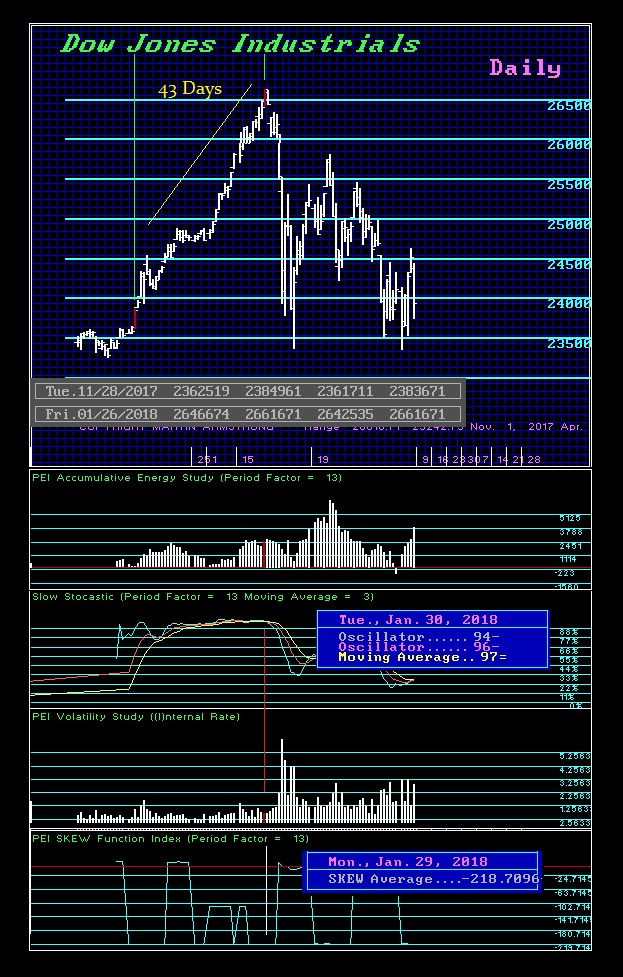
The high was Friday January 26th. Every model we had was starting to scream DOWN! The Cycle Inversion was confirmed on the first day of December. I warned if we exceeded the November high, we would rally into January. The high came exactly 43 days (8.6 /2) from the breakout. That frequency does work in the share market except at extreme turning points. That lined up perfectly. The oscillators, always a lagging indicator, turned down on the 30th. Our Skew Model bottomed one day from the high on the 29th. Our Energy model peaked on the day, The subsequent sharp rally into March confirmed this was a reaction high.

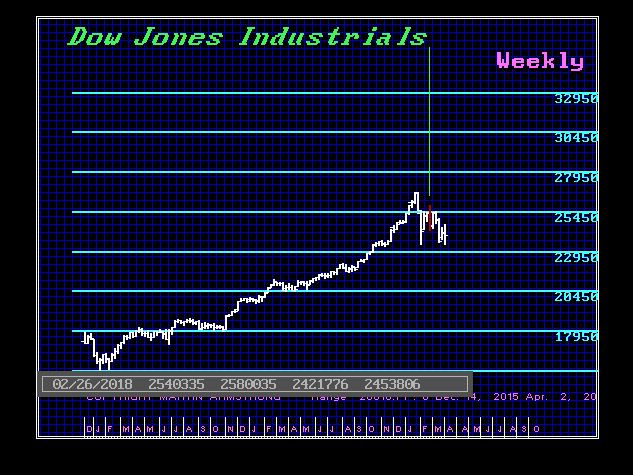
Here is the Array on the Dow. There were three weeks targeted 02/12, 02/26, and 03/12 followed by 04/02. The week of 02/12 was a Directional Change and that sent the market back up leaving the February low intact. The next target was 02/26 which produced the reaction high in the Dow. The next target 03/12 produced the high in the Nasdaq.  Then the next target 04/02 produced the retest of the Feb low. Once again, we can see how the markets were interacting and producing the shift from international to domestic.

Clearly, commentary is just an attempt to expalin what is unfolding. It is NEVER for trading purposes. We trade based upon the Reversals and Toming exclusively.

President Trump Tweets Strong Support for EPA Head Scott Pruitt: “Scott is doing a great job!”…


Making left-wing ‘splodey heads one tweet at a time:

(Tweet Link)

NAFTA Watch – No “Agreement on Major Issues” After Three Days of Discussion Between Principals…


After three days of discussions between U.S Trade Representative Robert Lighthizer, Canadian Foreign Minister Chrystia Freeland and Mexican Economy Minister Ildefonso Guajardo they were not able to develop any consensus on the major issues within the North American Free Trade Agreement, NAFTA.

The likely outcome of the upcoming Mexican national election on July 1st brought the principals together for non-scheduled talks, as U.S. President Trump instructed Ambassador Lighthizer to explore whether the three nations could find common ground on the ‘big picture’ issues behind the largest schism.  The auto sector and rules of origin is the epicenter of the biggest difference between the U.S., Mexico and Canada.

The U.S. auto-sector NAFTA position is that North American content of vehicles made in NAFTA countries be increased to 85 percent from 62.5 percent.  The Canadian and Mexican position is for lower North American content.

Canada is not arguing for higher Canadian content.  Mexico is not arguing for higher Mexican content… Instead both Canada and Mexico are arguing for higher imported content (China and Asia).  Honestly, I cannot fathom why more people don’t see the inherent ridiculousness of NAFTA against the reality of Canada and Mexico arguing for more Chinese imports.

The reason Can/Mex are arguing for more imported material content is because both of their trade economies exploit the NAFTA loophole that allows European and Asian parts to be shipped into Can/Mex, assembled, and shipped into the U.S. market without duty.

It’s bizarre; yet this is the reality.

NAFTA is so completely flawed, it is against Canada and Mexico’s financial interest for them to agree to a North American trade agreement that is structured around North American trade.

When you ask a pro-NAFTA advocate why Canada and Mexico are arguing for less Canadian and Mexican manufacturing in their NAFTA position the advocate cannot answer with any intelligence…. because their pro-NAFTA entire premise is ridiculous, and based on structural falsehoods.  Very frustrating.

Depending on which ideological broadcast or print media you review, there is a massive disconnect in their projected framework of optimism that a deal can be reached. Canadian media are desperate to find hope that any deal can be reached. Mexican media is ambivalent; and U.S. media is mostly driven by the position of multinational corporations who demand the exploitative nature of NAFTA be retained.

My gut, and the ongoing deep reviews of nuance therein, still lean heavily toward the inability of any deal to be possible because the underlying dynamic is so structurally flawed. It is against U.S. interests to stay in NAFTA. It is against Mexico and Canada’s interests to exit NAFTA. There is a massive amount of media manipulation between those polar opposite positions.

.

Princess Rainbow Sparkles continues selling the Canadian position based on ‘feelings’ and ’emotion’…

.

Companies Stop Buy-Backs Causing January Crash?


QUESTION: Mr. Armstrong; The analysis being punted around is that the crash from January was caused because companies stopped buying back their own shares. The analysis claims that $4 trillion in buy-backs have taken place since 2009 and they stopped because of regs and that was the cause of the crash. It seems to me that this is bogus for the Nasdaq rallied into March and it was the Dow that led the whole way. This analysis appears to be fake news for it is as you say, trying to reduce everything to a single cause. Would you agree?

HC

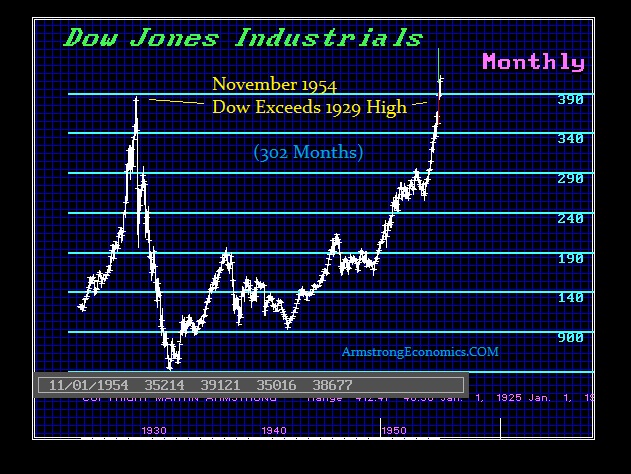
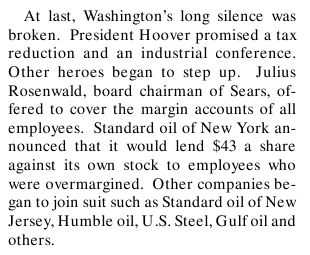
ANSWER: Absolutely. Yes, Bloomberg wrote about that and put out the research of Goldman Sachs. During the Great Depression, companies tried to support the market and were buying back their shares aggressively during the crash. It not only failed to support the market, it undermined the companies themselves and many failed because they could not raise money nor borrow money as the Great Depression continued. This fundamental sounds logical, but it is just nonsense. Not only did companies rush to buy their own shares back as the 1929 Crash unfolded, they even went as far as to offer loans on their own shares to workers. I wrote about that in the Greatest Bull Market:

/id. page 231

None of all this support had any impact in stopping the Crash. As I have stated many times, everything is connected. If the entire market is crashing, a company trying to buy back its own shares to support its share price has NEVER worked even once in reversing the trend. Bloomberg’s report is indeed bogus. It is simply trying to report ah – this was the cause! It never works that way

World Trade – Who is Really Hurt in a Trade War?


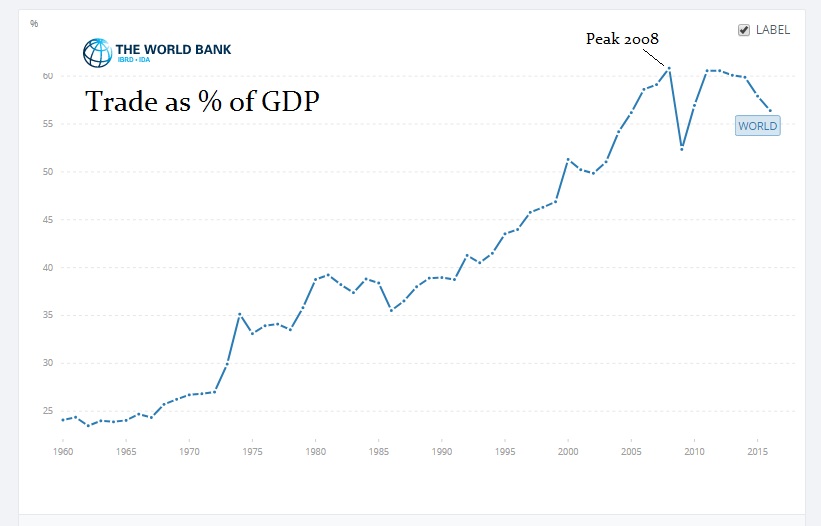
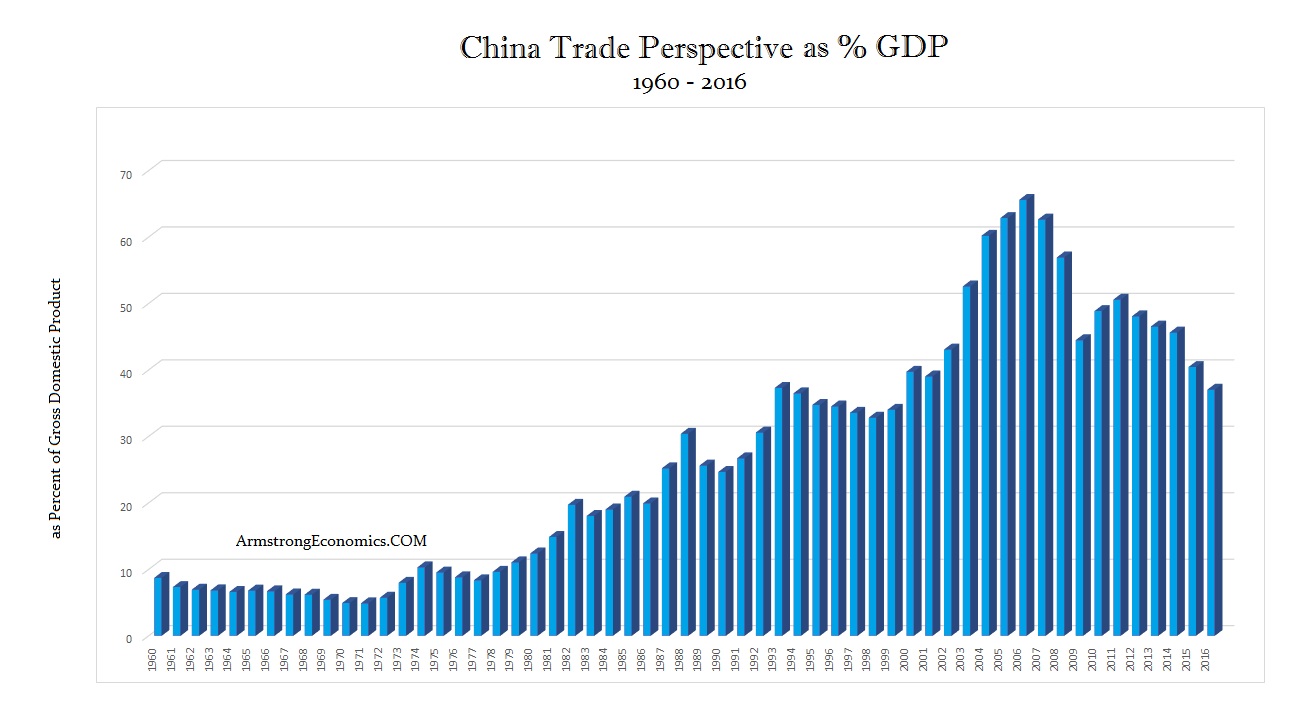
The US share markets opened lower on today as renewed fears of a trade conflict between the United States and China continued to top the excuses for a correction. This even surpassed the lower-than-expected March jobs data which they traditionally have focused on with respect to interest rate hikes. As always, there seems to be zero research into any of these fundamental issues that people hang their hats on to explain corrections or rallies. World trade, even in nominal dollars, peak in 2008. To think that a trade war will somehow reverse the trend is rather absurd.


When we look at world trade as a percentage of GDP in China, it has been declining since 2005 and will continue to decline into 2020 even in nominal terms. I really hate to burst everyone’s bubble, but (1) there has been a significant decline in world trade, and (2) China has been turning inward building its domestic economy.

Trade as a percent of GDP for the United States peaked in 2011. Trump has misread the trade perspective and has only focused upon domestic jobs. If we were to allocate trade according to the parent company, the United States dwarfs most everyone else. The USA also shows that trade is about 26.57% of GDP while in China it is now about 37.05%. This continues to demonstrate that the USA has the primary economy that is holding up the world. Canada is 64.3%, Japan 31.23%, Mexico 78.11%, United Kingdom is 58.02%, France 60.46%, Germany6 is 84.26% and Norway is 67.40% with Sweden coming in at 83.70%. The European Union as a whole stands at 82.62% and the Middle East as a whole stands ar 85.74%.

The higher the number the more dependent they are on world trade. The lower the number, the more resilient they are with a stro9ng domestic economy. All the bearishness on selling the dollar because of a trade war is exactly opposite of what the numbers show who will suffer.

Report: President Trump Will Skip Self-Congratulatory White House Corespondent Awards Dinner…


President Trump will not be attending the White House Media Awards event again this year.  According to Reuters:

WASHINGTON (Reuters) – U.S. President Donald Trump, who has feuded with several media personalities and organizations, will not attend the White House Correspondents’ Association annual black-tie dinner for the second straight year, the president of the group said on Friday.

[…]  “The White House has informed us that the president does not plan to participate in this year’s dinner but that he will actively encourage members of the executive branch to attend and join us as we celebrate the First Amendment,” Margaret Talev, the president of the White House Correspondents’ Association, said.  (link)

Attorney General Jeff Sessions Announces ‘Zero Tolerance’ Policy For Border Enforcement…


WASHINGTON – Attorney General Jeff Sessions today notified all U.S. Attorney’s Offices along the Southwest Border of a new “zero-tolerance policy” for offenses under 8 U.S.C. § 1325(a), which prohibits both attempted illegal entry and illegal entry into the United States by an alien. The implementation of the Attorney General’s zero-tolerance policy comes as the Department of Homeland Security reported a 203 percent increase in illegal border crossings from March 2017 to March 2018, and a 37 percent increase from February 2018 to March 2018—the largest month-to-month increase since 2011.

“The situation at our Southwest Border is unacceptable. Congress has failed to pass effective legislation that serves the national interest—that closes dangerous loopholes and fully funds a wall along our southern border. As a result, a crisis has erupted at our Southwest Border that necessitates an escalated effort to prosecute those who choose to illegally cross our border,” said Attorney General Jeff Sessions.

“To those who wish to challenge the Trump Administration’s commitment to public safety, national security, and the rule of law, I warn you: illegally entering this country will not be rewarded, but will instead be met with the full prosecutorial powers of the Department of Justice. To the Department’s prosecutors, I urge you: promoting and enforcing the rule of law is vital to protecting a nation, its borders, and its citizens. You play a critical part in fulfilling these goals, and I thank you for your continued efforts in seeing to it that our laws—and as a result, our nation—are respected.”  (read more)

(PDF LINK)

Once More Unto the Breach, Dear Larry, Once More…


NEC Director Larry Kudlow defending President Trump’s trade policy: