Gold – Dollar – Bonds


businessman_juggle_dollar_symbols_150_clr_18746

QUESTION: Hi,
I have two questions:
a) do you believe US dollar has been kept artificially lower than it should be (or at least in long range trading range) by at least two central banks lately? if so how long you think it would last, years?
b) you remind many times gold does not yield so investors should avoid it at any cost – as the most investors have done. benefits of stocks are clear but why many investors still buy / have bought bonds even with negative interests or buy fiat currencies with very low interest levels.
BR, J

ANSWER: Yes. The central banks have been trying to keep the dollar down because a rising dollar will undermine Europe exposing the ECB total failure, and then there is the risk of major sovereign defaults among emerging markets who issued their debt in dollars. The IMF has lobbied hard with the Fed pleading not to raise rates for this fear of capital pouring into the dollar. They do not appear to be able to sustain this policy beyond January.

Gold is not something to avoid. True, institutions cannot buy gold for they earn no income. Gold is really for the individual and it will eventually be the hedge against government and the change in the monetary system which could come as early as 2018 but by 2020 if on schedule.

Gold-Fluctuated

Institutions buy bond because they simply go by the book. Then pension funds often have restraints requiring various portions MUST be in government debt to varying degrees. Social Security is only in US debt. Fiat money is currency that a government has declared to be legal tender, but it is not backed by a physical commodity according to most people. The value of fiat money is supposed to be derived from the relationship between supply and demand rather than the value of the material that the money is made of. But throughout history, ALL money has always been fiat. Bretton Woods collapsed because they continued to print money and the claimed backing was not there. So even the pretend gold standard was fiat. When money was gold coins during the 19th century, it was legal tender, not backed but anything else, and yet it still rose and fell in purchasing power. There is no such period in monetary history of such a Utopia or money remaining steady and a constant purchasing power. It has never existed.

OPEC & Manipulating Oil Prices


oil-middle-east

Electric CarsThe Organization of Petroleum Exporting Countries’ (OPEC) agreement to cut production is supposed to end Saudi Arabia’s policy of the last to years to pump-at-will. This has sent Middle Eastern economies into a tail-spin and the glut of oil has meant rising taxes and selling bonds to raise capital. With this new claimed reversal of that pump-at-will policy, there are of course the optimists who say oil should now soar, yet they overlook some very critical points. OPEC deals have routinely failed, and there is a real glut of oil in inventories, not to mention the reduction in oil demand rising from electric cars.

The EU first introduced mandatory 2015 CO2 standards for new passenger cars way back in 2009. Mandatory targets for light-commercial vehicles come into play in 2017, which was passed back in 2011. Then by the end of 2013, the EU reached an agreement that will implement mandatory 2020 CO2 emission targets for new passenger cars and light-commercial vehicles. Europe is applying these standards for 95% of vehicles in 2020 with 100% compliance in 2021 and the light-commercial vehicle standards are are required for 2020. Electric cars are becoming commonplace in Europe. Charging stations are seen just about everywhere including in London. This is not the case in the United States. Clearly, demand will decline for oil moving forward.

The optimists also overlook the reality of the oil production countries. OPEC cannot control the 60% of world production outside its membership. The United States is the largest oil producer. In the top five oil producing countries, only Saudi Arabia makes that list as number two. Of the top 10 producing countries, only four are OPEC members. The bottom line; OPEC can not manipulate oil prices any more.
2014 Country Production (bbl/day)

1 United States 11,973,000
2 Saudi Arabia (OPEC) 11,624,000
3 Russia 10,853,000
4 China, People’s Republic of 4,572,000
5 Canada 4,383,000
6 United Arab Emirates (OPEC) 3,471,000
7 Iran (OPEC) 3,375,000
8 Iraq (OPEC) 3,371,000
9 Brazil 2,950,000
10 Mexico 2,812,000
11 Kuwait (OPEC) 2,767,000
12 Venezuela (OPEC) 2,689,000
13 Nigeria (OPEC) 2,427,000
14 Qatar (OPEC) 2,055,000
15 Norway 1,904,000
16 Angola (OPEC) 1,756,000
17 Algeria (OPEC) 1,721,000
18 Kazakhstan 1,719,000
19 Colombia 1,016,000
20 India 978,000
21 Oman 951,000
22 Indonesia (OPEC) 911,000
23 United Kingdom 906,000
24 Azerbaijan 856,000
25 Argentina 715,000
26 Malaysia 697,000
27 Egypt 667,000
29 Libya (OPEC) 516,000
30 Australia 478,000
31 Thailand 422,000
32 Vietnam 316,000
33 Turkmenistan 276,000
34 Equatorial Guinea 269,000
35 Sudan and South Sudan 262,000
36 Congo, Republic of the 259,000
37 Gabon 240,000
38 Peru 180,000
39 Denmark 171,000
40 Italy 169,000
41 Germany 160,000
41 South Africa, Republic of 160,000
43 Japan 137,000
44 Yemen 127,000
45 Brunei 124,000
46 Trinidad and Tobago 116,000
47 Ghana 106,000
48 Romania 104,000
49 Chad 103,000
50 Pakistan 98,000
51 Uzbekistan 85,000
52 Cameroon 81,000
53 South Korea 79,000
54 Timor-Leste 76,000
55 Bolivia 67,000
56 Ukraine 66,000
57 Bahrain 64,000
57 Netherlands 64,000
59 France 61,000
59 Turkey 61,000
61 Tunisia 59,000
62 New Zealand 50,000
63 Cuba 49,000
64 Spain 40,000
65 Poland 39,000
66 Ivory Coast 37,000
67 Papua New Guinea 34,000
68 Syria 33,000
69 Belarus 32,000
70 Austria 27,000
71 Philippines 26,000
72 Hungary 25,000
73 Taiwan 22,000
74 Albania 21,000
74 Myanmar 21,000
78 Congo, Democratic Republic of the 20,000
78 Niger 20,000
78 Singapore 20,000
81 Croatia 18,000
82 Chile 15,000
82 Virgin Islands, U.S. 15,000
84 Guatemala 14,000
84 Suriname 14,000
86 Belgium 13,000
86 Estonia 13,000
88 Sweden 12,000
89 Czech Republic 11,000
90 Finland 10,000
91 Lithuania 9,100
91 Slovakia 9,100
93 Greece 8,700
94 Portugal 7,100
95 Mauritania 6,000
96 Palestine 5,800
97 Morocco 5,100
98 Bangladesh 4,800
99 Switzerland 3,900
100 Bulgaria 3,400
101 Aruba 2,800
102 Jamaica 2,100
103 Paraguay 2,000
104 Belize 1,800
105 Netherlands Antilles 1,500
106 Uruguay 1,200
107 Barbados 1,000
107 Georgia 1,000
107 Latvia 1,000
110 Ireland, Republic of 900
111 Puerto Rico 700
112 Costa Rica 300
112 Slovenia 300
114 Jordan 200
114 Malawi 200
114 Tajikistan 200
114 Zambia 200
118 Ethiopia 100
118 Hong Kong 100
118 Zimbabwe 100

More Hoax Stories Claiming Bill is not Father of Chelsea


Armstrong Economics Blog
Re-Blog/2016 U.S. Presidential Election
Posted Oct 3, 2016 by Martin Armstrong

hillary-toilet-paper

The latest HOAX running around is that Bill is not the father of Chelsea Clinton. It really is amazing how people are making up stuff at this point right down to Hillary toilet paper (sent in as a gift). I have never seen such an election that is so out of wack in all the years I have been compelled to pay attention to the sport of folly. The reliable source from behind the curtain expresses real concern that there is so much at stake here for career politicians and the media, that they will blame Putin if Trump wins. They will by no means accept Trump as President.

We see that November is shaping up as a key target for a turning point. It is beginning to reflect that something important may unfold. Just how far is the establishment willing to go? Mainstream media only trashes Trump. Every possible thing they can dig up is being used. Of course they will never attack Hillary with the same vigor. Will the American people rise up as they did in Britain against the corrupt media?

We certain will have some interest times ahead. One must wonder if all these Hoax stories are not being planted to Hillary supporters to blame Trump.

Categories: 2016 U.S. Presidential Election

Understanding Deutsche Bank’s Possible Bail-in


Deutsche_Bank_Frankfurt

Chancellor Merkel cannot afford to bailout Deutsche Bank from the point of view of foreign policy perspective within the EU since she has taken such and intolerable hard line in the Italian bank rescue not to mention Greece. On the other hand, Deutsche Bank is different since it is the primary clearing bank in Europe. Any bail-in is more likely to take place by wiping out its bonds called CoCos which have no maturity date. Indeed, investors may never get their money back. Under the terms, the bank can redeem them, usually after five years if it wants to. The annual coupon payments are contingent on the bank’s ability to keep its capital above certain critical threshold levels. If the bank’s capital falls below that threshold, the bank won’t make the coupon payment. Investors cannot call a default on these bonds, and that sets them up for a bail-in. Investors are simply sitting on bonds that they bought because they had a 6% coupon. However, there is not maturity and no guarantee of redemption and if capital falls below the threshold they plunged in value and pay no coupon. Consequently, if regulators deem that the bank is failing, then these CoCos will be bailed-in by either being converted into declining values in shares or could be just canceled.

These 6% CoCo notes have traded as high as 104 cents on the euro in early 2014 shortly after they’d been issued, and plunged to about 70 cents and are trading in the 77 level in this latest crisis. Therefore, the CoCos are a good indication of public confidence for if investors believe those thresholds are approaching, the bank will not pay the coupon and the risk of being converted to shares rises. Of course, converting to shares at any value could be a blessing in disguise since shares can be sold.

de-y

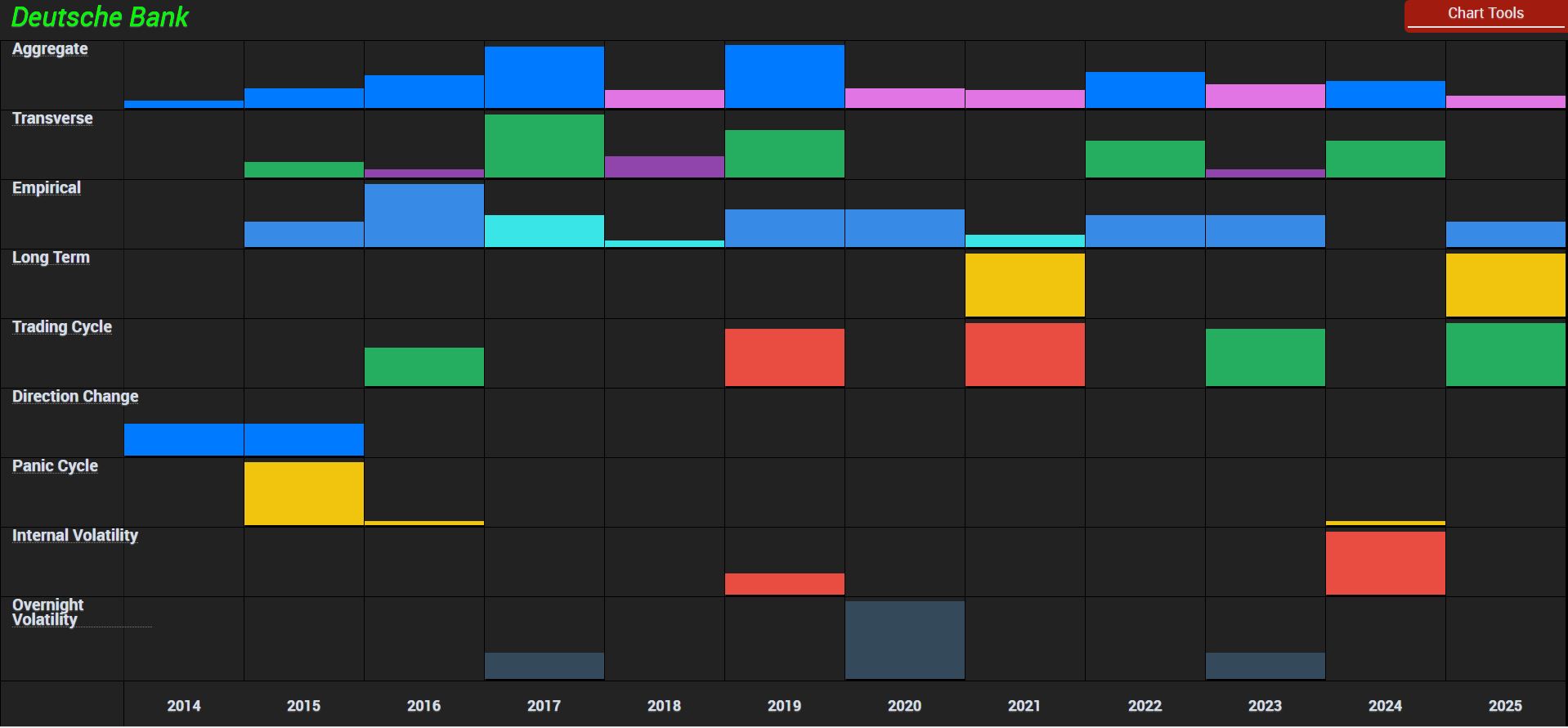
When we look at Deutsche Bank, we elected a Yearly Bearish Reversal at the close of 2015. Support lies at 8.55 and this is really important. We have reach 11.19 so far and resistance overhead will stand at 15.50. The primary target for a major turning point still appears to be 2017 whereas 2016 could produce the lowest yearly closing.

de-for-y-10-2-2016

Whatever we get in 2017, should be followed by the opposite direction into 2019. This means a rally into 2017 without making a new low under 2016 levels, would most likely result in a Knee Jerk reaction high (one time unit). This becomes possible only if we exceed the 15.50 level. Even that is minor for the Monthly Bullish Reversal really cap this stock standing at 17.90 warning it is not over just yet.

defor-m-10-2-2016

The timing Array in Deutsche Bank has been targeting September all along. There are back to bank Directional Changes for September October and the next main target for a turning point is November. The Panic Cycle play out well for September as well. This all warns that is last week’s low holds, a bounce into November becomes possible.