
Armstrong Economics Blog/USD $
Re-Posted Nov 7, 2019 by Martin Armstrong

QUESTION: Marty, you said at the conference the efforts to overthrow the dollar as the reserve currency have failed and it will take the Monetary Crisis Cycle to accomplish that. Now that Lagarde is in the ECB, will she aid that overthrow to be replaced by the IMF’s SDR?
It was a fantastic conference this year.
FG
ANSWER: The US has abused the role of the dollar in world commerce by imposing sanctions on places like Iran. These sanctions are supported by enforcement using the dollar. The US has weaponized the dollar in this respect. About 90% of international debt is denominated in dollars. Foreign countries issue their debt in dollars to eliminate FOREX risk in order to sell it globally. Both Putin and Xi want to find an alternative to the dollar. It has been the role of the dollar that drives Putin to dethrone the dollar.
 There is NO ALTERNATIVE to the dollar — PERIOD!!!!! The stupid Negative Interest Rates on the euro undermined the euro as a possible reserve currency. It has been dumped internationally, which nobody wants to talk about. In discussions with major central banks and key international banks, nobody wants the euro. Negative Interest Rateshave killed the euro as a viable currency for exchange purposes. The EU President Juncker has said that it is “absurd” that Europe has to pay for its energy imports in dollars. He has failed to understand that it is their own fault, for the structurally defective euro lacks a central national debt and forces everyone to look at each member state independently in the same manner that applies to state debt in the USA. That lack of a national debt where capital can park has been the fatal flaw behind the euro. Then add the stupidity of Negative Interest Rates and you get a currency that dressed up for Halloween, but is by no means a real reserve currency.
China has given up on trying to fight the dollar. They realize that all the yelling and screaming is pointless. The yuan accounts for only 4% of international transactions. The key for China is to use the yuan in loans to build its road of trade globally. Their greatest hope will be for the Monetary Crisis Cycle to undermine the dollar in the year ahead. That combined with the neo-cons trying to weaponize the dollar will be the ultimate means to dethrone the dollar
Manipulating the World Economy
Armstrong Economics Blog/Reports and DVDs
Re-Posted Nov 5, 2019 by Martin Armstrong
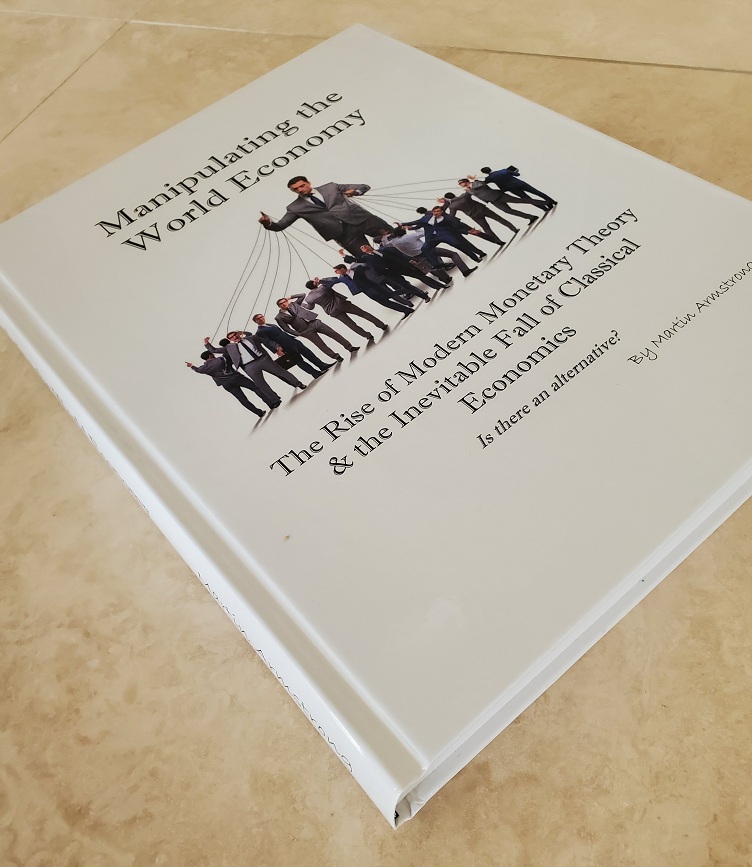
COMMENT: I just finished “Manipulating the World Economy.” What a wonderful book and actually a gift to those of us who attended the October conference. I hope you will soon publish this book for all the public to read.
JL
REPLY: It is going off to the printers within the next week. We hope to have it ready for Christmas. I really did try to make it the most comprehensive book on the subject matter. I was asked to write it because there was nothing out there to combat the Modern Monetary Theory, and those such a Thomas Piketty who advocate seizing the wealth of anyone who has more than he does.
US Economy Soft – But Holding
Armstrong Economics Blog/Economics
Re-Posted Nov 5, 2019 by Martin Armstrong

COMMENT: I find it interesting how the rest of the world is declining and Socrates forecast that the US economy would be only slightly weak going into January 2020. It is interesting how it picks up the major differences. They are blind to the trend. You bring together the world. Thank you for that and there will always be idiots who cannot comprehend the trend and think Warren Buffet is a great investor when he was just a buy and hold no different than Trump. They both made money simply because of the inflationary asset trend since 1985.
Great forecast
KL
REPLY: The US economy was not poised for a major recession that everyone was forecasting because of the China trade dispute. It is softer, yes, but it is really holding up the entire world economy. The third quarter GDP was still up 0.8% whereas the prior quarter was up 1.1%. So yes, it was a slight decline. But we do not show a major economic decline in the USA.
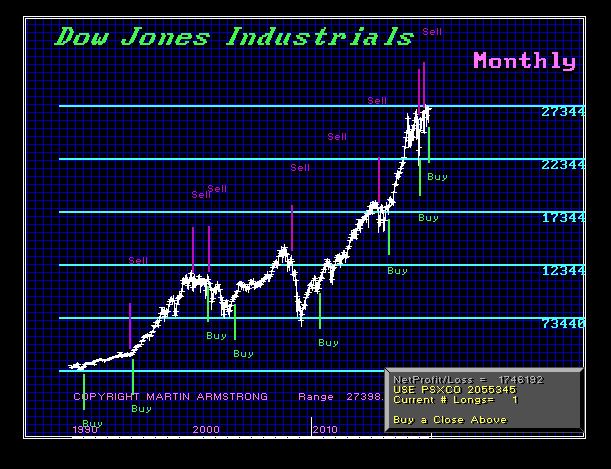
As long as stocks have been in a bull market since 1985, then buy and hold works. But they lose in downtrends. Everyone forgets that. The year 2008 was the worse year Buffett had in 44 years. Most people cannot hold through such declines. This is why institutions have used us for decades. They cannot buy and sell like short-term investors. They need to know when to flip a major portfolio. Truly smart value investors hedge. That eliminates the risk of having to declare bankruptcy during the declines.
Norway – the Confusion in Trend
Armstrong Economics Blog/Scandinavia
Re-Posted Nov 5, 2019 by Martin Armstrong
QUESTION: Dear Mr. Armstrong.
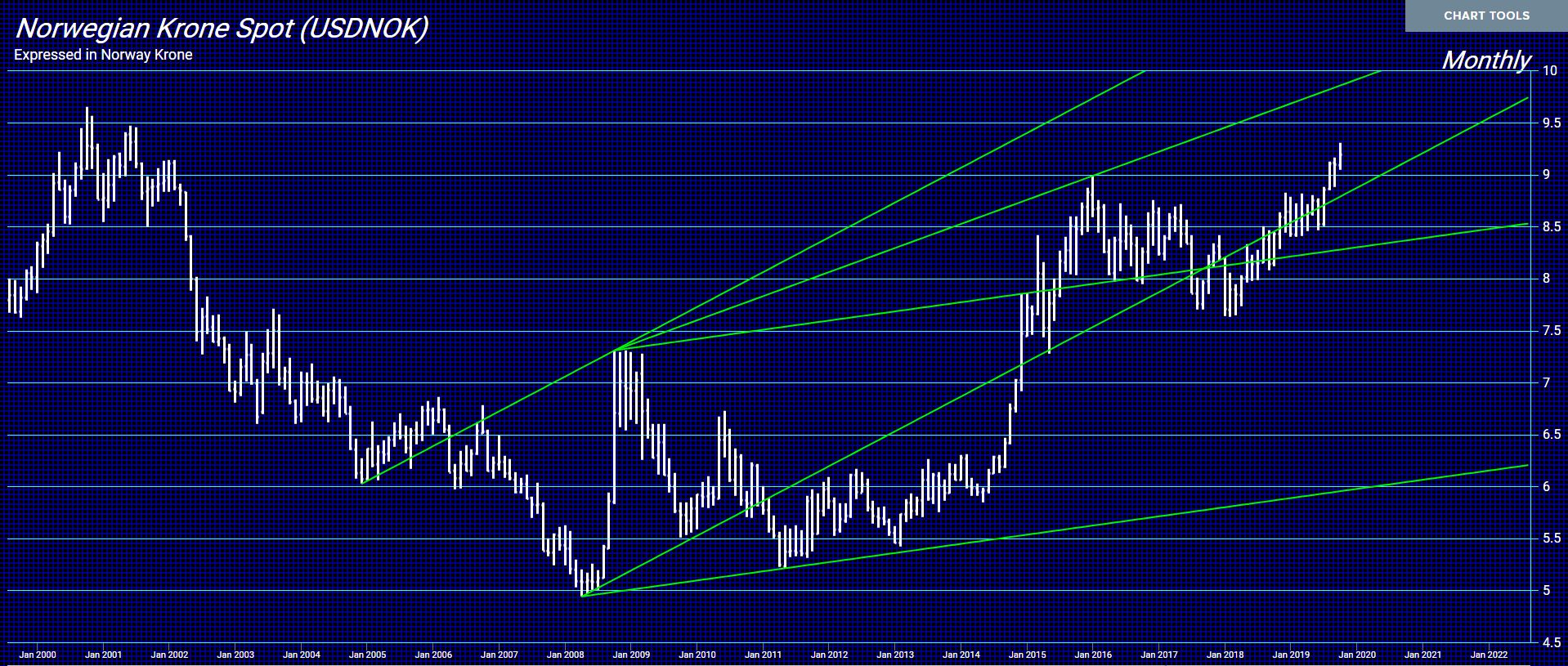
Does Socrates have an explanation of what is happening to the Norwegian Kroner? All the financial newspapers and banks here in Norway are scratching their heads and don’t have an explanation of why it’s devaluating against the Euro and Dollar. The central bank of Norway has an interest rate of 1.50%, while Euro has an interest rate of -0.5%.
BT
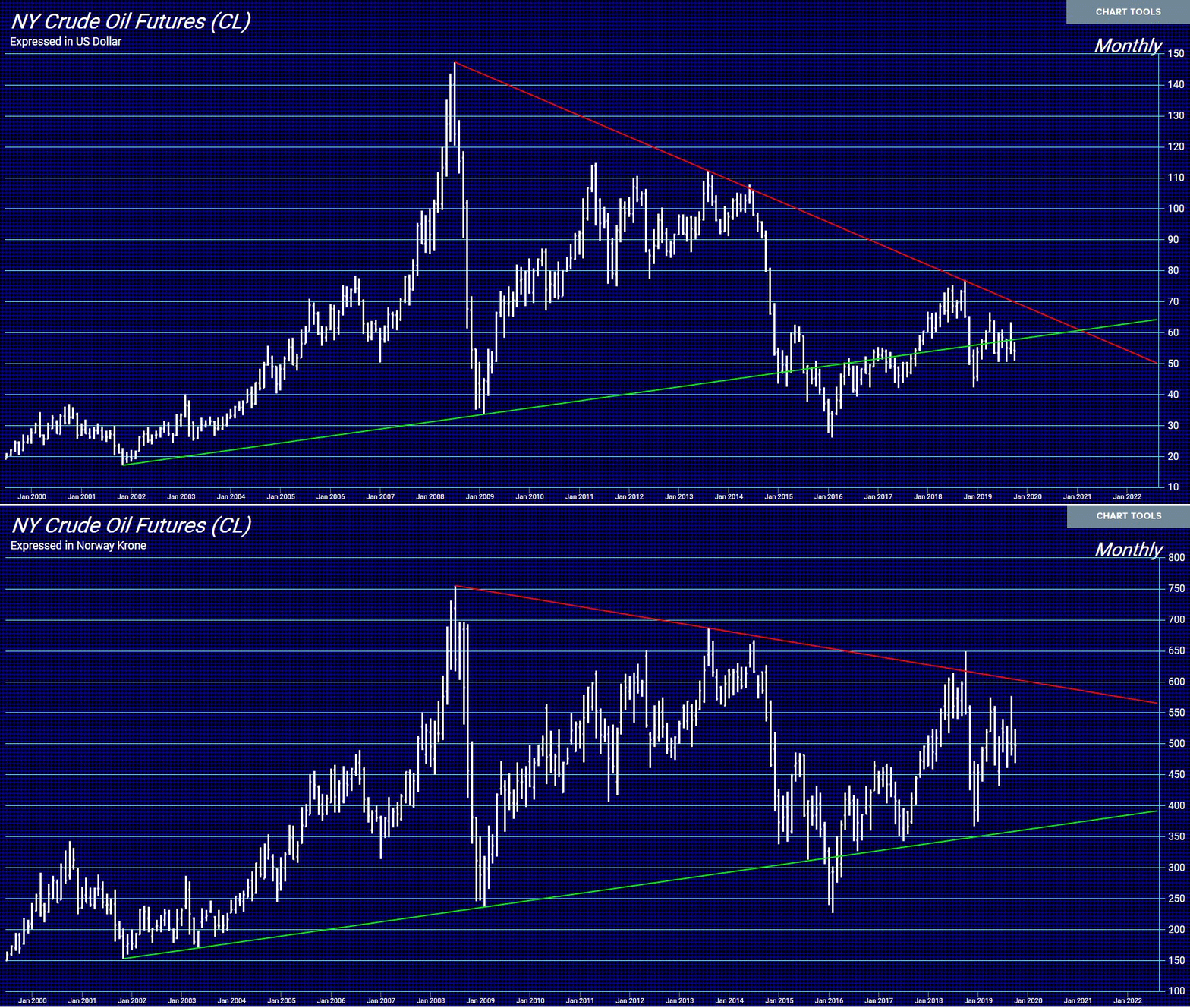
ANSWER: Norway’s currency has been declining recently over concerns with regard to the US-China trade dispute given the fact that it is highly exposed to the US-China trade situation. Additionally, the sharp decline in crude oil prices has also impacted the currency given the oil and gas industry accounts for more than 1/20th of Norway’s gross domestic product and about 2/3rds of its exports. Therefore, Norway’s economy has been highly correlated with oil prices.
Nevertheless, in Korona, the price of oil is rising given the decline in the currency (click on the image). The analysis never looks at everything from an international perspective. Your currency is retesting the 2000 high in the dollar.
Mortgage Backed Securities Still Defaulting – Bad Omen for Real Estate?
Armstrong Economics Blog/Real Estate
Re-Posted Oct 25, 2019 by Martin Armstrong

During the last Mortgaged Backed Security scandal which undermined the entire world economy, they created mortgage modifications which enabled millions of delinquent homeowners to avoid having their home foreclosed. Since 2007, it has been estimated that some 8.7 million permanent mortgage modifications were created. There are still over $800 billion of these bubble-era loans outstanding. How were they allowed to survive? For at least the past five years, between 75% and 95% of all mortgage modifications have taken the past interest due that was in default, included it in a capitalization of interest arrears, which means the resolution was never for the benefit of the homebuyer.
By adding the past-due interest, they have been paying interest on the interest. This failure to address the issue by some partial debt forgiveness with respect to prior interest means that the mortgage crisis has been simply postponed. If a new financial crisis hits, the old one will simply be sent off into foreclosure and real estate values can still plummet even more in the low-end of the market.
Barrons did a good review of the problem. They came to the conclusion that re-defaults will be more likely as home values fail to get back to par and these people will just walk away. Indeed, the resolution should have been the forgiveness of past-due interest. Then the value of the homes would have been less impacted. But the bankers refused to accept the loss and as a result, real estate has been unable to recover on the low end of the market which is why the economy has not been robust as it should be boosted more by capital inflows than true economic recovery.
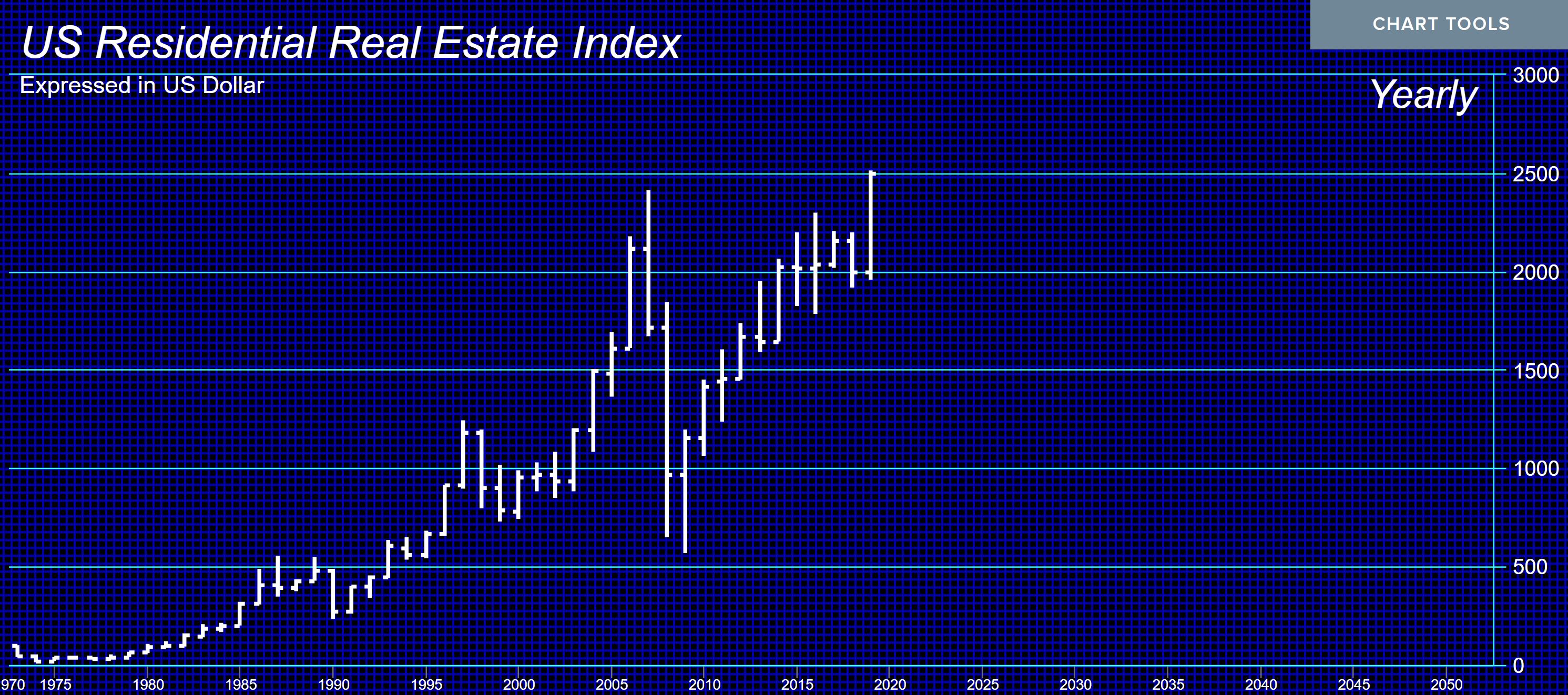
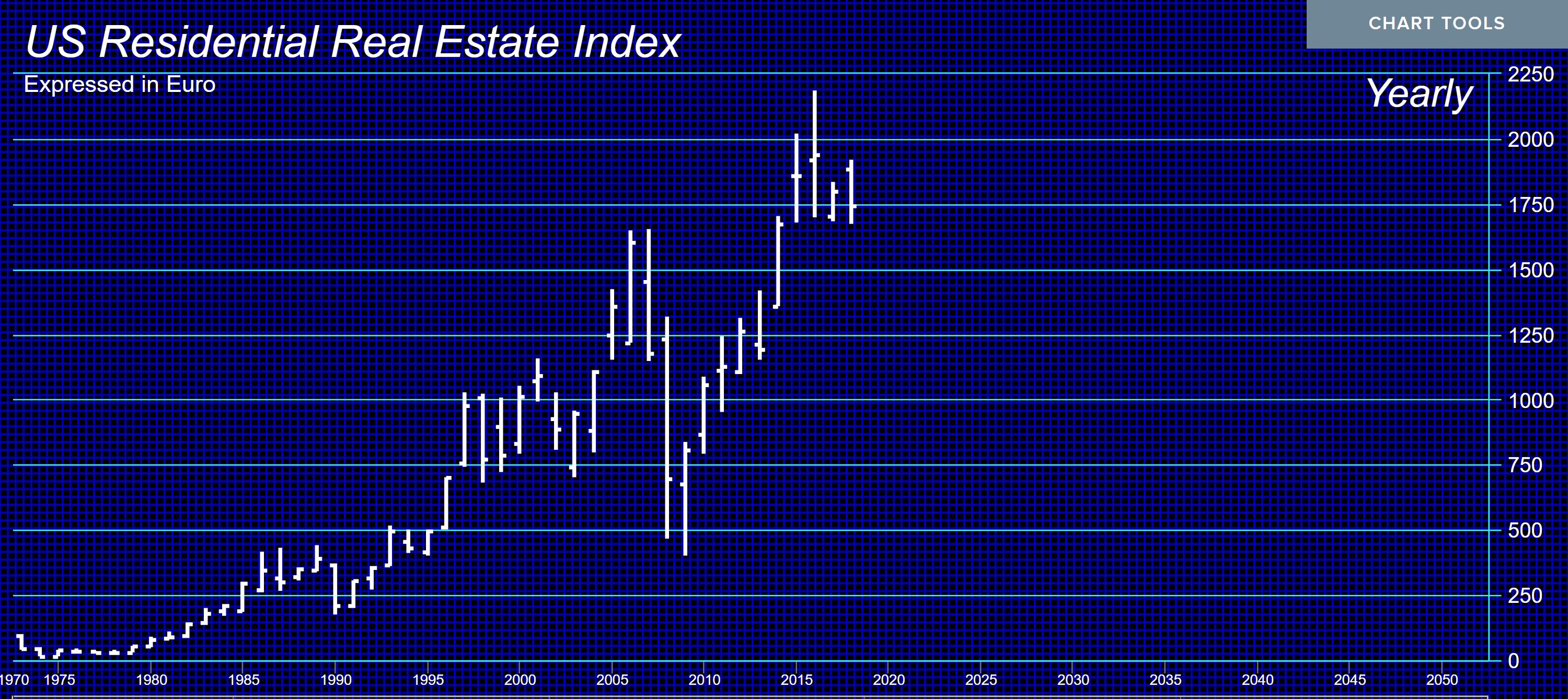
When we look at our broad real estate index, it has been making new highs in 2019. However, when we plot this in Euro, we can see why there have been foreign capital inflows. But the foreign capital has been buying the high-end, not the class where the mortgage bubble of 2007 impacted. From a foreign perspective, the high investment end of the markets has been above the 2007 high for the past 4 years. This is why the new highs have tended to be concentrated in the major centers like New York City and Miami – not local main streets.
Barrons reported that if we look at JPMorgan Chase (JPM) which holds the second-largest residential mortgage portfolio in the nation, we see in its second quarter of 2019 report, that almost $10 billion of modified loans (known as troubled debt restructuring)remained outstanding. Of this restructured debt, 43% were listed as having re-defaulted. Bank of America (BAC) has stated that 41% of its modified loans had re-defaulted.
Howie Baetjer explains what Communism is!
How is Communism described in theory, and how does it play out in the real world? Join us for our question and answer series with Prof. Howard Baetjer
Release Date
January 8, 2018
Using Other People’s Money
Armstrong Economics Blog/Opinion
Re-Posted Oct 8, 2019 by Martin Armstrong

QUESTION: Mr. Armstrong; You had said you retired from market-making in the precious metals when in the early ’80s people were claiming to sell Krugerrands for spot with delayed delivery. I think they went bust and went to jail if I recall you said back in 1985. Is this the same thing happening in online brokerage with this no commission scheme? How are they making money?
SY
ANSWER: No, it’s not the same. If I remember correctly, it was a firm delaying the delivery of the gold coins by 90 days. They were playing the bear market, assuming gold prices would always be lower based on the fact that the Fed raised interest rates to 14% in 1981. Back then, I was making more money on the float in my account than I was on the gold. The cost on the Krugerrands was spot +4%, so they were making +15% using the money in overnight markets, plus delaying delivery, and they would not buy the coins until the price declined from where they sold them to you. That was pure speculation and I decided I would retire rather than play that game. If I had to speculate to pay salaries it made no sense. They went bust in 1985 and ended up in jail, if I recall, when gold rallied out of the 1985 low and they could not cover all the promises they had made on the coins.
Here we have a similar issue with making money indirectly. Stockbrokers get kickbacks or rebates from the market-makers for steering the business and they make money on the spread between bid and ask. So the retail brokers are still making money that way. But then they also get to use your funds to earn interest. In place of commissions, they make money from charging traders who buy stocks on margin.
Therefore, you have:
- Interest they earn on your money
- Rebates from market-makers
- Interest they charge on margin
This is more legitimate than the gold brokers who were speculating with other people’s money back in the ’80s
Should Americans Hoard Cash?
Armstrong Economics Blog/Economics
Re-Posted Oct 8, 2019 by Martin Armstrong
QUESTION: Martin, I appreciate all the information that you provide and just got done reading about money shortage and hoarding. Would it be good for US citizens to hoard also? Is there any difference in hoarding dollars or gold and silver coins? Thanks for your comments.
DM
ANSWER: In order for gold and silver to be a medium of exchange, it requires the general population to accept that. The older generations know what a silver quarter or a $20 gold coin might be. However, the younger generation does not. Paper dollars will still be best to hoard for every day use until about 2022. At that time, we will have to reassess the climate of the monetary system. There are those videos where people were offered a 10 oz bar of silver of a chocolate bar. They took the chocolate.
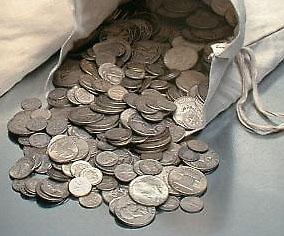
Gold and silver should be in coin form. Bars will not be easily used among the average person.
Precious Metals Desk at JP Morgan Criminally Charged
Armstrong Economics Blog/Rule of Law
Re-Posted Oct 7, 2019 by Martin Armstrong

The precious metals Desk at JP Morgan Chase on September 16, 2019, was criminally charged by the U.S. Department of Justice with being a criminal enterprise for approximately eight years in its manipulation of the prices of gold, silver, and other precious metals. The head of that desk and two other precious metals traders were charged with racketeering under the RICO statute which was originally passed to target organized crime.
The Justice Department said that the traders and their co-conspirators “conducted the affairs of the desk through a pattern of racketeering activity, specifically, wire fraud affecting a financial institution and bank fraud.”
Why Did the Dollar Rally Only After the 1929 High?
Armstrong Economics Blog/Capital Flow
Re-Posted Sep 24, 2019 by Martin Armstrong
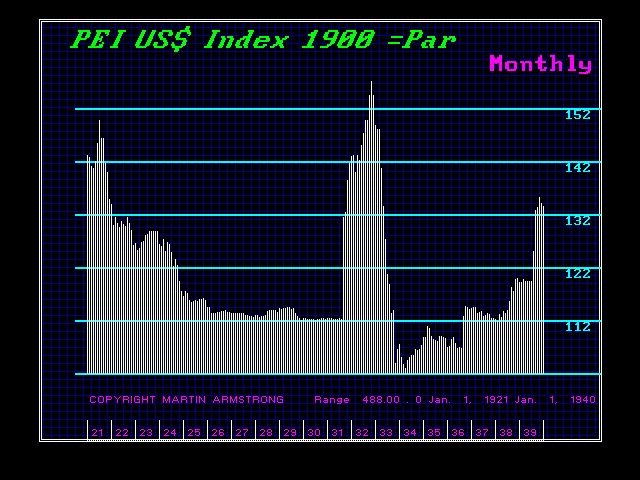
QUESTION: Hello, I am having trouble understanding how capital flows into the US, which helped the Dow double from ’27-29 didn’t move the dollar. Instead, the dollar moved up abruptly when inflows collapsed. It doesn’t make sense to me. Can Marty cover this at the WEC or help me understand in an email or blog response.
Thanks,
Norm

ANSWER: This period was when there was a fixed exchange rate so you will not see the change in the dollar. The capital flows turned out as the crisis took place in Europe and they needed to repatriate capital to cover losses at home.
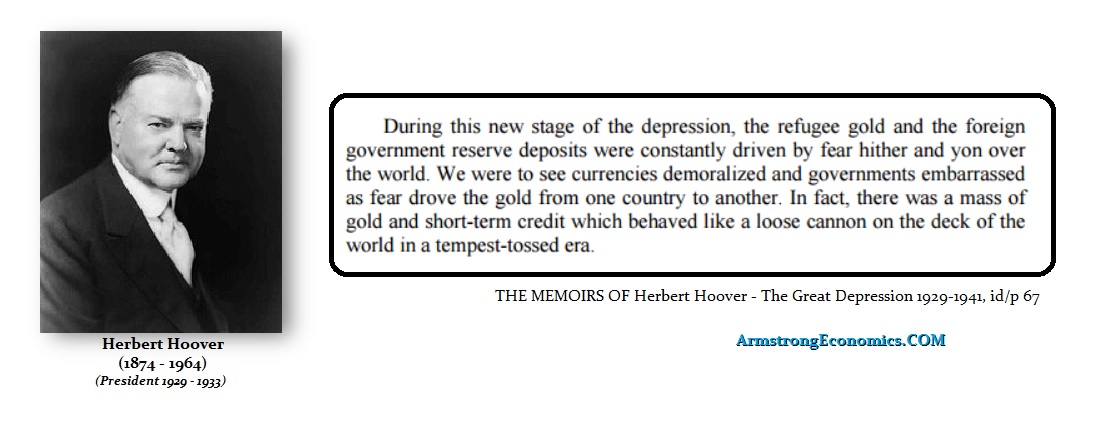
However, 1931 was the Sovereign Debt Default, which meant the fixed exchange rate system collapsed. This is when the dollar really rose for this was the true value of the dollar during the 1920s due to capital inflows, but it was fixed and sort of like what happened with the Swiss peg.
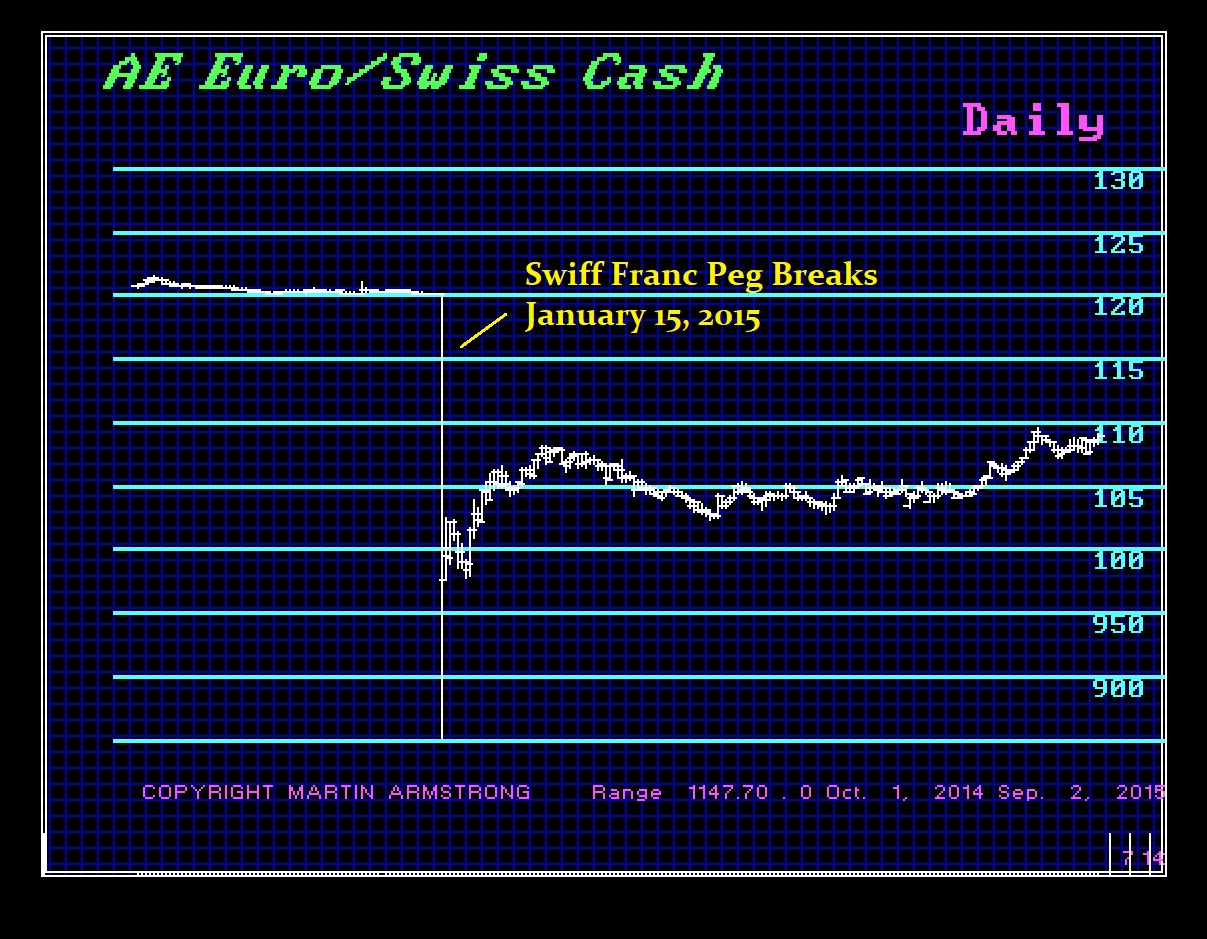
You see the same identical issue with the Swiss franc. The capital inflows were intense as people were buying the Swiss and selling the euro. The capital inflows reflected the move, but the peg was holding. It was that intense capital inflow that broke the peg. The same pattern took place during the 1920s. The capital inflows to the dollar were intense as capital fled Europe due to the war. However, you do not see it in the currency because of the fixed exchange rate. It was this intense inflow that caused the Sovereign Debt Crisis in 1931 and suddenly you see what the dollar would have been in a free market.
I have explained that there is also currency inflation. The tangible assets will rise in a country when the currency declines IF there remains underlying confidence in the nation at large. If not, the tangible assets may rise in hopes of a revolution, which may be bloodless as in Germany 1923, but there must still be confidence in the nation surviving. When there is no confidence as in Communist takeovers in Russia, China, Venezuela, tangible assets will NOT rise.
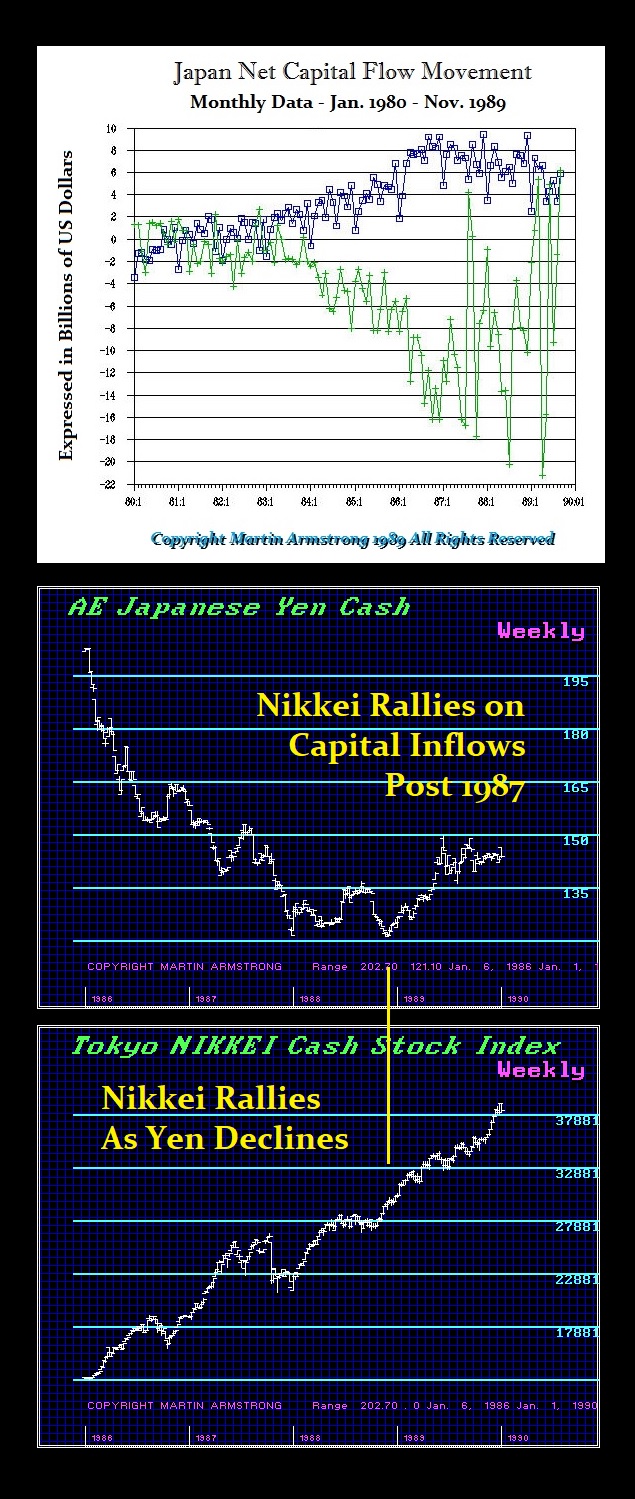
Applying this understand to Japan for the Bubble 1989 top, we see the combination of the rise in the Nikkei in proportion to the decline in the currency which was orchestrated by the Plaza Accord in September 1985. Confidence in Japan was not in question politically. However, the 1987 Crash was a currency move where the fear became whether the dollar would fall another 40%. This caused the Japanese to sell US assets and repatriate their capital home, which then was causing the Nikkei to rise WITH the currency.
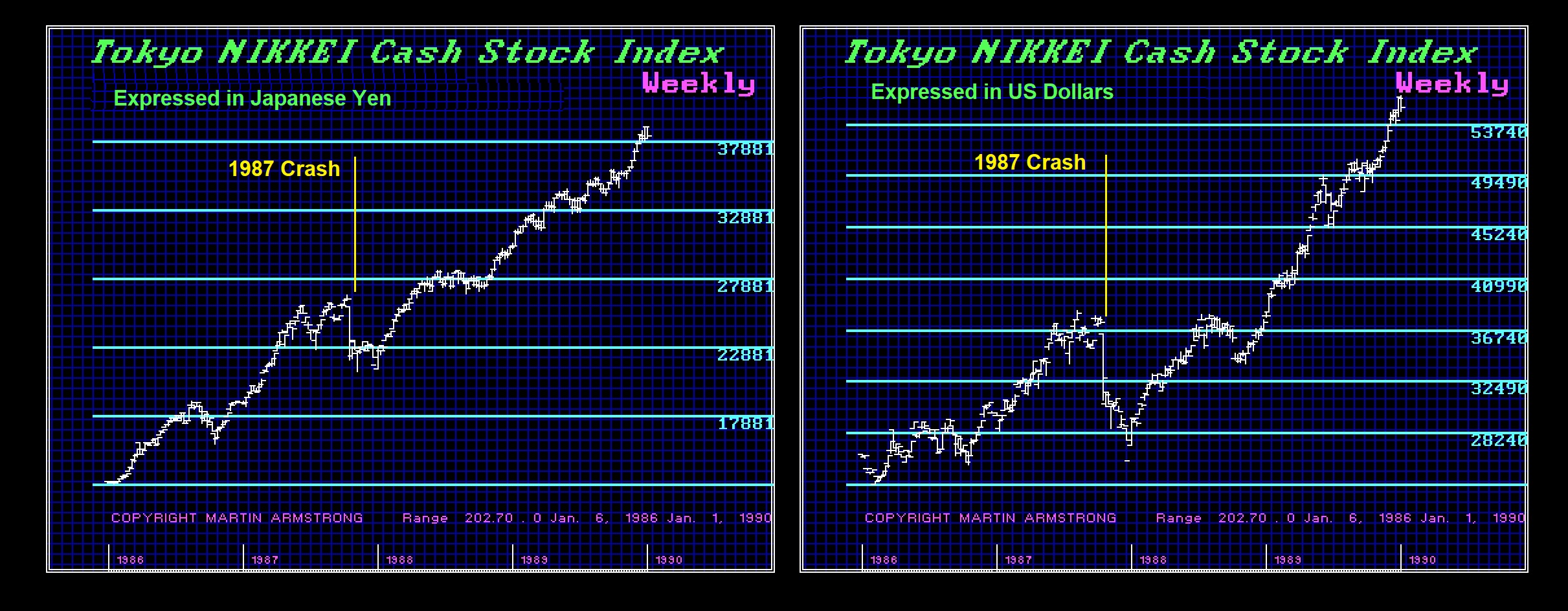
If you look closely, you will see that the Nikkei rallied more in US$ than in yen going into the 1989 Bubble top. This is the same pattern currently of how the Dow has rallied from 2009 into 2019 leading the S&P 500 and NASDAQ because it was rising more in euros than in dollars. The 1989 Bubble top in Japan was so severe like 1929 BECAUSE it had attracted capital from around the world which intensified the rally. But when the foreign investors sold, Japan crashed and burned because nobody understood the consequences of capital flows.
Even when the CIA came to us and wanted me to build this model for them and I declined, they understood we invented capital flow analysis and it was the key to the rise and fall of nations.
 Centinel2012