Big Bang v REPO


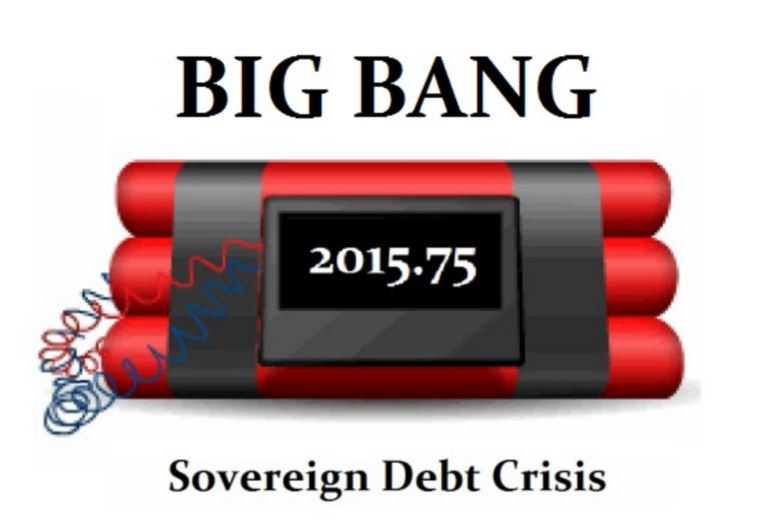
QUESTION: Mr. Armstrong; I can see your warning about Big Bang and the bonds markets would crash after 2015.75 going into the bottom of your business cycle on January 18, 2020. However, it seems that the negative interest rates have created your bond crash not in price but in participation. There is no viable bond market outside the United States with small exceptions of Britain, Canada, Australia, and New Zealand. Is there any way to come back from this destruction? Do you see the bond markets ever reviving or is this destruction permanent?

HC

ANSWER: If there was a free market, then you would have witnessed the bonds crash price and interest rates rise as people perceived risk. The introduction of negative interest rates which began in late 2014 going into 2015.75 and Quantitative Easing, shifted the risk from the free market to the central banks. This is what I mean that they are now TRAPPED! If interest rates rise, their portfolios crash in value (price). Such an outcome would raise the question of will the private sector return to the government bond markets when they see there is a rising risk factor? Our model shows that this will not be the case. In other words, the Sovereign Debt Crisis has taken place and to prevent the PRICE crash, the central banks became the buyer to hold interest rates down and bond prices up.

Some would think that the forecast was wrong simply because the prices have not crashed. We have had the Bank of Japan saying they will buy government bonds on an unlimited basis. This is NOT a free market. It has “crashed” from the perspective of participation.
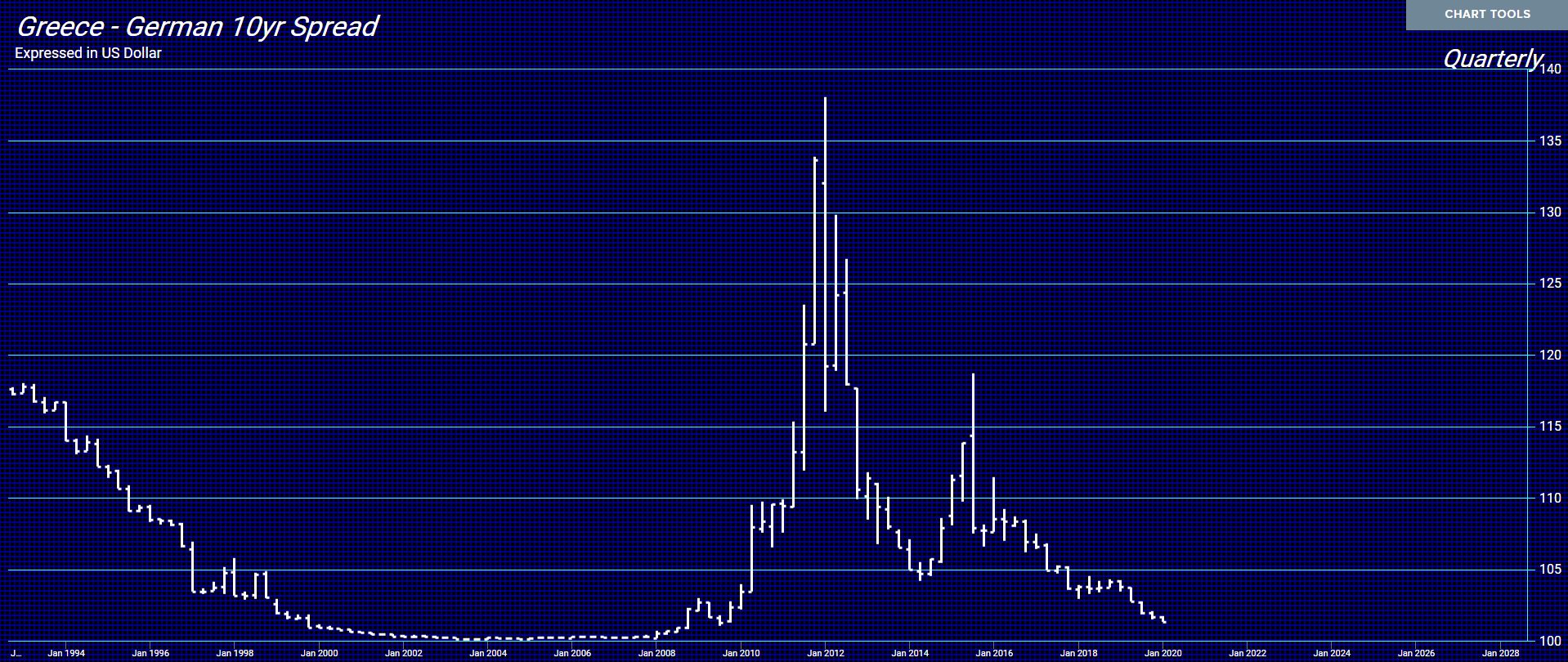


It is like the creation of the Euro. Yes, it effectively eliminated the volatility in the currency markets between the Eurozone members. However, it really only transferred the volatility from the currency market to the spreads between the bond markets of member states. Obviously, Greece and Germany both use the Euro. The volatility which would have been reflected in the currency simply moved to the bond markets.

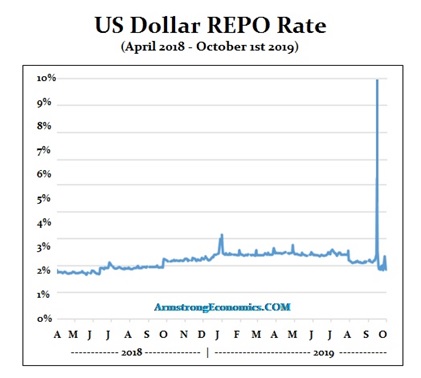
Now we have a serious crisis that has shifted from the bond markets exclusively to the central banks. This is now part of the crisis unfolding in the REPO Market. There does not appear to be any recovery on the horizon. Politicians are undermining the confidence in government, to begin with, and that will influence bond buyers.
 

Can Interest Rates Rise when Central Banks are the Only Market Maker?


QUESTION: How can interest rates can rise when central banks are the only market maker, & pension funds FORCED to buy gov.debt by their statutes?

but why is the REPO crisis starting in the US where rates are WAY higher than in japan & Europe?
you would expect this crisis to start somewhere in European debt markets/ instruments…why isn’t all the capital that is fleeing to the US not financing REPOs?
thank you

CB


ANSWER: This is laid out in the Repo Crisis Report (an update goes out this week). Central Banks do not control long-term rates. They set the short-term rate such as Fed Funds and Discount Rate. That is what Quantitative Easing was all about. The central banks began to BUY the long-term debt in hopes of “influencing” the long-term rates by reducing the supply of government long-term debt and in theory then the free market would have been willing to buy private long-term debt such as mortgages. That failed because banks had no confidence in the real estate market and were loaded to the gills with real estate debt which people were defaulting on.

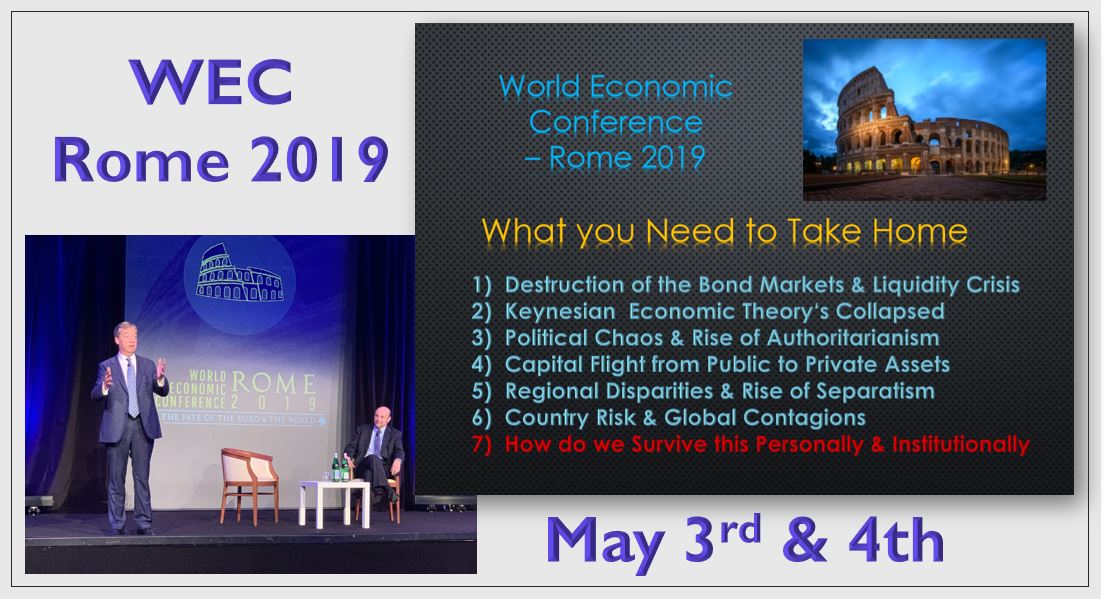
The Repo Crisis has begun in the states BECAUSE this is the only viable free market to speak of. Both Japan and Europe have destroyed the bond markets. The Repo Crisis is the manifestation of our forecast that we would enter a liquidity crisis by September 2019. We listed that as one of the major points to take homes from the May World Economic Conference in Rome.

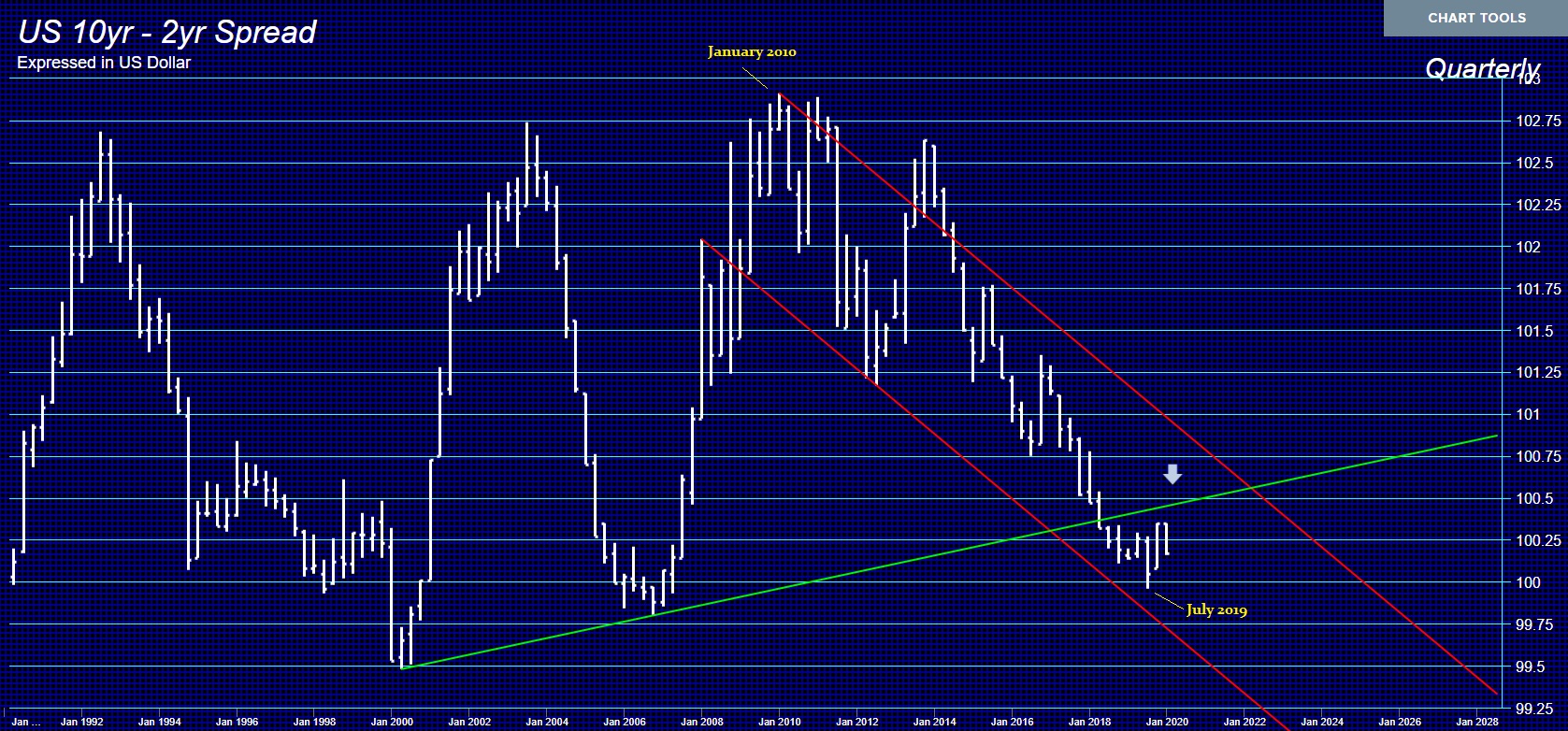
The Repo Crisis is a liquidity crisis because of the collapse in confidence. Banks are unwilling to lend to each other because they are deeply concerned about a crisis in the international banking sector. The Fed was lowering short-term rates into August 2019 because the yield curve inverted on the 10yr-2yr during the 3rd quarter of 2019. Then the Repo Crisis hit on September 17th. That forced the Fed to stop its intended policy to lower rates for the Free Market dictated otherwise.

The image that central banks are in control is an illusion. They too are subject to the Free Market. They are not in control of interest rates as they like to make everyone believe. If that were true, then there would have been no Repo Crisis to start with.

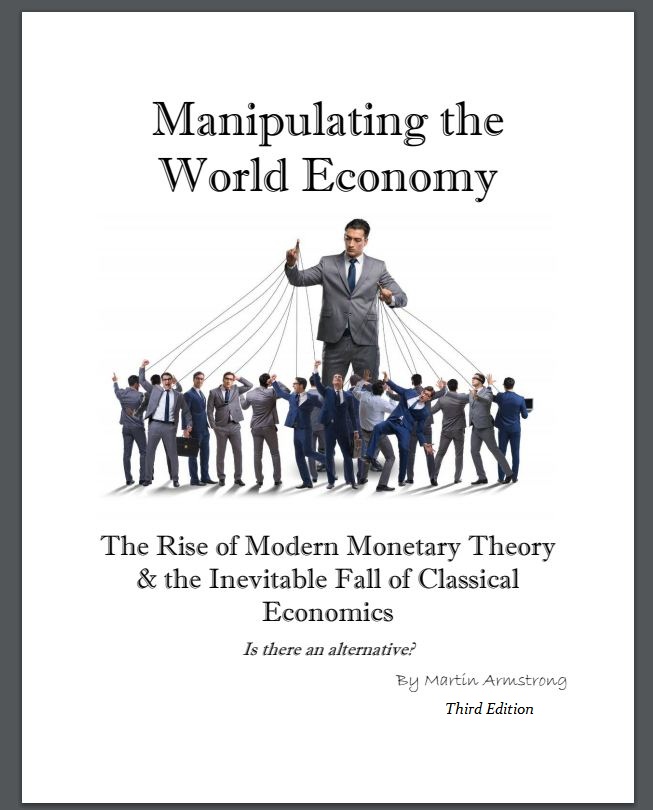
3rd Edition Manipulating the World Economic Goes to Print This Week


We have received many inquiries about the 3rd edition. We have added some text and an index. It is going to print this week. With respect to those asking if we can reserve a copy or those asking if they can buy a quantity at a discount to redistribute, we do not get involved in selling the books. It really is a big project having to handle shipping even internationally.

Amazon picks up the books directly from the printer. So they do not even come to us in the process. With respect to selling quantities, we would have to make an inquiry of the printer if they can even make independent shipments and if so what would be the minimum quantity.

All we know is that there were people who bought multiple copies from Amazon. A number of people purchased multiples to send to third parties based upon emails we received were usually friends or politicians. There was a group that sought to purchase one for every member of Congress but there were not enough left to accomplish that goal.

We will make inquires of the printer to see if they could make individual shipments. I would suspect it would be probably a minimum lot of 20 books. We will let everyone know.

With respect to autographed copies, I will always be glad to do that at conferences only

Chinese Tourism Has Come to a Halt


Anyone who has been traveling these past few years will notice the changes in tourism. Back in the ’90s, the number one tourist group was clearly Japanese. As their economy imploded thanks to government mismanagement, the next group was the Russians. When I was in Venice a year ago, there are a couple of performances that alter back and forth in St Mark’s square at night. They were still playing Russian songs when the only tourists there were Americans and Chinese. When I asked them why they were still playing Russian songs, he responded he would play New York, New York. I replied you don’t go to Venice to eat McDonalds.

The Chinese tourists outnumber Americans at least 2 to 1. There were no Japanese and I never saw any Russians there either. The #1 tourists around the world are always from the hottest economy. So with the coronavirus, Chinese tourism has come to a complete halt. This will have a negative impact on the economies dependent upon tourism.


Do Lower Interest Rates Really Produce Bull Markets in Stocks?


QUESTION: Hi Marty,

Yes, the political situation in our country is out of control and you are right, there is no turning back.

But this truly pales in comparison to what is happening in the financial markets today. It looks to me like the Fed has aided and abetted this ridiculous surge in stock prices. The phase we are in started back in early 2016 when we were plumbing new lows. The blinked. Then as they tried to raise rates in 2018, the marked puked and once again, they blinked. Less than a year later we have the REPO Crisis which you have discussed many times. At your WEC in Orlando, you stated one of the problems today is “the paradox of solution”, which I found brilliant…every solution to a crisis produces an even worse result later. Then you mentioned this: That politicians in office today have even less experience, that those in the know are leaving letting those in charge impose solutions that don’t work.

Marty, all of this is adding up to those in charge of debt and rates, the Fed, now being incapable of dealing with reality. To me, it’s worse than politics. The markets seem to be telegraphing an inflation ahead and a collapse in debt markets at some point. But you have always used the 1920’s as a sort of analogue to our times, claiming at some point the Fed will be forced to raise rates, realizing too late they have goosed markets and are now losing control. I just don’t see it. Nothing in the current makeup of the Fed indicates they understand the issues. Not them, not anyone in government will let weak companies fail, banks even less. There is no will in this country anymore. No one can take the pain. The Fed seems like they want to bail out everyone.

Your thoughts?
M

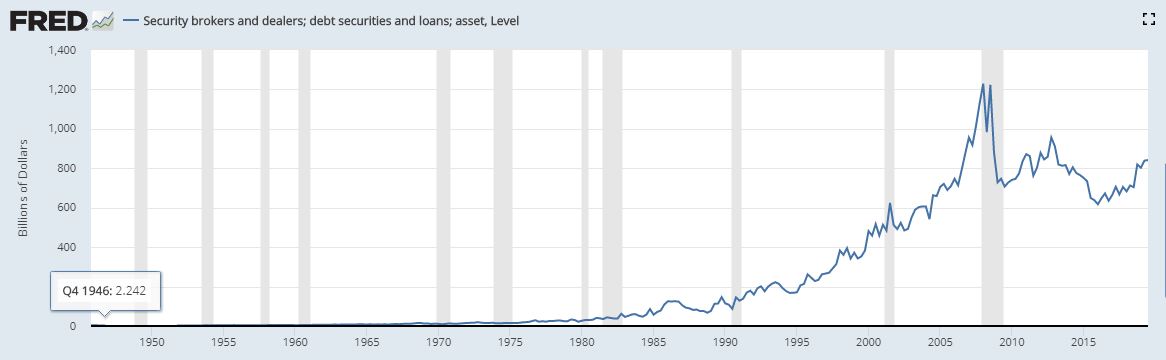
ANSWER: I understand that the traditional view states that cheap money means people will borrow to buy stocks. That entire theory is very naive. However, when we actually look at the data, that market myth evaporates in sunlight. We have been making lower highs in broker loans, which shows what I have been saying all along — this is the MOST Hated Bull Market in History! We are nowhere close to the highs of 2007.


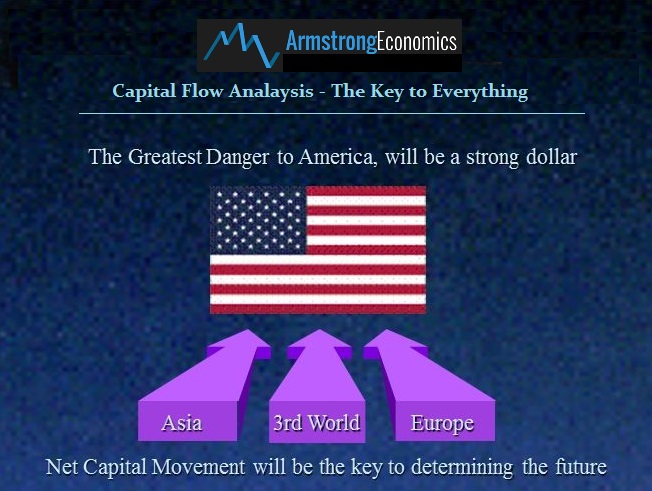
The market has risen NOT because of cheap rates but on a capital flight from just about everywhere into the US dollar. The Fed has been baffled because they initially were looking at that market myth. But they see there is no validity to that theory. They are focused on the problem that negative interest rates in Europe and Japan have created. The slightest uptick will be devastating to those economies, not to mention the losses on the outstanding long-term bonds which negative yields.

It is by no means creating future inflation. What it is creating is a future collapse in confidence with respect to the governments actually being in charge of the economy. This is why I wrote that book, “Manipulating the World Economy.” This is all coming to an end. We are looking at, not inflation, but a massive shift in investment strategy from public to private. The Fed cannot raise interest rates to prevent a rally without undermining the sovereign debt globally. The game has changed. The politicians will brow-beat the Fed because the Democrats are really Marxists and will scream at the Fed because their low rates are benefiting the rich. They are beyond brain-dead. The politicians are incapable of understanding the problem and they have become so confrontational that we can guarantee there will be no understanding reached because they are absorbed by this class warfare

“Economics” – What Does the Term Imply?


QUESTION: Dear Mr. Armstrong, I am following your blog while living in the Netherlands and first of all I would like to express my deep admiration for the work you have been doing for so many years. And yet…..I have my doubts. Your company name involves the term “economics”. And when I read your blogs you seem to favor “economics” and “economic growth” above anything else. I know this is a worldly view. But could it be – with all the changes that are taking place – that let’s say twenty years from now we have reorganized ourselves and that we value other things in life? Is there any data that supports this view?

J

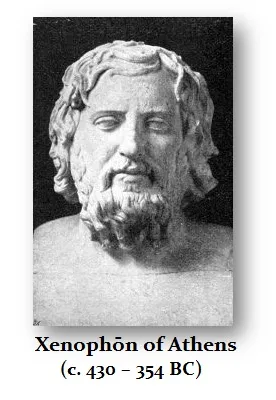
ANSWER: The actual term “economics,” I believe, was plagiarized by Adam Smith’s teacher Francis Hutcheson (1694-1746), who translated a book by the Greek Philosopher Xenophon (c. 430–354 BC) who wrote Oikonomikos around 400 BC. This work was basically how to manage your estate for dummies. Hutcheson called his Book III “The Principles of Oeconomics and Politics” giving birth to the word “economics.” The word’s Greek “Oikonomikos” stems from the compounded form of “oikos”(ancient Greek: οἶκος, plural: οἶκοι, English prefix: Eco) which was the equivalent of a household, house, or family, combined with “nomikos” which means the law or to regulate/manage. Therefore, Oikonomikos meant to regulate/manage the household or villa estate in those days. Francis Hutcheson, the teacher of Adam Smith, copied Oikonomikos virtually chapter by chapter which included how to manage your wife.

It was also Xenophon who proposed the first public corporation for a bank that would be formed by shares subscribed to by all the Athenian people. Commerce was seen as more important than even agriculture. Xenophon proposed a public bank that would lend at interest to expand the economy. He proposed that the profits would be used to pay for public works. During the reign of Augustus (27 BC-14 AD) in Rome, there was such a public loan bank, but not subscribed to by individual members of society. This public bank provided loans to the poor without interest and it was funded by the confiscation of property from those alleged to be criminals, which included political dissents as well. Collateral was required at twice the amount being borrowed. These types of public banks aided the purchases of land.

Even the committee in Congress known as the Ways & Means in the House of Representatives is the tax-writing committee. Members of the Ways and Means Committee are not allowed to serve on any other House Committee unless granted a waiver. The House Ways & Means Committee has jurisdiction over all taxation, tariffs, and other revenue-raising measures, as well as a number of other programs including Social Security, unemployment benefits, Medicare, the enforcement of child support laws, temporary assistance for needy families, and foster care and adoption programs. This is the committee that is named after the chapter of Xenophon’ work.

Therefore, against this backdrop, the term “economics” does not imply any specific type of system. You have everything from Smith, Ricardo, Marx to Keynes all lumped together under this same category. The economy will always change and evolve over time. So I am using it in this context. Xenophon’s world was all about how to manage an agrarian estate. So things will change with time, technology, and population.

The principle “economic growth” implies also population growth. The economy must grow to accommodate population growth. That is why communism fell because they arrested economic growth by divorcing it from population growth and then it must collapse. It is not something that is exclusive to “materialism” but reflects civilization and people coming together. Under feudalism, Rome collapsed into simple feudal states, and although they minted some coins, they are rarely discovered more than 30 miles from their origin. That is strong evidence that the economy collapsed and there was no interaction between these small states. Thus, you had low economic output or growth.

Even in Star Trek, money was eliminated and people simply used electronic credits – cryptocurrency. That is perfectly reasonable for the long-term future. The economy simply reflects the exchange of money (whatever form it shall take) for labor of the average person. The “rich” get richer from INVESTMENT which creates the economic growth vital to expand and accommodate the expansion of the population. It does not advocate any particular system. It applied under Communism to republics and everything in between.

What Were the 30 Silver Coins Given to Judas?


QUESTION: Marty, do you happen to know what type/kind of shekel coins Jesus was most likely betrayed for?

Thanks,

A

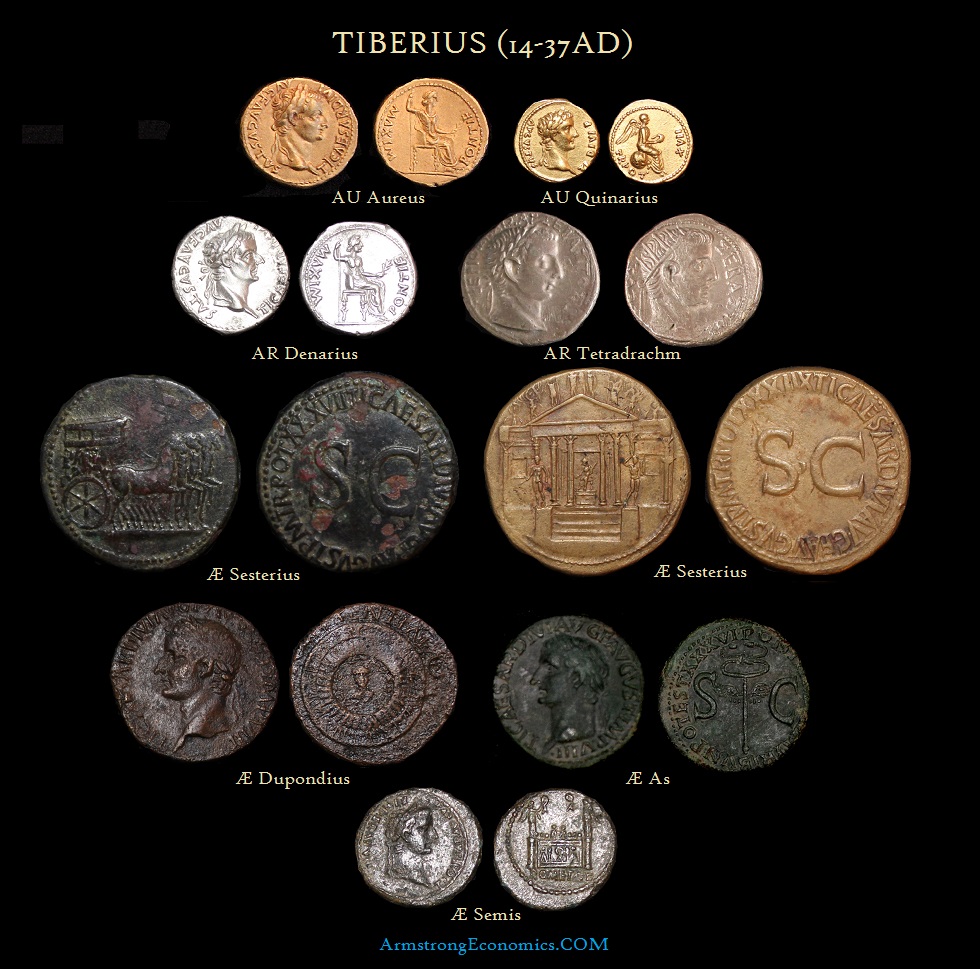
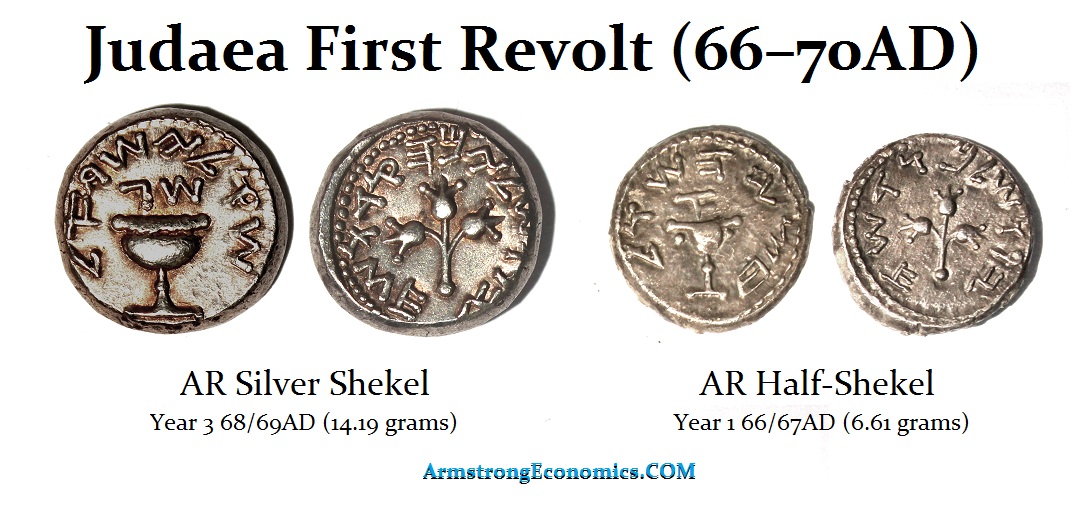
ANSWER: The Biblical account makes no mention of shekels for they were not the coin of currency. Thirty pieces of silver was the payment for Judas Iscariot’s betrayal of Jesus, according to an account in the Gospel of Matthew 26:15 in the New Testament. The Roman Emperor at the time was Tiberius (14-37 AD). The exact date of his crucifixion is not known. Most scholars have provided estimates for the crucifixion to be within the range 30–33 AD, with perhaps April 7, 30 AD to be the majority of consensus. The pieces of silver would have been of the silver denarius. The amount of coinage under Augustus (27 BC-14 AD) was massive. The coinage of Tiberius was very frugal.

The only local coinage was that of tiny bronze coins for small change. To put this in perspective, the wages of a Roman foot soldier in 30 AD was 900 sestertii annually. A silver denarius was worth 4 sestertii. Therefore, 30 pieces of silver was about one and a half month’s pay for a Roman soldier. It was not a huge amount of money, but it was respectable for an average Jew.

The Roman denarius weighed about 3.7 grams in reality when its theoretical weight was supposed to be 4 grams. When the Jews revolted against Rome, that is when they over-struct or melted down other coins and issued their Shekel which was a Sumerian unit of weight. This was the dominant system from Babylon to Carthage throughout Northern Africa. The Shekel was by no means simply a Jewish standard of weight or coin.

Forthcoming Books


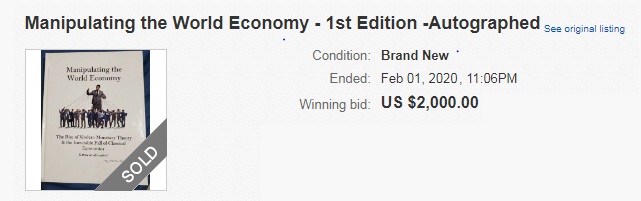
COMMENT: Marty; the books you handed out at the WEC are spectacular. One first edition just sold for $2,000 on eBay. The second edition is going for $300 on eBay but there aren’t many of those either. I just wanted to say thank you for your generous gift to the attendees. The book is worth the price of the ticket, lol. I hope you get the time to do the next one.

DF

REPLY: I am trying to have another book for this year’s WEC. I have collected books my whole life. I know the Greatest Bull Market in History from 1986 goes for $2500 to $3000 on eBay. I only have one copy of that myself. One of those was presented to President Reagan back in the day. So First Editions are always worth a lot more. The second edition of Manipulating the World Economy was amazing. It sold out in less than 3 hours. That is the one that some members of the press got their hands on. Not the first edition. We will have a 3rd edition but that will not have the same value as the 1st and 2nd. If that book becomes a major classic when the economy turns down, then its value should rise even more. Keynes first published his work in 1921 despite the fact he wrote it before WWI. His book: The General Theory of Employment, Interest and Money was published in 1936. They will bring $3,000+. Even a 1799 edition of Adam Smith still brings over $2,000.

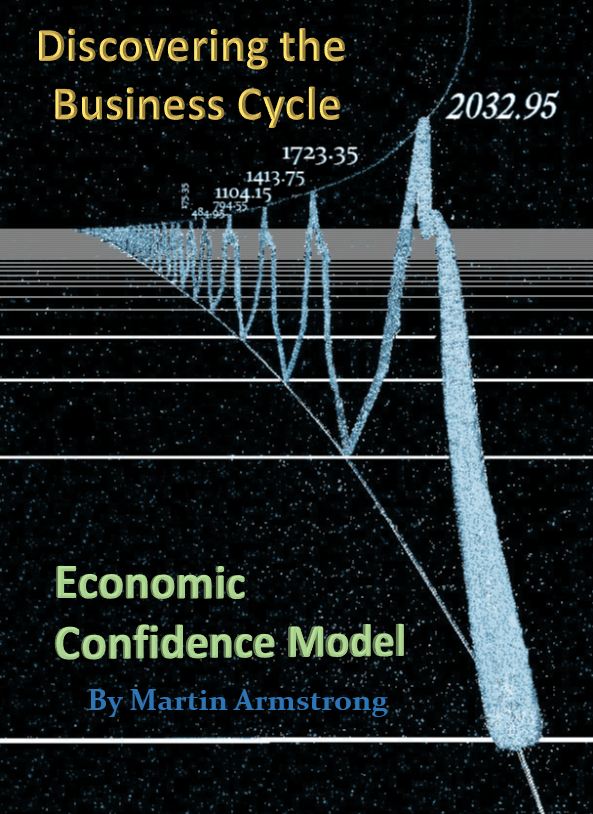
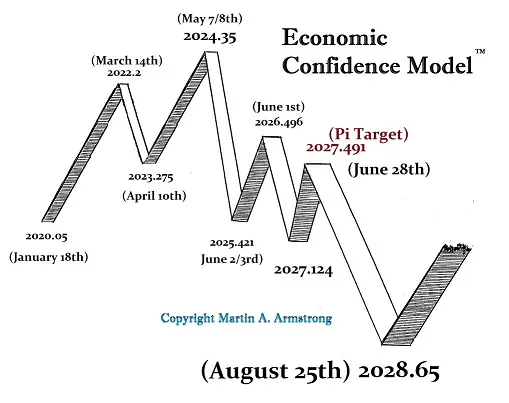
I am finishing up two books I really want to get out this year before all my time evaporates. I am trying for the Geometry of Time and the Economic Confidence Model, which is the proof back to the inception of recorded time. I know a lot of people are waiting for the 3rd edition of Manipulating the World Economy. We are working on that too.


Is the Boom-Bust Cycle Dead?


QUESTION: Do you agree with Bridgewater’s Bob Prince that the Boom-Bust Cycle is over? Have they made an offer to buy you out yet?

SH

ANSWER: Absolutely no way. His theory is that the tightening of central banks all around the world “wasn’t intended to cause the downturn, wasn’t intended to cause what it did.” Prince explained, “I think lessons were learned from that and I think it was really a marker that we’ve probably seen the end of the boom-bust cycle.”

That is an interesting take, but it reflects the typical investment manager focus. They tend not to pay attention to history and always assume that the financial world started as far back as maybe 1971 if not 1990. The boom-bust cycle that he refers to has been the classical economic expansion and contraction in economic activity. However, the very book I just published, “Manipulating the World Economy,” deals with this issue of central bank intervention. He seems to think that since the financial crisis and monetary easing has disrupted that cycle, that it has fueled the longest-running bull market in stocks.

This is why Bridgewater has had a terrible year in 2019. They have completely misunderstood the market and do not grasp the capital flows and how they drive markets. Indeed, Bridgewater Associates, the world’s largest hedge fund firm, had a very difficult 2019 because of this view. The firm’s flagship Pure Alpha strategy was essentially flat in 2019, with Pure Alpha 18%, the more leveraged version, falling 0.5% for the year, according to an investor in the funds. It has been this fundamental focus which is why they missed the bull market.

The repo market is already proving the idea that the boom-bust cycle is dead. Interest rates are pushing higher and the Fed is desperate to try to prevent that rise. You cannot defeat the business cycle. Even Paul Volcker admitted that much (Rediscovery of the Business Cycle). Many people have thought that governments have killed the business cycle. They have ALL BEEN PROVEN to be wrong!

No, I have never met Ray Dalio that I remember. If I did, it was just in passing perhaps at some cocktail party. Bridgewater is not a client so the idea of some offer is not even plausible. It is one thing to take in a partner, it’s something entirely different to sell everything to some private firm which would then have exclusive use. That is not my goal and I would not live long enough to spend some mythical billion-dollar sell-out. Sorry, that is not my agenda. I would like to see Socrates help to better manage the world economy, not make money for a bank or hedge fund exclusively.

Quebec Issued the First Paper Money in the New World


QUESTION: Mr. Armstrong, a goldbug told me you were wrong that paper currency did not begin with the Civil War. I told him you have written plenty of times about the continential currency. I believe you said somewhere that paper currency did begin in America. Am I correct in that statement?

PC

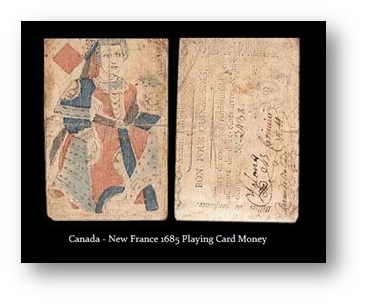
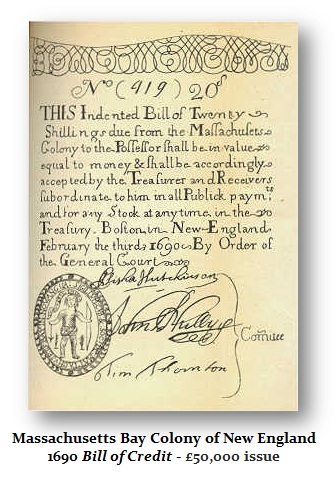
ANSWER: Ironically, the very first paper money in America was issued in Canada. In 1685, the colonial authorities in New France (Quebec) had no coin. A military expedition against the Iroquois, allies of the English, had failed and tax revenues were down as traders circumvented the taxes by dealing with the English. This predates the official first paper money issue of February 3, 1690, by the Massachusetts Bay Colony. This paper money issue was used to pay for its war in 1689 when the British demanded that Americans fight the French in Canada. Lacking coinage to pay the troops, the government issued certificates to the troops in lieu of paying them with coins.

Lacking coins, New France printed various face values on playing cards and affixed a seal to them. When the king’s ship arrived, they redeemed this “playing card money” in cash. This system was brought to an end after 1686, but it was necessary to return to it during the period 1689-1719. In 1714, card money equivalent to a value of 2 million livres was in circulation. Some cards were worth as much as 100 livres.

The king later returned to using playing card money in 1729 when the merchants demanded it due to the shortage of money. This issue of playing card money used white cards without colors. They cut or had their corners removed according to a fixed table. The whole card was worth 24 livres, which was the highest sum in playing card money. Depending on the number of corners that had been cut off, this is what determined the face value.

The first paper currency in what is now the United States was issued in 1690 in Massachusetts Bay. Because of the collapse of the Continental Currency, the United States did not issue any paper money until the Civil War. There were private bank issues which are known as broken bank note era from the 1840s. But the federal government did not issue paper money until the Civil War to fund its expenses