EU Energy Panic Cycle to Begin


Armstrong Economics Blog/Energy Re-Posted Jul 26, 2022 by Martin Armstrong

On August 1, the European Commission will begin to reduce its demand for gas with no alternative in place. Unsurprisingly, our computer states that a Panic Cycle will begin in August or September and go into Q1 of 2023. Europe must reduce its gas consumption by 15% (45 billion cubic meters). In comparison, Russia delivered 150 billion cubic meters to the EU last year. Russia’s largest gas provider, Gazprom, has threatened to cut off Europe from gas entirely. Europe has no alternative solutions at this time. Therefore, they’re implementing a “Save Gas for a Safe Winter” plan in Brussels.

Commission chief Ursula von der Leyen claims that all member states will suffer from their proxy war with Russia, albeit some more than others (e.g., Germany). “It’s important that all member states contribute in the saving, the storing and are ready to share gas,” she said. Let us see how friendly this bloc really is when it comes to sharing an essential resource in limited supply.

Member states are now required to submit energy plans to the Commission by the end of September and update plans every two months until March 2023. There is proposed legislation that would allow the Commission the authority to declare a “Union alert” and impose mandator gas caps on member states.

The bloc plans to fill its gas storage capacities to 80% by November, but that may be a lofty goal. European Commissioner for Energy Kadri Simson expressed pessimism in interviews.  “We risk ending this winter with empty storage, which will be impossible to refill in time for the next heating season,” she warned, as this crisis is only beginning.  Simson and others are calling on the public sector to reduce demand.

This will fall back to the citizens, who will be asked to limit their consumption and abandon comforts for a proxy war they never voted on. Frans Timmermans, the Executive Vice-President of the Commission in charge of the European Green Deal, has already suggested people switch off lights and electrical appliances and reduce AC/heater usage. No one will stop these politicians from flying around on their jets, surrounded by bodyguards in numerous SUVs, while they make the people suffer for their poor policies.

Worldwide Inflation in June 2022


Armstrong Economics Blog/Inflation Re-Posted Jul 26, 2022 by Martin Armstrong

There is a common misconception that the United States has the highest rate of inflation in the world. I see it questioned in numerous emails The United States does have a major problem when it comes to inflation, but its currency has not depreciated to the point where it is weak. Let us compare data on inflation from other nations.

According to data compiled by Trading Economics, the following countries are suffering the most from runaway inflation as of June 2022:

  1. Lebanon 210%
  2. Zimbabwe 192%
  3. Venezuela 167% (last compiled May 2022)
  4. Sudan 149%
  5. Syria 139% (last compiled in August 2021)
  6. Turkey 62%
  7. Argentina 64%
  8. Suriname 55.6% (last compiled May 2022)
  9. Sri Lanka 54.6%
  10. Iran 52.5%

These depreciated currencies are all but useless at the moment. As we have seen throughout history, the prospect of revolution rises when the people are unable to afford basic needs. Numerous countries on this list are already in the middle of ongoing civil wars and political turmoil. Barter becomes essential as trading goods and services are often the only available option.

Here is how the G20 nations rank as of June 2022:

  1. Turkey 62%
  2. Argentina 64%
  3. Russia 9%
  4. Brazil 89%
  5. Spain 2%
  6. United Kingdom 9.4%
  7. United States 9.1%
  8. Euro Area 8.6%
  9. Netherlands 8.6 %
  10. Canada 8.1%
  11. Italy 8%
  12. Mexico 99%
  13. Germany 7.6%
  14. South Africa 7.4%
  15. India 7.01%
  16. Singapore 6.7%
  17. South Korea 6%
  18. France 8%
  19. Australia 5.1% (compiled in March 2022)
  20. Indonesia 4.35%
  21. Switzerland 3.4%
  22. China 2.5%
  23. Japan 2.4%
  24. Saudi Arabia 2.3%

Turkey tried but failed to gain access into the EU and swap its lira for the euro. They would have been in insurmountable debt regardless, but their initial attempt failed. Is it any wonder that Turkey is trying its best to keep diplomatic relations with both the West and Russia amid the proxy war? They cannot afford to lose trading partners and have failed to impose tough sanctions on Russia. Turkey enjoys its NATO status but attempted to block Finland and Sweden from joining. They cited their reasoning as those countries supported Anti-Turkish terrorist groups, but part of the reason was not to anger Russia.

All of the other G20 nations are experiencing high inflation, none at the common 2% target, but some are faring much better than others as they are not involved in the ongoing proxy war and have maintained strong trade. The US sitting at 9.1% is alarming. As I have warned, other nations will fold before the US as the dollar remains unchallenged.

The White House Changed the Definition of a Recession


Armstrong Economics Blog/Economics Re-Posted Jul 26, 2022 by Martin Armstrong

Governments have a way with words. Namely, they can change the definition of a word at the stroke of a pen. The definition of “vaccine” changed under the CDC’s guidance from “a product that stimulates a person’s immune system to produce immunity to a specific disease, protecting the person from that disease” to “a preparation that is used to stimulate the body’s immune response against diseases.” This permitted the COVID experimental injection to be called a “vaccine.”

According to some on the top US court, only a specialized biologist can define the term “woman.” “Mothers” has changed to “birthing people,” and words seem to have lost all meaning.

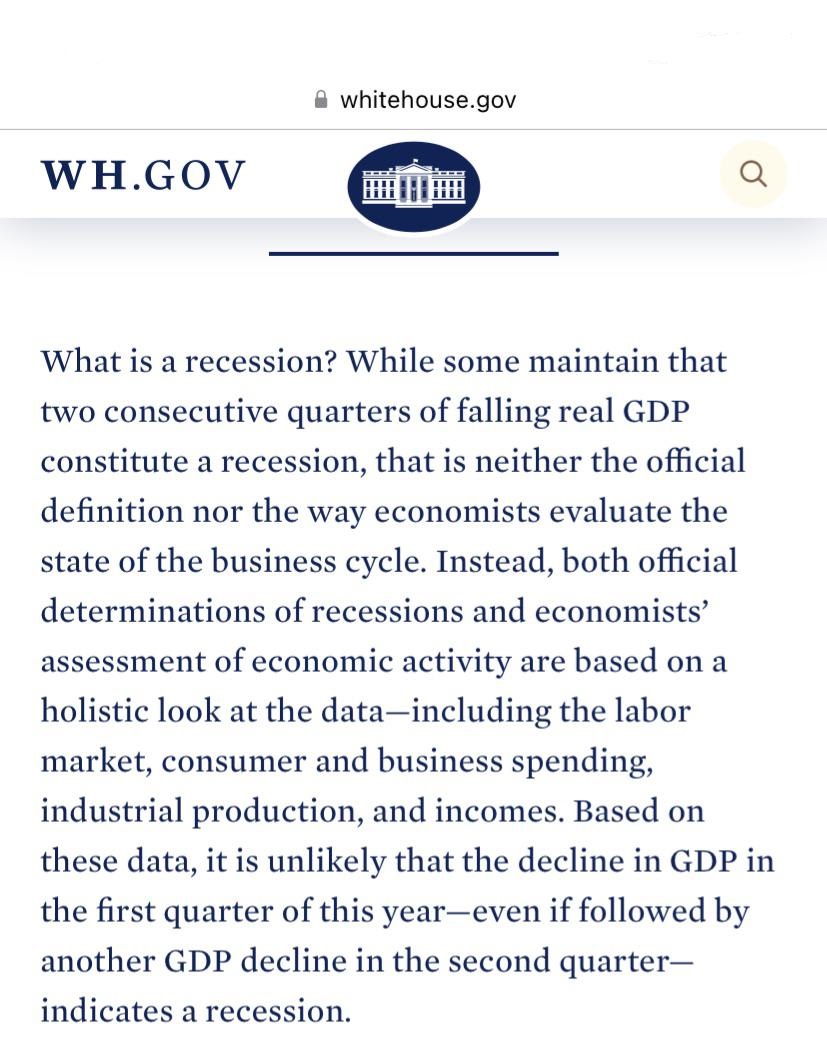
Now, the White House is changing its definition of “recession.” A recession was typically categorized as two consecutive quarters of GDP contraction, albeit not the best measure. Still, this was the tried and true formula for the government to determine the health of the overall economy. The White House now says that data from every facet of the US economy must be considered and foreshadows what to expect for Q2. The White House will not admit that the US is in a recession under Joe Biden. They will downplay the next GDP reading for Q2 and cite their newly formed definition for a “recession.”

Weber Manufacturing Announces Layoffs Due to Collapsed Sales, U.S. Economy Shrinking, CEO Resigns


Posted originally on the conservative tree house on July 26, 2022 | Sundance

It is only one U.S. company; however, the makers of Weber Grills and products released their sales data, and the background shows a severe economic contraction that has resulted in their operating loss of $51 million in the quarter that ended March 31, 2022.  NOTE THE DATE.

July 25 (Reuters) – Weber Inc (WEBR.N) on Monday replaced top boss Chris Scherzinger with an insider and warned that mounting inflationary and supply chain pressures could hit the grill maker’s financials and workforce, sending its shares down 20% in premarket trading.

The company withdrew its fiscal 2022 net sales and core earnings forecasts, saying higher consumer prices and geopolitical uncertainty were squeezing store traffic as well as margins.

Weber, which also suspended its quarterly cash dividend, said it was pursuing a number of initiatives, which may include job cuts, reducing expenses and tightening its inventory levels.

The company also forecast a net loss for the quarter ending June 30, citing weak store traffic and higher discounting. In the quarter ended March 31, Weber’s net sales decreased 7% and net loss came in at $51 million compared with a net income last year. (read more)

Weber is a good company with strong fundamental products.  Unfortunately, the layoffs that are likely to soon surface are not going to be isolated to Weber.  The contraction of economic activity is going to start surfacing in the balance sheets of multiple companies this quarter.

We can expect to see a bloodbath of employment layoffs in this quarter (July, Aug, Sept) at the same time as the federal reserve continues to raise interest rates to support the new energy “transition.”

As noted in Weber’s financials, the consumer contraction started escalating more than six months ago.  Companies can only hide a severe drop in income for a short period, and then eventually cost-cutting decisions must be made.

Tucker Carlson Outlines the Ukrainian Blacklist of American Critics, Including Rand Paul, Glenn Greenwald, Tulsi Gabbard and Col Douglas McGregor


Posted originally on the conservative tree house on July 26, 2022 | Sundance

The non-democratic, socialist and totalitarian Ukraine government of President Volodymyr Zelenskyy has created a blacklist of western voices that are considered “Russian propagandists” for their criticism of the Ukraine-Russia conflict. [Details Here]

The overwhelming commonality of the people on the list is their advocacy for citizens of nations who are providing support for Ukraine to have a democratic voice on the issue. The Zelenskyy government has stated it will not permit any criticism of their country and demands that all western nations continue to send billions of dollars to provide an appropriate lifestyle for all Ukrainian government officials.

Currently the burden of financing the continuation of the Ukraine government has fallen upon U.S. taxpayers who have provided approximately $60 billion so far for the pay and pension benefits of Ukraine officials and their families. President Zelenskyy says we have a moral obligation to continue this funding, and any voice who would question the process is now blacklisted within Ukraine and labeled a Russian propagandist.

Tucker Carlson discussed the issue with two of the people targeted by Zelenskyy, former Congresswoman Tulsi Gabbard and journalist Glenn Greenwald. WATCH:

.

Even CNN Panel Cannot Support the Biden Administration Redefining Terms Because their Economic Policy Sucks


Posted originally on the conservative tree house on July 25, 2022 | Sundance

No credit to the CNN team for calling out the obvious; I mean, this is the same panel who redefined “insurrection” to fit their needs; however, the Biden administration’s efforts to redefine economics are so pathetic even the narrative engineers at CNN cannot support them.  WATCH:

.

Biden Puts His Economic Credibility On The Line Ahead of Thursday BEA Report, I Do Not Think We Will See a Recession


Posted originally on the conservative tree house on July 25, 2022 | Sundance

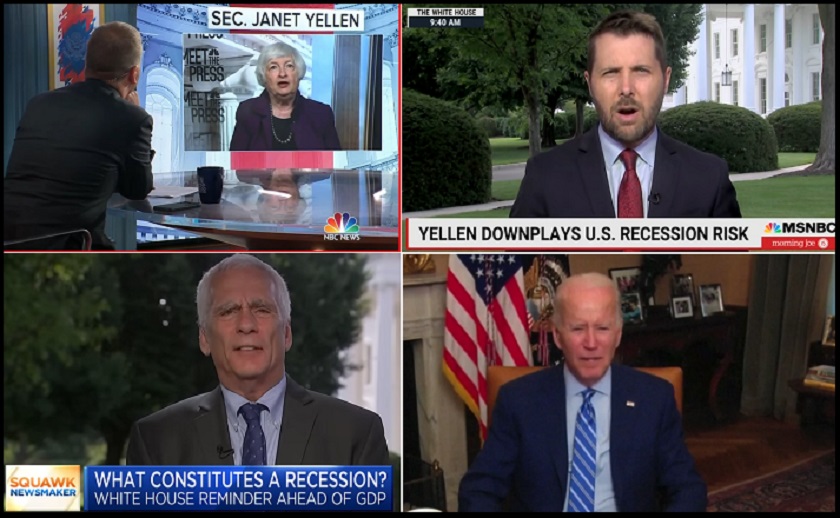
The White House is expending a tremendous amount of communication effort over the past 48 hours trying to convince the American public that the economy is good, and we are not in a recession.

Yesterday it was Treasury Secretary Janet Yellen. Today National Economic Council Chairman Brian Deese, White House Economist Jared Bernstein and even Joe Biden himself, all declaring that despite the economic contraction you may feel, see and even quantify, we are not in a recession.  WATCH:

.

The action of the recession deniers reminds me of the famous Ralph Waldo Emmerson quote:

The louder he spoke of his honor, the faster we counted our spoons.”

.

.

The Recession Deniers

Pretending Has Consequences – Western Media and Western Govt Continue Saying, Falsely, Global Food Crisis Caused by Russia


Posted originally on the conservative tree house on July 25, 2022 | Sundance 

As oft repeated, in order for severe ideologues to retain their insufferably bad policy they must pretend not to know things.  However, in the case of food shortages, the pretending about the origin of the problem has severe consequences.

Vladimir Putin’s military action against eastern Ukraine had nothing to do with the severe food shortages and inflation in Sri Lanka {link}.  Nor does Putin have any influence over the Dutch government trying to stop food production {link}.  Additionally, Putin has no control over Justin Trudeau’s decision to limit harvest yields by blocking the use of nitrogen-based fertilizer {link}. More importantly, it was not Vladimir Putin who forced all the western politicians to sign up for a new ‘climate friendly’ energy program that is destroying the ability of western farms to generate higher yield crops.

You do not need to be a farmer to understand that nitrogen/phosphorus-based industrial fertilizer has been the reason why farm yields have generated massive amounts of food on a global basis.  The United States, Canada, the U.K. and places like the Netherlands have massively increased their ability to generate food for export, in large part due to the success of improved fertilizer and crop saving modern pesticides.  Take those farming advancements away under the guise of climate change and you get a global Sri Lanka.

Those western climate and energy policies create downstream consequences.  The decision to chase a new global energy policy under the name “Build Back Better,” in combination with short-sighted EU sanctions against Russia, and you get food shortages. And boy howdy are they trying to avoid taking responsibility for it.

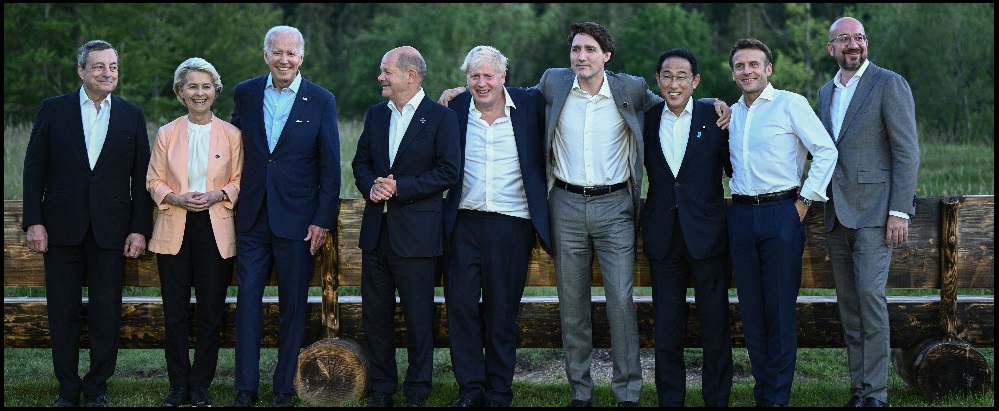
It was not Vladimir Putin who told British Prime Minister Boris Johnson and German Chancellor Olaf Scholz their proactive recommendation to switch from crop-based biofuels to human food would be blocked.  That G7 decision was made by Justin Trudeau and Joe Biden. {link} Even more significantly, it was not Russia who threatened the multinational energy companies about investing in Africa for expanded natural gas supplies for their fertilizer needs. That threat came from the same western government alliance, per their instructions from the World Economic Forum group {link}.

It was predictable {JUNE 21st} {June 30th} and {July 6th} that western government leaders would seek to avoid responsibility for the food crisis they created, and now we see more western media trying, desperately, to frame the Putin is to blame for global food shortages in order to protect them.

NEW YORK, July 25 (Reuters) – Russian President Vladimir Putin’s invasion of Ukraine shocked the world, forced Western countries to respond, and is driving up the cost of energy and food across the globe. High prices in the United States may spell electoral disaster for President Joe Biden’s administration in November’s congressional elections. However, the most urgent economic, social, and human crises are unfolding in poorer countries where populations face war, spillover-driven inflation, and more expensive foreign-currency debt. (more

Joe Biden, NATO, the G7, the European Union, the World Bank, USAID, and every western leader in the United States and Europe has stated there will be food shortages.

They are not saying there might be shortages; their statements are emphatic, there will be shortages.

Accept this basic cornerstone.  Then ask why not a single proactive step has been taken by any of the aforementioned institutions or governments to alleviate what they declare is a certainty.  Why?

Simple question, “why?”

If all of the western nations, non-govt organizations and heads of state, are aware of a coming food crisis, why is there no proactive response?

It is a question that even the most hardcore leftists will not answer, because there is only one answer.  No action is being taken because they do not want to take action.  No effort to avoid the crisis is being done, because they do not want the crisis avoided.

Peel all the layers of obfuscation and causation away, and what we find is the epicenter of the food shortage is directly the result of the Build Back Better agenda.  A post-pandemic western government deliberate decision to radically change global energy development.  In succinct terms, the climate change agenda.

However, regardless of how you feel about the validity of “climate change,” the cause of diminished food supplies is purposeful.  It is not climate change causing food shortages. It is the purposeful action taken under the guise of mitigating climate change that is causing the shortage of food.

The collective Build Back Better energy policy of western governments’ is the reason for massive increases in energy costs, massive oil price jumps, gasoline price increases, significant increases in chemical costs, increases in diesel fuel costs, shortages of fertilizer created using natural gas, and the end result is lower crop yields, higher farming costs and eventually, food shortages.  They know this.

All of the organizations and government who have been decrying the future shortage of food, know it is the radical shift in energy resource development that is creating the crisis.  This acceptance of reality begins the framework to understand just how entrenched and committed these western leaders are toward their beloved climate change agenda.

We do not yet know the scale of food shortage, but we do know -and everyone admits- there will be severe shortages on a global basis.

Western leaders will not and cannot accept the blame for what they are doing.  So, they will blame-cast, excuse and justify what is likely to surface.  Food shortages blamed on the Ukraine conflict, Russian aggression, climate change and any various iteration of justification that does not identify the true cause, their energy ideology.

I’m not so sure that people fully understand what the entire system of western government would be willing to do to avoid being blamed for avoidable death on a potential scale that is quite alarming.  All of the western leaders, institutions and governments are on the same boat.   They are all in this together.

JustInflation


Armstrong Economics Blog/Canada Re-Posted Jul 25, 2022 by Martin Armstrong

Consumer price gains hit their highest level since January 1983 in Canada. The news comes one week after the Canadian central bank surprised the markets by implementing a 100 basis point rate hike. June’s 8.1% inflation rate acted as another indicator that the Canadian economy is in trouble. The BoC is expected to raise rates by an additional 75 bps at the next meeting, but the central bank cannot solve this problem alone.

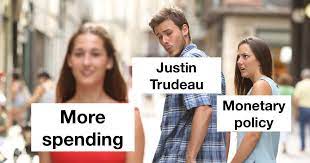
Canada is expected to post a 2% deficit in GDP this year, making it the poorest among the G7 nations. Finance Minister Chrystia Freeland announced that the nation would pull back on pandemic spending, which doubled Canada’s national debt. The Bank of Canada is relying on Freeland and the Trudeau Administration to reduce spending. Who will vote for Trudeau if he stops providing free handouts?

Rising interest rates are hiking up the price of debt servicing. Canada is still pushing for additional health and military spending and sending endless funds to Ukraine. Inflationary pressures will lead the people to look to the government for additional relief as they have provided it in the past.

Gas prices have increased 54.6% in the past year, natural gas and oil rose 38.8%, and food has spiked 8.8%. The hashtag #JustInflation has been spreading across social media as people are increasingly frustrated with Trudeau’s lack of response to the rising cost of living.

Germany to Bail Out Uniper


Armstrong Economics Blog/Energy Re-Posted Jul 25, 2022 by Martin Armstrong

Germany and Finnish parent company Fortum signed a $15.24 billion deal to save energy company Uniper. In return, Germany will take a 30% stake in the company. Uniper reported only receiving a fraction on contracted gas from Russia’s Gazprom since mid-June, and it seems shipments may continue to slow or cease entirely. Uniper has been purchasing gas elsewhere at a premium, dampening their profits.

“We are living through an unprecedented energy crisis that requires robust measures. After intensive but constructive negotiations, we found a solution that in an acceptable way met the interest of all parties involved,” said Fortum’s President and CEO Markus Rauramo.

Chancellor Olaf Scholz said saving Uniper is of “paramount importance” for the German economy. Sholz said the “government plans to introduce mechanism to pass through 90% of replacement costs for missing Russian gas to consumers as of October 1.” The costs will be passed on to the consumers, of course.