How the Rich Make Their Money


QUESTION:

Good Sir,

When you say the ‘rich get rich by investments, not wages’ you fail to identify the following wealthy class.
CEO’s of corporations, ‘Hollywood’ movie stars, Sports athletes, Recording artists, etc.

Regards and continued success,

An avid follower

LB

ANSWER: There are always exceptions, but those who receive big bonuses or high wages such as sports and movie stars are a tiny fraction of what they call the “rich.” The “rich” are defined as households with income in excess of $250,000. The “rich” who have built wealth from creating businesses and investment are really 99% of that class. The movie stars and sports figures are paid salaries based upon their draw. Many others in Hollywood get base salaries and a percentage of the box office take. The CEOs get bonuses based upon performance.

The government takes Social Security and places restrictions whereby it can only invest in government bonds. This deprives the average person from making appreciable capital gains.

Behavioral Economics: Full Series


Published on Sep 11, 2017

Behavioral economics helps you understand dating, partying, college loans, voter ignorance, and all the choices humans make. Here’s our full series. SUBSCRIBE: http://bit.ly/2dUx6wg


Debate: Is There Too Much Inequality in America? | Learn Liberty


Published on Mar 8, 2013

Wealth inequality is real, but is it fair? The distribution of wealth in America is lopsided in the favor of the 1% – a point made by the video “Wealth Inequality in America.” This inequality is intuitively and philosophically unfair to many people, but what happens when we examine the roots of our motivation? How can society BEST help the poorest? How can individuals BEST provide better lives for themselves – and their loves ones? Can our BEST laws also be our FAIREST? A fair society is a challenge to the status quo. Learn Liberty asked two professors — a libertarian (Professor Steve Horwitz), and an opposing philosopher (Professor Jeffrey Reiman) — to answer questions about wealth, fairness, inequality, and the United States. This is their debate.

There’s No Such Thing As An Unregulated Market


Published on Nov 16, 2017

We all want the safety and dependable quality that “regulation” is supposed to provide. Government can provide it to some extent, but markets can do it better, if we let them. Howard Baetjer of Towson University explains.


What If There Were No Prices? The Railroad Thought Experiment


Published on Nov 5, 2015

What if there were no prices? How would you use available resources? To appreciate why market prices are essential to human well-being, consider what a fix we would be in without them. Suppose you were the commissar of railroads in the old Soviet Union. Markets and prices have been banished. You and your comrades. Passionate communists all. Now, directly plan how to use available resources. You want a railroad from city A to city B, but between the cities is a mountain range. Suppose somehow you know that the railroad once built. Will serve the nation equally well. Whether it goes through the mountains or around. If you build through the mountains, you’ll use much less steel for the tracks. Because that route is shorter. But you’ll use a great deal of engineering to design the trestles and tunnels needed to cross the rough terrain. That matters because engineering is also needed to design irrigation systems, mines, harbor installations and other structures. And you don’t want to tie up engineering on your railroad if it would be more valuable designing those other structures instead. You can save engineering for other projects. If you build around the mountains on level ground. But that way you’ll use much more steel rail to go the longer distance and steel is also needed for other purposes. For vehicles, girders, ships, pots and pans and thousands of other things. Which route should you choose for the good of the nation? To answer, you would need to determine which bundle of resources is less urgently needed for other purposes. The large amount of engineering and small amount of steel for the route through the mountains, where the small amount of engineering and large amount of steel for the roundabout route. But how could you find out the urgency of need for engineering and steel in other uses? Find out more as Professor Howard Baetjer Jr. from Towson University explains market prices through the railroad thought experiment.

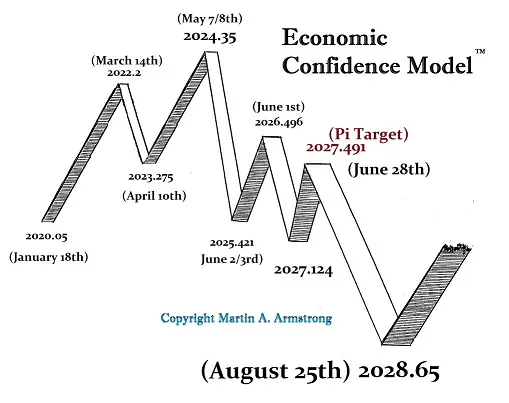
The Next Cycle in the ECM Beginning January 2020


QUESTION:

Martin,

I am a huge fan of yours and have followed your blog for probably 8 years now, I watched your many predictions using the AI models and have been amazed by their accuracy. I am a very concerned small investor and with this big shift coming in the ECM in January 2020 am wondering where you think I should be invested… Gold, the DOW, real estate, cash? I have bought far out of the money Jan 2021 GLD options which are extremely cheap right now. How do you best recommend your fans to position themselves for the coming storm?

Hopefully I will be able to make your next conference.

All the best.

Sincerely

RW

ANSWER: It is still too early to make a reliable forecast just yet. But generally, the next wave of the ECM business cycle should be an inflationary one. It certainly appears that all of this Quantitative Easing has caused tremendous damage and has now trapped the central banks to the point that the biggest debtor is the government. They have tried to use interest rates under Keynesian economics to manipulate “demand,” which is used to force us to borrow or stop borrowing. But all of these manipulations have no impact on preventing government borrowing. The danger now is that after 10 years of QE, governments are addicted to low interest rates and raising them this time will blow up the government budgets. They will respond by raising taxes to try to keep the ball rolling, but that will result in civil unrest and deflation

Could the Great Depression Have Been Prevented?


QUESTION:

Dear Martin,

I appreciate all you share. I watched a series on the Great Depression and they talk about how socialism saved capitalism. If true, is this part of a healthy cycle between the two? Could anything have been done to prevent the Great Depression?

Thank you!

LB

DJ3242-m Warren


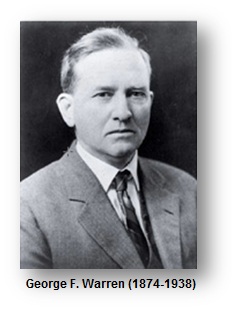
ANSWER: It was not socialism that saved capitalism, it was a shift in the understanding of money itself. George Warren convinced Roosevelt to devalue the dollar and end AUSTERITY, as Germany imposes on Europe today, which reversed the economy.

The Dust Bowl was the primary cause of the rise in unemployment to 25%. In 1900, 41% of the civil workforce was in agriculture. The invention of the combustion engine began to displace jobs as the internet has done recently. Tractors replaced workers in fields, so there was a huge transition in the labor force. Then the Dust Bowl took place and that created the hobos.

There was nothing the government could have done to prevent the Great Depression. The best that one can hope for is to understand the business cycle and prepare for the downturns. In that manner, it becomes more like Joseph warning the Pharaoh of 7 years of plenty to be followed by 7 years of drought. If we accept that the business cycle is complex and not a single source that can be controlled, then we will live with the cycle and understand it.

FDR’s programs came in 1935. The economy had already bottomed and turned up from July 1932. I find the argument that socialism saved capitalism as self-serving for the socialists, but the timeline does not agree

Trump v Federal Reserve – Why?


QUESTION: Good afternoon Martin,

Do you gander that President Trump is aware that a higher dollar will cream the economy and is doing all he can to fight that trend?

Maybe he is reading AE but like other politicians still thinks he can manipulate the economy?

Trump is battling the Fed over interest rates. What does it mean for your money?

MDC

ANSWER: Trump does realize that there has been a flight to the dollar. I believe his bashing the Fed to lower rates is inspired by the hope of keeping a lower dollar for trade. I do not believe higher rates are on his radar with respect to the markets. He is probably seeing briefings of the rise in rates and what is taking place with the national debt.

As far as what does it means for your money: the trend from public debt to private will be accelerated by this trend. I believe that the Fed will try pegging rates with caps rather than engaging in QE as Europe has don

There’s No Such Thing As An Unregulated Market


Published on Nov 16, 2017

We all want the safety and dependable quality that “regulation” is supposed to provide. Government can provide it to some extent, but markets can do it better, if we let them. Howard Baetjer of Towson University explains.

The International Unit of Account


QUESTION: I only recently learned of your material and am still digesting it. I appreciate that you encourage critical thinking. I hope you find my questions of the same spirit.

In your recent article “Are Two-Tier Monetary Systems a Possible Tool?”, you illustrated how South Africa’s experience could provide an example for nations wanting to untangle their domestic currency from global obligations (i.e., US dollar, presumably others too).
Would you mind elaborating on this concept in relation to the following questions?

My questions:
1) For this 2-tier approach to work, must every nation have a 2-tier money system, or would it suffice to have only the major players do so (i.e., USA, EU, etc)?
2) If every nation had a 2-tier money system, then how would that compare and contrast to a “global SDR” or some other global, non-national currency acting the reserve currency?

I suppose what I am really asking is: Imagine a collection of nations and each nation has a 2-tier system. The nations agree to use each other’s “external” tier when dealing with each other and keep the “internal” tier for solely domestic purposes. Instead, now imagine that same collection of nations decided they would each use a global, non-national currency (SDR or otherwise) as the global reserve currency.

What similarities and differences would these 2 different approaches yield? Are there certain conditions where 1 approach would be desirable over the other approach?

I find this subject both intriguing and very relevant, so I would like to hear your insight.

Thank you for the new (to me) material.

C
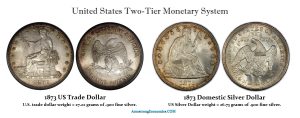
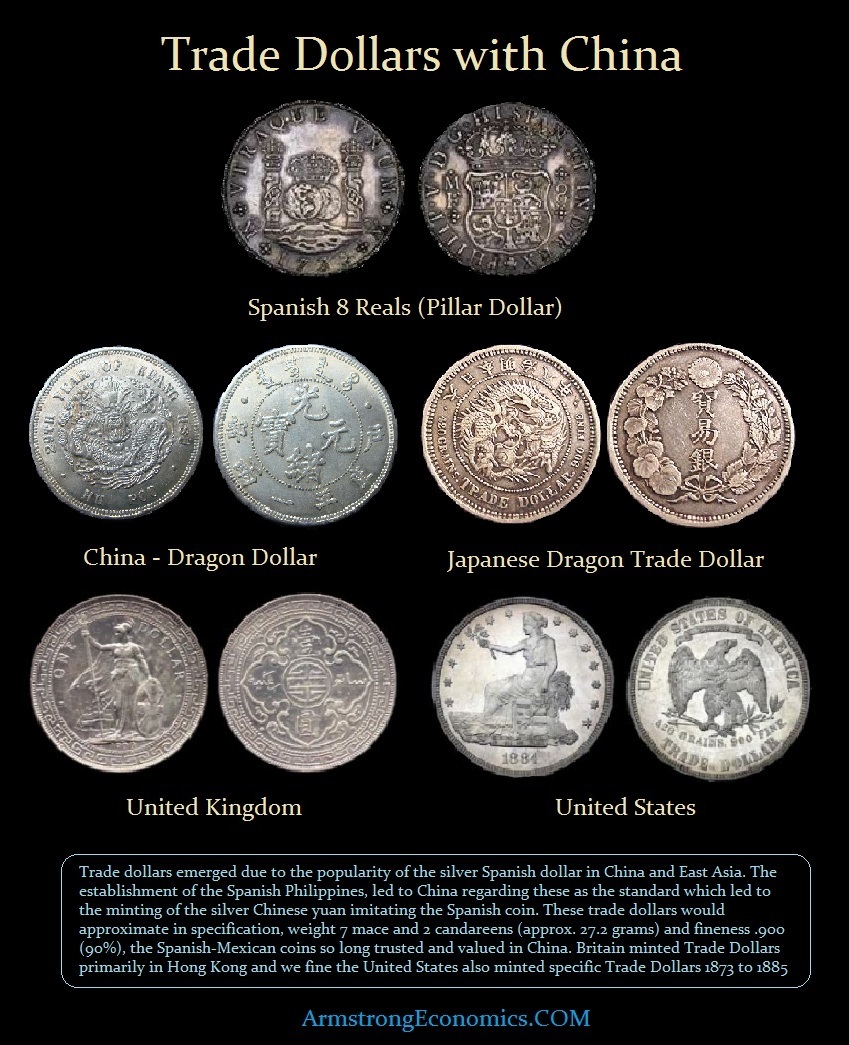
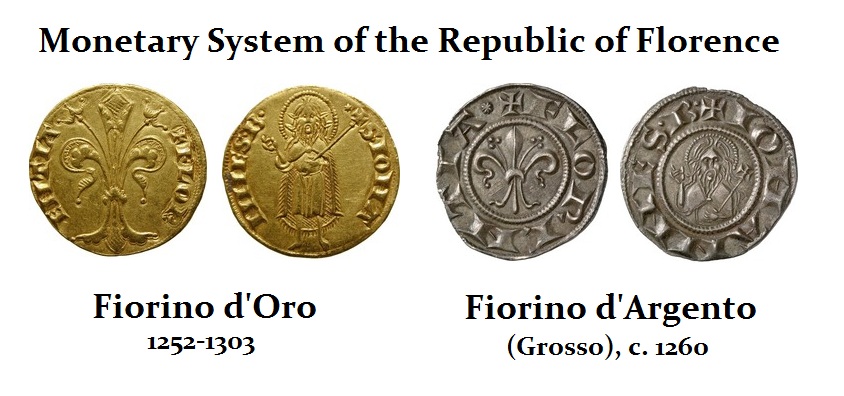
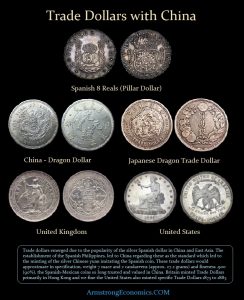
ANSWER: During the 19th century, it was common to issue a “trade dollar” with China who used the silver standard initially by using the Spanish 8 reals known also as pillar dollars. The US issued trade silver dollars and domestic silver dollars of different weight. All of these nations were issuing a two-tier currency to facilitate trade with China.
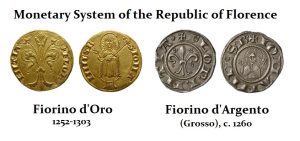
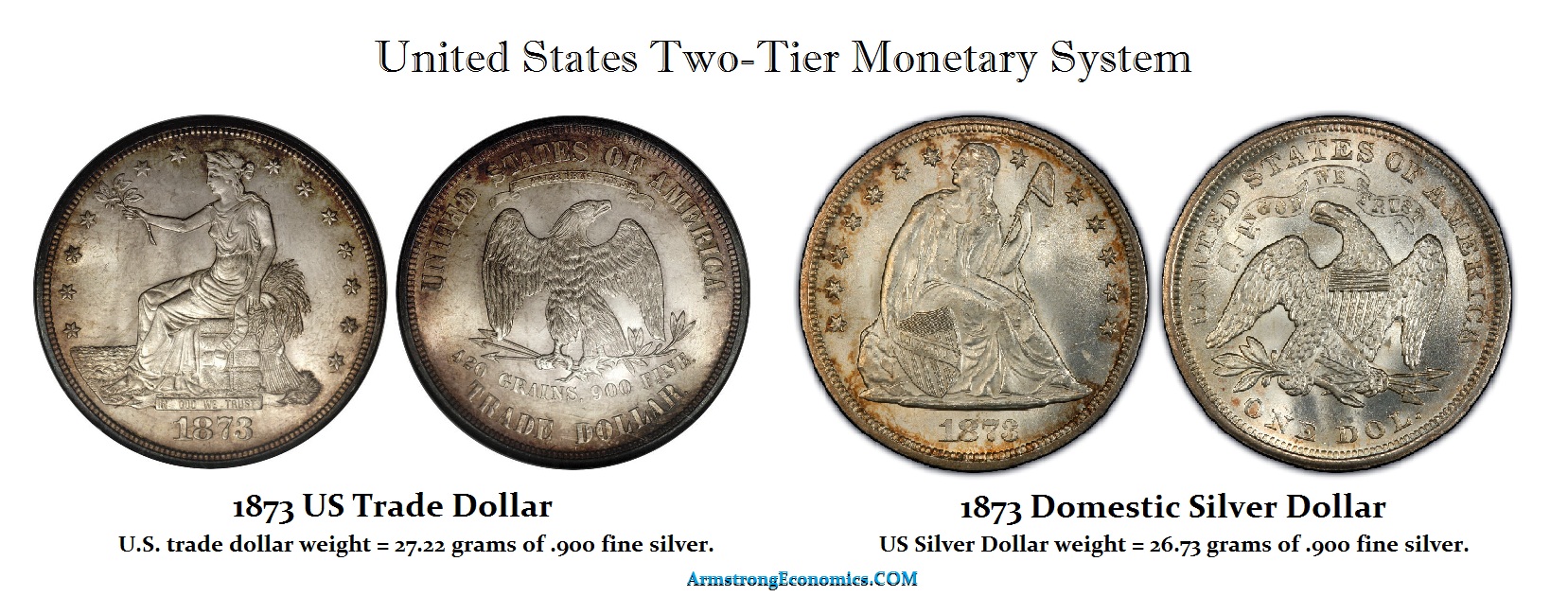
During the 14th century, there was also a two-tier monetary system. Florence used the gold florin for trade, but domestically, wages and commerce took place in silver. Companies were required to keep two sets of books by regulation.

A two-tier system can be used to isolate foreign capital inflows. Switzerland was suffering and that eventually broke the peg. The foreign capital was not looking to buy assets in Switzerland, they were just converting euro to Swiss and parking the money. Therefore, a two-tier system would have allowed the flow of capital to concentrate in what we would call the Financial Swiss Franc (FSF). This peg would have not been necessary and they could have even imposed negative interest rates or zero rates to deposits in the FSF. Any trade for produces could have then been delegated to the Swiss franc and the peg would not have been necessary.

We would not need a system where everyone had a two-tier currency and traded against each other. The new International Unit of Account (IUA) would be a basket of currencies and your local currency would then trade against that. You would need to allow contracts and debts to be contracted in this IUA freely, as takes place today in US dollars. This would by no means eliminate FOREX risk.

Insofar as a global SDR, the problem would be the calculation and then the IMF has been notorious for corruption. Would some nations put pressure to alter the formula because of a financial crisis?

I would say that the formula must be fixed and based on the total percentage of international trade a given nation wields. It should be subject to revision only once every 5 or 10 years at fixed terms.

The primary reason I would design the system in this manner is that the Federal Reserve has already become the central bank of the world. The Fed has lost the ability to manage its own economy because the IMF and others lobby it not to raise rates because that would adversely impact their currencies. There should be an IUA so that a central bank can manage its own economy without impacting others because they will be prohibited from issuing debt (public or private) in a foreign currency — only in an IUA. There would be no sovereign debt issued by the agency controlling the formula. The reserves of central banks would then be only in IUA terms.

Already, capital flows globally when it sees opportunity, and in this manner, it acts as an arbitrage tool. If real estate looks cheap in one country, the capital will flow in. Australia, New Zealand, and particularly Vancouver are fighting this trend. There will be a natural cycle to it and there is no need for changing laws to try to stop it. The Japanese were big buyers during the 1980s, even buying Rockefeller Plaza in New York. As their economy turned down, they resold it and exited.