Which Roman Emperor was Really “the Great”


QUESTION: Why Constantine the Great?

Mr Armstrong,

Of the 170 or so Roman emperors from 27BC to 476AD only one carries the title “the Great” and that is Constantine(r.306-337AD).
Would you have chosen another Roman emperor for this distinction in preference to Constantine?

JR

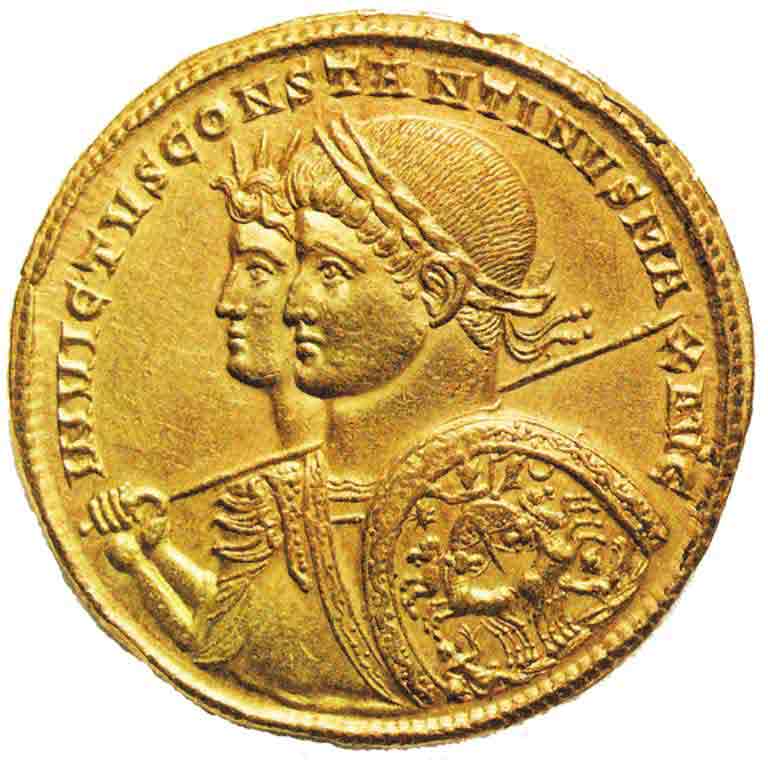
ANSWER: Constantine was given the title “the Great” because of his use of Christianity as his means to power. His mother Helena was a devout Christian. However, Constantine did not accept baptism until he was on his deathbed. He claimed that he had a vision where God showed him the sign of the cross and to put that on the shields of his army when they were outnumbered 2 to 1. It was a great tale. The truth was that the opposing army was mostly Christian and it was a great strategy. This gold medallion shows Constantine with the sun god Sol.

Constantine used Sol because he began to emerge as the supreme pagan god known as Sol Invictus (invincible sun which appeared every day). There was a tetrarchy set up by Diocletian (284-305 AD) where there were two emperors and two vice presidents, so to speak, named Caesars. Constantine used Sol and then Jesus Christ to justify his civil war in both instances by saying there was but one god above and there should be but one emperor on earth.

As far as who I would say was truly the best emperor, it would have been Marcus Aurelius (161-180 AD). You must understand that the title “the Great” or “Magnus” was often used for those who waged major wars and won. It did not mean that they did some magnanimous act. Pompey (106-38BC) was called “Magnus” for his victory in the civil war and not for his humanity. His success as a military commander in Sulla’s second civil war resulted in Sulla bestowing the cognomen Magnus, “the Great,” upon him.

Public Choice Theory: Why Government Often Fails


Published on Oct 9, 2017

Governments don’t work the way most people think they do. Public choice theory explores how voters, politicians, and bureaucrats actually make decisions. Prof. Antony Davies explains. SUBSCRIBE: http://bit.ly/2dUx6wg LEARN MORE: Behavioral Economics Ep. 5: What You Need to Know About Public Choice (video): Erika Davies and Prof. Antony Davies give an introduction to public choice economics and describe how insights on human behavior in the private sector can be applied to predict human behavior in the public sector. https://www.youtube.com/watch?v=FcLGU… Public Choice: Why Politicians Don’t Cut Spending (video): Prof. Ben Powell uses insights from public choice theory to explain why politicians, despite what they may promise to voters, rarely cut government spending. https://www.youtube.com/watch?v=6uR4l… Schools of Thought in Classical Liberalism, Part 3: Public Choice (video): Dr. Nigel Ashford gives a brief overview of the intellectual figures and ideas associated with public choice theory; part of a larger series on schools of thought in the classical liberal tradition. https://www.youtube.com/watch?v=ffJFN…


Introduction to bonds | Stocks and bonds | Finance & Capital Markets | Khan Academy


Published on Sep 28, 2013

What it means to buy a bond. Created by Sal Khan.


Economic Freedom of the World | Learn Liberty


Published on Sep 7, 2011

Do you prefer the world of Adam Smith or the world of Karl Marx? Prof. Robert Lawson tells the story of his numerous discussions about this very question with his friends in college. Even after years of theoretical discussion with his friends, a conclusion was never reached between them. Prof. Robert Lawson now works on the Economic Freedom of the World project, which is an empirical study that attempts to answer this same question. In order to do this, the study compares data related to economic freedom and quality of life. It finds that countries with institutions resembling those advocated by Adam Smith tend to provide the highest quality of life to its citizens. The latest edition of the Economic Freedom of the World report can be found here: http://www.freetheworld.com/release.html

BIS – The Central Bank of Central Banks


QUESTION: Could you please tell us more about the bank of the national banks (BIS) located in Swiss?
Many thanks for your information. I love to read your blog first thing in the morning!!!

JS

ANSWER: The Bank for International Settlements (BIS) was originally established to handle the reparation payments of Germany. It was also supposed to facilitate cooperation among the central banks. However, it had no real power to compel them to do anything, which was demonstrated by France who refused to agree with the other member concerning the reparation payments of Germany. The BIS was created in 1930 at the Hague Conference. A convention respecting the establishment of the BIS was signed between Belgium, France, Germany, Italy, Japan and the United Kingdom on the one hand, and Switzerland on the other. The BIS is owned by 60 central banks, representing countries from around the world that together account for about 95% of world GDP. It is the central bank for central banks.

The BIS does have a full range of traditional short-term instruments, denominated in reserve currencies. The BIS instruments allow customers to meet cash management objectives. They also provide tradeable instruments that are widely used by reserve managers seeking credit quality, which they will issue in major currencies along the yield curve. The paper is 1 to 5 years in maturity.


William Ackman: Everything You Need to Know About Finance and Investing in Under an Hour


Published on Nov 27, 2012

William Ackman: Everything You Need to Know About Finance and Investing in Under an Hour. WILLIAM ACKMAN, Activist Investor and Hedge-Fund Manager We all want to be financially stable and enjoy a well-funded retirement, and we don’t want to throw out our hard earned money on poor investments. But most of us don’t know the first thing about finance and investing. Acclaimed value investor William Ackman teaches you what it takes to finance and grow a successful business and how to make sound investments that will get you to a cash-comfy retirement. The Floating University Originally released September 2011. Additional Lectures: Michio Kaku: The Universe in a Nutshell http://www.youtube.com/watch?v=0NbBjN…

Introduction to the income statement | Stocks and bonds | Finance & Capital Markets | Khan Academy


Published on Aug 19, 2009

The income statement, revenue, gross profit, operating profit, net income, ROA and ROE. Created by Sal Khan. Watch the next lesson: https://www.khanacademy.org/economics… Missed the previous lesson? Watch here: https://www.khanacademy.org/economics… Finance and capital markets on Khan Academy: Life is full of people who will try to convince you that something is a good or bad idea by spouting technical jargon. Most of them have no idea what they are talking about. Don’t be one of those people or their victims when it comes to stocks. From P/E rations to EV/EBITDA, we’ve got your back! About Khan Academy: Khan Academy offers practice exercises, instructional videos, and a personalized learning dashboard that empower learners to study at their own pace in and outside of the classroom. We tackle math, science, computer programming, history, art history, economics, and more. Our math missions guide learners from kindergarten to calculus using state-of-the-art, adaptive technology that identifies strengths and learning gaps. We’ve also partnered with institutions like NASA, The Museum of Modern Art, The California Academy of Sciences, and MIT to offer specialized content. For free. For everyone. Forever. #YouCanLearnAnything

More on balance sheets and equity | Housing | Finance & Capital Markets | Khan Academy


Published on Mar 15, 2008

What happens to equity when the value of the assets increase or decrease? Created bySal Khan. Watch the next lesson: https://www.khanacademy.org/economics… Missed the previous lesson? Watch here: https://www.khanacademy.org/economics… Finance and capital markets on Khan Academy: This old and badly drawn tutorial covers a topic essential to anyone planning to not live in the woods — your personal balance sheet. Since homes are usually the biggest part of these personal balance sheets, we cover that too. About Khan Academy: Khan Academy offers practice exercises, instructional videos, and a personalized learning dashboard that empower learners to study at their own pace in and outside of the classroom. We tackle math, science, computer programming, history, art history, economics, and more. Our math missions guide learners from kindergarten to calculus using state-of-the-art, adaptive technology that identifies strengths and learning gaps. We’ve also partnered with institutions like NASA, The Museum of Modern Art, The California Academy of Sciences, and MIT to offer specialized content. For free. For everyone. Forever. #YouCanLearnAnything

When Will Interest Rates Rise?


QUESTION: In the recent past you have spoken about rising interest rates in the USA being imminent. Just wondering where we stand on that front as rates have been in a downtrend since peaking last fall?

Thanks,

Pete

ANSWER: The rise in interest rates comes with the turn in the ECM in January. However, what you have to understand is there will be a divergence between private and public rates. The central banks really cannot raise rates without creating a budget crisis. The more likely outcome is that governments are losing their ability to borrow in the real market. The public rates are more likely to become simply pegs that render them useless in all practical terms. We have already witnessed this in Europe. The central bank created negative interest rates. All they have done is to kill the viable domestic bond markets.

Millennials Saddled with Student Loans that Prevents them from Becoming Homeowners


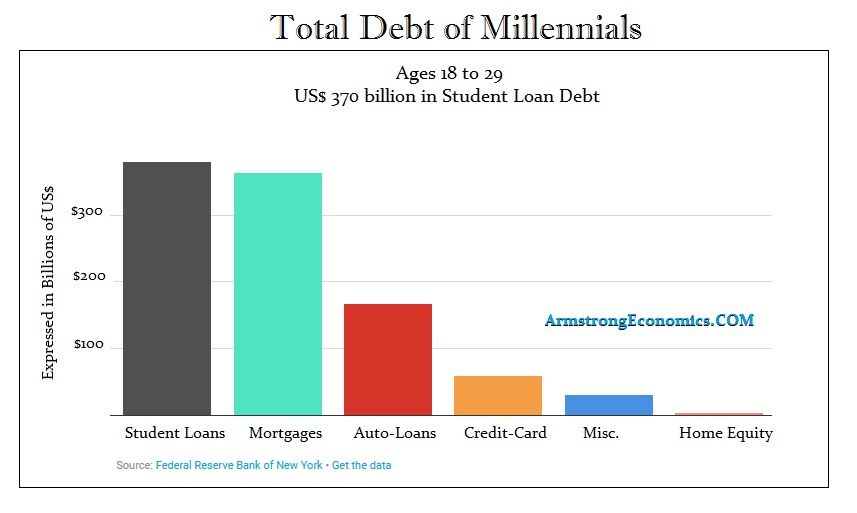
New findings are out from the New York Federal Reserve that reveal a troubling outlook for millennials who have now reached over US$1 trillion of debt, but the worst of it is student loans. This is a sharp rise of 22% over the past five years and is worse than any other generation in history. This debt crisis among millennials casts a dark cloud over the real estate market. With such high debt levels, this is a serious restraint upon obtaining home mortgages.

Ironically, millennials are much more conservative than the debt balances may indicate, but this could also be because of the student debt. In fact, in comparison to previous generations, this group is significantly more fiscally conservative with credit cards. Many into their 30’s are still living at home. With high student debt, many cannot afford a home, but another level cannot even afford an apartment. There is a new trend emerging whereby old motels are becoming housing. They lack the credit to rent an apartment with a security deposit. The new alternative is to rent per day in these old motels with rates of $50 to $80 per day.

This is not painting a very nice picture of the American Dream. To get the donations from the bankers, the Clintons served them up on a platter by making student loans non-dischargeable in bankruptcy. The Clintons signed into law economic fraud and slavery. These kids are paying for degrees and then cannot find a job in what degree they have studied.

Universities are notorious for handing out degrees for fields with no prospects of employment. So many went for degrees in Marine Biology wanting to help dolphins. The prospect of a job was never high on the list of probabilities. There are studies that show colleges are not providing jobs. They have turned higher education into just a business and buyer beware. In fact, the research has found that those jobs requiring a bachelor’s degree list more soft skills than technical skills among the set of requirements. On top of that, there is a trend of rising suicides due to student loans.

Student loan debt is now the second highest consumer debt category — second only to mortgages as a whole and higher than credit card debt. There are more than 44 million borrowers who collectively owe $1.5 trillion in student loan debt and growing. Even Zillow’s research, the big realtor, has reported that student debt has impacted the real estate market in many ways by reducing future buyers. The real shocking number is that 40% of millennials are still dependent on mom and dad. The excuses seem endless. Student loan debt can make buying a home IMPOSSIBLE! This is part of the reason real estate has been in a bear market since 2007 when we look at the average home.