T-Rex Visits South Korea: “”The policy of strategic patience has ended”…


Source: T-Rex Visits South Korea: “”The policy of strategic patience has ended”…

President Trump, VP Pence, Chancellor Merkel Attend Roundtable Business Discussion – Vocational Training…


Source: President Trump, VP Pence, Chancellor Merkel Attend Roundtable Business Discussion – Vocational Training…

RUSH: Trump Has Pulled Off An AMAZING Number Of Achievements Already


In Europe, Winners Are Losers & Left Is Right


Tyler Durden's picture

Authored by Raul Ilargi Meijer via The Automatic Earth blog,

The Dutch elections on Wednesday have provided a whole bunch of Orwellian narratives. PM Mark Rutte’s right wing VVD party, actually the ‘business’ -or should we say ‘rent-seekers’ in 2017- party, who lost some 20% of the seats they had obtained in the previous parliamentary election in November 2012, down from 41 to 33 seats, is declared the big winner. While Geert Wilders’ very right wing party, PVV, won 25% more seats -it went from 16 to 20- and is the big loser.

Moreover, Rutte’s coalition partner, labor PvdA, gave up 29 out of 38 seats to end up with just 9. That’s a loss of over 75%. Together, the coalition partners went from 79 seats in the 2012 election to 42 in 2017. That’s an almost 50% less. Not that it could prevent Rutte from proudly declaring: “We want to stick to the course we have – safe and stable and prosperous..” Makes you wonder who the ‘we’ are that he’s talking about.

That course he wants to stick to had a finance minister named Dijsselbloem, and his party just lost by over 75%. So he won’t be back. But perhaps the EU can pull another ‘Tusk’, and leave him in place in Brussels as chairman of the Eurogroup no matter what voters in his own country think of him. Still, declaring your intention to ‘stick to the course’ when your coalition has just been sawed in half, it’s quite something.

The only reasons Rutte’s VVD ended up being the biggest party all have to do with Wilders. The anxiety over the election all had to do with polls. Wilders is a one man party and a a one trick pony. If he would leave, his party would dissolve. And his sole ‘message’ is that Islam is bad and should vanish from first Holland and then Europe. He doesn’t really have any other political program points. Ok, there’s Brussels. Doesn’t like that either.

Perhaps that’s why he largely shunned the pre-election debates. Problem with that is, these things attract a lot of TV viewers, crucial free air-time. All in all, since he’s his own worst enemy in many respects, it’s not that much of a surprise that Wilders’ support collapsed, and that’s just if we were to take Dutch pollsters more serious than their counterparts in the US and UK.

Talking of which, according to Rutte, those are the countries where ‘the wrong kind of populism’ has won and delivered Trump and Brexit. And of course there are lots of people who agree with that. What either they, or Rutte himself, would label ‘the right kind of populism’ is unclear. Maybe Rutte himself is the right kind of populist?

The row with Turkey over the weekend must have helped Rutte quite a bit. Not only were his actions in the row met with approval by a large majority of the Dutch population, including just about all other party leaders, the Dutch also got to think about what WIlders would do in such a situation. And there can be no doubt that Rutte is seen as much more of a statesman than Wilders.

Not that the row is over. After Turkey announced yesterday it would return 40 Dutch cows (?!) , today Turkish Foreign Minister Cavusoglu said Europe’s politicians are “taking Europe toward an abyss”, and: “Soon religious wars will break out in Europe. That’s the way it’s going.” There can be no doubt that a shouting war like this with Wilders as one of the participants would take on a whole different shape, and a different choice of words.

What Rutte’s going to do next is form a new coalition, this time not with the left but with the center-right, and no-one will be able to tell the difference. If Dutch, and European, and global, politics have one main problem, it’s that. Left is right and right is left and winners are losers. If a guy like Dijsselbloem can squeeze Greek society dry in his capacity as Eurogroup head, while he runs as a leftist candidate in his own country, and loses hugely, anything goes.

All those who think they can see in the Dutch experience, a sign that Marine Le Pen’s chances in France’s presidential elections in April and May have dropped a lot, would appear to be delusional. Judging from reactions in the financial markets, many seem to be. But Le Pen is much less of a fringe figure than Wilders is, and she certainly wouldn’t shun a debate. It’s true that her Front National is a one-woman operation, bit she has a much clearer political program than Wilders does.

And she doesn’t have an opponent like Rutte, who’s become a formidable presence domestically, as anyone would be who can be PM for many years and not be put out by the curb. The man who should be Le Pen’s main adversary is not; Hollande is out by that curb and doesn’t even dare run again. His Socialist party has become a joke. The next strongest opponent should be François Fillon, but he’s all but gone now he’s been placed under formal investigation.

That leaves only Emmanual Macron, an independent without a party and without a program. In France, you can be elected president in such a situation, but your hand are tied in all sorts of ways, because you need parliament to vote for things.

..the nuances of the French political system put Macron in a spot of bother. The president derives their power from the support of a majority in the lower house of parliament, the National Assembly. Macron was a minister for the Socialist Party government but quit in 2016 to form his own political movement. Now he doesn’t even have a party, let alone a majority. Although the constitution of the French Fifth Republic, created by Charles De Gaulle in 1958, extended presidential powers, it did not enable the president to run the country.

There are only a few presidential powers that do not need the prime minister’s authorisation. The president can appoint a prime minister, dissolve the National Assembly, authorise a referendum and become a “temporary dictator” in exceptional circumstances imperilling the nation. They can also appoint three judges to the Constitutional Council and refer any law to this body. While all important tasks, this does not, by any stretch of the imagination, amount to running a country. The president can’t suggest laws, pass them through parliament and then implement them without the prime minister.

The role of a president is best defined as a “referee”. Presidential powers give the ability to oversee operations and act when the smooth running of institutions is impeded. So a president is able to step in if a grave situation arises or to unlock a standoff between the prime minister and parliament, such as by announcing a referendum on a disputed issue or by dismissing the National Assembly.

So, why does everyone see the president as the key figure? In a nutshell, it’s because the constitution has never been truly applied. There lies the devilish beauty of French politics. A country known since the 1789 revolution for its inability to foster strong majorities in parliament has succeeded, from 1962, in providing solid majorities.

Perhaps those who believe that what happened in Holland is also likely to happen in France are swayed by the notion that both are part of the EU. But they are very different countries and cultures, and different political systems. And Le Pen is no Wilders. She doesn’t say crazy things anymore, she’s cleansed the public image of her party by getting rid of her father, and she keeps any remaining extremists out of view.

There is still plenty suspicion in France about her, and about her party, but there are also a lot of people who agree with a lot of what she says. The perhaps most noteworthy statement she’s made recently is that she would step down if she loses the referendum about membership of the EU she intends to launch if elected president. That should keep Brussels on their toes. Marine means what she says. And a lot of French people may get to like her for that. In a political landscape in which the competition keeps shooting itself in the foot.

Another thing about Le Pen is that her political program contains quite a few bits and bolts that could be labeled leftist; a 35-hour work week, retirement at 60, lower energy prices. It’s just that she wants to reserve these things for the French. Foreigners, especially, Muslims, are not invited. And she is very much opposed to neo-liberalism and globalization:

They’ve made an ideology out of it. An economic globalism which rejects all limits, all regulation of globalization, and which consequently weakens the immune defences of the nation state, dispossessing it of its constituent elements: borders, national currency, the authority of its laws and management of the economy, thus enabling another globalism to be born and to grow: Islamist fundamentalism..

Le Pen’s popularity does not come from an overwhelming innate racism in France -though such a thing certainly exists-. It comes instead from the formidable failure that the country’s immigration policy has been for many decades. At the outskirts of major cities ghetto’s have been allowed to form in which those that come from former French colonies, especially in Africa, feel trapped with no way out. The French tend to feel superior to all other people, and the political system has let the situation slip completely out of hand.

Now France, and Europe is general, will have to deal with this mess. So far, the main European reaction is to turn Greece into a prison camp for a new wave of refugees and migrants. That can of course only make things worse. And it doesn’t solve any of the existing problems. Which makes the rise of Marine Le Pen inevitable.

And Wilders too; he’s the no. 2 party in Holland, because his party won 33% more seats than in 2012 to go from 15 to 20. That 33% gain, versus Rutte’s 20% loss, makes Wilders a loser in the eyes of many ‘relieved’ observers.

Winners are losers, and as is evident in Le Pen’s social policies for the French, in European coalition governments that contain Labor and right wing parties, and in the course of the Democratic party in the US, left is definitely the same as right.

Orwell always wins. Next problem: the actual left are not represented by anyone anymore.

Rising Rig Count Is Pushing OPEC To Breaking Point


Tyler Durden's picture

For the 9th straight week (and 35th of the last 37 weeks), the US oil rig count rose this week (surging by 14 to 631 – highest since September 2015).

The rig count continues to track the lagged WTI price


US Crude production has accelerated at a faster pace than the lagged rig count


And that is pushing OPEC to the breaking point:

  • *OPEC COMMITTEE SAID TO SEE COMPLIANCE WITH CUTS OF 106% IN FEB
  • *JOINT OPEC, NON-OPEC COMPLIANCE SEEN AT 94% IN FEB.: DELEGATES
  • *CUTS COMPLIANCE BY NON-OPEC ALONE SEEN AT 64% IN FEB.: DELEGATE

Who’s the sucker at that table?

As OilPrice.com’s Michael McDonald points out, the trend in the United States of accelerating oil production does not seem to be slowing down. Recent reports show that oil production from U.S. shale producers will increase in April, according to the Energy Information Administration. High market prices are currently being supported by OPEC cutbacks, and these higher profits are funding the growth of American drilling.

The release from the EIA predicts that net oil production will increase by 109,000 barrels per day in April. The seven major oil and gas basins that were included in the report will then have an output over nearly 5 million barrels per day collectively.

The monthly projections from the EIA have been climbing month after month since December. That month, 11 large oil exporting countries joined the supply cuts established by OPEC to control what they believed was an oversupplied market for crude oil.

In the United States, the main benefactors have been drillers at the Permian Basin, in Western Texas and southern New Mexico. The basin has been producing high volume since the end of 2016. The EIA expects the Permian drillers to see a gain of 70,000 barrels per day next month in their projections.

However, the Permian Basin is not the only United States site trying to capitalize on high prices. Drillers in southeast Texas, the Eagle Ford region, have also been ramping up production. Those drillers will amount for an increase 28,000 barrels per day in the EIA’s overall growth projections. Prior growth expectations for Eagle Ford producers was half on that number, at an increase of 14,000 barrels per day; the growth is not only steady, but is accelerating.

The EIA report for next month also shows a decline at several U.S. drilling sites. Take, for instance, the Niobrara region of Colorado and the Bakken Shale production in North Dakota. Both will experience declines of 11,000 barrels per day, and 10,000 barrels per day respectively.

The supply increases by the U.S. have capped any gains to be seen for OPEC nations from their cutbacks. This has been keeping crude futures within a tight range. On Monday, March 13th, U.S. crude ended at $48.40, a price that hasn’t been seen since before OPEC announced their cutbacks in December 2016.

These recent developments have led analysts to believe OPEC’s cutback policy is fated to end in the near future. It is clear that the United States has a sustainable means to regulate prices in the global oil market. Furthermore, the dynamics of U.S. outputs indicate that the country will not have any desire to participate in the cutbacks; U.S. law prohibits any such price controls. The United States will continue to threaten any gains to be had by OPEC.  

Saudi Arabia has been the leader in the cutbacks thus far, compensating for Russia’s hesitation with withholding supply. Historically, the kingdom has refused to participate in such cuts. However, under the tutelage of new oil minister Khalid al-Falih, they have exceeded their cuts far beyond the original OPEC deal. However, without total compliance, markets will remain unstable – regardless of how much the Saudis holdback.

These factors combined have led analysts to believe the OPEC deal will be forced to end, if only to end the profitability to U.S. growth and production.

Dollar Drops As Consumer Inflation Expectations Crash To Record Lows


Tyler Durden's picture

Having warned in November 2015 of a “deflationary mindset”, University of Michigan survey director Richard Curtin notes that things have done nothing but get worse.

While reflation trades run amok in capital markets, real people’s expectations of inflation in the medium-term has collapsed to its lowest on record…


In the latest massive setback for the Federal Reserve, which is desperate to break the recent “deflationary mindset” to have gripped the US population (see Japan for the results), long term inflation expectations declined to the lowest level since 1980: an annual rate of 2.2% was expected in the next five years, down from 2.5% last month and 2.3% in December. Just 6% expected long term deflation. These lows were supported by the fewest complaints of rising prices eroding their living standards—just 6%, the lowest since 2002 and barely above the all-time low of 4%.

Sponsored By Legg Mason

Need A Strategy For Income? Find Out About The Three Rs of Dividends

ClearBridge Dividend Strategy Portfolios target total return, risk management and dividend potential. Discover the strength of Legg Mason – A Leader In Separately Managed Accounts.

And this is weighing on the dollar…


The Dollar Index is very close it slowest since the election – seemingly erasing the hope of reflation and exuberance.

President Trump Delivers His Fiscal Year 2018 Budget Outline – (Full pdf included)…


Source: President Trump Delivers His Fiscal Year 2018 Budget Outline – (Full pdf included)…

Trump – Dollar & Why He Will Fail


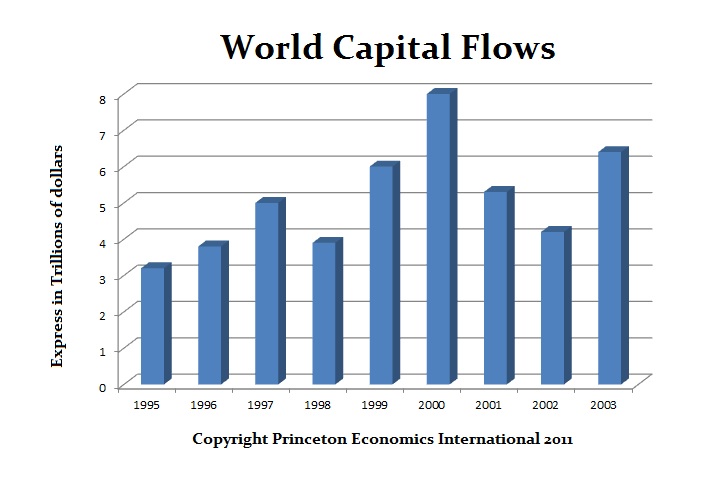
World-Capital-Flows-1995-2003

QUESTION: Hi Martin, How is the dollar supposed to continue to rise when Trump and all of his cabinet members want a weaker dollar? They constantly blame others with currency manipulation, all the while they are in fact manipulating the dollar lower with their comments. Hello pot, meet kettle!!! The last 2 Fridays the dollar has sold off drastically wiping out the entire week gains even on positive US market news. When will the dollar index start to breakout again?

ANSWER: Nobody can manipulate the currency market forcing it to change trend. Trump will fail because he cannot manipulate the dollar down when the FX market’s $5.3 trillion per day in trading volume dwarfs the equities and futures markets. Yes, the Treasury has less than $150 billion in its bad to try to manipulate the currency. Good luck. Trump is wrong about China manipulating its currency. You see China going after Bitcoin trying desperately to prevent capital flight. There is nothing Trump can do to prevent the rise in the dollar when you have Europe on life-support as is the case in Japan, and China keeps trying to stop its citizens from putting money offshore.

Even banning all the government together cannot reverse the global capital flows. If the economics of Europe are in crisis and election after election seeks to exit the EU, there is far more at stake than just politics. We are looking at a crisis in European banking as their reserves are made of of Euro members. The ECB hold 40% of member states bonds. A breakup of the Eurozone holds far more chaos than anything you have read about Europe – AND THAT IS AN UNDERSTATEMENT.

We are preparing an institutional risk report on this subject, and it is massively under-reported and not even comprehended. Trump will fail because he and his team lack the scope of international understanding. If we look only at trade, the share of manufactures in world merchandise trade fluctuated in the range of 55-60% between 1973 and 1985, then increased sharply, reaching 75% by 1995. One might expect total recorded world trade, exports plus imports, over all countries to equal financial flows payments plus receipts. But in fact, during 1996–2001, the former was $17.3 trillion, more than three times the latter, at $5.0 trillion. The problem is our accounting system for trade. To reduce the trade surplus Japan had with the USA during the 1990s, we instructed our clients to buy gold on the COMEX and take delivery. The golds was thus exported and resold again into London. The trade surplus was reduced for there is no distinction between a manufactured product and raw commodities.

Likewise, most financial capital flows are not recorded at all. Financial transactions between international financial institutions are cleared by netting daily offsetting transactions. Hence, U.S. banks have claims on Japanese banks for $10 billion and Japanese banks have claims on U.S. banks for $12 billion. Therefore, the net flow recorded in the transactions will be cleared through their central banks with only $2 million from the United States to Japan. Then if the purchase of the good in the USA by Japan are financed, the goods may travel but no money moves between the countries. Since the collapse of Bretton Woods, the introduction of the floating exchange rate system has rendered the global capital flows gibberish from a formal accounting standard since the value of the dollar rises and falls making comparisons impossible using a system that was designed with a fixed exchange rate system in mind. Since the 1970s, this has resulted in a sustained and unexplained balance-of-payments discrepancies in both trade and financial flows.The unrecorded capital flows in netting out positions distorts the real picture. We have to obtain raw data to overcome these problems and then run it through the filter of floating exchange rates to come up with any hope of understanding capital flows

Largest New Discovery of Oil in USA Puts USA in Top Ten


Oil Platform

Another major discovery of oil has been made in Alaska of 1.2 billion barrels. It is the largest find of conventional oil for 30 years on US territory. The discovery was made by the Spanish oil company Repsol on Thursday with its US partner Armstrong Energy. According to a report from the company, the production potential is up to 120,000 barrels of oil per day, and production is scheduled to start in four years. This will probably increase the US standing to overtake Nigeria entering the list of top ten.

Rank Country Barrels (bbl)
1 Venezuela 298,400,000,000
2 Saudi Arabia 268,300,000,000
3 Canada 171,000,000,000
4 Iran 157,800,000,000
5 Iraq 144,200,000,000
6 Kuwait 104,000,000,000
7 Russia 103,200,000,000
8 United Arab Emirates 97,800,000,000
9 Libya 48,360,000,000
10 Nigeria 37,070,000,000
11 United States 36,520,000,000
12 Kazakhstan 30,000,000,000
13 Qatar 25,240,000,000
14 China 24,650,000,000
15 Brazil 15,310,000,000
16 Algeria 12,200,000,000
17 Mexico 9,812,000,000
18 Angola 9,011,000,000
19 Ecuador 8,832,000,000
20 Azerbaijan 7,000,000,000

The Fed Raises Interest Rates & Markets Rally!


CNBUSA-M 3-15-2017

The stock market, gold, silver, and oil all rallied when the Federal Reserve delivered the widely expected increase in its benchmark interest rate on Wednesday, the Ides of March. It said that the domestic economy remained on a path of slow and steady growth. In a statement the Fed said that the United States economy continued to move along expanding at a “moderate pace.” The consumers were spending with businesses and employers were still hiring.

The Fed also noted a recent increase in inflation after a long period of sideways movement. Prices are now rising at roughly the 2% on an annual pace that the Fed regards as optimal, however, picking up the rug reveals that healthcare costs are acting more like oil did during the 1970s. This raises concern that we may be entering really stagflation and not true inflation driven by expanding demand. The Fed now said its focus would be stabilizing inflation. They really need to look closely at the driving forces. As more and more states move into crisis like California, we will see rising taxation to cover the crisis in pensions. This will feed stagflation – and prevent rising inflation from demand.

The Fed’s forecasts have moved in the direction of tightening, and despite what they say publicly, the most serious stimulus is rising stock prices. There was one vote against the rate hike, Neel Kashkari, president of the Federal Reserve Bank of Minneapolis, who said that the Fed’s statement did not provide a reason for Mr. Kashkari’s vote. However, this is because the real reason behind the rate hike has been the rise in the stock market.

CBDFOR-Y

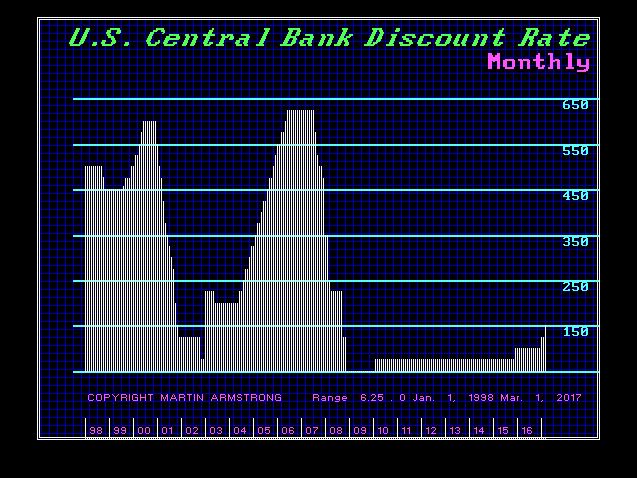
The computer forecast back in 2011 showed that the trend would change in 2015. Indeed, the first rate hike came that December. The next target was 2017 and we have seen the rates continue to rise. The next key target will be 2019.

CBDFOR-Y 3-15-2017

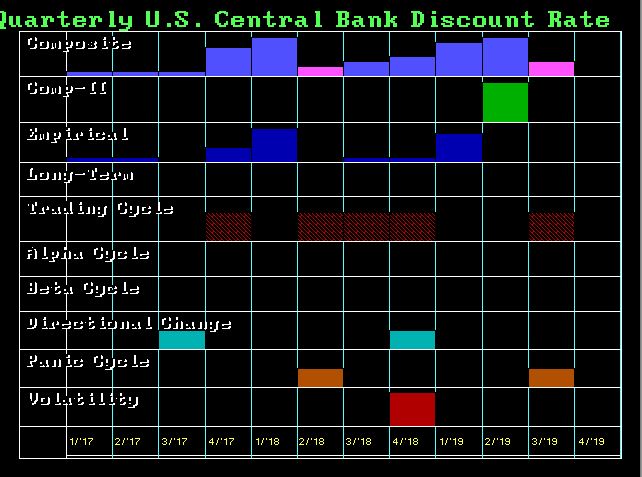
Here is the current Yearly Array. We still see 2019 as a major target objective. Note the Directional Changes either side and higher volatility should begin to appear starting next year.

CBDFOR-Q 3-15-2017

Honing in with the quarterly level, it appears we should be looking at the 1st quarter 2018 as the main target. Note the Directional Change coming the 3rd quarter here in 2017.

CBDFOR-M 3-15-2017

CBDUSA-Q 3-15-2017

We see the resistance standing at 2.25%. So we have a full 1% above the current level to rise before one must consider the crisis in interest rates begins. Keep in mind that low interest rates helps government but kills pensions. Higher rates will help ease the Pension Crisis but create a budget crisis.