Gold & The Hedge Against Government


QUESTION: Hi Martin,

You have mentioned repeatedly that gold is a hedge against political uncertainty. For the past several years the price has hovered at the cost of production and exploration is virtually non-existent as capital has dried up.

Nevertheless, the world is a political mess as far as the eye can see. So, it seems odd that gold is not bid more aggressively.

Regards,

Eric

ANSWER: The only time gold has rallied significantly is when the CONFIDENCE in government declines. That was the case during the post-1976 era for people saw inflation as running away. That was because of OPEC creating STAGFLATION meaning it was cost-push inflation that eventually converted to demand-push inflation by mid-1979. I understand that all of these gold-bug analysts have been preaching hyperinflation for decades. The whole Quantitative Easing (QE) was supposed to create $10,000 gold years ago. Here, after 10 years of QE, gold remains trapped in a consolidation.
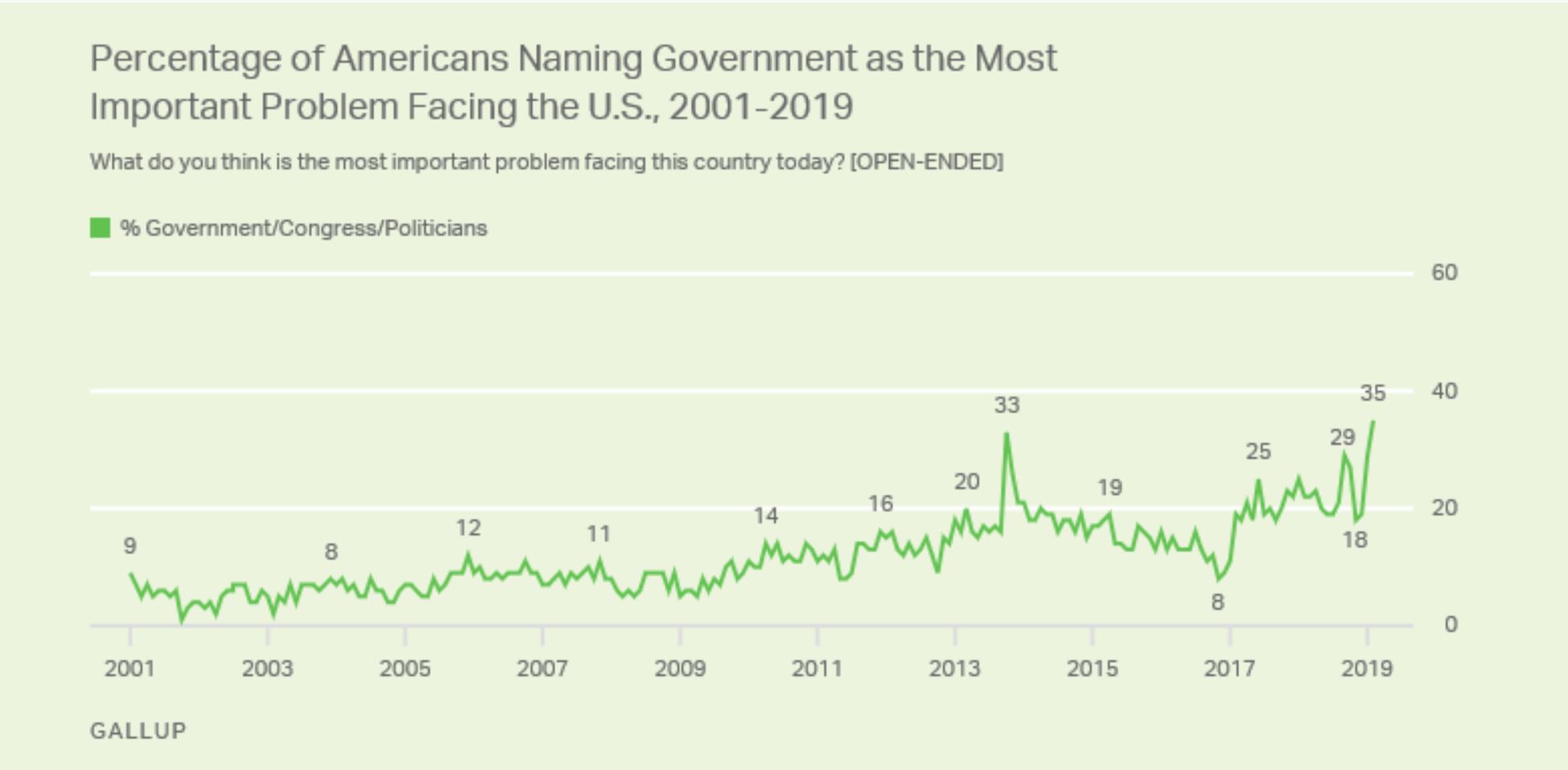
Gold will be the hedge against political uncertainty and government ONLY when the people reach that critical point of losing faith in government. We are at the 35% level where people believe the government is the number one problem. When that crosses the 45% mark, things will start to become different. This has nothing to do with the quantity of money. Most millennials use their phones to buy things or credit cards – not cash. The idea of gold as a store of value has faded between generations. The worst thing you could do is judge the world by what you believe. Everyone will act only on their own reasoning and belief system.
Calgary Vacancy Rate Still near Record Highs – Sorry, Calgary is closing


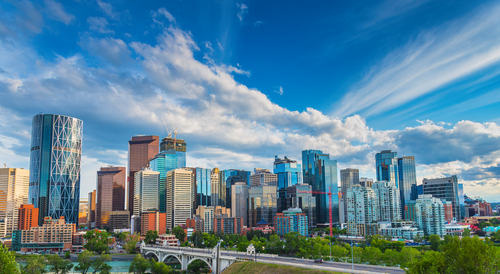
The environmentalists have really gutted Alberta which was an economy based upon commodities. With that industry under assault, the economy has been decline. According to the quarterly report released April 1st 2019, Calgary’s downtown vacancy rate is currently at 26.5%, the highest in Canada. Although it decreased slightly from its peak at 27.8% in the second quarter of 2018, it still exceeds the vacancy rate from the economic crisis in the 1980’s which stood at 22%. And although this has been in the 20% range for a few years now, it shows no sign of stopping soon.

With a loss in tax revenues from the downtown core, rising property taxes have shifted onto the shoulders of small businesses. Property taxes for small businesses have increased considerably from 2017 to 2018 and small  business owners were told the bill for 2019 will be even higher. Some businesses have had their property taxes increase by over 400% when they received their assessment, with the first substantial increase due July 1st 2019.

Alberta’s businesses have weathered numerous fiscal storms recently; the recession due to the fall in the price of oil and decreasing property values, the introduction of carbon tax on Jan 1, 2017 with a further increase on Jan 1, 2018 and the spike in minimum wage from $10.20 to $15.00 on Oct 1 2018, but the new property tax increase takes the cake and the already thin margins of struggling businesses will be wiped out completely. Many have reached out through social media and are connecting through a Facebook page called “Sorry, Calgary is closing.”

An emergency council meeting will be taking place Monday June 10th to try to patch things up but the council of Calgary won’t be the only ones there; a massive rally will be taking place before City Hall at 7:30am in protest. Petitions are also circulating as many are calling for the province to step in immediately and remove Calgary’s council members, including Mayor Nenshi himself.

What they don’t seem to realize, is if you raise taxes enough, there won’t be any incentive to work. People will instead be driven away and go where the prospects are more opportunistic for them. Like in Vancouver where the price of gas was at an all-record high last month ($1.789 per litre or $6.772 per gallon CAD) and many drove across the border to Washington State to fill up not only their vehicle, but multiple jerrycans as well. People will
always migrate away from where the prices and taxes are outrageous and Calgary is no different

How the Rich Make Their Money


QUESTION:

Good Sir,

When you say the ‘rich get rich by investments, not wages’ you fail to identify the following wealthy class.
CEO’s of corporations, ‘Hollywood’ movie stars, Sports athletes, Recording artists, etc.

Regards and continued success,

An avid follower

LB

ANSWER: There are always exceptions, but those who receive big bonuses or high wages such as sports and movie stars are a tiny fraction of what they call the “rich.” The “rich” are defined as households with income in excess of $250,000. The “rich” who have built wealth from creating businesses and investment are really 99% of that class. The movie stars and sports figures are paid salaries based upon their draw. Many others in Hollywood get base salaries and a percentage of the box office take. The CEOs get bonuses based upon performance.

The government takes Social Security and places restrictions whereby it can only invest in government bonds. This deprives the average person from making appreciable capital gains.

Behavioral Economics: Full Series


Published on Sep 11, 2017

Behavioral economics helps you understand dating, partying, college loans, voter ignorance, and all the choices humans make. Here’s our full series. SUBSCRIBE: http://bit.ly/2dUx6wg


Debate: Is There Too Much Inequality in America? | Learn Liberty


Published on Mar 8, 2013

Wealth inequality is real, but is it fair? The distribution of wealth in America is lopsided in the favor of the 1% – a point made by the video “Wealth Inequality in America.” This inequality is intuitively and philosophically unfair to many people, but what happens when we examine the roots of our motivation? How can society BEST help the poorest? How can individuals BEST provide better lives for themselves – and their loves ones? Can our BEST laws also be our FAIREST? A fair society is a challenge to the status quo. Learn Liberty asked two professors — a libertarian (Professor Steve Horwitz), and an opposing philosopher (Professor Jeffrey Reiman) — to answer questions about wealth, fairness, inequality, and the United States. This is their debate.

There’s No Such Thing As An Unregulated Market


Published on Nov 16, 2017

We all want the safety and dependable quality that “regulation” is supposed to provide. Government can provide it to some extent, but markets can do it better, if we let them. Howard Baetjer of Towson University explains.


What If There Were No Prices? The Railroad Thought Experiment


Published on Nov 5, 2015

What if there were no prices? How would you use available resources? To appreciate why market prices are essential to human well-being, consider what a fix we would be in without them. Suppose you were the commissar of railroads in the old Soviet Union. Markets and prices have been banished. You and your comrades. Passionate communists all. Now, directly plan how to use available resources. You want a railroad from city A to city B, but between the cities is a mountain range. Suppose somehow you know that the railroad once built. Will serve the nation equally well. Whether it goes through the mountains or around. If you build through the mountains, you’ll use much less steel for the tracks. Because that route is shorter. But you’ll use a great deal of engineering to design the trestles and tunnels needed to cross the rough terrain. That matters because engineering is also needed to design irrigation systems, mines, harbor installations and other structures. And you don’t want to tie up engineering on your railroad if it would be more valuable designing those other structures instead. You can save engineering for other projects. If you build around the mountains on level ground. But that way you’ll use much more steel rail to go the longer distance and steel is also needed for other purposes. For vehicles, girders, ships, pots and pans and thousands of other things. Which route should you choose for the good of the nation? To answer, you would need to determine which bundle of resources is less urgently needed for other purposes. The large amount of engineering and small amount of steel for the route through the mountains, where the small amount of engineering and large amount of steel for the roundabout route. But how could you find out the urgency of need for engineering and steel in other uses? Find out more as Professor Howard Baetjer Jr. from Towson University explains market prices through the railroad thought experiment.

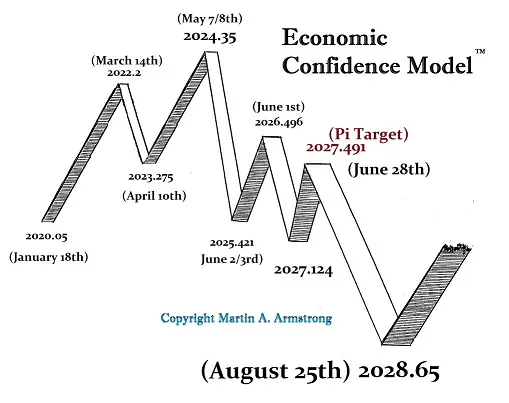
The Next Cycle in the ECM Beginning January 2020


QUESTION:

Martin,

I am a huge fan of yours and have followed your blog for probably 8 years now, I watched your many predictions using the AI models and have been amazed by their accuracy. I am a very concerned small investor and with this big shift coming in the ECM in January 2020 am wondering where you think I should be invested… Gold, the DOW, real estate, cash? I have bought far out of the money Jan 2021 GLD options which are extremely cheap right now. How do you best recommend your fans to position themselves for the coming storm?

Hopefully I will be able to make your next conference.

All the best.

Sincerely

RW

ANSWER: It is still too early to make a reliable forecast just yet. But generally, the next wave of the ECM business cycle should be an inflationary one. It certainly appears that all of this Quantitative Easing has caused tremendous damage and has now trapped the central banks to the point that the biggest debtor is the government. They have tried to use interest rates under Keynesian economics to manipulate “demand,” which is used to force us to borrow or stop borrowing. But all of these manipulations have no impact on preventing government borrowing. The danger now is that after 10 years of QE, governments are addicted to low interest rates and raising them this time will blow up the government budgets. They will respond by raising taxes to try to keep the ball rolling, but that will result in civil unrest and deflation

Could the Great Depression Have Been Prevented?


QUESTION:

Dear Martin,

I appreciate all you share. I watched a series on the Great Depression and they talk about how socialism saved capitalism. If true, is this part of a healthy cycle between the two? Could anything have been done to prevent the Great Depression?

Thank you!

LB

DJ3242-m Warren


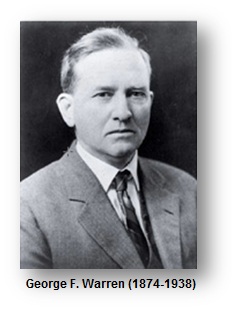
ANSWER: It was not socialism that saved capitalism, it was a shift in the understanding of money itself. George Warren convinced Roosevelt to devalue the dollar and end AUSTERITY, as Germany imposes on Europe today, which reversed the economy.

The Dust Bowl was the primary cause of the rise in unemployment to 25%. In 1900, 41% of the civil workforce was in agriculture. The invention of the combustion engine began to displace jobs as the internet has done recently. Tractors replaced workers in fields, so there was a huge transition in the labor force. Then the Dust Bowl took place and that created the hobos.

There was nothing the government could have done to prevent the Great Depression. The best that one can hope for is to understand the business cycle and prepare for the downturns. In that manner, it becomes more like Joseph warning the Pharaoh of 7 years of plenty to be followed by 7 years of drought. If we accept that the business cycle is complex and not a single source that can be controlled, then we will live with the cycle and understand it.

FDR’s programs came in 1935. The economy had already bottomed and turned up from July 1932. I find the argument that socialism saved capitalism as self-serving for the socialists, but the timeline does not agree

Trump v Federal Reserve – Why?


QUESTION: Good afternoon Martin,

Do you gander that President Trump is aware that a higher dollar will cream the economy and is doing all he can to fight that trend?

Maybe he is reading AE but like other politicians still thinks he can manipulate the economy?

Trump is battling the Fed over interest rates. What does it mean for your money?

MDC

ANSWER: Trump does realize that there has been a flight to the dollar. I believe his bashing the Fed to lower rates is inspired by the hope of keeping a lower dollar for trade. I do not believe higher rates are on his radar with respect to the markets. He is probably seeing briefings of the rise in rates and what is taking place with the national debt.

As far as what does it means for your money: the trend from public debt to private will be accelerated by this trend. I believe that the Fed will try pegging rates with caps rather than engaging in QE as Europe has don