This report out of South Korea, while not confirmed, makes sense. Earlier today President Trump announced Secretary of State Mike Pompeo was en route to North Korea to finalized details for upcoming summit. Secretary Pompeo tweeted he was going to DPRK “at the invitation of N-Korean leadership.”
It makes sense, as an advanced gesture of goodwill ahead of the summit, for Kim Jong-un to release the U.S. captives.
SEOUL, May 9 (Yonhap) — North Korea is expected to release three U.S. citizens held in the communist state on Wednesday, an official from Seoul’s presidential office Cheong Wa Dae said, in an apparent goodwill gesture ahead of a historic meeting between its leader Kim Jong-un and U.S. President Donald Trump.
The official said U.S. Secretary of State Mike Pompeo was expected to return with the exact time of the Trump-Kim summit, along with the three U.S. captives in North Korea. “We expect him to bring the date, time and the captives,” the official said, while speaking on condition of anonymity. (more)
(left to right) Kim Dong Chul, Kim Sang Duk, Kim Hak Soon
Kim Dong Chul, Kim Sang Duk, Kim Hak Soon are the names of the three hostages being released. Two of the captives, Hak-Soon and Sang Duk, belong to the Pyongyang Univ of Science & Technology and were taken in in Apr & May 2017: they’ve been held for a year. The third, Kim Dong Chul, is an ordained minister taken in 2015 when he was commuting to Rason from China and and has been serving a 10-year sentence on espionage charges.
U.S. Secretary of State Mike Pompeo specifically requested their release while visiting Pyongyang on Easter weekend. The three are US citizens with Korean heritage. National Security Adviser John Bolton said on Fox News Sunday that North Korea could show its sincerity by releasing US hostages prior to the summit.
In March of this year Sweden was initially playing a large role and helping negotiate the terms of the North-South Korea summit as well as the release of three Americans held captive in North Korea.
“We believe that Mr. Trump can take them back on the day of the U.S.-North Korea summit, or he can send an envoy to take them back to the U.S. before the summit,” said Choi Sung-ryong, an activist pursuing release of North Korea’s political prisoners.
There are key mid-term primary races taking place today in multiple states. Some of the primary challenges and outcomes could potentially have larger ramifications for the November mid-terms.
In Ohio the race for governor and Senate is interesting. The former Obama ideologue from within the Consumer Financial Protection Bureau (CFPB), Democrat Richard Cordray, is up against outsider Dennis Kuchinich for the Democrat governors race. Additionally, there are multiple Republican candidates hoping to win their party position for a Senate challenge to incumbent Senator Sherrod Brown. Also, a bright young Republican candidate, Christina Hagen, is seeking a congressional seat in the Ohio 16th district.
Indiana has a closely watched Senate race. In a state where Donald Trump beat Hillary Clinton by 19 points in 2016, two GOP representatives, Todd Rokita and Luke Messer, and State Rep. Mike Braun will battle it out to determine who takes on Democrat Sen. Joe Donnelly, considered one of the most vulnerable Democrats up for re-election this year.
Then in West Virginia there’s a very visible Republican primary contest to determine who will square off against Democrat Senator Joe Manchin. Trump beat Clinton by over 40 points in West Virginia and the GOP primary is a toss-up. Rep. Evan Jenkins battling Attorney General Patrick Morrisey and outsider Don Blankenship, former CEO of Massey Energy Co. This race is being widely watched.
NAFTA is at a critical stage. Mexico has committed themselves to a full-court press this week in an effort to retain the investment influx from multinational corporations. To retain their advantage, Mexico needs to keep the NAFTA loophole allowing Asia and EU to use Mexico and Canada as back-doors to the U.S. market.
Additionally, AM-LO, a self-described soft-Marxist (similar to Hugo Chavez) is likely to win the July 1st Mexican election. Yesterday, Mexican Foreign Secretary Luis Videgaray travels down the street to the State Department for a meeting with Secretary Pompeo. From the U.S. perspective, anything from Secretary Videgaray is essentially moot at this point; the Mexican government is moving toward a more socialistic economic model.
[Transcript] SECRETARY POMPEO: Good afternoon. Today it is my pleasure and a great honor to welcome the Mexican Foreign Secretary Luis Videgaray to the State Department. Welcome.
We had a great discussion and we had so because Mexico is one of the United States’ closest partners. Together we are working to build a more secure, prosperous, and democratic hemisphere. We are neighbors, allies, and friends.
The conversation, as I said, was forthright. We talked about a range of issues. In particular, we spoke of four vital areas in which we work with Mexico every day: trade; management of our shared border; security; and the shared regional and global priorities of our two countries.
First, it comes as a surprise to no one that our economic interests are deeply intertwined. Mexico is our second largest export market, third largest trading partner. The importance of modernizing NAFTA cannot be overstated, and we will continue to work towards an agreement with Mexico and with Canada.
Second, we manage a couple-thousand-mile border. Every day more than $1.7 billion in trade crosses that border back and forth, supporting thousands of jobs on both sides of that border. We seek to improve efficiency at our ports of entry to support the legitimate flow of commerce between our two countries.
Third, we work together to enhance our shared security by disrupting transnational criminal organizations. We recognize the demand of – for drugs is principally on the American side of the border, and that this problem is destroying communities and tearing families apart. That is why the President has renewed efforts to prevent and treat addiction here at home and to combat the flow of drugs coming into our country from abroad.
Our security is linked to one another’s. It will take our shared resources and commitment to disrupt criminal groups that illegally traffic drugs, weapons, and human beings. Continued cooperation under the Merida Initiative advances our mutual security objectives. We’ve made some progress through the U.S.-Mexico Strategic Dialogue to disrupt these transnational criminal organizations. We should be proud of that. This will continue to be a priority for the administration.
Fourth, and finally, we work together with Mexico on regional and global challenges. For example, we are working with our partners in Honduras, Guatemala, and El Salvador to reduce insecurity and violence, enhance economic opportunity, and fight corruption. These shared efforts address the underlying conditions driving illegal immigration. We also cooperate with Mexico to build regional consensus on the crisis in Venezuela. Thank you for your leadership, Secretary, on this issue in particular. I echo the message of Vice President Pence from earlier today at the OAS meeting: We urge our entire hemisphere to impose strict accountability on the corrupt and brutal Maduro regime.
We are always looking for new ways to deepen our partnership with Mexico. Today, good news: the signing of the U.S.-Mexico Civil Nuclear Cooperation Agreement further expands our relationship and will benefit the North American and U.S. suppliers in the nuclear energy industry.
Again, Foreign Secretary, I want to thank you for coming here today to discuss the many pressing issues facing our two countries. I’m deeply appreciative of having my first press conference here at the State Department with you. Thank you, Foreign Minister.
FOREIGN SECRETARY VIDEGARAY: Thank you very much, Secretary. Although I’ll be speaking in Spanish in a moment, I just want to say that I am very, very proud and very honored to have this first conversation with you as Secretary of State, because we’ve met before, but not in your role as Secretary of State, so I am very, very, very honored. And we had, as you said, a very productive, very frank first conversation as such. Let me switch to Spanish.
(Via interpreter) Since the beginning of the administration of President Trump, the Mexican Government, the government of President Pena Nieto, has promoted and offered an institutional relationship of mutual benefit and mutual respect. We acknowledge that we share threats, that we have opportunities that we can take advantage of together; and we also need to say we also have some differences, some of which are public and well known, but we cannot allow those differences to define this relationship. We need to be able to work for the interest of two neighboring countries and two neighboring peoples who are brothers so as to overcome our differences. Mexico, Mr. Secretary Pompeo, is a large country, a proud country, proud of its history, enthused about its future, and we are a sovereign state. And as a sovereign state, we offer the United States our friendship, the will to work together on the issues that join us to do good things – good things for the people of the United States and of course for the people of Mexico.
The relationship between Mexico and the United States finds itself at a turning point of the decisions made between our governments in the next few months, even in the next few days. Well, this will determine the relationship between our two countries for the next years and even the next few decades.
We find ourselves at that crucial moment in the renegotiation and modernization of NAFTA, a renegotiation that Mexico faces in good faith with constructive spirit, convinced that North America can be the most competitive region in the world, and with the belief that we have huge, concrete opportunities for prosperity and well-paid jobs for all of our inhabitants.
We have shared challenges on the issue of security, and moments ago Secretary Pompeo was mentioning the work we’ve done throughout a new high-level group to fight transnational criminal organizations. We will continue along that path. This is what we have agreed upon on the understanding that the problem does not have to do with supply or demand; the problem is a market at the regional level that needs to be disarticulated so as to be able to fight successfully this phenomenon.
With regards to migration, we face common challenges. Mexico has stopped become – being simply an origin country; we are also becoming a country that receives migrants. We need to continue to think about priority to the fundamental dignity of migrants, whatever their migratory condition. Of course, we will continue to work on the regional issues where we share values and a vision. This is the case with regards to Central America. In particular with the countries of the so-called Northern Triangle – Guatemala, El Salvador, and Honduras – we will continue to promote development and security. We have agreed upon the fact that in the next few weeks we will have in the city of Washington the second conference that puts together Mexico and the United States as cohosts with the three governments of Guatemala, Honduras, and El Salvador, and other regional partners that will continue to be part of this effort.
With regards to Venezuela, we share to a very large extent the concern given the situation of systematic disruption of democracy. We will continue to call for a solution arising from Venezuelans themselves who can find a peaceful solution to re-establish democracy in their country. Of course, we will continue to work on different causes at multilateral organizations where we share values and purposes.
I’d like to take advantage of this opportunity to underscore the fact that the Government of Mexico is very pleased with the progress made to achieve the denuclearization of the North Korean Peninsula. We recognize the work of Secretary Pompeo in this regards. This is an issue that affects us all around the world.
Finally, I’d like to thank the Department of State, the Department of Energy, and the entirety of the Trump administration who was part of this for the signature of the Cooperation Agreement for the Peaceful Use of Nuclear Energy. This agreement, which will be presented throughout a newsletter in the next few minutes, will allow us to continue strengthening cooperation, specifically in the area of technological transfers so that Mexico can continue to develop its nuclear energy so that the next governments in Mexico can continue to develop the use of nuclear technology for medical purposes, for example, or for the generation of electricity if that is decided in the future.
Thank you, Secretary, for the signature of this agreement which I believe it is important to highlight; beyond everything we see on the media and the differences we might have, this shows we continue to work together, we continue to address specific issues that are useful for our peoples and creating a better future for our region. I wish you the greatest of success. It is an honor for me to be back at the Department of State and to be here with you at your first message to the media in this hall. Thank you, Secretary Pompeo. We are ready to continue working together.
SECRETARY POMPEO: Thank you very much. This is wonderful. Thank you so much.
QUESTION: If governments have been borrowing without limit since world war 2, are you saying that there is some line that is cross in debt to GDP that results in default?
Thank you
JU
ANSWER: No. The debt to GDP ratio is interesting. The USA is at about 103% and China is at 250%. The ratio is at 180% for Greece and France is at 96.5%. If we used exclusively these numbers, China should be worse than Greece. If France’s debt is less than the USA, then why is the French economy doing so badly? So what is the real issue that causes defaults?
To answer that question we need to introduce currency. France and Germany were less impacted by converting to the Euro than Greece, Italy, Spain, and Portugal. Why? Currency Inflation! Southern Europe had always issued debt and over time you were paying back with cheaper currency. The USA is insulated in that manner. $1 million in 1930 could buy 1,666 Cadillacs. Today, financed for 39 months, the cost of a Cadillac is $26,700, which means that $1 million will only buy 37.4 cars. The debt issued in 1940 has been devalued over time. This is how debts have escaped the theory that a national debt has some limit.
Then countries like Germany worry about the debt so they raise taxes to keep the ratio down below 70%. In taking that approach, they lower the standard of living of their population to support the government. The government spending as a percent of GDP in Germany has run on average about 46.5% of GDP compared to the USA average at 36.57%. The higher that ratio the lower the standard of living. It also warns that there is a limit to taxation before you reach the threshold of revolution – remember No Taxation without Representation?
The debt crisis we are currently in has been accelerated by two factors:
deflation making past debt more expensive and
artificially low interest rates
Greece converted its past debt to Euro which then doubled in value as the Euro rallied from 80 cents to $1.60. That meant the past debt was now double in real terms and there was no possible way Greece could pay such a load. In real terms, the debt rose relative to its GDP because you converted the currency base.
The crisis we face globally is that as interest rates rise, the servicing of the debt will rise exponentially. This will impact everyone around the world. Now, if the dollar rallies sharply because of the structural crisis in Europe and the turning down of the economies elsewhere, then the past debt of the USA will rise in real terms as was the case with Greece. Then add to this Cauldron and stir gently rising interest rates.
QUESTION: Why are long-term yields on risky European debt below that of US Treasuries? Is this the European bubble madness?
HN, Frankfurt
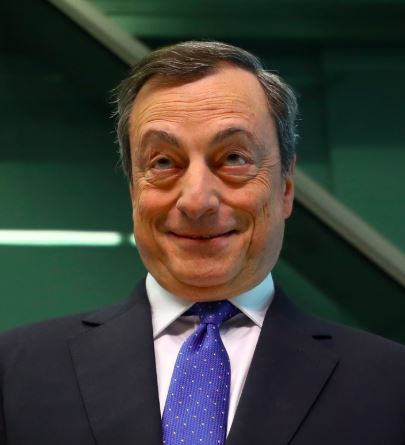
ANSWER: This is unquestionably a bubble, but the buyer has been the ECB (European Central Bank). Yields on risky European bonds have been driven below the yields of long-dated US securities. The financial system may appear to be riddled with anomalies, distortions and erroneous prices, but all of those labels assume it is the madness of crowds rather than the government. Mario Draghi has created the worst possible financial nightmare perhaps in modern history since governments began borrowing in the 12th century. These are not driven by a free market, but one that is manipulation of a central bank gone absolutely mad.
The average return on European junk bonds is below “risk-free” US government bonds. This is completely driven by the insanity of the ECB. In fact, Draghi purchased around $ 2.6 trillion in securities since his Quantitative Easing began in March 2015. He assumed that this would stimulate the economy. However, all it has done is kept the member states on life-support. He is trapped and has no way out, which is why he has come out and said that the ECB will reinvest when the bonds they hold mature. There will be no end to this madness and he has single-handedly wiped out the bond markets. There is no free-market remaining so the question becomes – how will governments ever sell its debt in the future?
President Trump is scheduled to make an announcement about his final determination on the future of the Iran Deal, also known as the Joint Comprehensive Plan of Action. Due to EU allies desire to remain in the sketchy deal with Iran, the most likely announcement is a staged U.S. exit over 90-days prior to the re-imposition of sanctions.
The announcement will be delivered during public remarks in the diplomatic room of the White House. Scheduled Time 2:00pm EST.
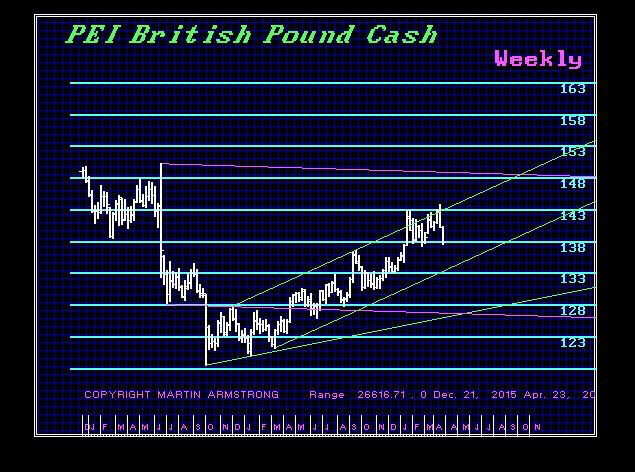
QUESTION: You models called for a rally in the pound sterling into April and it seems like that is spot on. We did bound off of the 144 level. In your year-end report, you said the resistance in the pound for 2018 was at the 14500-14600 level throughout 2018. Living here in Britain, I really get a laugh out of these people who keep saying the dollar is in a bear market forever. They are clueless about what is going on outside the United States. I know you are not, but the view of Americans from across the pond is they are ignorant of anything outside the States particularly the Goldbugs who are notoriously wrong for decades. So has this begun to turn?
PHN
ANSWER: Granted, there are a lot of Americans who see the world only in dollars and the United States. They usually hate my guts because they have been wrong. Yes, we came close to the resistance level, but we still did not reach it. This is part of the consolidation period that was broader than just the stock market. Capital as a whole has been confused and trying to figure out which direction everything is going.
Gold has run up and then runs down. It too has been unable to breakout out. This is yet another confirmation of the entire overall consolidation pattern our computer saw for early 2018.
People have to get their head around interest rates. Will rising rates be bearish for stocks, bonds, and everything else? So much opinion and propaganda have been spilled out for decades that people cannot see clearly.
In the pound, we elected 3 of the four Weekly Bullish Reversals – not the fourth. We elected only ONE Monthly Bullish at the next one stands at 14775 level, which we have been unable to reach. So how anyone can claim that the dollar is in some long-term bear market is just bias because that is what they WANT to believe usually so their gold will rise. They seem to be the only people who refuse to open their eyes and just peek at the other markets and political trends outside the USA.
They will never be able to survive what is on the horizon because they are too biased to be objective. They cannot even understand that a weak dollar helps everything and a strong dollar creates the deflation and collapse in debt.
Greece got in trouble BECAUSE they joined the Euro, the Euro then doubled in value and their previous national debt then cost twice as much deal with. Hello? Why can’t they get this through their heads? Probably because their mortgages are in dollars. In Canada, Europe, Australia, they alone understand when you borrow in a foreign currency, and the currency rises, you lose money.
I Helped some of the takeover boys during the 1980s to converting debt into a PERFORMING asset. We would borrow in a currency that would depreciate against the asset. We made more money on the currency than on the asset. Such things are just over their heads.
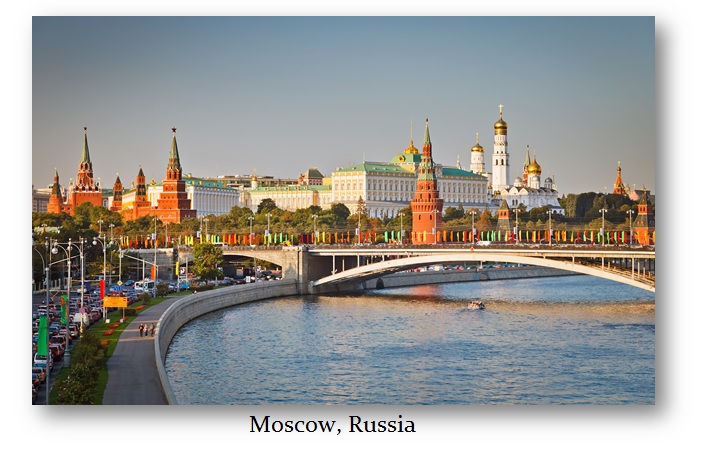
The US sanctions against Russia are pointless and are placing the West at risk the politicians are too stupid to even comprehend. Already, some Russian companies have asked the government for liquidity injections of up to $2 billion. Even the world’s second-largest aluminum producer Rusal has asked for help. Nevertheless, the impact of sanctions goes beyond the internal borders of Russia for they also impact the international financial markets.
For example, Rusal had previously made clear that the US sanctions are threatening their ability to even meet debt obligations. They carry $7.7 billion of debt in US dollars of which about $1 billion in debt is maturing within five years. In terms of US dollars, Rusal cannot even pay the debts because it would have to do so through US banks. That means, under the sanctions, they would have to default on their bonds. Now let’s turn to Polyus, which is Russia’s largest gold producer. Here they have also $5 billion in US debt. Those US dollar bonds maturing in 2024. doubles as sanctions become known.
The same story applies to many Russian companies for they still have to conduct business in US dollars regardless of the sanctions. For example, let’s look closer at Rusal. Here the company conducts over 60% of all its business in US dollars. The US sanctions prohibit Americans from doing business with the affected Russian companies or individuals. This is really crazy. Any Russian state-controlled bank cannot step in as an intermediate because they could then become the target of sanctions itself.
Western investors are actually the ones who will be punished by the US sanctions if the Russian companies cannot pay their debts under the law. They cannot even go to an intermediary in Europe for they too could then be targeted by the US for violating the sanctions. The US sanctions would actually justify Russian defaults on all their debt. Will the US then bail out the Western bondholders?
This may end up simply as a 1931 event where one default starts a panic and the entire house of cards comes crashing down.
QUESTION: Thanks for the update. So it looks like the Vertical Market in the Dow will extend into the end of this cycle 2032 as you warned it could do. Correct?
EK
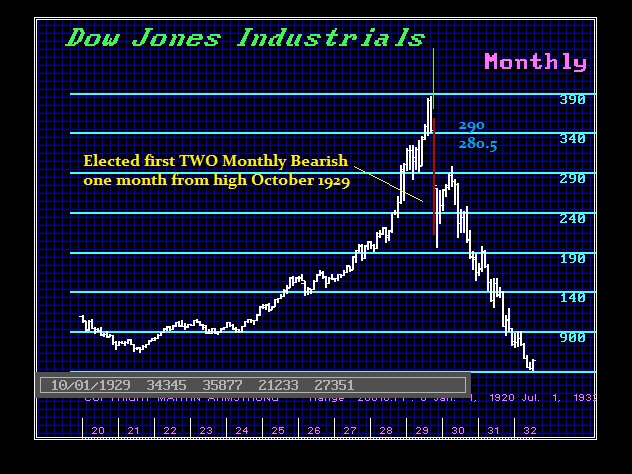
ANSWER: It appears to be shaping up that way. The consolidation has been shallow and nothing to get excited about. If the January high was it, then you should have made a major thrust downward by now certainly electing Monthly Bearish Reversal within the first three months. To judge the extent of a potential decline, the key is to watch HOW FAST does a market elect Monthly Bearish Reversals or Bullish for that matter. This is how to gauge the tone of a market. If we look at 1929, it elected the first TWO Monthly Bearish Reversals in just one month from the high. That was obviously a signal that this was going to be a protracted decline of MAJOR importance.
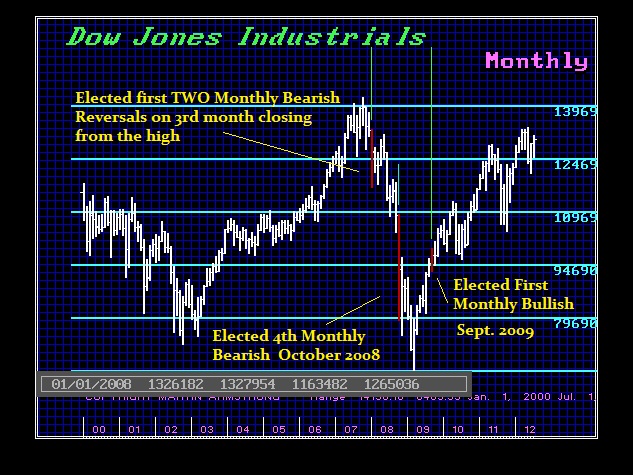
Now, let us compare 1929 to the 2007 Crash which was dramatic, but not anything close to 1929. We did elect ALL FOUR Monthly Bearish. Here we also elected the first TWO Monthly Bearish at the same time 3 months from the high. We have not elected anything on this consolidation no less even reached the Monthly Bearish. Then coming out of the low, it took 6 months to elect the first Monthly Bullish Reversal.
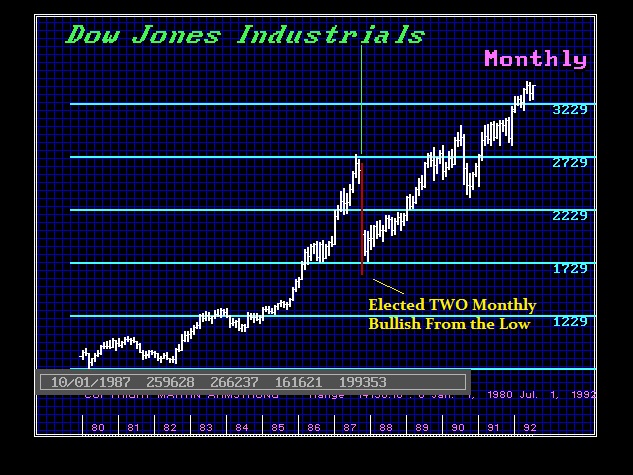
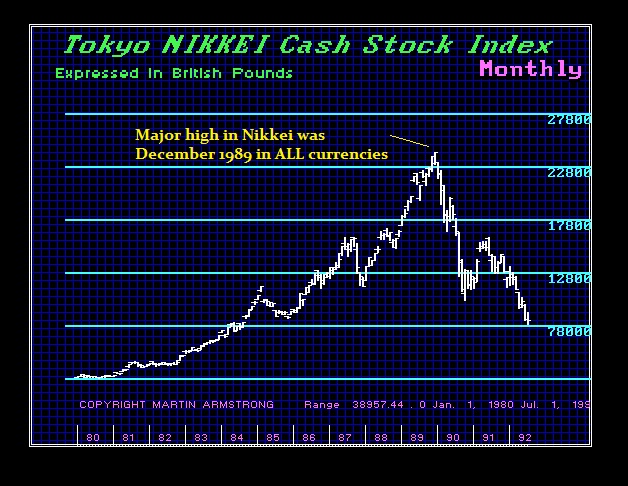
Now let us look at the 1987 Crash. People thought I was nuts when the very day of the low I came out and said that was it, the low was in place, and we would make new highs by 1989. Yes, this was all confirmed by the Economic Confidence Model. The low was precisely that day of the ECM and the next target was 1989.95 which was the Bubble top in the Nikkei. But this was NOT THE ONLY confirmation. We elected TWO Monthly Bullish Reversals at the close of October 1987. Hopefully, you can see that this was NOT a personal opinion call. We can see that we elected the Monthly Bullish right then and there. This is what I mean by how fast reversals are elected determines the type of trend move we get.
I love the idiots who so immediate are always trying to find something they can claim I am wrong about. They try to attack me like 99% of the analysts out there that offer just their opinion. The mere fact that they say – oh you are wrong, the Vertical Market is over, demonstrates that this type of person is INCAPABLE of every learning anything because they are desperate to prove me personally wrong. We are on a journey here to understanding how everything moves. These people are obsessed with trying to disprove something because they are not capable of understanding the free markets in the slightest. This is not about me being right or wrong. Nobody is every right personally in life all the time. We only learn from our mistakes – never our victories. So such comments simply reveal they are not really worth talking to.
The model is objective. That is the best way to approach this. The forecast was for a January high following be “consolidation” which is what you call this. We have not declined to test the Monthly Bearish and we would have to close BELOW 21600 on the Dow on a Monthly Basis to imply a short-term correction will be sustained even briefly.
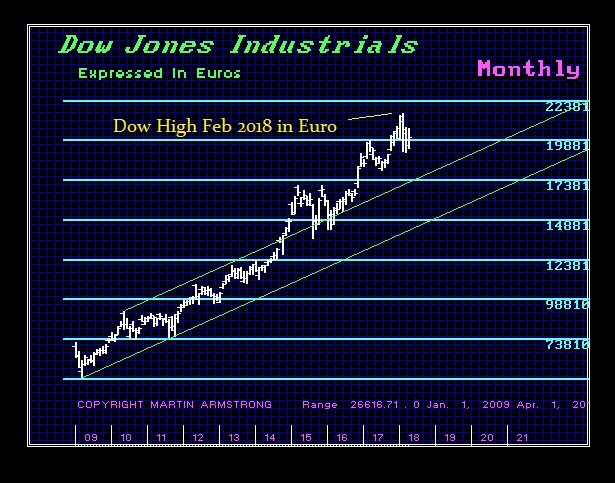
What these type of people are obvious to have always been the global economy. Here too, usually major highs are highs in terms of ALL currencies. Here we have a divergence once again. The high in the Dow in Euros took place in February – not January.
Clearly, is the Vertical Market over? No way. There is no other choice for capital but to move to equities when (1) bonds crash, (2) confidence in government decline, and (3) the rise in interest rates send everyone’s budgets into high gear for automatic expansion.
Obviously, the people who are incapable of comprehending what is at stake will be the source of profits for the rest of us. That is simply the way it goes. So smile, shake their hand, say oh you are right and thank you for being there when I need to trade against someone
I have created this site to help people have fun in the kitchen. I write about enjoying life both in and out of my kitchen. Life is short! Make the most of it and enjoy!
This is a library of News Events not reported by the Main Stream Media documenting & connecting the dots on How the Obama Marxist Liberal agenda is destroying America


 (left to right) Kim Dong Chul, Kim Sang Duk, Kim Hak Soon







 Centinel2012