Terrific ‘big picture’ interview and discussion between National Trade Council Director Peter Navarro and CNBC’s Rick Santelli about President Trump’s trade policies, the threat of China, and the future of how our nation will deal with allies and trading partners.
.
A perpetual trade deficit is detrimental to our American economy because it is financed with debt. We can buy more than we make because we borrow from trading partners. The trade deficit simply means we purchase more foreign goods, and send more money overseas, than they purchase from us. We then turn around and borrow back the money we just paid.
Another broad concern revolves around national security. A perpetual trade deficit is a statement about the competitiveness of the U.S. economy itself. By purchasing manufactured goods overseas for a long enough period of time, U.S. companies lose the expertise and even the factories to make those products; ex: try finding a pair of shoes made in the America. As the United States loses manufacturing competitiveness, we outsource more jobs, and our total standard of living declines.
It’s well known that Republican Speaker of the House Paul Ryan doesn’t want to be in an actual leadership position; and it’s also well known -enhanced by the campaign, and victory, of Donald Trump- that Republicans did not want to win the majority position and face having to reveal their true UniParty agenda.
The evidence of this UniParty positioning has been staring the electorate in the face, repeatedly and brutally, since candidate Donald Trump actually campaigned on key tenets of the Republican party and found himself being openly opposed by GOP leadership.
Now, a stunning discovery surfaces of Paul Ryan’s Congressional Leadership SuperPAC, congressionalleadershipfund.org, actually campaigning for the Democrat, Conor Lamb, in the recent PA18 congressional race.
As evidenced by Big League Politics the Paul Ryan SuperPAC sent a mailer to Pennsylvania CD-18 voters touting Lamb’s favorable position on gun ownership rights:
Now, there will be some who think this is just a bone-headed move by Paul Ryan because the Democrats already held a +50,000 registration advantage in the district and the SuperPAC didn’t know this mailer would actually end up supporting Lamb. However, as mentioned, there’s a history here that tells us “a mistake” is likely not the case.
The real motive, based on an honest review of history, is the professional UniParty apparatus knew that Democrat Conor Lamb needed a lift to offset the cross party voting that was reflected in the district voting (by over 20 points) for Donald Trump in 2016.
The DC Republican apparatus is quite comfortable losing their majority position so long as they are not forced to support Trump policies which are entirely against their financial interests. [How Mitch McConnell Crushed The Tea-Party]
Even before candidate Trump entered the 2016 presidential race, the agenda was visible for anyone who was willing to admit it. In 2014 the same Republican leadership paid Democrats to vote against the Republican primary winner of the Mississippi Senate race (Cochran -vs- McDaniel) simply because Mitch McConnell didn’t like the idea of having an actual Republican in the seat.
Remember, this is the GOP wing of the UniParty who operate on behalf of the U.S. Chamber of Commerce {DEEP DIVE} and support: comprehensive immigration reform to include amnesty; lax border security to allow cheap labor; Omnibus spending as reflected in their Obama budget-fulfillment votes; the retention of ObamaCare as mandated by the U.S. CoC; the expansion of federal common core education standards; the Wall Street trade agenda to include TPP. All of these “DC-Republican” positions are opposed by the current Republican President and the majority of Republican voters.
Enhancing and emphasizing my argument that this mailer as a deliberate effort to elect a Democrat, I would remind everyone of a few brutally obvious points: ♦the Republican controlled senate voted unanimously to block any Trump recess appointments (summer 2017); ♦and also the reality that both the House and Senate had no legislative constructs prepared for a Trump victory in January/February 2017; ♦and top off the cake of duplicity with the fact it was Republican controlled House and Senate committees who willingly opened ridiculous investigations against their own elected president claiming a ‘Vast Planetary Russian Collusion Conspiracy’.
In short, both Republicans and Democrats want the threat of Donald Trump removed.
There is no desire on the part of Paul Ryan/Kevin McCarthy or Mitch McConnell/John Cornyn to actually win seats in 2018. These GOP “leaders” would just as soon lose their majority position so they can go back to the comfortable indulgences of remaining in leadership in the minority status.
In the minority the leadership of the GOP are no longer threatened by President Trump and can hide behind the smokescreen of loyal opposition.
Substantively nothing changes, and the GOP leaders are just as well compensated in the minority by the lobbyist industry within DC.
The only threat to the financial interests of the GOP is President Donald Trump remaining in office and having to actually face carrying out a conservative Trump agenda in 2019 and 2020. That Trump agenda is entirely against their “establishment republican” interests.
The Paul Ryan mailer to elect a Democrat is just another example of how corrupt the entire UniParty political apparatus is within Washington DC.
That truism is entirely why this MAGA graphic, from 2015, remains accurate:
An accurate headline could also be: President Trump puts a beautiful potted plant into the unused meeting room of the National Economic Council, and Wall Street cheers.
According to media and White House confirmation President Trump has selected Larry Kudlow to chair the National Economic Council:
[…] “Larry Kudlow was offered, and accepted, the position of assistant to the President for Economic Policy and Director of the National Economic Council,” Sanders said. “We will work to have an orderly transition and will keep everyone posted on the timing of him officially assuming the role.” (link)
Kudlow is essentially adored by Wall Street (writ large), and as such all the nervous nellies will be back-slapping and high-fiving. As the stock market crowd cheers, what the insufferable dolts miss, thankfully miss and don’t appreciate, is the strategy of a master economic predator, Donald Trump. This Trumpian move is brilliant.
First, President Trump is immovable on his trade and economic agenda. Period; end of story. Ask Gary Cohn or any other member of the disassembled manufacturing council advisory board who quit last year because POTUS Trump just wouldn’t heed their duplicitous and high-minded advice. Do you remember candidate Trump mentioning the endless talking to nowhere that he has not time for? Yeah, that.
President Trump has a 30-year-developed plan and strategy for the U.S. to recapture economic power. Commerce Secretary Wilbur Ross, Treasury Secretary Steven Mnuchin, U.S. Trade Representative Robert Lighthizer, and key trade strategist Peter Navarro are carrying out that plan.
Cohn or Kudlow thinking they would somehow disrupt three decades of trade planning by POTUS Trump is too funny to give typeset space.
Secondly, Larry Kudlow has a well known history of drug addition and drug abuse. He will likely never pass the background security clearances. Even Maggie Haberman at the New York Times recognizes this issue.
So what gives? Why would Trump select him?
Again, don’t think about this appointment as an actual intent to ingest a trade policy perspective. That’s nonsense. Oh, he’ll listen; Trump’s a good listener. But what POTUS is doing is giving the Wall Street crowd the appearance of influence; key word “appearance”. It’s a stock market appointment, nothing more. Nothing will change the intent of Trump to deliver on his already-in-the-works economic plan.
POTUS would cut off his own hand before he would change direction on his economic strategy. Remember: “America First”. Titan-minded Trump is the most committed economic influence agent in the history of American politics.
The National Economic Council (NEC) is an entity demanded by the traditions of the Office of the President. They assemble, meet, discuss, hold conferences, invite guests etc. However, for POTUS Trump it’s an exercise in formality run by professionals who benefit from the indulgences of membership.
The NEC has no more influence on Trump’s economic plan than any chosen Country Club has influence over his skills on the golf course.
But it looks good.
And that’s it.
Enjoy the stemware and cocktail party invites Larry.
The Senate voted 67-31 to end debate on a reform bill to modify the Dodd Frank banking bill. While overall the approach is needed and will likely find White House support, the Senate Bill -as constructed- doesn’t do enough to modify the control held by massive multinational financial institutions, who hold lobbying power over congress. Unfortunately, the corruptocrat leadership in the Senate will not allow the house to modify the bill as needed.
The current reform bill sets the tiered definition for lowered regulation at $250 billion in assets and there are some domestic banking beneficiaries. However, it doesn’t break up the investment division from influence over the commercial banking. The argument against breaking up the system is that if divisional separation is required – the banks best interests would naturally put the investment division ahead of commercial lending and the liquid capital within the overall economy would shrink.
The Trump/Mnuchin approach toward a secondary deregulated but financially sound banking system focused on commercial lending and was constructed around Community Banks and Credit Unions with far less regulatory and compliance hurdles.
WASHINGTON – All Republicans and more than a dozen Democrats voted to move the bill toward a vote on final passage, which is scheduled for Wednesday evening.
The bill, long expected to pass the Senate, faces an uncertain future in the House, where conservatives are demanding stronger curbs to Dodd-Frank before pledging their support.
[…] Banks with less than $250 billion in global assets would no longer be subject to yearly Fed stress tests or higher capital requirements meant to ensure risky firms could weather a lending crisis. Those banks would also be exempt from submitting for Fed approval a “living will” that outlines how the company could be liquidated upon failure without causing a widespread meltdown.
The threshold for tighter Fed regulation is currently set at $50 billion, and the increase would free several major regional banks, including SunTrust, BB&T, Citizens, Fifth Third, M&T and BMO Financial Corp., from those standards. Those banks all have at least $100 billion in assets, and among the bill’s biggest beneficiaries.
The bill also exempts banks that extend 500 or fewer mortgages a year from reporting some home loan data to federal regulators and broadens the definition of qualified mortgages. (read more)
Back in July 2010 when Dodd-Frank banking regulation was passed into law, there were approximately 12 to 17 banks who fell under the definition of “too big to fail”.
Meaning 12 to 17 financial institutions could individually negatively impact the economy, and were going to force another TARP-type bailout if they failed in the future. Dodd-Frank regulations were supposed to ensure financial security, and the elimination of risk via taxpayer bailouts, by placing mandatory minimums on how much secure capital was required to be held in order to operate “a bank”.
One large downside to Dodd-Frank was that in order to hold the required capital, all banks decreased lending to shore-up their liquid holdings and meet the regulatory minimums.
Without the ability to borrow funds, small businesses have a hard time raising money to create business. Growth in the larger economy is hampered by the absence of capital.
Another downstream effect of banks needing to increase their liquid holdings was exponentially worse. Less liquid large banks needed to purchase and absorb the financial assets of more liquid large banks in order to meet the regulatory requirements.
The four to six big banks (JP Morgan-Chase, Bank of America, Citigroup, Wells Fargo, US BanCorp and Mellon) now control $9+ trillion (that’s “TRILLION). Their size is so enormous this small group now controls most of the U.S. financial market.
Because they control so much of the financial market, instituting a Glass-Steagal firewall between commercial and investment divisions (in addition to the Dodd-Frank liquid holding requirements), would mean the capability of small and mid-size businesses to get the loans needed to expand or even keep their operations running would stop.
2010’s “Too few, too big to fail” became 2016’s “EVEN FEWER, EVEN BIGGER to fail”.
That’s the underlying problem for a Glass-Steagall type of regulation now. The Democrats created Dodd-Frank which: #1 generated constraints on the economy (less lending), #2 made fewer banking options available (banks merged), #3 made top banks even bigger.
This problem is why President Trump and Secretary Mnuchin were working on a proposal to create a parallel banking system of community and credit union banks that are entirely external to Dodd Frank regulations and could act as the primary commercial banks for small to mid-sized businesses.
The goal of “Glass Steagal”, ie. Commercial division -vs- Investment division, would be created by generating an entirely new system of banks under different regulation. The currently remaining ten U.S. “big banks” operate as “investment division banks” per se’, and the lesser regulated community banks/credit unions operate as would be the “Commercial Side”.
Instead of fire-walling an individual bank internally within its organization, the Trump/Mnuchin plan was presented to fire-wall the banking ‘system’ within the U.S. internally. Hope that makes sense.
The Senate Dodd Frank reform bill does little to change this structural issue.
Justin from Canada discusses his confidence at defeating U.S. President Donald Trump over concessions in NAFTA. Essentially Sparkle Socks argument comes down to his view that women’s rights, climate change and globally progressive policies are more than enough to swat away the territorial annoyances of President Trump.
Extremely reliable sources from Behind the Curtain in Europe are becoming deeply concerned that Draghi at the ECB has created a monumental economic disaster he is just praying to holding off until he leaves next year. Interest rates are already starting to rise significantly in several important money and interbank markets. Both banks and debtors are facing a rapid rise in interest expenditures that will shock the world. This is going to blow-out budgets around the globe and both private and public debtors face higher costs of funds.
The Libor (London Interbank Offered Rate), the most important reference rate for the global interbank market, is currently at its highest level since 2008. We elected a Yearly Bullish Reversal on the close of 2016. Once we see the rate close above 213 on a monthly basis, LIBOR rates will be poised to jump to 510. When the Libor price rises, the short-term borrowing for banks becomes more expensive, and for borrowers in the financial market, such as sellers of bonds or buyers of mortgages, debt service becomes more difficult. The demand for debt is exceptionally high. We are looking at LIBOR rates rising sharply. The dollar-lending rate for dollar loans has been rising steadily in all maturities since about the end of 2014. The dollar-Libor for three-month loans in March 2017 were trading at around 1.1%. Currently, this dollar-Libor rate stands at around 2%.
This year’s WEC will be focused on the next major crisis and how all the markets will interact. This is the beginning of the Monetary Crisis Cycle. Our Yearly Models on LIBOR are already in a bullish posture on both short-term indicators. A closing on an annual basis above 208 will signal rates will rapidly more than DOUBLE into 2020. A closing above 510 on an annual basis will warn of a MAJOR financial crisis hitting just about every economy.
COMMENT: I have been following your blogs for the past two years and have attended the past two WECs. I read with interest your continued comments on CALPERS and its pension mismanagement. I’m an attorney advisor and a client disclosed a few months ago that they had purchased $1m in municipal debt on the recommendation of their broker. They were complaining about undisclosed fees. I asked them why they would purchase muni bonds in a rising interest rate environment, they said it was to balance their portfolio with bonds. They also expressed some amusement that I purchased a house in Florida. They didn’t sell right away and were deaf to any discussion about the status of fiscal irresponsibility in CA, particularly the Democratic control of all levels of government. So I kept harping on the rise in interest rates, and they finally liquidated their entire muni bond position after rates did start to creep up. Trying to explain any historical info that you provide was a non-starter since to sell their real estate would be a big inconvenience and they don’t like the idea of changing their lives that much. It reinforces that people are unwilling to change until the crisis hits and no doubt they’ll rush out with everyone else at the same time. Hard to move that mentality unless people have a cycle-oriented view.
RDE
REPLY: Of this is exactly the problem. I have often spoken how I go to high level meets in various governments. They know what we are forecasting, but to claim I am a “governmental advisor” is in my view a misrepresentation. True, I am called in many times before a crisis. Despite the fact I have warned them in advance, nobody seems to do actually anything UNTIL the crisis hits. So I view myself more as a canary in the coal mine. They seem to consult me ONLY to see if I have changed my mind and/or our forecast. Only one country has ever done anything I told them in advance and they are in Asia. Not a single country has ever done ANYTHING I have advised in advance, They have listened to me ONLY in a state of PANIC.
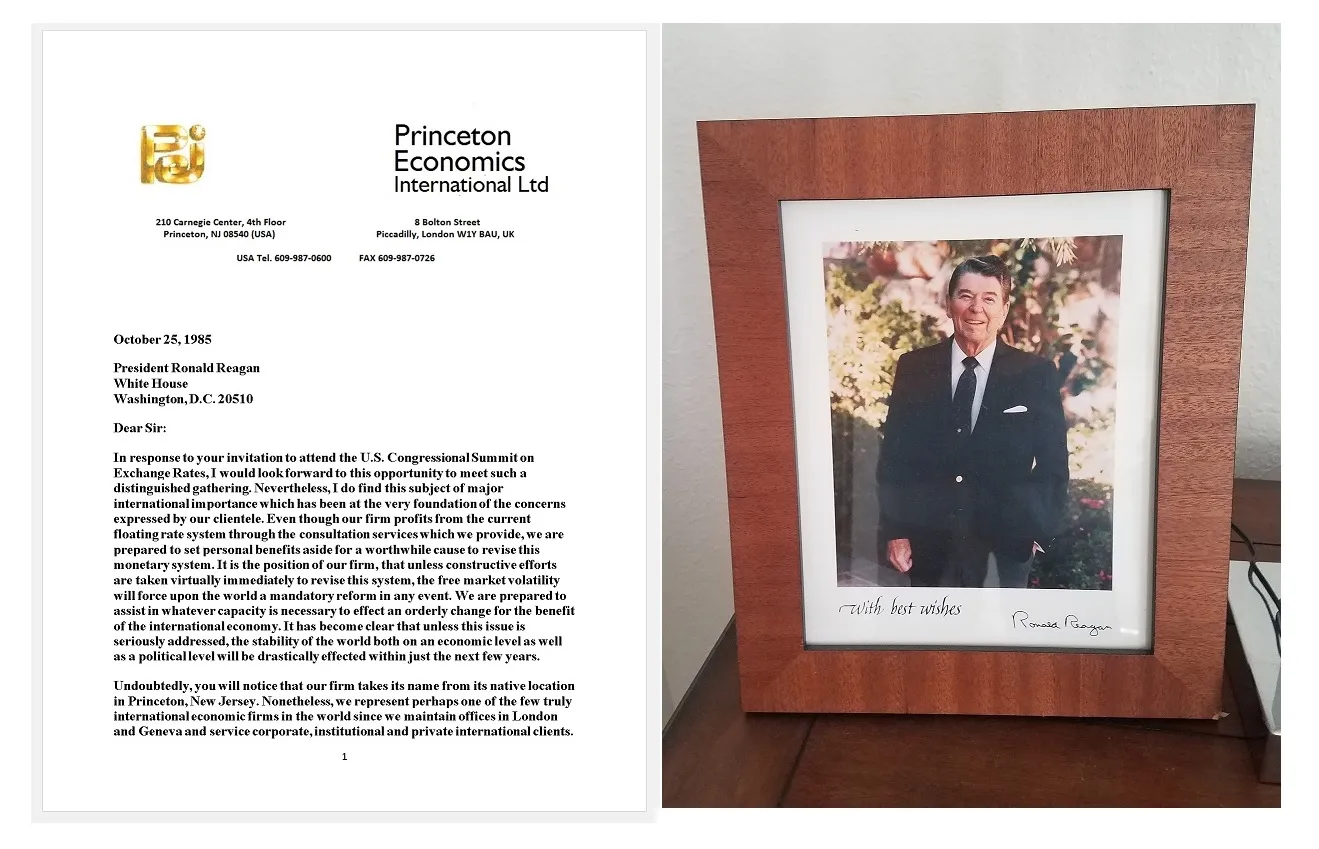
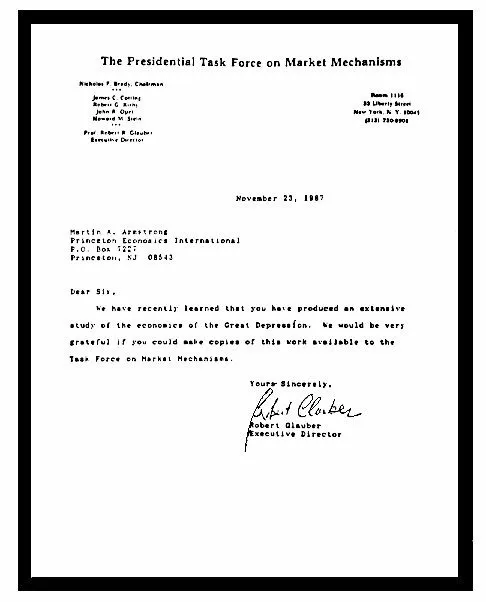
Anyone who portrays themselves as some advisor to government is misrepresenting the facts. Governments will NEVER listen to avoid a crisis. They ONLY act because of a crisis. For example, I was called in back in 1985 when they were using people to pretend that experts agreed with forming G5. Nobody that I heard agreed and that is when I wrote to President Reagan (see:Martin Armstrong to President Reagan October 25, 1985 ).
The response from the White House said thanks, but no thanks.
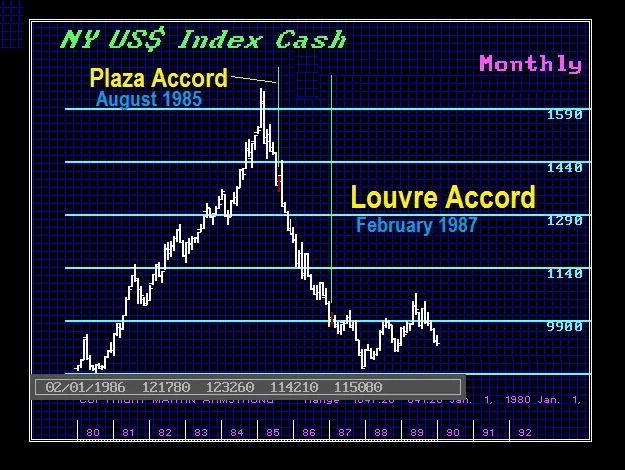
After the Plaza Accord in 1985, then they pulled the Louvre Accord to try to stop the volatility. They were stunned when the markets kept going despite the fact that the governments tried to stop the decline of the dollar.
Then when the Crash of 1987 came. suddenly they wanted the research and amazingly conceded that the number one problem was the rise in volatility I had originally warned they would create. So nobody EVER listens until the CRISIS hits. This seems to be human nature. This is why I do what I do. Walking from meeting to a meeting among governments is fruitless. They will NEVER prevent the Crash & Burn. It is just not in their nature nor human nature.
This is what the old saying means: You can lead a horse to water, but you cannot force him to drink. It just seems to be part of humanity. There is just no changing it this seems.
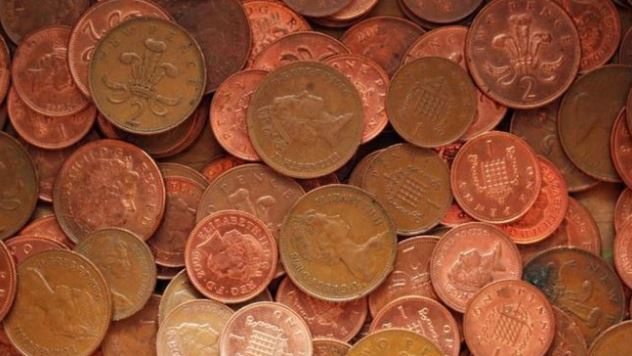
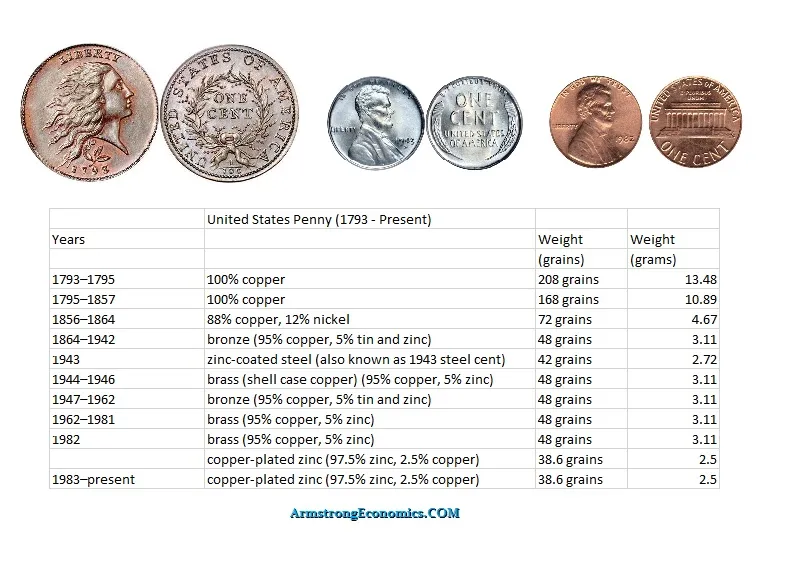
Inflation over time raises the cost of raw metal and we see that such coins vanish from the money supply. Britain is the latest in line to eliminate the 1 & 2 pence coins. They are costing more to produce than they are worth. I have written about the monetary reform Act of 1857 when the penny was drastically reduced in size. Canada eliminated the penny as well.
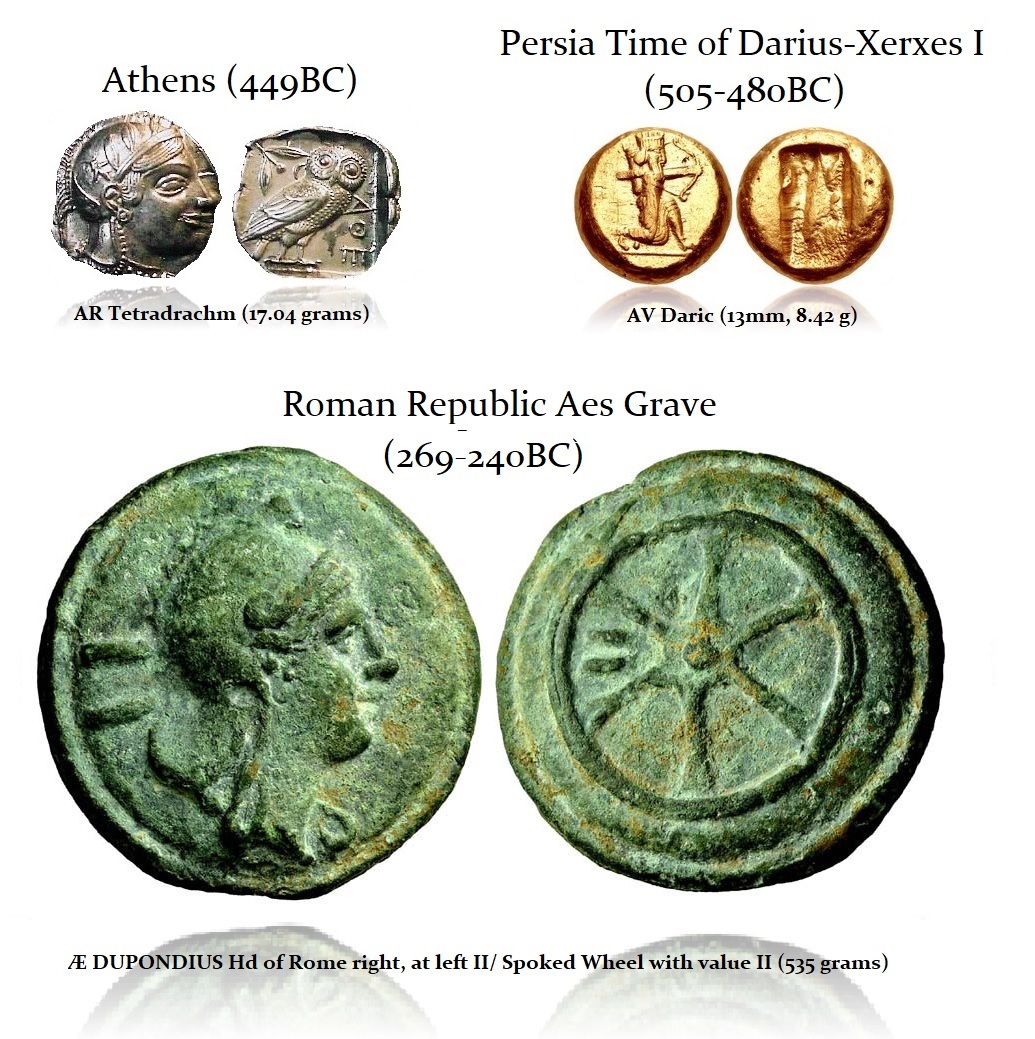
The United States dropped copper from the penny in 1982. Today, the penny is made of 97.5% zinc. It is copper-plated to give the appearance that it is still really copper. Throughout history, the supply of copper, gold, and silver, have all risen and fallen at different times based on their own cycle. Where the Persians had excess gold, the Greeks only had silver mines. The Romans had neither silver nor gold and began their monetary system with bronze.
We can see how the three empires began with gold, then silver, and finally bronze and modern society turned to paper starting with the Chinese during the 13th century. The main coin of the Persians was known as the gold Daric, whereas the dominant coinage among the Greeks was the silver Athens tetradrachm known as the Owl. The Romans were the last to depart from the Bronze Age. Their coinage remained bronze until silver was introduced and struck in Greek denominations beginning in 280BC, which was just one 51.6-year wave from Alexander the Great (336-323BC).
We can see the same process of the rising cost of copper that prevailed during the early Roman Republic. The Roman As drops from 280BC with a weight of 341 grams to 10.6 grams by the time of Augustus (27BC-14AD). The drastic decline was been 280BC and 115BC, which was about 19 waves of 8.6-years.
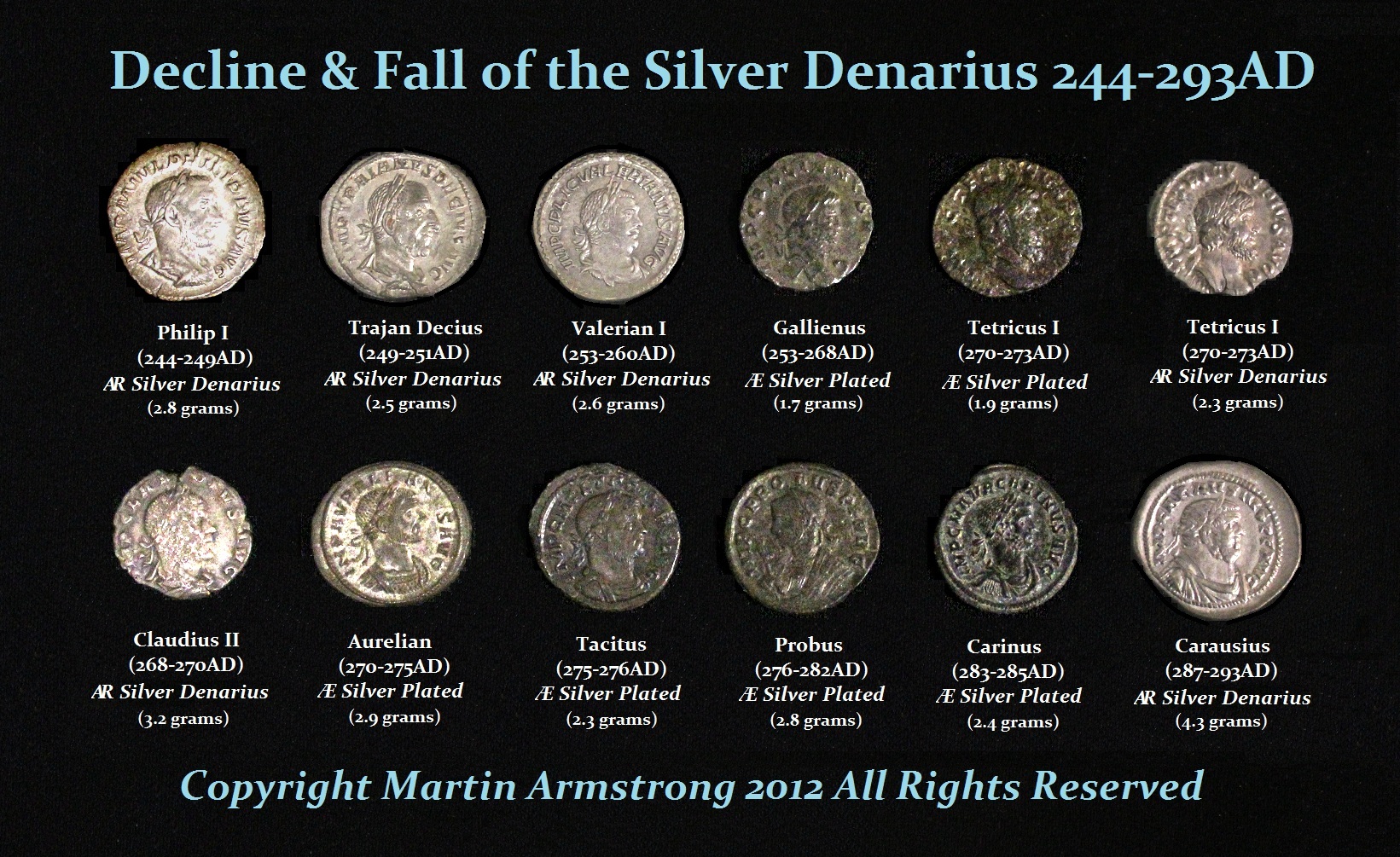
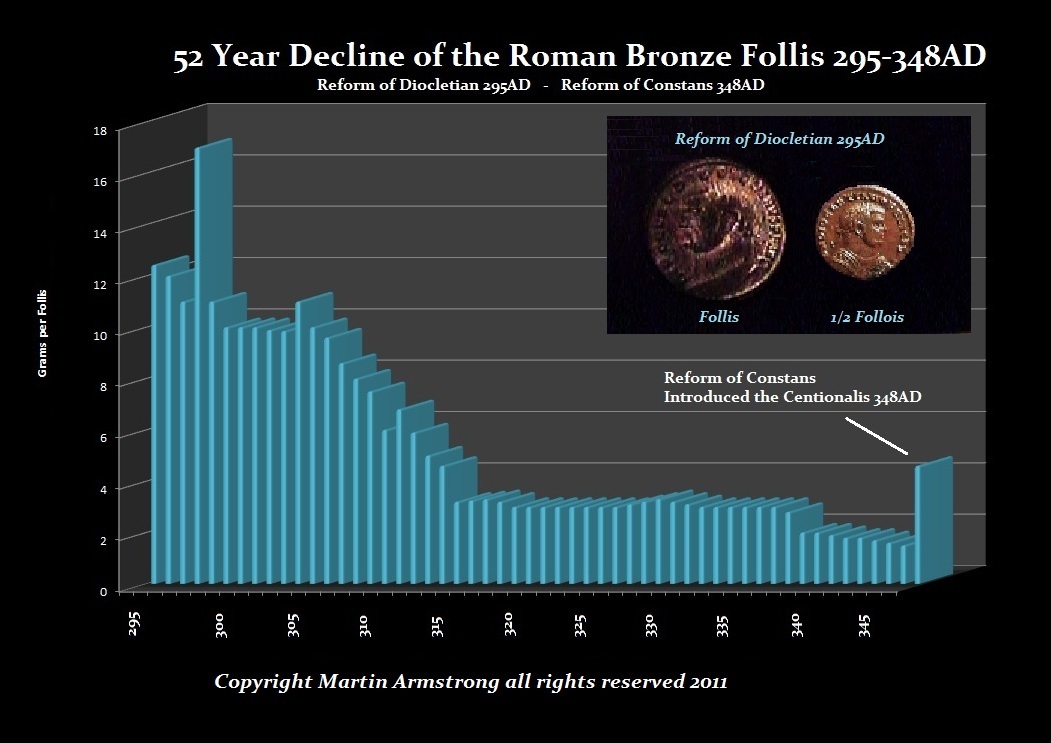
While we see the same process of a decline in Roman silver denarius into the 3rd century, what emerges is always the effort to reform. The Roman Emperor Diocletian (284-305AD) reintroduced silver coinage as well as bronze. Once again, we see the gradual reduction in the bronze coinage while the silver and gold were not affected.
The bronze coinage simply keeps reducing as we see what is going on today. In 348 AD, a new bronze denomination was also introduced known as the “centenionalis” in a monetary reform carried out by Constantius II (337-361AD) with an initial weight of 6.6 grams. The weight almost immediately began to decline rapidly to 4.3 grams. He also introduced the half-centenionalis, which seems to continue to be produced and eventually becomes the standard until about 360AD. Despite the noble effort, the inflationary trend continued and the value of bronze kept rising forcing the discontinuation of this denomination 354 AD after just 6 years (one volatility cycle). This was then replaced by the reduced bronze denomination of about half the weight known today simply as the AE3 or half-centenionalis.
During the reign of Julian II (360-363AD), he attempts yet another monetary reform trying to restore the original Folles of Diocletian known as a Double Centenionalis or a Majorina. This new denomination bronze denomination was 28mm in diameter with a weight of 8 grams. This monetary reform lasted unmolested until about the reign of Arcadius (383-408AD). For about 19 years, the Double Centenionalis remained fairly true to its weight. When we see once again usurpers begin to rise in the West such as Magnus Maximus (383-388AD) in Britain and the usurper in Rome itself of Eugenius (392-394AD) where the bronze coinage is reduced to a tiny token with a weight of 0.94 grams.
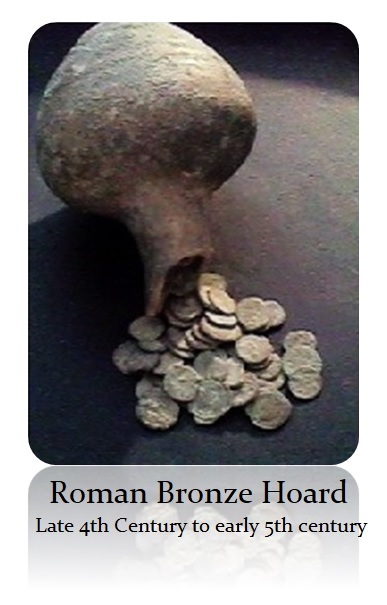
From about 400AD until the final collapse of Rome in the West during 476AD, bronze coinage is poorly struck and typically only tiny 1 gram coins. Many emperors did not even strike bronze coinage. When the Vandals from North Africa invade and sack Rome3 during 455AD, the word today is still used “vandalize” which refers to the events at that time. Copper was scarce so the Vandals stripped the roofs of Roman buildings which had been adorn in copper to shine brightly as if it were gold.
Therefore, throughout history, the cycles between the three metals are significantly different and thus we see periods during which bronze if rarer than gold or silver and at times each metal comes into excess supply and shortages. This is one primary reason any attempt to establish fixed ratios has always failed without exception. We are following the same path. Soon, all metal will be worth too much to use for coins.
President Donald Trump is traveling to Missouri today to promote recent tax cuts and campaign for Republican U.S. Senate candidate Josh Hawley. The president is scheduled to visit the Boeing plant in St. Louis where he will hold a round table with business leaders and workers, then plans to attend a fundraiser for the senate candidate.
The roundtable discussion with Boeing business leaders will be livestreamed at 4:00pm
QUESTION: I just returned from Venice and I was told that they stole the bones of St Mark from Egypt and built a church there for them. The four horses on the Church they stole from Constantinople. It seems a bit strange that they would go take relics from somewhere else. Do you have any comments on the Venetian Empire and their kleptomania?
JE
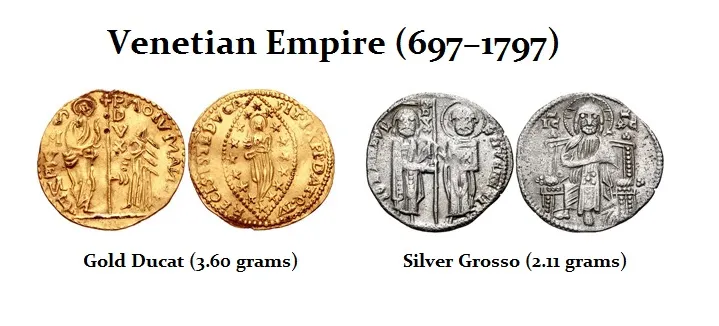
ANSWER: Venice had extensive trading connections with the eastern Mediterranean regions as well as an off/on relationship with the Ottoman Empire. Venice was the medieval center for the trade in antiquities as well as ancient coins. They loved history and it was a serious business in Venice. The Venetian gold ducat even rose to be an internationally accepted coin. This pictures St Mark standing giving a gonfalone to the kneeling doge (head of Venice). So indeed, St Mark was the center of Venetian culture. The four horses were from a chariot full size driven by Constantine which once stood in Constantinople before the Venetians conquered the city. They took just the horses back to Venice.
This interest in antiquities and relics first began in the Middle Ages and initially was focused on holy relics, which included removal of the bones of St. Mark from Alexandria in 828AD and moving them to what became known as St Mark’s Square. Most of the important early coin collections were actually formed through Venice. Andrea Loredan was a patrician of an old family of Venice dating back to the 12th century that occupied hereditary seats on the Great Council from 1297 onward. The family still exists today with the Palazzo Loredan Cini at Campo San Vio. Andrea Loredan was a serious coin collector who ordered an illustrated list of all his coins to be made in 1560 in order to help with their sale. A reproduction of that list has been produced by the American Numismatic Society – Irritamenta: Numismatic Treasures of a Renaissance.
With respect to the mummified body of St Mark, there is still a controversy that the remains are not that of St Mark, but Alexander the Great. Three early Christian sources stated that St Mark’s body was burnt after his death. As the story goes, the pagans seized Saint Mark in Alexandria, Egypt, when he was serving the Liturgy and beat him, dragging him through the streets and threw him in prison. On the following day, the crowd again dragged him through the streets to the courtroom, but along the way, Saint Mark died. The pagans were so angry and the Egyptian tradition was to preserve the body, so they wanted to burn the body in disrespect. It is said that when they lit the fire, everything grew dark, thunder crashed, and there was an earthquake. The pagans then fled in terror. Some Christians then took up the body of Saint Mark and buried it in a stone crypt on April 4th, 63AD.
During the year 310AD after Constantine, I the Great becomes Emperor in 307AD and two years before the Battle atMilvian Bridge onOctober 28th, 312AD, a church was constructed over the relics of Saint Mark. The Pope prayed a prayer on the grave of Saint Mark when the church was then a little chapel on the eastern coast containing bodies said to be of Saint Mark and some of his holy successors. The church was later enlarged in the days of Pope Achillas, who was the 18th Pope.
After the Siege of Alexandria in 641AD, the tomb of Saint Mark was no longer in Christian hands. The church was greatly ruined in 641AD when the Arabs invaded Egypt. Then in 680AD, Pope John III rebuilt the church. In 828AD a group of Venetian Christian merchants traveled to Alexandria and obtained the body of Saint Mark. As the story goes, these merchants used pork to prevent the Islamic authorities from inspecting what they were transporting. The Venetians and the body of Saint Mark managed successfully to make its way to Venice. The church was destroyed again in 1219, during the time of the crusades, and was rebuilt once more. However, during the 16th century, the French explorer Pierre Belon mentions the founding of the church in 1547.
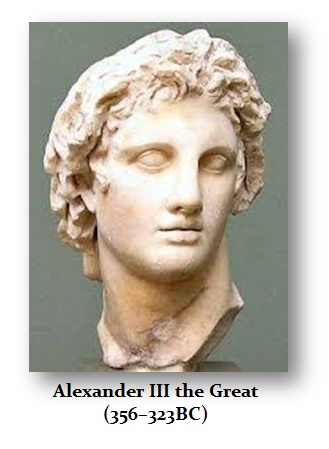
The other tomb of a mummified person in Alexandria was that of Alexander the Great. The location of Alexander the Great’s tomb has remained a great mystery. After the death of Alexander in Babylon, the possession of his body became a subject of negotiations between his generals. Where to bury Alexander became a controversy. Aegae was one of the two originally proposed resting places. The body, however, was stolen en route by Ptolemy I Soter, the general who took Egypt. According to contemporary records for the years 321–320 BC, Ptolemy initially buried Alexander in Memphis. Sometime during the early 3rd century BC, Alexander’s body was transferred from Memphis to Alexandria, where it was reburied in a new tomb. It was this tomb that became a major tourist destination for hundreds of years.
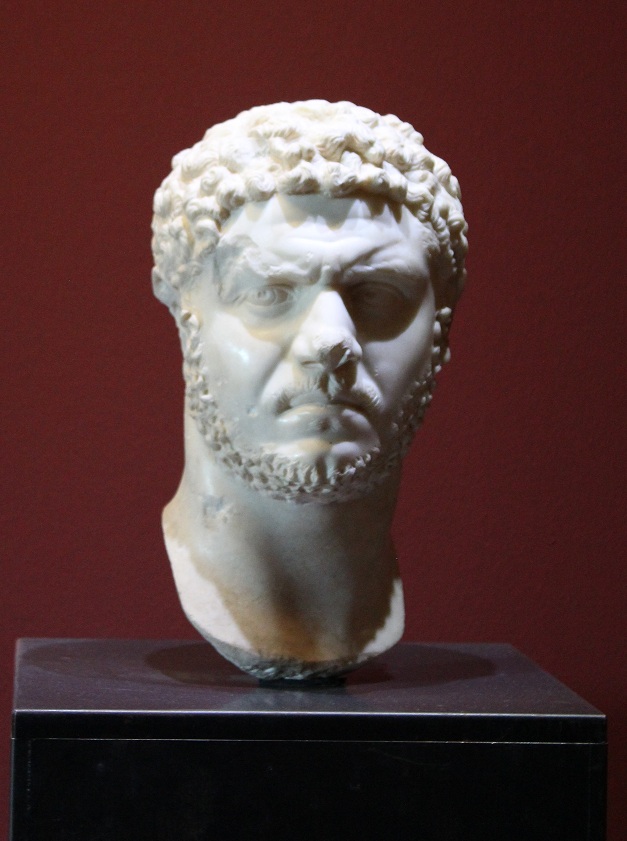
Julius Caesar paid his respects to the tomb of Alexander the Great. The first Emperor of the Roman Empire Augustus declined the opportunity to visit any tombs saying that he came to see a King and not a bunch of dead people. Emperor Caracalla (198-217AD) had seen himself as the reincarnation of Alexander the Great. Caracalla even retraced Alexander’s route to Egypt however and in 215AD, Caracalla was warmly received when he visited Alexander’s tomb. For some unknown reason, he slaughtered many of Alexandria’s inhabitants shortly thereafter. It is known that Caracalla apparently left with a piece of Alexander’s body armor. According to chronicler John of Antioch, Caracalla removed Alexander’s tunic, his ring, his belt with some other precious items and deposited them on the coffin.
When John Chrysostom (349 – 407AD), the Archbishop of Constantinople visited Alexandria in 400AD, he asked to see Alexander’s tomb and remarked, “his tomb even his own people know not”. Later authors claim to have seen the tomb during the 9th century. Others claimed to have visited a sepulcher in the center of Alexandria that was still venerated as the resting place of Alexander. This seems to be unlikely given the fact that the Christians sought to destroy anything that was a Pagan worship. Therefore, credible historical references of Alexander’s tomb continued only until about 390AD, and then vanish.
It has been argued that two years after the last historical reference of Alexander’s tomb, another tomb in Alexandria seems to surface after 310AD. But it is not the tomb of Alexander, the tomb belongs to Saint Mark. Saint Mark had been dead for over 300 years. Some have suggested that the mummified body of Saint Mark could, in fact, be Alexander the Great. The missing link is the question that if the Christians did indeed rescue the body of St Mark from the pagans and it was not burned, then was it mummified in Egyptian tradition or simply buried? If in 828AD a group of Venetian Christian merchants took a mummified body, was it really St Mark? Could the pagans have rescued Alexander’s body from the Christians who would have certainly destroyed it in their rage and placed it in a church pretending it was St Mark to protect it?
The Copts (Greek Orthodox Christians) believe that the head of St. Mark remains in a church named after him in Alexandria, and parts of his relics are in St. Mark’s Cairo’s Cathedral. Some believe that the rest of what are believed to be his relics are in the St Mark’s Basilica in Venice, Italy. However, back in 1063, during the construction of a new basilica in Venice, Saint Mark’s relics could not be found. According to legend, in 1094, the saint himself revealed the location of his remains by extending an arm from a pillar. The newly discovered remains were then placed in a sarcophagus in the basilica pictured here. There remain many questions about the body in the church. In Egypt, every year, on the 30th day of the month of Paopi, the Coptic Orthodox Church celebrates the consecration of the church of St. Mark and the appearance of the head of the saint in the city of Alexandria. This takes place inside St. Mark Coptic Orthodox Cathedral in Alexandria, where the saint’s head is said to be preserved.
The whereabouts of Alexander’s body remains one of the great mysteries yet to be resolved. Some argue it was buried in a remote community outside of Alexandria. A DNA test of the body in St Mark’s of Venice would resolve the issue and settle the question is the person of Greek or Semitic origin? Naturally, such a test would never be allowed for what if it showed it was the body of Alexander the Great? Can you imagine what that would do to Venice?
I have created this site to help people have fun in the kitchen. I write about enjoying life both in and out of my kitchen. Life is short! Make the most of it and enjoy!
This is a library of News Events not reported by the Main Stream Media documenting & connecting the dots on How the Obama Marxist Liberal agenda is destroying America


 In the minority the leadership of the GOP are no longer threatened by President Trump and can hide behind the smokescreen of loyal opposition.





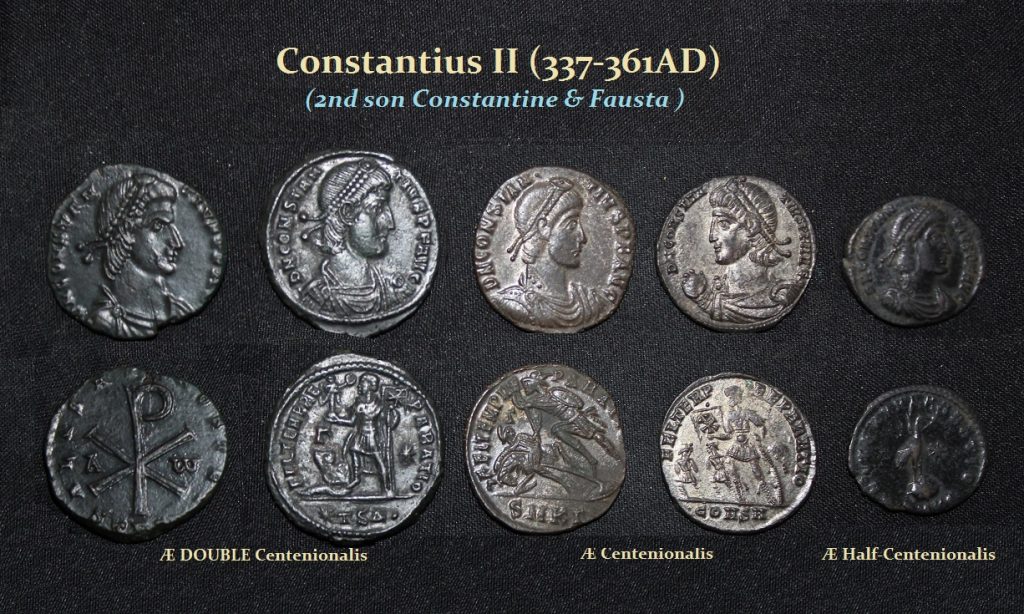 The bronze coinage simply keeps reducing as we see what is going on today. In 348 AD, a new bronze denomination was also introduced known as the “centenionalis” in a monetary reform carried out by Constantius II (337-361AD) with an initial weight of 6.6 grams. The weight almost immediately began to decline rapidly to 4.3 grams. He also introduced the half-centenionalis, which seems to continue to be produced and eventually becomes the standard until about 360AD. Despite the noble effort, the inflationary trend continued and the value of bronze kept rising forcing the discontinuation of this denomination 354 AD after just 6 years (one volatility cycle). This was then replaced by the reduced bronze denomination of about half the weight known today simply as the AE3 or half-centenionalis.



 Julius Caesar paid his respects to the tomb of Alexander the Great. The first Emperor of the Roman Empire Augustus declined the opportunity to visit any tombs saying that he came to see a King and not a bunch of dead people. Emperor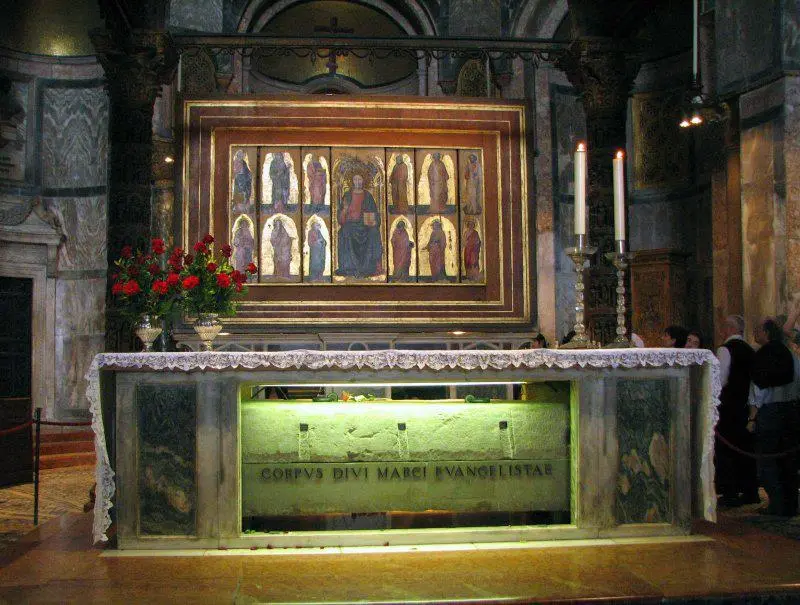
 Centinel2012