South Africa Expropriating White Farmer’s Property


South Africa is turning extremely left-wing to the point that it is risking any viable economic future. The Parliament of South Africa on Tuesday voted to expropriate the majority white farmers of the country without compensation. This is how the Russian Revolution took place – the just took everyone’s property. The motion was submitted by the left-wing party Economic Freedom Fighters (EFF) and it was supported by the ruling party ANC (African National Congress). This maneuver is trying to change the constitution. All the work of Nelson Mandella is being gradually eliminated.

Clearly, the topic of land expropriation has been one of the most sensitive issues since the end of apartheid in South Africa. New President Cyril Ramaphosa, in his first major speech after taking office in mid-February, publicly stated that he supported the expropriation of white farmers without compensation. The excuse is that this will lead to increased food production. It has absolutely nothing to do with that. The majority of the agricultural land in South Africa still belongs to the white South Africans even 24 years after the end of apartheid. White ownership has declined slightly from 85% to 73%. However, the idea of a free market in South Africa does not truly survive. The rising chants assert that the “time for compensation is over; now is the time for justice!”

Parliament mandated the Constitutional Commission to report on the issue at the end of August. The ruling ANC party is under pressure before next year’s parliamentary elections, and land seizures of white South Africans could increase popular support in the poor black electorate. Of course economically, when a nation simply expropriates private property, thereafter, it becomes economically a high risk to do business with them.

The hyperinflation of Zimbabwe was in part set in motion by the violent expropriation of white farmers. Zimbabwe saw a sharp decline in production of food plunging the country into chaos. Zimbabwe was formerly known as the breadbasket of southern Africa. Once it expropriated the farms of white farmers, the country fell into complete chaos. South Africa is risking the very same future. Inflicting vengeance upon the white farmers may make many feel better, but it risks sending the economy into total chaos.

Meanwhile, President Cyril Ramaphosa was part of the original movement in South Africa’s peaceful transition to democracy. However, he has also been criticized for his conduct dealing with firms such as his joint venture with Glencore and allegations of benefitting illegally from coal deals with Eskom. Glencore became a huge controversy because of its business activities involving Tony Blair, former Prime Minister of UK. There is a Directional Change due in 2020. The Apartheid era (1948-1994) lasted for 46 years. The current situation appears moving toward a major economic crisis going into 2020.

Hope Hicks Leaving White House….


The New York Times is reporting Ms. Hope Hicks is resigning from her role as White House Communications Director to seek opportunities in the private sector.

This doesn’t come as a surprise considering 29-year-old Ms. Hicks was/is romantically involved with Rob Porter, the embattled White House Staff Secretary who was swamped in a controversy of accusations of abuse against him by former spouses earlier this month.

Hope Hicks was initially candidate Donald Trump’s personal aide, and one of a very small group organized within the initial presidential campaign headed by Cory Lewandowski.

Together with Lewandowski, Hope Hicks, Dan Scavino Jr., Michael Cohen, Michael Glassner, Brad Parscale and Jared Kushner were the team who powered through the political machine to win the GOP nomination and later the presidency.

According to the Times: “Ms. Hicks had been considering leaving for several months. She told colleagues that she had accomplished what she felt she could with a job that made her one of the most powerful people in Washington, and that there would never be a perfect moment to leave, according to White House aides.”  Her exact departure date is unknown.

(NYT) […] “Hope is outstanding and has done great work for the last three years,” Mr. Trump said. “She is as smart and thoughtful as they come, a truly great person. I will miss having her by my side, but when she approached me about pursuing other opportunities, I totally understood. I am sure we will work together again in the future.”

As communications director, Ms. Hicks worked to stabilize, to some extent, a fractious press department of about 40 people who were often at odds with one another in 2017. She maintained one of the lowest public profiles of anyone to ever hold the job, declining to sit for interviews or appear at the White House briefing room podium. That mystique added to the outsize attention she received.

“I quickly realized what so many have learned about Hope: She is strategic, poised and wise beyond her years,” said John F. Kelly, the White House chief of staff. “She became a trusted adviser and counselor, and did a tremendous job overseeing the communications for the president’s agenda including the passage of historic tax reform. She has served her country with great distinction. To say that she will be missed is an understatement.” (Link)

Sebastian Gorka Speech CPAC 2018.


Michelle Malkin Speech CPAC 2018.


Laura Ingraham Speech CPAC 2018.


Jeanine Pirro CPAC 2018 2/23/18


NAFTA Watch – USTR Robert Lighthizer Interview With Laura Ingraham…


As U.S. Trade Officials meet with auto executives surrounding ongoing NAFTA sector negotiations, U.S.T.R. Ambassador Robert Lighthizer appears on Fox News to discuss ongoing trade initiatives with Laura Ingraham.

.

It’s challenging to discuss the basic ‘fatal flaw’ within a modern NAFTA in a short discussion segment; however, Ambassador Lighthizer, Secretary Ross and the newly positioned Peter Navarro have a strong position for withdrawal.

The essential problem with NAFTA is an evolution that took place over time.  In its current form NAFTA became an exploited doorway into the coveted U.S. market.  Asian economic interests, large multinational corporations, invested in Mexico and Canada as a way to work around any direct trade deals with the U.S.

By shipping parts to Mexico and/or Canada; and by deploying satellite manufacturing and assembly facilities in Canada and/or Mexico; China, Asia and to a lesser extent EU corporations exploited a loophole.  Through a process of building, assembling or manufacturing their products in Mexico/Canada those foreign corporations can skirt U.S. trade tariffs and direct U.S. trade agreements.  The finished foreign products entered the U.S. under NAFTA rules.

Why deal with the U.S. when you can just deal with Mexico, and use NAFTA rules to ship your product directly into the U.S. market?

This exploitative approach, a backdoor to the U.S. market, was the primary reason for massive foreign investment in Canada and Mexico; it was also the primary reason why candidate Donald Trump, now President Donald Trump, wanted to shut down that loophole and renegotiate NAFTA.

This loophole was the primary reason for U.S. manufacturers to relocate operations to Mexico.  Corporations within the U.S. Auto-Sector could enhance profits by building in Mexico or Canada using parts imported from Asia/China.  The labor factor was not as big a part of the overall cost consideration as cheaper parts and imported raw materials.

If you understand the reason why U.S. companies benefited from those moves, you can begin to understand if the U.S. was going to remain inside NAFTA President Trump would have remained engaged in TPP.

As soon as President Trump withdrew from TPP the problem with the Canada and Mexico loophole grew.  All corporations from TPP nations would now have an option to exploit the same NAFTA loophole.

Why ship directly to the U.S., or manufacturer inside the U.S., when you could just assemble in Mexico and Canada and use NAFTA to bring your products to the ultimate goal, the massive U.S. market?

From the POTUS Trump position, NAFTA always came down to two options:

Option #1 – renegotiate the NAFTA trade agreement to eliminate the loopholes.  That would require Canada and Mexico to agree to very specific rules put into the agreement by the U.S. that would remove the ability of third-party nations to exploit the current trade loophole. Essentially the U.S. rules would be structured around removing any profit motive with regard to building in Canada or Mexico and shipping into the U.S.

Canada and Mexico would have to agree to those rules; the goal of the rules would be to stop third-party nations from exploiting NAFTA.  The problem in this option is the exploitation of NAFTA currently benefits Canada and Mexico.  It is against their interests to remove it.  Knowing it was against their interests President Trump never thought it was likely Canada or Mexico would ever agree.  But he was willing to explore and find out.

Option #2 – Exit NAFTA.  And subsequently deal with Canada and Mexico individually with structured trade agreements about their imports.  Canada and Mexico could do as they please, but each U.S. bi-lateral trade agreement would be written with language removing the aforementioned cost-benefit-analysis to third-party countries (same as in option #1.)

All nuanced trade-sector issues put aside, the larger issue is always how third-party nations will seek to gain access to the U.S. market through Canada and Mexico.  [It is the NAFTA exploitation loophole which has severely damaged the U.S. manufacturing base.]

This is not direct ‘protectionism’, it is simply smart and fair trade.

Unfortunately, the U.S. CoC, funded by massive multinational corporations, is spending hundreds of millions on lobbying congress to keep the NAFTA loophole open.

The U.S. has to look upstream, deep into the trade agreements made by Mexico and Canada with third-parties, because it is possible for other nations to skirt direct trade with the U.S. and move their products through Canada and Mexico into the U.S.

Additionally, with Canada now joining TPP it has become impossible for the U.S. to remain in NAFTA and simultaneously conduct trade negotiations with TPP nations.

President Trump, Commerce Secretary Wilbur Ross and U.S. Trade Representative Lighthizer well understand this structural problem.  ONLY Trump, Ross, Mnuchin and Lighthizer are willing to confront this problem.  If Trump had lost the election, Clinton would have joined the multinationals and U.S. workers would have suffered greatly.

Lastly, the issue of Canada and Mexico making trade agreements with other nations (especially China), while brokering their NAFTA position with the U.S. as a strategic part of those agreements, is a serious issue that cannot adequately be resolved while the U.S. remains connected to NAFTA.

At the conclusion of Round #6, this was the direct issue at the heart of a very frustrated U.S.T.R. Lighthizer’s strongly worded response to Canada:

[…]  In another proposal, Canada reserved the right to treat the United States and Mexico even worse than other countries if they enter into future agreements. Those other countries may, in fact, even include China, if there is an agreement between China and [Canada]. This proposal, I think if the United States had made it, would be dubbed a “poison pill.” We did not make it, though. Obviously, this is unacceptable to us, and my guess is it is to the Mexican side also. (read full remarks)

So you see, if you just look at the pure economics of the options, and you remember that President Trump is constitutionally antithetical to anyone having influence over U.S. interests other than the American people inside the United States, you can clearly see there is only one-way this entire process ends.

California in Peril


California is trying to scheme to circumvent the Trump Tax Reform which limits deductions to $10,000 in state taxes from their federal returns. Of course, the California press portrays this as punishment for voting for Hillary. But they support higher taxes as long as they get to deduct them from the Feds, which has been very hypocritical, to say the least.

The average tax paid in California amounts to $18,438 for 6.1 million returns of state residents who itemized deductions in 2015. And that adds up to a mountain of money — 6.1 million multiplied by the lost $8,438 in deductions is $51.5 billion. So we will, at last, see just how generous Californians really are in their Democratic beliefs that everyone should pay higher taxes.

The dishonesty of politicians in California knows no bounds. Naturally, there is no discussion whatsoever of reducing the tax burden for residents by reducing the cost of government. OMG! How dare someone even utter those words in a state that wants to tax per mile a space launch travels above the state.

State Senate President Pro Tem Kevin de León, D-Los Angeles, proposed to set up a state charity named the California Excellence Fund which would allow taxpayers to donate to it get a 100% credit on state income taxes. Since Trump’s federal taxes doesn’t impose limits on charitable deductions, the scheme would, in theory, allow Californians to lower their federal tax obligations while paying the same amount in state taxes. Ah! Brilliant!

The problem would be that this could alter the definition of charity and result in the Feds eliminating real charities to circumvent California’s latest scheme.

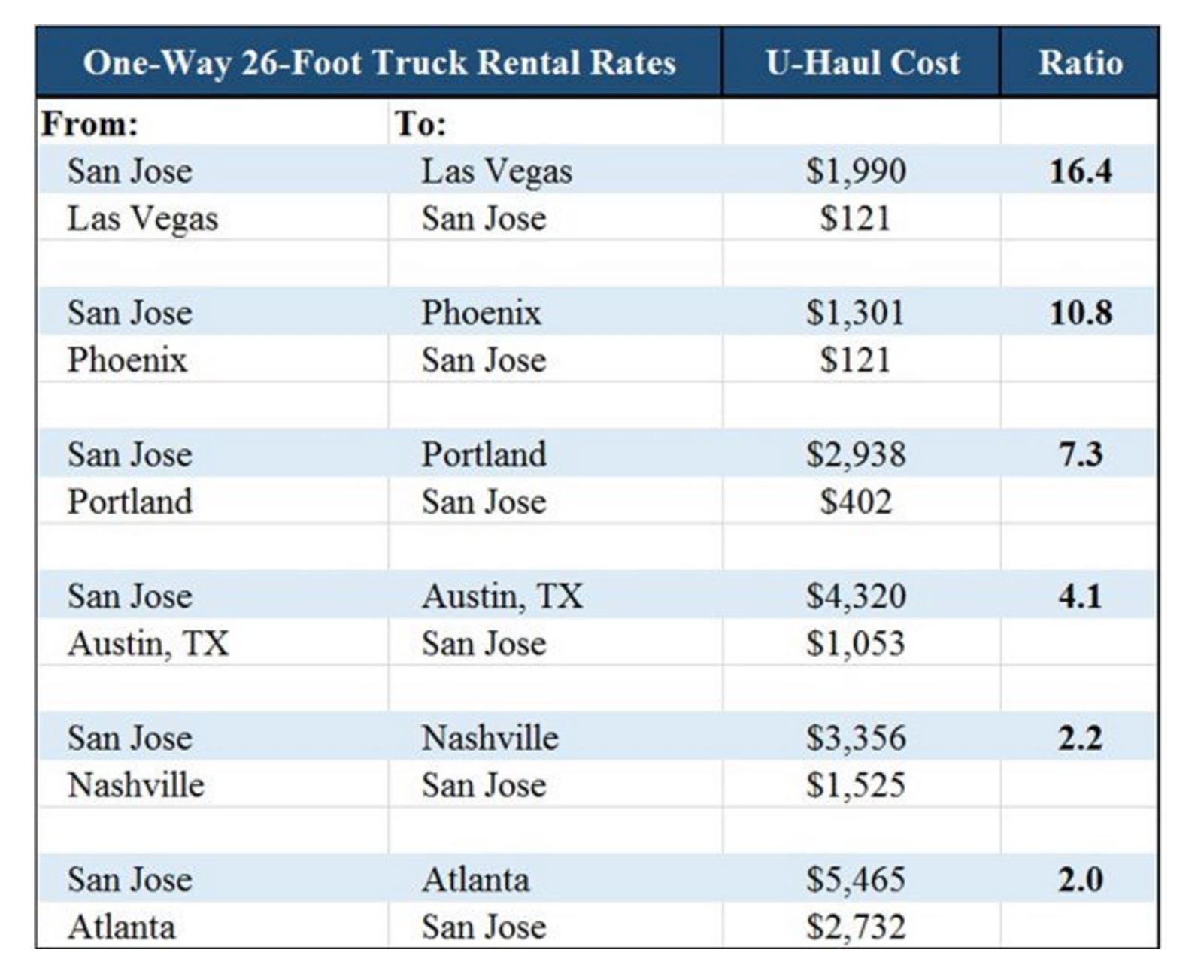
The truck rental business is a leading indicator of net migration. There is a shortage of trucks for rent to get out of California. The rates can be 300% higher to rent a truck for one-way trips out of California v trips into the La La Land of endless taxes.

Seven U.S. states currently don’t have an income tax: Alaska, Florida, Nevada, South Dakota, Texas, Washington, and Wyoming. And residents of New Hampshire and Tennessee are also spared from handing over an extra chunk of their paycheck on April 15, though they do pay tax on dividends and income from investments. The number one place Californians are migrating to is Nevada with the truck rental ratio at 16.4:1 leaving California.

Real estate is starting to decline in the high tax states and it is flat to rising in non-income taxed states. California has surpassed some of the most socialistic taxed countries in Europe and they get even less. So where does the money go? Into the pension for state employees. CalPERS is still underfunded, and it is a $345 billion pension fund has been collecting more money from employers. In 2016, CalPERS paid out $20.5 billion in benefits – $4 billion more than it earned, according to its annual financial report.

Sacramento Mayor Darrell Steinberg, seen here delivering the State of the City address on Jan. 18, wants to raise sales taxes to cover pension costs that are rising. The pension crisis will simply bankrupt the State and politicians refuse to address the problems.

Gov. Jerry Brown and Treasurer John Chiang have cooked up an idea to borrow $6 billion from the state’s Pooled Money Investment Account and spend it on an extra payment to the CalPERS — that is, make an advance payment to CalPERS for pensions. The idea was aired by Brown in his May 2017 budget proposal. In January 2017, Jerry Brown wanted a 42% increase in gas taxes to bailout CalPERS.

All of these schemes are only to help government employees – not the poor on the street in some magnanimous social caring effort. The question becomes, when will the sheet be pulled off the Democratic agenda laced with class warfare pretending this is for the people when it is for the government? A real Democrat is not a Donkey – it’s a Zebra, like Hillary who said you say one thing publicly and another privately.

California became a State on September 9th, 1850. When will California break away from the USA? The window opens in 2022.

Draghi Admits He Cannot Stop Buying Gov’t Debt


Draghi has realized that he has singlehandedly destroyed the European bond market. Besides the fact that it is illegal to short government bonds, he has come face to face with the stark reality that if the ECB stops buying government bonds, there will be NO BID at these price levels. Interest rates will skyrocket dramatically. On the German 10-year bond, once we see a monthly closing above .79, we are looking at a DOUBLING of rates and that is in Germany. Once rates rise above 1.55, then expect it to rapidly DOUBLE again.

Consequently, Mario Draghi has been warned there is a serious problem. He told the Economic and Monetary Affairs Committee of the European Parliament that he would maintain a very loose monetary policy because it was necessary despite the upturn in the euro area. He said that INFLATION remains critically dependent on a strong push using monetary policy. Of course, you would assume that after 10 years of this policy and there is no sign of a major return of inflation, that you would start to question the entire Quantity of Money Theory.

Draghi said Monday that he will continue to include the billion-dollar bond purchase program and he will reinvest expiring bonds exactly OPPOSITE of the policy at the Federal Reserve. While the dollar-bears keep calling to the end of the Greenback, they are deaf, dumb and blind when it comes to international capital flows or monetary policy.

Draghi realizes that he is subsidizing the European governments. He is not stimulating the economy, he simply has them on life-support.  Stopping the bond program will lead to a major crisis when there is NO BID for government bonds. Not only will Draghi keep buying government debt, he will be repurchasing debt as what he already has expired.

Draghi has created the economic NIGHTMARE from which there is no escape. We will be putting together a special report on World Debt market since this is the real crisis we are facing with the Monetary Crisis Cycle that began here in 2018

U.S. District Judge Rejects Lawsuit Attempting To Block Border Wall…


Still no word on the turrets and sharks with lasers idea, but we’re holding steady…

SAN FRANCISCO (Reuters) – A U.S. judge on Tuesday sided with President Donald Trump’s administration and rejected an attempt by the state of California and environmental groups to stop the government from building a wall on the U.S. border with Mexico.

The lawsuit filed in a San Diego federal court alleged that Trump’s proposed wall violates federal environmental standards, as well as constitutional provisions regarding the separation of powers and states’ rights.

The plaintiffs asked U.S. District Judge Gonzalo Curiel to stop the administration from pursuing the barrier until it demonstrates compliance with environmental laws.

The wall, a key item for Trump’s political base of supporters, has become a sticking point in talks to keep alive a federal program that protects from deportation young people who were brought to the United States illegally as children.

In his latest budget proposal to Congress, Trump requested $23 billion for border security, most of it for building the wall.

Curiel said his decision on Tuesday was not based on whether the underlying decisions to construct the wall “are politically wise or prudent.” Rather, Curiel said the Trump administration had not exceeded its legal authority in pursuing the project.  (read more)