US Taxes Can Expose Wealth of Royal FAMILY in UK


The marriage of Prince Harry with Meghan Markle, an American, presents a real nightmare for the Royal Family. Meghan is required by law to not merely pay taxes on worldwide income, but if she receives money from her husband or his family, that will be income of gifts both of which will be taxable in the USA even if she never returns to the United States – EVER!

Worse still, Meghan will have to file Form 8938 if she has more than $300,000 worth of assets in any given tax year. She is already a millionaire for her acting career so filing Form 8938 means she will have to reveal in great detail all assets she owns. This may now include foreign trusts and details of the royal family’s estate that was previously undisclosed. One the USA and Japan tax worldwide income. Everyone else is far more civilized. You do not pay taxes if you live overseas. The theory is rather simple. You pay tax because you are using the services. Under USA law, you are owned by the government and are thus the property of the state and whatever you make even living outside the USA, taxes art due.

The tax code is proving a difficult obstacle for the Royal Family.

Cross the Line & They Go Nuts


COMMENT: They use to call you Mr. Yen. They also called you the manipulator of the world. Then it was the legend. Now they will call you Mr. Dow.

All the best

SJ

REPLY: Well, they always have to find someone to blame. Cross the line and try to explore new methodologies and they just go nuts. I can understand Mr. Yen, and I get the crazy allegation by the government that I manipulate the world economy, but the “legend” I really remain clueless as to what that one is about. As to Mr. Dow – well I suppose that’s next in the queue.

They prefer to always claim I have too much influence rather than look at what I am saying and the methodology. It is just human nature to desperately try to keep everything unchanged. Labelling someone is a form of downgrading them.

BitCoin Reality Check?


At What Point do we reach Euphoria in the Equity Markets?


QUESTION:

Marty,

John Templeton has said “Bull markets are born in pessimism, grow on skepticism, mature on optimism and die on euphoria. The time of maximum pessimism is the best time to buy, and the time of maximum optimism is the best time to sell.” “If you want to have a better performance than the crowd, you must do things differently from the crowd.”

My question is…….. at what point do we reach euphoria in the equity markets?

ANSWER: Our Energy Models are designed to ascertain that dimension of a market. Naturally, everyone responds to whatever the last event is in recent memory. Therefore, the 2007-2009 Crash lives on in their experience so that means they will be skeptical of new highs. We have witnessed that with analysts constantly calling for every new high would be the last. They keep trying to forecast the last event because they missed that one as well.

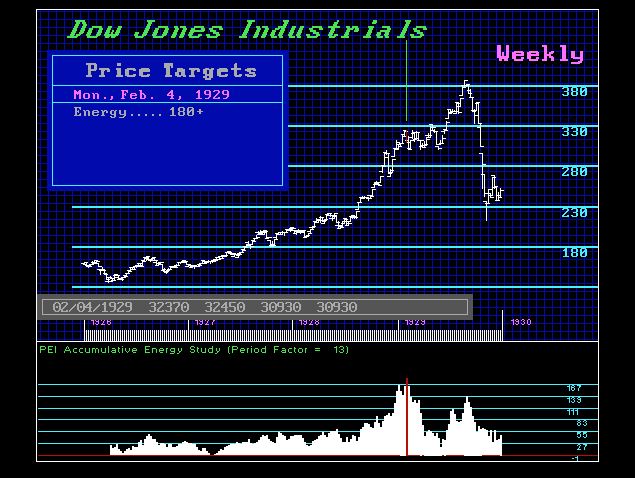
The only way to approach this is from a quantitative viewpoint. Human opinion will inevitably be wrong no matter who it is. How the market responds to our Energy Models is critical for long-term forecasting. Look at the chart for 1929. Here you see that there is a huge spike in energy which peaked in February 1929. The market rallied to new highs but note that the Energy Models we not making new highs. This peak BEFORE the major high confirmed a very serious undermining of the market structure warning that this type of high was a Bubble and therefore would not be exceeded for decades.

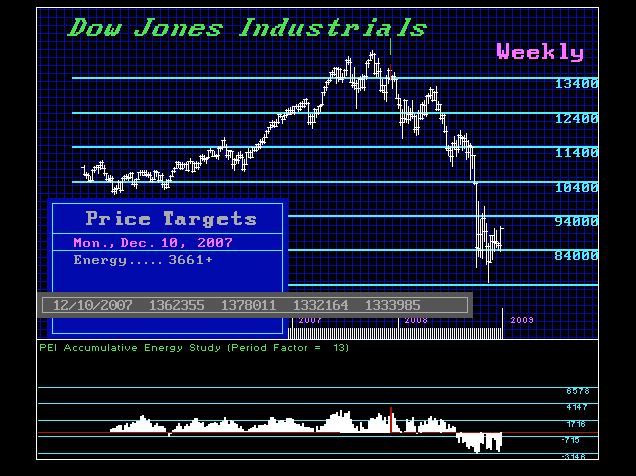
Now compare this to the Energy Models for the 2007 high. We do not have aBUBBLE formation at all and the high came on the reaction high following the major high for the move. This confirmed this was by no means a BUBBLE and in fact new record highs would be make once again.

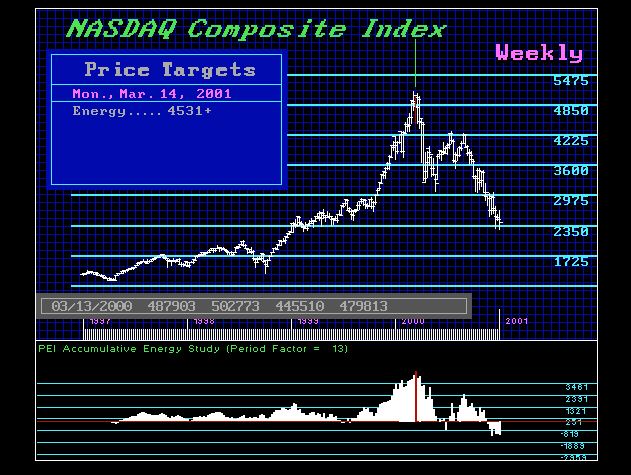
Let’s turn to the DOT.COM BUBBLE. The first thing you will notice is that the Energy was clearly in a BUBBLE formation. The slight difference here is that the Energy Model peaked the week after the high rather than before. This confirmed that it was not going to be a 1929 type event and the new record highs would be made which indeed unfolded in April 2015 which was 61 quarters intraday and 66 quarters to close above the 2000 high on a quarterly basis.

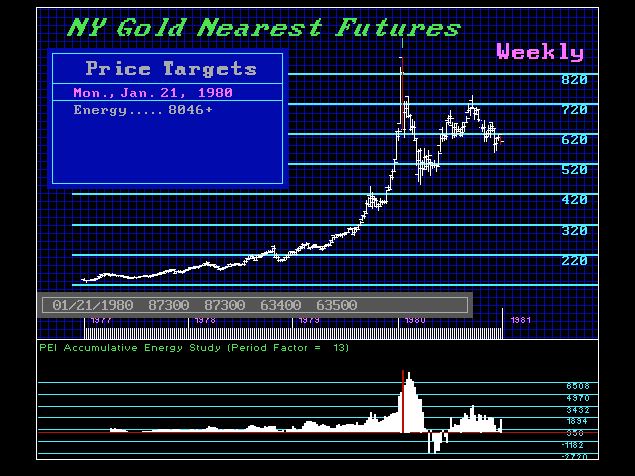
Here is gold for the 1980 BUBBLE. Once again you see the extreme BUBBLE formation and here the peak took place with the peak in gold. So while we are not looking at the same type of formation with the peak unfolding in advance of the high as in 1929, this reflected that gold would eventually make new record highs within a mid-term perspective. Unquestionable, it took 19 years for gold to decline before the major low was established. Gold finally exceeded the 1980 high during the crisis of 2008.
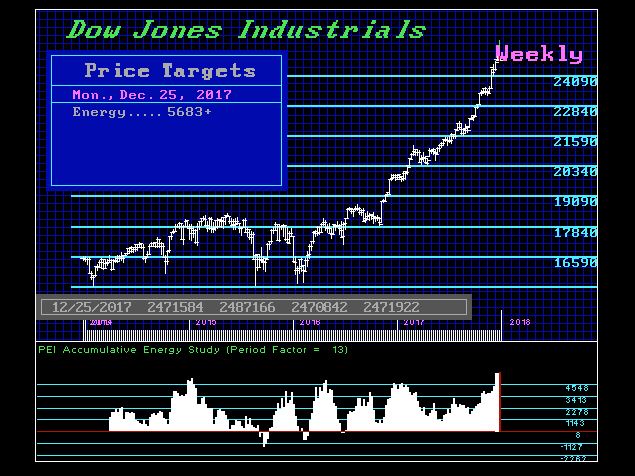
Now, let us look at the current situation. Again we do not have a major BUBBLE formation. What we do have is a market that is still expanding and in fact, the high on our Energy Models on the weekly level took place last week. This implies we would still press higher into January and that has been out target once you exceeded the November high.
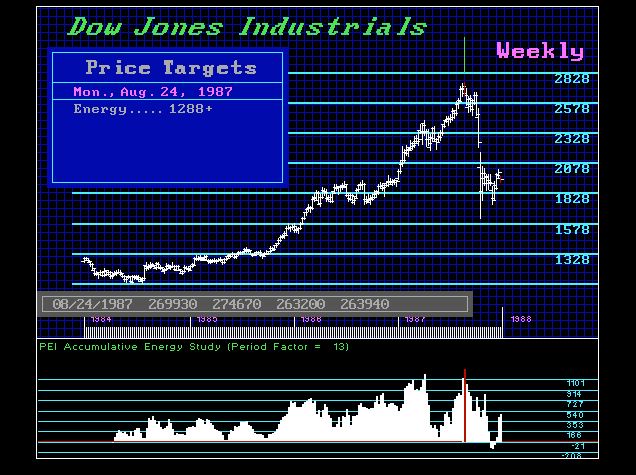
We are by no means in a 1929 BUBBLE type of formation. Here is the view of the 1987 Crash. Like Gold, the peak came 1 week following the high. Yet we see escalating advances in Energy leading into the 1987 high. So far, we lack that type of pattern warning that the real advance in our Energy Models is yet to come.
Therefore, the answer to your question is rather simple. It is always a matter of TIME rather than price. As markets rally, human interpretation of price will always be wrong. NOBODY is going to call this final high from a human perspective and anyone who claims that will be a fraud. It is not a matter of opinion for we can personally only forecast what we think is possible, to begin with.

The 2017 Closing US$ – Gold – Dow


The Dow failed to OPEN above the 2017 Intraday high so we are not yet ready for prime time. This is still a 0ff-Broadway play, but we are getting closer. The dollar still finished neutral so it too is not yet ready for its move higher. Gold closed in a positive position for the end of 2017 confirming the posture in the dollar.

We will review all the world markets for 2018 in the coming Outlook Report for 2018.

Housing Begins to Crash – Australia – New Zealand – London


Property values are starting to crash hard in Sydney Australia, New Zealand, and London. Politicians are simply idiots. They all targeted foreigners buying property as the leading cause for the rise in housing prices. What they failed to grasp is that people spend more money when they THINK they have equity in their home. Whenever housing starts to decline, so does consumer spending and guess what – you get the economi9c downturn. Dah!

Universal Basic Income – Insanity or Rational?


QUESTION: What is your opinion of Elon Musk and Mark Zuckerberg idea of universal income?

ANSWER: The idea of free money being touted by Elon Musk and Mark Zuckerberg only demonstrates that they know nothing about humanity or economics. They see universal free money as a cushion for workers whose jobs might be replaced by automation or robots. They argue that free money could provide workers with the flexibility to retrain for a new career, pursue creative interests, or start their own business.

If we are talking about a temporary benefit during a retraining period, then that is an entirely different idea from a universal basic income guarantee. You can drive down the streets in New Jersey and you see hand-made signs posted that they pay cash for diabetes medical material handed out free by the government. They also sell food stamps. You cannot change humanity. Some people will obey the rules and others will circumvent them.

The last thing you want to do in society is provide to the population some sort of guaranteed income where people can stay home and do nothing. This will foster the same hatred of anyone who works and has more than they do and it will promote hatred and class warfare.

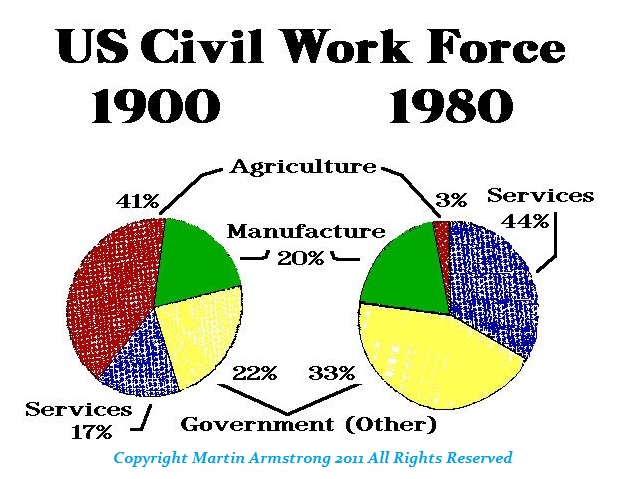
When the automobile was invented, that displaced people who were carpenters making wagons. When the Dust Bow hit during the Great Depression, it added to the displacement of farmers. The tractors replaced people tilling the soil just as the cotton gin replace slave labor in the South. Technology will always replace workers and the greater the tax burden, the greater the incentive to replace workers.

Neither Elon Musk nor Mark Zuckerberg has any clue about economic history for if they did, they would understand that technology always advances and displaces segments of the workforce. This is also one reason governments like war to thin the herd when unemployment rises.

Providing free money is actually an experiment in Finland. It began one year ago taking 2,000 unemployed Finns who were randomly selected from across the country for a trial testing universal basic income. Each month for two years they would receive €560 euros from the government, tax-free. They can spend the money however they decide. The plus of this program is the reduction in bureaucracy. As I said, the US government hands out food stamps but people sell them. From an economic standpoint, this system is less costly than the current one in play with bureaucrats determining what they will allow people to have or not. The full report on the Finland experiment will not be issued until the 2-year program is complete after January 1st, 2019.


Why Models Fail


QUESTION: Mr. Armstrong; Did AIG use the Black-Scholes Model and that is what created the crisis again in 2007?

WJ

ANSWER: No. It’s my understanding that AIG developed different models, they called a “Value-at-Risk Model,” (VaR) which used a binomial-expansion-technique to start valuing their positions. I believe the original model was developed at Moody’s. However, like the Black-Scholes Model, it too lacked depth. In model development, it is extremely complex.

Virtually every model created tends to be predominately flat with a minimum of dynamic variables lacking understanding of TIME. Then the testing period lacks the database reflecting all conditions. In the case of Black-Scholes, they back-tested only with data to 1971. If I created a model with only data from 2009 forward, then it would be biased to presume a bull market is normal in the stock market.

The Value at risk (VaR) model is a measure of the risk of investments. It estimates how much a set of investments might lose, given normal market conditions, in a set time period such as a day. VaR is typically used by firms and regulators in the financial industry to gauge the number of assets needed to cover possible losses. It obviously failed in 2007-2009 because once again it was not a “normal market condition” for it fails utterly to understand CONTAGION when sound assets are sold to raise cash for other assets that collapse. The assumption of the model is its own nemesis.

For example, if a portfolio of stocks has a one-day 5% VaR of $10 million, this actually means that there is a 5% probability that the portfolio will fall in value by more than $1o million over a one-day period if there is no trading. Therefore, a loss of $1o million or more on this portfolio would be expected on 1 day out of 20 days given a 5% probability. A loss which exceeds the VaR threshold is termed a “VaR breach“.

So you can see, such models are incapable of determining TIME and as a result, they will always fail during a CONTAGION that they cannot see coming.

This is why the bulk of portfolio models fails during a financial crisis. This is also why some of the top Institutional portfolios come to our firm because they have realized that only TIME determines the success of any model and making broad assumptions of probability have ALWAYS failed. If you cannot model TIME and CONTAGION, you will be wiped out during a crisis and VaR will fail just as Black-Sholes.