Biden Administration Confirms Canadian and Mexican Truck Drivers Must Show Vaccination Passport Beginning Tomorrow


Posted originally on the conservative tree house on January 21, 2022 | Sundance | 348 Comments

The preparation window has closed.

Given the destabilized and tenuous nature of the current supply chain, many people wondered if the Biden administration would actually be stupid enough to follow through with a truck driver vaccination mandate.  The answer is yes.  Please conduct yourselves accordingly.
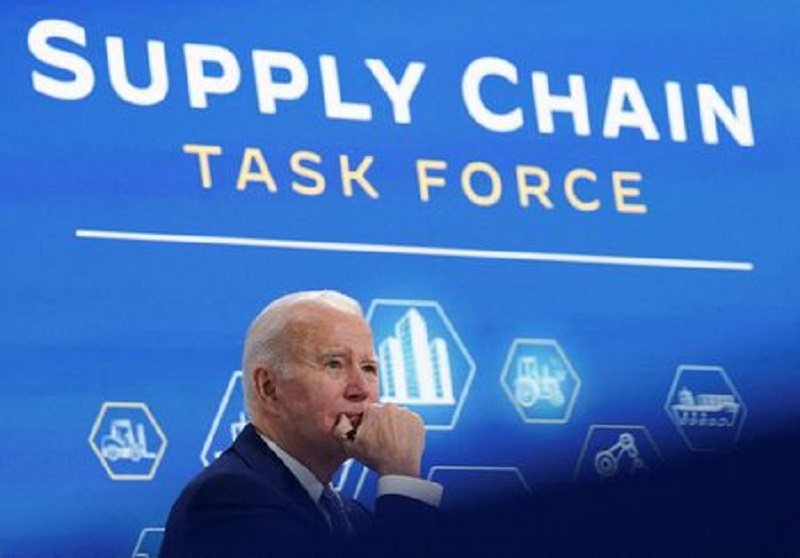
The Department of Homeland Security (DHS) updated their guidance yesterday [LINK HERE] and put a hard date of tomorrow, January 22nd, for the trucker vaccine mandate at all border crossings and ferry terminals.   Canada put the vaccine mandate into effect last week, January 15th.

[Dept. of Homeland Security] – [..]  “Starting on January 22, 2022, the Department of Homeland Security will require that non-U.S. individuals entering the United States via land ports of entry or ferry terminals along our Northern and Southern borders be fully vaccinated against COVID-19 and be prepared to show related proof of vaccination,” said Secretary Alejandro N. Mayorkas. “These updated travel requirements reflect the Biden-Harris Administration’s commitment to protecting public health while safely facilitating the cross-border trade and travel that is critical to our economy.”

These changes – which were first announced in October 2021 and made in consultation with the White House and several federal agencies, including the Centers for Disease Control and Prevention (CDC) – will align public health measures that govern land travel with those that govern incoming international air travel.

Non-U.S. individuals traveling to the United States via land ports of entry or ferry terminals, whether for essential or non-essential reasons, must:

  • verbally attest to their COVID-19 vaccination status;
  • provide proof of a CDC-approved COVID-19 vaccination, as outlined on the CDC website;
  • present a valid Western Hemisphere Travel Initiative (WHTI)-compliant document, such as a valid passport, Trusted Traveler Program card, or Enhanced Tribal Card; and,
  • be prepared to present any other relevant documents requested by a U.S. Customs and Border Protection (CBP) officer during a border inspection.

COVID-19 testing is not required for entry via a land port of entry or ferry terminal.

Although these new vaccination requirements do not apply to U.S. citizens, Lawful Permanent Residents, or U.S. nationals, all travelers are reminded to bring a WHTI-compliant document when re-entering the United States.  (more)

Approximately 50% of U.S. Truck Drivers are unvaccinated, they can no longer enter Canada.  Starting tomorrow, Canadian and Mexican truck drivers must be vaccinated, or they will not be able to enter the U.S.
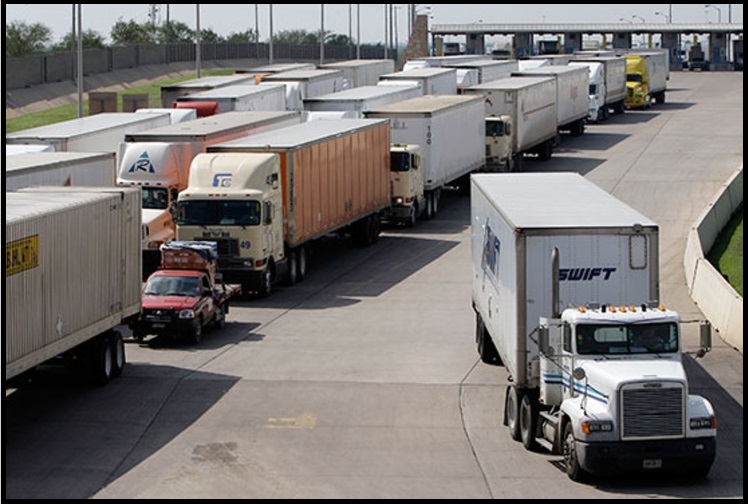
Land shipments of fresh fruits and vegetables into Canada are immediately impacted.  Land shipments of fresh fruits and vegetables into the U.S. from Mexico are impacted starting tomorrow.  In addition to agriculture, lumber and auto-parts are likely to face significant impact.

CANADA – […] Alberta Premier Jason Kenney, at a news conference in Calgary, urged the government to extend an exemption that had been in place for truckers since the start of the pandemic.

Kenney made his request on the same day the United States confirmed its own vaccine border mandate for truckers would start on Saturday. Canada’s has been in place since Jan. 15.

“Common sense tells us that we are at the peak of supply chain constraints across North America, around the world, huge inflation,” Kenney said.

This is not the moment “to lose potentially thousands of truckers on our roads, bringing groceries up from the US and who knows maybe (COVID) rapid test kits as well,” he said.

As many as 32,000, or 20 per cent, of the 160,000 Canadian and American cross-border truck drivers may be taken off the roads by the mandate, the Canadian Trucking Alliance (CTA) estimates. The industry was short some 18,000 drivers even before the mandate, CTA said. (read more)

The bottom line is both shortages and higher prices.  Canada will feel it the worst; however, U.S. stores will feel it also.  The inflation this will drive will be on top of existing price pressure.  We have been warning since October, prices will increase, and shortages will be impactful.

The retail food stores have been reflecting the majority of the price increase from government COVID policy.  This vaccine mandate will make those price increases more as transportation costs will increase again.   However, the second route for fresh food delivery, “food away from home“, will suffer the majority of this price increase.  Restaurants, hotels, cafeterias, bars and institutional settings (hospitals, nursing homes, etc.) will see significant increases in their food costs.

A perfect storm has been created by policy.
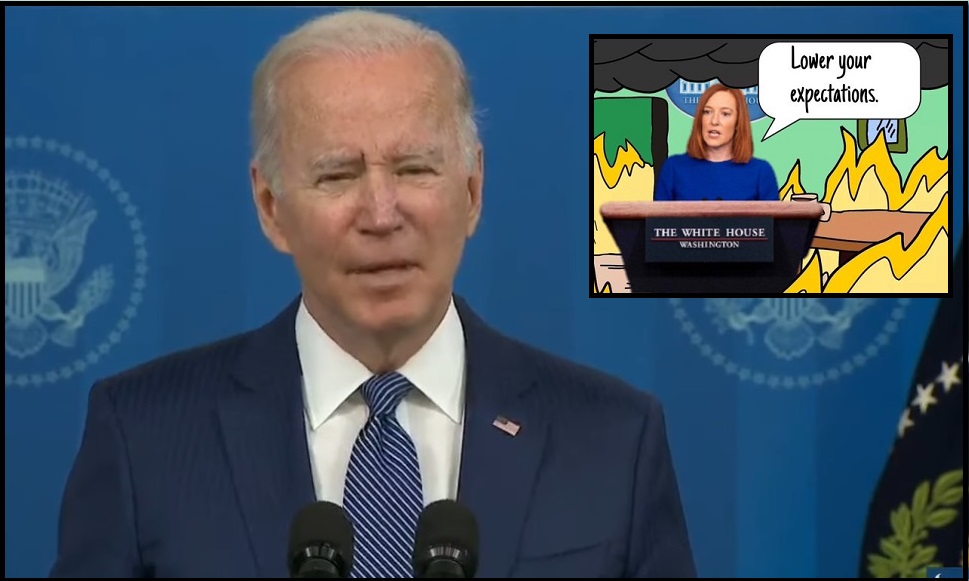
Energy policy has driven up oil, fuel, packaging and gas prices.  Transportation costs have skyrocketed. Emission regulations have driven up port costs and delayed transportation fracturing the supply chain.  Vaccine mandates have hit the manufacturing and processing sectors.  Legislative policy and COVID spending have artificially inflated the economy.  Monetary policy has devalued the dollar and driven even higher inflation.

A tenuous economy cannot take these self-inflicted wounds…. and it’s about to get worse.

Into this hurricane of stagflation, the fed is going to raise interest rates.  The stock market could lose half its inflated value.  The NASDAQ is already responding to the storm clouds.  Employment is going to start getting really sketchy.  Congress will eventually announce their remedy, which will be more spending – and the dollar gets worse.

All of this was avoidable.

None of this is caused by COVID-19.

All of this is caused by Joe Biden’s economic, financial, monetary and legislative policy.

The people behind Joe Biden are laughing….

Biden has no idea.

IRS: Expect Tax Delays This Year


Armstrong Economics Blog/The Hunt for Taxes Re-Posted Jan 21, 2022 by Martin Armstrong

The Treasury Department has warned that the Internal Revenue Service (IRS) may face “enormous challenges” processing returns this year. The IRS usually enters tax season with one million outstanding returns from the year prior, according to the Washington Post. However, the IRS currently has 6 million outstanding individual returns and 2 million unprocessed amended returns from 2020. Numerous social programs and tax credits provided to millions of Americans during the pandemic only exacerbated the problem.

Adding to the problem is the labor shortage and budget cuts as the agency has lost 25% of its workforce. “By definition, no matter how much more efficient you are, you can’t lose 25 percent of the workforce and assume you can do the same volume of work. It’s a problem across the board — information technology; revenue agents; people answering the phones,” said John Koskinen, former commissioner of the IRS under presidents Barack Obama and Donald Trump.

Worsening matters, as government agencies tend to do, the IRS will begin requiring photo identification to process taxes beginning in the summer of 2022. You don’t need an ID to vote, but you certainly need one for the government to track the money it believes you owe. The IRS website previously only required users to make a simple name and password. Beginning in the summer, users will need to upload a government ID and take a video selfie.  “Tax payments can be made from a bank account, by credit card or by other means without the use of facial recognition technology or registering for an account,” the IRS stated. However, people will be unable to use certain features without uploading a video selfie. How are the elderly going to use this feature? Will those living in poverty face consequences for not having a smartphone or computer? This seems like another great way for the government to compile our personal data and develop better facial recognition software.

Despite the drastic backlog, there will be no extension for taxpayers; the government wants their money by April 18. As I have always said in the past, receiving a refund is not a gift from the government. The government preys on the poorest people in society by holding onto their funds for a year and preventing them from investing. They expect the people to provide them with an interest-free loan every year, and in exchange, they will dissect each tax return for errors and ask for more money.

Supply Chain, Ominous Headline from Canada: “Brace for Impact”


Posted originally on the conservative tree house on January 20, 2022 | Sundance | 285 Comments

The business section of the Toronto Star has an appropriate albeit ominous headline for Canadians today:

“Brace for impact: Our supply chain is about to take a further hit, and we’ll all feel it

The news couldn’t come at a worse time considering that Canada is feeling the biggest increase in food inflation in the past 30 years.  Yeah, for American’s it is a bad situation, but for those north of the border it’s even worse.

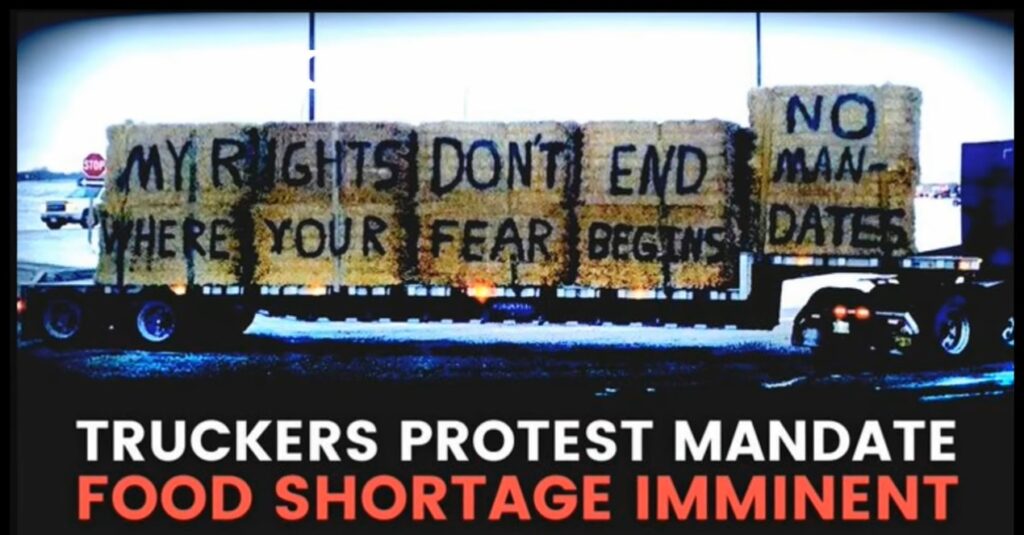
The truckers north of the border are planning a major protest to draw the attention of Canadian citizens who continue to keep their head buried. #TruckersForFreedom.   What they are trying to avoid, is soon to be unavoidable.

(MSM, CANADA) – In Canada, where as much as 90% of the country’s fruits and vegetables come from the US during the winter, a vaccine mandate for truckers is slowing down food shipments. Drivers who aren’t fully vaccinated against covid-19 have to quarantine for two weeks after entering Canada. Just about half of US truckers are vaccinated, according to industry estimates.

Vaccination rates among Canadian truckers are roughly in line with the national average, which is in the 83% to 87% range, according to the Canadian Trucker Alliance.

The mandate adds to the already strained supply chains in Canada, which have been subject to worker shortages, transportation bottlenecks, and recent storms. These factors are pushing up food prices globally.

The price to bring food across the border has doubled on some routes due to the scarcity of available truckers, Alex Crane, an operations manager at Paige Logistics, a freight broker in British Columbia, told Bloomberg. As a result, some shipments are just sitting in warehouses.  The US is set to impose similar rules on Jan. 22, which could worsen the cross-border food trade. (read more)

Freedom Convoy 2022 has raised over $625,000 [SEE HERE] to support a trucker protest, pay for fuel and cover the basic expenses of hundreds of truck drivers who are driving their rigs to Ottawa to rally for removal of the vaccine mandate.

“We are taking our fight to the doorsteps of our Federal Government and demanding that they cease all mandates against its people,” wrote Go Fund Me organizer Tamara Lich. “Small businesses are being destroyed, homes are being destroyed, and people are being mistreated and denied fundamental necessities to survive.”

The decision for Canadian truckers to meet in Ottawa to protest the vaccine mandate comes as the industry struggles with issues , such as disruptions to the supply chain and a shortage of drivers.  The federal vaccine mandate could result in a loss of 12,000 to 16,000 cross-border commercial drivers, according to the Canadian Trucking Alliance.

“THESE are the times that try men’s souls. The summer soldier and the sunshine patriot will, in this crisis, shrink from the service of their country; but he that stands it now, deserves the love and thanks of man and woman.

Tyranny, like hell, is not easily conquered; yet we have this consolation with us, that the harder the conflict, the more glorious the triumph.

What we obtain too cheap, we esteem too lightly: it is dearness only that gives everything its value. Heaven knows how to put a proper price upon its goods; and it would be strange indeed if so celestial an article as FREEDOM should not be highly rated.”

Thomas Paine

Unemployment Claims Rise for Third Straight Week to 286,000


Posted on the conservative tree house on January 20, 2022 | Sundance | 107 Comments

The U.S. Dept of Labor has released the unemployment claim data [DATA HERE], and the results show claims of 286,000 last week: an increase of 55,000 from prior week and the third consecutive week of increased claims.

As we have continued to point out from data, in part due to the vaccine mandate, and in part due to the underlying economic issues created by the Biden administration, the working class economy has bifurcated and cleaved.   The trendline is negative.

Ask yourself, where are these current claimants going to gain future jobs when the inflationary pressure is contracting consumer demand?

WASHINGTON (AP) — The number of Americans applying for unemployment benefits rose to the highest level in three months as the fast-spreading omicron variant disrupted the job market.

Jobless claims rose for the third straight week — by 55,000 to 286,000, highest since mid-October, the Labor Department reported Thursday. The four-week average of claims, which smooths out weekly volatility, rose by 20,000 to 231,000, highest since late November.

A surge in COVID-19 cases has set back what had been a strong comeback from last year’s short but devastating coronavirus recession. Jobless claims, a proxy for layoffs, had fallen mostly steadily for about a year and late last year dipped below the pre-pandemic average of around 220,000 a week.

Altogether, 1.6 million people were collecting jobless aid the week that ended Jan. 8.

Companies are hanging on to workers they have at a time when it’s difficult to find replacements. Employers posted 10.6 million job openings in November, the fifth-highest monthly total in records going back to 2000. (read more)

The highest insured unemployment rates in the week ending January 1 were in Alaska (3.1), Minnesota (2.8), Kentucky (2.7), New Jersey (2.6), New York (2.6), Rhode Island (2.5), California (2.4), Connecticut (2.4), Massachusetts (2.3), and Oregon (2.3).

The largest increases in initial claims for the week ending January 8 were in California (+11,295), New York (+10,639), Texas (+10,437), Kentucky (+8,476), and Missouri (+7,768).

While there is still inflationary pressure to jump jobs in order to capture higher wages in many sectors of the economy, the manufacturing sector is becoming more unstable.  I believe demand is contracting. Remember, productivity in the third quarter (June, July, August) was -5.2%.

PRIOR WARNING – The value of all products and services generated in the third quarter increased by 1.8 percent.  However, the labor cost of generating that small amount of added value increased by 7.4 percent.  The difference between those two numbers is a drop in productivity of 5.2% over the entire quarter.

This was the largest quarterly drop in productivity since 1960 !

The Biden administration will blame the drop in productivity on a lack of material to produce the end product (ie. the COVID excuse).  Which means employed people were sitting around waiting for goods to arrive and being less productive.   There is a small amount of that which might be true.  However, it is not the biggest factor, at least not on this scale.  Keep in mind we are talking about both goods and services.

The more likely cause of such a massive decline in productivity is a genuine decline in demand.  In the aggregate, consumers needed less goods and services.  This likelihood aligns with the diminished and softened retail sales figures recently noted.   It is a simple cause and effect.  When gasoline, energy, and essential products like food cost more, consumers have less money for other stuff.  Demand for the non-essential products drop.

As the demand drops, the productivity of the economic activity to generate those goods and services also drops.  However, the scale of the decline is the part to pay attention to.  A five percent drop in productivity is huge for a single quarter.  Under normal circumstances, this means more slack in the labor market, and that is what we saw recently in the retail sector of the employment figures from November {data here}.

During the month when retailers are customarily ramping up their employment to cope with increases in consumer demand, last month that didn’t happen.   The ‘retail sector‘ lost 20,000 jobs in November.  Think about that.

At the time of the November jobs report, the “national economists” were trying to figure out why the employment report missed expectations by 300,000+ jobs.  We were not so surprised, because the actual result aligned with other data suggesting the Q3 economy overall was contracting.  Consumers are being squeezed by inflation, that is creating a stagnant economy or “stagflation.”

Wage growth is currently at 3.9% {data}, and when combined with the loss in productivity, the unit labor costs for businesses at a macro level means a total cost of +9.6 percent in the third quarter.   If employers do not start reducing their payroll costs as demand contracts, each unit produced will cost more money.  Unfortunately, that dynamic adds to inflation, and we grease the skids on this downward spiral.

I have not seen any financial pundits concerned about where this cycle naturally ends.  Perhaps the media silence is because the White House knew the Q3 productivity data was alarming, and that stirred the administration to contact those pundits in advance in an effort to avoid widespread notice.

Regardless of reason for their avoidance, a drop in productivity of such a scale tells us to complete our economic preparations as soon as possible.  The intensity of the inflation storm worsens with a weak employment outlook.

THAT warning was in early December.   We are now settling down from the holiday data skews.  Now look where we are.

Folks, we are in the center of an economic mess of FUBAR proportions.  All prices are rising, the supply chain is a tenuous mess and getting worse, supplies of critical goods are now shrinking, wage increases are insignificant when compared to inflation, and the Federal Reserve is about to start raising interest rates…. it’s the perfect storm.

China’s President Xi Begs the Fed Not to Ease Rates


Armstrong Economics Blog/World Trade Re-Posted Jan 20, 2022 by Martin Armstrong

Chinese President Xi Jinping has a request for Federal Reserve Chairman Jerome Powell — do not raise interest rates. “If major economies slam on the brakes or take a U-turn in their monetary policies, there would be serious negative spillovers. They would present challenges to global economic and financial stability, and developing countries would bear the brunt of it,” Xi said during the virtual Davos meeting.

The Fed indicated that they will gradually raise rates this year after failing to combat inflation through artificially low rates. Rates have been low for quite some time and “slamming the breaks” isn’t exactly the situation here. Poor countries risk facing a spike in debt repayments, but that is likely not Xi’s main concern.

Xi realizes that China will be forced to abandon easing policies when the Fed raises rates. China is burdened with debt, namely in the real estate sector, and developers such as Evergrande cannot currently climb out of its financial grave. China’s GDP fell to 4% year-on-year in Q4 2021 and advanced only 1.6% on a quarterly basis. The People’s Bank of China cut rates by ten basis points on Monday, but they’re going to need to change their strategy once the Fed does.

Capital will begin to flow from China to the US once it becomes an increasingly attractive place to park money. If America decreases the demand for imports, Chinese exports will feel the brunt of the burden. China heavily relies on its top trading partner, with over $463 billion entering the US through November.

“We will build a unified, open, competitive and orderly market system where all businesses enjoy equal status before the law, and have equal opportunities in the marketplace,” Xi said. Well, that is not how the world economy functions. The Fed will not abandon domestic interests in favor of foreign ones and Powell knows he needs to act soon to control runaway inflation.

Proctor and Gamble Announce Another Wave of Retail Price Increases


Posted originally on the conservative tree house on January 19, 2022 | Sundance | 155 Comments

Proctor and Gamble makes a variety of familiar products under various brand names.  As we noted last October, we were awaiting details on a predictable next wave of retail price increases for products in the chemical and household cleaner segment.

Today, P&G announced an average price increase to retailers of 8% on their laundry products (Tide, Gain, etc.) effective with the next fulfillment of supplier purchase orders.  On the liquid detergents, that’s an average increase well over $1 per bottle…. YIKES.

(VIA CNN Business) – It’s going to cost you more to wash your clothes. Procter & Gamble (PG) said Wednesday that it was raising prices by an average of about 8% on retail customers next month for its Tide and Gain laundry detergents, Downy fabric softener and Bounce dryer sheets.

[…] “Transportation and labor markets remain tight. Availability of materials remain stretched,” P&G CEO Jon Moeller said on an analyst call Wednesday. “In some categories and in some markets, inflationary pressures are broad-based with little sign of near-term relief.” P&G makes many of the most recognizable brands in US homes, such as Gillette, Charmin, Bounty, Pampers and Crest.

[…] Moeller said P&G has raised prices on all 10 of its product categories in the United States and told retailers Tuesday it will be increasing prices on some personal health care brands in April, although he didn’t specify which ones. (P&G makes Metamucil, Neurobion, Pepto-Bismol and Vicks.)  (read more)

OCTOBER WARNING – The wholesale prices of products into the system that end up at the retail level is still through the roof.   In a major way, this is being driven by massive increases in energy costs throughout the entire supply chain.

This is going to get even uglier.  Even if wages jumped in price 5% overnight (single month), which would be a large increase in wages, those wage increases are nowhere near enough to deal with this level of price increase at a consumer level.   A nickel more per dollar earned is futile against a loaf of bread costing $1 more, or gasoline at $4.00/gal.

Do what you can do now to start preparing your weekly budget in ways you may not have thought about before.   Shop sales, use coupons, look for discounts and products that can be reformulated into multiple meals or multiple uses.   Shelf-stable food products that can be muti-purposed with proteins is a good start.

Consider purchasing the raw materials for cleaning products and reformulate them yourself to avoid these massive increases in petroleum costs.  Most working families use laundry detergent, and that cost is going through the roof with no signs of slowing down.

♦ EXAMPLE – Several years ago, a dear friend showed us a method for making laundry detergent at home along with a bucket.  After using this for several weeks (and then making it) I was stunned at how simple, cost-effective, and good it works. Not only does it save big $$, but it works better than, or at least as good as, Tide or any other high-priced name brand product for literally pennies on the dollar.

What You’ll Need: {check your local store’s laundry aisle}

  • 1/2 Cup: Arm & Hammer Super Washing Soda {not Baking Soda}
  • 1/2 Cup: Borax {you might be able to print a coupon here}
  • 1/3 Bar of Fels-Naptha Soap {Mark the bar in thirds before using}
  • Bucket {3 gallon size }
  • Empty laundry detergent containers or bucket with lid to store detergent.

How to make:

Use small cheese grater to grate 1/3 bar of Fels-Naptha Soap over large pot or saucepan…

  • Add 6 cups of water.
  • Heat over medium-high until soap dissolves and melts.
  • Add 1/2 cup Washing Soda & 1/2 cup Borax, and stir until dissolved.
  • Remove from heat and set aside.
  • Pour 4 cups hot water into bucket, then add Soap Mixture.
  • Stir well, then add 1 Gallon + 6 Cups of additional water. Stir.
  • Transfer to a bucket with a lid, or pour into empty laundry detergent containers.
  • Set aside, and let it sit overnight, or up to 24 hours, to thicken and gel up.  It will likely turn into a gel overnight.
  • Consistency and color will vary depending on your soap & water ~ it may be lumpy and watery ~ kind of like a watery gel, but it works great!
  • Stir or shake before each use, as it will continue to gel.

How Much Will it Cost?

This recipe makes a low-sudsing detergent, and remember, it will turn to a liquid/gel after it settles, so you will need to shake the container before use. You can also pour it into a spray bottle to use as a pre-spot treatment. The 3 ingredients will make at least 3 batches and will last a long time.

I would not present this idea if it did not work exceptionally well, as this was one of the most useful tricks I learned to stretch a budget that really does save money and work even better than high-priced laundry detergents.   The homemade detergent even removes hard soils and red clay stains from clothing remarkably well.

We are all in this together!

December Report from Long Beach Shows Port Handling Less Cargo in December Than When Biden Announced Expanded Port Operations


Posted originally on the conservative tree house on January 19, 2022 | Sundance | 53 Comments

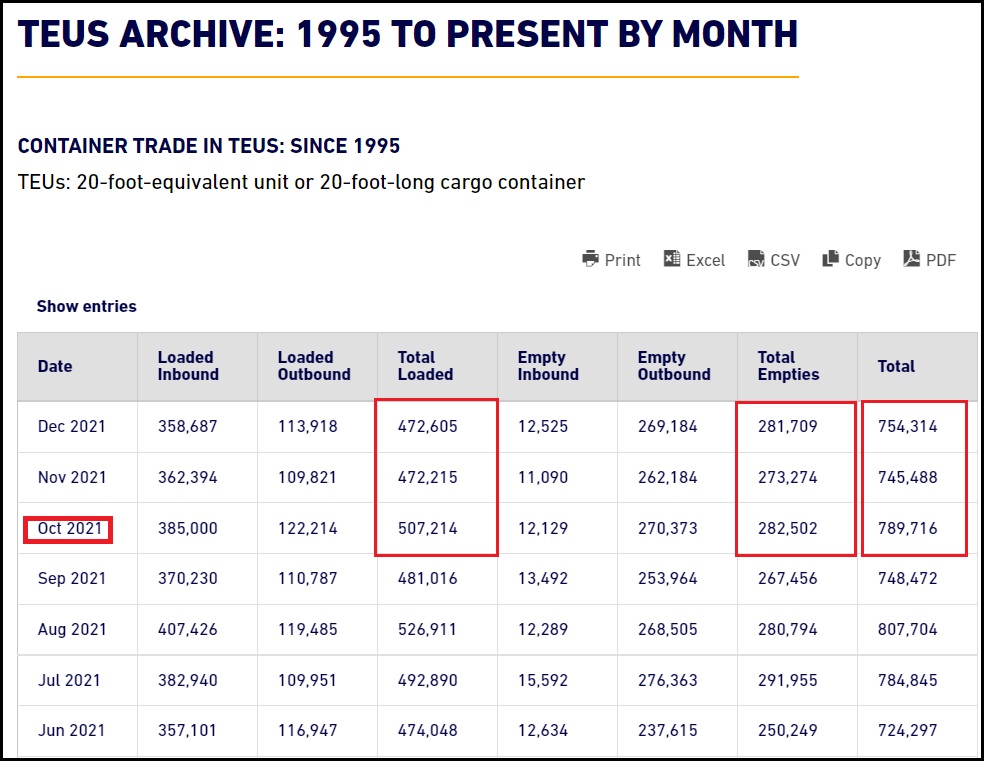
When Joe Biden took to the microphones in October to announce, “a series of public and private commitments to move more goods faster, and strengthen the resiliency of our supply chains, by moving towards 24/7 operations at the Ports of Los Angeles and Long Beach,” the supply chain objective was to increase the productivity of the ports.  However, data released for November [SEE HERE] and now December, show exactly the opposite.

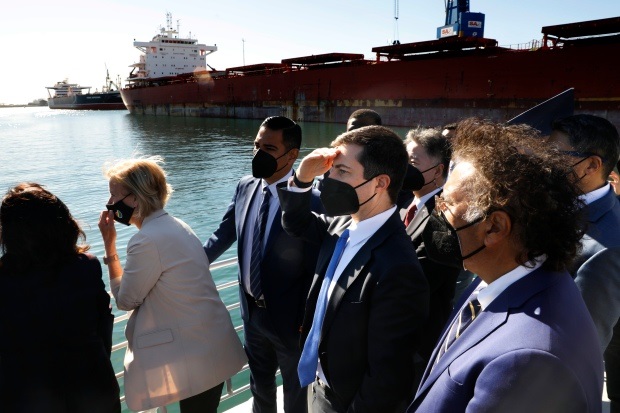
Transportation Secretary Pete Buttigieg visited both ports recently.  Both ports, along with Oakland, also made the arriving ships remain further offshore than when the October announcement was made.  They are hiding the ships.

For some unknown reason the Port of Los Angeles (POLA) has delayed reporting of December; but the Port of Long Beach (POLB) just released their data {LINK}.  What the statistics show is that less cargo is being handled now, than it was when the 24/7 port operations announcement was made:

The purpose of telling the ships to await their port time in a queue farther offshore is transparent.  The Biden administration wants to give the illusion they eliminated the bottleneck of container ships.   Out of sight is out of mind.

Operation ‘Hide the Ships’ allows the administration to make claims about port efficiencies and increased productivity that are abjectly false.  The data from the two months after the announcement shows less container offloading and onloading happened in November and December than happened in the prior month of October when the new initiatives were announced.

Many of the high-end canned cat foods (wet foods) come from Thailand processing, and we are told they are sitting in containers offshore right now.

Port of Long Beach – […] Trade was down 7.5% in December compared to the same period in 2020 with 754,314 cargo container units moved. Imports declined 11.7% to 358,687 TEUs. Exports dropped 13.9% to 113,918 TEUs, while empty containers climbed 1.5% to 281,709 TEUs. (link)

NBC Reports the U.S. Trucker Vaccine Mandate Scheduled for January 22nd May Collapse Supply Chain for Food and Auto Parts


Posted originally on the conservative tree house on January 19, 2022 | Sundance | 269 Comments

Perhaps the mainstream media is starting to wake up.  NBC is now reporting that cross-border auto parts and food shipments may start being disrupted as the trucker vaccine mandate begins.  Approximately 60 to 75% of all U.S. truckers are not vaccinated.  The cross-border vaccine mandate for American truckers begins January 22nd as part of the Dept of Homeland Security protocol.

In October DHS announced:

…”beginning in early January 2022, DHS will require that all inbound foreign national travelers crossing U.S. land or ferry POEs – whether for essential or non-essential reasons – be fully vaccinated for COVID-19 and provide related proof of vaccination. This approach will provide ample time for essential travelers such as truckers, students, and healthcare workers to get vaccinated.” (link)

The Canadian trucker vaccine mandate began January 15th, the U.S. mandate begins this weekend, January 22nd.  Given the scale of out of season fresh fruit and vegetable shipments from South and Central America, as well as Mexico, we can anticipate serious issues in the food supply chain.  The NBC article highlights trade with Canada, but that’s miniscule when compared to the trade we get from Mexico.

(Via NBC) – […] The U.S. mandate, announced in October, requires all essential foreign travelers, including truck drivers, who cross U.S. land borders to be fully vaccinated. Essential nonresident travelers had been able to enter the U.S. during the pandemic regardless of their vaccination status, in part so as not to disrupt trade and to give them more time to get vaccinated.

The forthcoming mandate follows one that went into effect in Canada last week that prohibits unvaccinated truckers from crossing into Canada from the U.S.

[…]  The border restriction will make the automotive supply chain issue worse, said Doug Betts, president of the global automotive division at J.D. Power, a data and analytics company focused on the auto industry. He noted that auto parts come from all over the world and one obstruction in the chain can significantly slow or stop production.

“By the time you map out the supply chain, it’s just a spider web going everywhere,” he said.

“I would be surprised if there are any (U.S.) cars that don’t have at least one Canadian-based part. Canada is a pretty important part of auto manufacturing,” Betts said. “Any part that doesn’t arrive or if there’s something wrong with it, you can’t build it. There’s more points of failure.”

[…]  In Michigan, Brian Hitchcock, owner of MBH Trucking LLC, said he expects his freight transportation company to lose 40 percent in revenue because only five of his 30 drivers are vaccinated, leaving the others ineligible to haul diesel exhaust fuel back and forth from Ontario, Canada, to Michigan.

And it’s all because we can’t cross the border,” he said. “It’s affecting every sector of what we use in this country.”

Hitchcock, also the interim executive director of the Michigan Trucking Association, said he’s spoken with 15 other trucking companies who have about 400 drivers, 75 percent of whom are unvaccinated.  (read more)

One example below.

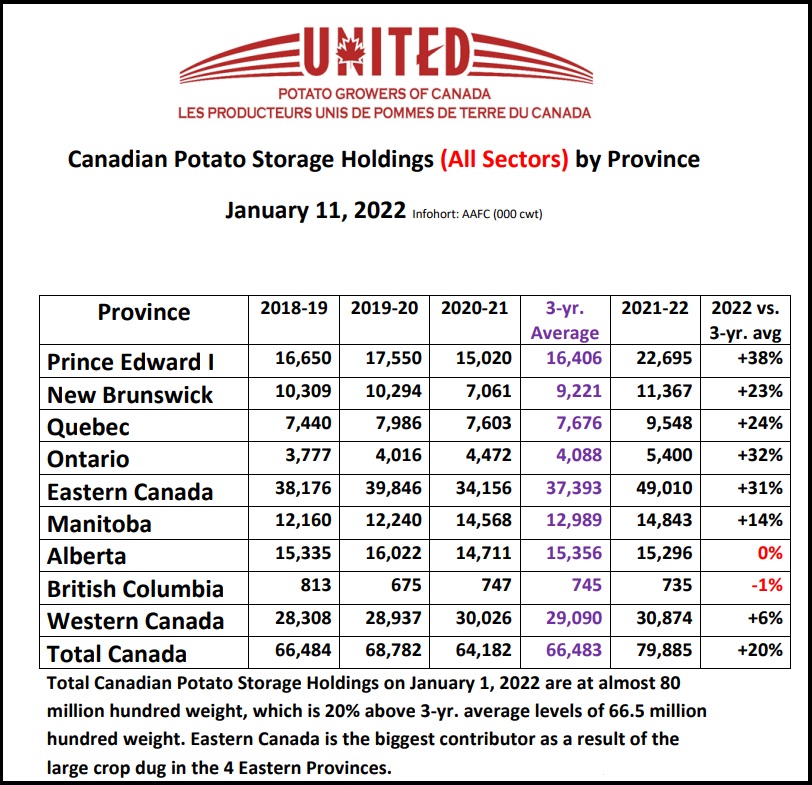
Current Canadian potatoes in deep chill storage.

[SOURCE – United Potato Canada]

80 million hundred weight (CWT) is essentially 8 million tons.  Article on excess potatoes without shipment HERE.

Good luck moving 8 million tons of potatoes without truck drivers.

Destroying the Supply Chain One Mandate at a Time


Armstrong Economics Blog/World Trade Re-Posted Jan 19, 2022 by Martin Armstrong

The Canada Border Services Agency (CBSA) initially announced that it was eliminating vaccine requirements for truck drivers amid a severe supply and labor shortage. Health Minister Jean-Yves Duclos decided that contributing to inflation by reversing the order was the “right thing to do,” and now unvaccinated truck drivers have “a right of return” but must quarantine for 14 days. So, although Canada cannot ban their citizens from re-entering the country, they can force drivers to submit to tests and quarantines.

Truck drivers gathered at the US/Manitoba on Monday to protest the absurd laws (see image above). Numerous truckers and advocates have stated that a two-week quarantine would ruin their finances and potentially cause smaller trucking companies to go under as it will lead to a labor shortage.

The United States has decided to contribute to the supply chain crisis by implementing a vaccine mandate for truckers as well. As of January 22, all drivers entering from Mexico or Canada must be fully vaccinated. As mentioned in an earlier post, over two-thirds or C$650 billion ($511 billion) of trade between Canada and the US occurs via road, and any disturbance would have significant consequences. The Canadian Trucking Alliance (CTA) estimates that the vaccine mandate will force up to 10% (16,000) of Canadian truckers off the road. “There isn’t one aspect of the supply chain that won’t be impacted,” warned CTA President Stephen Laskowski.

Mexico’s drivers will be less affected by this law as the US typically does not allow trucks to pass the border.

Only 55% of US truck drivers are currently vaccinated; 9% plan to take the vaccine, but 36% refuse. The Supreme Court’s ruling to end Biden’s vaccine mandate for private corporations did not expand to border laws. The US Department of Homeland Security is already warning travelers to expect border crossing delays once this mandate goes into effect. This will have a negative chain reaction — driver shortages will lead to supply shortages, which will lead to higher prices for both businesses and consumers. If these mandates continue, expect the supply chain crisis to continue as well.

Gas Prices on the Rise Again, Biden Corporate Media Concerned About Political Impact


Posted originally on the conservative tree house on January 18, 2022 | Sundance | 105 Comments

One of the biggest and most frequently stated lies in American media and financial punditry; motivated entirely by their alignment with the hoax of global climate change; is that a United States President can do nothing about gasoline prices.  This is an oft familiar claim by the political left, media pundits, financial media and leftist economists.  It is one of the more transparently false assertions in their arsenal of deceit.

CNN reports that gas prices are rising again as the White House occupant’s inflation and supply chain crises persist, during a segment on CNN’s “New Day” with John Berman and Brianna Keila.  WATCH:

So, what can a U.S. President and administration specifically do?  We have abundant U.S. energy resources.  Quite literally the strongest in the entire world.

  • Permit the use of preexisting approved leases in ANWAR (Alaska) to put more volume into the Alaskan oil pipeline that is severely underutilized.
  • Finish the Dakota access pipeline.
  • Re-approve the preexisting energy leases in New Mexico, Arizona, NE Atlantic and Gulf of Mexico.
  • Retract the stoppage of the Keystone pipeline to permit efficient oil transport shipments from Canada.
  • Stop blocking the expansion of coastal oil refineries in Texas, Louisiana and Alabama (regulatory issue), as well as Northwest, Northeast and Southeast Seaboard.
  • Continue to develop natural gas as a clean burning fuel.
  • Drive Liquefied Natural Gas (LNG) as an export.

Unfortunately, this would mean reversing the entire energy policy of the current administration.  The existing energy inflation and high prices of oil, natural gas and gasoline are a direct and intentional part of Joe Biden policy.  That policy is driven by the leftist demand for a “green new deal.”

(more…)