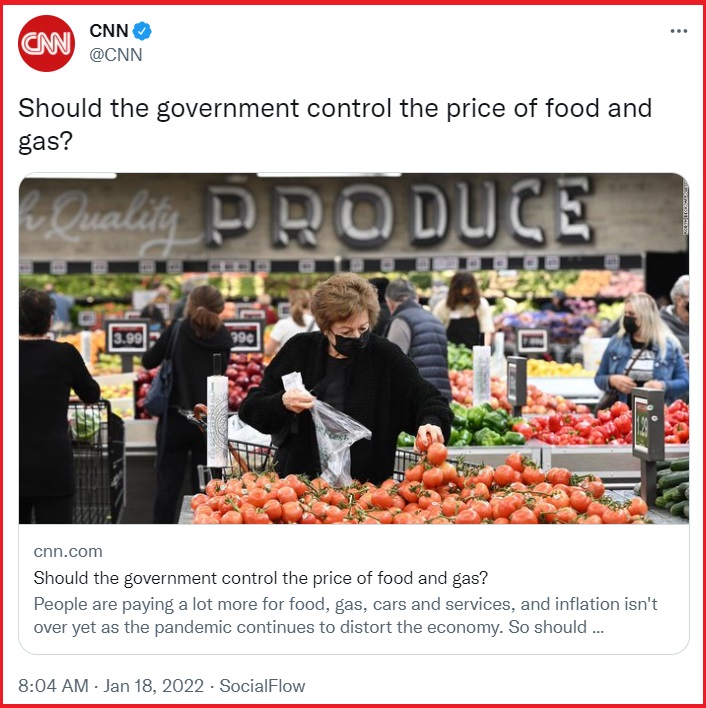
Signal Flare, CNN Asks if Government Should Take Over Food and Gas Prices


Posted originally on the conservative tree house on January 18, 2022 | Sundance | 202 Comments

History may not always repeat, but it rhymes.   As seen in just about every situation where socialism and government intervention in the market economy of any nation is triggered, eventually you get to the point where government solutions to their created crisis take center stage.

We have seen this exact scenario repeated in the former Soviet Union, Poland, Europe, Cuba and more recently Venezuela.  The triggers are the same, and the outcomes are identical. Now, as unbelievable as it may seem, Joe Biden’s socialist policies have triggered the discussion in the United States.

CTH warned this was going to become a narrative; and we saw the first signs of it at the White House podium on January 12th.

WASHINGTON – People are paying a lot more for food, gas, cars and services, and inflation isn’t over yet as the pandemic continues to distort the economy. So, should governments consider setting the price of essential goods?

It’s been done before, typically during times of crisis, but for most mainstream economists, the answer to this question is a resounding “no.” Limiting how much companies can charge will distort markets, they argue, causing shortages and exacerbating supply chain problems while only temporarily reducing inflation.

“Price controls can of course control prices — but they’re a terrible idea,” David Autor, a professor of economics at the Massachusetts Institute of Technology, remarked in a survey published earlier this month by the University of Chicago. Asked whether price controls similar to those used in the United States during the 1970s could reduce inflation over the next year, less than a quarter of economists surveyed said they agree while nearly 60% said they disagree or strongly disagree.

[…] with annual inflation running at a four-decade high of 7% and midterm elections approaching, price controls could feature in future debates about how to reduce prices, particularly if actions taken this year by the Federal Reserve fail to tame inflation. (read more)

See that emphasis of mine in the above paragraph.  Yeah, the same University of Chicago at the epicenter of Alinsky crowdsourcing.

Accepting socialism in the United States does not come easily.  To use the lingo of the Marxists, it comes as an outcome of a “larger conversation” where we begin to “reimagine a nation of greater equity.”   Every nudge begins with the opening of a conversation…

Create the crisis.  Fuel the crisis. Then offer government solutions for the crisis.  Use the crisis to advance the goal.

[Barack Obama and crew are smiling at CNN right now.]

The Sad Story of Davos


Armstrong Economics Blog/Conspiracy Re-Posted Jan 18, 2022 by Martin Armstrong

California’s Guaranteed Health Care for All to Increase Taxes by $12,250 per Household


Armstrong Economics Blog/North America Re-Posted Jan 18, 2022 by Martin Armstrong

California Governor Nuisance Newsom would like to pass Assembly Bill 1400, “Guaranteed Health Care for All,” as the nation’s first single-payer health care system. Unfortunately, this does not equate to free health care. The Tax Foundation estimates that this measure will increase taxes by $12,250 per household, doubling the state’s sky-high tax collections. The 2022-23 budget proposal is $286 billion, but many believe it will rise to $400 billion.

“The top marginal rate on wage income would soar to 18.05 percent—nationally, the median top marginal rate is 5.3 percent—and the state would adopt a new 2.3 percent gross receipts tax (GRT), at a rate more than three times that of the country’s highest current pure GRT,” the Tax Foundation reported. The new tax package aims to raise $163 billion annually, but California has never been close to raising that amount through taxes.

The tax will take on three forms:

  1. Surtaxes atop the current individual income tax structure beginning at $149,509 in income;
  2. A graduated-rate payroll tax system with the top rate kicking in for employees with more than $49,990 in annual income; and
  3. A gross receipts tax of 2.3 percent, excluding the first $2 million of business income.

After 2.5 years of increased spending, Newsom has failed to produce any notable changes aside from pushing many Californians to flee the state. In 2019, Newsom permitted illegal immigrants between 19 and 25 to qualify for Medi-Cal coverage, intended for poor and disabled citizens who legally pay taxes. Adding illegal immigrants to Medi-Cal could increase the cost by $98 million annually.

Democrats always promise not to raise taxes on “the little guy,” but funding Guaranteed Health Care for All will dig into the pockets of anyone earning over $49,000. Assemblyman Health Flora (R) said, “When they realize they don’t have enough money to pay for this, they can raise taxes on everyone on a simple majority vote. They wrote that right into the bill. But anything fiscal has to be a 2/3 majority vote.”

These policies are why people have been fleeing the once desirable state of California for greener (redder) pastures where they are not taxed into oblivion with Socialistic promises of someone else’s money footing the bill.

Media Beginning to Notice Food Supply Chain “Perfect Storm” as It Arrives


Posted originally on the conservative tree house on January 16, 2022 | Sundance | 181 Comments

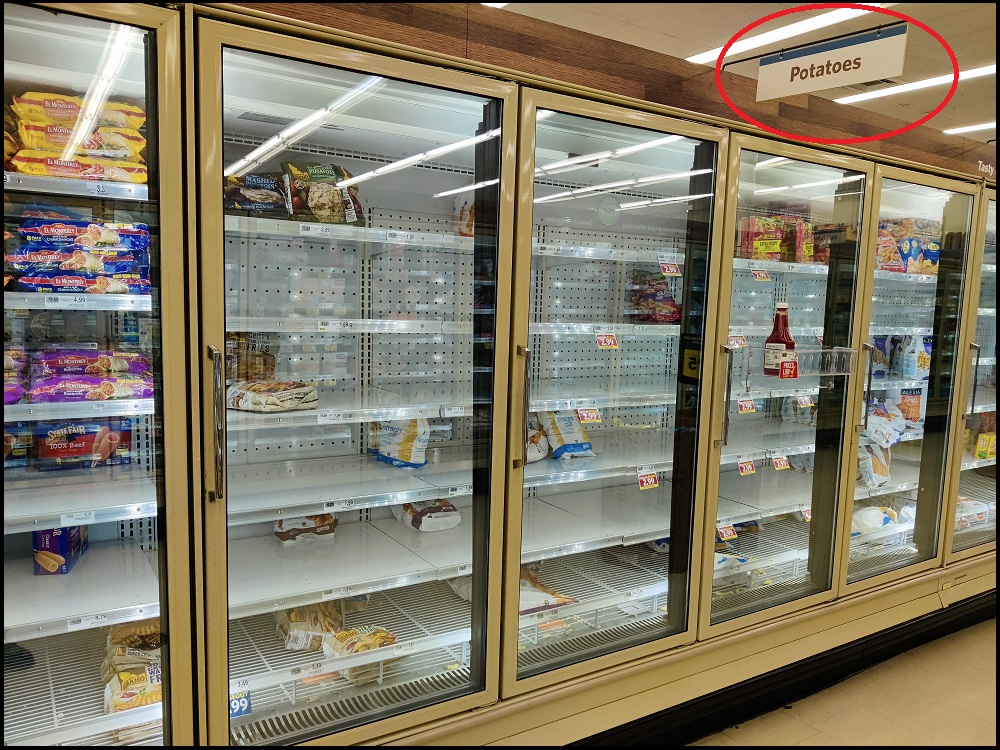
Quite remarkably this ABC report on empty shelves is not far away from outlining the truth.  They are still obfuscating some of the predictable reasons, and they completely ignore the vaccination mandate aspect that is going to worsen the issue, but they are nibbling the edges, nonetheless.

The backward-looking comparative statistics they cite, “15% shortage for food and beverages” overall, are nonsense.  The severity of unavailable products is much higher than that.  You will note from your own store visits the most unavailable products are the manufactured food and heavily processed products.

The raw material shortage inside the retail manufacturing supply chain path, combined with the increased demand on those manufactured sectors, is the direct cause of the manufactured food shortage. {Go Deep}  [Example: a high demand for citric acid means complex foods that use citrus flavorings (ie. sports drinks) are in short supply.  Chase that backward, and you see shortages in citrus & higher citrus costs, etc.]

Each seemingly small issue creates another small issue, which creates another small issue, which ultimately pokes holes in the supply.  Poke enough holes in enough small categories from manufactured condiments to manufactured drinks, to manufactured cereals, pasta, grains, soups, pet foods, and the complex food processing system overall begins to show the larger problem.  It’s a system collapse by a thousand paper cuts.

Some well intentioned people will claim the shortage of processed and manufactured food is a good thing, and people should eat more fresh foods and be healthier.

Let me be very frank about this.  Without full-service fresh prepared food delivery operating normally (restaurants, hotels, cafeterias, lunchrooms, food trucks, venues etc) there isn’t enough fresh food in the U.S. retail distribution system (grocery chains) to feed 350 million people.

We simply need processed and manufactured foods.

Additionally, many of those manufactured foodstuffs (spices, sauces, etc) are additives to what people call “fresh food” preparation.  If you want salt, pepper, olive oil, butter, tomato paste, pasta, flour, etc., you need processed and manufactured food.

As we go into this phase, the ABC report was correct on where these issues will be less noticeable, less fragile.  The smaller grocery outlets with closer connections to the field.   The closer the grocer is to the farmer, the less fragile they are in this shortage phase.   “Grocers” (traditionally defined) will do better than “supermarkets”.

Also think about it like this.  Does your grocery store have an in-store bakery?  If so, their ability to make bread means they are less susceptible to running out of bread.  If processed industrial bakeries experience issues, your in-store bakery may not.  You will pay much more, but the product will exist.  The key is having knowledge of where the product exists.

On a supermarket basis, the total operational excellence comes into play now.   Top shelf field-to-fork operations like Hannaford, HEB, Publix and Wegmans will fare much better than Kroger, Ahold, Giant Eagle, Albertsons, Shop Rite, Meijer, Safeway, Winn Dixie etc.   You can see how the former group rely more on fresh product supply chain relationships, and the latter group are weighted heavily toward low-price highly manufactured.

What are you seeing around you?

Resource Material:

The Bigger Big Picture

The Supply Chain Warning

Government Intervention

Govt Making Matters Worse

Posted in Big GovernmentBig Stupid GovernmentCoronavirusDem HypocrisyEconomyElection 2022Joe Biden

New Interview with Laura-Lynn Tyler Thompson


Armstrong Economics Blog/Armstrong in the Media Re-Posted Jan 14, 2022 by Martin Armstrong

Watch the latest interview with Laura-Lynn Tyler Thompson! As you may recall, YouTube immediately removed our last interview. Rumble does seem to be a safer platform.

Click here if you have trouble viewing the page from the embedded image above.

Vaccine Passports, Food Insecurity and the Law of Unintended Consequences


Posted originally on the conservative tree house on January 13, 2022 | Sundance | 349 Comments

The axiom of “the law of unintended consequences” has never been more appropriate than right now.  In the background, as you are reading, there is a looming storm that is going to soon surface in the food supply chain, and the regional vaccine passports are going to make things worse.

To understand what is happening, it becomes necessary to give a more specific background on how the things work inside the supply chain that has been disrupted by government intervention.  This is complex, but I hope to make it understandable for the average person.

How do we avoid supply chain chaos?   My response seems counterintuitive to those who do not understand this unique issue.

Effective immediately, or at least as soon as possible, every venue that can provide food on a commercial basis must be removed from all COVID regulations, including vaccine passports.

Restaurants, school lunchrooms, cafeterias, industrial kitchens, hotels, bars, food trucks and every possible venue for the delivery of freshly cooked meals must immediately be reactivated, and all terms and conditions for visiting those venues, like “vaccine passports”, must be cancelled quickly.

If they are not, and worse, if the restrictions expand beyond current status, there is going to be a worsening retail food crisis as the total food supply chain begins to collapse even further.

Beginning around 1990, the retail food industry, the supermarket and grocery business, began a process for automated replenishment.  Walmart’s introduction into the grocery business was the trigger, as the massive internal supply chain created by the Arkansas company was the leading edge in growth and retail sales.   Walmart began selling groceries, cheap groceries, by using their supply chain efficiencies to undercut prices within the retail food industry.  It was a seismic change.

Soon other regional supermarket chains began to modify their ordering, purchasing and buying offices to add inventory efficiencies into their operational systems.  If they did not adapt their inventory management, they would lose competitive price position.

As years passed, technology in the inventory management system became more and more important, as the thin margins inside the retail supermarket system looked to capitalize on automated replenishment.  This is the beginning of “Just in Time” inventory within the retail food distribution network.

Computers began to make forecasts for products and shelves were replenished through a complex system of automated orders.  Years of multi-SKU data was assembled to create forecasts for future orders.

Instead of clerks, managers and supermarket operators ordering products from store level, slowly those same people became responsible for only recording the amount of an existing item currently on the shelf.  The computer algorithm -filled with historic data on consumer purchasing- would forecast the need and place the order.  This system formed the cornerstone of automated replenishment, as computers told the buying offices how much of every item would be needed, and when.

Billions were invested by the industry, as a whole, to develop this complex replenishment system.  Within the process of just in time ordering (JIT), slowly computers replaced humans in the ordering process.  Retail stores no longer housed massive amounts of inventory.  Warehouses that feed the stores no longer housed massive amounts of inventory awaiting the orders from the stores.  Warehouses even changed their terminology to “retail distribution centers“, as they became hubs for distribution and not holding centers for inventory.

Years and years of refinements to this process continued as the computers learned in ever more granular detail how to trigger replenishment orders based on checkout scan data.  Tens-of-millions continued to be invested in the latest tech software and scanning systems that would thin down the supply chain at each step.

In essence, the timeline from field to fork was also being reduced, as the total food supply chain inventory management system refined each year becoming more and more efficient at recognizing purchasing patterns and predicting sales.

The value inventory efficiency to the industry was great.

The cost of excess inventory to support sales was reduced, and the efficiencies of the Walmart purchasing, and supply chain excellence was being duplicated in every retailer.

Without excess inventory, the value of store inventory counted as “days on hand” was also reduced.  This meant more profits for the retail outlets, as the overhead cost of their inventory was lowered.

Companies passed along these supply chain efficiencies in the form of lower prices to the consumer.  This was, in very direct measures, the Walmart influence in the retail food supply industry.   All regional supermarket chains were duplicating the Walmart supply chain excellence, and that allowed them to compete on price.

Eventually, what was once seen as a Walmart competitive advantage, became an industry-wide way of doing business.   The retail food supply chain for grocery outlets was structurally and permanently changed.   Every retail outlet was/is using some form of just-in-time inventory management with automated replenishment based on computer forecasts for purchasing needs.  However, there is a downside…. less inventory in the total system means less capacity to deal with increased demand.

This supply chain system is best understood in reverse:

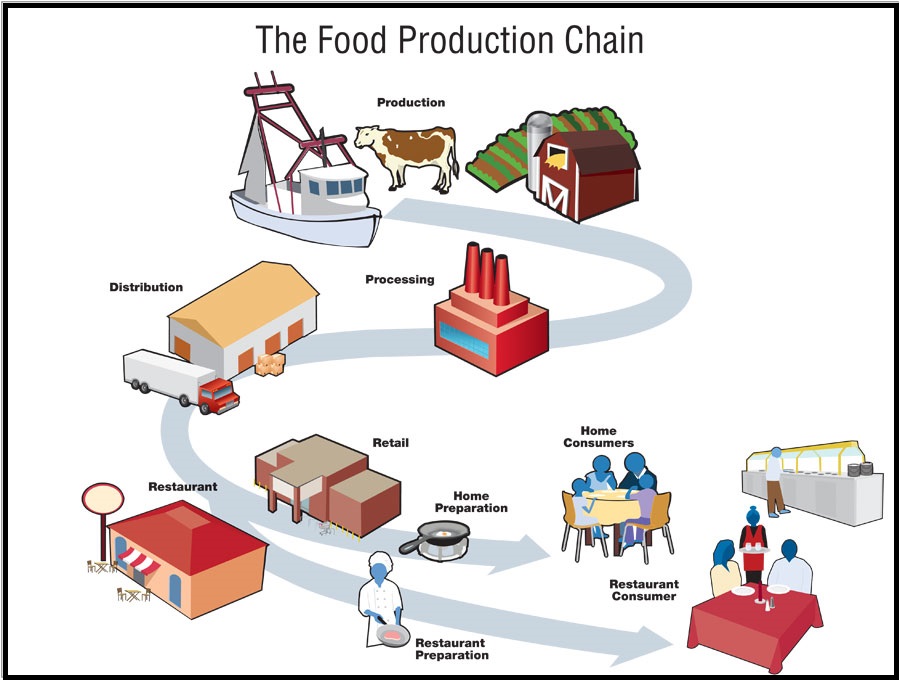
♦ The data from retail scanned sales is shared backwards into the supply chains, with retail grocery stores sharing their scan data with suppliers.  The suppliers like Kraft foods then know exactly how much anticipated product is needed, by which retailers, where and when.

♦ The suppliers and manufacturers then share that information backwards into the food processing sector.   The processors of raw material food now know what products are needed by the branded suppliers.

♦ The processors then share that information backwards in the supply chain to their raw material providers. Those are the protein conglomerates and farming groups.  This is also where Big Ag makes import/export decisions and controls the prices for their own profitability.

The contracted commercial farmers, cattlemen, fishermen etc., all know -or are instructed- roughly what crops, pork, beef, chickens, poultry, etc. will be needed in the following season to provide to the processors, who provide to the manufacturers, who provide to the suppliers, who provide to the distribution centers, who provide to the retail stores.   This is the complex system known as the retail food supply chain.

As you can see from above, this complex inventory management system originates with historic data from the stores and travels throughout the supply chain providing users at each step to assemble the data that pertains to their role.   This is like thousands of interconnected gears in a finely tuned machine, and this is NOT a system that can be interrupted without consequence.

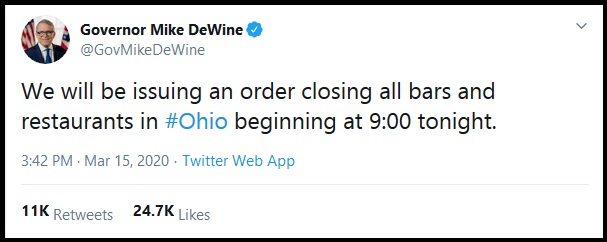
CTH warned in March 2020 [LINK HERE], when government first suggested that all retail food establishments (restaurants, lunchrooms, hotels, cafeterias, etc.) should shut down due to the pandemic, that closing 60% of fresh food distribution would be catastrophic for the total food supply chain.

“A government cannot just shut down 30 to 50 percent of the way civil society feeds themselves, without planning and advanced preparation for an alternative. Those who ARE the alternative, the retail food grocers, need time to prepare themselves (and their entire logistical system) for the incredible impact.  Without preparation this is a man-made crisis about to get a lot worse.” (LINK)

Those decisions in 2020 triggered a cascading sequence of events that has yet to be fully understood. {Go Deep}

For 30+ years, the highly complex and data driven retail food supply chain, the delivery vehicle for 40+ percent of total food available, has become increasingly refined.  Unfortunately, like a finely tuned watch, those refinements also mean the supply chain is vulnerable to unforeseen changes in the system.

The government upended the total food supply system by shifting 25 to 40% more customers into the retail grocery supply chain for their food.  The supply chain we just explained cannot handle that level of stress.   Operational capacities are reached very quickly throughout the system, and even the packaging of increased demand is an issue.  Suppliers for packaging also have capacity constraints.

Processors cannot process enough.  Manufacturers cannot manufacture enough. Suppliers cannot supply enough. Distribution centers cannot distribute enough, and stores cannot stock enough.

The entire food delivery system is not designed for this and cannot reasonably be expected to adjust on this scale; it is just not feasible.  We are seeing the cascading results of this in our supermarkets right now.  People are starting to worry, and there is good reason to worry.  {Go Deep}

This is where the vaccine mandate and mandatory vaccine passports make things worse.  Even a small amount of excess demand right now is causing exponential problems for a system that is already beyond capacity.   The system stressors, specifically the demand side, need to be reduced.

If just 10% of a population, within a metropolitan region of consumers, are blocked from restaurants or food venues because they are unvaccinated, they are going to put stress on the alternative, the grocery supply chain…. meaning, more empty shelves and cases.   Those empty shelves impact the vaccinated and unvaccinated alike.

Restricting restaurant capacity, shutting food venues, closing school lunchrooms, shutting or restricting cafeterias or hotels, blocking venue access by vaccine restrictions, all of these have damaging unintended consequences to the food delivery system.  We need every possible fresh food delivery system open for everyone…. and that needs to happen quickly.

Additionally, the trucker vaccine mandate -scheduled to go into effect for domestic freight haulers on January 22nd- needs to be cancelled fast.

If these mandates, COVID restrictions, passports and gateways continue as blocks in the system, it is very likely the shortages in the food supply chain will only worsen.

It is only going to take a few visits of worsening empty shelves before “national food security” panic becomes a self-fulfilling prophecy.

MASSACHUSETTS –  BOSTON — Vaccinated state residents are now able to access a digital record of their COVID-19 vaccine history, including a scannable QR code, that could be stored on their smartphone and presented to businesses requiring immunizations for entry.

Gov. Charlie Baker’s administration is rolling out the “COVID-19 SMART Health Care” just as the city of Boston prepares for a new vaccine requirement to take effect at the end of the week in all restaurants, gyms and entertainment venues.

Boston is one of the few cities in the state to adopt a universal vaccine requirement for certain businesses. (read more)

Biden Asks Social Media Companies to Crack Down on Any Vaccine Discussion That Does Not Comply with Official Government Narrative


Posted originally on the conservative tree house January 13, 2022 | Sundance | 171 Comments

After making frequent statements that “democracy is under attack”, and recently proclaiming the choices are between “democracy and autocracy” while attempting to force medical treatments on unwilling subjects, today Joe Biden asked social media companies to crack down on any speech that does not comply with the officially approved government narrative. {Direct Rumble Link}

BIDEN: “If you’ve haven’t gotten vaccinated, do it. Personal choice impacts us all — our hospitals, our country. I make a special appeal to social media companies and media outlets: Please deal with the misinformation and disinformation that’s on your shows.  It has to stop.   COVID-19 is one of the most formidable enemies America has ever faced.  We’ve got to work together, not against each other.” (link)

Final Goods Producer Price Index Rises 9.7 Percent in December, Highest Rate of Inflation Since Records Began


Posted originally on the conservative tree house on January 13, 2022 | Sundance | 99 Comments

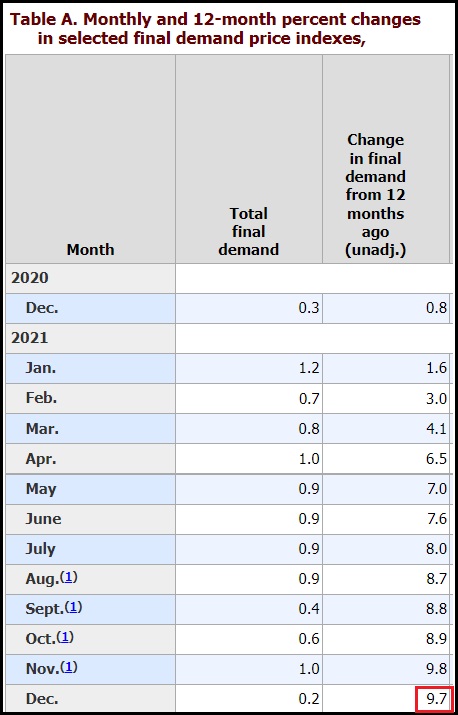
Unfortunately, the upward trend is continuing unabated.  The “producer price index” is essentially the tracking of wholesale prices at three stages: Origination (commodity), Intermediate (processing), and then Final (to wholesale).  Today, the Bureau of Labor and Statistics (BLS) released December price data [Available Here] showing a dramatic 9.7% increase year-over-year in Final Demand products at the wholesale level.

I’m not going to beat this dead horse {Go Deep Here}, except to point out a few even larger warning signs that are evident.    Suffice to say, despite the spin likely from defenders of the White House occupant, the inflation impact is continuing exactly as we would expect.

The monthly price increase was 0.2% which would under normal circumstances give the impression that price pressure for the month was lower than previous.  However, there’s a key component clouding the problem.

As noted by the BLS, “A major factor in the December decrease in prices for final demand goods was the index for gasoline, which moved down 6.1 percent.” Gas prices momentarily dropped in the December capture of pricing; this has skewed the data considerably.  As a consequence, the energy costs measured in December looked like they dropped 3.3 percent.

You are well aware that gasoline has jumped back up in price in the past few weeks.  Additionally, total energy costs to you have not dropped at all.  In the background of this momentary skew, the costs of final demand goods after the energy impact rose .04% in December.

The momentary drop in gasoline and diesel fuel in December gives an artificial outcome in the data for all three stages.   Oil prices are back on the climb, and the prices of the goods and services overall to consumers have not reflected any decrease; factually they have increased even more.

The White House will likely claim this result is showing a positive trend.  However, if you take away the temporary gasoline price drop, that claim evaporates quickly.

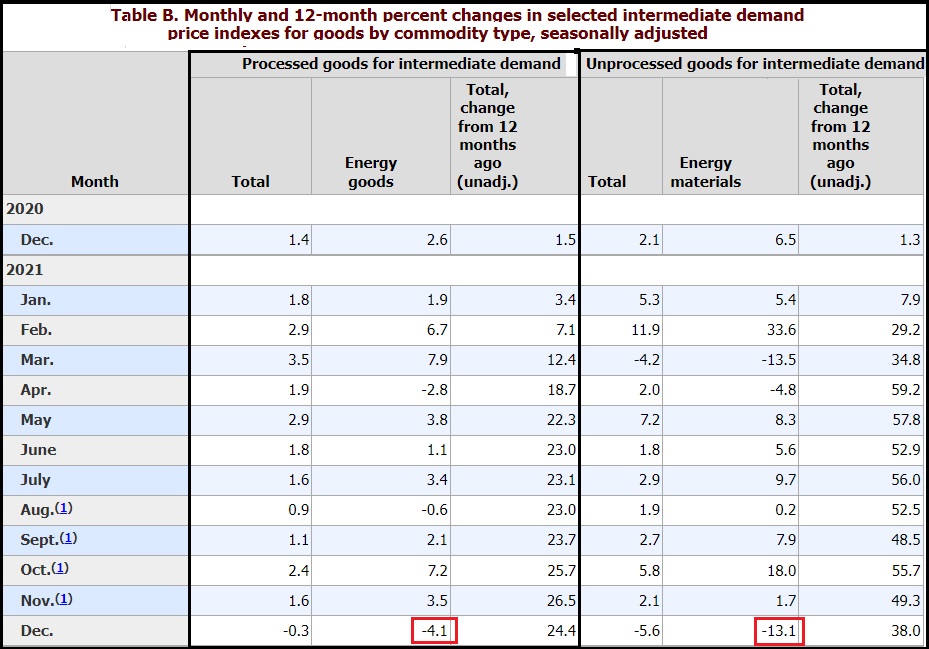
I have modified Table B on “Intermediate Demand” to take out the noise and show the impact of the heavily weighted energy cost.

The prices of intermediate demand goods, both processed and unprocessed, appear to be going down. However, that appearance is only created by the temporary weight of energy cost decreases, which are heavily weighted on gasoline costs.

Processed goods showing year-over-year inflation in December of 24.4% at the intermediate level, and unprocessed goods showing year-over-year inflation of 38.0%.   However, both of those numbers are heavily impacted by the false sense of security from the temporary gas price drop.

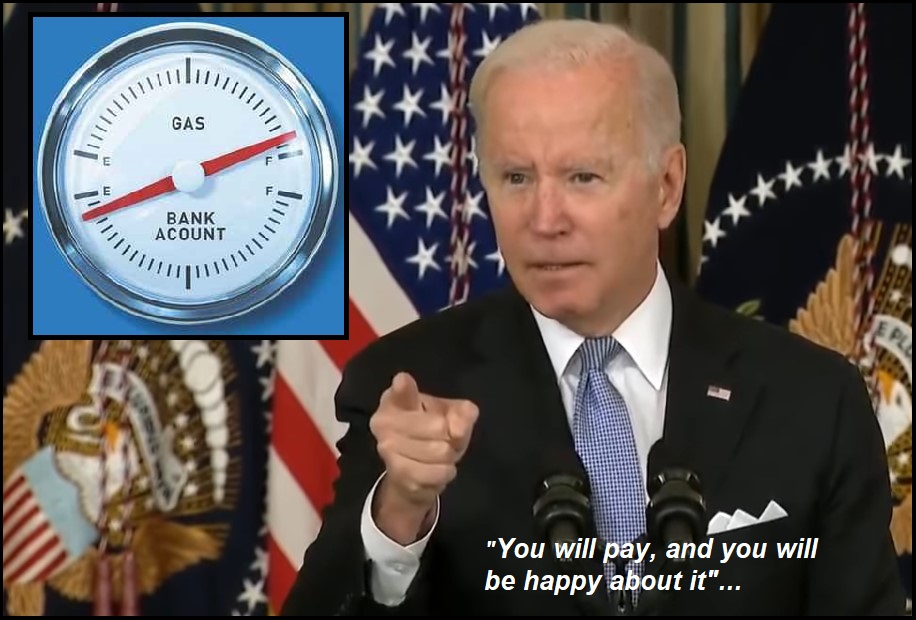
All of that said, the scale of price inflation, what we are actually feeling in our checkbooks and bank accounts, is well represented by inflation rates at 25 to 40 percent.  Those rates of inflation are factually what we are witnessing at the grocery and hardware store.

FUBAR.

Prepare your affairs accordingly…

Religion & Egotism


Armstrong Economics Blog/Religion Re-Posted Jan 13, 2022 by Martin Armstrong

COMMENT: I do not believe in a God. However, I treat people honestly like I would want to be treated. I want the government to be small and decentralized. I don’t want to harm others, nor do I want to take anything from them not negotiated where both parties benefit. ….

JR

REPLY: I do not think you need to believe in God to be good regardless of who you envision to be God. The Greeks believed more in super-beings, not gods who created you. Even this gold aureus of Diocletian on the reverse pictures the Greek three Fates. They were the ones who judged you. Zeus could only make a recommendation. He neither created you and the world nor judged you upon death. Hence, we still call our future is dictated by fate. The Roman goddess Fortuna was pictured with a cornucopia in one arm and her hand on the rudder of a ship symbolizing she could change your future on a whim. Simply because they were not Christian had nothing to do with the morality of the people predating that religion. Greek philosophy predated Christianity by hundreds of years.

AE Follis 325-328 Christian Symbol

Most of us have a conscience that guides us. Those who are egotistical seem to be absent that core trait. That may be the better explanation than calling it religion per se. An instinctive sense of morality. It does appear that those who reject any sort of image of any God and believe that it is up to them to rule the world are an egotistical difference from being even an agnostic which in itself does not imply evil. They lack any moral conscience. Just because someone professes to believe in God does not mean he is moral – i.e. Constantine the Great. Constantine only ever issued a single bronze coin with any Christian symbol out of millions. He cleverly used Christianity as the excuse to not just win the battle, but to confiscate all the wealth in the pagan temples.

Julian II of the house of Constantine rejected Christianity because, on the death of Constantine, his sons massacred all rivals in the palace who had been born by his first wife. He came to the conclusion that being Christian did not mean that they were moral.

I have been respectful of all beliefs as long as they believe in live and let live. I disagree with Marxism for it is this egotistical vision that there is no God so they will fill that role. That is not you leave me alone and I will leave you alone. That is rejected by socialists who believe that they can rule the world and dictate how others should live. They cannot believe in Freedom of Religion and simultaneously be religious which is in conflict if they stopped and thought what they are really saying.

That is the real essence of Freedom of Religion which includes having one or not. Today, there is a growing trend toward no denominational beliefs that are described as “spiritual” but do not cross that line into the egotistical world that they can reshape the world because there is no God. One does NOT have to believe in God and the last judgment to be moral. They are not mutually exclusive.

These people have created COVID and believe in reducing population which would in other times be called genocide. That is not bringing in nature and the cycles that truly dictate the future – not egotistical demigods.

Biden’ Spending Spree – The Real Agenda


Armstrong Economics Blog/Economics Re-Posted Jan 13, 2022 by Martin Armstrong

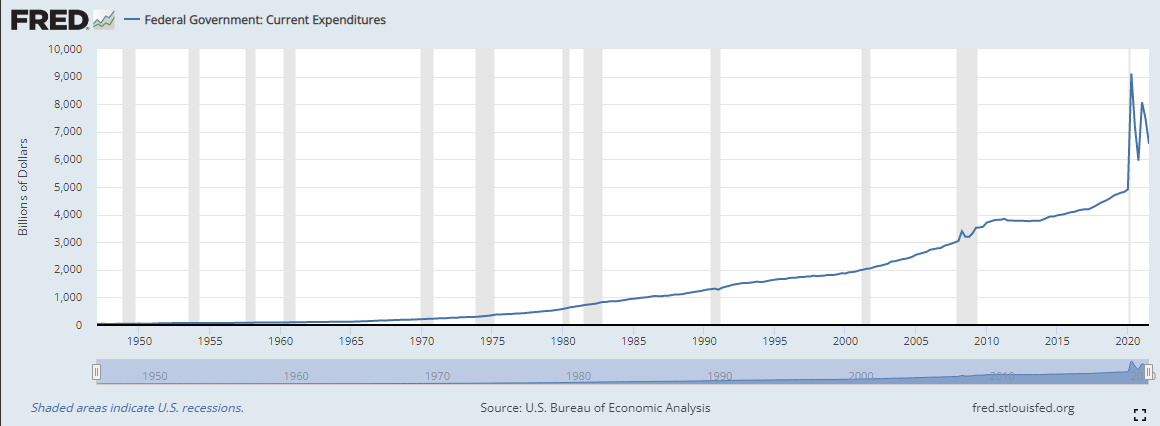
Many people have written in asking why are all the government spending like there is no tomorrow? The answer is – there is no tomorrow! This Great Rest is all about defaulting on the national debts and so they are all going nuts spending whatever they like knowing that the end game is the default.  There is no longer any pretense of fiscal management. Everything will simply vanish according to the forecasts of Klaus Schwab. This is also why they have been using COVID to enforce lockdowns and terrorize people. Washington State has a bill floating around to imprison the unvaccinated because they know they are the anti-government faction. In Quebec, they are proposing taxing the unvaccinated into poverty.

NEVER in the history of government has there ever been such reckless spending and we have Chuck Schumer desperately trying to overthrow the Filibuster to usher in this dictatorship. Schummer has clearly become a traitor to our Constitution.

This is the real agenda. Do not try to think for one moment this is good for the country or it is just the politics of Republican v Democrat. All Western governments are moving as fast as they can to flood the economy so they can just force the fault and suppression of the people.