Teaching Hedging


Armstrong Economics Blog/Trading Re-Posted Aug 27, 2023 by Martin Armstrong

COMMENT: Marty, I just wanted to thank you. I attended your 1985 World Economic Conference, and you taught me how to hedge. That made my career, and now I am about to retire. Nobody was teaching hedging in the early 1980s. You have impacted the world far more than you realize.

I will be at the WEC this year in my official capacity. Next year, it will be for me personally. I sincerely wanted to thank you, and you should post this. The newbies need to know you were there decades before anyone else.

God bless.

GK

REPLY: George, it has been a long journey. I am glad I helped you in your career. You have always been there for me and I appreciate old friends. BTW, they still do not teach hedging in universities. Just amazing.

Japan Exports Fall in July, Driven by 14.3% Decline in Shipments to China


Posted originally on the CTH on August 17, 2023 | Sundance 

Some economic data released by the land of the rising sun points to a larger global weakness in manufacturing demand.   Within the data year-over-year exports from Japan fell in July by 0.3%, which is the first time since 2021 the contraction was noted.

Digging a little deeper, the weakness in Japanese exports is driven primarily by a decline in exports to China of 14.3% in July, which follows a 10.9% decline in June.  Japan is a component supplier to China, which would indicate the demand for Chinese products globally is substantially less than Beijing has previously admitted.

That said, Japan’s direct export of finished goods to the U.S. actually increased 13.5%, mostly driven by the export of electric vehicles.

However, 13.5% is identical to the overall decrease in Japanese imports.

Essentially, component parts to China are down, but completed finished goods to the U.S. are up.  Overall, the results from Japan point to a soft overall global economic status, the result of continued contraction of Western economic activity.

TOKYO, Aug 17 (Reuters) – Japan’s exports fell in July for the first time in nearly 2-1/2 years, dragged down by faltering demand for light oil and chip-making equipment, underlining concerns about a global recession as demand in key markets such as China weaken.

Japanese exports fell 0.3% in July year-on-year, Ministry of Finance (MOF) data showed on Thursday, compared with a 0.8% decrease expected by economists in a Reuters poll. It followed a 1.5% rise in the previous month.

[…] Japanese policymakers are counting on exports to shore up the world’s No. 3 economy and pick up the slack in private consumption that has suffered due to rising prices.

However, the spectre of a sharper global slowdown and faltering growth in Japan’s major market China have raised concerns about the outlook.

The World Bank has warned that higher interest rates and tighter credit will take a bigger toll on global growth in 2024. (read more)

Meanwhile, I would not bet against Michael Burry.

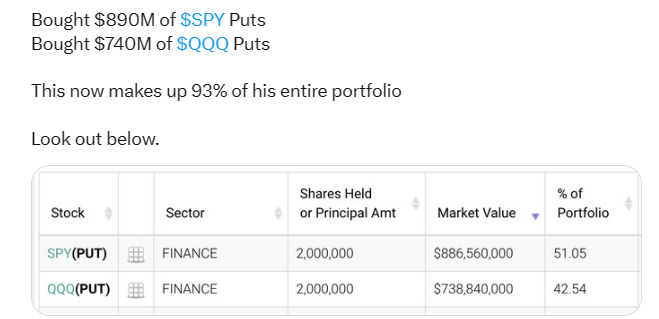
Burry is betting against the S&P 500 and Nasdaq 100 this week, according to his fund’s latest releases. Securities and Exchange Commission filings.  The filing shows that he is now holding options against the S&P 500, hedging $886.6 million against the index.

The filing also revealed that Burry sold his shares in Capitol One, First Republic, PacWest Bancorp, Wells Fargo and Western Alliance after betting on them earlier this year in Trying to make money from the regional banking crisis.  Burry also sold his stakes in Chinese e-commerce giants Alibaba and JD.com.

In addition, he bought $738.8 million in put options against the Invesco QQQ Trust ETF – a fund made up of popular high-tech Nasdaq companies, such as big tech companies Apple and Microsoft as well as Nvidia, Tesla and PepsiCo.

Burry has pulled money out of China investments and U.S. banks and is hedging against tech and the S&P.  He took these positions before the data from Japanese exports to China was released.

AI & Self-Awareness


Armstrong Economics Blog/AI Computers Re-Posted Aug 8, 2023 by Martin Armstrong

QUESTION: You do not see AI as actually becoming conscious? There are so many claiming that is the future. Are you hiring programmers in machine language?

LK

ANSWER: Let me explain something. Most generative AI models today are being trained and run in the cloud. These models are language-oriented, generating text. They are often at least 10 times to 100 times bigger than older AI models. ChatGPT is learning from the question people are asking. While this is impressive to the average person, there is no real economic value other than adding to the search function. This has resulted in a boom along with an insatiable appetite for running large language models at this point in time.

Even dogs have personalities. My little one will take a pill covered in peanut butter. The older one takes the peanut butter and spits out the pill. Just like having two children, they are not the same. What causes one to have a personality that is different from the other? I’m afraid I have to disagree with this theory that if you throw in enough data, suddenly, the computer will become self-aware. My little dog was just 11 weeks old. She is still exploring her environment, displaying curiosity, so she has a distinct personality BEFORE acquiring knowledge of her environment. This PROVES beyond a shadow of a doubt that this theory of a computer becoming self-aware is just nonsense. We do not teach our children how to be self-aware. They are born that way.

There is something there that creates the personality, and it appears from birth in dogs and humans. My dogs clearly think dynamically. If I get up with a coffee cup, they know I am going to the kitchen and heading there. Not all animals have that ability. So why are dogs capable of looking for patterns and anticipating my next move, and a hippo, snake, or alligator is not?

I do not believe we are anywhere close to comprehending those differences, and as such, we cannot create a true cognitive machine that is self-aware when we do not understand what makes us self-aware.

To build Socrates, I had to study intensely how we actually think. Let’s say you met the person who is your soul mate. You went to dinner. Your mind is actually recording every aspect of that evening, and you are totally unaware of what it is recording. Years later, you return to that same restaurant, and that memory involuntarily comes rushing to the forefront of your mind. Or there was music playing that night, and suddenly you hear that same song, and that memory again involuntarily comes to mind. Perhaps it is the food. The point is that memory is stored, but any of our senses can access it. The complexity is enormous.

My oldest dog does not like going to the Vet. She even knows her surroundings. Miles from the place, she knows where I am going and begins to tremble. She is aware of her surroundings miles from home, which astonished me. It was not a capability I assumed a dog would have. A dog stayed with a two-year-old girl who went missing and always protected her.

There is a lot more hidden within us and many animals that cannot be explained or recreated by a computer.

Just be careful with claims suddenly of people coming up with AI trading programs. It took me 17 years to build Socrates. You cannot create an AI trading program in a few weeks. As for hiring, yes, of course. We always have projects under development.

Understanding REAL AI


Armstrong Economics Blog/AI Computers Re-Posted Aug 4, 2023 by Martin Armstrong

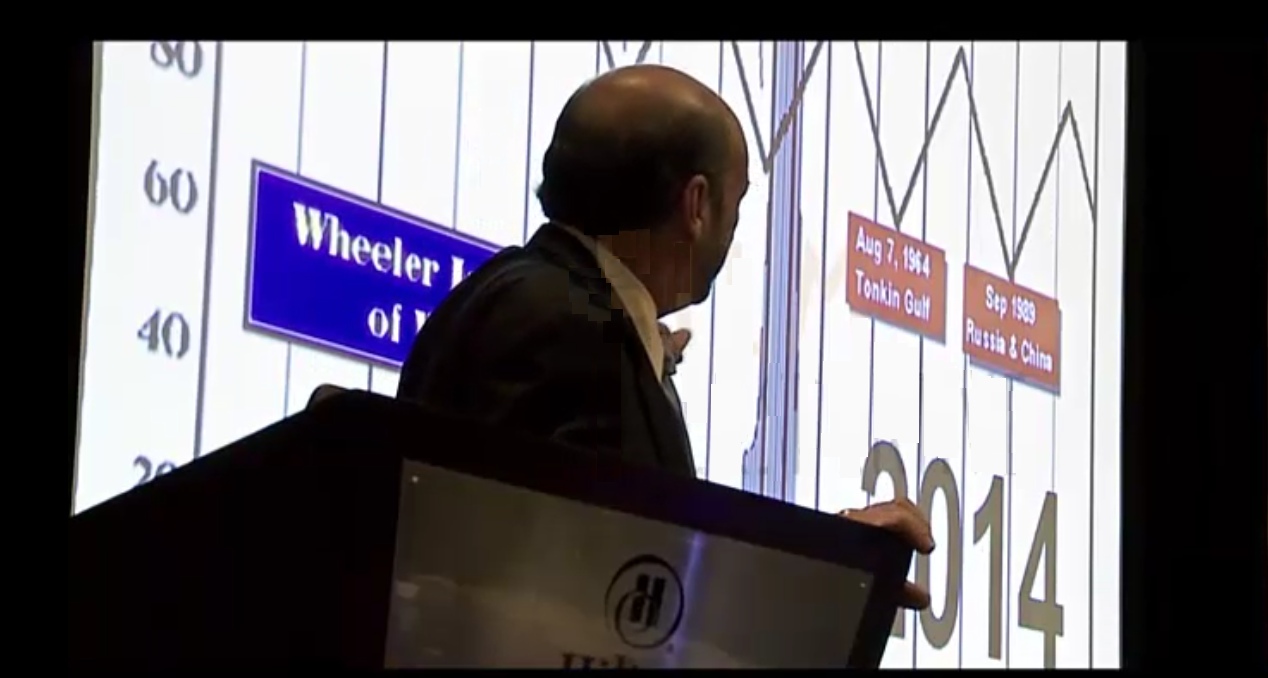
QUESTION: Mr. Armstrong, I attended your 2011 conference in Philadelphia. A friend of mine insisted and paid for the ticket, telling me your computer has been incredible on forecasting long-term that nobody can come close. I confess I thought your forecasts at the event were out there. You put up the war cycle and said it would all begin in 2014. That was three years in advance. There were cameramen there filming what later became the film The Forecaster. I hear they are doing a sequel to show all the forecasts you made ten years ago have come true. I also hear they are doing a Holywood film on you, like the Big Short.

You have accomplished what nobody else has done, and you are even a legend in markets and were even a speaker at the American Hackers convention in computers. With all the craziness going on about Artificial Intelligence, some people call it a threat to humanity, and others seem to be hinting that AI might take over everything. So there is no better person to speak about this than you. Are we at risk from AI, or is the hype some excuse claiming AI starts the war, not the people, as a cover-up?

DS

ANSWER: ChatGPT has dazzled the world and led everybody to think that AI will be something like the movie Terminator or The Matrix. I will dig out the old program I wrote in the early 1980s for my children. It was a simple program where I taught the computer to have a conversation. I would ask a question like – Do you have a dog? My daughter would reply yes. Of what is their name? She would then say the name. It stored all that info so the next time she went to the computer; it would ask: How is your dog Buttons? One day she came home from school and saw I had the computer apart, and she started crying, saying I killed it.

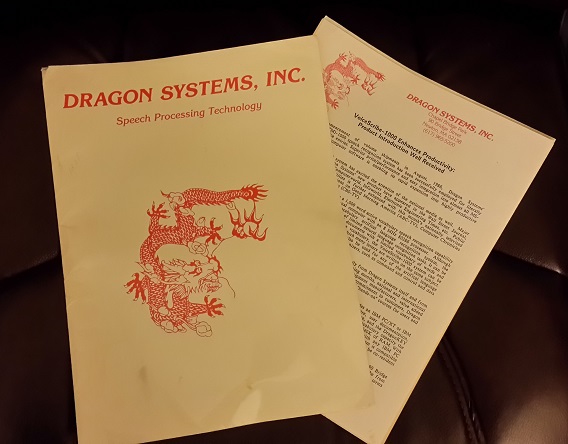
Back then, I worked with Dragon Systems. They produced hardware that you plugged in a board in the slot of an old IBM XT, and the computer would speak. She would bring over her girlfriends to prove to them her computer talked to her.

The point is that such a program is not really AI in the sense that it is self-aware to the point it will take over the world. With the introduction of the internet, such a program that has free reign to search can provide astonishing answers. Nevertheless, this is by no means self-aware.

The theory behind these wild claims entirely rests upon this theory that there is no God, we have no soul, and our entire existence is no more than a biological supercomputer. Therefore, they presume that if you through in enough data, some miracle will emerge, and it will become conscious just as a living being. That may make a great movie, but I think I am pretty well advanced in AI, and aside from disagreeing with this theory, I can write code that will make you think it is alive, but that is just mimicking human interaction. I do not know of any possible way to create a fully conscious AI system. It is only theory.

As far as Socrates is concerned, I poured myself into the program. It is NOT a neural net that you hope for the best. I taught Socrates how to analyze and know history, so I did not hardwire relationships. That is why it has discovered things and can do long-term forecasting beyond anything out there. As I have said, we are all connected. You cannot forecast a single market in isolation – you will always be wrong caught by the wildcard from an external market. They lost in Russia in 1998 and needed cash in the middle of a liquidity crisis. So they started selling assets everywhere to raise money to cover their losses in Russia. You would never have seen that coming just by looking at a single market.

The mystery if Pi – Full Version


Armstrong Economics Blog/ECM Re-Posted Jul 30, 2023 by Martin Armstrong

COMMENT: Hi Mr. Armstrong,
Here is the full version of that short video you posted about Pi. In it, he makes the statement “Where ever there is Pi, there is a hidden circle.” Interesting thought in regards to Pi and the ECM.

Joel

REPLY: Thank You. It is fascinating.

The Mystery of Pi – It’s Everywhere


Armstrong Economics Blog/ECM Re-Posted Jul 29, 2023 by Martin Armstrong

Trying to Make Heads or Tails about Recessions


Armstrong Economics Blog/Economics Re-Posted Jul 28, 2023 by Martin Armstrong

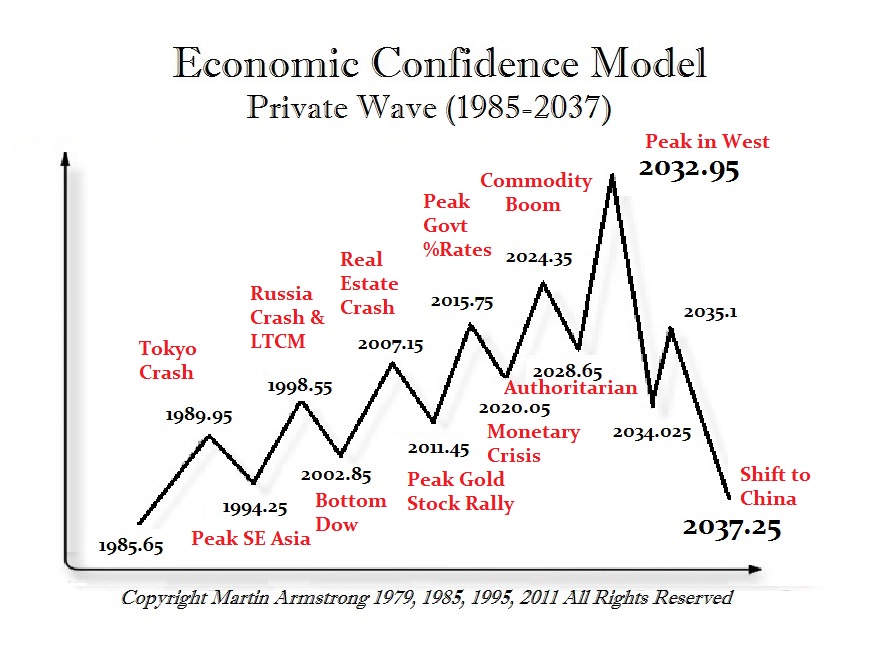
QUESTION: Looking at Socrates,  do you think that these people who were constantly calling for a recession because there were two quarters that declined with covid really need revision? Socrates was correct, no recession. But it is showing major turning points in 2024 which seem to align with your old ECM forecast calling for commodity inflation into 2024. How would you define a recession?

EJ

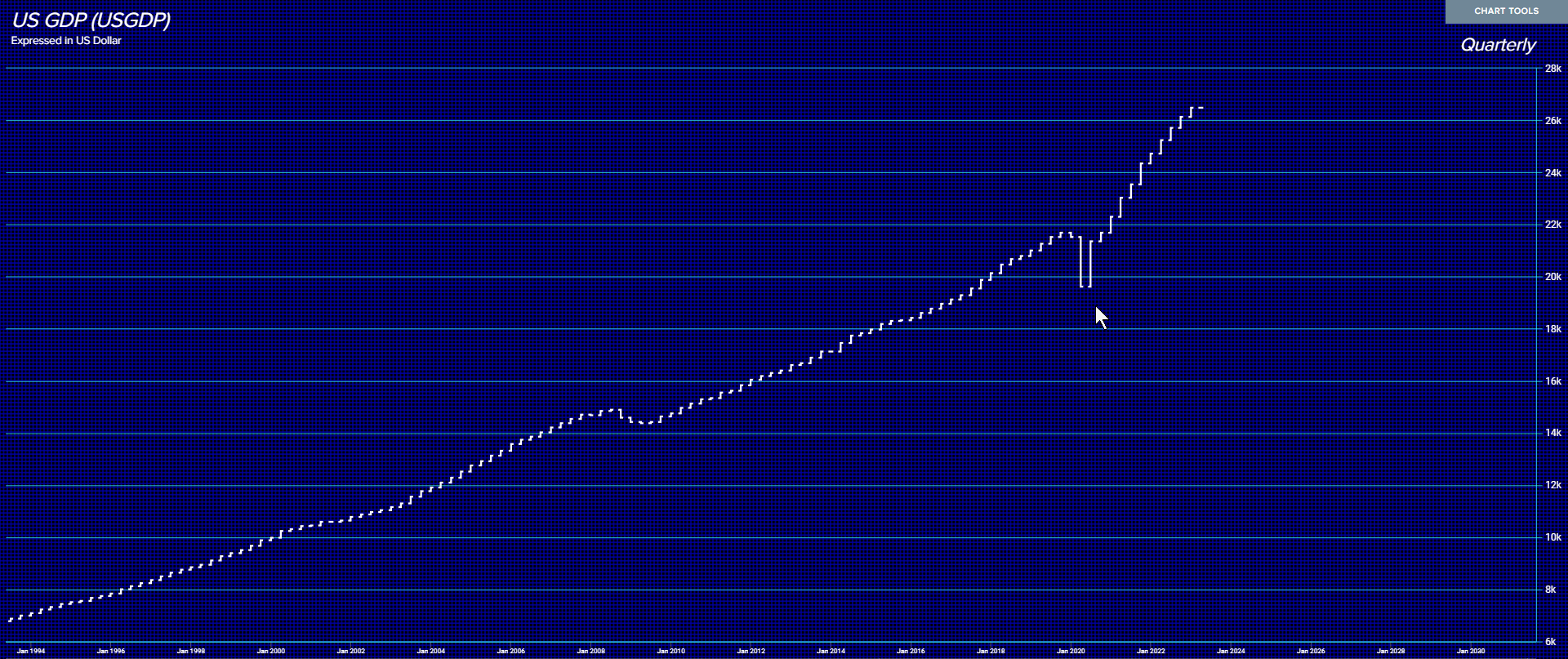
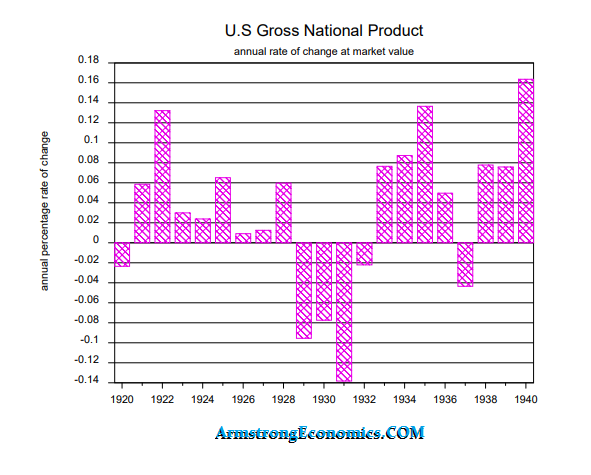
ANSWER: In trading, reactions are 1 to 3 time units. I believe that the same definition should be used for classifying a recession. They define a recession as two consecutive quarterly declines. If you look at the “Great Recession” of 2008-2009, you will see three consecutive quarterly declines and a rebound. If we look at the COVID recession caused by locking everyone down, that was just two consecutive quarterly declines.

I personally would argue that a true economic recession MUST exceed three consecutive declines. Here is the chart of GNP from 1929 to 1940. There were three years of negative growth. I simply think that this definition of two quarters is wrong. You can have a slight decline of 1 to even 5%, but that does not suggest a recession. In the case of 1929, that was a decline of 9.5% in 1930 – the first year. Now look at the COVID Crash, which was also a decline of 9.53%. But the difference is that the COVID decline was forced and not natural. That is why it rebounded so quickly. Now the so-called “Great Recession” of 2008-2009 only saw a decline in GDP of 3.47%.

The “Great Recession” was not really so great. It wiped out real estate and bankers but did not fundamentally alter the economy. So who is right and who is wrong will always depend upon the definition. Yes, the AI Timing Arrays point to a recession starting Next Year by their definition. This will most likely be caused by the decline in confidence that will lead to UNCERTAINTY, and as such, the consumer will contract. Up to now, the continued expansion of the economy into 2024 has also been fueled by the shift in assets from public to private.

As originally forecast, we should have seen a commodity boom into 2023,

and we should expect a highly authoritarian attempt by 2028.

Artificial Intelligence Positioned to Define Terms of Reality


Posted originally on the CTH on July 12, 2023 | Sundance 

There has been a great deal of increased discussion surrounding the issues of automated Artificial Intelligence, colloquially called “AI.”

At the central core of the AI issues in communication; you inevitably enter a discussion on the issue of definitions and terms.  Who is determining the definitions of what constitutes valid information? Who is determining what types of information are not valid, not approved for communication networks and how are their definitions being applied?

A solid and short-read thread on the assembly of people, groups and institutions surrounding the issue of AI in communication and media is presented HERE.

[Article/Thread LINK]

The topic of AI in general is a very large conversation.  The topic of AI specific to communication is equally large and perhaps even more significant.

AI applied to communication must first establish a need for it to exist.  Within that discussion, government interests and corporate interests take large seats at the table.  Social media platforms, communication outlets, almost the entire technology sector and various special interest groups are also stakeholders in the discussion of how AI can be applied to the filtering of information – or what I would more appropriately call the CONTROL of information.

The predicate of the conversation jumps around a little, but the issue of defining reality is throughout the discussion.  This is where my prior warnings about defining information must be emphasized.  I am losing the current argument, but I retain optimism that eventually the control mechanisms will need to be destroyed by a generation that falls under its influence.

“There is no such thing as “disinformation” or “misinformation” or “malinformation”.  There is only information.  There is information you accept and information you do not accept.  You were not born with a requirement to believe everything you are told; rather, you were born with a brain that allows you to process the information you receive and make independent decisions.”

There are only two elements within the public discussion of information – truth and not truth.

In an era filled with “fact-checkers” and institutional guardians at the gates of Big Tech, let me explain exactly why it is important not to accept the speech rules of the guards.

When you accept the terms “disinformation”, “misinformation” or the newest lingo, “malinformation,” you are beginning to categorize truth and lies in various shades.  You are merging black and white, right and wrong, into various shades of grey.

When your mind works in the grey zone, you are, by direct and factual consequence, saying there is a problem.  You are correct; however, this is where people may make a mistake. The problem is supposed to be there.

It is not a solution to the problem to try and remove the grey simply because it takes too much work to separate the white pixels from the black ones.  You were born with a gift, the greatest gift a loving God could provide.  You were born with a brain and set of natural instincts that are tools to do this pixel separation, use them.

If you define the grey work as a problem you cannot solve on your own, you open the door for others to solve that problem for you.  You begin to abdicate the work, and that’s when trouble can enter.

The sliding scale of Pinocchios is one of the most familiar yet goofy outcomes.

Put more clearly, when you accept the terminology “disinformation”, you accept a problem.

The problem is then the tool by which authorities will step in to make judgements.

Speech, in its most consequential form, is then qualified by others to whom you have sub-contracted your thinking.

When you willingly sub-contract information filters to others, you have lost connection with the raw information.

CTH was founded upon the belief that truth has no agenda, nor does it care about you, your feelings, or your opinion of it.  It just sits there, empirically existing as evidence of information in its most pure form.

The search for truth, in all things, is the mission objective of this assembly.   Often, we don’t like the truth; often, the truth is bitter, cold, challenging and even painful to accept.  However, the truth doesn’t care.

Information in its most raw form is ambivalent to your opinion.  If you struggle to accept these things, that’s when you need grey.  The New York Times is not called the “grey lady” accidentally.

Personally, I am an absorber of information – perhaps on a scale that is unusual.  But I do not discount information from any form until I can put context to it and see if the information makes sense given all the variables present.

When something doesn’t feel right, it’s almost always because it isn’t right.

Often, I find myself struggling in the grey and complex.  It is not unusual to spend days researching, digging, clarifying a situation, only to discover the path to finding the truth is in another direction entirely.   Erasing everything and starting over is frustrating, but it is genuinely the only approach that works; and often finding truth is supposed to be difficult, that’s why it is rewarding.

In the digital information age, we are bombarded with information.  It is easy to be overwhelmed and need to find something or someone who has better skills at separating the black grains from the white ones.  All opinions in this quest should be considered; thus, it is important to allow the free flow of information.

I am not necessarily a speech absolutist.  There is some language that needs to be constrained if we are to participate in a respectful society, with grandma’s rules and knowing the audience.  The CTH has guidelines for comments for this exact reason.  However, those constraints need to be based on a set of inherent values.   When it comes to information it is important to draw a distinction from speech.

There needs to be an open venue for all information. Unfortunately, when we begin to apply labels or categorization to information, there’s an opportunity for information to be manipulated – even weaponized.  Saul Alinsky spent decades pondering the best techniques to weaponize information and speech.  Alinsky’s intentions in the endeavor to change society by changing how language and information was used were not good. He devoted his completed rulebook to Lucifer.

Be careful about anyone saying we need to label or categorize information in order to control or remove speech from the discussion.  Be careful about those who advocate to automate this process via Artificial Intelligence filters.

You were not born with a requirement to believe everything you are told; rather, you were born with a God-given brain that allows you to process the information you receive and make independent decisions.

Teach your family, especially your children and grandchildren, to view information only insofar as it is valuable to your understanding the real world based on morals and virtues.  Upstream, those who are now defining the rules and terms of automated information filtering do not carry those same morals and virtues.

No one is going to get to avoid this issue.  We are on a glidepath to a future that was/is entirely predictable.

Missing Titanic Tourist Sub Suffered Catastrophic Failure of Pressure Chamber, All Five Souls are Lost


Posted originally on the CTH on June 22, 2023 | Sundance 

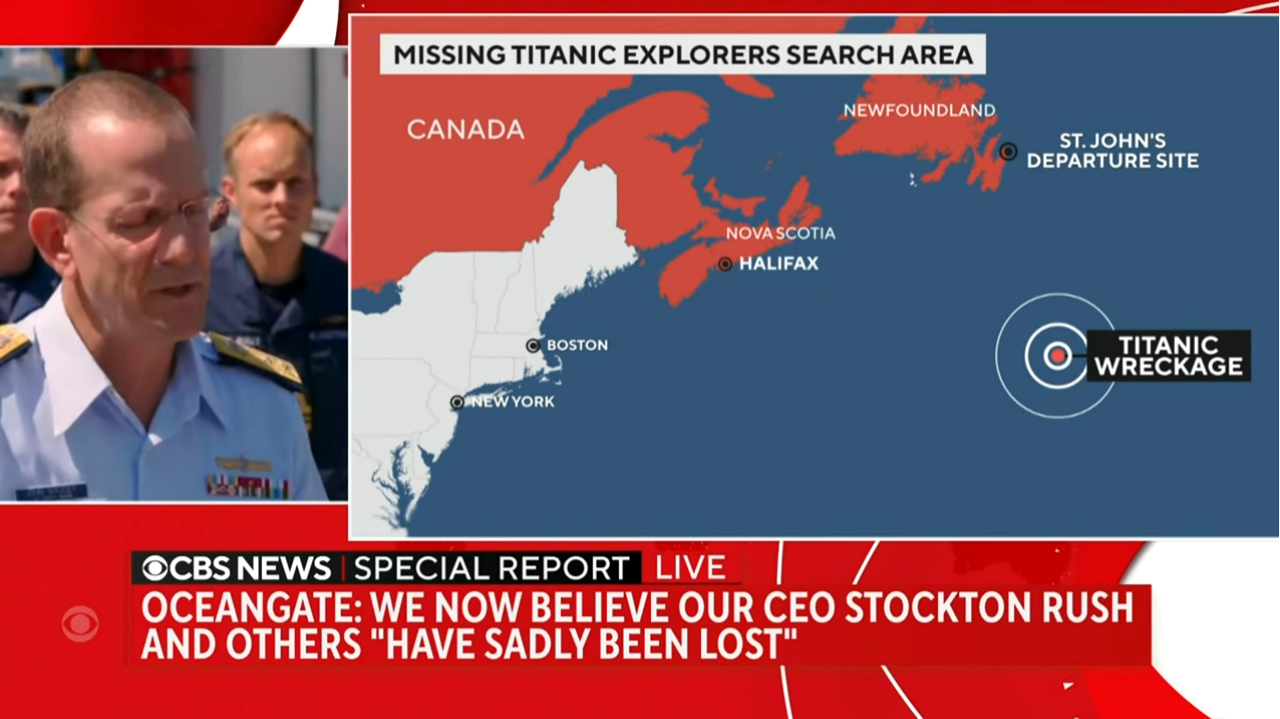
Coast Guard Rear Admiral John Mauger announced today that a remote operated underwater vehicle was able to locate the wreckage of the OceanGate tourist sub approximately 1,600 feet from the hull of the titanic. The mini submarine had been missing for four days.

The passengers on the 21-foot sub were British businessman Hamish Harding, Pakistani businessman Shahzada Dawood and his teenage son, Suleman, French explorer Paul-Henri Nargeolet, and Stockton Rush, CEO of OceanGate, the company that operates the vessel.   VIDEO:

CBS NEWS – Five people who were on a sub that went missing during a voyage to the wreckage of the Titanic did not survive, OceanGate, the company that planned the trip, said Thursday as the U.S. Coast Guard said the vessel experienced a “catastrophic loss of the pressure chamber,” and confirmed that the debris found on the sea floor were pieces of the missing sub.

“This is a incredibly unforgiving environment down there on the sea floor and the debris is consistent with a catastrophic implosion of the vessel,” Coast Guard Rear Adm. John Mauger told reporters.

An ROV, or remotely operated vehicle, from a Canadian vessel found the tail cone of the sub about 1,600 feet from the bow of the Titanic on Thursday morning, Mauger said during a briefing in Boston on Thursday afternoon. He said more debris was found and authorities consulted with experts who determined the debris was consistent with the sub.

“On behalf of the United States Coast Guard and the entire unified command, I offer my deepest condolences to the families,” Mauger said. “I can only imagine what this has been like for them, and I hope that this discovery provides some solace during this difficult time.” (read more)

Interview: Martin Armstrong on Why the CBDC Will Fail and a Great Depression is About to Begin


Armstrong Economics Blog/Armstrong in the Media Posted May 20, 2023 by Martin Armstrong

Rumble link Martin Armstrong on Why the CBDC Will Fail and a Great Depression is About to Begin