The Dutch Government Has Fallen – Prime Minister Mark Rutte Future Uncertain, New Elections Likely


Posted originally on the CTH on July 8, 2023 | Sundance 

The Netherlanders are a rather dramatic sort, organizing their system of governance on coalitions of various shades that agree to high-minded pleasantries as a way to remain above the fray of pesky conflict.  Alas, once a moment of core and consequential disagreement reaches an impasse, the entire Dutch government is said to “collapse.”

The Dutch Prime Minister Mark Rutte traveled to Tunisa earlier this year, together with EU leaders, pledging €1 billion in assistance if the North African gatekeepers could just stop the flow.  The effort didn’t work, and his small country of 18 million, already dealing with major internal conflict driven by farmers and climate change, could not cope with the toxic political challenge of increased unlawful migration.

Associated Press – The ruling Dutch coalition collapsed Friday after tense talks among the four parties in Prime Minister Mark Rutte’s ruling bloc failed to broker a deal over ways to rein in migration, a senior politician said. 

Henk Kamp, a senior member of Rutte’s People’s Party for Freedom and Democracy told Dutch television: “It is a great shame that the government has now fallen.” The failure of months of talks on the thorny issue could now force a general election. 

Rutte’s Cabinet gathered late Friday in a hastily scheduled meeting. “We talked for a long time, we are coming here tonight because we did not succeed,” Defense Minister Kajsa Ollongren told reporters as she walked into the Cabinet meeting.

Meanwhile, opposition lawmakers wasted no time in calling for fresh elections. 

Geert Wilders, leader of the anti-immigration Party for Freedom, tweeted, “Quick elections now.” Jesse Klaver, leader of the Green Left party also called for elections and told Dutch broadcaster NOS: “This country needs a change of direction.”

Rutte, the Netherlands’ longest serving premier, presided over late-night meetings Wednesday and Thursday that failed to result in a deal. More talks were held Friday evening, and he declined to answer questions about the issue at his weekly press conference before the discussions.

[…] There will likely be an election for the 150-seat lower house of the Dutch parliament later this year amid a polarized and splintered political landscape. Rutte’s Cabinet would likely remain in office as a caretaker administration until a new government was formed.

During provincial elections earlier this year, a populist pro-farmer party put Rutte’s party into second place. The defeat was seen as a possible incentive for Rutte to do his utmost to hold together his coalition until its term ends in 2025. (read more)

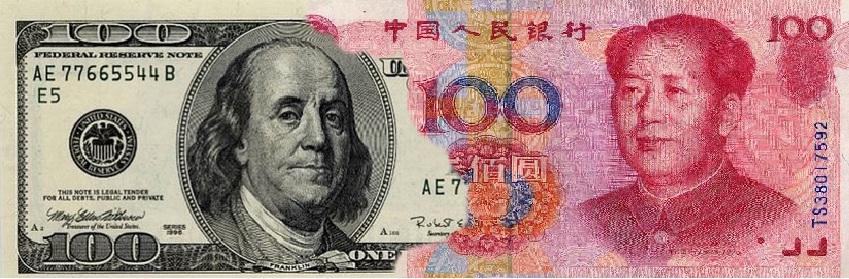
BRICS to Replace the Dollar?


Armstrong Economics Blog/Foreign Exchange Re-Posted Jul 6, 2023 by Martin Armstrong

The goldbugs cling to everything they can to promote gold at the destruction of the dollar. They are pushing the idea that China, Russia, and other BRICS countries are developing a dollar alternative. The truth of the matter is that is more fiction. Even India’s foreign minister S. Jaishankar came out and said, “There is no idea of a BRICS currency.” Foreign minister S. Jaishankar made it clear that the five-member BRICS group – consisting of Brazil, Russia, India, China, and South Africa – isn’t currently planning to develop a greenback substitute for trade and investments.  “On what we will discuss at the BRICS meeting, we’ll have to see because there are many other issues – but there is no idea of a BRICS currency,” he said, as shown by footage from the Hindustan Times.

To even attempt to do something is absurd to create a BRICS currency like the euro would doom their economies. The #1 market remains the American consumer, and to price things in some alternative currency would undermine their own economies. People need to understand currency.

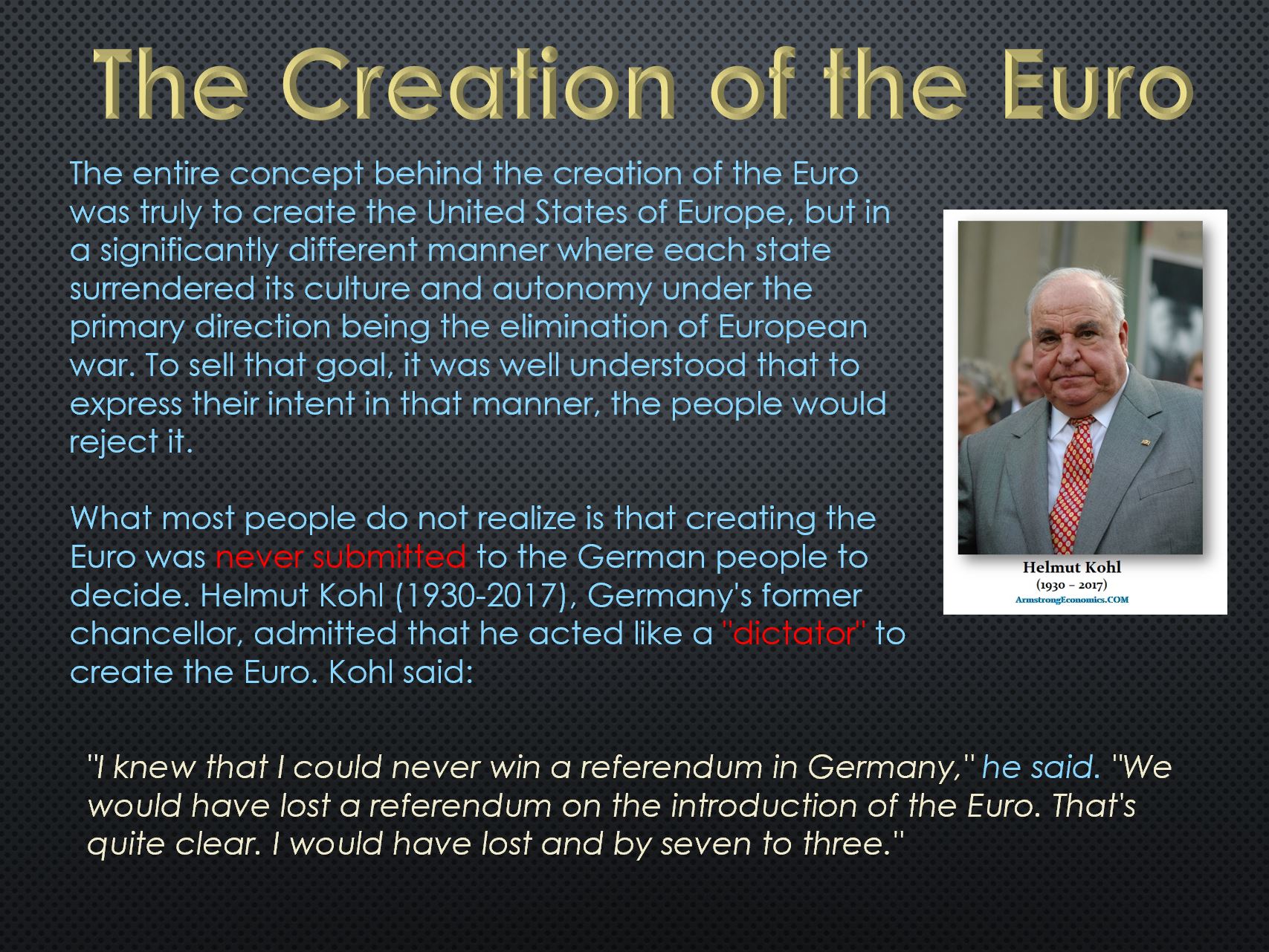
That was the entire purpose of creating the Euro. German Chancellor Kohl took Germany into the euro for the purpose of eliminating the foreign exchange risk to other European states so that Germany could then sell more products throughout Europe. The euro was to eliminate that foreign exchange rise to increase sales. The propaganda of the goldbugs who just hate the dollar is utter nonsense. They will not create some BRICS alternative to the dollar, surrendering their sovereignty to some central power as all European states did by creating Brussels. Kohl denied the Germans the right to vote on joining the euro, for he knew he would lose. That is why he refused to consolidate the debts fearing the German people would rise up in revolt against him.

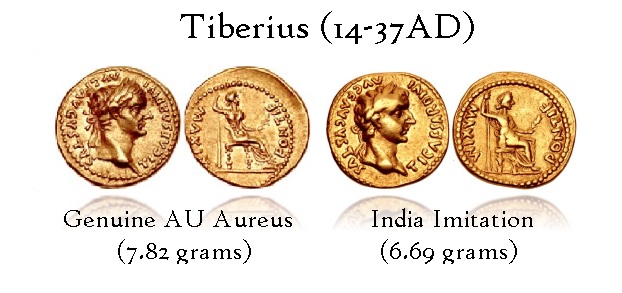
The Roman Empire was the financial capital of the Western World. They traded with both China through the silk road and India for spices. Even Alexander the Great attempted to conquer India and failed. Here we have an Indian imitation of a Roman gold aureus of Tiberius. The importance of Indian imitations of Roman gold coins demonstrates that there was a PREMIUM to the coinage of Rome above the metal content, which is why the Indians imitated Roman coinage. Otherwise, they would have minted their own coins in Southern India.

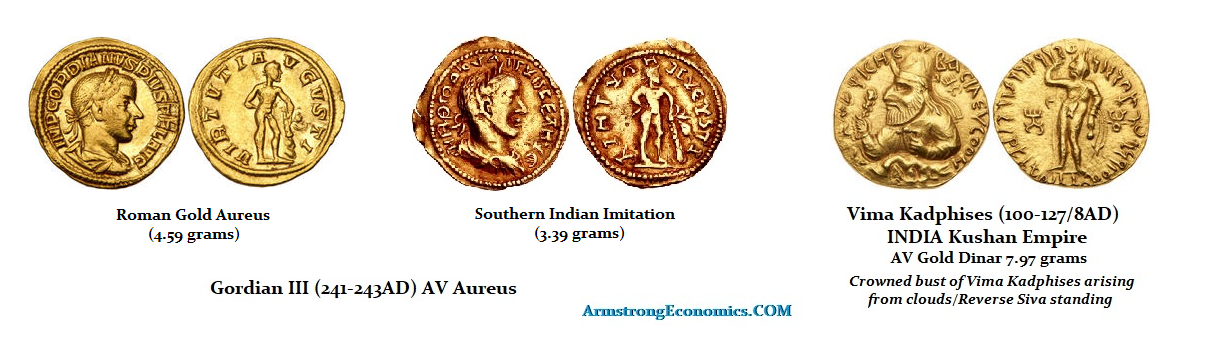
Indian imitations of Roman gold coins continued into the reign of Gordian III (2388-244AD), minted in Southern India that traded spices with the Greeks and the Romans. In Northern India, there was the Kushan Empire which was the first to issue Indian gold coinage. However, the Kushan Empire was not that portion of India that was engaged in the spice trade.

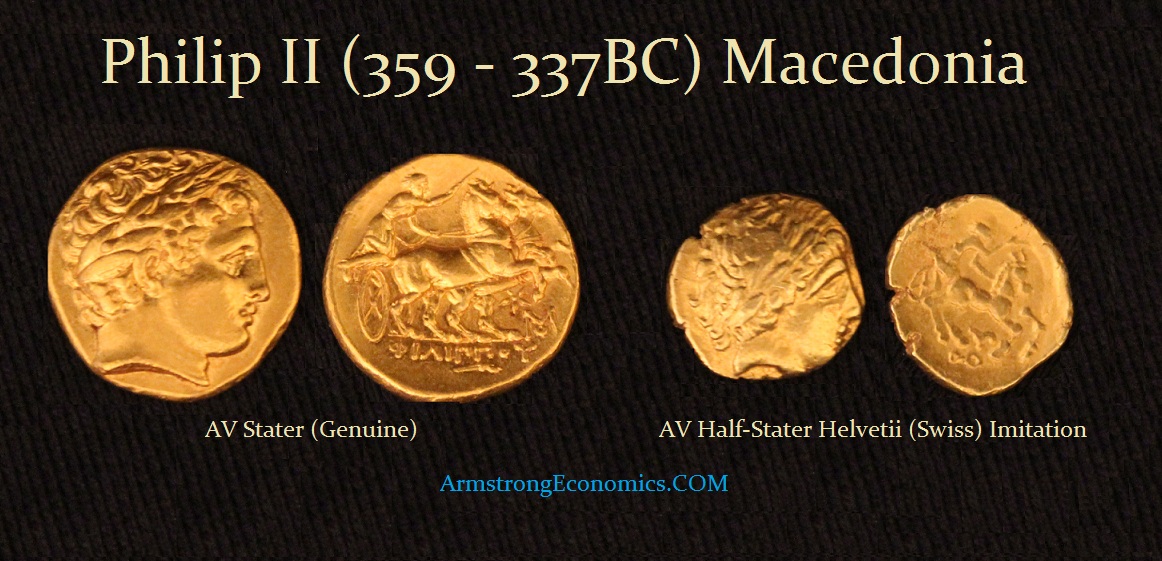
All of this proves a very significant point. The coinage was not simply the metal content. If that were the case, we would not find an imitation of the coinage of the dominant financial capital at that time. Here is a gold imitation of Philip II (359-337BC), Alexander the Great’s father.

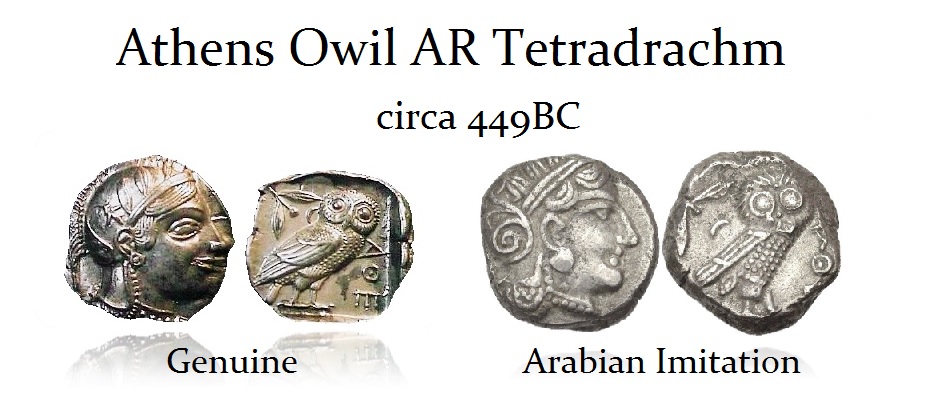
We see the same imitation of the silver Athenian Owls (Tetradrachm) minted in Arabia. The same exists in Egypt, which did not issue its own coinage. Imitations of the dominant coinage of financial capital existed throughout the centuries.

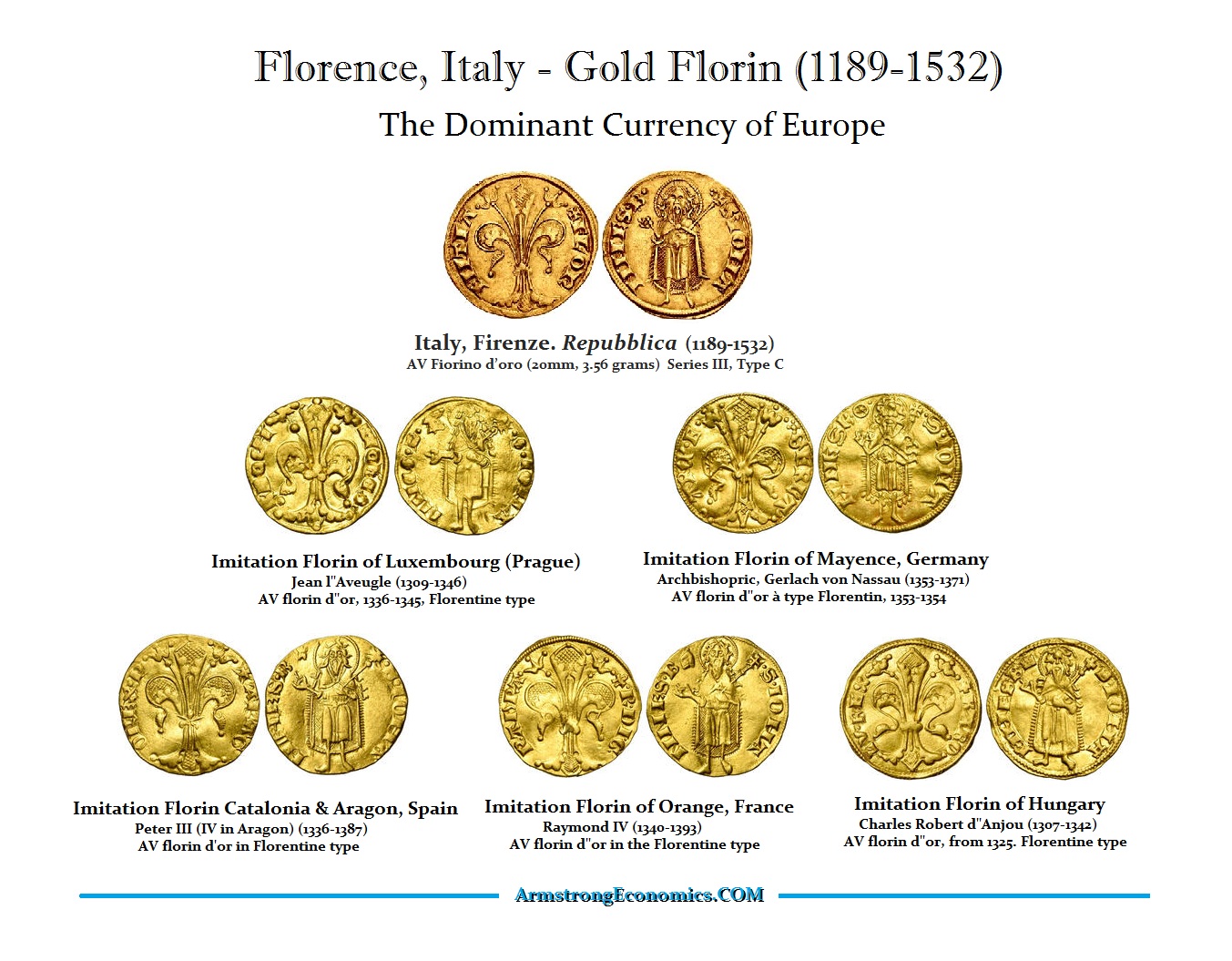
Even during the 12-13th centuries, European states also imitated the gold Florin of Florence. All of this clearly establishes that the goldbugs are simply wrong and do not understand the monetary history of the world. There is always a premium to the dominant economic empire. For right now, that is the US dollar.

For now, the dollar will retain that role up to about 2029.