
Posted originally on the CTH on August 10, 2023 | Sundance
Several people have made queries about the current state of our national economic condition against the backdrop of disconnected data points that seemingly conflict. Here’s my review.
July and August are key months to gauge the prior six months of U.S consumer positioning.
Why?
Because all advance purchase orders for the U.S. holiday season are made in May, June and July for inventory builds and delivery schedules for September. The decisions made by purchasing officers in late spring and early summer, reflect their predictive analysis for the holiday season.
Inventories are evaluated, critical financial discussions are held, and orders are placed for September arrival and distribution. This predictive activity is what we see in the July and August data that flows from the global, multinational and shipping corporations who facilitate the transfer of the goods. Check what is happening in distribution, and you can see what eventually creates the boxcar effect in the supply chain that ultimately leads to shuttered manufacturing.
Those who are involved in the business of shipping goods are signaling the flares around the state of the consumer economy and what will happen. At the same time, the wording is almost hilarious in this era of great pretending. Instead of saying ordinary words like “poor sales results for durable goods,” the parseltongue calls sales, “destocking.” Example: “CEO Vincent Clerc said he saw no sign that the destocking which has curbed global trade activity would end this year.”
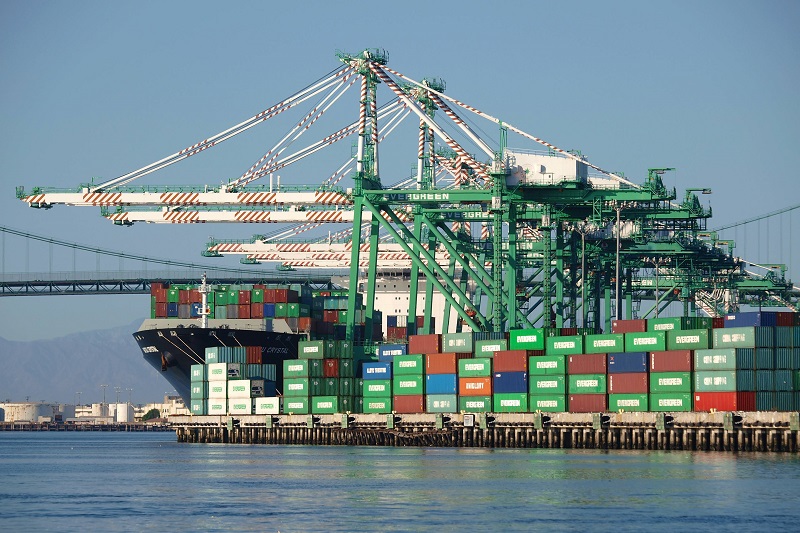
Global shipping company Maersk is warning that shipping volume is low because warehouse inventories are high. The goods are unsold.
(Reuters) – […] CEO Vincent Clerc said he saw no sign that the destocking which has curbed global trade activity would end this year.
“We had expected customers to draw down inventories around the middle of the year, but so far we see no signs of that happening. It may happen at the beginning of next year,” Clerc said at a media briefing. “Consequently, the uptick in volumes we had expected in the second half of the year has not occurred,” he said. (read more)
The lack of shipping leads to a review of inventory status for the warehouses who would receive the goods.
Bulging Warehouses – […] A review of corporate statements and briefings shows more than 30 U.S. and European companies, including Hugo Boss, Heineken and A.P. Moller-Maersk, 3M Co and Stanley Black & Decker complained that destocking hurt their second-quarter performance.
Retailers particularly have struggled with stocks of clothing and footwear as consumers splurge on holidays rather than goods as they did during pandemic lockdowns.
The downbeat outlook comes amid low expectations for second-quarter results as China’s post-pandemic recovery slows. Refinitiv I/B/E/S data shows U.S. and European companies are expected to report their worst quarterly results in years.
Companies which stockpiled last year are finding it harder to shed inventories when higher borrowing costs and inflation crimp consumer demand, corporate executives and analysts said.
In the euro zone, stocks of finished products hit records in August last year and destocking only started in May, based on latest euro-zone manufacturing data.
In the U.S., an analysis of U.S. Bureau of Labor Statistics by CFRA Research showed business inventories soared by 20% in mid-2022, the biggest jump on record based on data that goes back to 1993. Retailers led the trend – raising inventories by a quarter from a year earlier.
The date in this next paragraph is key:
[…] The U.S. inventory-to-sales ratio was 1.4 in May, up from 1.33 a year ago, which means retailers, manufacturers and wholesalers have more inventory than they can sell at a higher rate than a year ago. (link)

When purchase order decisions for the holiday season of 2023 were being made, the inventory levels were higher than 2022. This is KPI (Key Performance Indicator) data, because the holiday of 2022 was a total mess.
Holiday sales last year were exceptionally weak as wage earners were struggling to pay for higher prices in essential goods and services, fuel, oil, heating, energy, gasoline, food and shelter. The lack of consumer purchasing for non-essential goods and/or luxury items resulted in poor sales last year, and the inventory levels are actually higher this year than last year when this year’s purchasing decisions were being made. That reality drops purchase orders. The dropped purchase orders lead to Maersk saying they are shipping less goods.
Now, let’s get USA domestic…. because it’s all connected. For that let’s turn to the U.S. Postal Service:
USPS DATA – First-Class Mail revenue increased $221 million, or 4.0 percent, on a volume decline of 678 million pieces, or 5.9 percent, compared to the same quarter last year. Shipping and Packages revenue remained relatively flat while volume declined 41 million pieces, or 2.4 percent, compared to the same quarter last year.
Marketing Mail revenue decreased $333 million, or 8.8 percent, on a volume decline of 2.6 billion pieces, or 16.0 percent, compared to the same quarter last year. The Marketing Mail decreases were driven by the continued decline in advertising spending due to economic pressures experienced throughout most of the fiscal year, a higher inflationary environment affecting print media production costs. (link)
So, let’s put it all together….
Consumers did not buy stuff. As a result, spring inventories were high. Purchasing managers forecast weak sales. Summer purchase orders were very low. Shipping companies reflect declines in shipping because the purchase orders were low. Advertising and marketing budgets were cut to meet the decrease in consumer spending. Consumers are not forecast to spend this holiday season.
The economic pie is getting smaller.
Keep in mind, this is all intentional. This is all part of the outcome from “managing the transition” to a new energy economy.
As you are well aware the various western nation central banks including the U.S. Federal Reserve, are raising interest rates into a global economic contraction, a drop in demand. Raising interest rates into a contracting economy is counterintuitive, it runs against the expressed interest of government to grow economic conditions. However, there is a purposeful design to the contradiction. [A TLDR Version Here]
The central bankers are trying to support western government policy. Unfortunately, the government policy they are under obligation to support is the fundamental energy shift, or what the World Economic Forum (Davos Group) has called the “Build Back Better” climate change agenda.
Monetary policy can only impact one side of the inflation challenge. The western bankers (EU central bank, U.S. federal reserve bank, and various banking groups) are raising interest rates in order to “tame inflation” by “taming demand.” However, as you know the global economic demand has been declining for several quarters. Raising interest rates into an already contracting economy only does one thing, it speeds up the rate of economic contraction.
Economic contraction is the lowering of economic activity. Raise interest rates -in a general sense- and businesses invest less, borrowers borrow less, consumers purchase less, employers expand less, and the economy overall slows down. When the economy turns negative, meaning less products and services are produced, we enter a recession. Some businesses and employers do not survive a recession and subsequently unemployment rises.
During recessionary periods people buy less stuff, people have less income stability, and economic activity drops. When the banks raise interest rates into an economy that is already stalled or contracting, unemployment and general pain on Main Street increases. Workers are laid-off, incomes shrink, consumer spending drops and that leads to less employment. Recessions are bad for middle-class and working-class people.

However, that said, there is one benefit from a recession…. Energy use drops.

 Centinel2012