Posted originally on CTH on March 23, 2026 | Sundance
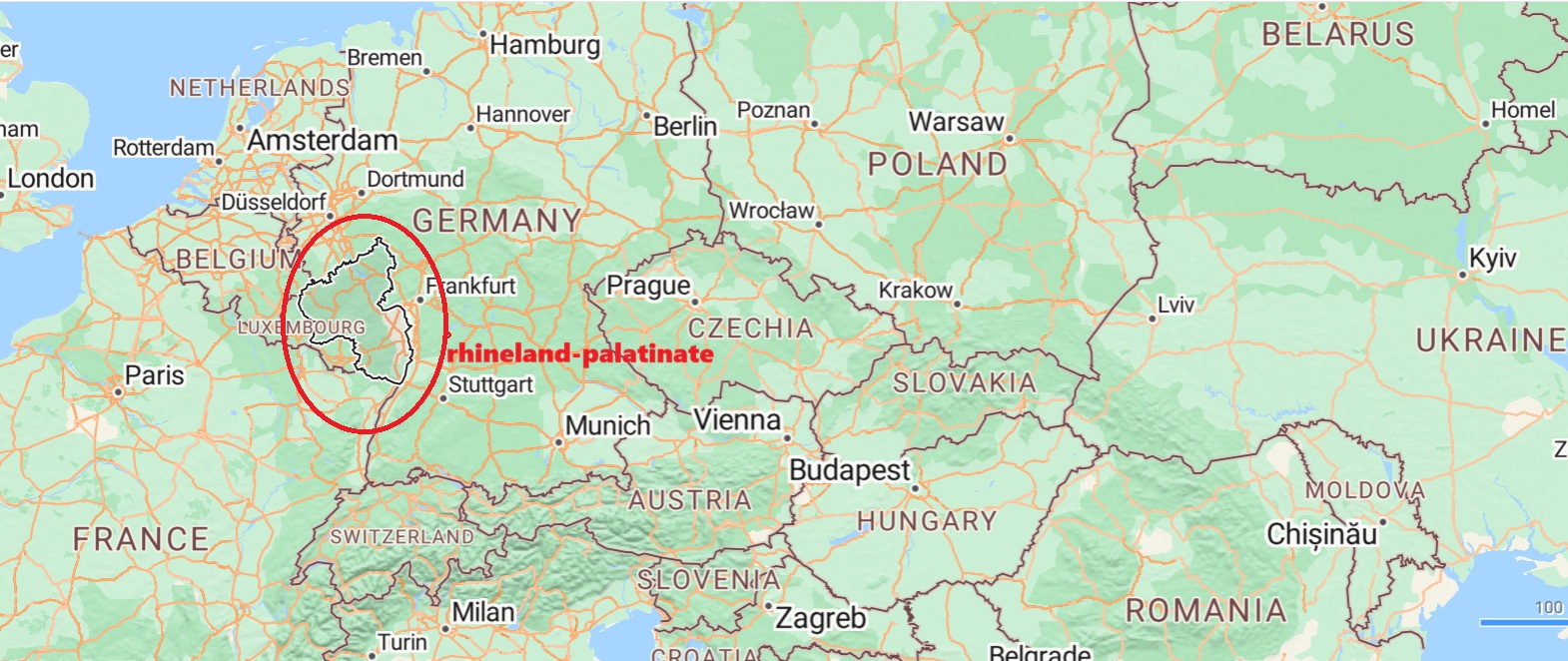
Within Germany the Rhineland-Palatinate regional parliament electionwas held yesterday. The region is the heart of the German industrial sector and home to the massively important auto-manufacturing sector.
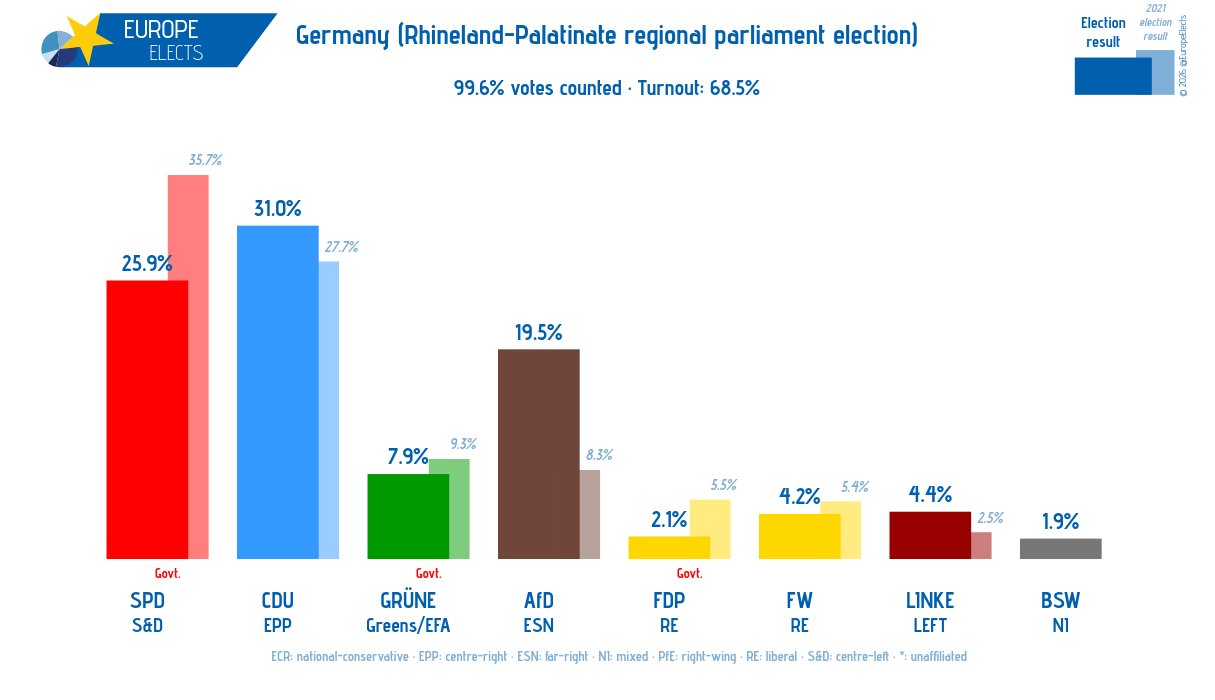
Chancellor Friedrich Merz’s conservative party the Christian Democratic Union (CDU) won the biggest portion of the election, defeating the Social Democratic Party (SPD) who lost ground in the western area bordering France. However, the biggest electoral gains were for the Alternative for Germany (AfD) party, with gains that more than doubled its previous vote share.
There is intense interest throughout Europe on the ideological shift in political sentiment mostly driven by economic concerns as well as rising nationalistic sentiment against the elitist minds in Brussels. Essentially those being ‘ruled’ are increasingly fed-up by those doing the ‘ruling.’ The AfD party is akin to the pragmatic MAGA base more focused on economic nationalism than all the nonsense associated with multiculturalism, green energy programs and terrible immigration policy.
The ideological battle within Europe is ongoing, with some gains by nationalist parties over the collective mindset of the European elites. However, the European Commission doesn’t just have a finger on the scales, they have full control over the mechanics of the elections themselves. Yes, AfD more than doubled their share of votes to 20%, but CDU at 31% and the socialists at 26% is akin to mainstream corporate republicans and progressives respectively controlling 57% of the support base.
The biggest election to be held in Europe in the last decade or more, is going to be the election in Hungary which takes place April 12, next month.
The European Commission is going all-in to try and manipulate the Hungarian voting base against Prime Minister Viktor Orban and the Fidesz party who is/are viewed by Brussels as standing in the way of their scheme to fund the ongoing war in Ukraine.
Orban’s reelection campaign has been under relentless assaults from restrictions on EU social media, to outright propaganda and financing for his opposition Péter Magyar and the Tisza party.
Prime Minister Orban is strongly supported by President Donald Trump and the Trump administration; however, the scale of opposition to both of them is intense.
Former leftist USAID Administrator Samantha Power spent time inside Hungary organizing the Tisza party to oppose Viktor Orban, and the totality of the European opposition to Orban cannot be underestimated.
Every element of every political construct within the Europe Union is aligned to try and defeat Orban and the Fidesz party. Additionally, the government of Ukraine is actively working all intelligence angles to defeat Orban due to the $90 billion EU loan scheme that Hungary is blocking.
Prime Minister Viktor Orban winning reelection this time in 2026 would be akin to Trump’s victory in 2016.
Do not underestimate the power of the U.K/European control system and the alignment of all their collective interests. Chancellor Friedrich Merz (Germany), President Emmanuel Macron (France), Prime Minister Keir Starmer (UK) along with the governing elites of Denmark, Finland, Sweden, Norway, Austria, Netherlands and many more, have all publicly taken positions against Hungary.
As we saw in Romania, Moldova and Georgia, it is not simply a matter of what the Hungarian voters want that will determine the outcome of the Hungarian election, the European Commission has many tools and techniques to shift the outcome.
This single small Hungarian election is the most critical election for the EU since Brexit.
Posted originally on Jan 28, 2026 by Martin Armstrong |
The idea that Europe always tries to conquer Russia is a common historical fact. To be accurate, there have been several major conflicts initiated by European powers against Russia, driven by specific geopolitical, ideological, and strategic reasons. It’s not a constant effort by a monolithic “Europe,” but rather a series of distinct invasions from different Western powers at different times; the goal has always been to capture Russian wealth. They consistently rewrite history to justify their endless greed to conquer Russia. The truth about the January 1863 Uprising against Russia, it was the Polish-Lithuanian Army that invaded and even occupied Moscow until the Russian people staged an uprising to take their country back.
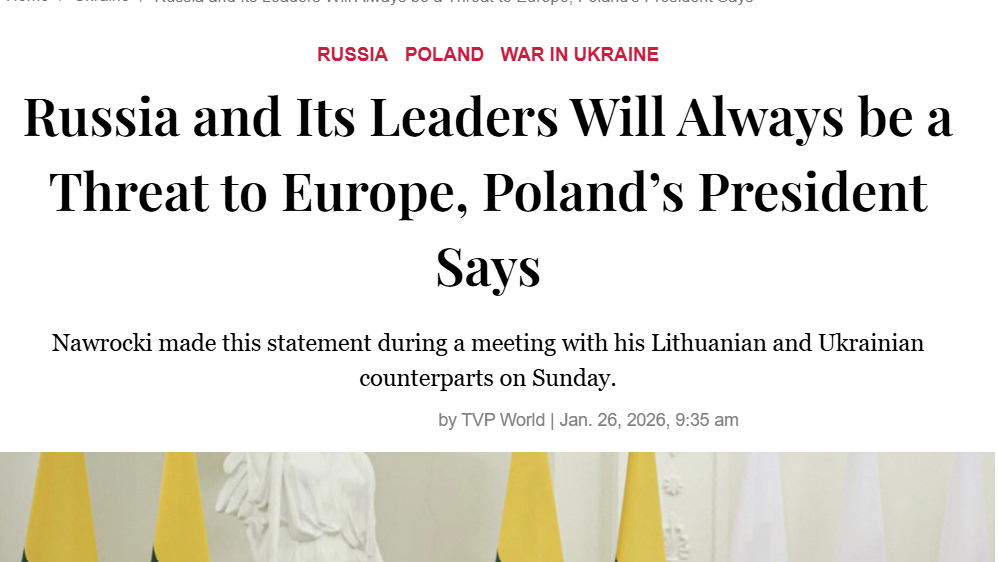
Ukraine’s President Volodymyr Zelensky, Lithuania’s President Gitanas Nauseda, and Poland’s President Karol Nawrocki met to commemorate the 1863 January Uprising against Russian rule. They have declared their hatred for Russians and boldly stated “Russia will ALWAYS be a threat.”
The January Uprising is a central symbol of Polish resistance and the fight for independence, and its memory is honored for its heroism and sacrifice. However, this is also a one-side revision of history.
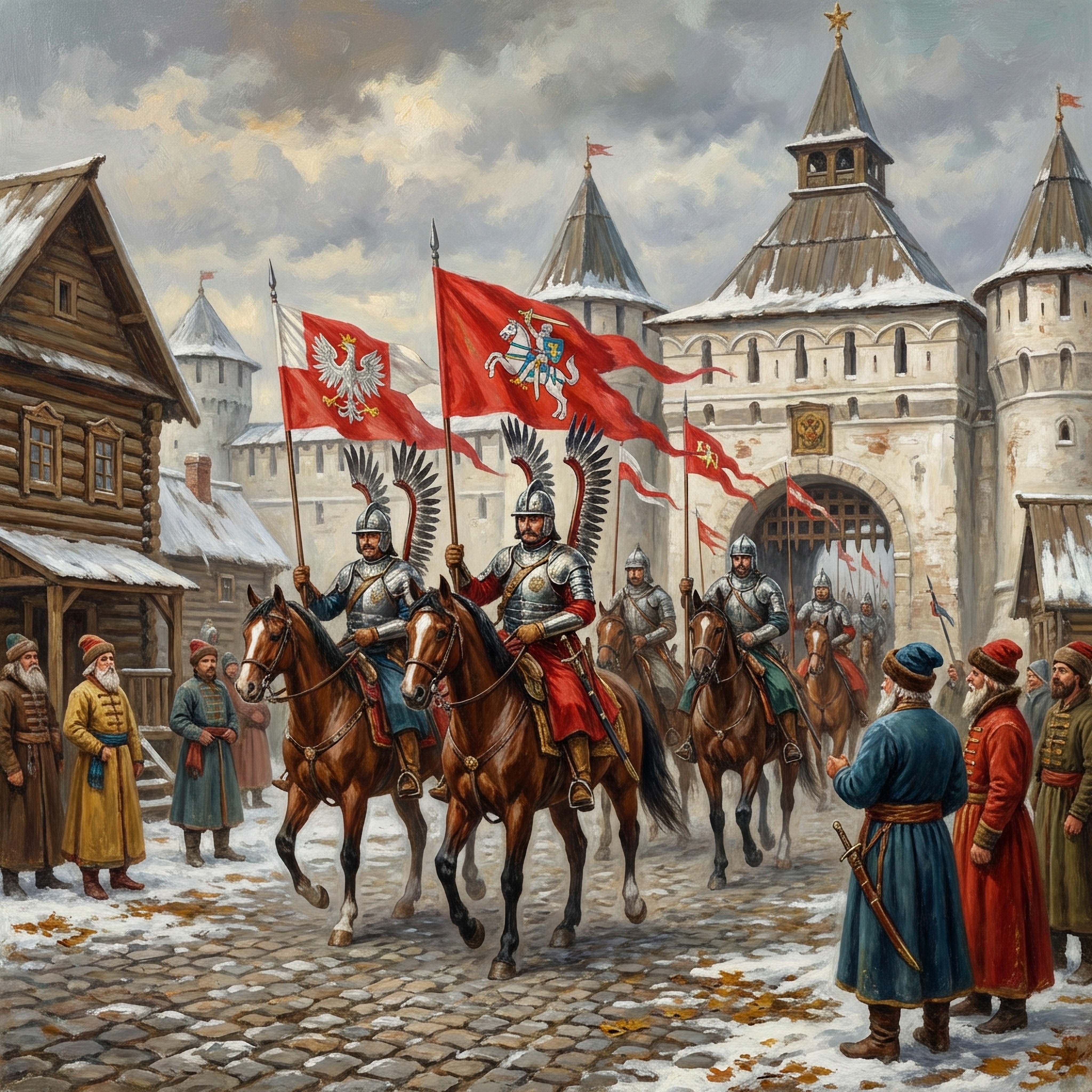
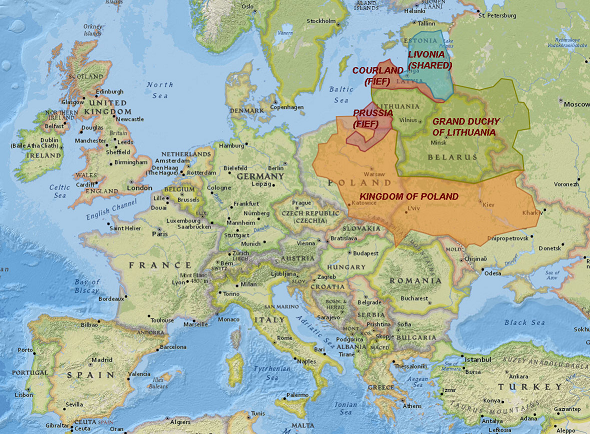
The January Uprising of 1863 was not a war, it was a major Polish-Lithuanian rebellion against the Russian Empire that ended in a decisive defeat for the rebels. What they omit from their history books is the blunt fact that the Polish-Lithuanian Commonwealth invaded Russia during a period of profound crisis known as the Time of Troubles (c. 1598-1613). This was not a single, clear-cut war but a complex series of interventions and campaigns driven by Polish-Lithuanian ambition to conquer Russia for its wealth taking advantage of internal Russian instability. So to be historically correct, they sought to conquer Russia, lost, were then occuppied, and celebrate this 1863 uprising as if they were the victims of an invasion they launched and lost.
The Dimitriads (1605-1612) This refers to Polish-backed campaigns by pretenders to the Russian throne, known as False Dmitrys. False Dmitry I (1605-1606) with the support of Polish magnates, invaded Russia, gained support from disaffected Russians, and briefly seized the throne in Moscow. His rule ended with his assassination.
False Dmitry II (1607-1610) was a second pretender, also backed by Polish-Lithuanian forces and Cossacks, set up an alternate court near Moscow. His campaign further destabilized the country.
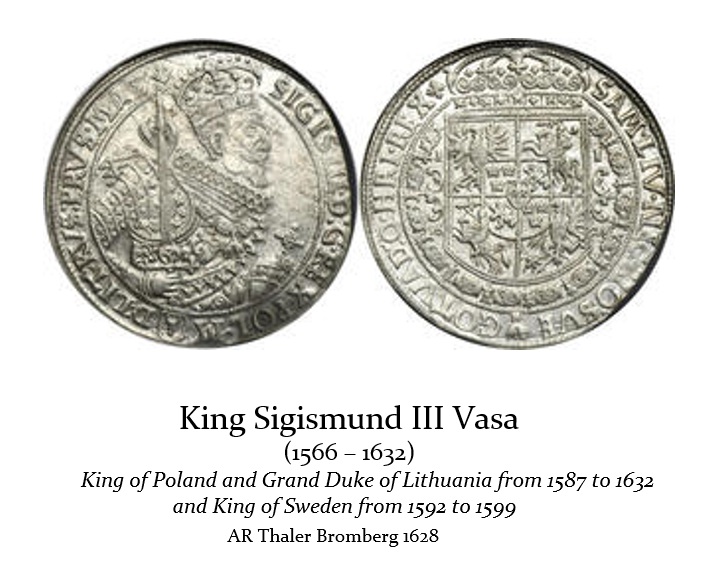
Then came the Polish-Muscovite War (1609-1618). As the chaos continued, King Sigismund III Vasa of Poland-Lithuania shifted from covert support for pretenders to an open, royal invasion with the goal of conquering Russia and placing his son (or himself) on the throne.
The Polish-Lithuanian army besieged and captured the key fortress city of Smolensk (1609-1611) after a long and brutal 20-month siege. A decisive Polish-Lithuanian victory over a much larger Russian-Swedish army took place at the Battle of Klushino in 1610. This opened the road to Moscow.
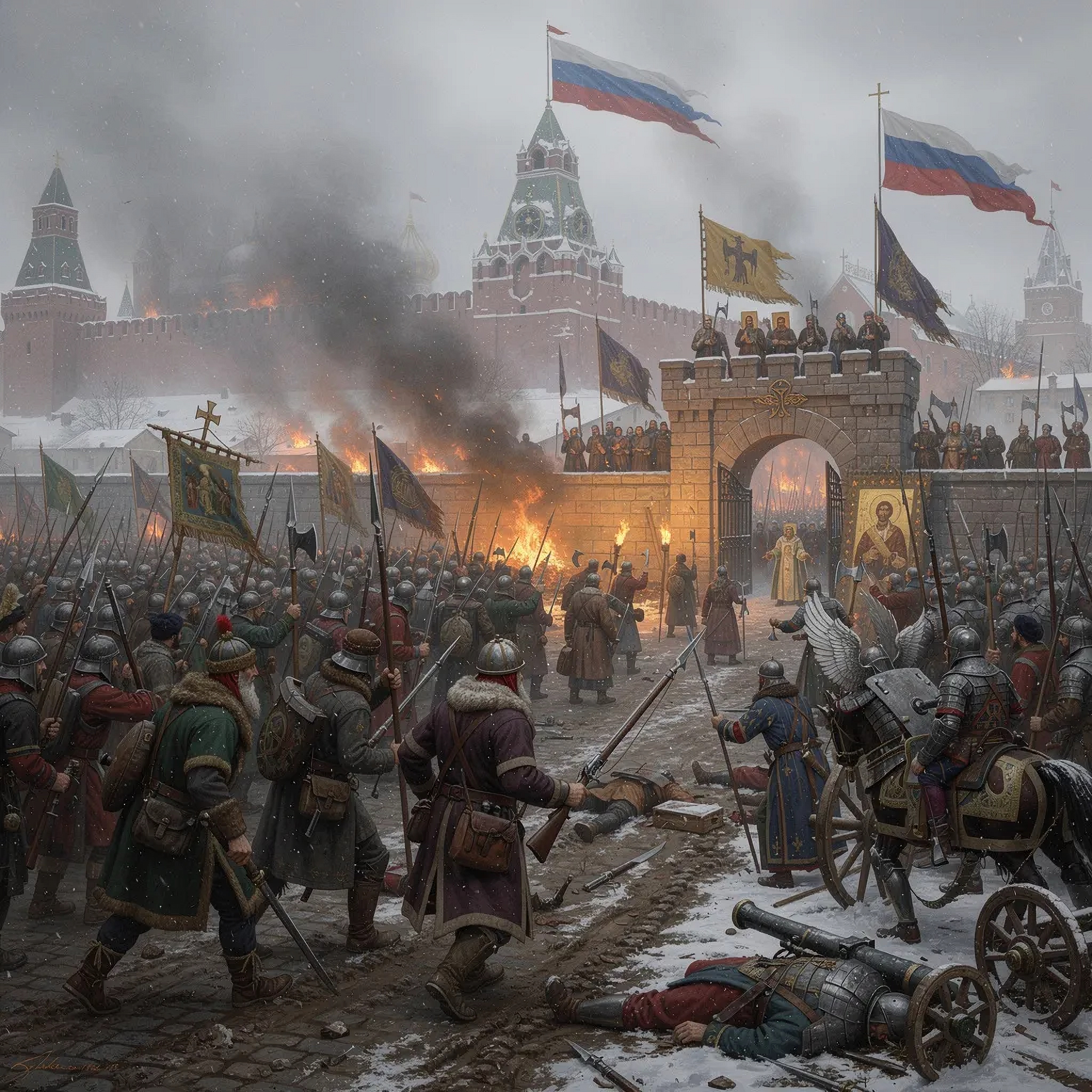
Polish Occupation of Moscow the took place 1610-1612. Following Klushino, a group of Russian boyars invited the Polish prince Władysław IV Vasa to become Tsar, on conditions including his conversion to Orthodoxy. Polish-Lithuanian troops entered and garrisoned the Moscow Kremlin. However, King Sigismund insisted he should be Tsar, negotiations broke down, and the occupation turned into a hostile siege from within the Kremlin itself.
A Russian national uprising, led by Kuzma Minin and Prince Dmitry Pozharsky, formed a militia and besieged the Polish garrison in the Kremlin. In November 1612, the starving Polish forces surrendered, ending the occupation. This event is now commemorated in Russia as National Unity Day.
The war officially ended with the Truce of Deulino (1618), which granted the Commonwealth significant territorial gains, including the Smolensk region. However, the primary goal of placing a Polish king on the Russian throne had failed.
The Polish invaded Russia during a civil war. The Commonwealth exploited Russia’s internal collapse (dynastic crisis, famine, peasant uprisings). It ultimately failed yet the Commonwealth gained territory, the core ambition of political control over Russia was defeated by a national uprising.
In Russia, this period is remembered as a patriotic struggle against foreign invaders. In Poland, it is seen as the zenith of the Commonwealth’s power and a “lost opportunity” to dominate Eastern Europe.
This invasion was a pivotal moment that deepened the long-standing rivalry between the two powers, setting the stage for future conflicts (like the Smolensk War and The Deluge) and contributing to a mutual distrust that shaped Eastern European history for centuries.
To this day, celebrating the January Uprising of 1863 is a revision of history for Russia has NEVER invaded Europe even once, whereas there have been five attempted conquests of Russia sll based on the fact that to this day, Russia is still the richest country on Earth from a natural resource perspective. In 1917, Russia had the largest gold reserves in the world. Someone hid them so the Communists would not get them, and they have never been found since.
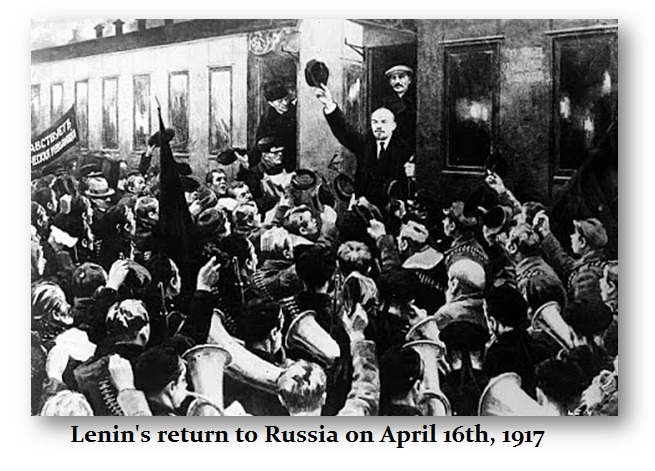
The German Emperor Wilhelm II Imperial Government actually feared that Russia would enter World War I. The rising communist movement in Russia was anti-war. Germany saw a chance for victory in Europe if it kept Russia out of the war. Hence, Germany supported the Communist anti-war sentiment of the Bolsheviks in Russia. Germany permitted Vladimir Lenin (1870-1924) to travel in a sealed train wagon from his place of exile in Switzerland through Germany, Sweden, and Finland to Petrograd. Since the start of the February Revolution in Russia, Lenin was trying to figure out a way to get back into Russia. Germany aided his return assuming he was anti-war and would thus keep Russia out of World War I. Lenin returned to Russian on April 16th, 1917. Within months of arriving, Lenin led the October Revolution in Russia and the Bolsheviks seized power and indeed Russia withdrew from the world war. According to Leon Trotsky, the October Revolution would not have succeeded without Lenin.
The West has been abscessed with Russia for centuries. They are painted as evil and the excuse always changes. Before Gorbachev, it was that Russia was Communist and wanted to spread communism and conquer Europe. Communism collapsed all by itself, but the claim that Russia wants to still invade Europe remains. It does not matter who is the head of state in Russia, they will always change the narative to justify the conquest of Russia no matter what.
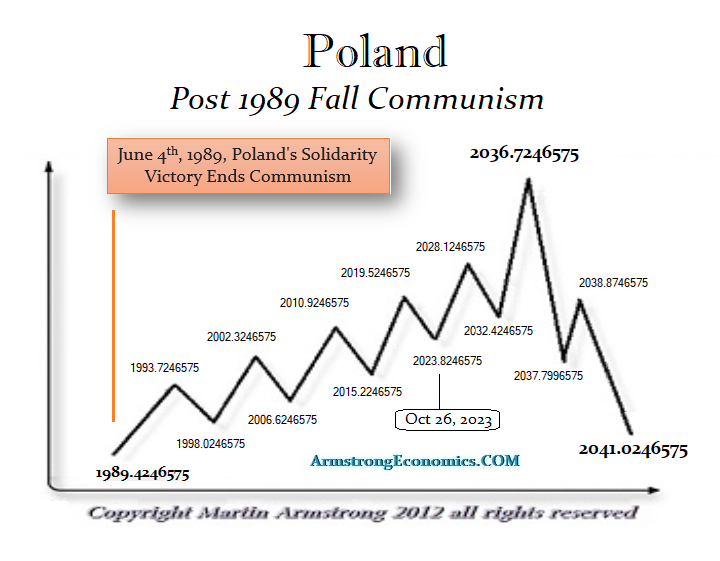
As one of our readers from Poland noted, the October 26th 2023 turning point was the precise day that President Duda called for a new Polish parliament to convene after the October 15th elections. Our models show a Directional Change in 2027 and that volatility in Poland was due to start rising here in 2026 all the way into 2034.
Europe seems to have a death wish because the EU experiment is failing. Instead of addressing the issues, they prefer to live in the past, assume they can conquer Russia and the 6th time will be the charm, celebrate with $75 trillion in assets, free gas for all, and the EU will rise to lead the world, which is why Carney is taking Canada into the arms of the EU.
Posted originally on Jan 27, 2026 by Martin Armstrong |
Ukraine’s President Volodymyr Zelensky, Lithuania’s President Gitanas Nauseda, and Poland’s President Karol Nawrocki met to commemorate the 1863 January Uprising against Russian rule. Even though 163 years have passed, politicians still believe that Russia is an enemy that could attempt to conquer their land at a moment’s notice. The Europeans simply cannot help themselves. They NEVER learn from history, and that is why history keeps repeating itself. Kyiv Post ran an article with the headline “Russia and Its Leaders Will Always be a Threat to Europe” that basically sums up the mindset that has been driving this entire conflict from day one.
“Policies backing a ‘reset’ with the Russian Federation are disappearing, but one thing remains unchanged: whether it’s Tsarist Russia, Bolshevik Russia, or Vladimir Putin’s Russia, our countries, now independent, still face the same threat from the Russian Federation,” Poland’s President Nawrocki said. He added: “The countries of central and eastern Europe were not wrong in their opinions about the Russian threat, even at a time when western Europe was still focused on climate policy or letting in illegal immigrants.”
This is the same propaganda cycle that we have seen for centuries. You demonize the opponent, you claim they are inherently aggressive, you declare that they will “never change,” and then you justify endless war spending, suppression of dissent, and total economic destruction at home. President Nawrocki admitted that Europe will always view Russia as a threat, regardless of who is in charge.
The real threat is Europe’s leadership, which is dragging the continent into an economic depression. Every time they push sanctions, weaponize trade, and centralize power in Brussels, they accelerate the capital flight and the collapse in confidence. People do not understand that wars are not just fought with weapons. They are fought with capital flows. Once confidence breaks in government, money moves. That is why gold rises when people are trying to get OUT of the system. They are trying to escape the arbitrary rule of government and the risk of confiscation, capital controls, or banking restrictions. Europe is walking right into that trap again.
And of course, once they create this narrative that “Russia will ALWAYS be a threat,” then there is no room for peace. You cannot negotiate with someone you claim is permanently evil. That is the entire point. If peace breaks out, then the excuses for authoritarian policy at home disappear. The budget scams get exposed. The censorship ends. And the public begins asking why they were sacrificed for a political agenda.
This is why I have warned that the war cycle is rising into 2026. War becomes the tool of last resort for governments that have destroyed their own economies and need an external enemy to blame. It is not about defending Ukraine. It is about preserving a system that is collapsing under sovereign debt, energy shortages, and political corruption.
Posted originally on Jan 20, 2026 by Martin Armstrong
Around 10% of all autos sold in Poland were manufactured in China, a sharp 427% annual increase. Governments have been leery of Chinese autos, fearing their ability to undercut the European market, but now a new concern has arisen—military security.
Chief of the General Staff General Wiesław announced a coming ban on all Chinese-manufactured cars in military facilities and units. “In 2025, the Military Counterintelligence Service issued guidelines on how to protect military facilities in connection with threats arising from the use of various devices manufactured in China,” the ministry stated.
Poland is not the first nation to ban Chinese-made vehicles from military bases. The Israel Defense Forces (IDF) refuse to permit Chinese autos form entering military bases. Owners must park outside the perimeter as the Chinese government may be using cameras and sensors to acquire sensitive data. The IDF has already recalled 700 Chinese-made EVs, citing a “real concern of sensitive information leakage.”
The UK Ministry of Defense (MoD) has also banned certain Chinese vehicles from “sensitive military bases” and other sites that could be vulnerable to espionage. The MoD went as far as asking personnel to monitor their private discussions while driving in Chinese cars, and to assume that the Chinese government has the ability to monitor them at all times.
China has banned Tesla vehicles from entering their military bases and housing complexes for the same reason. All modern vehicles have advanced cameras, GPD, microphones, and the ability to log data. We cannot ensure we are in privacy even when we are inside our personal vehicles. The bigger concern becomes whether governments will begin rejecting foreign vehicles entirely.
Yes – Canadahas also adopted the BAIL-IN abandoning the socialist BAILOUT so banks can take depositors money legally. This is how we move from Capitalism to Socialism to Tyranny,
From January 31st, 2018, the UK authorities have a new power. They can now use new and expansive investigative authority to require both individuals and corporate bodies to provide information as to how they acquired property. Known as Unexplained Wealth Orders (“UWOs”), which is another step toward tyranny all because governments are totally incapable of managing their own finances. They line their own pockets with promises of pensions for government workers and when they need to be paid their attitude is simply that the people are like an apple orchard – just go pick some more apples when you get hungry.
The new UWO imposes obligations to disclose information with respect to property anywhere in the world and can even be served on persons living outside the UK. Britain is taking a step closer toward imposing worldwide taxation for it is now requiring even non-resident to divulge information that historically was not taxable. The legal framework behind UWOs, and their interaction with other criminal and civil statutes, as well as the implications for individuals, institutions, and trustees are serious issues.
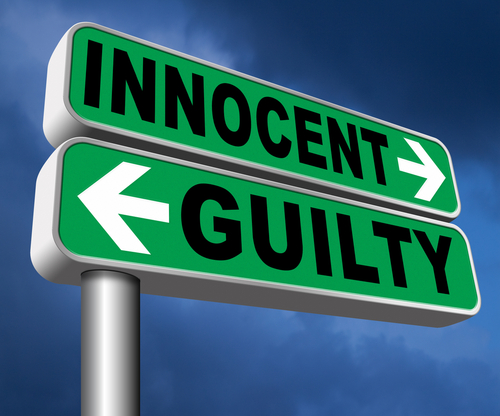
What has taken place is rather stark and we can expect that other countries will file Britain’s lead. This new law has turned the entire legal system on its head. We have always believed that we were supposed to be innocent until proven guilty. That has been completely eradicated from the law. The UWOs now presume guilty and it becomes your burden to prove you are innocent.
The Legal background
Sections 1 to 9 of the Criminal Finances Act 2017 (“CFA”) have now amended section 362 of the Proceeds of Crime Act 2002 (“POCA”), This has created a whole new regime of UWOs. As of January 31st, 2018, several of the UK authorities have new powers including the National Crime Agency, Serious Fraud Office, Financial Conduct Authority and HM Revenue & Customs. All of these agencies are now able to require both individuals and corporate bodies to explain how they obtained an interest in a specified property.
The Court may now also engage in a UWO requirement where the following four conditions are satisfied:
Condition 1: There are reasonable grounds to believe that the person holds the asset(s).
Condition 2: There are reasonable grounds to believe that the cumulative value of the asset(s) is greater than £50,000.
Condition 3: There are reasonable grounds for suspecting that the known source of the person’s lawfully obtained income would have been insufficient for the purposes of obtaining the property – for these purposes, the Court will consider any mortgage or other security that it is reasonable to assume was or may have been available and assume that the person obtained the property for market value.
Condition 4: The person falls into one of the following categories –
· The person is a “Politically Exposed Person” (“PEP”) i.e. someone entrusted with prominent public functions by an international organisation or any country other than the United Kingdom or another EEA state; · The person is a family member, a close associate or a connected person of a PEP; · There are reasonable grounds for suspecting that the person is, or has been, involved in serious crime (either in the UK or elsewhere) (“a suspected criminal”) – serious crime will include fraud, money laundering, tax evasion, sanctions offences, and bribery and corruption; or · The person is connected with a suspected criminal.
UWOs must be served in accordance with the usual Civil Procedure Rules. So in other words, we are looking at a whole new type of power. You are now GUILTY and you must prove your INNOCENCE. I have explained that I was held in prison for “Civil Contempt” not CRIMINAL. The difference is one I was being “coerced” and the other is you are being “punished” so only then are you entitled to a real trial by jury.
Here we have the same pretense. The burden and standard of proof regarding UWOs fall under the civil investigative tools and as such they do not form part of the UK’s criminal law regime. Therefore, as long as it is civil, you can be stripped of all rights and any imprisonment is “coercive” so you are not being punished. Consequently, the UK authorities can engage in full-blown tyranny applying for a UWO they will only need to show “reasonable grounds” for their suspicions. This is a much lighter legal standard than the “realistic prospect of conviction” standard required in order to bring criminal prosecutions what is call in America “probable cause”.
The real danger her is there is no practical limitation on the scope. That means the UK is applying the scope to worldwide turning its citizens and corporations as well as trusts into tax slaves. Laws are normally limited to TERRITORIAL JURISDICTION meaning if you killed someone in Paris, you stand trial in Paris not in Hong Kong or wherever you are a citizen. Hence, here the scope of UWOs can be made in respect of any property, regardless of where in the world it is located converting everyone to a tax slave. This applies to any individual or corporate, whatever their place of residence, business or incorporation (there is no requirement to demonstrate a nexus to the UK). This is really tyranny for the way the code is written, they could bring thistoanyone even if not British.UWOs can be made in respect of any property, including property acquired before January 31st, 2018, as well as property held by more than one person meaning partnerships and trusts. Laws have traditionally been regarded as tyranny if they are applied retroactively, known as Ex Post Facto. Here, because this is “civil” in pretense, they are circumventing all the historic safeguards against legal persecutions by writing a law after the fact to make something criminal.
The penalties of a failure to respond to the UWO within the prescribed time without reasonable excuse will give rise to a presumption that the property specified in the UWO is recoverable for the purposes of a civil recovery order (“CRO”) which means the property will be presumed to be ill-gotten gains and seized by the government. You then will have the burden to prove you are innocent and you are presumed to be guilty. If you refuse to answer, they can throw you in prison until you die as they did with me using the contempt of court powers. If you lie in any statement in response to a UWO, now this becomes criminal and punishable by a prison sentence of up to two years and/or a fine.
You will be deemed guilty unless you have “reasonable excuse” to have failed to comply with the terms of the UWO, yet what constitutes a “reasonable excuse” is not actually defined. In the States, a mother was required to pay her son’s student loan even though he had been killed and the court held that was not a “reasonable excuse” so this becomes a pure tyranny.
The UWO also allows in the legislative changes a new Interim Freezing Order (“IFO”). So, the government can freeze your assets until you comply. The High Court may grant a IFO to prohibit a respondent to a UWO (and any other person with an interest in the property) from dealing with the property specified in the UWO. If the court issues an IFO, the agency bringing the action must determine whether or not to instigate proceedings within 60 days. If it fails to do so, the IFO will expire, however, the relevant authority is still free to determine what proceedings it may take against the respondent “at any time” in the future without any statute of limitations – another tyranny under the law.
The DANGER in this legislation is simple. It is pure and unadulterated tyranny for it removes ALL protections of law and shreds the English Bill of Rights no less the Magna Carta. Then King John also derived income from fines, court fees, and the sale of charters and other privileges. Fines were called “amercements” and at the time, it was said that there was hardly an Englishman of substance who had not been amerced at least once a year. Magna Carta introduced the right to trial by jury, where the people decide if someone is guilty and what the fine should be. This drastically curtailed the king’s abuse of the legal system at that time. King John was very unpopular, for he had intensified his efforts to maximize all possible sources of income to regain Normandy. Contemporary commentators describe him as “Avaricious, miserly, extortionate and money minded.”
The entire right to trial by jury was to stop the king and his corrupt courts from fining people to raise money. This law has shredded the Magna Carta and has restored all the former tyranny of the King once again to raise money. In 2015, that marked the 800th year following the signing of Magna Carta.
Behind the curtain, there is a growing concern about a serious banking crisis beginning once again in Europe. Many governments are talking about the crisis behind-the-curtain and we are now beginning to see steps that are being taken to end the TO-BIG-TO-FAIL policies that dominated the 2007-2009 Crash.
The United States is looking at a new radical bank rescue policy where the government is proposing to revise a central pillar of the idea of bailing out banks creating new financial regulation with a new Chapter 14 bankruptcy procedure. They are looking at eliminating the risk of taxpayers’ costs to bail out banks. They are investigating the means for an orderly resolution so that the taxpayers do not have to bail out the banks. This development is causing some concern among the high-flying Wall Street banks, for if that is the case, then another crisis as 2007-2009 will result in even Goldman Sachs closing. The proposal looks to shift the burden to the shareholders and creditors of that bank. This means depositors who are thus creditors.
In Australia, we see similar legislation being proposed. This is the Financial Sector Legislation Amendment (Crisis Resolution Powers and Other Measures) Bill 2017. This also authorizes bail-ins bringing an end to the bailout.
While the stock market crashed as the pundit looked in their bag to try to come up with an excuse, they blamed rising inflation and interest rates. Yet, nobody is really paying attention to the underlying trend. The cost of carrying debt has been rising gradually and there are noticeable measurable impacts that the pundits are of course oblivious to since they have to explain every day’s movements and not the real trend.
Already, the 10-year rate is piercing above the 2.6% area. There is an impact on the currency once people begin to comprehend the trend. The 10-year German bond rate is 0.70%, and this has been maintained by the ECB buying 40% of European government debt to no avail for nearly 10 years.
The real crisis comes when they realize that the ECB will not be there to buy government debt. The bidders will demand a higher yield so rates will rise very rapidly.
Meanwhile, the Fed will pursue higher interest rates as they need to be normalized to help pensions funds that are rapidly collapsing. This idea of a lower dollar will raise the price of imports and with tariffs, inflation in consumer products will rise.
Mueller is still not ending his investigation. Why should he? He would have to go get a real job in the private sector. Keep the investigation alive to pay the light bills. He shows no sign of embracing unemployment. His pretend indictment is dancing between raindrops, indicting people in Russia knowingly there will never be a trial. We cannot count him out yet as a factor that will undermine the economic confidence.
So we stand at the threshold of rising rates that will then feed into the market and create a bid for the dollar it appears after March.
I have warned continually that the Sovereign Debt Crisis will unfold not so much by people selling government debt, but by the lack of people buying new debt. The greatest peril is when there is NO BID for the new issues because all governments are operating a PONZI scheme. The sell new debt to pay off maturing debt. Currently, holders of Indian government debt have been dumping 4.7 billion rupees ($73 million) of government bonds on average every day this year, according to data from the Clearing Corp. of India. Last year, their net daily sales totaled 368 million rupees.
The Sovereign Debt Crisis emerges when the government is unable to raise enough cash to pay off the maturing debt. India has crossed that threshold so as we have warned, the Sovereign Debt Crisis will begin from outside the USA and spread to the core. This is how all Empires, nations, and city-states collapse.
QUESTION: Mr. Armstrong; You previously mentioned that we can grow crops inside warehouses without the sun or soil. How did mankind survive the last mini Ice Age wit dropping temperatures as we have seen in recent winters here in Europe?
LW
ANSWER: With each cycle, we tend to improve upon technology. Being able to grow food inside will be an important advance for us during this cycle. You can set one up in your basement.
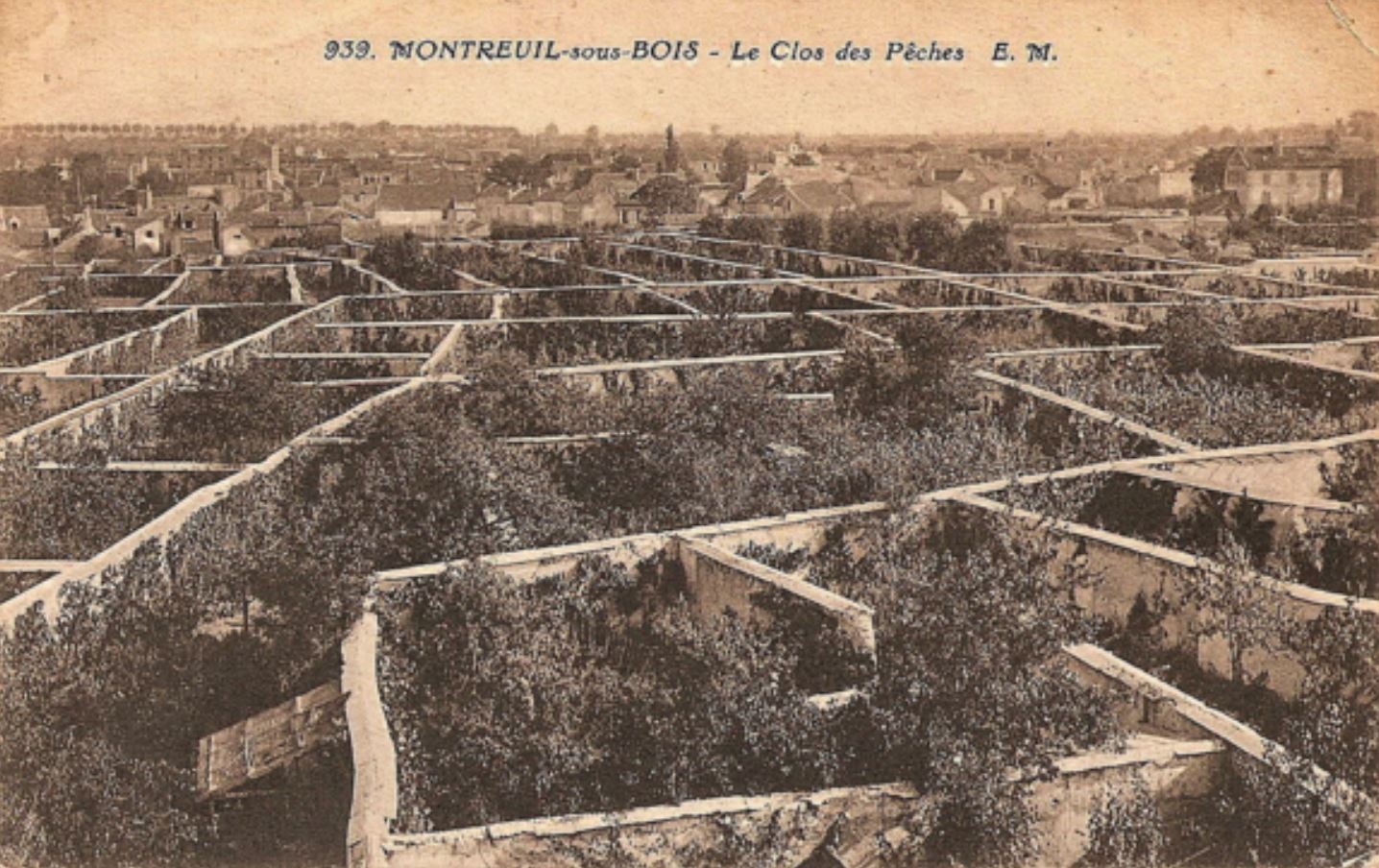
Previously, there was the invention of the fruit wall which appeared around the beginning of the Little Ice Age that ran the course of about 200 years from about 1550 to 1850.
The invention of the fruit wall saved society. They built walls which reflected sunlight during the day essentially using solar energy to improve growing conditions. These walls also absorbed solar heat, which in turn was slowly released during the night, preventing frost damage. They created a warmer microclimate 24 hours per day.
Fruit walls also protected crops from cold blasts of winds from the north as we are experiencing today. They eventually began to construct wooden canopies to shield the fruit trees from rain and hail. They would also use mats suspending then from the walls in case of bad weather. I remember my grandfather loved figs and he had fig trees he would wrap during the winter to protect them in New Jersey. In Europe, these fruit walls were used as far north as England and the Netherlands.
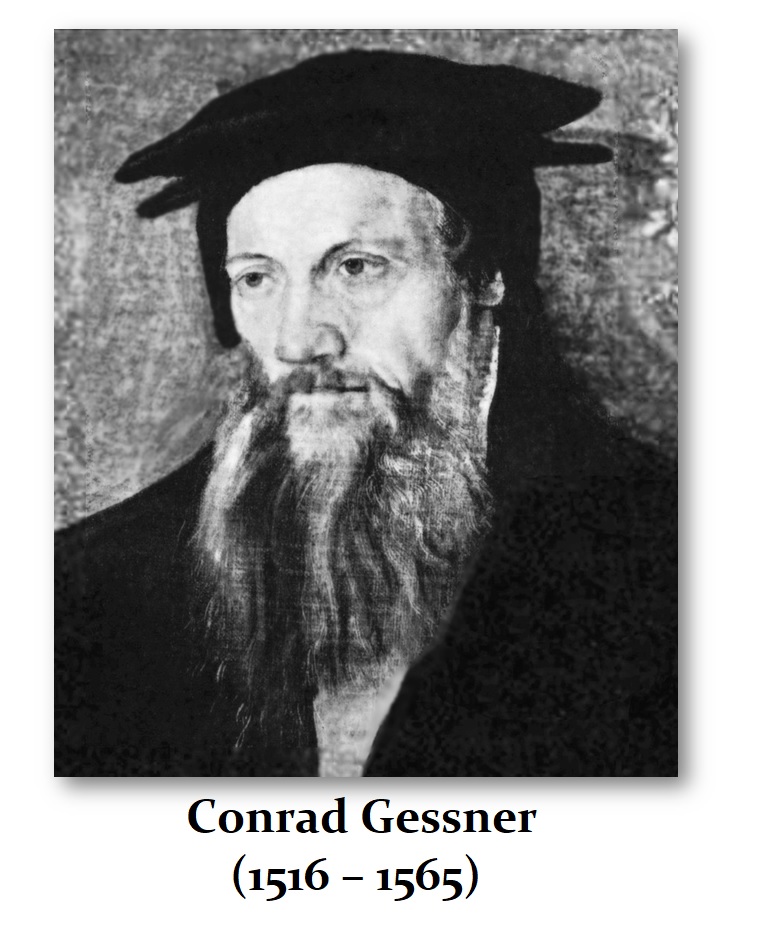
Conrad Gessner (1516 – 1565) was a true Renaissance man. He was a Swiss physician, naturalist, bibliographer, philologist, zoologist, and a botanist. He wrote of the effect of the Fruit Walls which then popularized them in Europe.
The French began to improve the technology by pruning the branches of the fruit trees in such ways that they could be attached to a wooden frame on the wall.
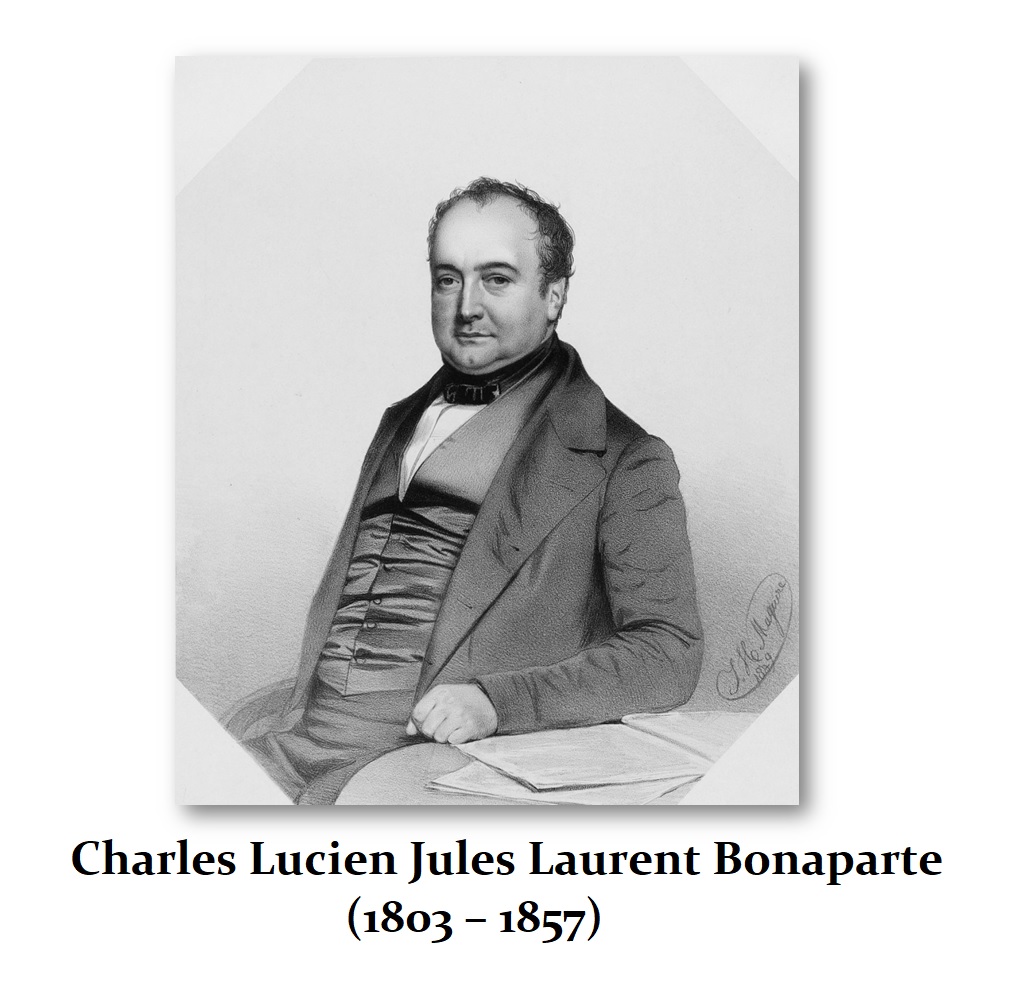
The French botanist Charles Lucien Bonaparte (1803 – 1857) is credited with building the first practical modern greenhouse in Leiden, Holland, during the 1800s to grow medicinal tropical plants. The French called their first greenhouses orangeries since they were used to protect orange trees from freezing. Today, Holland grows more food in greenhouses than any other country.
Today, the next step forward is growing food in warehouses without the sun or earth.
I have created this site to help people have fun in the kitchen. I write about enjoying life both in and out of my kitchen. Life is short! Make the most of it and enjoy!
This is a library of News Events not reported by the Main Stream Media documenting & connecting the dots on How the Obama Marxist Liberal agenda is destroying America













 Centinel2012