Comrade Kathy Hochul Issues Order Mandating Indoor Masks for All New York Citizens


Posted originally on the conservative tree house on December 10, 2021 | Sundance | 182 Comments

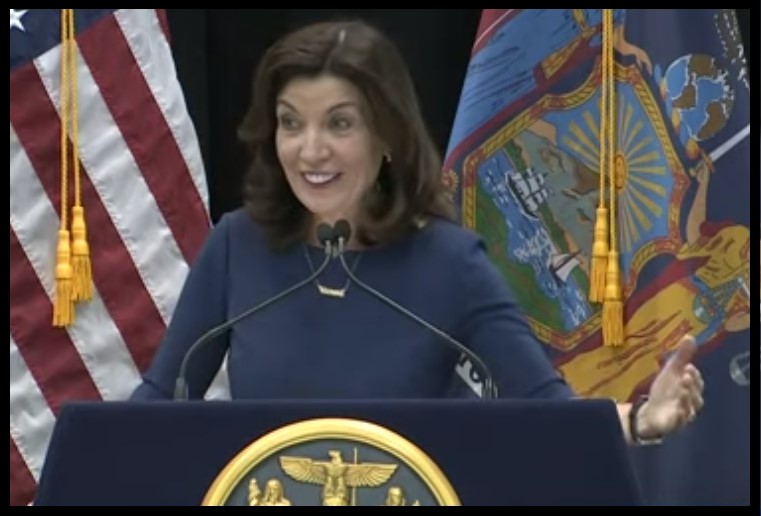
New York Governor, Comrade Kathy Hochul, delivered an order today mandating mask-wearing indoors throughout the state of New York.

You will take a knee, wrap your face and be compliant… or else.  It’s for your own good comrade citizen. WATCH:

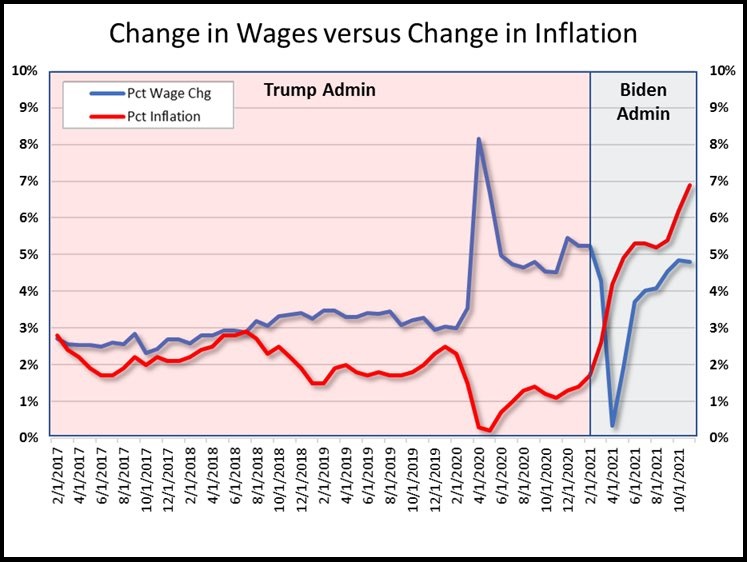
MAGAnomics vs JoeBamanomics, a Simple to Understand Graphic


Posted originally on the conservative tree house on December 10, 2021 | Sundance | 71 Comments

President Trump economic policy -vs- Joe Biden economic policy

When wages (blue line) are above inflation (red line) our income is growing, life is good and the working class has more disposable income to enjoy life.  However, when wages (blue line) are lower than inflation (red line) our income is shrinking, life is a struggle and the working class has less disposable income to enjoy life.

♦ Point One – Nothing happens accidentally. The road to a “service-driven economy” is paved with a great disparity between financial classes. The wealth gap is directly related to the inability of the middle class to thrive.

♦ Point Two – There is nothing of value behind the obtuse term “service-driven economy.” The multinationals are paying for this administration, just like they paid the Obama administration; paying for economic policy that advances their interests.  Congress goes along with the K-Street demands, because Wall Street is now the primary benefactor of legislative intent. Nothing about their effort is done with American interests in mind.

To go deep, keep reading.

♦ Point Three – Traditional Fascism was defined as an authoritarian government working hand-in-glove with corporations to achieve totalitarian objectives. A centralized autocratic government headed by a dictatorial leader, using severe economic and social regimentation, and forcible suppression of opposition.

That governmental system didn’t work in the long-term because the underlying principles driving free people rejected government authoritarianism.  Fascist governments collapsed, and the corporate beneficiaries were nulled and scorned.  Then along came a new approach to achieve the same objective.

The World Economic Forum (WEF) was created to use the same fundamental associations of government and corporations.  Only this time the corporations organized to tell the governments what to do.  The WEF was organized for multinational corporations to assemble and tell the various governments how to cooperate to achieve control.

Fascism is still the underlying premise, the WEF just flipped the internal dynamic.

The assembly of the massive multinational corporations, banks and finance offices now summon the government leaders to come to their assembly and receive their instructions.  Some have called this corporatism. However, the relationship between government and multinationals is just fascism essentially reversed with the government doing what the corporations tell them to do.

A massive multinational corporate conglomerate; telling a centralized autocratic government leader what to do; and using severe economic and social regimentation as a control mechanism; combined with forcible suppression of opposition by both the corporations and government.

Then we broke the glass, hit the emergency button and called Batman.

♦ Point Four – Donald J Trump was/is a walking red-pill; a “touchstone”: a visible, empirical test or criterion for determining the quality or genuineness of anything political. I have been deep enough into the network of the Deep State to understand the scale and scope of this enemy. To think that President Trump alone could carry the burden of correcting four decades of severe corruption of all things political, without simultaneously considering the scale of the financial opposition, is naive in the extreme.

POTUS Trump was disrupting the global order of things in order to protect and preserve the shrinking interests of the U.S. He was fighting, almost single-handed, at the threshold of the abyss. Our American interests, our MAGAnomic position, was/is essentially zero-sum. His DC and Wall-Street aligned opposition (writ large) needed to repel and retain the status-quo. They desperately wanted him removed so they could return to full economic control over the U.S, because it is the foundation of their power.

Without Donald J. Trump, these entities would still be operating in the shadows. With Donald J. Trump, we can clearly see who the real enemy is.

In these economic endeavors President Trump was disrupting decades of financial schemes established to use the U.S. as a host for their endeavors. President Trump was confronting multinational corporations and the global constructs of economic systems that were put in place to the detriment of the host (USA) ie YOU. There are trillions at stake; it is all about the economics; everything else is chaff and countermeasures.

In most of the modern post-war industrial era (1950-1980), banking was a boring job and only slide rule bean counters and actuarial accountants moved into that sector of the workforce. Most people don’t like math – these were not exciting jobs. Inside the most boring division of a boring banking industry were the bond departments within the larger bank and finance companies.

The excitement was in the actual economy of Main Street business. The giants of industry created businesses, built things, manufactured products, created innovation and originated internal domestic wealth in a fast-paced real economy. Natural peaks and economic valleys, as the GDP expanded and contracted, based on internal economic factors of labor, energy, monetary policy and regulation.

Main Street generated the pool of political candidates, because the legislative conduct of politicians had more impact on Main Street.  Simply, the business agents had a vested interest in political determinations.

Political candidates courted industrialists, business owners, and capitalist giants to support them. As a consequence, Main Street USA was in control of DC outcomes.

Despite the liberal talking points to the contrary, this relationship was a natural synergy of business interests and political influence. It just made sense that way, and the grown-ups were generally in charge of it.

government-money

♦ Commercial banks courted businesses because bankers needed deposits. Without deposits banks could not generate loans; without loans banks could not generate profits…. and so it was. By rule, only 10 percent of a commercial bank’s income could stem from securities.

One exception to this 10% rule was that commercial banks could underwrite government-issued bonds. Investment banks (the bond division) were entirely separate entities. The Glass-Steagall banking laws of 1932 kept it that way.

However, mid 1970’s bank regulators began issuing Glass–Steagall interpretations -that were upheld by courts- and permitted banks and their affiliates to engage in an increasing variety and amount of securities activities. After years of continual erosion of the Glass-Steagall firewall, eventually it disappeared.

This became the origin of the slow-motion explosion of investment banking. If you look back historically from today toward 1980 (ish), what you will find is this is also the ultimate fork where economic globalism began overtaking economic nationalism.

Banks could now make money, much more money, from investment divisions issuing paper financial transactions, not necessarily dependent on actual physical assets. The transactions grew exponentially.

The bond market portion ultimately led to the ’07/’08 housing collapse, and derivative trading (collateralized debt obligations or CDO’s) generated trillions of paper dollars. Long before the ’08 collapse, business schools in 1980 began calling this the second economy (a false economy, or the invisible economy).

The second economy, which ultimately became the global economy, is also the Wall Street investment economy. Two divergent economies: Wall Street (paper), and Main Street (real).

There is no real property, real capital, real tangible assets in the Wall Street economy. The false economy is based on trades and financial transactions, essentially opinions. Paper shifts, and buys and sells based on predictions and bets (derivatives).

Ford Motor Company (only chosen as a commonly known entity) has a stock valuation based on their actual company performance in the market of manufacturing and consumer purchasing of their product. However, there can be thousands of financial instruments wagering on the actual outcome of their performance.

There are two initial bets on these outcomes that form the basis for Hedge fund activity. Bet ‘A’ that Ford hits a profit number, or bet ‘B’ that they don’t. There are financial instruments created to place each wager. [The wagers form the derivatives] But it doesn’t stop there.

Additionally, more financial products are created that bet on the outcomes of the A/B bets. A secondary financial product might find two sides betting on both A outcome and B outcome.

Party C bets the “A” bet is accurate, and party D bets against the A bet. Party E bets the “B” bet is accurate, and party F bets against the B. If it stopped there, we would only have six total participants. But it doesn’t stop there, it goes on and on and on…

The outcome of the bets forms the basis for the tenuous investment markets. The important part to understand is that the investment funds are not necessarily attached to the original company stock, they are now attached to the outcome of bet(s). Hence, an inherent disconnect is created.

Subsequently, if the actual stock doesn’t meet it’s expected P-n-L outcome (if the company actually doesn’t do well), and if the financial investment was betting against the outcome, the value of the investment actually goes up. The company performance and the investment bets on the outcome of that performance are two entirely different aspects of the stock market. [Hence two metrics.]

Insurance products create an even larger subdivision within the false economy as hedgers wagered on negative outcomes. The money wagered is exponential – some say more than a quadrillion currently floats.

♦ Now you realize, in hindsight, there had to be a point where the value of the second economy (Wall Street) surpassed the value of the first economy (Main Street). Investments, and the bets therein, needed to expand outside of the USA.  Hence, globalist investing.

However, a second more consequential aspect happened simultaneously.

The politicians became more valuable to the Wall Street team than the Main Street team;  and Wall Street had deeper pockets because their economy was now larger.

As a consequence, Wall Street started funding political candidates and asking for legislation that benefited their interests.

When Main Street was purchasing the legislative influence the outcomes were beneficial to Main Street, and by direct attachment those outcomes also benefited the average American inside the real economy.

When Wall Street began purchasing the legislative influence, the outcomes therein became beneficial to Wall Street. Those benefits are detached from improving the livelihoods of main street Americans because the benefits are “global” needs. Global financial interests, investment interests, are now the primary filter through which the DC legislative outcomes are considered.

♦ Most people think when they vote for a federal politician -a House or Senate representative- they are voting for a person who will go to Washington DC and write or enact legislation. This is the old-fashioned “schoolhouse rock” perspective based on decades past.  There is not a single person in congress writing legislation or laws.

In modern politics, not a single member of the House of Representatives or Senator writes a law, or puts pen to paper to write out a legislative construct. This simply doesn’t happen.

Over the past several decades, a system of constructing legislation has taken over Washington DC that more resembles a business operation than a legislative body. Here’s how it works right now.

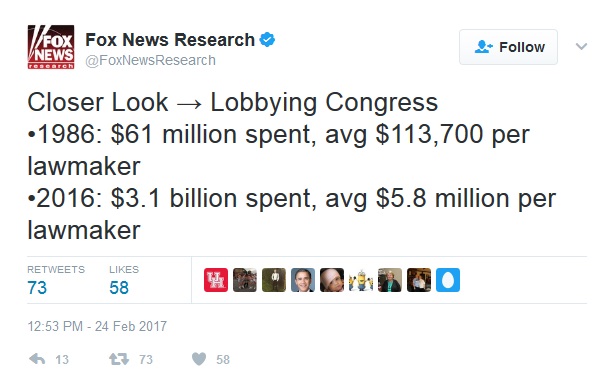
Corporations (special interest group) write the legislation. Lobbyists take the law and go find politician(s) to support it. Politicians get support from their peers using tenure and status etc. Eventually, if things go according to norm, the legislation gets a vote.

Within every step of the process there are expense account lunches, dinners, trips, venue tickets and a host of other customary financial way-points to generate/leverage a successful outcome. The amount of money spent is proportional to the benefit derived from the outcome.

The important part to remember is that the origination of the entire process is EXTERNAL to congress.

Congress does not write laws or legislation, special interest groups do. Lobbyists are paid, some very well paid, to get politicians to go along with the need of the legislative group.

When you are voting for a Congressional Rep or a U.S. Senator, you are not voting for a person who will write laws. Your rep only votes on legislation to approve or disapprove of constructs that are written by outside groups and sold to them through lobbyists who work for those outside groups.

While all of this is happening, the same outside groups who write the laws are providing money for the campaigns of the politicians they need to pass them. This construct sets up the quid-pro-quo of influence, although much of it is fraught with plausible deniability.

This is the way legislation is created.

If your frame of reference is not established in this basic understanding, you can often fall into the trap of viewing a politician, or political vote, through a false prism. The modern origin of all legislative constructs is not within congress.

Now, ask yourself this important question….

…. Who is writing the details of the Build Back Better bill?

Joe Biden has no idea, and that my friends is entirely by design.

Clueless Joe Says Federal Spending Doesn’t Increase Inflation, Reality Begs to Differ


Posted originally on the conservative tree house on December 10, 2021 | Sundance | 164 Comments

At the most troubling level, Joe Biden believes what people tell him to say for the reason they tell him to say it.  This reality underscores the reason why Barack Obama’s network selected Biden as their disposable front man in 2020.  Biden sounds convinced, because Biden is convinced.  He’s wrong, factually and fundamentally wrong, but he believes what he repeats in public.

The most painfully obvious examples of this dynamic are present when Joe Biden explains economic things based on what other people have told him.  The guy really is the modern personification of the naked emperor parading around to show off an invisible coat that he genuinely believes he’s wearing. The self-deception would be embarrassing except for the fact he is only deceiving himself; so people laugh…. but this is dangerous.

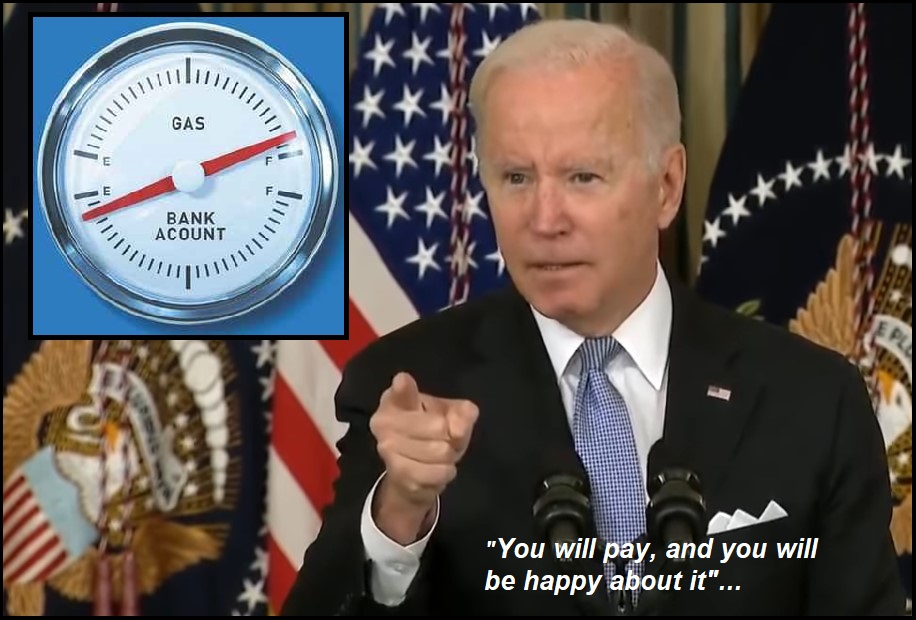
Questioned today about inflation, Joe Biden starts talking about his Build Back Better program.  It really is worth watching to see how oddly emphatic he is in the belief that if government pays for a thing (childcare, healthcare, prescriptions) the cost of that thing somehow mysteriously disappears.

Biden believes that if government subsidizes something there is no longer a cost associated with it.  He believes this.

Setting aside the historic fact/truth that anything government pays or subsidizes ultimately costs more, the real cognitive dissonance in Biden’s worldview is that any cost associate with a ‘thing‘ disappears if the government pays for that ‘thing’.   From that bizarre viewpoint, the disappearance of public expense for that government subsidized thing then creates “deflation”, or a lowering in overall prices.

This claim is abject nonsense.  Truly and genuinely batshit crazy nonsense.

Example.  According to Joe Biden’s talking point: if government pays for college education, the price of a college student’s car drops.  It doesn’t.  To make that claim is absurd in the extreme.   The college student may have more money to pay for a car if they are not paying for tuition, but the car itself doesn’t change in price.

A person may have more money to pay for groceries if they are not paying for childcare expenses, but the price of the groceries doesn’t change.   The inflation on the prices of products at the grocery store does not change just because some families no longer have daycare expenses.   But Joe Biden believes it does.  

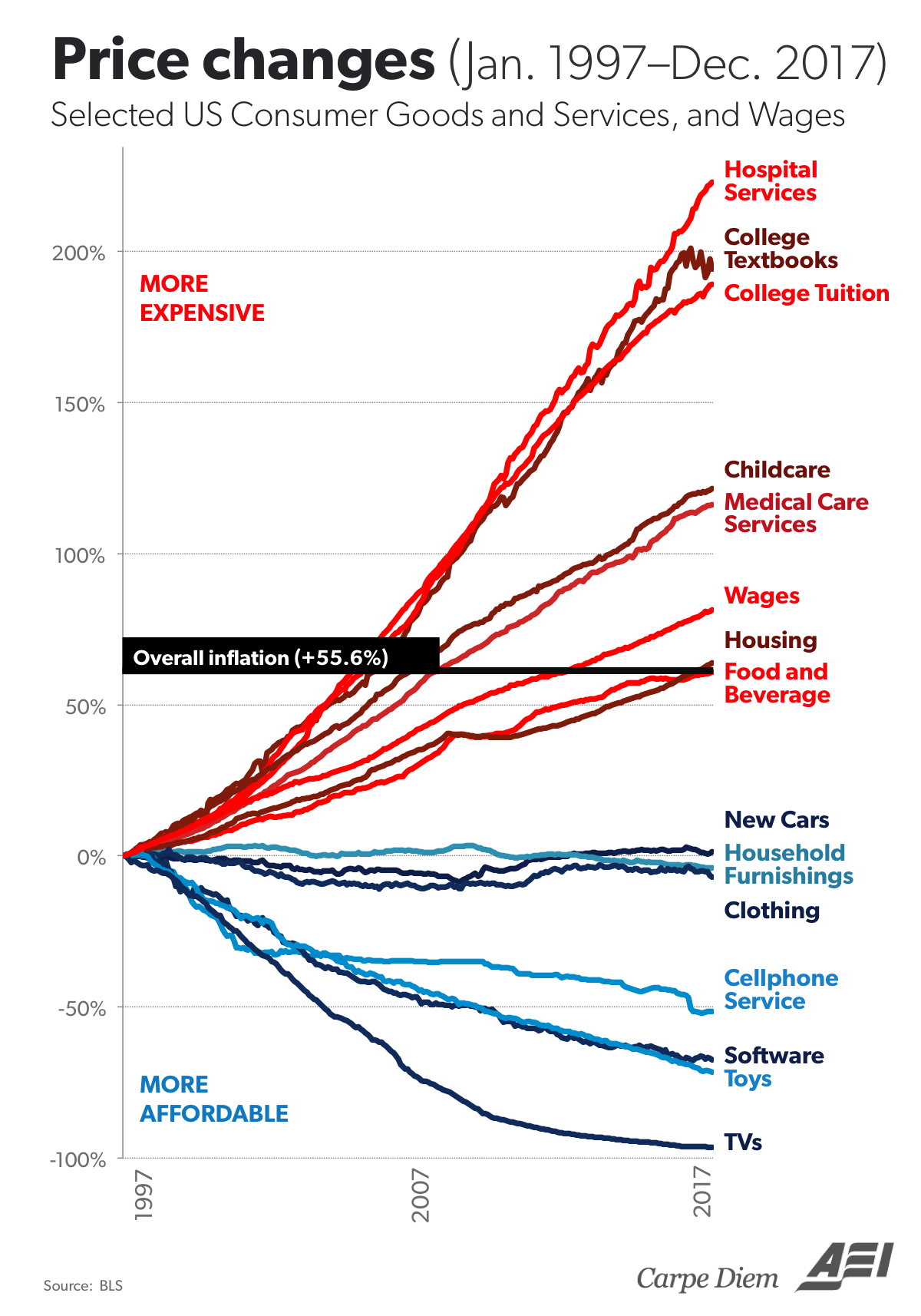
Regarding the price of something once government starts subsidizing that somethingconsider this:

Notice the correlation between the affordability of something once the government starts subsidizing it?

Perhaps the worst part of Joe Biden’s policy implementation is his actual belief in it.

This is what happens when your entire life is centered in a bubble or echo-chamber of academics, politicians and think-tanks that have no connection whatsoever to Main Street and common sense.  This is also why lobbyists are effective.  Lobbyists can bullshit the gullible politicians into believing just about anything, because the people who are at the highest level of politics are genuinely clueless about Main Street.

We are so screwed….

….please prepare your affairs accordingly.

He Did It – White House Celebrates Joe Biden Reaching Inflation Milestone Set By Jimmy Carter, 6.8 Percent and Rising


Posted originally on the conservative tree house on December 10, 2021 | Sundance | 187 Comments

Joe Biden may be celebrating his historic achievement in reaching an inflationary milestone previously set by Jimmy Carter, but the working class is paying the price for their economic stupidity.

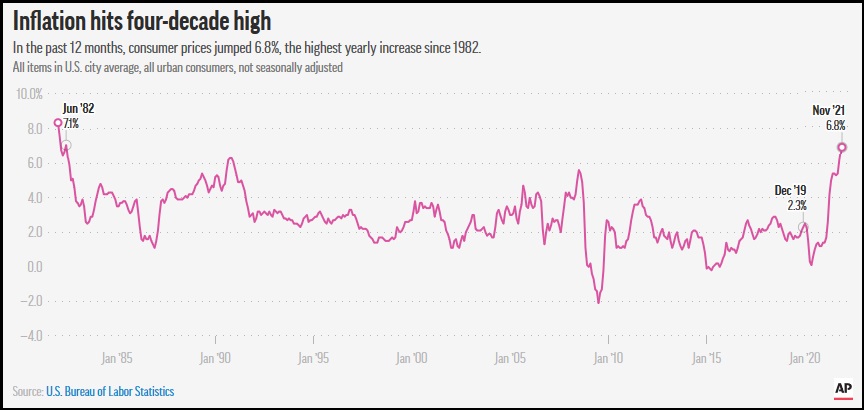
The Bureau of Labor Statistics releases the November inflation rate today [DATA HERE] showing another rise in the annualized rate of inflation of 6.8 percent.  As you review the data, ask yourself this question: ‘Is there anything in the current economic landscape to indicate this is going to stop?’  The honest answer is no.  Here’s why…

As the BLS accurately (albeit briefly) notes, their inflation data reflects the cumulative increases in costs of products and services at all stages in the supply chain.  Raw materials cost more (extraction, regulation impact), processing costs more (energy impact), transport costs more (fuel impact), final goods assembly costs more and handling costs more.  From field-to-fork or mining-to-showcase, the total cost to create stuff costs more. [AP Interactive Chart]

Yes, the inflation data is backward looking. Meaning, it is looking back toward the previous period to compare costs.  However, despite the White House protestations to the contrary, that’s not a good thing, because it is going to get worse.

The contracted price for goods delivered (depending on sector) are net terms in 30, 60 or 90 days.  Meaning, the purchase price on final goods wholesalers are receiving now, were agreed upon months ago.  Those terms for current arriving goods are no longer valid.  The new terms (purchase orders) carry higher costs, and as an outcome higher prices to consumers are still coming.

The AP chart above shows the ascending spike in inflation overall.   Do you see that little plateau (mid spike)?  That’s June and July of this year, when we noticed the economy overall appeared to have stalled out.  As we highlighted yesterday {Go Deep}, that brief plateau corresponds with a gear change internally in the macro economy as productivity dropped by 5% very quickly in the third quarter.

Immediately following that two month plateau around 5%, the next few months of data showed that American consumers, writ large, were reacting to inflation by changing their spending habits.  That’s when future contracts for new housing starts stalled out.  In the next few months, up to today, all the data indicates working class U.S. consumers are hunkering down with less disposable income and prioritizing spending on essentials: housing, rent, gasoline, food.  All else is less than.

In the service sector, specifically hospitality and venue employment, overall demand for services slowed, but the employment data -showing the contraction- remained hidden, because we were climbing out of the COVID lockdown hole.   It appeared the service sector was gaining back jobs; but the backward to last year comparison was clouding an actual slowdown in services, because the data was comparing itself to 2020 when services were shut down.  Demand for services was down, but we couldn’t really see it.

All of this inflation is being driven by policy.  •[1] Energy policy (oil, gas leases nullified & pipelines cancelled) in combination with regulations targeting environmental impacts (CA ports emissions rules) is driving up energy costs. CORE inflation results from this. •[2] Fiscal policy by White House and legislature has been spending like drunken sailors, and that adds to a storm of •[3] monetary policy, with the Fed buying back the debt created by spending, and as a consequence devaluing the dollar currency.

The cost of exporting products is less, because China and the Euro benefit from lower U.S. dollar values.  However, more export of raw materials means higher prices domestically in what little remains of the supply/demand influence.  The multinationals are making out like bandits, Wall Street is happy, and the middle class of America is once again a victim of economic policy.

First, the DC politicians delivered the “rust belt” to us as an outcome of their favoring Wall Street over Main Street, and now they are wiping out our checking accounts with massive inflation.  Remember the oft repeated -and infuriating- catch phrase, “The U.S. is a service driven economy?“, said by both wings of the UniParty?   Well, put another way… first they off-shored our jobs, now they off-shore our wealth.   This is not an accidental outcome of flawed policy, they are doing this intentionally.

We are being gutted from the inside.

You don’t accidentally stop pipelines, cancel oil leases, shut down refining capacity, change port regulations and then act surprised by saying: ‘whoopsie’ gasoline seems to be costing more?  Duh! It’s a feature not a flaw.   Many of the people behind Joe Biden are stupid, but they ain’t *THAT* stupid.  They know what they are doing, but they have to pretend not to know things in order to avoid the tar and feathers.

Table-1 gives us a good snapshot of how the sector specific prices are rising [data here]:

If you want to go even deeper into the categories, check out Table-2 HERE.

Final points….  This is backward looking data, and there’s nothing visible right now to give any optimism that prices will not continue rising yet again in the next few months.  Exactly the opposite is true.  There is visible evidence that prices will go up again in December, January and February based on the current situation.

If the Build Back Better legislation is passed, the current rate of inflation will jump even higher after February.  If it doesn’t pass, we may plateau again in March and April of 2022 as we did in June/July of this year.  However, prices will never drop back, because the devalued dollar status is permanent.

What will change this scenario is an actual drop on the demand side as U.S. consumers see their income values wiped out.   Unfortunately, that appears to be part of the policy agenda for the White House.  If they can reduce demand by making things unaffordable, they can claim victory over inflation and proclaim their economic policies a success.  The downside of their achieving success is we have nothing left, we’re broke.

Elon Musk Two Word Response to Congress About Biden’s Build Back Better Spending Bill: “Delete It”


Posted originally on the conservative tree house on December 9, 2021 | Sundance | 90 Comments

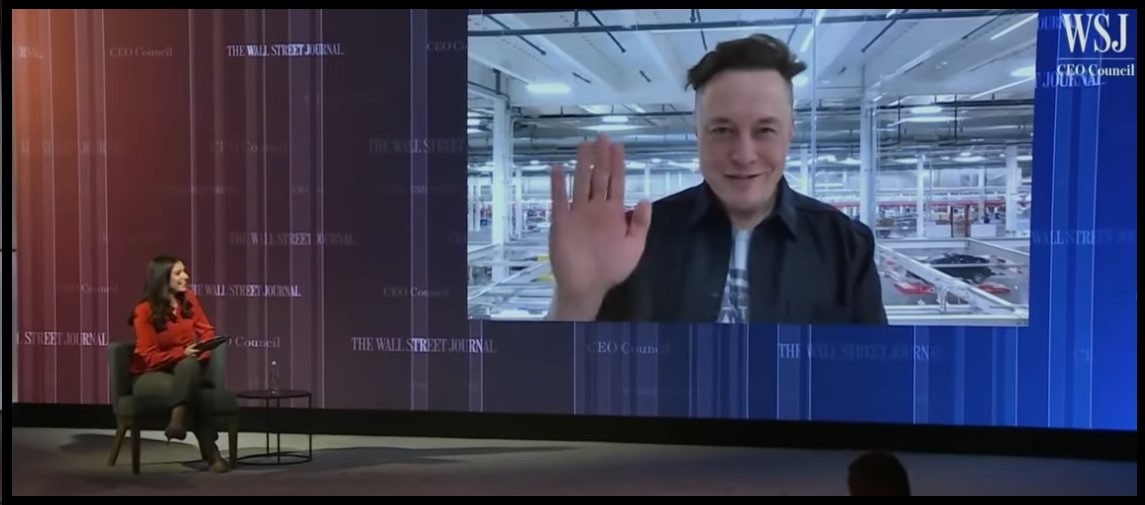
Tesla CEO Elon Musk was seemingly channeling his inner Galt during a video interview with Joanna Stern of the Wall Street Journal at the CEO Council Summit.  Apparently Mr. Musk can see what’s on the other side of this spending horizon and doesn’t want to experience it.  WATCH:

The Full Interview is below:

.

Foreboding – U.S. Productivity Declined 5.2 Percent in Third Quarter, Largest Quarterly Drop in 61 Years


Posted originally on the conservative tree house on December 9, 2021 | Sundance | 78 Comments

U.S. nonfarm productivity is a measure of economic activity within the engine of the U.S. economy.  The U.S. productivity rate is a measure of how much value is produced by the economy through demand for the products and services, and the labor associated with the creation of those products and services.

I have often used the example of making bread {Go Deep}.  If you are making 10 loaves of bread, there is a set amount of cost associated with each loaf created.  The total cost of each loaf is the total cost to produce the entire batch divided by ten. However, if you have customers demanding 15 loaves of bread, you make more profit on the last five because it doesn’t cost 50% more in material or labor to make 50% more loaves.

Your productivity in the last five loaves is higher because the fixed costs of production (raw materials, energy) barely change, and the labor is only slightly higher.  The opposite is also true.  It costs more per loaf to make fewer than ten loaves because the fixed costs and your labor are pretty consistent, yet the finished value of 7 loaves is less than the finished value of ten.

Anecdotally, it has looked for quite some time that around May of this year the economy peaked, plateaued for a few weeks, and then began a slow downward progression.  Today the Bureau of Labor statistics puts some revised data to that third quarter (July, August and Sept) economic activity {data here}.  The quantified results align with what we sensed was taking place.

The value of all products and services generated increased by 1.8 percent.  However, the labor cost of generating that small amount of added value increased by 7.4 percent.  The difference between those two numbers is a drop in productivity of 5.2% over the entire quarter.

This is the largest quarterly drop in productivity since 1960 !

The Biden administration will blame the drop in productivity on a lack of material to produce the end product (ie. the COVID excuse).  Which means employed people were sitting around waiting for goods to arrive and being less productive.   There is a small amount of that which might be true.  However, it is not the biggest factor, at least not on this scale.  Keep in mind we are talking about both goods and services.

The more likely cause of such a massive decline in productivity is a genuine decline in demand.  In the aggregate, consumers needed less goods and services.  This likelihood aligns with the diminished and softened retail sales figures recently noted.   It is a simple cause and effect.  When gasoline, energy, and essential products like food cost more, consumers have less money for other stuff.  Demand for the non-essential products drop.

As the demand drops, the productivity of the economic activity to generate those goods and services also drops.  However, the scale of the decline is the part to pay attention to.  A five percent drop in productivity is huge for a single quarter.  Under normal circumstances this means more slack in the labor market, and that is what we saw recently in the retail sector of the employment figures from November {data here}.

During the month when retailers are customarily ramping up their employment to cope with increases in consumer demand, last month that didn’t happen.   The ‘retail sector‘ lost 20,000 jobs in November.  Think about that.

At the time of the November jobs report, the “national economists” were trying to figure out why the employment report missed expectations by 300,000+ jobs.  We were not so surprised, because the actual result aligned with other data suggesting the Q3 economy overall was contracting.  Consumers are being squeezed by inflation, that is creating a stagnant economy or “stagflation.”

Wage growth is currently at 3.9% {data}, and when combined with the loss in productivity, the unit labor costs for businesses at a macro level means a total cost of +9.6 percent in the third quarter.   If employers do not start reducing their payroll costs as demand contracts, each unit produced will cost more money.  Unfortunately, that dynamic adds to inflation and we grease the skids on this downward spiral.

I have not seen any financial pundits concerned about where this cycle naturally ends.  Perhaps the media silence is because the White House knew the Q3 productivity data was alarming, and that stirred the administration to contact those pundits in advance in an effort to avoid widespread notice.

Regardless of reason for their avoidance, a drop in productivity of such a scale tells us to complete our economic preparations as soon as possible.  The intensity of the inflation storm worsens with a weak employment outlook.

White House Says Joe Biden Will Veto Bill Blocking Vaccine Mandate if It Passes The House


Posted originally on the conservative tree house on December 9, 2021 | Sundance | 130 Comments

Two Democrats joined with Republicans yesterday in passing a bill that would eliminate any federal vaccine mandate.  It seems silly that Congress would have to pass a law saying the unlawful and unilateral act of the executive branch, which has been blocked by separate federal courts, is unlawful…. but that’s where we are.

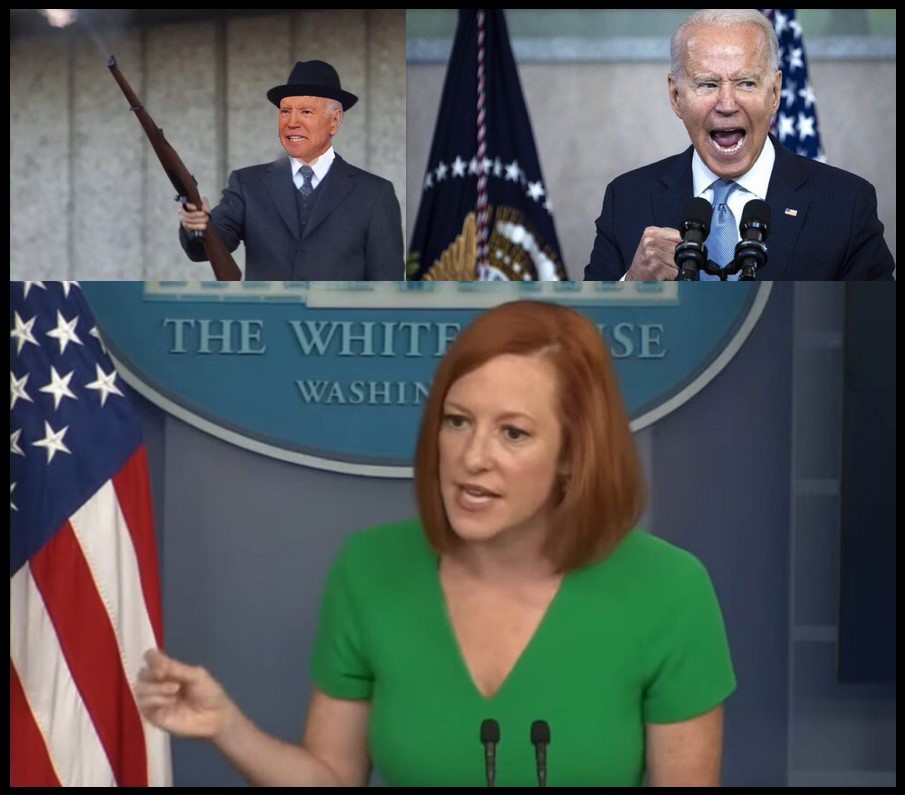
Democrats Joe Manchin (West Va.) and Jon Tester (Montana) joined all the Republicans present in the 52-48 vote.  The bill now goes to the House, where it is going to be put on ice by Nancy Pelosi in order to save Joe Biden from an embarrassing rebuke of his overreach.  However, White House Press Secretary Jen Psaki was asked today if the House were to vote on the bill, would Joe Biden veto it.

The White House spokesperson affirmed that Joe Biden would veto any bill, created by the representatives of the people, that declared his authority null. WATCH:

The FBI Can Access Your Personal Data in 15 Minutes


Armstrong Economics Blog/Police State Re-Posted Dec 10, 2021 by Martin Armstrong

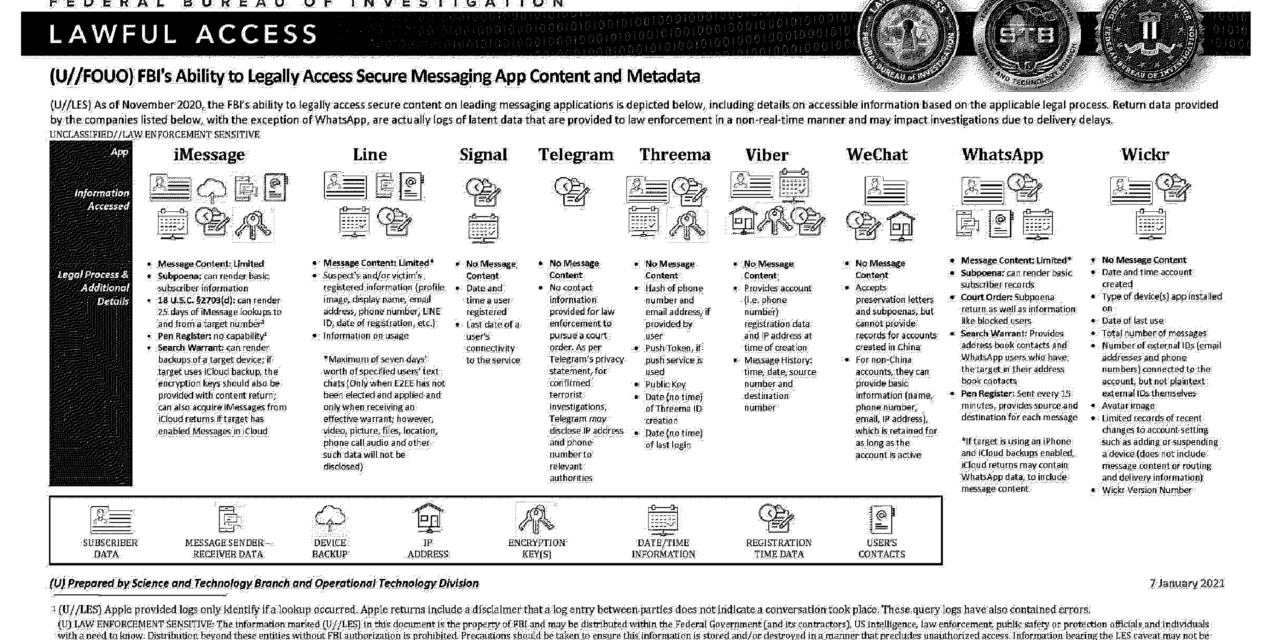
(Click on image for higher resolution)

The Federal Bureau of Investigations (FBI) can legally access your “secure messaging app content,” according to a new report by The Epoch Times.  In fact, it would only take officers about 15 minutes to access the contents of iMessages to collect metadata from WhatsApp. Our phones and personal electronic devices can provide agents with our location, contacts, pictures, search history, and more. Numerous people believe that encryption is one-dimensional and their messages are secure.

There are different forms of encryption and ways to bypass poorly encrypted software. People believed iMessage was secure due to Apple’s encryption, but automatic cloud backups are not encrypted and can be accessed. WhatsApp only began offering encryption backup in September, and the feature is not the default setting. The FBI document noted that search warrants could provide them with backup encryption keys as well.

Signal, Telegram, and WeChat are a bit more secure, but the FBI can still determine data logs or when the user logged into the service. Some may shrug and say they have nothing to hide and, therefore, nothing to fear. The problem is that the government can and will twist any information provided to them in order to win or develop a court case. Also, the FBI is not a beacon of ethics, and no one wants to have their personal information publicized. Since the majority of the world is not a threat to national security or a predator, sharing this much information with the government without a subpoena is asinine. All it would take is 15 minutes for someone’s private life to become public government information.

Rep. Chip Roy: If We Don’t Stop It, This Country Will Not Survive


Armstrong Economics Blog/Politics Re-Posted Dec 10, 2021 by Martin Armstrong

Watch Rep. Chip Roy (R-TX) destroy the House by questioning government spending and a complete lack of communication between parties. The Democrats pushed forward massive spending bills this year as the nation teetered on a recession and nearly defaulted on its debt. There are continuous plans to fund a growing number of social programs with zero solutions on how to fund them. “If we don’t stop it, this country will not survive,” Roy warned.

The issue is government-wide. “We never make a choice, ever — both parties, by the way,” Roy declared. Roy stated that he voted to take away powers from the president under the Trump Administration, despite being a Republican. Now, Roy noted, the current president has issued a federal vaccine mandate that no one voted on. He publicly admits that only a few people are making decisions for the masses. This means that a handful of people, acting in their own self-interests, are deciding the fate of millions. Democracy is in jeopardy.

Zarah Sultana MP: Rules for Thee but Not for Me


Armstrong Economics Blog/Politics Re-Posted Dec 10, 2021 by Martin Armstrong

British Parliament Labour Party member Zarah Sultana has urged the public to wear masks. “I feel incredibly unsafe in the chamber… I see most Tories not wearing masks,” MP Sultana said in a November 3 interview with the BBC. Interviewer Julia Hartley-Brewer promptly questioned, “Why are you not wearing one now?”

Answer: the rules do not apply to her. Sultana recently attended the Music of Black Origin (MOBO) Awards where she was spotted in a packed room without a mask. A proponent of shutting down schools and forced mandates, Sultana said that a mask-free Chamber was a “dangerous message to send to the rest of the country.” Yet, she is seen partying at a crowded function without the “protective” restrictions she expects the rest of the nation to abide by. Do we need any more proof that these policies are purely political?