Biden Plan to Cap Russian Oil Prices Could Seriously Backfire, Which Means It’s Likely to Happen


Posted originally on the conservative tree house on July 3, 2022 | Sundance

The G7 plan to create another economic sanction against Russia by capping the price anyone could pay for Russian oil has a serious downside.  If Russia slows down the export of oil, global oil prices will jump dramatically.   That policy outcome would mean a massive increase in the price of gasoline for U.S. consumers.

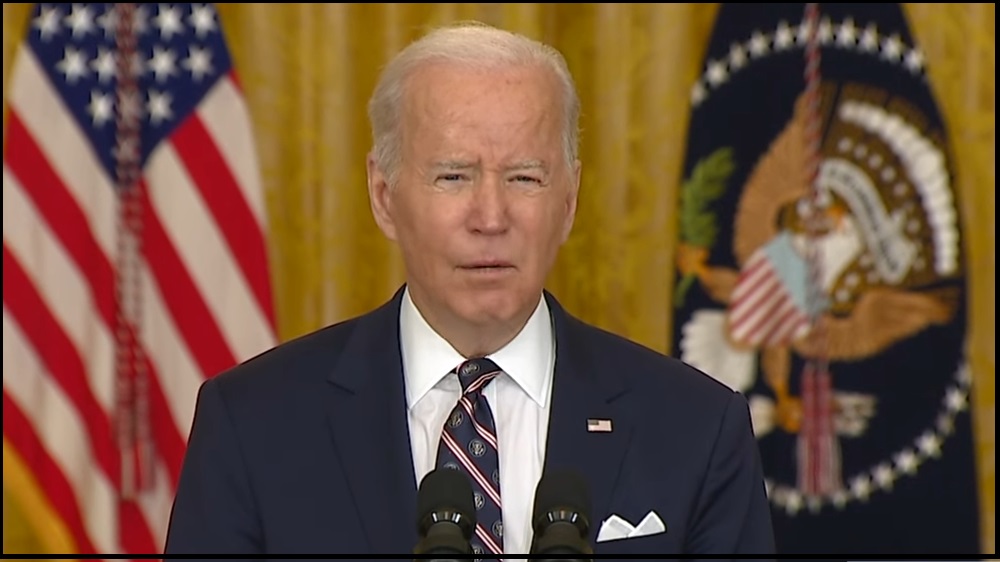
Because the consequences are horrible, that’s precisely the reason Joe Biden might push to have the Russian price cap.  Every policy Joe Biden has historically supported, has been the exact opposite of what should have been done.  Biden has a profound and innate ability to screw up anything.

[Bloomberg] – Global oil prices could reach a “stratospheric” $380 a barrel if US and European penalties prompt Russia to inflict retaliatory crude-output cuts, JPMorgan Chase & Co. analysts warned.

The Group of Seven nations are hammering out a complicated mechanism to cap the price fetched by Russian oil in a bid to tighten the screws on Vladimir Putin’s war machine in Ukraine. But given Moscow’s robust fiscal position, the nation can afford to slash daily crude production by 5 million barrels without excessively damaging the economy, JPMorgan analysts including Natasha Kaneva wrote in a note to clients.

For much of the rest of the world, however, the results could be disastrous. A 3 million-barrel cut to daily supplies would push benchmark London crude prices to $190, while the worst-case scenario of 5 million could mean “stratospheric” $380 crude, the analysts wrote.

“The most obvious and likely risk with a price cap is that Russia might choose not to participate and instead retaliate by reducing exports,” the analysts wrote. “It is likely that the government could retaliate by cutting output as a way to inflict pain on the West. The tightness of the global oil market is on Russia’s side. (link)

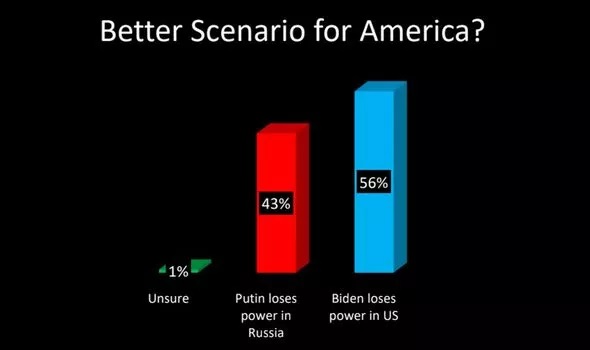
[Poll Source]

Fed Chair Ignores Impact of Build Back Better Energy Policy on Supply Side of Inflation


Posted originally on the conservative tree house on July 3, 2022 | Sundance

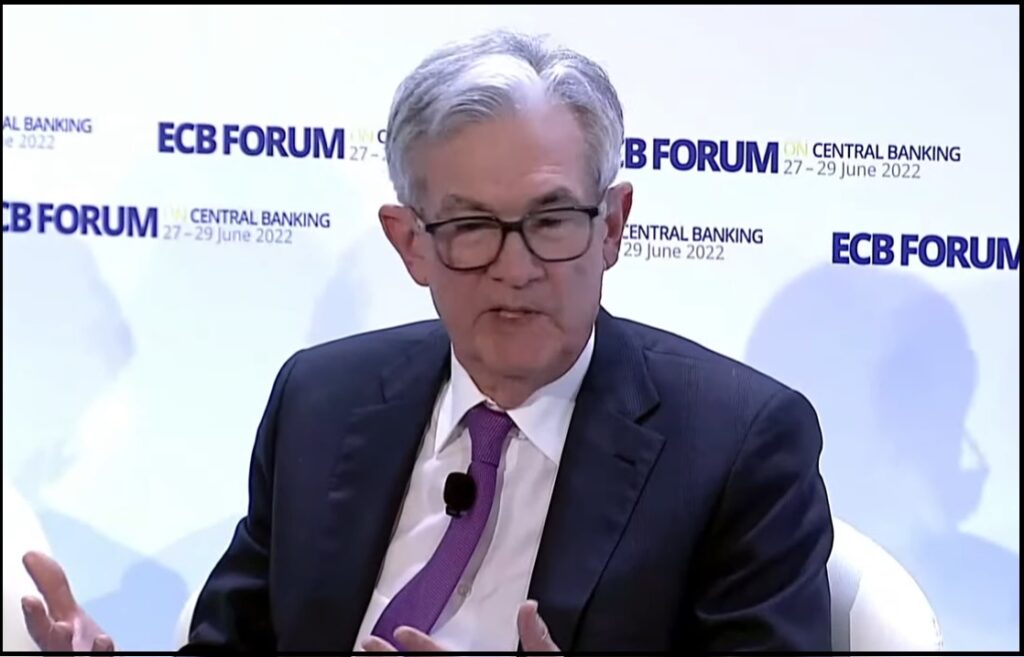
Much has been made of comments by Federal Reserve Chairman Jerome Powell in his brief explanation of what the Fed got wrong.  Last week Powell made comments during a European Central Bank forum on bank policy, implying the absence of unvaccinated workers returning to the labor force is part of the US inflation problem.

Powell’s comments seem to align with the government vaccine mandate position which ignored the rights of the worker. Considering the responsibility of the Fed to anticipate price and labor issues, Powell’s sense of credulity toward those workers who dropped out of the labor force rather than inject an untested vaccine into their body is quite remarkable.  Inartful and arrogant are soft terms for his commentary.

However, there’s a bigger “tell” in the segment of what the Fed got wrong, when you listen to Powell talk about the supply side issues and how the Fed Reserve had no model to predict the mandated lockdowns, economic activity stoppages and consequences.   Notice how Powell completely dismisses the structural energy policy, the Build Back Better agenda, that lies at the heart of the current supply side inflation issue.  Video Prompted to 01:03:34, WATCH:

.

Throughout the discussion the primary focus to control inflation is reliant on a demand side cause.   The goal to reduce demand is seen as a way to mitigate and reduce inflation.  Thus, this worldview, as mistaken as it was/is, explains the justification for why the Fed waited to increase interest rates.  They never saw the radical energy policy as a structural driver of supply side inflation.

According to Powell, they thought the supply side issues would moderate quickly, without giving any consideration at all to how a radically new energy policy would embed.  He just ignores the issue completely; again, pretending not to know.  But perhaps it’s actually worse.  Perhaps he really doesn’t see a radical new energy policy as a driving force behind current inflation.  If that’s true, and he genuinely does not see it, then Fed policy in the future is going to make the recession much worse.

If you ignore massive energy price impacts, the FED will keep interest rates high despite demand dropping, and then eventually get to a place where demand has dropped so low the recession is deep, while turning toward each other and asking why are prices still so high?

Keep that disconnect in mind.

Fourth of July Celebration Price Hike


Armstrong Economics Blog/Agriculture Re-Posted Jul 3, 2022 by Martin Armstrong

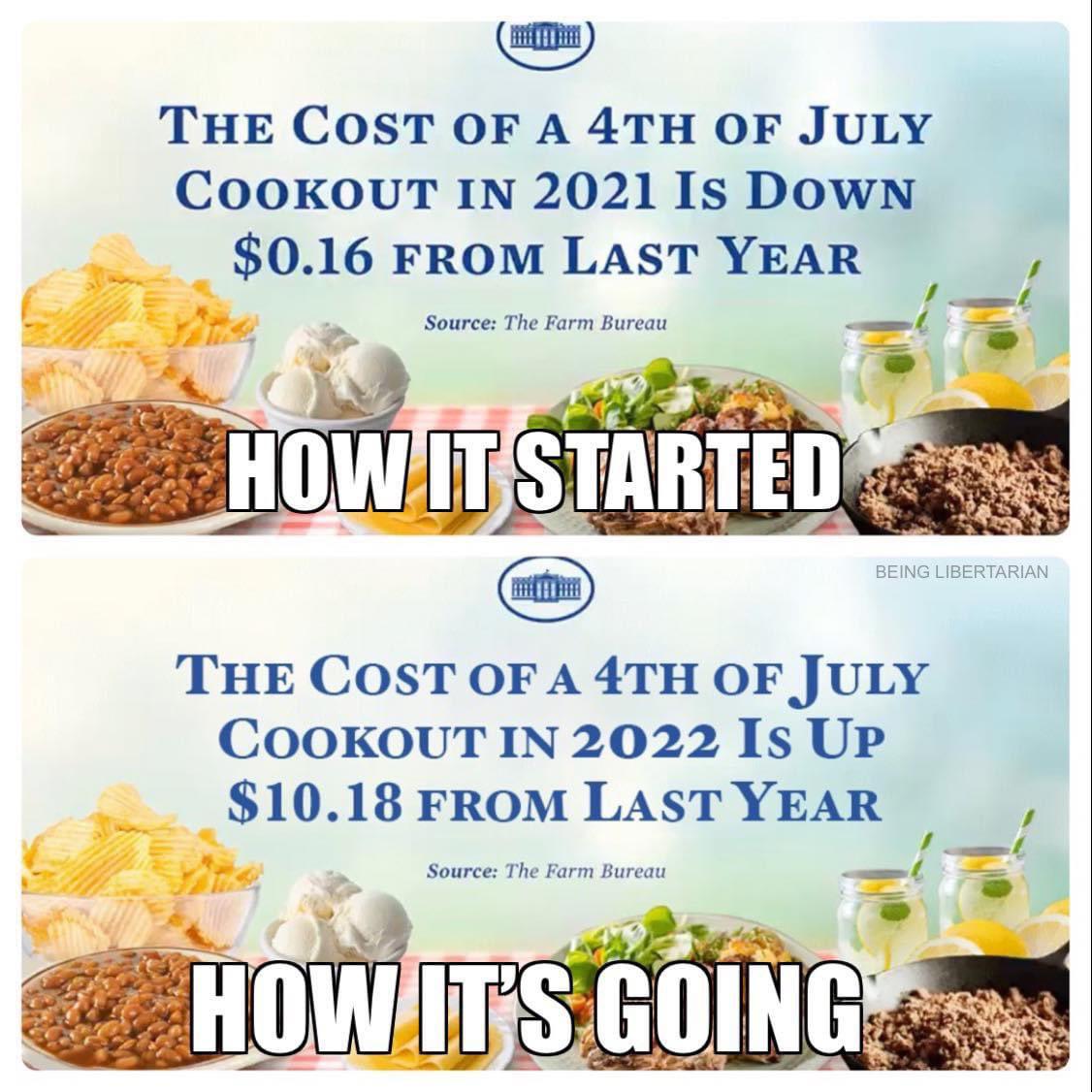
The White House celebrated the measly 16-cent discount that Americans enjoyed last Fourth of July. As a reminder of how our leaders have catapulted our economy and opportunity to prosper, the average cost for Independence Day celebrations is now 17% higher than last year.

The White House actually marketed their $0.16 price decline in 2021. “Planning a cookout this year? Ketchup on the news. According to the Farm Bureau, the cost of a 4th of July BBQ is down from last year. It’s a fact you must-hear(d). Hot dog, the Biden economic plan is working. And that’s something we can all relish,” the White House tweeted last July. They actually thought Americans would believe that the slight price change was an indication of the Biden Administration serving the people.

The American Farm Bureau stated that the average Fourth of July traditional BBQ costs around $59.50 for a party of 10 in 2021. This year, the average party will cost consumers $69.68. That is well beneath normal estimates and does not include liquor costs.

Beef alone has risen 36% in the past year ($11.2 for 2 lbs), and even a hamburger bun package will cost an extra $1.93 this holiday. Nearly every item has risen in cost, and the farmers who provide for us are being paid less. “According to the Agriculture Department’s revised Food Dollar Series, farmers currently receive approximately 8% of every food marketing dollar,” AFBF Chief Economist Roger Cryan said. “The farmers’ share of the retail food dollar is as low as 2% to 4% for highly processed foods such as bread and cereal, and can be 35% or more for some fresh products.”

Here are some of the extra costs you can expect to see this Fourth:

Individual Prices, AFBF 2022 Summer Cookout

  • 2 pounds of ground beef, $11.12 (+36%)
  • 2 pounds of boneless, skinless chicken breasts, $8.99 (+33%)
  • 32 ounces of pork & beans, $2.53 (+33%)
  • 3 pounds of center cut pork chops, $15.26 (+31%)
  • 5 quarts of fresh-squeezed lemonade, $4.43 (+22%)
  • 5 pounds of homemade potato salad, $3.27 (+19%)
  • 8 hamburger buns, $1.93 (+16%)
  • Half-gallon of vanilla ice cream, $5.16 (+10%)
  • 13-ounce bag of chocolate chip cookies, $4.31 (+7%)
  • 2 pints of strawberries, $4.44 (-16%)
  • 1 pound of sliced cheese, $3.53 (-13%)
  • 16-ounce bag of potato chips, $4.71 (-4%)

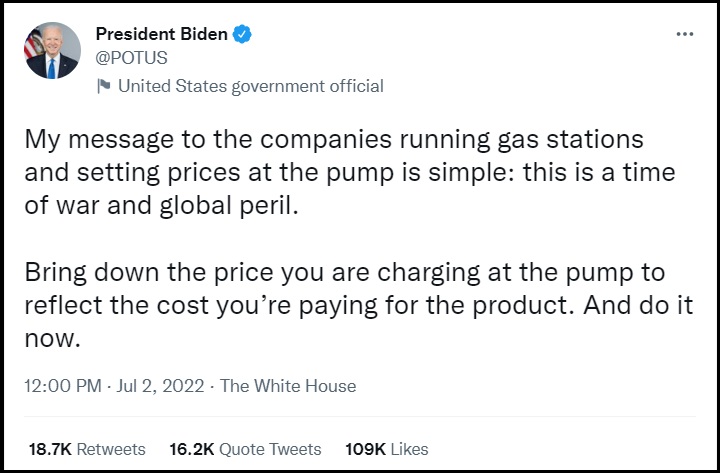
Someone Controlling the Twitter Account of Joe Biden is Demanding Gas Stations Lower Prices, Because He Said So


Posted originally on the conservative tree house on July 3, 2022 | sundance 

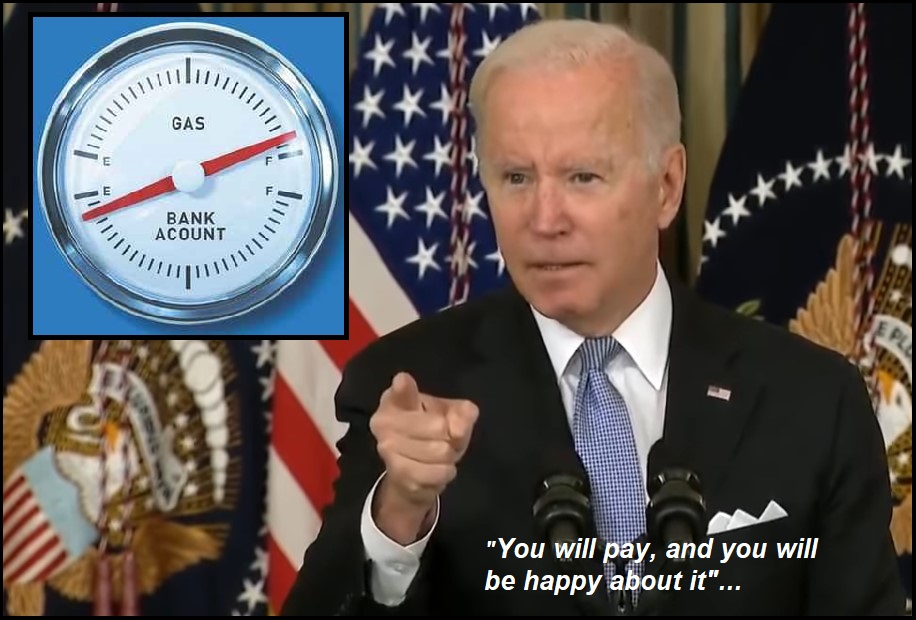
This administration is a lesson in abject silliness.  Everyone knows that Joe Biden has no clue who or what is being done in the energy policy of his administration; heck, he could not even name his Interior Secretary.   That said, whoever controls his Twitter account is now just making him look even more stupid as Biden blames the gas stations.

[Tweet Source]

I would draw attention to the most overlooked quote from Joe Biden as it pertains to gas prices.  This statement was made May 23, 2022, and it proves he knows the gas price is directly related to his choice to implement the Green New Deal by executive policy:

…”Here’s the situation.  And when it comes to the gas prices, we’re going through an incredible transition that is taking place that, God willing, when it’s over, we’ll be stronger and the world will be stronger and less reliant on fossil fuels when this is over.”…  [source]

EU Caves Putin Wins, Transportation of Russian Goods to Kaliningrad Through Lithuania Will Resume


Posted originally on the conservative tree house on July 2, 2022 | sundance 

Two weeks ago, a NATO blockade of Kaliningrad, an outpost of Russia, was triggered when Lithuania blocked the transport of goods through Suwalki corridor.  According to the Lithuanian justification they were following through on NATO sanctions against Russian goods.  However, the escalation was very provocative toward Russia and discussions between Russia and NATO countries were tense.

Apparently, Germany was increasingly concerned the blockade was creating a scenario where Russian military were going to escort the transport of railroad goods to Kaliningrad, and that would lead to escalated military conflict with Russia. “German Chancellor Olaf Scholz is eager to avoid unnecessary provocations of Russia. He has repeatedly emphasized that he would do everything in his power to ensure that NATO does not become a party to the war between Russia and Ukraine. German soldiers are stationed in Lithuania and could become involved in a possible conflict.” {link}

The EU has now dropped the blockade and the transport of goods between Kaliningrad and Russia will resume.  The EU decision was made before the NATO meeting in Madrid concluded; however, it looks like NATO postponed the announcement until after Biden left in order to save face on the reversal of position.

GERMANY – The European Commission plans to issue a clarification that will allow Russia to resume sending supplies to the exclave of Kaliningrad via Lithuania. Berlin supports the idea, but some in Vilnius are not pleased.

[…] The move will put an end to a disagreement that had not only been a significant source of tension between Russia and Brussels – but also exposed deep rifts within the EU regarding the correct approach to Moscow.

[…] The European Commission clarification expressly applies to all EU member states, but it mostly only affects the situation in Kaliningrad. According to the document, Russia will be allowed to transport sanctioned goods to Kaliningrad, but only in amounts comparable to pre-invasion deliveries.

The policy that has been adopted by the Commission largely reflects the position of the German government. Berlin had been critical of the approach taken by Lithuania.

German Chancellor Olaf Scholz is eager to avoid unnecessary provocations of Russia. He has repeatedly emphasized that he would do everything in his power to ensure that NATO does not become a party to the war between Russia and Ukraine. German soldiers are stationed in Lithuania and could become involved in a possible conflict.

The rules for the transit of goods, Scholz said at the conclusion of recent NATO summit in Madrid, “must of course be established in light of the fact that this is about shipments between two parts of Russia.” The comment made it clear that Berlin has a different interpretation of the legal situation than the government in Lithuania. (read more)

Massive Implications, Saudi Arabia in Discussion to Join BRICS Coalition – The Outcome Would be Global Energy and Economic Cleaving


Posted originally on the conservative tree house on July 2, 2022 | sundance

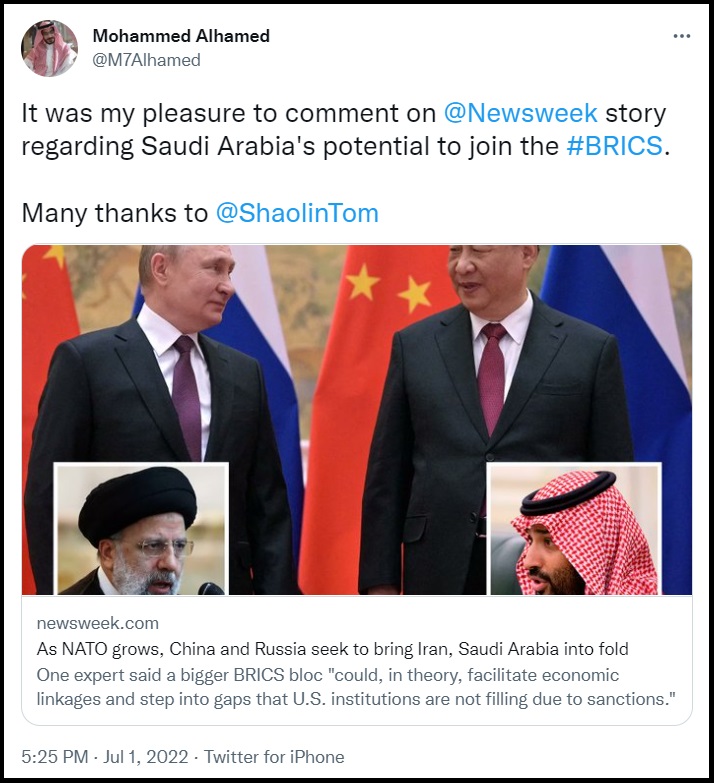
It is very curious timing in this article from Newsweek, containing massive geopolitical implications, using identified Saudi Arabia sources, would come in advance of Joe Biden’s visit to the Kingdom of Saudi Arabia.

Is this strategic geopolitical pressure from Saudi leader Mohamed Bin Salman (MbS) ahead of the meeting with Biden; or is this a genuine possibility that looms as likely?  If the former, then Joe Biden is being geopolitically slow roasted by Saudi Arabia for his previous disparagements and ideological hypocrisy in his visit.  If it is the latter, well, then the tectonic plates of international trade, banking and economics are about to shift directly under our American feet.

We have been closely monitoring the signs of a global cleaving around the energy sector taking place.  Essentially, western governments’ following the “Build Back Better” climate change agenda which stops using coal, oil and gas to power their economic engine, while the rest of the growing economic world continues using the more efficient and traditional forms of energy to power their economies.

This article from Newsweek is exactly about this dynamic with Saudi Arabia now potentially joining the BRICS team.

NEWSWEEK – Finland and Sweden’s green light to join NATO is set to bring about the U.S.-led Western military alliance’s largest expansion in decades. Meanwhile, the G7, consisting of NATO states and fellow U.S. ally Japan, has adopted a tougher line against Russia and China.

In the East, however, security and economy-focused blocs led by Beijing and Moscow are looking to take on new members of their own, including Iran and Saudi Arabia, two influential Middle Eastern rivals whose interest in shoring up cooperation on this new front could have a significant impact on global geopolitical balance.

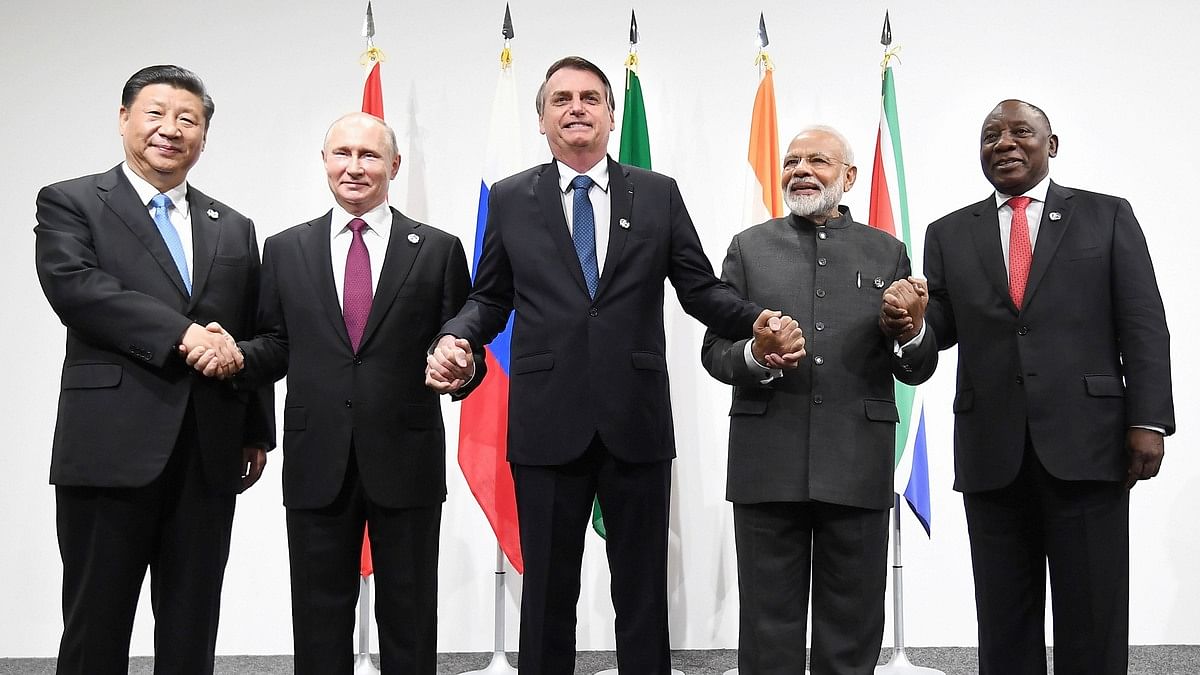
The two bodies in question are the Shanghai Cooperation Organization (SCO) and BRICS. The former was established in 2001 as a six-member political, economic and military coalition including China, Russia and the Central Asian states of Kazakhstan, Kyrgyzstan and Tajikistan before recruiting South Asian nemeses India and Pakistan in 2017, while the latter is a grouping of emerging economic powers originally consisting of Brazil, Russia, India and China (BRIC) upon its inception 2006, and including South Africa in 2010.

Here is the money quote:

[…] “China’s invitation to the Kingdom of Saudi Arabia to join the ‘BRICS’ confirms that the Kingdom has a major role in building the new world and became an important and essential player in global trade and economics,” Mohammed al-Hamed, president of the Saudi Elite group in Riyadh, told Newsweek. “Saudi Arabia’s Vision 2030 is moving forward at a confident and global pace in all fields and sectors.”

[…] “This accession, if Saudi joins it, will balance the world economic system, especially since the Kingdom of Saudi Arabia is the largest exporter of oil in the world, and it’s in the G20,” Hamed said. “If it happens, this will support any economic movement and development in the world trade and economy, and record remarkable progress in social and economic aspects as Saudi Arabia should have partnerships with every country in the world.” (read more)

That would essentially be the end of the petrodollar, and -in even more consequential terms- the end of the United States ability to use the weight of the international trade currency to manipulate foreign government.  The global economic system would have an alternative.  The fracturing of the world, created as an outcome of energy development, would be guaranteed.

Keep in mind, in early June Federal reserve Chairman Jerome Powell stated, “rapid changes are taking place in the global monetary system that may affect the international role of the dollar.”  {LINK}

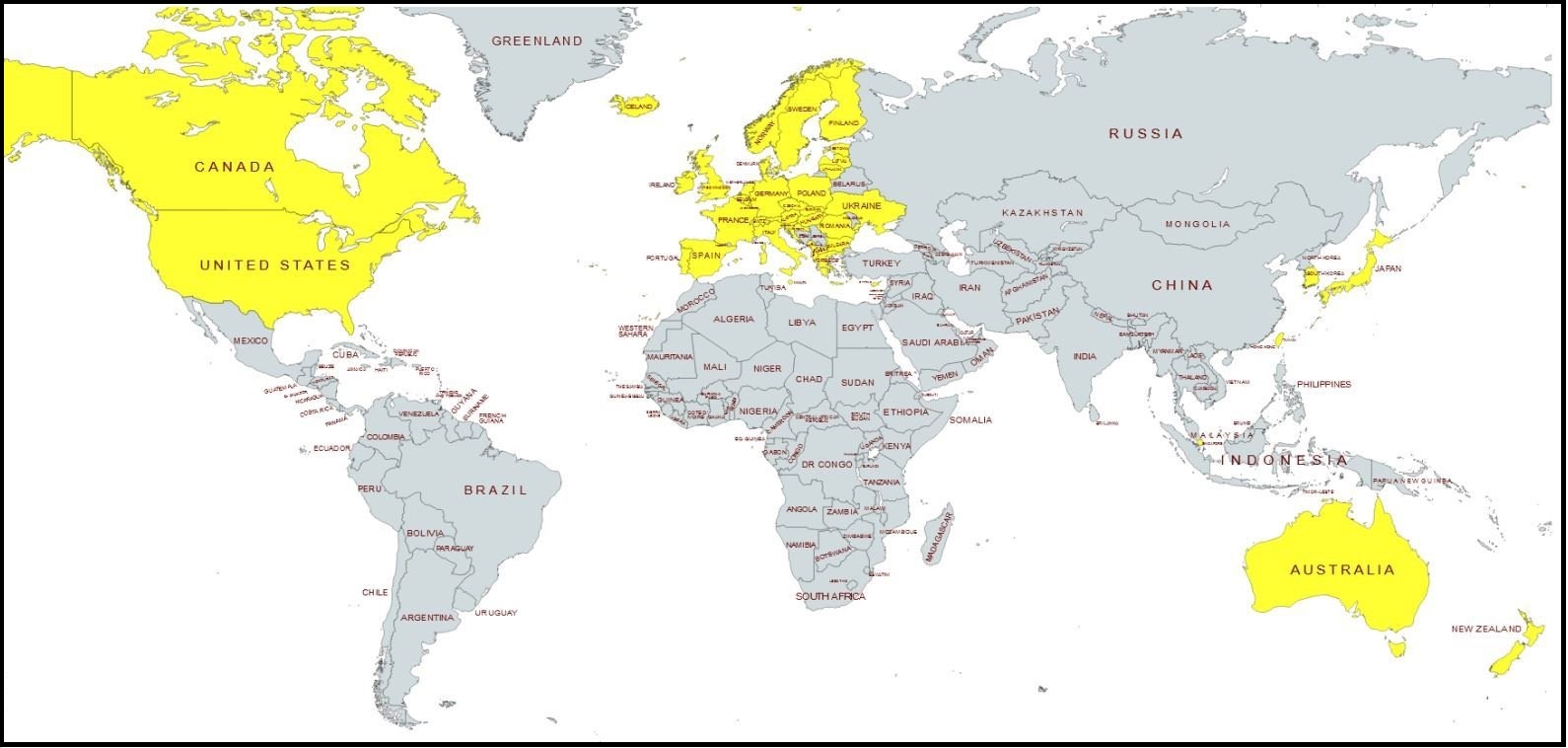
The western alliance (yellow) would be chasing climate change energy policy to power their economies.  The rest of the world (grey) would be using traditional and more efficient energy development.  The global cleaving around energy use would be complete.

This is not some grand conspiracy, ‘out there‘ deep geopolitical possibility, or foreboding likelihood as an outcome of short-sighted western emotion.  No, this is just a predictable outcome from western created events that pushed specific countries to a natural conclusion based on their best interests.

You can debate the motives of the western leaders who structured the sanctions against Russia, and whether they knew the outcome would happen as a consequence of their effort, but the outcome was never really in doubt.  Personally, I believe this outcome is what the west intended. The people inside the World Economic Forum are not stupid – ideological, yes, but not stupid. They knew this global cleaving would happen.

For a deep dive on BRICS, as predicted by CTH, {SEE HERE}.  The bottom line is – the 2022 punitive economic and financial sanctions by the western nations’ alliance against Russia was exactly the reason why BRICS assembled in the first place.

Multinational corporations in control of government are what the BRICS assembly foresaw when they first assembled during the Obama administration.  When multinational corporations run the policy of western government, there is going to be a problem.

In the bigger picture, the BRICS assembly are essentially leaders who do not want corporations and multinational banks running their government. BRICS leaders want their government running their government; and yes, that means whatever form of government that exists in their nation, even if it is communist.

BRICS leaders are aligned as anti-corporatist.  That doesn’t necessarily make those government leaders better stewards, it simply means they want to make the decisions, and they do not want corporations to become more powerful than they are.  As a result, if you really boil it down to the common denominator, what you find is the BRICS group are the opposing element to the World Economic Forum assembly.

The BRICS team intend to create an alternative option for all the other nations. An alternative to the current western trade and financial platforms operated on the use of the dollar as a currency.  Perhaps many nations will use both financial mechanisms depending on their need.

The objective of the BRICS group is simply to present an alternative trade mechanism that permits them to conduct business regardless of the opinion of the multinational corporations in the ‘western alliance.’

The BRICS team, especially if Saudi Arabia, Iran and Argentina are added creating BRICS+, would indeed be a counterbalance to the control of western trade and finance.  This global cleaving is moving from a possibility to a likelihood.  If Saudi Arabia joins BRICS the fracture becomes almost certain.

Cargo Routed Away from West Coast Ports as Labor Union Contracts Expire


Posted originally on the conservative tree house on July 1, 2022 | Sundance

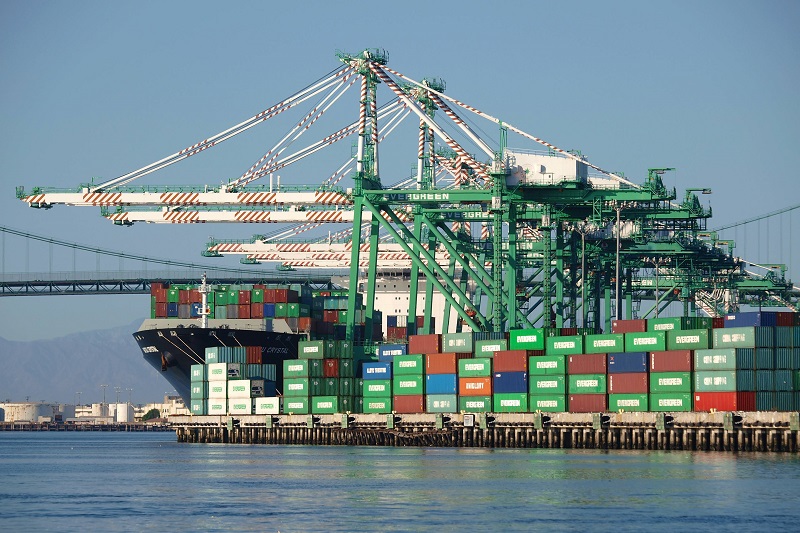
Keep all of the Biden administration visits to the Port of Los Angeles, Port of Long Beach and Port of Oakland in mind (aka the hide the ships program) as you review this pending issue with port labor unions.   The labor union contracts expired at 5:00pm today.  Massive wage increases, the result of inflation, are demanded by the unions and White House is likely to get involved (if they are not already).

In a very weird economic scenario, the Biden administration actually benefits from a port stoppage as imports are a deduction to GDP and the U.S. economy is presumably on the “zero” growth bubble.   If the Bureau of Economic Analysis (BEA) calculates a negative GDP in the second quarter (not likely for political reasons), the Biden administration would officially be responsible for a recession.  [Any delay in import quantification helps shape the economic statistics; however, Q2 ended yesterday.]

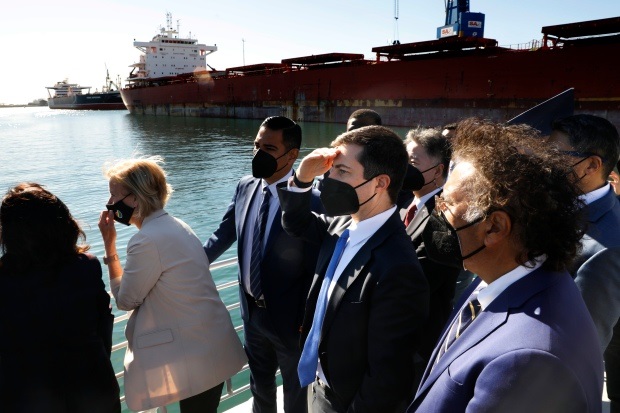
Additionally, port infrastructure specialist, John D. Porcari, is part of the Biden administration economic team.  Porcari shaped the response to the import and supply chain crisis in 2021 that formed the hilarious ‘hide the ships’ strategy.   Porcari works to prop-up the insufferable Transportation Secretary Pete Buttigieg who has no idea what he’s doing.

CALIFORNIA – LOS ANGELES, July 1 (Reuters) – The contract covering more than 22,000 workers at 29 U.S. West Coast ports expires late on Friday, dialing up worries that labor disruption could roil the nation’s battered supply chains, stoke inflation and threaten a weakening economy.

The International Longshore and Warehouse Union (ILWU) and the Pacific Maritime Association (PMA) employer group, which declined comment for this report, said in a rare joint statement on June 14 that they were not planning any work stoppages or lockouts that would worsen supply chain logjams.

That matters because when the contract expires at 5 p.m. PDT(0000 GMT Saturday), so does its “no strike” clause, said Peter Tirschwell, vice president of maritime, trade & supply chain at S&P Global Market Intelligence.

History suggests a last-minute extension is not likely. The union in November rejected a one-year contract extension, saying its members had already granted a three-year extension to the current contract.

[…] Meanwhile, wary shippers are not taking any chances. They are routing cargo away from the West Coast to avoid potential labor-related slowdowns, particularly at the nation’s busiest seaport complex at Los Angeles/Long Beach that handle nearly $500 billion in cargo annually. That is driving up their costs and contributing to backups at ports in New York/New Jersey, Savannah and Houston.

The last West Coast port labor contract negotiation broke down in 2015 after nine months of talks. Dockworkers stopped work for eight days, a move that gummed up U.S. supply chains and siphoned an estimated $8 billion from the Southern California economy.

U.S. President Joe Biden met with the ILWU and the PMA in Los Angeles on June 10.

Any disruptions at Pacific Coast ports that handle almost 40% of imports to the United States could send transportation costs even higher, exacerbating pressure on a softening economy that is sinking Biden’s approval ratings.

“We’ve never had a White House that is all over these negotiations the way they are now,” Tirschwell said. (read more)

Hmmm….  Opportunity knocks?

A labor union stoppage would be bad for the economy although statistically good for Biden, and any extended work stoppage would be an excuse for empty shelves, shortages and increased ‘demand side’ inflation that might surface.   Huh, funny that.

Understand Operation Hide The Ships Here

Wall Street Advocates Begin Admitting Demand Side Economy is in Free Fall


Posted originally on the conservative tree house on July 1, 2022 | Sundance

Keep in mind as you review this article from the Wall Street Journal that every corporate (think Wall St) media outlet, has claimed for well over a year, that inflation was predominantly a demand side issue.  In essence, consumer demand was so strong that prices were rising because of it.

The demand side argument/justification for inflation was always false.  However, it was/is still the claim made by members of the Biden administration and almost every board member of the federal reserve.

All of them, almost universally, dismissed the supply side inflation argument which is the reality at the epicenter of inflation causation.

Inflation was/is an exclusive outcome of three supply side aspects which merged simultaneously: (1) the Joe Biden energy policy, (2) the Joe Biden promoted covid response via legislative spending, and (3) the promoted Biden administration monetary policy.

While the legislative spending did create artificial economic activity, all of these inflationary sources are supply side impacts.

The demand side claim for the origin of inflation was always a ruse, a con, a complete farce intended to backstop the claim that inflation would be “transitory” once consumer spending moderated.   From that perspective every approach from government toward controlling inflation was wrong.  Not wrong by accident, wrong as a matter of deceit and purposeful media manipulation in order to maintain the “Build Back Better” or “Green New Deal” agenda….. which, I might add, benefitted from the advanced Wall Street investment in both constructs, globally and domestically.

In short, a collaboration of purposeful ignorance and pretending not to know has culminated in the collapse of much of the global economy.  Now, with that result visibly and unavoidably surfacing, the controllers of policy, both here and aboard, need to shift and start making admissions.  Thus:…

Wall Street Journal – Factories around the world are reporting weakening demand for their products, a sign that the consumer-goods boom that kick-started the postpandemic economic recovery could turn into a bust as surging prices and interest rates erode spending power.

Surveys of manufacturers released Friday told a similar story whether the factory was in South Korea, Italy or the U.S.: Output is falling or is rising at a slower pace, driven by declines in new orders, and particularly those from overseas buyers.

When prices began to rise rapidly early last year, central bankers thought the surge would be short-lived because supply would increase to match higher demand. As higher inflation persisted, they stopped waiting and began raising borrowing costs to reduce demand.

Now it seems higher prices themselves appear to be having the same effect, weighing on purchases even in places such as the eurozone, where interest rates have yet to rise.

“Demand is now weakening as firms report customers to be growing more cautious in relation to spending due to rising prices and the uncertain economic outlook,” said Chris Williamson, chief business economist at S&P Global Market Intelligence.

U.S. factory activity grew in June at the slowest pace in two years, according to the Institute for Supply Management’s measure of U.S. manufacturing activity known as the purchasing managers index.

New orders fell for the first time in two years as customer demand weakened. Employment in the manufacturing sector also fell for the second straight month, the survey found.

A separate measure of U.S. manufacturing PMIs produced by S&P Global indicated that output stagnated in June as sales fell for the first time since May 2020. Expectations for future output dropped to the lowest level since October 2020. (read more)

U.S. inflation was/is driven -in the vast majority- by supply side impacts as a result of policy (Build Back Better).  The U.S. recession was/is now going to be driven by demand side impacts that are the result of increased supply side costs.  This is the natural economic truth being denied by all levels of political leadership.

Joe Biden policy makers, specifically the U.S. treasury secretary and the federal reserve chairman, have claimed -falsely- that current inflation was/is being driven by demand. In essence, and ironically, their position means consumers are to blame for high prices.  This has been their story and they have stuck to it.  However, remember monetary policy can only impact the demand side of the economy.  Monetary policy cannot impact the supply side, that aspect is led by Joe Biden policy.

The Federal reserve, having denied (pretended) the supply side causation, has effectively raised interest rates (0.75%) into an economic environment where consumer demand was already contracting.  CTH has been asserting this fundamental position all year.   Here is the evidence:

US Manufacturing PMI fell dramatically to 52.4 in June 2022 from 57 in May.  This drop is well below the market and economic expectations of 56, and now points to the slowest growth and steepest drop in factory activity in almost two years.  Contractions in output and new orders are pushing the index down.

Production and new sales declined for the first time since the depths of the pandemic in mid-2020 driven by weak consumer demand.  Inflation and a drop in wholesale and retail purchases have lowered purchase orders.  The gears inside the economy are slowing to a halt.

Look at the PMI trendline and you can clearly see what we have been discussing on these pages since March of 2021.   Consumer demand has been dropping in direct proportion to the dramatic rise in inflation (consumer prices).

At the exact moment that U.S. inflation began spiking in housing, energy, fuel and food, consumer demand for non-essential purchases, durable goods, started dropping.  This is a natural outcome that mirrors your own experience in checkbook economics.

When food, fuel and energy cost you more, you stop buying stuff and start prioritizing.

Following the path of the “build back better” agenda, the U.S. version called “Green New Deal,” meant the Biden administration had to continue denying that any demand side contraction was taking place.   However, it is clear from the indexes under the control of purchasing managers that orders for factory goods have been dropping.

The same is true on the services side of the PMI.  Demand for services are being prioritized, and demand for non-essential services are dropping.

The U.S. economy is contracting.  Denial abounds.

Infuriating does not adequately describe my sentiments toward these intentional liars.

We are in an abusive relationship with all levels of government and their media spokespeople.

Independent and honest journalism, the sharing of information that can empower people to intercede events with political liars, is quite literally the only thing that might save us from the catastrophic consequences of all this pretending.

Knowledge is power, and we need to build our arsenal with an urgency unlike any before in our lifetime.

A Red Wave is Coming


Armstrong Economics Blog/Politics Re-Posted Jul 1, 2022 by Martin Armstrong

After examining 12 months of data from 1.7 million Americans, the Associated Press (AP) has found that people are fleeing the Democratic Party. The Democrats enjoyed a slight edge while Trump was in power, as the outspoken president seemingly polarized voters who felt the two parties represented good v. bad. Inflation is running at a 40-year high, people cannot afford rent, crime has skyrocketed, the borders are open, and we are in the midst of an energy crisis – the list of issues that the Biden Administration has created is endless.

It is no wonder that 1 million voters in 43 states have switched to the Republican Party in the past year. The poll noted that middle-class suburban dwelling voters have been even more likely to switch parties, which spells trouble for the Democrats who previously relied on this demographic in swing states. In swing state Pennsylvania, for example, party changers switched to the GOP from 58% to 63%.

Biden’s popularity seems to diminish weekly. Democratic lawmakers have lost control of their cities and crime will continue to rise with poverty. COVID fear-mongering worked for only so long. Now, people are disgruntled with the “new normal” and are shifting their political beliefs to align with traditional American morals.

New York Prohibits Illegal Aliens from Voting


Armstrong Economics Blog/Politics Re-Posted Jul 1, 2022 by Martin Armstrong

In a groundbreaking moment of enlightenment, New York lawmakers decided that only US citizens should be able to vote. “There is no statutory ability for the City of New York to issue inconsistent laws permitting non-citizens to vote and exceed the authority granted to it by the New York State Constitution,” wrote Staten Island Supreme Court Justice Ralph Porzio.

The recent ruling has blocked over 800,000 non-citizens from voting, accounting for nearly one in nine of the city’s voting-aged 7 million residents. The vote was approved with a 33-14 majority. Imagine visiting another country, perhaps living there for a month, and having a say in who they elect in positions of power?

The only requirement for non-citizen voters of age under this failed proposal would be that they are authorized to work in the US and have spent a measly 30 days in the city. They were pushing for this bill to pass by 2023 to infiltrate the 2024 US Presidential Election, among others. Mayor Bill de Blasio questioned the proposal but said he would not use his veto powers if the measure passed. Republican minority leader of the City Council Joseph Borelli told the Associated Press that the bill “devalues citizenship” as “citizenship is the standard by which the state constitution issues or allows for suffrage in New York state elections at all levels.” Borelli accused certain lawmakers of using the bill to infiltrate the voting process.

Non-citizens do not need knowledge of the English language, and they do not need to have any real understanding of the US election process. This law violates the Constitution so blatantly that there was bipartisan skepticism. It seems only the “progressives” were firmly in support of this measure since everything is racist in their bloodshot eyes.