
Category Silver
Cash Not Accepted
Armstrong Economics Blog/The Hunt for Taxes Re-Posted Mar 16, 2023 by Martin Armstrong

There once was a time when cash was the undisputed king. Merchants preferred cash payments over credit, and there were often incentives for paying with paper. I recall receiving lower gas prices when paying with cash, for example. It is increasingly common to see “no cash accepted” signs at establishments as the world moves toward a cashless society. At the Federal level, there are no laws protecting consumers who wish to pay in cash. The Federal Reserve stated on its website:
There is no federal statute mandating that a private business, a person, or an organization must accept currency or coins as payment for goods or services. Private businesses are free to develop their own policies on whether to accept cash unless there is a state law that says otherwise.
"Section 31 U.S.C. 5103, entitled "Legal tender," states: "United States coins and currency [including Federal Reserve notes and circulating notes of Federal Reserve Banks and national banks] are legal tender for all debts, public charges, taxes, and dues." This statute means that all U.S. money as identified above is a valid and legal offer of payment for debts when tendered to a creditor."

Yet, the Federal Reserve also recognizes that as of 2021, 4.5% of US households were “unbanked.” This means that 5.9 million households are unable to pay by card. This is the lowest unbanked rate since the Fed began keeping track in 2009. The most common reason for not having an account, reported by 21.7% of unbanked households, is that they do not meet minimum balance requirements. The second most reported reason (13.2%) is that people simply do not trust banks, while the third most cited reason (8.4%) was the desire for privacy.
If merchants refuse to accept cash, these people cannot participate in consumerism. Their legal tender is simply not accepted. Unbanked households are more likely to contain persons with lower levels of education, lower incomes, disabilities, single mothers, and minorities. As the Fed reported:
“Differences in unbanked rates between Black and White households and between Hispanic and White households in 2021 were present at every income level. For example, among households with income between $30,000 and $50,000, 8.0 percent of Black households and 8.4 percent of Hispanic households were unbanked, compared with 1.7 percent of White households.”
If cash is legal tender, then it should be accepted everywhere. Numerous merchants not only refuse cash but they charge an additional fee for using credit. Tennessee, Arizona, Delaware, District of Columbia, Idaho, Maine, Massachusetts, Michigan, Mississippi, New York, North Dakota, Oklahoma and Pennsylvania, New Jersey, Rhode, Colorado, and Connecticut have laws at the state level protecting cash payments. Some cities such as Washington D.C., Berkley, Chicago, New York City, Philadelphia, and San Francisco also have laws in place. However, I can assure you that many retailers in these areas still do not accept cash.
Washington wants to move us toward a cashless society to tax everyone, even those with the least to give, on every transaction we make.
Hoards -Even Gold
Armstrong Economics Blog/Hoards Re-Posted Mar 10, 2023 by Martin Armstrong
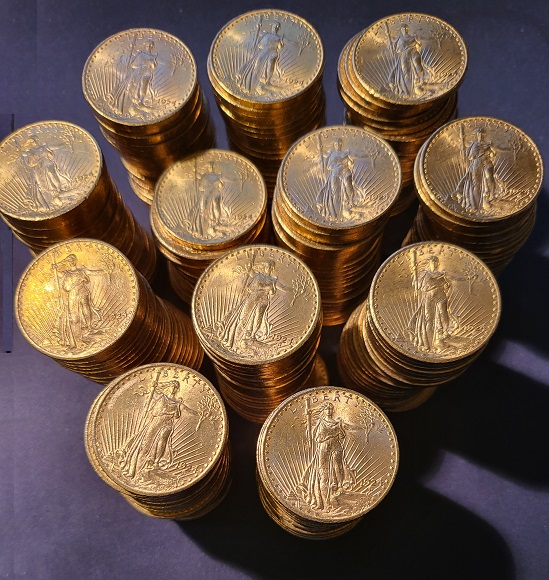
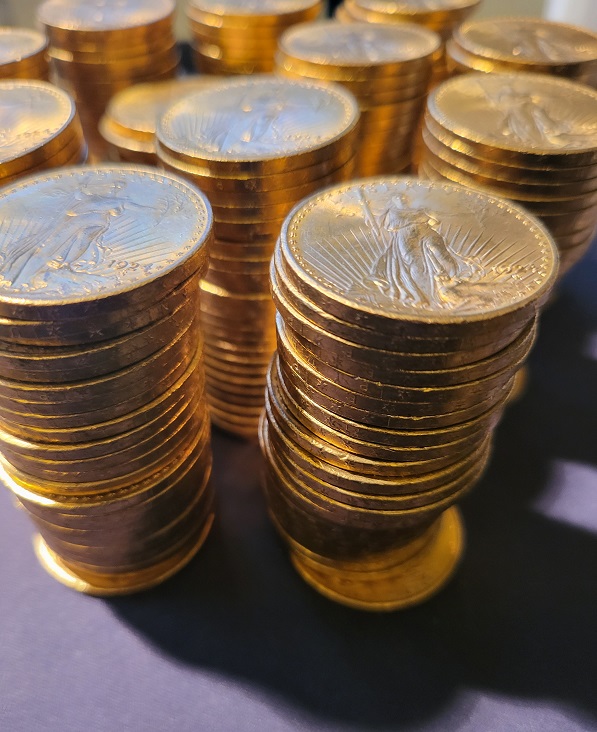
In times of economic distress, people will hoard their wealth. This is as true in ancient times as it is in modern times. I was called in about a hoard of gold – one thousand $20 St Gaudians gold coins all dated 1924 – uncirculated. As you see, I have a reputation for buying hoards as well as funding major archaeological digs. This was a hoard of US$20 gold coins. So I took the lot. As for those who say I hate gold, no, I have always loved the $20 st Gaudens.
Obviously, this was a stash. It was the year of a Presidential election and in 1925, Calvin Coolidge was the first President to have his inauguration broadcasted on radio. In 1921 the Chinese Communist movement began and in 1924 Stalin came to power after poisoning Lenin and his wife. The flight from Russia began in 1917, but it escalated by 1919. It is hard to say why this hoard was stashed away. But they are all dated 1924 and may have been connected to the upheaval in Russia. By the end of 1919, it was clear to almost everyone that the Bolsheviks had won the Civil War. The White armies were defeated on all fronts: Siberia, the Russian North, and Petrograd (as St Petersburg was then called). Pravda on Aug. 31, 1918:
“Our cities must be mercilessly cleansed of the bourgeois rot. All these gentlemen will be put on file, and those who pose a danger to the revolutionary class will be destroyed … Henceforth, the hymn of the working class will be a song of hatred and revenge! ”
It was the White Russians who fled. It was estimated that at least 2 million fled Russia at the time. That was about 2%-3% of the surviving population by 1919. Given the date of this hoard and the condition, they were tucked away and never saw circulation. They may have been related to the turmoil in Russia.
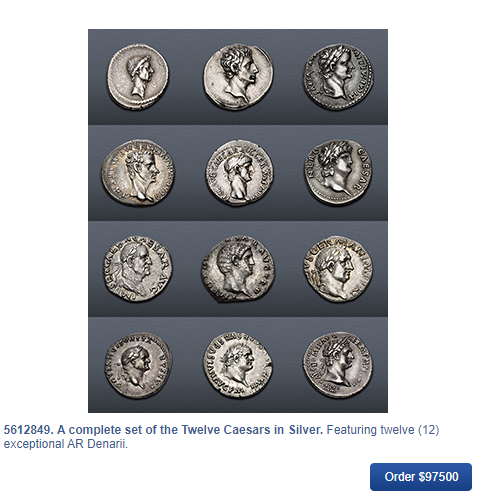
A number of people have asked if I could put together sets of the 12 Caesars because I had mentioned I thought that could be done for half the price of the set being offered elsewhere. I am trying to get a small hoard of Caligula denarii. They are very difficult to find. I believe because he was so hated, they may have just melted down his coinage.
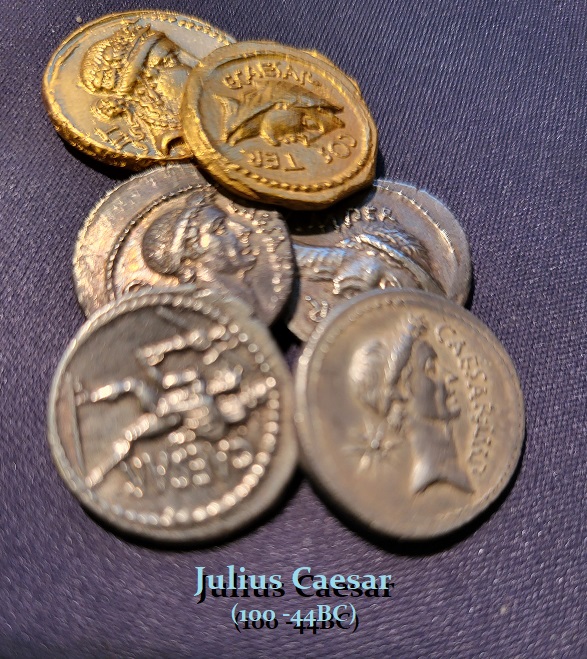
It all depends on quality. I have purchased a small hoard of Julius Caesar coinage. I will try to see If I get these Caligula denarii. If I do, I will try to see if I can put together some sets with much more realistic prices.
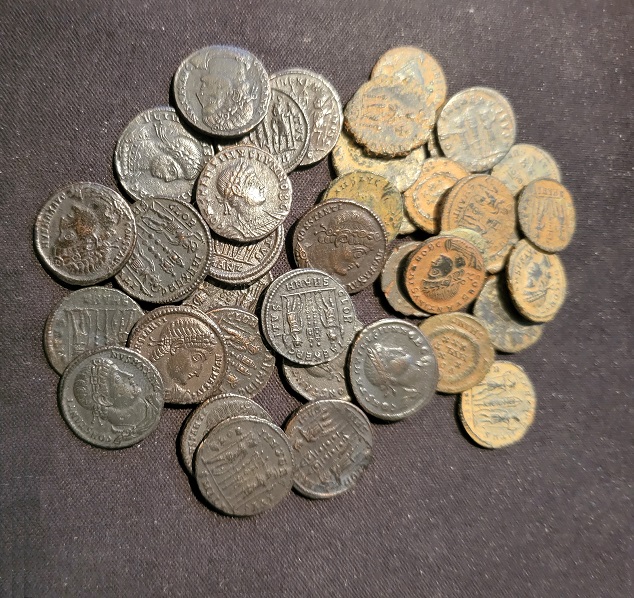
I have purchased a hoard of late Constantine bronze. They are very reasonable.
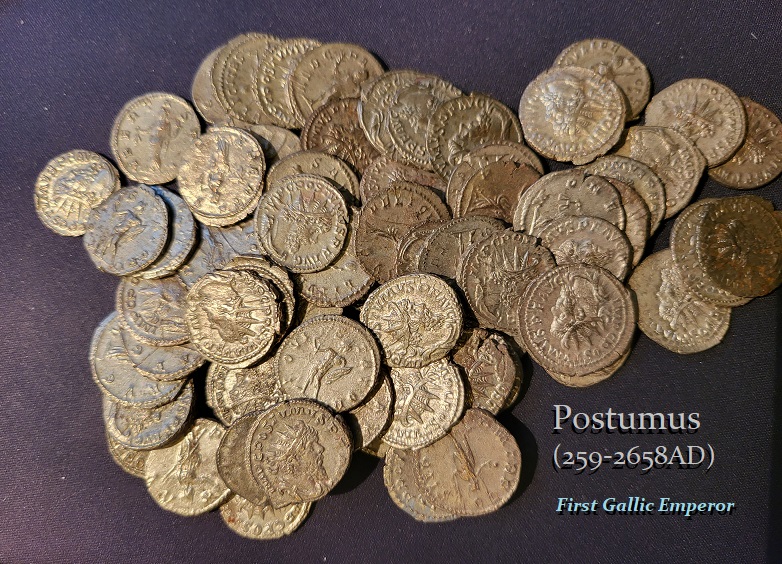
I have purchased an early hoard of Gallic coinage of Postumus which is silver. I also have purchased a hoard of Victorinus which are bronze. This is the period of both the split in the Roman Empire as well as the collapse of the monetary system.
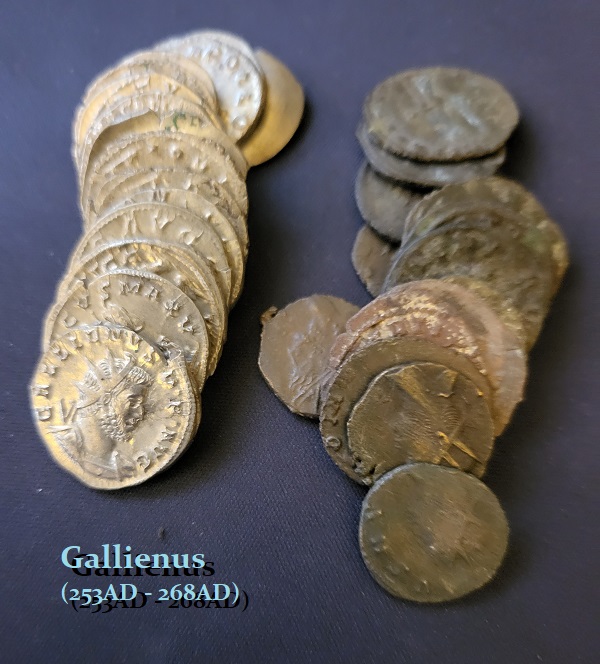
Others have asked if I can put together a progression of the coinage showing the debasement. I will try. Here is a photo showing the stark difference between the beginning of the region of Gallienus (253-268AD) and its end.
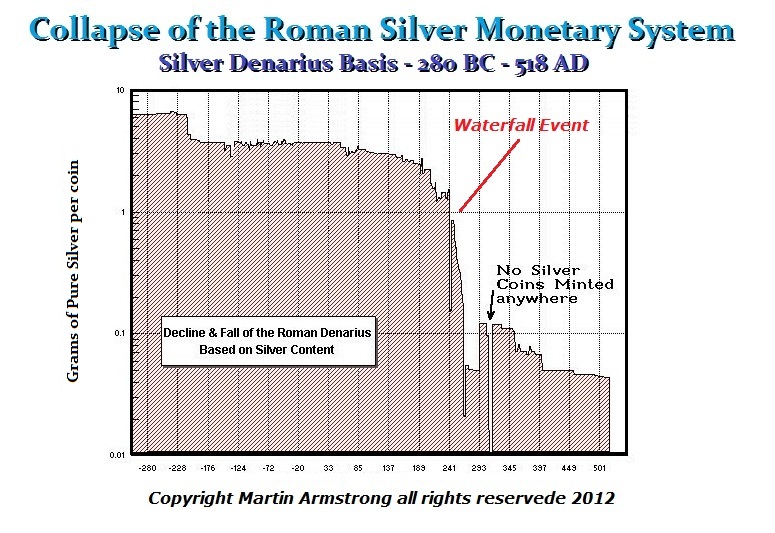
 Centinel2012