Walmart Joins List of Companies that Withdraws Advertising from Twitter – Looming Collapse of Platform Evident


Posted originally on the CTH on December 1, 2023 | Sundance

At dinner last night, I was questioned about Twitter and the recent remarks of Elon Musk.  My opinion is somewhat out of variance with the mainstream considerations.

I believe the demise of Twitter was essentially determined long ago.  Musk stepped into a scenario that was tenuous at best, and the government control of the platform was always the fulcrum issue.  Musk’s prior intent with the platform may be up for debate; however, against his recent remarks, I would argue Musk is presenting the potential collapse of the platform as a martyr scenario.

Musk said recently the platform may collapse without advertisers, but he will not acquiesce to corporate blackmail.  Sounds great, but keep in mind that Musk has known about the fulfillment of the DOJ search warrant for user data since January of this year; we only recently discovered it.  Put that background reality into the overlay of your opinion, given the year of comments about users shared by Musk, and the known lack of platform privacy.

Musk knew as an outcome of the platform fulfillment of the court order, the release of all user metadata who supported, followed, liked, or shared the tweets of Donald Trump, that the government created the “his kind” list earlier this year.   Yet, he never discussed the issue of compromised privacy throughout his commentary; he did exactly the opposite while assuring people the platform would protect users.  [Ex. How did the encrypted DM promise work out?]

Now Musk positions himself as the martyr, the victim of leftist targeting…. and his hired CEO Linda Yaccarino is doing the same thing [SEE HERE].  What better way to guide the platform into a controlled collapse than to be a martyred hero as the Twitter platform potentially disappears.  Just think about it.

Simultaneously, all prior DOJ/FBI/IC datamining and intelligence gathering operations against conservative or liberty-minded Americans becomes legal when contrast against the fulfilled subpoena.  That’s the same DOJ/FBI/IC motive behind the Carter Page FISA application.   All prior surveillance legalized ex-post-facto, history rhymes.

VIA CBS – Walmart said Friday that it is scaling back its advertising on X, the social media company formerly known as Twitter, because “we’ve found some other platforms better for reaching our customers.”

Walmart’s decision has been in the works for a while, according to a person familiar with the move. Yet it comes as X faces an advertiser exodus following billionaire owner Elon Musk’s support for an antisemitic post on the platform. 

The retailer spends about $2.7 billion on advertising each year, according to MarketingDive. In an email to CBS MoneyWatch, X’s head of operations, Joe Benarroch, said Walmart still has a large presence on X. He added that the company stopped advertising on X in October, “so this is not a recent pausing.”

“Walmart has a wonderful community of more than a million people on X, and with a half a billion people on X, every year the platform experiences 15 billion impressions about the holidays alone with more than 50% of X users doing most or all of their shopping online,” Benarroch said.

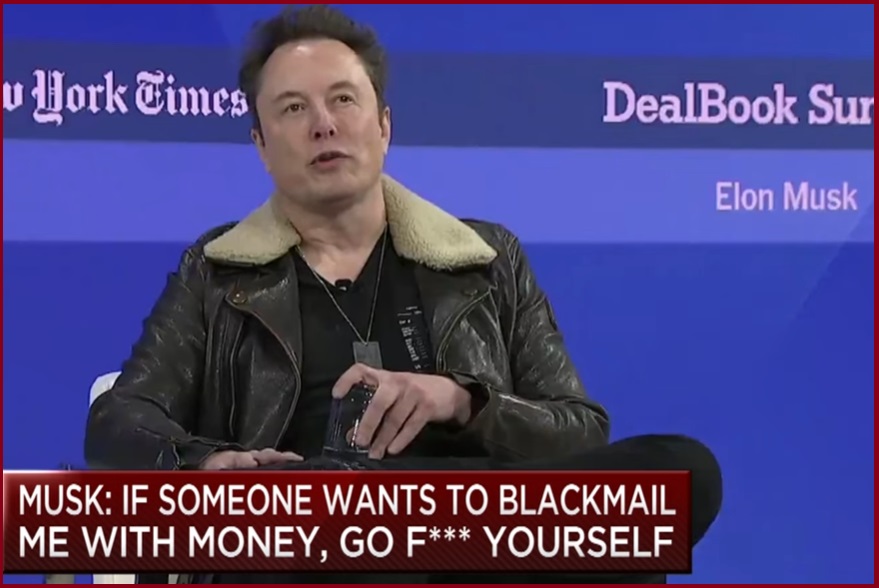
Musk struck a defiant pose earlier this week at the New York Times’ Dealbook Summit, where he cursed out advertisers that had distanced themselves from X, telling them to “go f— yourself.” He also complained that companies are trying to “blackmail me with advertising” by cutting off their spending with the platform, and cautioned that the loss of big advertisers could “kill” X. (read more)

Twitter has $12.5 billion in debt from the initial investor purchase of the platform.   The debt service costs around $1 billion per year ($100 million/mo).   There was never a viable path to profitability and/or platform solvency; the operating costs when combined with the debt service are just too high.

Now, think carefully…. In late September, Twitter CEO Linda Yaccarino made a bold statement.  Yaccarino stated that from her review of the current status, Twitter would start to turn a profit in the first quarter of 2024 {link}.  However, with $100 million per month in debt service alone, this statement seemed too far of a stretch.  At pre-Musk levels of revenue, maybe; but that $1.5 billion debt service is a heavy nut to carry.

Timing – Remember, in early October the Securities and Exchange Commission (SEC) gave special regulatory approval to Bill Ackman’s firm, Pershing Square (hedge fund), for a new investment vessel called SPARC, whose purpose is to invest in private companies in order to take them public.  As noted by CNBC, “In a SPARC, investors will know what company the financing vehicle would be used to merge with before they have to pledge their investments.”  The financial mechanism avoids some of the issues with typical IPOs.

•It was October 2023, inflection time.  •Yaccarino says a strategy is underway for profitability in Q1 2024.  •Ackman gets SPARC approval.  If you ask me what was going on, I’d say they were positioning a mechanism to get the debt removed and the investors repaid – sell the debt via Ackman.

Once the new advertising boycott began, the Ackman story disappeared completely.  The debt holders are naked with a platform that is worth less than the original investment.

Was this just naive stupid thinking?  Was the current scenario the result of failed foresight…. or, was this a guided and controlled outcome?   If you ask me, I’d say the latter.

Who wins?  The surveillance state…

….while everyone proclaims Elon Musk a hero for trying.

Brilliant!

Welcome to the 2024 election season.

A Strong Possibility Twitter Will IPO and Go Public Again, Here’s Why


Posted originally on the CTH on October 3, 2023 | Sundance 

I wasn’t going to write about this, but so many requests and contacts have come in, and considering that my background conversations with people are leading to actionable positioning, that I feel it is only fair to share publicly what I am analyzing privately.

The predicate for all assumptions is several fold: {Go Deep One} and {Go Deep Two}. Most of the financial groundwork for analysis already exists. In summary, Elon paid $44 billion for the platform. Current valuations are around $15 billion.  Current debt service is $1.5 billion/yr (roughly $100m/mo).  Current expenses include $100m/yr AWS, $100m/yr Goog cloud (both contracts), +payroll and misc.

Approximately 9 months ago, Musk had $1 billion in cash reserve for Twitter.  The burn rate deficit was roughly $100m/month. That put timeline estimates for an inflection point on/around October 2023.  It is now October 2023.

Approximately a week ago, Twitter CEO Linda Yaccarino made a bold statement.  Yaccarino stated that from her review of the current status, Twitter would start to turn a profit in the first quarter of 2024 {link}.  However, with $100 million per month in debt service alone, this statement seemed too far of a stretch.  At pre-musk levels of revenue, maybe; but that $1.5 billion debt service is a heavy nut to carry.

Timing – Remember, it’s October.  Last Friday, the Securities and Exchange Commission (SEC) gave special regulatory approval to Bill Ackman’s firm, Pershing Square (hedge fund), for a new investment vessel called SPARC, whose purpose is to invest in private companies in order to take them public.  As noted by CNBC, “In a SPARC, investors will know what company the financing vehicle would be used to merge with before they have to pledge their investments.”  The financial mechanism avoids some of the issues with typical IPO’s.

•It’s October, inflection time.  •Yaccarino says a strategy is underway for profitability in Q1 2024.  •Ackman gets SPARC approval, and then suddenly:

[…] “The answer is I have a lot of respect for Musk. I think Twitter is a really important platform,” Ackman told CNBC. “I think he’s made tremendous improvements to the platform, and I think it’s a unique, very difficult-to-disrupt, kind of asset and one that could grow.” 

[…] Though Musk hasn’t expressed any interest in working with Ackman to take X public, and despite the $13 billion in debt tacked to the company, Ackman has worked out a loose plan to make it happen, if Musk were interested. 

“What’s interesting here is we could commit $2 billion to a transaction, set the rights price to $121 million, set it at $100 a share and announce a transaction,” he said. 

“And then we tell the story and then the rights holders have a chance to decide whether to invest. As long as the rights have positive value, they’re all going to get exercised, and the IPO raises $13 billion.” (read more)

The heavy nut disappears.

Investors roll the debt into discounted shares of stock.  If Ackman can generate a $17-$20 billion outcome for Twitter, Musk nets $5b and retains 20-25% of shares.  Yaccarino gets well compensated.  It’s a win/win/win.

Critics would say the IPO would mean Musk compromising on the free speech commitment.  However, in reality Musk has already reinstalled many of the control mechanisms of the previous “safety council,” along with the “freedom of speech, not freedom of reach” outlook.  Musk and Yaccarino have also partnered with the Global Disinformation Index.

The compromises are already baked into the platform, and seemingly have been since Yaccarino became CEO.  The 2024 election is next year, and influence is a lucrative business.

Musk Confirms Current Status of Ad Twitter Revenue


Posted originally on the CTH on September 4, 2023 | Sundance

The issues around the Twitter platform (X Corp) are important for several reasons, including the anticipated tech moves around the 2024 election.

Many people are holding up Elon Musk as a tech figurehead who might just be able to push back against the tide of totalitarianism.  However, a more realistic look at Musk shows he is participating in the control space just as much as any other platform.  Additionally, Musk has threat and influence vectors just like any other person or social media company.  The most obvious influence vector is the cost of operating his X platform.

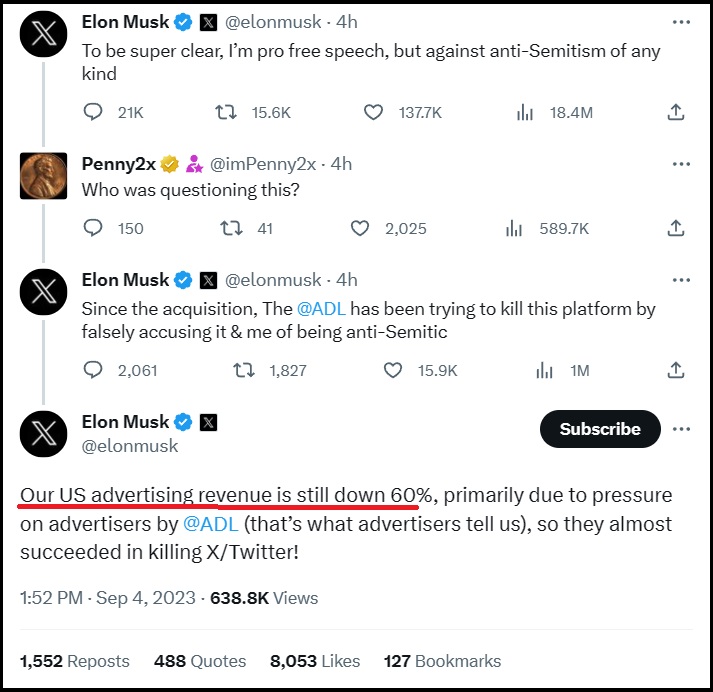
Earlier today Musk outlined the current status of Twitter revenue generation.   The baseline here is the prior peak of revenue for the company, which was around $3.8 billion, prior to Musk acquisition.  Musk shares today that revenue is down 60% from that point.

That would put current revenue around $1.52 billion/yr.

Service on debt is around $1.25 billion/yr.  Amazon and Goggle services around $1 billion/yr.  That’s an operational loss of around $1.6 billion/yr when you factor in subscription revenue.  In essence, Twitter loses around $130 million every month.

With the latest revelations we shared about the financial position of Twitter {Go Deep on FINANCIALS}, all of the moves now underway make sense.  Musk was on track to hit a date in/around October of this year where Twitter would be insolvent. If you had read those previous “Go Deep” links, you will easily see the problem. Musk needs another infusion of cash, and he is limited on his Tesla stock as an option.

The use of Enhanced Artificial Intelligence to control information and communication is a subject that too few people understand.  This is why I have spent time trying to share information so that people can see into the future of their internet reality.  Everything will change.

As you should know by now, the X platform (Twitter) is designed to produce a different user experience based on “definitions” of the user.  The definitions are applied by the platform, to create unique identifying characteristics of the user.  The result is that each user gets a completely different platform experience, based on their definitions.

“Twitter is a different platform for each user.”  Repeat that phrase as often as needed to understand the evolution of what is coming to the American internet.

You might ask, how is applying all of these granular definitions even possible?  The answer is through the use of AI.  Humans will no longer be assigning the definitions of you; an autonomous system will take on the job of assigning the definitions.  Now, keep referencing the word “definitions,” because that is your identity and gateway pass into the platform content.  If you carry a particular definition, you will be blocked, throttled, shadow-banned or experience friction applied to your user id.

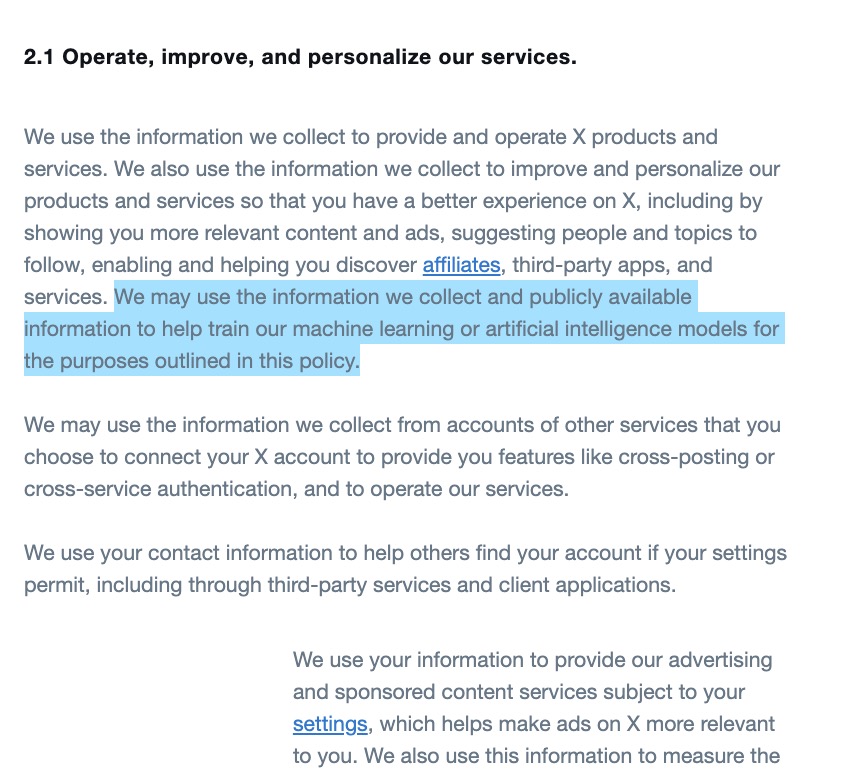
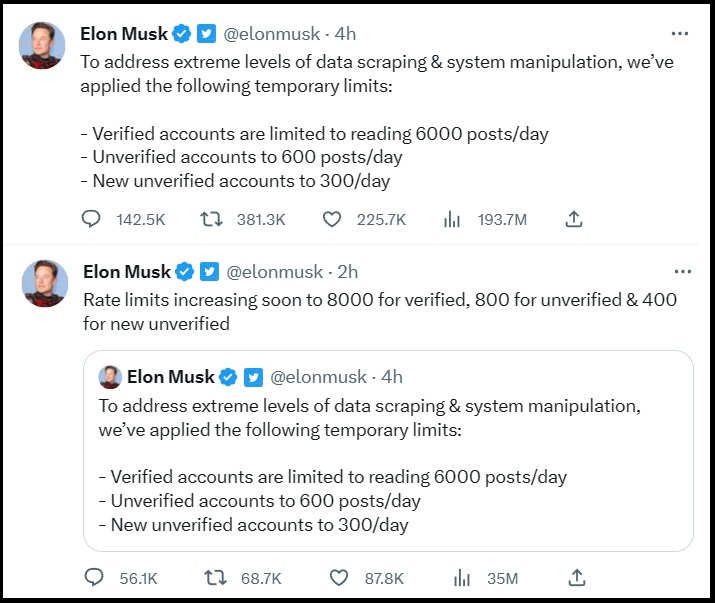
Remember when Elon Musk restricted users and claimed it was because the platform content was being “scraped” by organizations who were using the content to train their Enhanced AI systems?  Remember, Musk saying that, and expressing his concern?   Well, now the platform is telling users in a new X Corp privacy policy, that X corp itself is going to do exactly the thing Musk said he abhorred.

Twitter (X Corp) is going to use the content you provide to train the AI how to apply the definitions.  All of your interactions with the X Corp product are then going to be tailored based on the definitions that are applied to your identity, your account.   Some content will not be available to you; some content will only be available to you; the key and essential point is that YOU are defined.

Once you understand how your experience with the X platform is an outcome of definitions applied by X platform to you, then you can elevate your thinking and start to understand what the new American internet is all about.  Your definitions will determine what paths and/or roadways are available to you.

Enhanced AI will act like an invisible gatekeeping system on the American internet, showing or hiding internet outcomes according to your definitions.  It’s not that the offramp (a specific pathway on the internet) doesn’t exist, it’s an issue of you not being able to see any off ramp.  Your experience online is modified according to the definitions, that are applied to you.   This is why Enhanced AI is needed to (a) monitor and define; then (b) control the pathways of your travel.

Currently, your experience with Twitter is contingent upon your definitions.  Very soon, that same process will apply to the larger internet.

There really is no other phrase that seems to adequately describe the future for online life in the United States than to describe it through the prism of the previously discussed shadow banning that takes place on the X-platform for specifically wrong-thinking users.

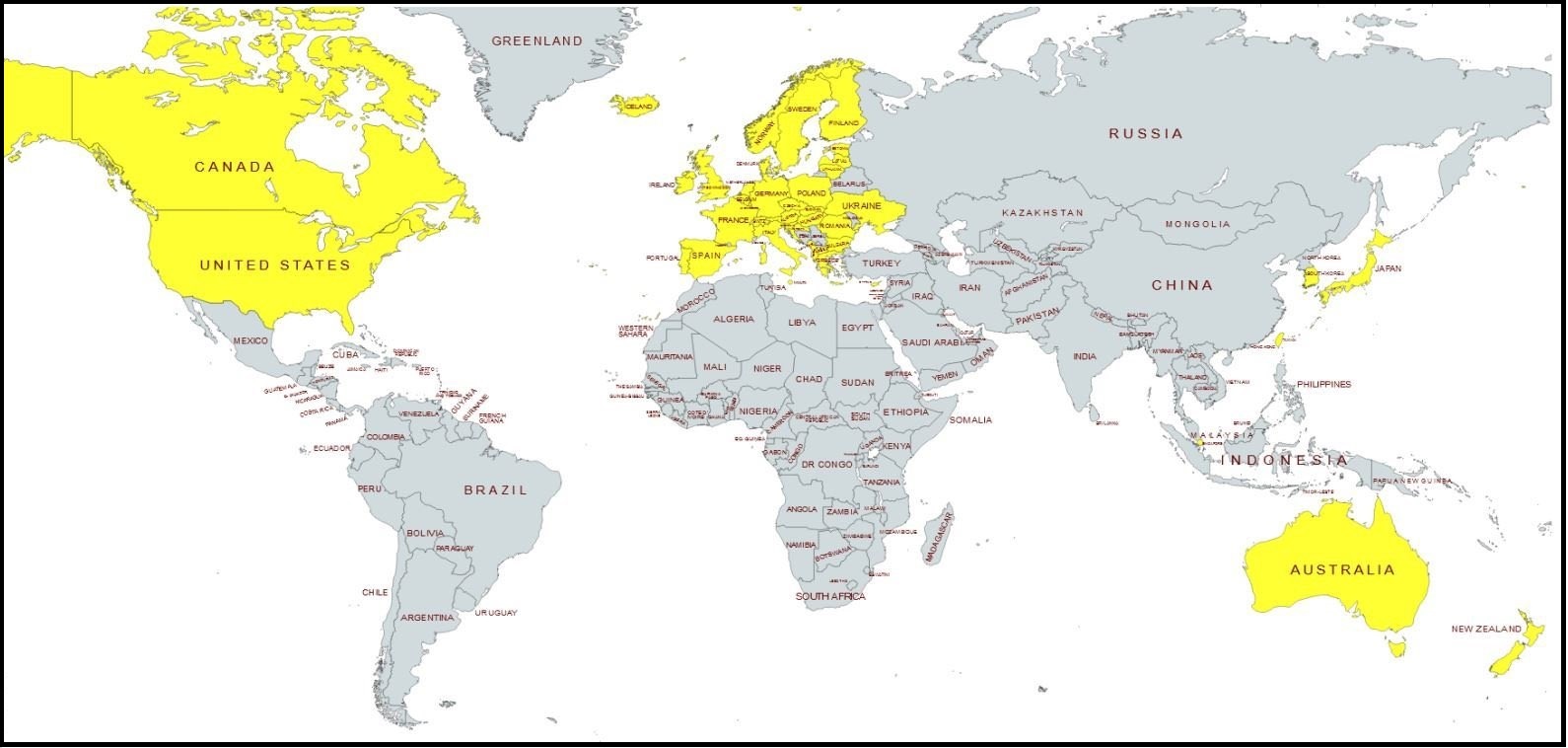
It is important to begin with the end in mind.  Perhaps some people are unaware that internet services, meaning the actual experience of using the internet for communication and commerce, are not the same in every nation.  In fact, it is quite a different experience depending on where on the globe you are located.  The differences are driven by internal controls, the intranet of the regional internet per se.

The internet in China is not the same as the internet in Europe, which is not the same as the internet in Australia, which is not the same as the internet in North America, which is not the same -at all- as the internet that now exists within Russia.  Even in some continents, the internet traffic flows are controlled at different levels within each nation. The “world wide web” is a format, but when you get down to the national level, things change.

This baseline helps to understand that internet freedom is defined by access to information and commerce.

To the extent the information or commerce is defined as against the interests of the authority structure, or potentially a threat to the national security interest of the government therein, the internet content is filtered, modified, censored, removed or just simply blocked from view.  This is one layer in the information control system.

Another layer is the flow of commerce that floats atop the flow of information.  This is where advertising, product sales, purchasing and general e-commerce takes place. This layer represents another option for control; therefore, this e-commerce layer should be considered running in parallel to the information, albeit perhaps indirectly attached.

When western government applied economic sanctions against Russia via financial restrictions writ large, the layer of internet commerce control merged with the information and national security control systems of the internet.

Russian citizens were blocked from e-commerce access, specifically from western nations in alignment with the sanctions, and the mechanisms of online purchasing were restricted.  However, the entire world did not participate in the sanctions, and there is a massive amount of e-commerce that takes place, even with the systems of western control financial blocks in place.

Additionally, there is a large black-market system for commerce and financial transactions that started organically in the aftermath of the Russian sanctions.  Crypto currency, as a financial transaction mechanism, was predictable; however, over time people became even more strategic and alternate transfer systems were created.  You can purchase advertising in Russia, but are you really purchasing advertising – or are the purchasers really just transferring funds?  Think about it.

I share that Russia example, because I do not want people to get too disheartened in what is going to happen here in the United States.  There will always be a market for information, regardless of the control systems that are created to stop it.  Additionally, there will always be smart rebellious people who think of ways to subvert the intents of the control mechanisms.  Freedom may be diminished from a raging fire to a small burning flame, but it will never be fully extinguished.  WE just need to learn to adapt.

It took me over two years to assemble The Benghazi Brief, because the background story was so large and complex that it took time, research and retrospection to appropriately contextualize the truth of the issue. {GO DEEP}  The Benghazi attack was a small, albeit deadly outcome, of a much larger story.  The brief walks through everything in context.

In a similar construct, the Shadowbanning of The United States internet is a big and complex story, and I am only about halfway through the assembly of all the data to put context to it.  However, as time becomes critical, it is important for me to push the information forward – because many of the timelines in the construct are likely to surface before I am complete with the fully assembled story.

I am going to drop some links that will help serve as a flashlight into the rabbit hole.  Each story may seem initially disparate or disconnected.  However, I would encourage you to think big picture with each of the puzzle pieces that are presented.  This is likely to become a series, and I will create a new “Internet” category on the side bar where I will tag any future elements.

Please keep in mind, the issues of e-commerce: ie. information monetization, advertising, deplatforming and debanking, are not disconnected from the issues of information control.  The same larger national security system that has mandated (and will mandate), information blocks, content censorship, content restrictions, content removal and various platform control elements, is all part of one interconnected compliance system.  Electronic Commerce and Electronic Information are all subject to the online control process.  This is a public-private partnership on the internet.

The origin of the public-private partnership goes all the way back to the origin of the tech system in relationship to the DARPA programs and government sponsored research labs.  The outcome of the modern partnership is evident in the Dept of Homeland Security (DHS) collaboration with the various communication platforms or pipes of information. Systems like the Global Internet Forum to Counter Terrorism’s (GIFCT) database, are simply outcomes of the partnership.  There are hundreds more.

There is a rush now to provide context because Artificial Intelligence (AI), or smart data systems, are launching into the United States internet control mechanisms almost daily.  We are close to the time when AI will be triggered to help control the content of the internet under the guise of national security.

The timeline for full deployment of the modern United States internet control system, is likely around late fall and early winter this year, in advance of the 2024 U.S. election cycle.

Everything will change.  Every route of online traffic including Internet Service Providers (ISP’s) to filters and rerouting on Domain Name Systems (DNS), to the Internet Protocol (IP) itself will be subject to change in the form of background shadow banning.  If the DHS partnership is successful, you will not initially notice – much like a shadow banned platform user doesn’t notice their new defined status.  The shift will become more obvious over time.

One odd outcome will be a regional targeting system.  Depending on where you are in the USA, your online experience will be different. There will also be enhancements to your internet travel based on your profile.  Good thinking users will have benefits that enhance the experience of the user and supports the interests of the national security guardians.

♦ Deployment of a Virtual Private Network (VPN) is irrelevant in this construct.  A VPN is like you renting a car without a license plate.  You travel past all the Automatic License Plate Readers, arrive at your destination, leave the keys in the ignition and just abandon the car.  Your personal travel was essentially invisible to the APLR system.  However, when the internet roads are controlled by the national security state, and there is no longer an offramp to the destination, your VPN use is irrelevant – you cannot reach your destination.  That’s part of the shift.

You will notice I use the term “definition” quite often.  That is because the root of every control mechanism is grounded upon defining things.  When you accept the terms ‘disinformation’, ‘misinformation’, and/or ‘malinformation’, you are buying into the process that permits definitions to determine your travel. Those who define both you and your destination, ultimately control your online experience.

Now, before getting to a recent example of this construct as it is being built, it is important to return to the e-commerce aspect and overlay the Diversity, Equity and Inclusion (DEI) index into the world of online commerce.

♦ Right now, you can physically boycott Bud Light by choosing another brand.  However, for total goods and services the amount of online purchasing is now exceeding the amount of purchasing in real life (brick and mortar shopping).   Overlay the economic control system (think Russian sanctions approach) with the national security requirements for DEI, amid all online commerce, and apply that layer of analysis.  In the e-commerce world, choosing not to buy Bud Light will become a little more difficult; and those who do support the boycott become subject to the previously mentioned “definitions”.

I’m jumping ahead, because there was a big development a few weeks ago. As you read this, do not think small as presented – think bigger.  Think beyond the use of AI moderation on a platform and think of AI moderation on the U.S. Internet System.  Online moderation conducted by AI:

OPEN AI – […] GPT-4 is also able to interpret rules and nuances in long content policy documentation and adapt instantly to policy updates, resulting in more consistent labeling. We believe this offers a more positive vision of the future of digital platforms, where AI can help moderate online traffic.

[…] Content moderation demands meticulous effort, sensitivity, a profound understanding of context, as well as quick adaptation to new use cases, making it both time consuming and challenging. Traditionally, the burden of this task has fallen on human moderators sifting through large amounts of content to filter out toxic and harmful material, supported by smaller vertical-specific machine learning models. The process is inherently slow and can lead to mental stress on human moderators.

We’re exploring the use of LLMs to address these challenges. Our large language models like GPT-4 can understand and generate natural language, making them applicable to content moderation. The models can make moderation judgments based on policy guidelines provided to them. (read more

Do you remember me telling you about what I noticed in the most recent Google spider crawls?

“The Alpha/Google spiders are not crawling around with their enhanced AI looking for words, phrases or content issues.  Enhanced Artificial Intelligence (AI) has given the spiders the ability to look for context.  The new Alpha/Goog AI spiders are crawling the internet looking for information provided with a detrimental and accurate context.  Those who are applying truthful context are the subversive voices that must be targeted.  Keep this in mind.”

Google Spider Crawl Result, CTH Subversive Content, July 2023

As we have shared, the crawl is not headlines, the crawl is in content.  Yes, even content in the comment section is now flagging to the control systems.  Why? Because we operate a proprietary constructed private commenting system that doesn’t have a backdoor and protects you, the user.

The Google Spiders are newly enhanced with AI instructions, dispatched looking for content and ‘context’ that is against the interests of the Vanguard, Blackrock, Larry Page (Alpha/Goog owners), and the public-private partnership.   This content is considered “dangerous or derogatory”. Think about that for a moment.

Do not get alarmed, get informed.

I share this information with you so that you understand what is being constructed and what is about to be deployed on a large scale throughout the U.S. internet operating system.  The U.S. internet will be different.  The social media restrictions became more prevalent and noticeable in the past several years; now it is time for DHS to expand that process to the entire U.S. internet.

When I wrote about Jack’s Magic Coffee shop, people initially thought I was crazy – but the guys inside the coffee shop didn’t.  Eventually DHS control over Twitter was revealed in the Twitter files.  The same background is true here.  The entire American online apparatus is going to change, quite soon.

More will follow….

RESOURCES:

Using AI for Content Moderation

Facebook / META / Tech joining with DHS

Zoom with allow Content Scraping by AI 

AI going into The Cloud

U.S. Govt Going into The Cloud With AI

Pentagon activates 175 Million IP’s

Big Names to Attend Political AI Forum

X-Corp CEO Linda Yaccarino: “If it is lawful but it’s awful, it’s extraordinarily difficult for you to see it, and you get labeled”…


Posted originally on the CTH on August 10, 2023 | Sundance 

X-Corp, formerly known as Twitter, CEO Linda Yaccarino appeared on CNBC to discuss the new direction of the platform and affirm her complete autonomy to control the decision making within the corporation.

It’s important to note the timing for the first CEO appearance of Yaccarino against the backdrop of CTH financial analysis of the company.  According to my calculations X-Corp will run out of working capital, the actual cash needed to pay expenses, in mid to late October; roughly two months from now.  At that point Elon Musk and Linda Yaccarino will need to go back into the market for more cash.

After asserting her complete unilateral control over all decision making within the company, Yaccarino then went on to discuss how information will be defined according to new operational standards she is helping to implement.  The pertinent part of the conversation happens at the 01:16 point of the video segment below. WATCH: 

.

…”if you are going to post something that is illegal or against the law, you’re gone. Zero tolerance. But more importantly, if you are going to post something that is lawful, but it’s awful, you get labeled.  You get labeled, you get deamplified, which means it cannot be shared, and it is certainly demonetized. … So, they [advertisers] are protected from the risk of being next to that content.”… 

The position essentially seems reasonable, I guess. However, I still don’t trust any of the cattle car valets with DHS authorizations and credentials.

.

.

Elon Musk Partners with Global Disinformation Index, the Progressive Disinformation Specialists, to Diminish Advertiser Fears


Posted originally on the CTH on August 9, 2023 | Sundance 

The Global Disinformation Index (GDI) is the group who define the content on platforms according to their ideological worldview and then blacklist sites who do not align their content to support the GDI perspective.   According to the Washington Examiner, Elon Musk has just partnered with them in order to enhance the advertising portfolio of Twitter and find ways to make it lose less money.

CTH has previously said to watch the economics of the Musk situation, because that will determine the outcome of the decisions. The hiring of NBC-Universal executive Linda Yaccarino was explicitly to lure the advertising side of the issue back onto the platform.

Once you are reliant on the advertising, you must then comply with the content terms of the companies who control the advertising.   Joining with a group to define “disinformation” is an outcome.

WASHINGTON – Elon Musk’s X, the social media company formerly known as Twitter, signed an exclusive partnership with a “misinformation” tracker linked to a government-funded group blacklisting conservative media outlets, records show.

On the heels of Musk in July describing how the social media company had negative cash flows due to a 50% drop in advertising revenue, X is teaming up with Integral Ad Science, an ad-verification company, for a “brand safety” initiative. That same ad group, which uses an artificial intelligence algorithm to rate alleged “misinformation,” is affiliated with the Global Disinformation Index, a British group with two affiliated U.S. nonprofit groups that the Washington Examiner revealed is covertly feeding blacklists of conservative websites to advertisers to defund disfavored speech.

“I am completely against GDI in any form,” Rep. Ken Buck (R-CO), who sits on the House Judiciary and Foreign Affairs committees and has launched investigations into the British group over its alleged censorship efforts, told the Washington Examiner. “This new partnership with a group connected with GDI would only amplify the coercive and destructive powers targeting free speech.”

The partnership between X and IAS appears to undercut Musk’s touted commitment to free speech. The X owner has notably released “Twitter Files” documents to journalists, including Matt Taibbi, from Jack Dorsey’s time running the platform that show the company’s apparent coordination with the government to thwart right-leaning voices online. (read more)

I don’t want to say I told you so, but….

…”There is no such thing as “disinformation” or “misinformation”.  There is only information you accept and information you do not accept.  You were not born with a requirement to believe everything you are told; rather, you were born with a brain that allows you to process the information you receive and make independent decisions.”… 

Keep in mind, long before people realized the Dept of Homeland Security (FBI, DHS, CISA etc.) had a portal into Twitter, I was explaining how transparently obvious it was. {Go Deep – Jack’s Magic Coffee Shop} In part, the transparency of the problem is driven by CTH understanding of the costs associated with Twitter as a very unique platform in the sphere of social media. {Go Deep – Understand the Costs}

With the latest revelations we shared about the financial position of Twitter {Go Deep on FINANCIALS}, all of the moves now underway make sense.  Musk was on track to hit a date in/around October of this year where Twitter would be insolvent. If you had read those previous “Go Deep” links, you will easily see the problem.

In 2021, Twitter generated $5.1 billion in revenue, according to the Wall Street Journal.  According to the New York Times, in 2023 that revenue has dropped to around $1 billion per year.

Musk stated during public conversation that Twitter was essentially break even at $4 billion, which was the position in 2022 just prior to his taking over.  [2022 costs around $4.5 billion and revenue around $4 billion +/-, per public financial statements and reporting].   Musk cut approximately $500 million in expenses from realignment and staffing reductions.

Musk has a $1.5 billion debt service on the loan he took out, per his own admission: that’s more than $100 million per month.  The debt service alone is higher than his revenue.  As I noted last month, Twitter is losing somewhere around $300 million per month.  With $1 billion liquid in the bank, as of June (per Musk), that only gets him to September; by October, he needs another influx of cash, or else.

There is no business model, even with paying subscribers, for Twitter to exist without a major increase in revenue (Yaccarino) or a major decrease in costs.  As the business grows (more users), the costs increase (more simultaneous users), and the costs to subscribers would grow.  Twitter Blue subscriptions are around 180,000 users, paying $11/mo.  That’s around $2 million a month- a pittance in comparison to what he needs.

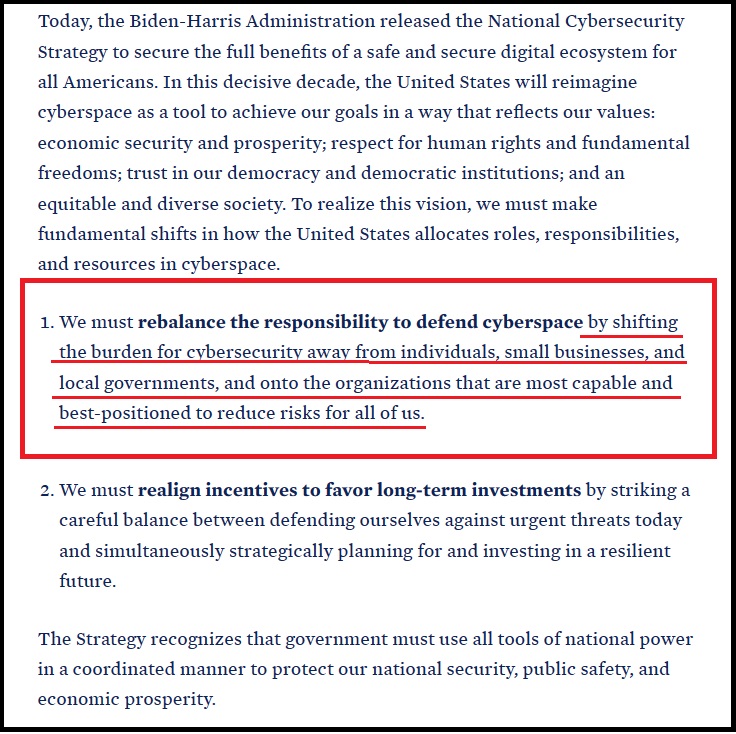
On March 2, 2023, the people in control of the Joe Biden administration officially announced that government control of internet content was now officially a part of the national security apparatus. [White House Link] If you have followed the history of how the Fourth Branch of Government has been created, you will immediately recognize the intent of this new framework.

The “National Cybersecurity Strategy” aligns with, supports, and works in concert with a total U.S. surveillance system, where definitions of information are then applied to “cybersecurity” and communication vectors.  This policy is both a surveillance system and an information filtration prism where the government will decide what is information, disinformation, misinformation and malinformation, then act upon it.

In part, this appears to be a response to the revelations around government influence of social media, the Twitter Files.  Now we see the formalization of the intent. The government will be the arbiter of truth and cyber security, not the communication platforms or private companies.  This announcement puts the government in control.

All of the control systems previously assembled under the guise of the Dept of Homeland Security now become part of the online, digital national security apparatus. I simply cannot emphasis enough how dangerous this is, and the unspoken motive behind it; however, to the latter, you are part of a small select group who are capable of understanding what was in this announcement without me spelling it out.

…”There is no such thing as “disinformation” or “misinformation”.  There is only information you accept and information you do not accept.  You were not born with a requirement to believe everything you are told; rather, you were born with a brain that allows you to process the information you receive and make independent decisions.”… ~ SUNDANCE

Twitter Court Filing Cites Alarming FTC Conduct Pressuring Consent Decree Arbiter to Target Elon Musk and Company


Posted originally on the CTH on July 13, 2023 | Sundance 

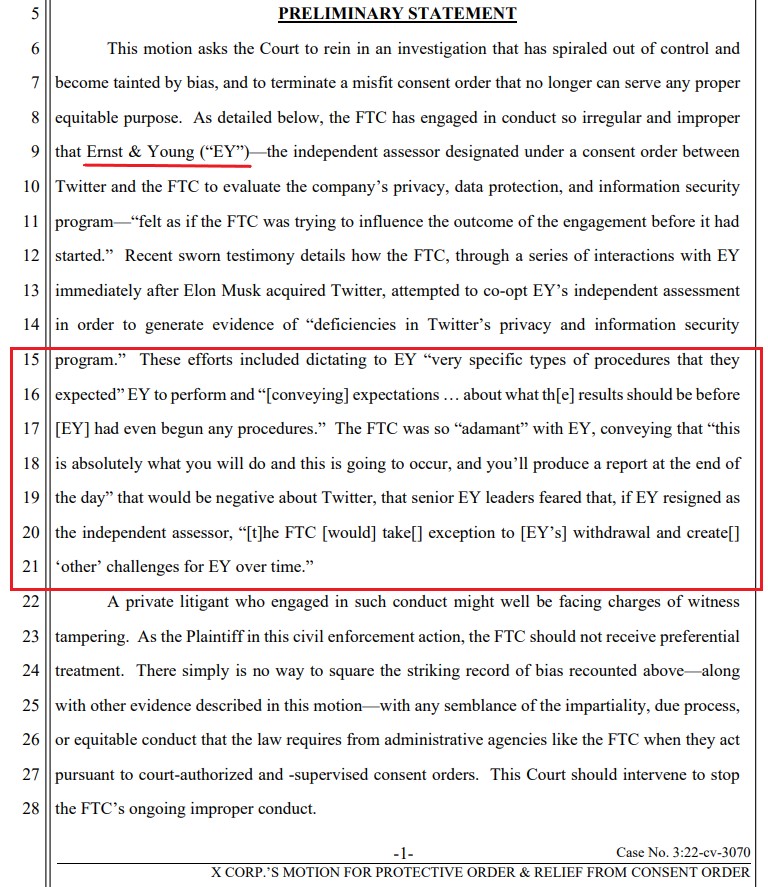
Prior to Elon Musk taking control of Twitter, the social media company entered a consent decree with the Federal Trade Commission putting a neutral arbiter from Ernst & Young in an oversight position for the company’s privacy, data collection and information security protocols.  Given what we know about DHS and FBI control and influence over Twitter content, there is a certain irony in the prior position of the FTC regarding user privacy.

That said, Twitter’s new parent company X Corp filed a court motion Thursday [PDF HERE] asking a federal court overseeing the settlement to either throw out the consent decree entirely, or put it on hold until the FTC turns over documents to Twitter showing historic bias against the company. Twitter is also seeking to bar the FTC from deposing CEO Elon Musk over issues that preceded his arrival.

Within the filing, Twitter presents some alarming information as shared by Ernst and Young about the FTC pressure applied to them.

[SOURCE LINK]

House Judiciary Committee Chairman Rep. Jim Jordan questioned FTC Chair Lina Khan about this issue today during a congressional hearing.

Elon Musk Signs Pledge to Support China’s Socialist Values


Posted originally on the CTH on July 9, 2023 | Sundance 

There’s a lot of background discussion about this latest issue created by Elon Musk signing a pledge to support the socialist (communist) economic enterprise systems under the control of the Chinese Communist Party.

Most of the current discussion is focused on the weak ideological ‘free-market and democratic’ commitment exhibited by Musk’s adherence to the rules and dictates of the Chinese state.  However, I’m staying far outside the esoteric and nuanced implication of this.  The reality is much simpler.

Elon Musk is in a dire financial situation; he cannot afford to be high-minded and ideologically connected to free-speech and free-enterprise right now (if he ever was).

The Musk empire is in a very weak financial position; these decisions made, while China is holding such financial leverage over him, are made without option.  Ironically, Twitter is banned in China. lolol

(Via Daily Mail) – […]  Elon Musk’s Tesla was the only foreign company in the lineup of 15 other automakers to sign the letter.  Part of Musk’s pledge was a promise to support China’s ‘core socialist values’ and bear ‘the heavy responsibility of maintaining steady growth.’ 

The automakers also agreed not to ‘exaggerate or use false publicity and disrupt fair competition with abnormal pricing,’ according to Bloomberg

China accounts for one third of Tesla’s annual sales, reports the FT. The communist country is Tesla’s second-largest market after the U.S. and the Shanghai plant is the electric car maker’s largest production hub. 

Yaqiu Wang, senior China researcher with Human Rights Watch, criticized Musk’s moves, telling the FT: ‘Failing to comply with ‘core socialist values’ has been frequently used by authorities to punish speeches that are critical of the Chinese government.’  (read more)

Once you strap onto the ride with the dragon, you don’t get off until the ride’s over.

When the Turkish government told Musk to block the political opposition to the Turkish government, Musk complied.

When the French government told Musk to block and remove content adverse to their domestic interests, Musk complied.

When China says support Communism in our country, or else…. Musk adheres.

Elon Musk is no John Galt.

Elon Musk Is Self-Immolating on Twitter and Being Disingenuous About the Reasoning


Posted originally on the CTH on July 1, 2023 | Sundance

The Twitter platform decisions are making headlines and opening conversation, because Elon Musk is trying to retain his platform against all odds and not really working to solve his problem.  Several platform changes are taking place that are being less than honestly explained.  As interested CTH readers look on quizzically, perhaps it’s time for me to revisit the truth of Musk’s challenge as it has always existed so people can understand. [NBC ARTICLE HERE, that doesn’t understand]

Keep in mind, long before people realized the Dept of Homeland Security (FBI, DHS, CISA etc.) had a portal into Twitter, I was explaining how transparently obvious it was. {Go Deep – Jack’s Magic Coffee Shop} In part, the transparency of the problem is driven by CTH understanding of the costs associated with Twitter as a very unique platform in the sphere of social media. {Go Deep – Understand the Costs}

With the latest revelations we shared about the financial position of Twitter {Go Deep on FINANCIALS}, all of the moves now underway make sense.  Musk was on track to hit a date in/around October of this year where Twitter would be insolvent. If you had read those previous “Go Deep” links, you will easily see the problem. However, if you have not read those backgrounds, this could be difficult to understand.

[Source Link]

Musk is being disingenuous in his explanation here.  I’m being generous in not calling him a fibber.  His problem is multifaceted, and he is looking at it with two approaches.

First, by Musk’s prior admissions, he’s losing approximately $300 million/month and needs to grow revenue fast.  That’s why he hired Linda Yaccarino.  Second, he’s trying desperately to reduce operational costs for data processing.  Twitter has a systemic platform cost issue that will not change easily – due to his very unique issue of “simultaneous users,” in combination with no proprietary content.  That’s where he is being less than honest about these changes.

Twitter is a global discussion platform, essentially a global commenting system.  Elon Musk is trying to address the cost and utility of his platform at the same time that a similarly constructed META alternative is about to launch.  Yes, Mark Zuckerberg is JUST ABOUT to launch a Twitter version of META that will link Facebook, Instagram, and Google YouTube content into one big instant conversation and commenting system.

Zuckerberg has one key thing Musk doesn’t, proprietary content and actively engaged and solid advertising systems built into the operation.

META CEO Mark Zuckerberg has the revenue options that will cover the extreme costs of the simultaneous user interface and data processing, while simultaneously allowing content creators to cross post their content.

Zuckerberg has multifaceted advertising engagement systems that allow advertisers to target and engage with users in very creative ways on his platform(s). You can even shop directly from Instagram and Facebook with the advertiser.  Setting aside the other issues with advertisers, corporate wokeism etc, Elon Musk has nothing like that – not even close.

However, Musk’s biggest issue is the cost of his platform.  This is what he is trying to tackle right now, while simultaneously fending off the META infringement.

In the big picture of tech platforms, Twitter, as an operating model, is a massive high-user commenting system.

Twitter is not a platform built around a website; Twitter is a platform for comments and discussion that operates in the sphere of social media.  As a consequence, the technology and data processing required to operate the platform does not have an economy of scale.

There is no business model where Twitter is financially viable to operate…. UNLESS the tech architecture under the platform was subsidized.

[NOTE: In my opinion, there is only one technological system and entity that could possibly have underwritten the cost of Twitter to operate.  That entity is the United States Government.  That’s where the quid pro quo in allowing DHS to have a backdoor comes in.]

Unlike websites and other social media, Twitter is unique in that it only represents a platform for user engagement and discussion.  There is no content other than commentary, discussion and the sharing of information – such as linking to other information, pictures, graphics, videos url links etc.

In essence, Twitter is like the commenting system on the CTH website.  It is the global commenting system for users to share information and debate.  It is, in some ways, like the public square of global discussion.   However, the key point is that user engagement on the platform creates a massive amount of data demand.

Within the systems of technology for public (user engagement) commenting, there is no economy of scale.  Each added user represents an increased cost to the operation of the platform, because each user engagement demands database performance to respond to the simultaneous users on the platform.  The term “simultaneous users” is critical to understand because that drives the cost.

According to the Wall Street Journal, Twitter has approximately 217 million registered daily users, and their goal is to expand to 315 million users by the end of 2023.   Let me explain why things are not what they seem.

When people, users, operate on a tech platform using the engagement features, writing comments, hitting likes, posting images, links etc, the user is sending a data request to the platform’s servers.  The servers must then respond allowing all simultaneous users to see the change triggered by the single user.

Example: when you hit the “like” button feature on an engagement system, the response (like increasing by one) must not only be visible to you, but must also be visible to those simultaneously looking at the action you took.   If 100,000 simultaneous users are looking at the same thing, the database must deliver the response to 100,000 people.  As a result, the number of simultaneous users on a user engagement platform drives massive performance costs.  In the example above, a single action by one person requires the server to respond to 100,000 simultaneous users with the updated data.

As a consequence, when a commenting platform increases in users, the cost not only increases because of that one user, the cost increases because the servers need to respond to all the simultaneous users.   Using CTH as an example, 10,000 to 15,000 simultaneous commenting system users, engaging with the servers, costs around $4,500/mo.

This is why most websites, even big media websites, do not have proprietary user engagement, i.e. commenting systems.  Instead, most websites use third party providers like Disqus who run the commenting systems on their own servers.  Their commenting systems are plugged in to the website; that defers the cost from the website operator, and the third party can function as a business by selling ads and controlling the user experience.  [It also sucks because user privacy is non existent]

The key to understanding the Twitter dynamic is to see the difference between, (a) running a website, where it doesn’t really matter how many people come to look at the content (low server costs), and (b) running a user engagement system, where the costs to accommodate the data processing -which increase exponentially with a higher number of simultaneous users- are extremely expensive.   Twitter’s entire platform is based on the latter.

There is no economy of scale in any simultaneous user engagement system.  Every added user costs exponentially more in data-processing demand, because every user needs a response, and every simultaneous user (follower) requires the same simultaneous response.  A Twitter user with 100 followers (simultaneously logged in) that takes an action – costs less than a Twitter user with 100,000 followers (simultaneously logged in), that takes an action.

If you understand the cost increases in the data demand for simultaneous users, you can see the business model for Twitter is non-existent.

Bottom line, more users means it costs Twitter more money to operate.  The business model is backwards from traditional business.  More customers = higher costs, because each customer brings more simultaneous users….. which means exponentially more data performance is needed.

User engagement features on Twitter are significant, because that’s all Twitter does.  Not only can users write comments, graphics, memes, videos, but they can also like comments, retweet comments, subtweet comments, bookmark comments, and participate in DM systems.  That is a massive amount of server/data performance demand, and when you consider simultaneous users, it’s almost unimaginable in scale.  That cost and capacity is also the reason why Twitter does not have an edit function.

With 217 million users, you could expect 50 million simultaneous users on Twitter during peak operating times.  My back of the envelope calculations, which are really just estimations based on known industry costs for data performance and functions per second (pfp), would put the data cost to operate Twitter around $200 to $300 million per month.

In 2021, Twitter generated $5.1 billion in revenue, according to the Wall Street Journal.  According to the New York Times, in 2023 that revenue has dropped to around $1 billion per year.

Musk stated during public conversation that Twitter was essentially break even at $4 billion, which was the position in 2022 just prior to his taking over.  [2022 costs around $4.5 billion and revenue around $4 billion +/-, per public financial statements and reporting].   Musk cut approximately $500 million in expenses from realignment and staffing reductions.

Musk has a $1.5 billion debt service on the loan he took out, per his own admission: that’s more than $100 million per month.  The debt service alone is higher than his revenue.  As I noted last month, Twitter is losing somewhere around $300 million per month.  With $1 billion liquid in the bank, as of June (per Musk), that only gets him to September; by October, he needs another influx of cash, or else.

There is no business model, even with paying subscribers, for Twitter to exist without a major increase in revenue (Yaccarino) or a major decrease in costs.  As the business grows (more users), the costs increase (more simultaneous users), and the costs to subscribers would grow.  Twitter Blue subscriptions are around 180,000 users, paying $11/mo.  That’s around $2 million a month- a pittance in comparison to what he needs.

Right now, meaning literally right now, Musk is trying to reduce operational costs by limiting user engagement.

It is not an accident these solutions target the “simultaneous user” issue?

Can you see it now?

.

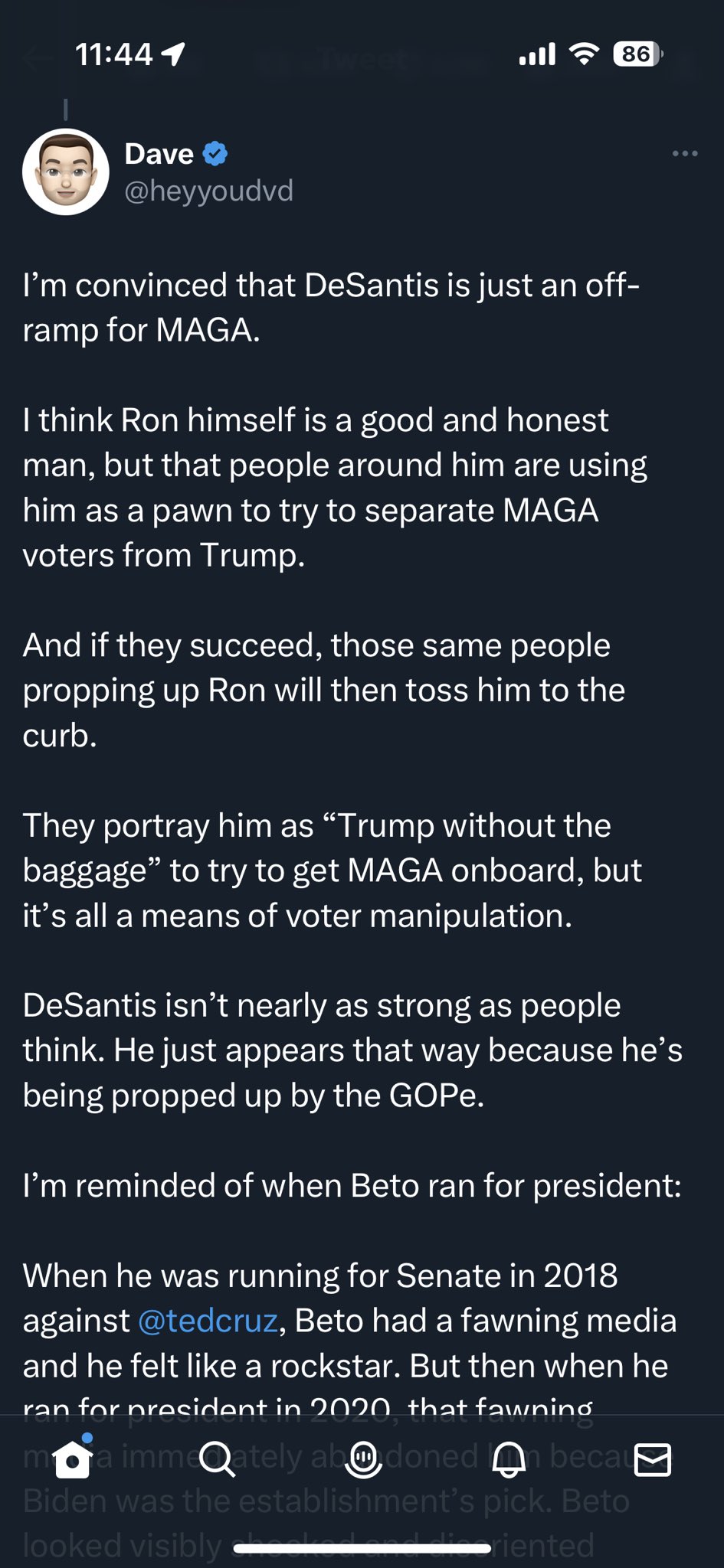
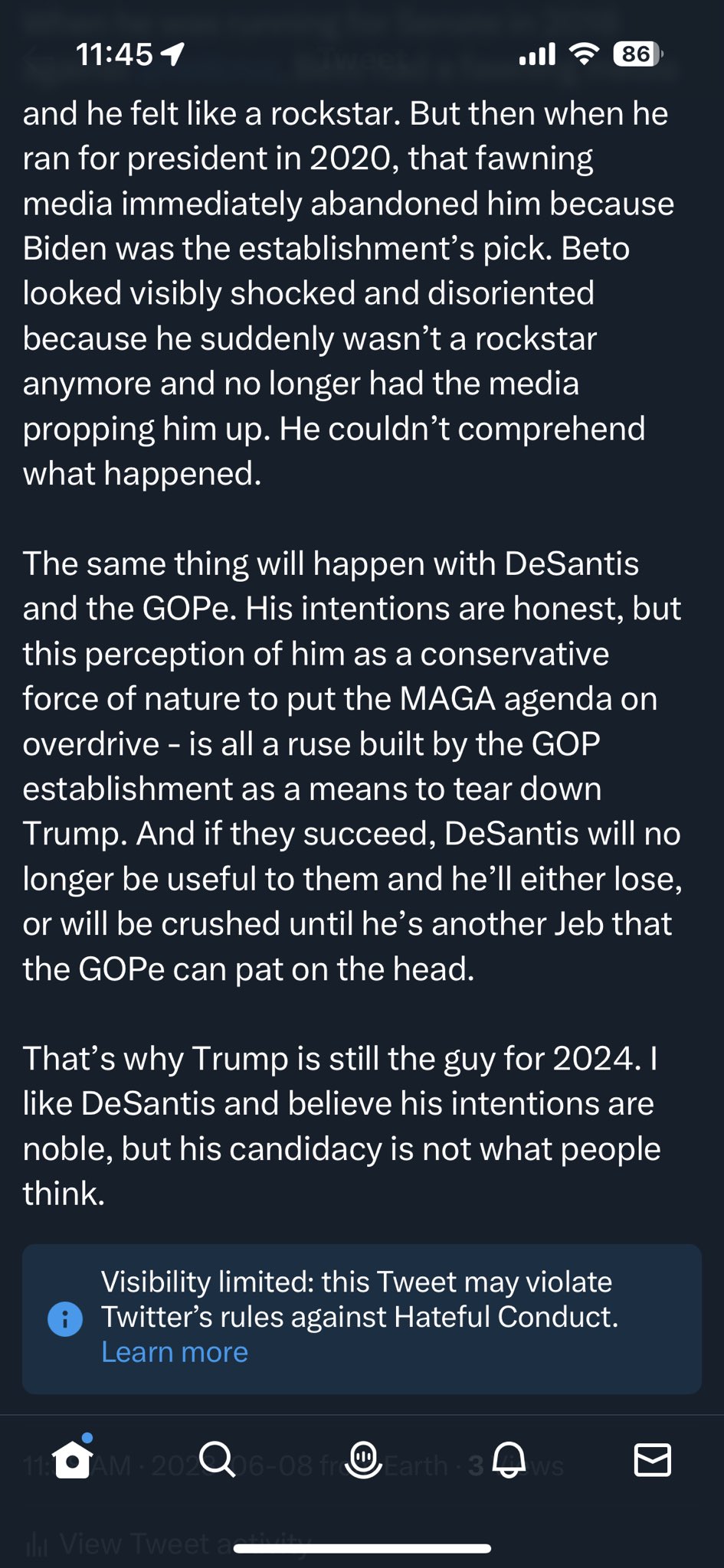
As Expected Twitter Begins Limiting Reach of Content Critical of Ron DeSantis


Posted originally on the CTH on June 8, 2023 | Sundance 

Everything is connected to the economics and financials of the thing.  This is the one guiding truth that underlines every curiosity of human nature.  If you want to understand behavior, follow the money.

An example surfaces today [SOURCE HERE] highlighting the background hands of those who seek to control public opinion.  This is the psychological operation that we see through every mechanism under the command and control of interests who have vested financial stakes.  Notice the disclaimer.:

“Visibility limited: this Tweet may violate Twitter’s rules against Hateful Conduct”

Yeah, we can’t have people sharing honest, albeit softly critical, opinion of Ron DeSantis because they become a threat – ergo, hateful conduct.

Comrade, wrong thoughts require reeducation.  In the bigger picture, this is all part of the control mechanisms operating to influence the 2024 election.  And yes, Elon Musk is very much a part of it just like the DHS operatives that controlled the platform before he arrived.

I am not going to spend time dwelling on it, but I am going to keep pointing out the strings on the puppets so that more people start to see them.  Once you see the strings on the marionettes, you cannot watch the performance and simultaneously return your brain to that moment in time before you noticed them.

Damnit Sundance! But, muh conspiracy or something. lol

The MAGA movement is one giant ‘red pill’ distribution operation.

New York Times Gains Insider Information on Twitter Revenue, Expanded Financials Look Worse Than Former Estimates


Posted originally on the CTH on June 5, 2023 | Sundance 

The New York Times has gained insider information on the current advertising revenue for the social media platform Twitter. [Article Here]  Ignoring the nonsense narrative engineering and just focusing on the data itself, the revenue side for Twitter is half what we previously estimated.  This makes the overlay for decisions on platform content even more stark.

According to the data, ad revenue for the month of April was a lackluster $88 million.  That’s a pace of just over $1 billion a year.  With a pre-Musk operating expense of $4.5 billion, and pre-Musk revenue at $4 billion cited by the Twitter owner as the backdrop, here’s the outlook.

Assuming post Musk labor cost reductions saved $500 million, a decline in revenue to $1 billion/yr would be a $3.0 billion deficit, to wit you would need to add the $1.5 billion in debt service as part of the investor buyout structure.

That puts Twitter into a $4.5 billion loss ballpark per year.

This is the high end of what Musk previously estimated in public statements.  Now we see why.

(New York Times) – Twitter’s U.S. advertising revenue for the five weeks from April 1 to the first week of May was $88 million, down 59 percent from a year earlier, according to an internal presentation obtained by The New York Times.  (read more)

$1 billion per year in advertising revenue is a whopping 75% loss from the claimed $4 billion in revenue before the Musk purchase.  Perhaps the Fidelity estimate of company value at $15 billion is closer to reality.

If the value of Twitter has dropped to the $15 billion level, that means almost all of the $30 billion in personal equity Musk put into the company has been lost.

Current investor debt is $12.5 billion, with $1.5 billion in debt service/yr. A valuation of $15 billion would only leave Musk with around $2.5 billion in equity position.  If the valuation is accurate, Musk personally would have lost around $27.5 billion in this Twitter platform purchase.

The last time I outlined the Twitter financial position, several people took exception to the data as shared.  However, the data is from Elon Musk himself, and I will again post the video at the bottom of the article.

Revenue is now Elon Musk’s #1 priority.  All other platform decisions are going through the prism of financial viability.

Twitter CEO Elon Musk has provided some convincing commentary about his willingness to forgo revenue in order to retain “free speech.” However, more recently he has qualified that outlook by saying, “Freedom of speech is not the same as freedom of reach.”  Musk noting Twitter will block, remove, censor, shadow ban, deboost, downrank and stop content from amplifying based on the determination of those in charge of Twitter content.

This controlled “freedom of reach” perspective, which is really shadow-banning in practice, is generally accepted and now admitted.  Against this backdrop, it becomes important to understand the priorities of the platform to understand the guidelines of the platform.  Within this context the financials are key to understanding what elements are included within “approved content.” {GO DEEP}

Twitter is now a private company, therefore understanding the financials of Twitter is a little more challenging than when they were required to post their financial statements publicly.  However, Elon Musk gave an interview with the Babylon Bee yesterday and revealed some of the internal financial challenges. [VIDEO HERE]  I am going to summarize the status of the Twitter financial position according to what Musk himself revealed.

♦ Twitter was initially purchased by Musk and his investors for around $44 billion.  The company now estimates its value around $20 billion. Last week, the mutual funds giant Fidelity, which owns shares in Twitter, valued the company at $15 billion. Bottom line, Musk grossly overpaid.

♦ Musk put roughly $30 billions of his own net worth into the purchase and financed the rest.

♦ Current outstanding debt on the financing for the purchase is around $12.5 billion. Per Musk statement.

♦ Current debt service, interest on the loans (from investors), is roughly $1.5 billion/yr.  $120.5 million per month for debt service.  Per Musk statement.

♦ Previous revenue (when public) was roughly $4 billion/yr.  Twitter was generally breaking even.

♦ Advertising revenue, as a result of changes in industry in combination with concerns about Twitter, are “half” what they were during the acquisition phase, per Musk statement.  That puts current advertising revenue around $2 billion/yr. Per NYT report that’s now $1 billion/yr.

♦ Per conversation, current status of Twitter is -$3 billion/yr and could be as high as -$4 to 5 billion/yr.

The NYT revenue leak now makes the top side of this scale make sense.  If $4 billion in revenue was generally the breakeven point (before acquisition), and now they have $2 billion $1 billion in revenue and $1.5 billion in additional debt service [as they trim operational costs (including labor) to offset].

♦♦ For the bottom line to be an operational loss of $3 to $5 billion (est) per year, Twitter is generally losing around $300 million per month.

♦ There is only so much Tesla stock Musk can sell to support Twitter.  He has limits. Per conversation.

♦ Twitter has around $1 billion in liquid cash available. Per conversation.  With a burn rate of $300+ million a month.

Twitter is in locked contracts with AWS and Google cloud services through 2025 at roughly $300 million per year for both [AWS $100 million, Goog $200 million].

Twitter Blue subscriptions are around 180,000 users, paying $11/mo.  That’s around $2 million a month; pittance in comparison to what he needs.

There’s your prism for platform content!

Elon Musk needs revenue desperately.

Twitter urgently needs advertising revenue.

Without revenue or acquisition of another platform (with assets) to offset the current status of Twitter, it is only a matter of time before some form of bankruptcy.   [Note, Twitter investors are backstopped with Tesla/SpaceX as collateral against default.]

The tightrope… Elon Musk must appease the Google advertising control agents and adhere to content rules and regulation (DEI etc.) in order to maximize his revenue.  That’s where Linda Yaccarino comes in as a critical player.

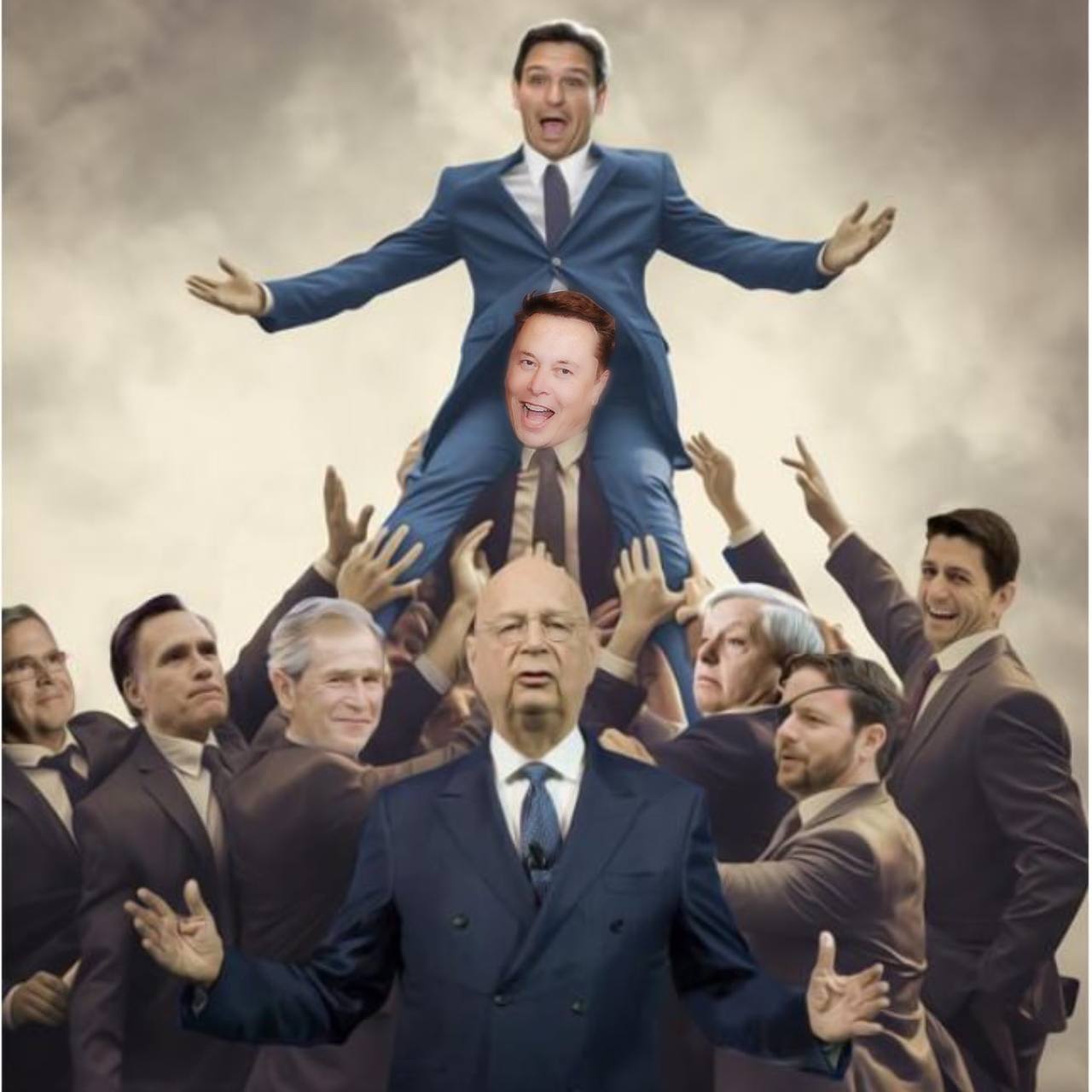
Bottom line, Musk has to make decisions through one prism, THE ECONOMICS.  Musk’s decision-making, pro freedom or not, is constrained by this financial dependency. Hence, a lot of the platform censorship elements remain (including some personnel) and now the outreach to appoint Google/WEF approved Linda Yaccarino in an effort to enhance the revenue.

When you are perplexed about Musk decision making….  THERE’S YOUR ANSWER.

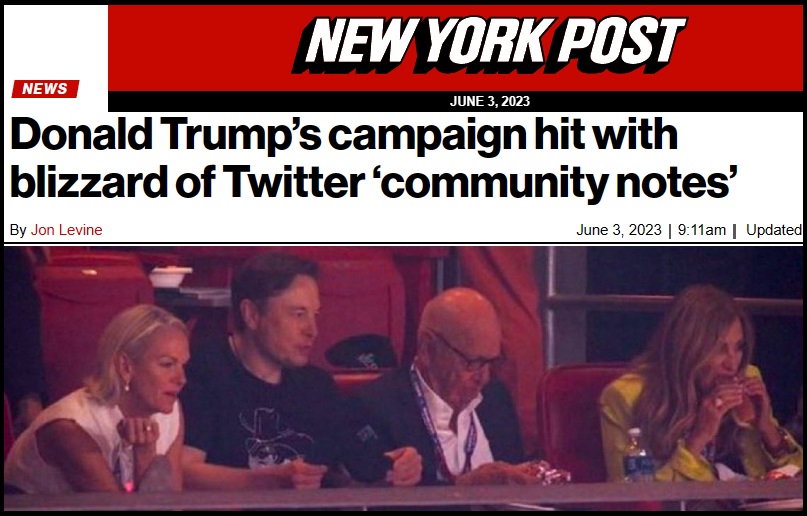
The recent relationship between Elon Musk and the Rupert Murdoch media enterprise, now makes even more sense.

Musk discusses the financials: