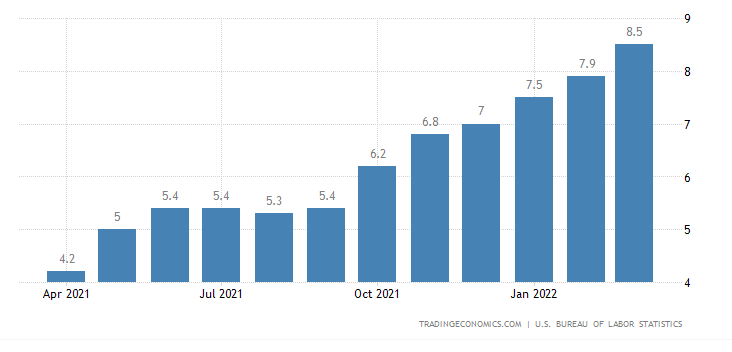
The Consumer Price Index soared 8.5% in March year-on-year, according to the report released by the Labor Department on Tuesday. Prices have not been this inflated since Reagan was in power in December 1981.
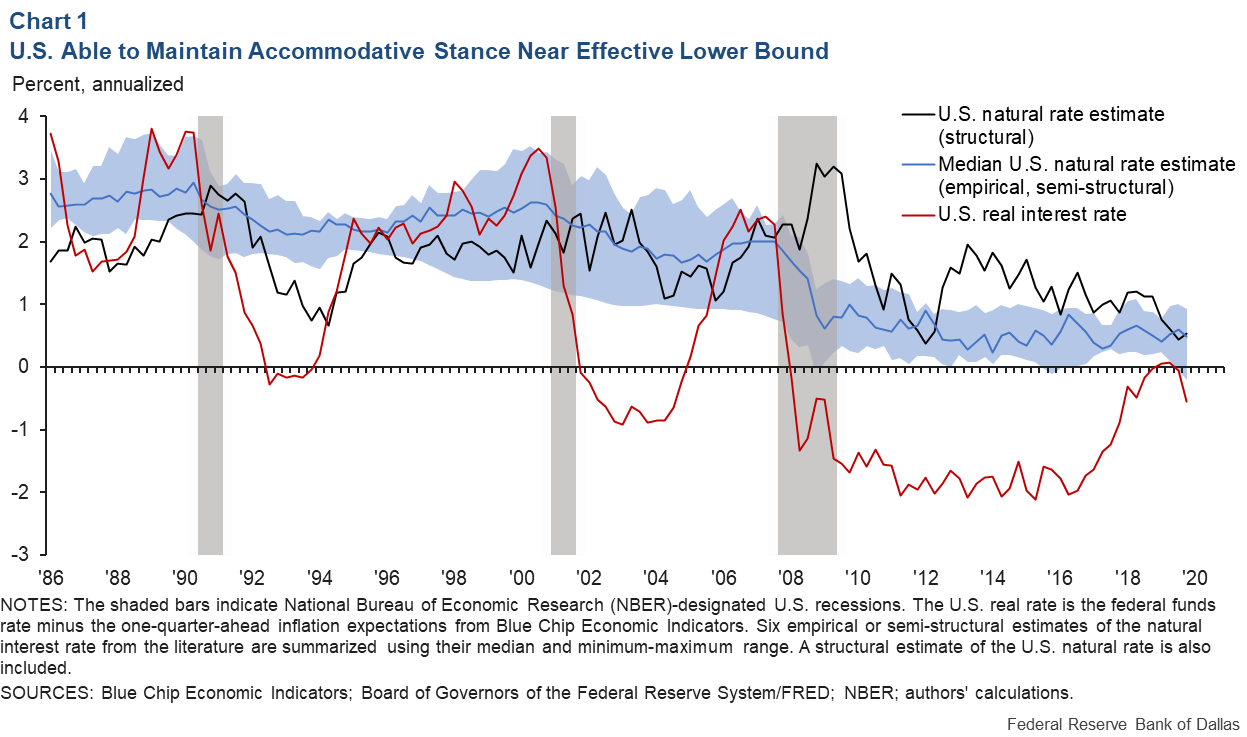
Former Fed Chair Ben Bernanke set the target level of inflation at 2% back in 2012. Once the Federal Reserve began pursuing a 2% level of inflation in 2012, that standard was soon set as the target for numerous central banks across the world. This all changed when the world collectively agreed to stop spinning for the coronavirus. As you can see, median inflation in the US was declining prior to 2020.
The 2% level remained in place for some time until they realized that inflation was not “transitory” and artificially low rates had diminished the central bank’s ability to control the situation. Guidelines and restrictions were lifted chaotically. The US government continued to spiral into debt by adopting new socialistic spending programs. Unemployment levels are just now recovering three years later, but the damage from COVID cannot be ignored. While wages are increasing, inflation has reached such an unsustainable level that everyone’s buying power has decreased.
By August of 2020, the Federal Reserve carefully changed its language:
“Notably, the Fed changed its language on inflation, replacing its 2 percent inflation target commitment, and instead said it will “[seek] to achieve inflation that averages 2 percent over time.”
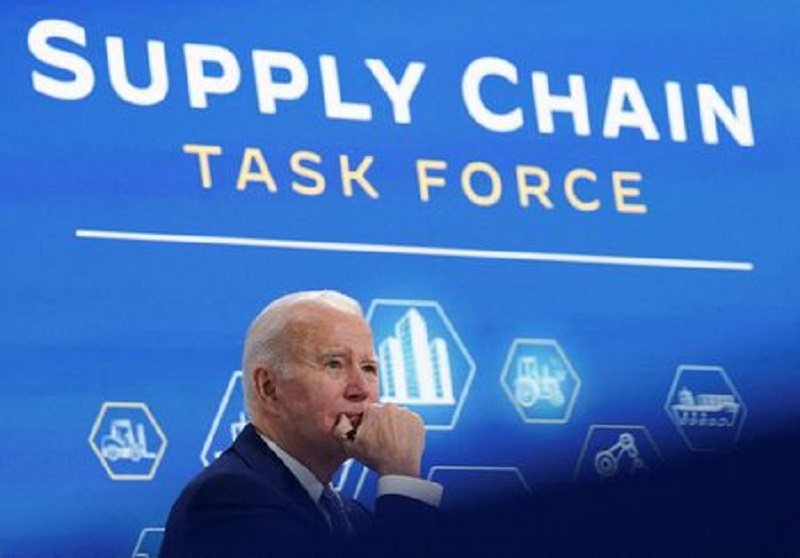
Inflation made a notable uptick in April 2021 (4.2%) at a pace not seen since the Great Recession. By the end of Q4 2021, Chairman Powell admitted inflation was not “transitory,” and underplayed the situation that would unfold. We are now in the midst of a supply chain crisis, energy crisis, and wage-price spiral. Every variable of this situation contributes to inflation on top of a government that does not take measures to address any crisis.
White House Press Secretary Jen Psaki tried to do damage control a day before the report was released. “We expect March CPI headline inflation to be extraordinarily elevated due to Putin’s price hike,” Psaki said. The numbers do not lie. Inflation was on the rise well before Putin engaged with Ukraine. Government and central bank mismanagement have caused the current situation. Powell admitted they should have moved a bit quicker, but Biden remains wholly unaware of the problem and continues to worsen matters with his policies that are intended to destroy America before Build[ing] Back Better.
Posted originally on the conservative tree house on April 12, 2022 | Sundance
I want to be very careful here, because multiple people have sent me a version of this outline asking for opinion. Basically, is David Friedberg correct?
The discussion in this video surrounds farming as a construct of global caloric creation. Meaning, with all that is taking place in the farming system on a global scale, will there be dramatic food shortages? It is a complex issue. In the larger picture what Friedberg, a former scientist within the Monsanto organization, explains is accurate; however, I would inject some nuanced dissension as it relates to U.S. farm production specifically.
The first four and a half minutes of the video are an accurate representation of the global state of farming, albeit with a little too much weight on the Ukraine-Russia aspect. There was a preexisting issue long before Russia entered the picture. The price of fertilizer was already skyrocketing, Russia-Ukraine has made that already looming issue, worse. WATCH First 04:30 minutes:
The problem described, about farmers deciding not to plant, is weighted more heavily in less developed countries where access to the financing for a future crop is not stable {AP Article Here}. For most of the developed world farming will continue; it is the end product where prices will reflect the additional costs of bringing a harvest to market. Bottom line, as the futures market is showing, crops will be more expensive.
There is going to be a problem in the same areas of the world where food stability and dependency is already an issue. Yes, the convergence of current farm challenges will make those areas more vulnerable. We do not know, to what extent.
The notation about a 90-day supply of food on a global basis (Northern Hemisphere) is slightly askew, as countries like the United States have a much deeper reserve and storage capacity. We discussed this last year {Go Deep}.
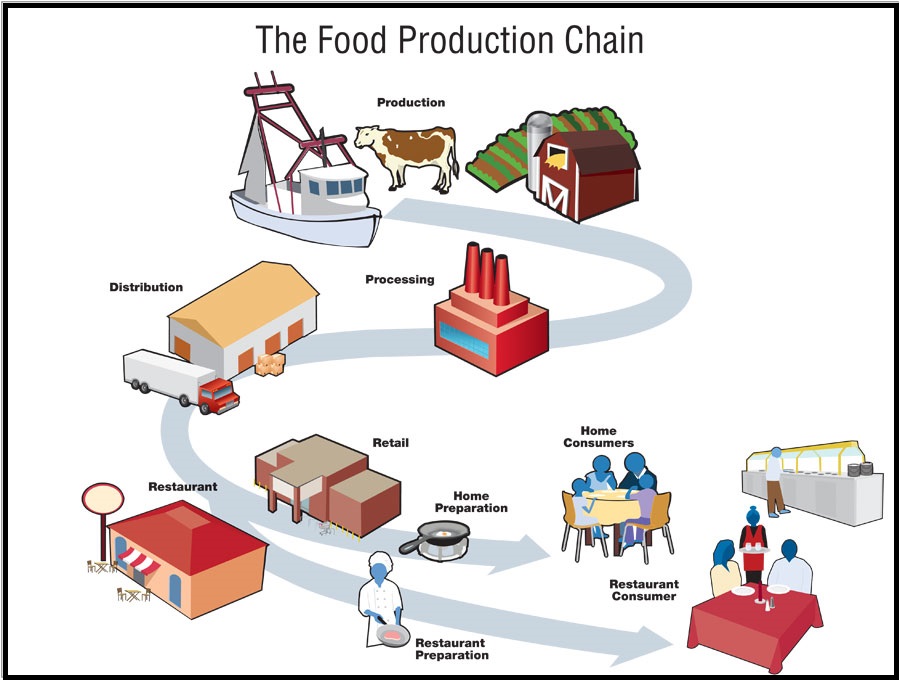
Essentially, in the U.S. we operate approximately one full harvest cycle ahead of demand. However, our problem is the COVID lockdowns in 2020 and 2021 disrupted the two food delivery systems by shutting down restaurants, cafeterias, hotels, hospitality venues, entertainment, school lunchrooms etc and limiting capacity for six months. The government intervention seriously messed up our food supply chain. {Go Deep}
In North America I do not foresee any major scarcity of total food availability, certainly not in the fresh food supply side. There may be shortages on specific segments within the processed and manufactured food supply chain, but those would be nuanced based on specific ingredient issues.
What we will see is continued increases in price and a demand for U.S. agricultural products to fill the voids in global markets that result from less developed nations needing the products our North American farming experts can deliver. There will be a higher demand for us to export food materials, and when combined with the already increased cost for the harvest, that means much higher prices still coming.
Our North American farmers are awesome in their ability to maximize yield, with the customary and appropriate qualifier that ultimately mother nature will determine success or failure. Our U.S. and Canadian farmers and ranchers are the best of the best. Their ability to feed our nation is a national and strategic advantage, unparalleled in any other region. They know how to do it, if the government will just get out of the way and let them work.
If it was a priority for the U.S. government to ensure U.S. food stability, they could spend a few billion by securing fertilizer and reasonably priced energy (diesel) for our farmers, simply to offset the upfront and increased production costs. Then, just turn North America loose, pray a little bit, and let them create as much product as possible for the overall market. Let the market demand determine the crop, and get government out of their business.
Farmers in the U.S, Mexico and Canada have the capacity to drive higher yields. Unfortunately, the politics of war, Wall Street – and the influence of the international banking system – takes a higher priority for DC than simple farming commonsense. Unfortunately, as we saw today, turning corn into gasoline additive just exemplifies the stupidity of the DC mindset.
On one hand, we have serious people concerned about global famine. On the other hand, we have a narcissistic occupant of the oval office, and a tribe of DC idiots worried about gasoline prices and the mid-term election. These issues do not have to be mutually exclusive, and there is a reasonable solution for both of them. However, all that reasonableness evaporates once the people behind a fraudulently elected DC politician walk in the room.
Will there be a dangerous level of food shortage globally? Yes
Will there be a dangerous level of food shortage in North America? No, but there may be some scarcity.
Will there be higher prices? Absolutely.
Unleash the farmers and unleash the energy experts and all of this maddening anxiety ends. Unfortunately, those actions are adverse to the Build Back Better agenda.
We are in an abusive relationship with our government.
I have created this site to help people have fun in the kitchen. I write about enjoying life both in and out of my kitchen. Life is short! Make the most of it and enjoy!
This is a library of News Events not reported by the Main Stream Media documenting & connecting the dots on How the Obama Marxist Liberal agenda is destroying America

 Centinel2012