Another painful week as the Dept. of Laborprovides the latest data on jobs and the economy. For the week ending April 18, an additional 4.427 million Americans filed unemployment claims.
Over the past five weeks, more than 26 million Americans have filed unemployment insurance claims.
“Today’s unemployment report shows continued, elevated unemployment claims caused by the coronavirus pandemic. The Department of Labor is continuing to provide guidance and support to the States as they implement the enhanced unemployment benefits under the CARES Act, with 44 States now paying the $600 additional weekly benefit provided by the Act.”
“The Department also continues to implement the paid leave requirements of the Families First Coronavirus Response Act, and has now initiated hundreds of cases to ensure workers receive what they’re entitled to under the law. As American businesses look to open up again under the guidelines presented by the White House last week, the Department’s Occupational Safety and Health Administration will continue to provide guidance and support to protect workers and ensure safe workplaces, backed up as necessary by appropriate use of OSHA’s enforcement authorities.” (LINK)
Comrades, after the Meridian cornavirus enforcement police received several calls from compliant citizens, a dangerous group of subversive moms were identified engaging in non-approved playground activity against the interests of the state. Local authorities activated an emergency response task force & arrested the lead scofflaw mom at the park.
According to video smuggled from the park by an underground network of rebellious female breeders, Mrs. Sarah Brady was instructed by the COVID-19 compliance officers to vacate the playground. Ms. Brady refused to comply with the order and was subsequently handcuffed and arrested for violations of the state lock-down, ie. misdemeanor trespassing.
IDAHO – Meridian officers made several attempts to help BRADY adhere to the rules. She was non-compliant and forced officers to place her under arrest to resolve the issue. She was arrested for trespassing.
These are very trying times and the Meridian Police Department supports the public’s right to assemble for peaceful protest, however the right does not include damaging public property or ignoring closures of City property and facilities (link)
The brave officers of Idaho law enforcement and coronavirus compliance put their lives on the line to capture this outlaw. However, the fate of the world hangs in the balance, and the Meridian police are thankful for compliant citizens who used the tip-line to notify the task-force of this threatening and subversive activity.
Fortunately, this time the thin-blue-line was able to overcome the resistance and suppress the rebellion; but this example should remind us all it takes the entire village to stay alert & report these dangerous scofflaws immediately.
All rogue citizens must be contained, especially the breeders, lest they put our compliant society at risk of infection. Playground moms are some of the most dangerous and subversive elements within our society; some even carry the potential for home-schooling.
Breeding citizens are a big concern, they may not just carry biologics they could possibly carry a more alarming virus of wrong-thought, potentially even perspectives on freedom, against the interests of the state.
During these stressful times any wrong-thought, without regard for our collective need, is an indication a breeder citizen may be a subversive. Rogue citizens would be subversive to our new society and must be controlled with extreme mitigation efforts.
The COVID Compliance Ministry appreciates good citizens who comply with the interests of the state. Good citizenship is rewarded with enhanced credits allowing access to a safe COVID Compliant Society. A safer society; where the odds will always be in your favor.
Meridian Police Dept@PoliceMeridian
Media Release: Meridian Police Arrest Woman for Violating City Orders http://nixle.us/BSGHY
Media Release: Meridian Police Arrest Woman for Violating City Orders from Meridian Police Depart…
MERIDIAN POLICE DEPARTMENT MEDIA RELEASE: Tuesday, April 21, 2020 CONTACT: Stephany Galbreaith, Public Safety PIO, 208-830-8100 or sgalbreaith@meridiancity.org Meridian Police Arrest Woman …
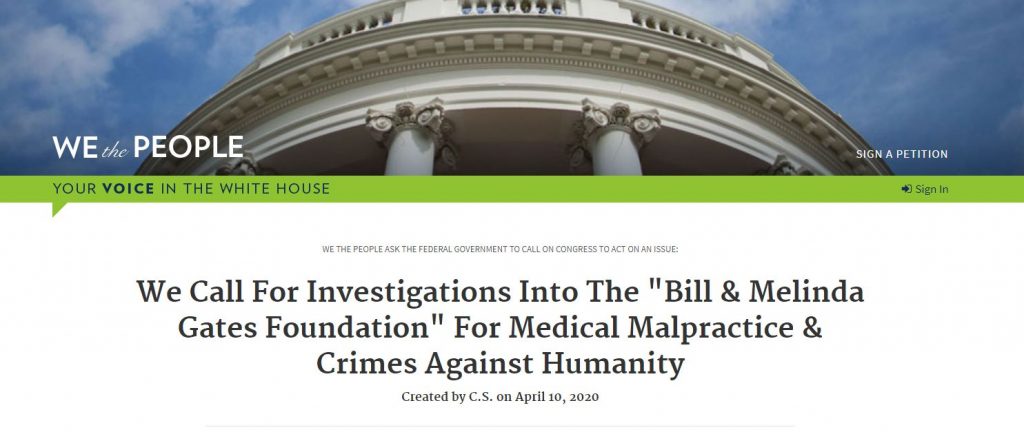
A petition to the White House calling for an investigation into Bill & Melinda Gate Foundation is absolutely NECESSARY!!!! Gates has taken a high profile on this demanding we remain locked down until everyone is vaccinated as he said on German TV. Even the CDC admits that the flu vaccine is at best 60% effective. Clearly, what Gates has been pushing would not be 100% guarantee either and then the flu vaccine has to be changed every year because viruses mutate.
Everyone whose business has been harmed by this lockdown should sign this petition. Perhaps if enough people do so, Trump will see that this can even become a campaign issue and that alone would give any politicians ammunition for the political battle.
I disparage, disapprove and condemn mankind’s blatant double-standard, which has us, on the one hand, joining-in together to defend the species against a common enemy, and, on the other hand, continue with our untroubled approval to kill each other
For some of us, the word “statistics”, brings back memories of our college days, when we were forcefully required to deal with this occult science – one which I, sooner than later, found to be a rather valuable tool used in collecting, organizing, analyzing and interpreting data in rather meaningful quantitative forms. Matter of fact, I venture to say, statistics are intimately entwined in our lives as a means of evaluating the present and forecasting the future.
Given its obvious usefulness, I personally have remained an avid practitioner of this applied science throughout my life while exploiting its infinite value, albeit as intended today, putting it to good use relative to its common-sense practicality when analyzing this Coronavirus /COVID-19 pandemic.
The moment I started my analysis, I came across some rather revealing occurrences. The first lesson I learned was that the average world-wide mortality rate is compiled in what is known as ‘crude death rate’, typically interpreted as number of deaths per 1000 inhabitants in a population. In 2020, the CIA estimates the U.S. crude death rate will be 8.3 per 1000, a tad higher than the world global rate of 7.7 per 1000. Translated into real numbers, we conclude that the yearly world-wide death-toll today is of approximately some 60+ million people, of which 2+ million pertain to the U.S.
Next, I learned that the leading causes of death in the U.S. were Heart Disease, closely followed by Cancer and Accidents. These 3 causes alone account for approximately 1.4 million or 68.1% deaths in the nation every year. Compare this number to the number of Coronavirus / COVID-19 deaths reported thus far as of Monday, April 13th, 23,462 were in the United States.
When I first wrote this piece, I set out to do a comparative analysis of the Coronavirus / COVID-19 pandemic relative to other mortality statistics, only to find some revealing and much unexpected results. Considering the fact that the world-wide Coronavirus fatalities reported thus far of 119,091 and 23,462 in the U.S. took place during a short-span within the last four months, to wit, between January and April of this year, and, for the sake of parity, comparing “pears with pears and apples with apples,” in my comparative model, I made an allowance which presumes, hopefully not, there will be an equal number of deaths in the remaining 3 quarters of 2020. That is, for comparative purposes, I am projecting a death-toll from the Coronavirus Pandemic of approximately 350,000+ people world-wide, and 70,000+ here in the U.S., throughout the rest of 2020.
Were this the case and if I am right, mind you, the number of Coronavirus deaths would be equivalent to a rather low 0.6% of the total yearly world-wide deaths of 60+ million, and for the U.S., the projected 70,000 would be equivalent to 3.5%. Tell you the truth, I was utterly surprised and at the same time thrilled to find how low these percentages were relatively low as compared to the state of disruption ensuing from the pandemic.
I was further amazed by the fact that this 3.5% compared much lower to other causes of death in the nation such as Heart Disease with 31.1%, Cancer with 28.8%, Accidents with 8.2%, Respiratory Diseases with 7.7%, Strokes with 7.0%, Alzheimer with 5.8% and Diabetes with 4.0%. In the same comparison table, I couldn’t help but notice that my Coronavirus projected deaths only compared to deaths caused by Influenza, Nephritis and Suicides.
My next comparison was to the number of people that have been killed in wars throughout history, which historians have it as high, ranging up to 1 billion people. Add another 60.9 million killed by human Genocides, and it will give you a death toll averaging 500,000 people every year over a span of 2,166 years since 146 BC. We can then conclude that mankind’s wars and genocides have been approximately 28.5% higher than the projected world-wide deaths resulting form the Coronavirus. Here again, the projected number of Coronavirus deaths is considerably lower than people dying in man-made wars and genocides.
In my comparative tour, I purposely left for last, the one statistic closest to my heart and that is a comparative analysis of deaths caused by Communism as compared to the Coronavirus / COVID-19 pandemic. While the number of deaths attributed to Communism varies greatly, according to one the most trusted sources on the subject, R. J. Rummel, in his book Death by Government (1994), there were approximately 110 million people killed by Communist democide from 1900 to 1987 – the term “democide” defined by Rummel as ‘the intentional killing of an unarmed or disarmed person by government agents in their authoritative capacity and pursuant to government policy or high command.”
So, in essence, you can say the Communists have killed an average of 1.2 million people per year in 87 years. So, if I take all these comparative statistics into consideration, I can’t help but come to some rather obvious conclusions, the first one being a refreshing realization that the number of deaths resulting from this Coronavirus pandemic are not anywhere nearly as high as we have made them out to be – that is, as compared to the magnanimous state of preparedness and disruption of our lives, such as that we have been experiencing. In my humble opinion the death threat has been somewhat gently over-stated.
My next observation deals the rather overt double-standard afflicting mankind relative to our state of collective hysteria that has resulted from the Coronavirus pandemic as compared to the avertible deaths that result year-in and year-out from man-made wars and genocides. Before I go on, however, let me just clarify something before you pass judgment on me prematurely. I am not, by any stretch of the imagination, underestimating the deadly threat posed by the Coronavirus pandemic. But I am, on the other hand, questioning our collective madness in hedging the virus as compared to our copacetic approval to kill each other in wars and genocides.
In summary my dear friends, I do acclaim, approve and applaud the way the world, as a whole, has quickly reacted to the threats posed by this pandemic attack, more so, the way that our president, Donald Trump and his administration have swiftly handled the crisis, possibly avoiding many more deaths in the nation. By the same token, I disparage, disapprove and condemn mankind’s blatant double-standard, which has us, on the one hand, joining-in together to defend the species against a common enemy, and, on the other hand, continue with our untroubled approval to kill each other through our wars and genocides. May God save us and may God save the United States of America.
Unfortunately, with President Trump effectively communicating the latest information on the federal efforts to mitigate COVID-19, more corporate U.S. resistance media have decided not to carry the live broadcasts from the White House task force briefings.
Today at 5:00pm ET the White House will hold a briefing for the public and media on the latest mitigation efforts against the coronavirus. [Livestream Links Below]
Things are getting interesting, potential ramifications are growing, as the FISA Court responds to the latest information from the DOJ Office of Inspector General (OIG).
After a review of 29 FISA applications, from eight FBI field offices, the OIG informed the FBI and DOJ that none of the surveillance applications were compliant with the Woods procedures. Meaning zero applications had FBI evidence to support the validity of the claims within the FISA warrants. That’s a very big problem if those FISA warrants were used to gather evidence used to prosecute the 29 targets of the applications.
In a FISC order released today [pdf here] presiding Judge James Boasberg is ordering the FBI to identify who those targets were; and asking the DOJ to explain what they did with the evidence gathered as a result of the fraudulently obtained FISA warrants. Big.
If evidence obtained by execution of a fraudulently obtained warrant was used in the prosecution of any of those targets; there’s a possibility those cases will be reopened.
Considering the twenty nine applications from the OIG go back to 2015, there’s a lot of potential for some downstream consequences not only for those 29 applications, but also for all FBI FISA applications with a similar level of neglect.
In the issue of the Carter Page application the DOJ and FBI were already looking into how far the ripple effects carried. The FBI was already undertaking a ‘sequestration effort’ to identify the fruit of the poisonous tree; and the results are still unknown.
This order from Judge Boasberg essentially expands that type of review upon another 29 applications and demands the DOJ identify to the court who were the targets. The court can then, on their own, look and see if any of those U.S. persons were prosecuted in court.
BACKSTORY – The OIG began reviewing FISA applications from eight field offices (the proverbial “rank and file”). The OIG selected 29 FISA applications from those field offices over the period of October 2014 to September 2019. Additionally, every field office and the DOJ-NSD generate internal “Accuracy Reviews”, or self-checks on FISA applications; so the OIG inspected 42 of the accuracy review FISA files to determine if they were compliant.
The results were so bad the IG produced an interim memorandum to the DOJ and FBI [pdf link here]. Within the 17-page-memo the IG notifies Attorney General Bill Barr and FBI Director Chris Wray that all of the claimed FISA processes, in every field office, are grossly deficient, and in most cases there is zero compliance with FISA standards. The IG memorandum is presented before the IG even looks at the specifics of the non-compliance.
Below is the report/memorandum. Additionally I am summarizing the stunning top-lines identified by the IG memo:
The IG reviewed 29 FISA applications, surveillance warrants, used against U.S. persons.
The 29 FISA applications were from eight different field offices.
The FISA applications were from Oct/2014 through Sept/2019.
All of the FISA applications reviewed were approved by the FISA court.
The ‘Woods File’ is the mandatory FBI evidence file that contains the documentary proof to verify all statements against U.S. persons that are contained in the FISA application. Remember, this is a secret court, the FISA applications result in secret surveillance and wiretaps against U.S. persons outside the fourth amendment.
♦ Within the 29 FISA applications reviewed, four were completely missing the Woods File. Meaning there was zero supportive evidence for any of the FBI claims against U.S. persons underpinning the FISA application. [ie. The FBI just made stuff up]
♦ Of the remaining 25 FISA applications, 100% of them, all of them, were materially deficient on the woods file requirement; and the average number of deficiencies per file was 20. Meaning an average of twenty direct statements against the target, supporting the purpose of the FISA application, sworn by the FBI affiant, were unsubstantiated. [The low was 5, the high was 63, the average per file was 20]
♦ Half of the FISA applications reviewed used Confidential Human Sources (CHS’s). The memo outlines that “many” of applications containing CHS claims had no supportive documentation attesting to the dependability of the CHS.
♦ Two of the 25 FISA applications reviewed had renewals; meaning the FISA applications were renewed to extended surveillance, wiretaps, etc. beyond the initial 90-days. None of the renewals had any re-verification. Both FISAs that used renewals were not compliant.
But wait… it gets worse.
The DOJ and FBI have an internal self-check mechanism. The DOJ National Security Division (DOJ-NSD) chief counsel, and the chief counsel for every FBI field office are required to conduct an “Accuracy Review” of selected FISA applications. One per field office (25 to 30 field offices),which are also sent to DOJ-NSD (main justice) for general counsel inspection.
Keep in mind, these “accuracy reviews” are known in advance, so the FBI has all the time in the world to select the best FISA file for review. Additionally, I surmise the OIG wanted to inspect the “accuracy review” FISA’s because they would show the best light on the overall system itself. The OIG was looking for the best, most compliant, product to report on.
However, when the OIG inspected 42 of these Accuracy Reviews, the IG identified that only three of them had accurately assembled documents (Woods File) supporting the application. The error rate within the files self-checked was over 93%.
So the best FBI files are selected to undergo the FBI and DOJ-NSD accuracy review. The accuracy review takes place by FBI legal counsel and DOJ-NSD legal counsel. However, the IG finds that only three FBI applications in the accuracy reviews were compliant.
The error rate in the files undertaken by the internal accuracy review was over 93% (3 compliant out of 42 reviewed). These were the FISA files with the greatest possibility of being accurate. Let that sink in…
The always political Senate Minority Leader Chuck Schumer sent a letter to President Trump today saying it was “long past the time” to name a senior military officer to lead the supply-chain effort.
Senator Schumer was attempting to construct a political narrative around the administration not taking action to secure U.S. supply needs combating COVID-19.
The letter was/is ridiculous; and built upon an entirely false premise; because Admiral John Polowczyk is already in that supply-chain procurement and distribution position working closely with Peter Navarro after the invocation of the Defense Production Act.
Replying to the ridiculous Schumer letter, President Trump calls out his stupidity:
This letter follows a tweet earlier in the day calling out Chuck Schumer for being a political idiot.
The ADP payroll report shows a drop of 27,000 jobs, better than the forecast drop of 125,000; but many fear the worst is yet to come as millions of people file unemployment claims as a result of the coronavirus shut-down.
A big unknown question surrounds the number of employees that businesses will attempt to keep on the payroll through use of the coronavirus relief funds passed by congress.
The ADP period in the latest report ran through March 12th. Within that data Goods-producers lost 9K jobs while Services were down twice that much. Small businesses (fewer than 50 employees) were the hardest hit, shedding 90K positions last month; while Large businesses (greater than 500 employees) actually gained 56K jobs; and Medium-sized businesses grew 7K through the March 12th period.
The big question surrounds how quickly small businesses can access the federal relief funds; and whether those businesses will use the incentives to retain their workers.
Associated Press – […] We get a peek at what we might expect in future employment reports — both tomorrow’s Initial Jobless Claims and Friday’s non-farm payrolls, as well as the next few months of employment data — when we look at the ADP breakdown by sector: Trade/Transport lost 37K jobs in March, Construction was down 16K and Leisure/Hospitality -11K.
On the other hand, Education/Health Services grew by 48K positions, pretty much in-line with months past. And if there is one sector in high demand at the moment for treating the coronavirus wave, it is in Healthcare.
In fact, places like Amazon AMZN are likely to hire an increased workforce as more and more commerce is conducted via home computer and home delivery.
Pharmaceutical companies taking an aggressive stance against COVID-19 and searching for treatments and a vaccine, such as Johnson & Johnson JNJ and Gilead GILD, may also bolster the employment situation, near-to-medium term. But these are sector-specific green shoots; most areas will see massive depletions of workforce. (read more)
U.S. Treasury Secretary Steven Mnuchin has announced that small businesses (0 to 500 employees) and sole proprietorships can start applying for the coronavirus relief funds on April 3rd. One week later, April 10th, self-employed individuals, 1099 contractors and s-corps can apply. [Visit SBA.gov/coronavirus]
WASHINGTON – Following President Trump’s signing of the historic Coronavirus Aid, Relief, and Economic Security (CARES) Act, SBA Administrator Jovita Carranza and Treasury Secretary Steven T. Mnuchin today announced that the SBA and Treasury Department have initiated a robust mobilization effort of banks and other lending institutions to provide small businesses with the capital they need.
The CARES Act establishes a new $349 billion Paycheck Protection Program. The Program will provide much-needed relief to millions of small businesses so they can sustain their businesses and keep their workers employed.
“This legislation provides small business job retention loans to provide eight weeks of payroll and certain overhead to keep workers employed,” said Secretary Mnuchin.
“Treasury and the Small Business Administration expect to have this program up and running by April 3rd so that businesses can go to a participating SBA 7(a) lender, bank, or credit union, apply for a loan, and be approved on the same day. The loans will be forgiven as long as the funds are used to keep employees on the payroll and for certain other expenses.”
“This unprecedented public-private partnership is going to assist small businesses with accessing capital quickly. Our goal is to position lenders as the single point-of-contact for small businesses – the application, loan processing, and disbursement of funds will all be administered at the community level,” said Administrator Carranza.
“Speed is the operative word; applications for the emergency capital can begin as early as this week, with lenders using their own systems and processes to make these loans. We remain committed to supporting our nation’s more than 30 million small businesses and their employees, so that they can continue to be the fuel for our nation’s economic engine.”
The new loan program will help small businesses with their payroll and other business operating expenses. It will provide critical capital to businesses without collateral requirements, personal guarantees, or SBA fees – all with a 100% guarantee from SBA.
All loan payments will be deferred for six months. Most importantly, the SBA will forgive the portion of the loan proceeds that are used to cover the first eight weeks of payroll costs, rent, utilities, and mortgage interest.
The Paycheck Protection Program is specifically designed to help small businesses keep their workforce employed. Visit SBA.gov/Coronavirus for more information on the Paycheck Protection Program.
The new loan program will be available retroactive from Feb. 15, 2020, so employers can rehire their recently laid-off employees through June 30, 2020.
Loan Terms & Conditions
Eligible businesses: All businesses, including non-profits, Veterans organizations, Tribal concerns, sole proprietorships, self-employed individuals, and independent contractors, with 500 or fewer employees, or no greater than the number of employees set by the SBA as the size standard for certain industries
Maximum loan amount up to $10 million
Loan forgiveness if proceeds used for payroll costs and other designated business operating expenses in the 8 weeks following the date of loan origination (due to likely high subscription, it is anticipated that not more than 25% of the forgiven amount may be for non-payroll costs)
All loans under this program will have the following identical features:
Interest rate of 0.5%
Maturity of 2 years
First payment deferred for six months
100% guarantee by SBA
No collateral
No personal guarantees
No borrower or lender fees payable to SBA
Visit treasury.gov/cares for more information on SBA’s assistance to small businesses.
Get your paperwork together now, contact your local bank and make an appointment. You will need one year of expenses and payroll records. You can apply at your current (FDIC insured) bank. Treasury will use the FDIC system to mitigate lender risk. This means you can receive those funds deposited on the same day you apply.
Economic impact payments: What you need to know | Internal Revenue Service
Check IRS.gov for the latest information: No action needed by most people at this time IR-2020-61, March 30, 2020 WASHINGTON – The Treasury Department and the Internal Revenue Service today announced…
I encourage businesses to take full advantage of the new Employee Retention Credit to keep employees on their payroll during these challenging times.
Learn more here: https://home.treasury.gov/news/press-releases/sm962 …
I encourage small business to apply for Paycheck Protection Program so you can keep your employees paid! Program will be available Friday. Contact SBA Lenders, FDIC Banks and credit unions to participate. Learn more here: https://home.treasury.gov/system/files/136/PPP%20–%20Overview.pdf …
Earlier today U.S. President Trump and Ireland Prime Minister Varadkar held a press availability prior to their bilateral meeting. [Video and Transcript Below]
.
[Transcript] – PRESIDENT TRUMP: Well, thank you all very much. It’s an honor to be with the Prime Minister of Ireland. We’ve known each other now for quite a while, and we have a great relationship and a great relationship with Ireland. And we have a lot to discuss.
We will be talking about the obvious, and we’ll also be talking about the virus that’s hit the world. I see they’ve cancelled their big soccer games, their championship games, and a lot of other games. They’ve cancelled a lot over in Europe and all over the world. So this is big world problem.
We’ve taken some bold steps. We took the original boldest step of all when we closed very early with China. That helped us save thousands of lives. And we went very early with Europe. And I think that’ll likewise be very good, and hopefully we can get it back together very quickly in terms of reestablishing with China. That’s on track to — something happened fairly quickly, because they’ve made a lot of progress over the last three of four weeks.
And certainly, with Europe, we think we can go, hopefully, very quickly. They have some hotspots that are really bad, but they’ll get them better. Germany, I guess, has some problems now. France has some problems — some pretty big problems. And Italy, of course, is probably record-setting in terms of what they’ve gone through. Italy is having a very hard time.
But we think we’ll reestablish very quickly once this ends, and it’s just a question of time. And I think it’ll go pretty quickly. Stay away from people and wash your hands, and do all of the things that we’re supposed to be doing a little bit anyway. But it’ll be — it’ll go very quickly.
I know that — we were just talking — that Ireland has closed their schools. And maybe I’d ask the Prime Minister to say a little bit about what you’re doing in Ireland having to do with that we’re going through.
PRIME MINISTER VARADKAR: First of all, thank you, Mr. President —
PRESIDENT TRUMP: Thank you.
PRIME MINISTER VARADKAR: — for having us again here today in the run-up to St. Patrick’s Day. Just another opportunity, I think, to show how close Ireland and America are and how good our relationship is politically and economically and everything else.
And St. Patrick’s Day has become, I think, a symbol of how close Ireland and America are and how we’re going to continue to stay close into the future.
The big concern in Ireland and Europe at the moment, as you know, is COVID-19. And we’ve acted, just as you’ve acted, decisively in the last couple of days. So we have restrictions on travel, for example, to Italy for a few days already. But as of tomorrow, our schools will close, our crèches will close. We’re banning all indoor gatherings of more than 100 people and outdoor gatherings of more than 500. And this is all based on the public health advice —
PRESIDENT TRUMP: Right. Right. Sure.
PRIME MINISTER VARADKAR: — from our CDC that we need to do this for a couple of weeks to make sure the virus doesn’t spread. And we’re particularly trying to protect older people and people with chronic diseases.
So we’ve had about 30 or 40 cases so far, one death. But we have a real concern that that could rise, and that’s why we’re taking the action that we’re taking.
But, as you know, it’s a virus that’s gone pandemic; it’s all over the world. Knows no borders. Knows no nationalities. And I think we all need to work together in the world on this. And America in particular, you’re the richest country in the world. You’ve got great scientists, great companies, great universities, and we need them working on treatments, working on tests, and working on a vaccine, because that’s — that’s what will get us on top of this.
PRESIDENT TRUMP: Right. And we’re making great progress there, I will say.
PRIME MINISTER VARADKAR: I was with the Vice President this morning, who I know is heading up the task force for you, and he gave me a lot of confidence that you’re getting on top of this and you’re investing in this.
PRESIDENT TRUMP: Right.
Q Mr. President, can you confirm if Ireland will be excluded from your travel ban — your European travel ban you announced last night?
PRESIDENT TRUMP: Well, they know, and I think it was made very clear last night who is and who isn’t. And we’ll be discussing that. We’ll be discussing some other moves that we’re going to be making. And I think it’s going to work out very well for everybody.
But it’s a world problem, and you do need separation in some cases. You have some areas that are very heavily infected, and you have some areas that aren’t, frankly. But we do need separation for a little period of time, in some cases.
PRIME MINISTER VARADKAR: Just saying that the President has excluded Ireland from the travel ban. And one of the things that we have in Ireland is CBP, American border security, in Ireland. I went through it myself yesterday, and they were asking the right questions — whether people had been to China, things like that. So that puts us slightly in a different position.
PRESIDENT TRUMP: And one of the reasons the UK, basically, has been: It’s got the border; it’s got very strong borders. And they’re doing a very good job. They don’t have very much infection at this point, and hopefully they’ll keep it that way.
Q Mr. President, there are many European leaders who are upset that they weren’t consulted about the travel ban. Can you explain your rationale for not consulting with them first before announcing it last night?
PRESIDENT TRUMP: Well, we get along very well with the European leaders, but we had to make a decision, and I didn’t want to take time and — you know, it takes a long time to make the individual calls. And we are calling, and we have spoken to some of them prior to — some of the majors, prior to. But we had to move quickly.
I mean, when they raise taxes on us, they don’t consult us, and I think that’s probably one in the same. They’ve done things — the European Union, as you know, has done some very big tax raises over the years, not so much with me because I won’t put up with it. But they haven’t consulted us. In the case of the European Union, I consulted with many people.
Q Do you have any idea what the overall economic impact of these travel restrictions will be?
PRESIDENT TRUMP: Well, it’ll be a big impact, but it’s a bigger impact, and it’s also a human impact, which is more important, frankly, than the financial, when you lose thousands of additional lives.
As an example, if I didn’t close very, very early, Leo — you know, we closed very early with China, and I took a lot of heat, including from you people. A lot of heat. They called me everything from a “racist” to everything else. It was terrible. And the same people, then they say, “Oh, he closed too fast. Why did he close…” — most of them said, “Why did he close with China?” That turned out to be a great move.
What we did with Europe is — this was the time. And China — a lot of it came from — when you think of what happened to Europe, because it was very fast and very furious, and what happened is a lot of people went from China into Europe, and Europe suffered tremendously. You know, you see what’s going on. And so I just wanted that to stop as it pertains to the United States. And that’s what we’ve done — we’ve stopped it.
Q What are your plans, Mr. President, about campaign rallies, about travel outside the White House? You originally had some travel on the schedule for tonight.
PRESIDENT TRUMP: Right, I did. We had some big rallies. We cancelled one that we were thinking about doing in Las Vegas, as you know, and one in Reno, Nevada. We had one — we had about three of them in Nevada, actually. And we had four or five of them that we were thinking about. We have a big one in Tampa, all sold out. We have over 100,000 requests for tickets, but I think we’ll probably not do it because people would say it’s better to not do. You know, we need a little a separation until such time as this goes away. It’s going to go away. It’s going to go way.
I was watching Scott — I was watching Scott this morning, and he was saying within two months. But, you know, in the meantime, we want to lose as few people as possible. So important.
And what is the number as of this morning? Is it 32? You could tell me. Is it 32 deaths? Steve? Around that.
Q I think so.
PRESIDENT TRUMP: I mean, think of it: The United States, because of what I did and what the administration did with China, we have 32 deaths at this point. Other countries that are smaller countries have many, many deaths. Thirty-two is a lot. Thirty-two is too many. But when you look at the kind of numbers that you’re seeing coming out of other countries, it’s pretty amazing when you think of it. So, that’s it.
Q Are you going to invoke the Stafford Act today, declaring a national emergency?
PRESIDENT TRUMP: Well, we have things that I can do. We have very strong emergency powers under the Stafford Act. And we are — we have it — I mean, I have it memorized, practically, as to the powers in that act. And if I need to do something, I’ll do it. I have the right to do a lot of things that people don’t even know about.
Q Are you going to do that today or something today?
PRESIDENT TRUMP: Well, I don’t want to say that, but, you know, at some point, it may be some of the more minor things at this point. But, you know, look, we’re in — we’re in great shape. Compared to other places, we are in really good shape, and we want to keep it that way. That’s why I did the ban with respect to Europe.
Q Mr. President, (inaudible) emergency actions that you could take last night with regard to workers —
PRESIDENT TRUMP: I have a lot of emergency actions that I can take.
Q But with regard to workers —
PRESIDENT TRUMP: Yeah.
Q — what are you looking at to help American workers?
PRESIDENT TRUMP: Well, we’re looking at a lot of things, including paid leave, and — we’re looking at many things. We’re also making sure they’re going to get their salaries. We have other workers too, and those are people that work for tips, and nobody thinks about them. And we’re including them in a lot of our schedules.
We’re also making sure that the companies, which are good companies, stay solvent, have the money necessary to keep functioning. So we have a lot of things that we’re working on with the financial markets. And it’s going to work out fine. You know, we’re —
Q When will you decide?
PRESIDENT TRUMP: You have to remember, the stock market, as an example, is still much higher than when I got here. And it’s taken a big hit, but it’s going to all bounce back and it’s going to bounce back very big at the right time.
Q When will you decide, though, for the American workers, what steps you will take —
PRESIDENT TRUMP: Well, we’re deciding right now, and we’re dealing also — prior to even the Stafford Act, we’re dealing with the Democrats in Congress and we’ll see what can be done.
I happen to think that a payroll tax cut would be a very good idea. It very dis- — you know, it distributes it — really distributes it very evenly among middle class and other workers. I mean, many workers. It would be a great thing. I happen to think it would be a great thing even beyond this, okay?
So we’re looking at the payroll tax cut, and that won’t come immediately because that’s a stronger measure. But we are looking to do that. And I think, at the right time, Congress will probably go along with it, because it really is the most sensible thing.
We had the biggest bankers in the world here yesterday, getting their opinions. They all thought payroll tax cut would be a great thing. It would evenly and quickly distribute a lot of money.
Q Do you support the House bill — the House Democrat bill?
PRESIDENT TRUMP: No, because there are things in there that have nothing to do with what we’re talking about. So, you know, it’s not a way for them to get some of the goodies that they haven’t been able to get for the last 25 years.
Q Mr. President, will Irish citizens always be welcome to America throughout this coronavirus pandemic?
PRESIDENT TRUMP: Always. Always. Always. Just like your Prime Minister, always. They will be not only welcome — loved. We have millions — what is the number now, would you say? It changes every year. It gets actually bigger.
PRIME MINISTER VARADKAR: Yeah, well, about 35 million are of Irish —
PRESIDENT TRUMP: Can you imagine? It’s got to be one of our —
PRIME MINISTER VARADKAR: — Irish blood.
PRESIDENT TRUMP: — it’s got to be one of our biggest.
No, we — we love the Irish.
Q Do you support Irish citizens getting access to the E-3 visa?
PRESIDENT TRUMP: We’re going to be looking at that. We’re going to be talking about that today. It’s a very important part of our conversation. It’s going to be, actually, a very important part of our conversation today.
Q Are there concerns about Huawei, the Chinese telecoms company and its operations and its connections with countries like Ireland? Is that going to come up today?
PRESIDENT TRUMP: Well, I think there’s a lack of security. If they use Huawei, there’s a real problem with intelligence and intelligence security. And we’ll see what happens. We’ll be discussing that point also.
Q Mr. President, can’t an American still bring back coronavirus under these new travel restrictions?
PRESIDENT TRUMP: Can it what?
Q Can’t an American still bring back coronavirus?
PRESIDENT TRUMP: Sure. But we have them very heavily tested. If an American is coming back or anybody is coming back, we’re testing. We have a tremendous testing set up where people coming in have to be tested. And if they are positive and if they’re able to get through, because if they’re, frankly, if they’re not — we’re not putting them on planes if they’re — if it shows positive.
But if they are — if they do come here, they have to — we’re quarantine — it’s going to be a strong enforcement of quarantine.
Look, the key is you have to have separation. We have to have separation or this thing takes longer to go away. But the real — really important — and I think you can say this for your country, I think we can say if for a lot of countries, for all countries, hopefully: It goes away. It’s going away. We want it to go away with very, very few deaths. People have, you know, we call it cases — how many cases do you have? Well, relative to other countries, we have very few cases relative to certain of the — of the major countries that really have a bigger problem than us.
We’ve offered, by the way — just interestingly, I think we have the greatest doctors in the world. We’ve offered Iran assistance. Iran is having a tremendous problem, and we have offered Iran assistance. If they’d like it, we will help them. We’d be glad to help them.
Q Speaking of Iran, Mr. President, the Pentagon has determined that an Iranian-backed militia fired the rockets that killed two American soldiers in Iraq.
PRESIDENT TRUMP: Yeah. Yeah.
Q Should they expect a response?
PRESIDENT TRUMP: I’d rather not say. But let’s just put it this way: You will see. Okay? I can’t say. I was working on that last night also. They sent a lot of rockets now. It hasn’t been fully determined it was Iran, as you know. It was a rebel group. But most likely, it looked like it could be backed by Iran. And we’ll see what the response is.
Q Mr. President, would you like to see the Prime Minister return to the White House next year? He’s trying to form a government at home. Would you like to see him back as Prime Minister?
PRESIDENT TRUMP: Well, he’s a friend. I always want him to return because he’s a friend. We’ve been doing this now for quite a while. We started off both — both new to the job. And, yes, I would always like to see him. I know they have other people that I know and I get along with very well. Look, we get along with the country, but this is a very special guy.
PRIME MINISTER VARADKAR: We’d like to see you back in Ireland again for a longer visit, I hope, next time.
PRESIDENT TRUMP: Well, we’ll be — we’ll get there.
Q Would you like to see Mr. President reelected in November?
PRIME MINISTER VARADKAR: Oh, that’s, of course, a matter for the American people, but President Trump and any American President is always welcome in Ireland.
Q Mr. President, there’s a report that a press aide to Bolsonaro — Brazil’s Bolsonaro — may have the coronavirus. Are you aware of that? Because you were in contact with that person over the weekend.
PRESIDENT TRUMP: Yeah, I did hear something about that. We had dinner together in Florida in — at Mar-a-Lago, with the entire delegation. I don’t know if the press aide was there. If he was there, he was there. But we did — we did nothing very unusual. We sat next to each other for a period of time. Had a great conversation. He’s doing a terrific job in Brazil. And we’ll find out what happens. I guess they’re being tested right now, right?
Q Well, that’s what I’m asking you. I’m asking you what update you can provide.
PRESIDENT TRUMP: I’m — let’s put it this way: I’m not concerned.
Q Mr. President, yesterday we heard from an emergency room physician in Houston who had a patient who was showing symptoms of something; tested negative for the flu. This physician wanted to test this person for coronavirus and got caught in what this doctor described as an “infinite loop of stupid” trying to get through to the public health agencies in Texas, trying to get permission for this person to be tested. Is there something you could do as the President to try to —
PRESIDENT TRUMP: Well, no, I —
Q — cut through those bottlenecks?
PRESIDENT TRUMP: Yeah, I was watching. They have a million tests out now. They’re going to have — over the next few days, they’re going to have 4 million tests out. And, frankly, the testing has been going very smooth. If you go to the right agency, if you go to the right area, you get the test.
Q This person did go to the right —
PRESIDENT TRUMP: Now, with that being said, as you know, millions are being produced. This is a brand-new thing that just happened. But millions are being produced.
Q But this person did —
PRESIDENT TRUMP: If you go back and look at the swine flu and what happened with the swine flu, you’ll see how many people died and how actually nothing was done for such a long period of time, as people were dying all over the place. We’re doing it the opposite. We’re very much ahead of everything.
Q This person did contact the correct authorities, but they were closed for the day. Then he was on hold for an hour, simply trying to get a test.
PRESIDENT TRUMP: Well, you’re talking about one case. I mean, I can certainly look into it, John. It’s one case. I’ve heard also it goes very well.
I watched Scott Gottlieb today, who’s — was with us and I respect him a lot. I like him and I respect him. And he was talking about how we have so many different — and in some cases, they’re in California where we have too many. And then in other cases, the distribution could be a little bit better for certain areas.
But we’ve done a good job on testing. And it was very interesting. You might ask Scott about it actually.
Q You’ve broken with tradition today, President Trump. You’re not going to Speaker Pelosi’s annual lunch. Can you tell us why?
PRESIDENT TRUMP: No, I won’t be going. No, I have other things to do. I’m very busy.
Q You placed the restrictions on for 30 days on Europe. Is it possible you’ll need to extend it?
PRESIDENT TRUMP: Sure. It’s possible. And it’s possible I could also say that we could do it early. We could end it early. But I thought it was an important thing to do because of what’s happening over there.
Q On the rallies, is that — you know, what you said now, does that mean that’s it? No more rallies for the foreseeable future until it’s passed?
PRESIDENT TRUMP: Well, I think the Democrats won’t be having rallies, but nobody showed up to their rallies anyway. So what difference does it make?
Q But what about you, sir?
PRESIDENT TRUMP: I’ll be — my rallies are very big. They’re very big rallies. And we’ll be making a decision at the appropriate time. I mean, the next one scheduled is for the 25th, and that’s in Tampa. But we’ll have to see whether or not we do it.
No, I’m not going to do it if I think it’s going to be negative at all. If people are — if we haven’t made that turn yet. We’ll make the turn. The question is when, and the question is how many people will die. And I don’t want people dying. That’s what I’m all about.
I made a very tough decision last night and a very tough decision a long time ago with respect to China. I don’t want people dying, and that’s why I made these decisions. And whether it affects the stock market or not, very important, but it’s not important compared to life and death. So I had to make that decision.
And, frankly, the people that are professionals praised the decision. And it’s something I had to do. And I think you’ll see the end result is very good because of it. But it will take a period of time.
No, on the rallies, we’ll make that decision. But at this moment, we don’t have — I was going to Las Vegas. I was going out to Nevada, as I said. I was going to Colorado where we have Cory Gardner running. And he’s doing a great job, by the way. He’s done a fantastic job. But we’ve postponed that. I think we’re going to have Cory coming in here maybe on Friday. We’re going to do our event from the White House.
But we have a lot of things that we’re moving around because of what’s happening and because I want to be here. This is the nerve center. I want to be right here. I don’t want to be flying around in airplanes all over the place. I want to be right here.
Q Mr. President, clearly you’re not being advised to avoid small groups like this, but is —
PRESIDENT TRUMP: No, I’m not. Well, actually people said, you know, “You’re dealing with people that maybe you don’t want to deal with.”
Q But I’m wondering —
PRESIDENT TRUMP: I said, “You’re right about that.” (Laughter.)
Q I’m wondering, has the White House Medical Office of the Secret Service counseled you against straying too far from the White House?
PRESIDENT TRUMP: They have not, but it’s common sense. You know, a lot of it is — and what I say is: Use common sense, like washing your hands and, you know, certain things. Keep a little bit of distance away. That’s why the sporting events are a little bit tough because you have people sitting in small seats right next to each other. So it’s a little bit tough. What happened with the NBA is pretty incredible, but you look over in Europe, and you see their big soccer matches were canceled.
And it’s pretty amazing when you when you think of what happened and how fast this spread to the world. It was one country, then it was four countries, then it was nine. I’m reading this list every week. Then it was 13, then it was 22. And now, I guess, it’s over 100 countries. So it’s a — it’s an amazing thing how fast this one spread. This is — this is a very fast spreader.
Q Any more thoughts about the Tokyo Olympics?
PRESIDENT TRUMP: No, I just wish the Prime Minister — he’s a great friend of mine, Prime Minister Abe. And I wish him luck. They did such a perfect job. The venues are incredible. He was proudly showing me pictures of what they’d done the last time I was with him. This is before this came up. And I said, “What a job.” And they built it very well. They built it on budget, right on — even under budget. And they’re beautiful facilities. I don’t know.
I mean, it’s very possible — it’s very possible that for the Olympics maybe — I just can’t see having no people there — in other words, not allowing people. Maybe — and this is just my idea — maybe they postpone it for a year. Maybe they do that, if that’s possible. Maybe they — maybe that’s not possible. I guess it’s never happened with the Olympics. Although I think there was interruption for wars.
Q They’ve been canceled, a few.
PRESIDENT TRUMP: Right. It was canceled or interruption. But I would say maybe they postpone it for a year. It’s a shame because, really, I’m — you know, I used to be in the real estate business as you probably heard. They built some — and I built beautiful buildings, and they built some really beautiful buildings.
Q Would you make that recommendation to your friend, Shinzo Abe?
PRESIDENT TRUMP: No, no. They’re very smart. They’re going to make their own. But, you know, I like that better than I like having empty stadiums all over the place. I think if you cancel it, make it a year later, that’s a better alternative than doing it with no crowd.
Q Mr. President, are you okay with shaking hands with foreign prime ministers when they visit?
PRESIDENT TRUMP: Well, we didn’t shake hands today. And we looked at each other, we said, “What are we going to do?” You know, it’s sort of a weird feeling. (Laughter.)
PRIME MINISTER VARADKAR: I think we went for this. (Places hands together.)
PRESIDENT TRUMP: And we said at the same time — we did this. (Places hands together.)
You know, I just got back from India, and I didn’t shake any hands there. And it was very easy because they go like this. (Takes slight bow.) And Japan goes like this. (Takes slight bow.) They were ahead of the curve, okay?
Now, we looked at each other and we said — and we also had a lot of press staring at us, right? We’re saying, “Are we supposed to shake hands?” And when his group of very smart representatives came in, who I know, likewise we didn’t.
It’s a very strange feeling. You know, I was never a big hand shaker, as you probably heard. But once you become a politician, shaking hands is very normal. And it’s a very strange feeling when people that you know and like, they walk up and say, “Hi.” And they’re just like this. We were saying it’s a little bit — it’s a little bit, you know, different.
PRIME MINISTER VARADKAR: It feels — it almost — it almost feels — feels impersonal. It feels like you’re being rude, but we just can’t afford to think like that for the next few weeks. And —
Q Mr. President, could you talk about the trickle-through effect of everything that we’re seeing here? It’s like when you cancel an NBA season, you’re losing all of the revenue for the teams, the vendors.
PRESIDENT TRUMP: Oh, sure. It has — no, it has —
Q I mean, it’s that way all through the entire economy.
PRESIDENT TRUMP: Yeah, it has an obvious effect. The only thing worse can be that you lose thousands and thousands of people more than you would’ve lost if you did it the way we’re doing it. So it certainly has an impact.
And again, we’re very much working with the states because, you know, the states are a smaller form of government. They can control individual arenas and individual things better. And it’s different for different areas. Some areas have no problem whatsoever in our country and others do. So we’re working with the governors of the various states, and it’s — I think it’s working very well. I think the relationship has been very good with California and some others that in particular have been hit.
Q It looks like you’ll be facing Joe Biden now in the presidential run-off. Are you happy that he is favored?
PRESIDENT TRUMP: Yeah, I’m happy. I — whoever it is, I hope they make their choice soon. I thought it was going to be — everybody thought it was going to be Bernie. And I’ve said, Elizabeth Warren, if she waited for — you know, she waited that extra three days, four days, and Super Tuesday was a disaster — he would’ve won every one of those states or almost — I think almost every one of those states — Maine, Massachusetts, Texas.
You take a look at the states that were very close, and many of her — I would say most of her — I would almost say all of her — but many of her votes would’ve gone to him. So had she left prior to Super Tuesday, with just a few days, he would right now been declared virtually the winner. It would’ve been over. But now we have Joe, and I’m very happy to run against Joe.
You know, one of the reasons I ran for President is because of Joe and the job they did. So it’s one of the reasons. So in way, it’s — in a way, it’s — you know, it’s maybe the way it should be. But it looks to me like it would be Biden would win.
Q Are you considering travel restrictions within the United States, such as to Washington State or California?
PRESIDENT TRUMP: We haven’t discussed that yet. Is it a possibility? Yes. If somebody gets a little bit out of control, if an area gets too hot. You see what they’re doing in New Rochelle, which is — which is good, frankly. It’s the right thing. But they’re not — it’s not enforced. It’s not very strong. But people know they’re — they’re being watched. New Rochelle. That’s a hotspot.
Q Just a separate topic. You spoke to the Saudi Crown Prince the other day about —
PRESIDENT TRUMP: I did.
Q — what did you tell him about the oil market?
PRESIDENT TRUMP: Well, I asked him what’s going on. And they’re having a dispute with Russia. This is something that drove oil prices down. And one thing I can tell you is oil prices are at a point now that I would’ve dreamed about because the gasoline prices are going to be coming way down. They’ll be coming way down. So with gasoline prices coming down, that’s like a tax cut. Frankly, that’s like a big tax cut, not a little tax cut for the consumer. So there’s something about that that I like.
I have created this site to help people have fun in the kitchen. I write about enjoying life both in and out of my kitchen. Life is short! Make the most of it and enjoy!
This is a library of News Events not reported by the Main Stream Media documenting & connecting the dots on How the Obama Marxist Liberal agenda is destroying America

 Another painful week as the Dept. of Laborprovides the latest data on jobs and the economy. For the week ending April 18, an additional 4.427 million Americans filed unemployment claims.







 Centinel2012