Corporate Business, Markets, Analysts, All Missing The New Economic Dimension…


Source: Corporate Business, Markets, Analysts, All Missing The New Economic Dimension…

DHS releases list of police departments defying immigration orders


Its simple cut off federal money and they will comply!

How OPEC Lost The War Against Shale, In One Chart


Tyler Durden's picture

At the start of March we showed a fascinating chart from Rystad Energy, demonstrating how dramatic the impact of technological efficiency on collapsing US shale production costs has been: in just the past 3 years, the wellhead breakeven price for key shale plays has collapsed from an average of $80 to the mid-$30s…

… resulting in drastically lower all-in breakevens for most US shale regions.

Today, in a note released by Goldman titled “OPEC: To cut or not to cut, that is the question”, the firm presents a chart which shows just as graphically how exactly OPEC lost the war against US shale: in one word: the cost curve has massively flattened and extended as a result of “shale productivity” driving oil breakeven in the US from $80 to $50-$55, in the process sweeping Saudi Arabia away from the post of global oil price setter to merely inventory manager.

This is how Goldman explains it:

Shale’s short time to market and ongoing productivity improvements have provided an efficient answer to the industry’s decade-long search for incremental hydrocarbon resources in technically challenging, high cost areas and has kicked off a competition amongst oil producing countries to offer attractive enough contracts and tax terms to attract incremental capital. This is instigating a structural deflationary change in the oil cost curve, as shown in Exhibit 2. This shift has driven low cost OPEC producers to respond by focusing on market share, ramping up production where possible, using their own domestic resources or incentivizing higher activity from the international oil companies through more attractive contract structures and tax regimes. In the rest of the world, projects and countries have to compete for capital, trying to drive costs down to become competitive through deflation, FX and potentially lower tax rates.

The implications of this curve shift are major, all of which are very adverse to the Saudis, who have been relegated from the post of long-term price setter to inventory manager, and thus the loss of leverage. Here are some further thoughts from Goldman:

  • OPEC role: from price setter to inventory manager In the New Oil Order, we believe OPEC’s role has structurally changed from long-term price setter to inventory manager. In the past, large-scale developments required seven years+ from FID to peak production, giving OPEC long-term control over oil prices. US shale oil currently offers large-scale development opportunities with 6-9 months to peak production. This short-cycle opportunity has structurally changed the cost dynamics, eliminating the need for high cost frontier developments and instigating a competition for capital amongst oil producing countries that is lowering and flattening the cost curve through improved contract terms and taxes.
  • OPEC’s November decision had unintended consequences: OPEC’s decision to cut production was rational and fit into the inventory management role. Inventory builds led to an extreme contango in the Brent forward curve, with 2-year fwd Brent trading at a US$5.5/bl (11%) premium to spot. As OPEC countries sell spot, but US E&Ps sell 30%+ of their production forward, this was giving the E&Ps a competitive advantage. Within one month of the OPEC announcement, the contango declined to US$1.1/bl (2%), achieving the cartel’s purpose. However, the unintended consequence was to underwrite shale activity through the credit market.
  • Stability and credit fuel overconfidence and strong activity: A period of stability (1% Brent Coefficient of Variation ytd vs. 6% 3-year average) has allowed E&Ps to hedge (35% of 2017 oil production vs. 21% in November) and access the credit market, with high yield reopen after a 10- month closure (largest issuance in 4Q16 since 3Q14). Successful cost repositioning and abundant funding are boosting a short-cycle revival, with c.85% of oil companies under our coverage increasing capex in 2017.

That said, the new equilibrium only works as long as credit is cheap and plentiful. If and when the Fed’s inevitable rate hikes tighten credit access for shale firms, prompting the need for higher margins and profits, the old status quo will revert. As a reminder, this is how over a year ago Citi explained the dynamic of cheap credit leading to deflation and lower prices:

Easy access to capital was the essential “fuel” of the shale revolution. But too much capital led to too much oil production, and prices crashed.  The shale sector is now being financially stress-tested, exposing shale’s dirty secret: many shale producers depend on capital market injections to fund ongoing activity because they have thus far greatly outspent cash flow.

This is the key ingredient of what Goldman calls the shift to a new “structural deflationary change in the oil cost curve” as shown in chart above. As such, there is the danger that tighter conditions will finally remove the structural pressure for lower prices. However, judging by recent rhetoric by FOMC members, this is hardly an imminent issue, which means Saudi Arabia has only bad options: either cut production, prompting higher prices and even greater shale incursion and market share loss for the Kingdom, or restore the old status quo, sending prices far lower, and in the process collapsing Saudi government revenues potentially unleashing another budget c

Liquidity Suddenly Collapses As Stocks Tumble


Tyler Durden's picture

This is the biggest drop for Bank stocks since Brexit, as investor concerns over Trump’s reform agenda grow…


And, as Nanex points out, S&P 500 futures liquidity is collapsing today.


Why? Because whereas the BTFDers have been willing to jump in and, well, BTFD, on days where there is a sharp move lower, both the HFTs and the carbon-based traders step aside and pull their bids, unsure if this is “the start” of the selloff.  Maybe this time they are right, as the bank bloodbath continues:

Why The 2017 French Election Could Trigger A Major Market Drop


Tyler Durden's picture

In 1981, the French stock market dipped in fears over François Mitterrand’s presidency win and the same could happen again, says Saxo Bank’s head of macro analysis Christopher Dembik.


In the 30 days following the first round in the 1981 election, the French stock market dropped by over 20% as a result of concerns about the economic policies of Mitterrand, who eventually became president from 1981 to 1995.

Dembik says that if Marie Le Pen – who has an anti-Eurozone stance – wins, the same steep dive could happen to the CAC 40 by 20% after the election. The first round of voting is on April 23 and the second round is on May 7.

Bank Bloodbath Batters Stocks; Bonds, Bullion Bounce As Trumpcare Vote Doubts Rise


Tyler Durden's picture

Does this look like policy ‘success’ or ‘failure‘?


VIX is jumping as stocks sink…


And Bank stocks are collapsing…


With the Financials ETF breaking below a key technical level…Bank stocks have now gone nowhere since Dec 8th.


Lots of chatter about selling due to doubts on TrumpCare passing on Thursday – which will delay the tax reform foundation that the market is settled on (and any banking system reform).

Budget Director Mulvaney Admits No Hope “To Balance The Budget This Year”


Tyler Durden's picture

Appearing on Meet the Press earlier this morning with the always condescending, well at least if he’s interviewing a Republican guest, Chuck Todd, the Director of the Office of Management and Budget, Mick Mulvaney, said there’s no hope of achieving a balanced budget this year.  Of course, that should hardly come as a surprise to almost anyone other than the suddenly fiscally conservative Chuck Todd.

“No, we won’t be able to balance the budget this year, but we’re working on trying to get it to balance within the ten-year budget window, which is what Republicans in the House and the Senate have traditionally done the last couple of years.”

A smirking Chuck Todd also pressed Mulvaney regarding his thoughts on raising the debt ceiling with a series of ‘gotcha’ questions:

Todd:  “Debt ceiling.  We hit it on Friday.  Extraordinary measures by the Treasury Secretary will mean a couple more months.  You were a tough nut to crack on the debt ceiling when you were Congressman Mulvaney.  Why should people who were like minded with you who basically said ‘hey look, I’ll give you that debt ceiling but I want real cuts, I want real deficit reduction, I want a real plan.’  I think at one point you said I’ll raise the debt ceiling in exchange for a balanced budget.  You’re not going to be making that ask this time, are you?”

Mulvaney:  “I have voted to raise the debt ceiling before as most people in Congress have.  Traditionally, you go back to the 1920’s and 1930’s, the debt ceiling debate has been used to try and step back and say ‘why do we have a deficit problem, why do we have a debt problem and how can we fix it.’  So we’ll be coming forward with ideas to raise the debt ceiling but at the same time try to address some of those long-term reasons that we have the debt in the first place.”

Meanwhile, Mulvaney took a shot of his own saying that Trump’s vision for the budget is consistent with his comments on the presidential campaign trail and that “He’s trying to do something that politicians are not very famous for, which is actually following through on his promises.” For those who missed it, here is our previous summary of Trump initial “skinny budget” proposal:

Today at 7am, Trump released his “skinny budget”, his administration’s first federal budget blueprint revealing the President’s plan to dramatically reduce the size of the government. As previewed last night, the document calls for deep cuts at departments and agencies that would eliminate entire programs and slash the size of the federal workforce. It also proposes a $54 billion increase in defense spending, which the White House says will be offset by the other cuts.

“This is the ‘America First’ budget,” said White House budget director Mick Mulvaney, a former South Carolina congressman who made a name for himself as a spending hawk before Trump plucked him for his Cabinet, adding that “if he said it in the campaign, it’s in the budget.”

In a proposal with many losers, the Environmental Protection Agency and State Department stand out as targets for the biggest spending reductions. Funding would disappear altogether for 19 independent bodies that count on federal money for public broadcasting, the arts and regional issues from Alaska to Appalachia. Trump’s budget outline is a bare-bones plan covering just “discretionary” spending for the 2018 fiscal year starting on Oct. 1. It is the first volley in what is expected to be an intense battle over spending in coming months in Congress, which holds the federal purse strings and seldom approves presidents’ budget plans.

Trump wants to spend $54 billion more on defense, put a down payment on his border wall, and breathe life into a few other campaign promises. His initial budget outline does not incorporate his promise to pour $1 trillion into roads, bridges, airports and other infrastructure projects.  The budget directs several agencies to shift resources toward fighting terrorism and cybercrime, enforcing sanctions, cracking down on illegal immigration and preventing government waste.

The White House has said the infrastructure plan is still to come.

That said, Congress controlled by Trump’s fellow Republicans, is likely to reject some or many of his proposed cuts with some republicans calling the budget “dead on arrival.” Some of the proposed changes, which Democrats will broadly oppose, have been targeted for decades by conservative Republicans. Moderate Republicans have already expressed unease with potential cuts to popular domestic programs such as home-heating subsidies, clean-water projects and job training.

Trump is willing to discuss priorities, said Mulvaney. “The president wants to spend more money on defense, more money securing the border, more money enforcing the laws, and more money on school choice, without adding to the deficit,” Mulvaney told a small group of reporters during a preview on Wednesday. “If they have a different way to accomplish that, we are more than interested in talking to them,” Mulvaney said.

The defense increases are matched by cuts to other programs so as to not increase the $488 billion federal deficit. Mulvaney acknowledged the proposal would likely result in significant cuts to the federal workforce. “You can’t drain the swamp and leave all the people in it,” Mulvaney said.

A visual summary of the proposed budget changes is shown below, courtesy of Reuters:

The biggest losers:

Trump asked Congress to slash the EPA by $2.6 billion or more than 31 percent, and the State Department by more than 28 percent or $10.9 billion. Mulvaney said the “core functions” of those agencies would be preserved. Hit hard would be foreign aid, grants to multilateral development agencies like the World Bank and climate change programs at the United Nations.

Trump wants to get rid of more than 50 EPA programs, end funding for former Democratic President Barack Obama’s signature Clean Power Plan aimed at reducing carbon dioxide emissions, and cut renewable energy research programs at the Energy Department. Regional programs to clean up the Great Lakes and Chesapeake Bay would be sent to the chopping block.

Community development grants at the Housing Department – around since 1974 – were cut in Trump’s budget, along with more than 20 Education Department programs, including some funding program for before- and after- school programs. Anti-poverty grants and a program that helps poor people pay their energy bills would be slashed, as well as a Labor Department program that helps low-income seniors find work.

Long reviled by conservatives, the Internal Revenue Service would get a $239 million cut, despite Treasury Secretary Steven Mnuchin’s request for more funding. The Education Department would receive $1.4 billion to invest in public charter schools and private schools, even as its overall budget is cut by 14 percent. But other numbers appear to contradict some of Trump’s top priorities. One of his campaign pledges was to work to cure diseases, but the National Institutes of Health will reportedly see $5.8 billion slashed from its budget.

Trump calls for a 13 percent cut to the Transportation Department, which would ostensibly play a big role in Trump’s promised infrastructure overhaul. That includes $500 million from the TIGER grant program, which provides funding for road and bridge projects.

Trump’s rural base did not escape cuts. The White House proposed a 21 percent reduction to the Agriculture Department, cutting loans and grants for wastewater, reducing staff in county offices and ending a popular program that helps U.S. farmers donate crops for overseas food aid.

And the winners

White House officials looked at Trump’s campaign speeches and “America First” pledges as they crunched the numbers, Mulvaney said. “We turned those policies into numbers,” he said, explaining how the document mirrored pledges to spend more on the U.S. nuclear weapons arsenal, veterans’ health care, the FBI, and Justice Department efforts to fight drug dealers and violent crime.

The Department of Homeland Security would get a 6.8 percent increase, with more money for extra staff needed to catch, detain and deport illegal immigrants. Trump wants Congress to shell out $1.5 billion for the border wall with Mexico in the current fiscal year – enough for pilot projects to determine the best way to build it – and a further $2.6 billion in fiscal 2018, Mulvaney said.

The estimate of the full cost of the wall will be included in the full budget, expected in mid-May, which will project spending and revenues over 10 years. Trump has vowed Mexico will pay for the border wall, which the Mexican government has flatly said it will not do. The White House has said recently that funding would be kick-started in the United States.

The voluminous budget document will include economic forecasts and Trump’s views on “mandatory entitlements” – big-ticket programs like Social Security and Medicare, which Trump vowed to protect on the campaign trail.

“There is no question this is a hard-power budget,” said Mulvaney. “It is not a soft-power budget.”

The budget requests $1.5 billion to detain and remove undocumented immigrants, and $314 million to hire 500 new Border Patrol officers and 1,000 new Immigration and Customs Enforcement officers.

The Exchange Stabilization Fund – What Is It?


US Treasury Bldg

Apparently, some people have discovered the Exchange Stabilization Fund and are now touting this as some major power in manipulating the world economy. This is simply an emergency reserve fund of the US Treasury Department, which is typically used for foreign exchange intervention. This arrangement really goes back to the birth of the G5 and is the alternative to having the central bank intervene directly in foreign exchange. This is a Treasury function, which allows the US government to try to influence currency exchange rates without affecting domestic money supply created by the Federal Reserve.

Unlike those who are trying to sell newletters touting this as the new great manipulator, it holds less than $125 billion in funds which includes special drawing rights (SDR) from the International Monetary Fund. Trust me, there is no such great power that can manipulate the world economy. They have done their best to try to prevent the dollar from rising. They will fail as they did in 1987 and every other attempt to peg currencies. They are INCAPABLE of altering the capital flows.

Are Cycles Universal or Regional?


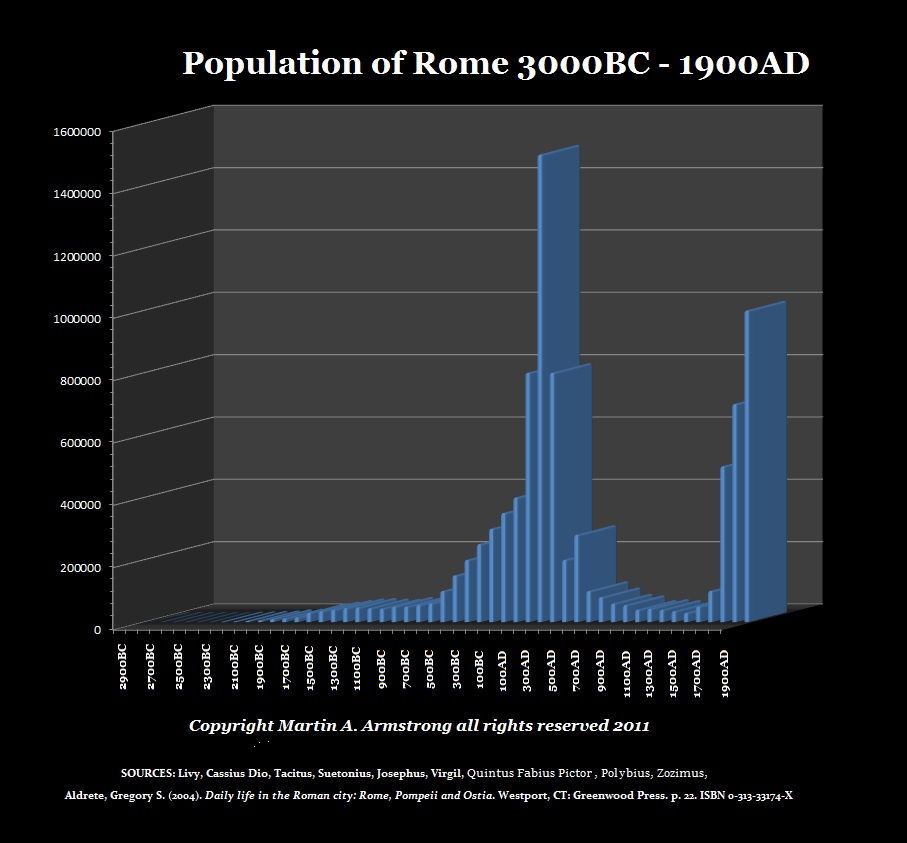
PopulationOfRome

QUESTION:  I have a question regarding cycles. You provide some very detailed, historic references showing why certain events are occurring now (again). Is there a disposition for something that occurred in the past to be destined re-occur for a particular region/country (i.e. Greeks abandoning property due to excessive taxation) because it happened once and now the propensity to repeat that causal action again is “in their DNA”. Is that something we as Americans do not yet possess because we have not been around long enough to experience a “fall of Rome” type event?

SM

ANSWER: Cycles are based upon two element – (1) nature and (2) human nature. Some regions will be prone to natural disasters while others are not. Ironically, many of the best ports where cities grew such as Tokyo and San Francisco just as examples, were great harbors because of earthquakes. The landscape in California is strikingly beautiful compared ot the flat plain in Oklahoma, again because of earthquakes. The rocks that appear in Central Park in New York City are there because an earthquake fault runs through New York City making the harbor what it was. Hence, there are cycles that impact only on a regional basis due to nature.

With regard to Greeks walking away from inheritance because they cannot pay the tax, this is inherent to all societies when government goes too far. They imposed harsh laws in Vancouver against foreign real estate buyers and the market crashed. Because it was a local law, they moved to Victoria and Toronto. In Australia, they are seizing properties own by foreigners and selling them off. All of these types of interventions are reactions to events set in motion externally.

realestate

That said, this is the US cycle for real estate as a national whole. I just bought a house in Florida at about 50% of its 2007 high value. Trophy spots for the high end where people are just parking money we warned would make new highs going into 2015.75 – but that is not the bulk of the market. Why is the US market (minus trophies) down hard when that is not the case in other countries? The difference is the regional issue. In the USA, many people have 30 year mortgages. In Canada, the best you can get is a 10-year fixed mortgage. In Germany, you can get up to a 15-year fixed mortgage.

We must understand that property values are LEVERAGED, so if the money for fixed rate loans dries up because of interest rate hikes and political uncertainty, then real estate prices MUST fall. This is all because of the leverage that was deliberately injected into the real estate market during the Great Depression for property fell  in value so far, only cash buyers could buy anything. Farm land fell in value to below what it was sold for by the government more than 80 years before.

Real estate is different from stocks and gold. Yes it is a place to park money. However, be careful because without mortgages available, it falls further than other tangible assets because it has been LEVERAGED! Moreover, it is a fixed asset meaning you cannot leave with it. Therefore, people are forced to simply walk away when (1) the tax burden is too high and (2) there is war and the region is being invaded.

America Supports Most of the Free World and we have 200,000 Troops Deployed To 177 Nation, this costs a lot of money but it is Required to Maintain world Peace


Tyler Durden's picture

There was no shortage of cuts proposed in Trump’s budget for 2018, which was released earlier this week. However, as Visual Capitalist’s Jeff Desjardins notes, one of the few departments that did not receive a haircut was the Department of Defense. If the proposed budget ultimately passes in Congress, the DoD would be allocated an extra $54 billion in federal funding – a 10% increase that would be one of the largest one-year defense budget increases in American History.

To put the proposed increase in context, the United States already spends more on defense than the next seven countries combined. Meanwhile, the additional $54 billion is about the size of the United Kingdom’s entire defense budget.

Courtesy of: Visual Capitalist


“BE ALL YOU CAN BE”

With over half of all U.S. discretionary spending being put towards the military each year, the U.S. is able to have extensive operations both at home and abroad. Our chart for this week breaks down military personnel based on the latest numbers released by the DoD on February 27, 2017.

In total, excluding civilian support staff, there are about 2.1 million troops. Of those, 1.3 million are on active duty, while about 800,000 are in reserve or part of the National Guard.

On a domestic basis, there are about 1.1 million active troops stationed in the United States, and here’s how they are grouped based on branch of service:

Internationally, there are just under 200,000 troops that are stationed in 177 countries throughout the world.

In 2015, Politico estimated that there are 800 U.S. bases abroad, and that it costs up to $100 billion annually to maintain this international presence