President Trump Oval Office Meeting With Crown Prince Salman Bin Hamad Al-Khalifa of Bahrain – (Video and Transcript)…


Against the backdrop of Iranian attacks on Saudi oil fields, earlier today President Trump delivered remarks with Crown Prince Salman Bin Hamad Al-Khaifa of Bahrain in the oval office; and held an impromptu press conference. [Video and Transcript below]

.

[Transcript] PRESIDENT TRUMP: Well, thank you very much. It’s a great honor to be with the Crown Prince of Bahrain. He is a friend of mine, and the country is a friend of ours. We’re always going to be with them, and I know they’re always going to be with us. We have a tremendous relationship militarily, but we have also a tremendous economic relationship — trade. And we’re going to be discussing all of those things. We’ll certainly be discussing what took place over the last two days in Saudi Arabia.

CROWN PRINCE SALMAN: Absolutely.

PRESIDENT TRUMP: And we’ll be discussing the Middle East. But our relationship has never been stronger than it is right now. And I think that is largely based on the relationship that we have. So I look forward to having our discussion.

CROWN PRINCE SALMAN: Thank you, Mr. President. It’s a great pleasure to be here.

PRESIDENT TRUMP: Thank you. Thank you very much. Please. Would you like to say something?

CROWN PRINCE SALMAN: Well, I would like to say — thank the President for receiving me and my delegation here today. I’m here to convey the greetings of His Majesty and the people of Bahrain; to strengthen the relationship, which is based on shared values where they overlap, ideals.

We primarily, as the President said, are going to focus on discussions related to security enhancement and trade enhancement.

We signed today a agreement to purchase additional — or to purchase our first Patriot Missile Battery Systems.

PRESIDENT TRUMP: Right.

CROWN PRINCE SALMAN: And it couldn’t have come at a better time.

PRESIDENT TRUMP: Good timing.

CROWN PRINCE SALMAN: Absolutely. And we seek to strengthen America’s ability to trade with the world, and we have some concrete ideas on how we can do that.

PRESIDENT TRUMP: Well, thank you very much.

CROWN PRINCE SALMAN: Thank you, Mr. President.

PRESIDENT TRUMP: I look forward to the day and spending time with you.

And thank you all very much. I’ll be doing a news conference outside in a little while. Just part of the trip. We’re going to New Mexico and to other places for two and half days. And many of you will be with us, and I look forward to that. But in particular, I look forward to our meeting.

CROWN PRINCE SALMAN: Thank you.

PRESIDENT TRUMP: Thank you very much.

Q Mr. President, have you seen evidence, proof, that Iran was behind the attack in Saudi Arabia?

PRESIDENT TRUMP: Well, it’s looking that way. We’ll have some pretty good — we’re having some very strong studies done, but it’s certainly looking that way at this moment. And we’ll let you know. As soon as we find out definitively, we’ll let you know. But it does look that way.

Q Do you want war with Iran, Mr. President? Do you want war with Iran?

PRESIDENT TRUMP: Do I want war? I don’t want war with anybody. I’m somebody that would like not to have war. We have the strongest military in the world. We’ve spent more than a trillion and a half dollars in the last short period of time on our military. Nobody has even come close. We have the best equipment in the world. We have the best missiles. And as you say, you just bought the Patriot system.

CROWN PRINCE SALMAN: We did.

PRESIDENT TRUMP: There’s nothing even close.

But, no, I don’t want war with anybody. But we’re prepared more than anybody. Two and a half years ago, I will tell you, it was not the same thing. And with what we’ve done, we’ve totally rebuilt our military in so many different ways, but we’ve rebuilt it. And there’s nobody — it has the F-35. We have the best fighter jets, the best rockets, the best missiles, the best equipment. But with all of that being said, we’d certainly like to avoid it.

Q What are the options, Mr. President? What are the options if not a military (inaudible)?

PRESIDENT TRUMP: Well, we have a lot of options, but I’m not looking at options right now. We want to find definitively who did this. We’re dealing with Saudi Arabia. We’re dealing with the Crown Prince and so many other of your neighbors, and we’re all talking about it together. We’ll see what happens.

Q Mr. President, will you meet with President Rouhani in New York, as it was speculated that you might meet?

PRESIDENT TRUMP: Say it?

Q Will you still meet with President Rouhani in Iran? Is this — in New York, I mean.

PRESIDENT TRUMP: Well, I have no meeting scheduled. I know they want to meet. I know they’re not doing well as a country. Iran has got a lot of problems right now that two and a half years ago — and even a little bit more than that — when I came in — it’s hard to believe it’s almost three years — but two and half to three years ago, they were causing a lot of trouble. And we’ll see what happens.

But we’ll let you know definitively if there were — as you know, there are ways to see definitively where they came from, and we have all of those ways. And that’s being checked out right now.

Q Are you still willing to meet with the Iranians without preconditions? Still willing to meet with President Rouhani?

PRESIDENT TRUMP: Well, you know, there were always conditions, because the conditions — if you look at it, the sanctions are not going to be taken off. So if the sanctions — that’s a condition. So, you know, that’s why the press misreported it. The biggest thing you can talk about are the sanctions, and the sanctions are massive. There’s never been sanctions put on a country like that. And I think they have a tremendous future, but not the way they’re behaving.

We’ll see what happens in terms of this attack. Secretary Pompeo and others will be going over to Saudi Arabia at some point to discuss what — they feel they’re going to make a statement fairly soon. But they also know something that most people don’t know, as to where it came from, who did it. And we’ll be able to find that out. We’ll figure that out very quickly. We pretty much already know.

Q (Inaudible) prepared for war?

PRESIDENT TRUMP: Say it?

Q You said the United States is prepared for war.

PRESIDENT TRUMP: The United States is more prepared than any country in the history of — of — in any history, if we have to go that way. As to whether or not we go that way, we’ll see. We have to find out definitively who did it. We have to speak to Saudi Arabia. They have to have a lot of — they have to have a lot in the game also. And, you know, they’re willing to do that. I think everybody knows they’re willing to do that.

So we’ll be meeting with Saudi Arabia. We’ll be talking to Saudi Arabia. We’ll be talking to UAE and many of the neighbors out there that we’re very close friends with. We’re also talking to Europe, a lot of the countries that we’re dealing with — whether it’s France, Germany, et cetera. Talking to a lot of different folks. And we’re figuring out what they think.

But I will tell you, that was a very large attack and it could be met with an attack many, many times larger, very easily, by our country. But we’re going to find out who definitively did it, first.

Q Can you clarify, Mr. President? So you said that you think that Iran is responsible for the attack. Do you think that the attack —

PRESIDENT TRUMP: I didn’t say that. Why do you say that?

Q You said — you said that you think you might —

PRESIDENT TRUMP: I said that we think we know who it was, but I didn’t say anybody.

Q And then you said it was Iran.

PRESIDENT TRUMP: But, certainly, it would look to most like it was Iran, but I did not say it the way you said. Go.

Q So do you think it was launched from Iran, is the second question.

PRESIDENT TRUMP: You’re going to find out in great detail in the very near future. We have the exact locations of just about everything. You’re going to find out at the right time. But it’s too early to tell you that now.

Q Do you want to release the oil reserves to help cushion the oil prices that are rising now?

PRESIDENT TRUMP: Well, they haven’t risen very much. And we have the Strategic Oil Reserves, which are massive. And we can release a little bit of that. And other countries, including Bahrain — but other countries can be a little bit more generous with the oil, and you’d bring it right down.

So, no, that’s not a problem. It went up five dollars, and that is not a problem.

And you have to remember, we’re now the largest producer of oil and gas in the world. So a lot of people in the old days — and this happened over the last very short period of time. We’re number one in the world, by far.

CROWN PRINCE SALMAN: Yes, you are.

PRESIDENT TRUMP: By far. So I never want to be benefitted that way. But the fact is, there are those that say we benefit. I don’t view that as a benefit. But we are certainly — we take in more money than anybody else from energy. Not even close.

Q Mr. President, do you still think it’s the responsibility of the Saudis to defend themselves? Or should the United States be —

PRESIDENT TRUMP: I think it’s certainly the responsibility of them to do a big — a big deal of their defense, certainly. I also think it’s the responsibility of the Saudis to, if somebody like us — which are the ones — are going to help them, they, I know, that monetarily will be very much involved in paying for that.

This is something that’s much different than other Presidents would mention, Jon. But the fact is that the Saudis are going to have a lot of involvement in this if we decide to do something. They’ll be very much involved, and that includes payment. And they understand that fully.

But they’re going to be — look, they’re very upset. They’re very angry. They know pretty much what we know. They know pretty much where they came from. And we’re looking for the final checkpoints, and I think you won’t be surprised to see who did it.

Q Mr. President, will you discuss the Israeli-Palestinian peace plan with the Crown Prince, since Bahrain hosted the first —

PRESIDENT TRUMP: We’ll be discussing it, yeah. We’ll be discussing.

Q And (inaudible), is it soon — before or after the Israeli election?

PRESIDENT TRUMP: Well, we’re going to see. I mean, it’s — the election is on Tuesday.

CROWN PRINCE SALMAN: Tomorrow.

PRESIDENT TRUMP: So —

CROWN PRINCE SALMAN: It’s tomorrow.

PRESIDENT TRUMP: So you have an election tomorrow, so I would think it would be afterwards, okay? But we — you do have an election. Big election tomorrow in Israel. And that’ll be a very interesting outcome. It’s going to be close. It’s going to be a close election.

Q Did Chairman Kim invite you to North Korea in that (inaudible)?

PRESIDENT TRUMP: I don’t want to comment on that.

Q Okay.

PRESIDENT TRUMP: The relationship is very good, but I don’t want to comment on it.

Q Would you be willing to go there?

PRESIDENT TRUMP: I just don’t think it’s appropriate for me to comment.

Q Would you be willing to go to North Korea?

PRESIDENT TRUMP: Probably not. I don’t think it’s ready. I don’t think we’re ready for that. I would do it sometime at — sometime at a later future. And depending on what happens, I’m sure he’ll love coming to the United States also. But, no, I don’t think it’s ready for that. I think we have a ways to go yet.

Q Do you stand with the autoworkers in the strike against GM?

PRESIDENT TRUMP: Well, I have a great relationship with the autoworkers. I got tremendous numbers of votes from the autoworkers. I don’t want General Motors to be building plants outside of this country. As you know, they built many plants in China and Mexico, and I don’t like that at all.

My relationship has been very powerful with the autoworkers — not necessarily the top person or two, but the people that work doing automobiles. Nobody has ever brought more companies into the United States. You know, I have Japan and Germany, and many countries have been bringing car companies in and opening plants and expanding plants. And big things are happening in Ohio, including with Lordstown. Very positive things are happening.

We have many plants that are either being renovated or expanded or built new, right now, in the United States — many more than we’ve had for decades and decades. So nobody has been better to the autoworkers than me.

I’d like to see it work out, but I don’t want General Motors building plants in China and Mexico. This was before my watch. And I don’t think they’ll be doing that, I don’t think.

I had meetings with Mary Barra, the head of GM, and I don’t want them leaving our country. I don’t want them building in China. I don’t want to build them in other countries. I don’t want these big, massive auto plants built in other countries. And I don’t think they’ll be doing that anymore.

You know, General Motors makes most of its money in the United States, and it’s too bad they spent billions and billions of dollars outside of the United States, before I got here. One of the things very important in the USMCA, which we have to have approved for the — not only for the unions, for the autoworkers, but for the farmers and for the manufacturers — for everybody. Everybody wants USMCA. It’s very important, even more so now than it was two weeks ago. But people really want it.

I’m sad to see the strike. Hopefully, it’s going to be a quick one.

Q Mr. President, has diplomacy been exhausted when it comes to issues of Iran? Diplomacy — has it been exhausted?

PRESIDENT TRUMP: No. It’s never exhausted. In fact, the Crown Prince can tell you, especially in your part of the world, it’s never exhausted until the final 12 seconds. Is that right?

CROWN PRINCE SALMAN: That is correct.

PRESIDENT TRUMP: You never know what’s going to happen. No, it’s not exhausted. Nothing is exhausted. And we’ll see what happens.

I think they would like to make a deal. I know they’d like to make a deal. They’d like to do it, but they’d like to do it on certain terms and conditions, and we won’t do that. But at some point, it will work out, in my opinion.

The problem was, the deal that was signed by the previous administration was a disaster — which, by the way, would be expiring in a very short period of time also. So you really don’t have a deal. You know, that deal was a very short-term deal. So they made a deal, but it was for a very short period of time. So that deal would be expiring very soon.

Q Mr. President?

PRESIDENT TRUMP: Yes.

Q Sorry. Are you encouraging Israel and the Saudis to work together on this issue, particularly since they have a shared common goal?

PRESIDENT TRUMP: Always. I encourage everybody. I want everybody to work together. The Middle East is an interesting place. They, historically, have not been working together too well.

But, no, Israel is starting to work together with a lot of countries that you wouldn’t have thought possible two years ago.

Yes, Steve.

Q Have you promised the Saudis that the U.S. will protect them in this case?

PRESIDENT TRUMP: No, I haven’t. No, I haven’t. I haven’t promised the Saudis that. We have to sit down with the Saudis and work something out. And the Saudis want very much for us to protect them, but I say, well, we have to work. That was an attack on Saudi Arabia, and that wasn’t an attack on us.

But we would certainly help them. They’ve been a great ally. They spend $400 billion in our country over the last number of years. Four hundred billion dollars. That’s a million and a half jobs. And they’re not ones that, unlike some countries, where they want terms; they want terms and conditions. They want to say, “Can we borrow the money at zero percent for the next 400 years?” No. No. Saudi Arabia pays cash. They’ve helped us out from the standpoint of jobs and all of the other things. And they’ve actually helped us.

I would call and I would say, “Listen, our oil prices, our gasoline, is too high. You got to let more go.” You know that.

CROWN PRINCE SALMAN: Yeah.

PRESIDENT TRUMP: I would call the Crown Prince and I’d say, “You got to help us out. You got to get some more.” And, all of a sudden, the oil starts flowing and the gasoline prices are down. No other President can do that. No other President was able to do that, or maybe they didn’t try. But I’ve done it.

So now they’re under attack, and we will work something out with them. But they also know that — you know, I’m not looking to get into new conflict, but sometimes you have to.

Q Mr. President, what’s your message to Iran right now?

PRESIDENT TRUMP: Excuse me?

Q What’s your message to Iran right now?

PRESIDENT TRUMP: I think I’ll have a stronger message, or maybe no message at all, when we get the final results of what we’re looking at. But, right now, it’s too soon to say. There’s plenty of time. You know, there’s no rush. We’ll all be here a long time. There’s no rush.

But I’ll have a message — whether it’s a strong message or maybe no message at all, depending on the final results.

Q And how concerned are you about the risk of an all-out war in the Middle East?

PRESIDENT TRUMP: I’m not concerned at all.

Q You don’t think that we’re a step closer to that, given what Iran just did?

PRESIDENT TRUMP: No. I’m not. Personally, I’m not concerned at all. We have military power the likes of which the world has never seen. I’m not concerned at all. I’d like to avoid it.

You know, when I came here three years ago almost, General Mattis told me, “Sir, we’re very low on ammunition.” I said, “That’s a horrible thing to say.” I’m not blaming him; I’m not blaming anybody. But that’s what he told me. Because we were at a position where, with a certain country — I won’t say which one — we may have had conflict. And he said to me, “Sir, if you could, delay it, because we’re very low on ammunition.” And I said, “You know what, General? I never want to hear that again from another general.” No President should ever, ever hear that statement, “We’re low on ammunition.”

And we now have more ammunition, more missiles, more rockets, more tanks, more — we have more of everything than we’ve ever had before. More jet fighters. When I came here, 50 percent of our jet fighters didn’t fly. You know that. And they were in bad shape. And now we have the best fighters in the world. Everybody wants to buy them. Are you buying our jet fighters?

CROWN PRINCE SALMAN: We are, sir.

PRESIDENT TRUMP: Which one?

CROWN PRINCE SALMAN: The F-16.

PRESIDENT TRUMP: That’s great.

CROWN PRINCE SALMAN: Signed it here.

PRESIDENT TRUMP: You have good taste. (Laughter.)

CROWN PRINCE SALMAN: Thank you, sir.

PRESIDENT TRUMP: That’s a great one.

So, we are very high on ammunition now. That’s a story I’ve never told before. Breaking news. But we have — we were very low. I could even say it stronger. I don’t want to say, “No ammunition,” but that gets a lot closer.

I said, “I never want to hear that again. And I never want another President of the United States to hear that again.” Could you imagine, as President, when they say, “We’re very low on ammunition?” By the way, stronger than that, but I’m not going to go there. That was what I was told. And I said, “I never want to be in a position like that again.” And he said, “Could you delay if we do something, sir? Could you delay it as we fill up?” And that is what I inherited from the past administration. And, in all fairness, to President Obama, to administrations before President Obama. That’s what I got stuck with. And we fixed it, and we fixed it good.

The Crown Prince understands $700 billion; the next year, $718 billion; and the next year, which is right now, we just got approved, $738 billion. And that’s a lot of money even for Bahrain. Right?

CROWN PRINCE SALMAN: It’s a lot of money, sir.

PRESIDENT TRUMP: It’s a lot even for Bahrain.

CROWN PRINCE SALMAN: It’s a lot of money.

PRESIDENT TRUMP: And Bahrain has a lot of money. Okay?

Q You have the Israeli election coming up tomorrow. How does that affect the timing of your Middle East peace plan?

PRESIDENT TRUMP: Well, we’ll have to see what happens, Steve. I just don’t know. I can’t tell you what’s going to happen. I can make a prediction; I sort of have a feeling. But we’re going to have to see what happens. That’s a big election. That’s one we’re all going to be watching.

Q Do you think Netanyahu will pull it out?

PRESIDENT TRUMP: Well, certainly he has a good chance. But it’s a very — you know, it’s a 50/50 election. A lot of people, if you look at the polls and everything else, it’s going to be very close. So we’ll see what happens. Polls — polls are often wrong.

Q Netanyahu called for annexing all settlements in the West Bank. Is that something your government would (inaudible)?

PRESIDENT TRUMP: Yeah, I don’t want to talk about that, but certainly it’s something we were told about that they’d like to do. But, no, I don’t want to be talking about that. It’s too soon.

Q Mr. President, can you, kind of, elaborate a little bit on why the decision was taken yesterday to release the Strategic Reserves? Why did you decide right away to do that?

PRESIDENT TRUMP: Well, just in case we ran a little bit low on oil. We have so much with the Strategic Reserves. Plus, being the number one producer, we can fill them up very quickly. Very, very quickly.

And one of the things I’m doing also is I’m approving the pipelines in Texas. We have a tremendous pipeline system that’s being held up by various agencies for a very good reason, for it — going through the normal process.

And we’re going to have to avoid the normal process, because if we do that — Texas is a massive distributor, a massive producer of oil, far bigger than anybody would have even thought five years ago. So what I’m going to do is expedite the pipeline approvals. That will get us another 25 percent energy — additional energy.

I know this is exactly the opposite of the Democrats. They want to have wind, solar, and, I guess, make-believe would be the third alternative, right?

No, this is something we have to do. We have the greatest wealth in the world, and we want to be able to capitalize on it, especially when it comes to safety. Okay?

Thank you all very much. Thank you.

Q Just for one more second. You talked about an urban agenda when you ran for President the first time. You went to Baltimore last week. What are your plans for Baltimore and cities like Baltimore? Instead of pointing fingers, what are you trying to do to help the city rise up from the “rodent-infested place” that you say it is?

PRESIDENT TRUMP: Well, I think what I’ve done for the inner cities is more than any President has done for a long time. We’ve created Opportunity Zones. In fact, I did that with Tim Scott, who you know very well, who is, I think, a tremendous guy. It was his initiative. And he came to see me.

They’re having a tremendously positive impact on the inner cities, including Baltimore, including a lot of other cities that you wouldn’t necessarily think. Oakland, California, is an example. We’re having tremendous success in the inner cities because of the Opportunity Zones.

Criminal justice reform — I was the one that got it. Nobody else. I mean, we had people that helped, but a group of extremely liberal Democrats came to the office and they said, “We cannot get it.” President Obama was unable to get it, as you know. President Bush — they were all unable to get it, and I got it.

And I got it with some very conservative senators and people that wanted it to happen. And nobody else could have done it. And it’s sort of interesting, because they don’t like mentioning my name, although, I guess now people are understanding.

But we got it. We got it done. We formed a coalition with some very conservative people, as you know, and some people that are very far left. And we did a thing called, “criminal justice reform,” something that nobody thought. The Crown Prince has seen this. Nobody thought this could possibly happen. And I’m very proud of criminal justice reform. So, we did that. We did the Opportunity Zones and a lot of other things.

Our job numbers for African Americans are the best in history. You saw the new ones came out; they’re even better than they were two months ago. Hispanic, the best in history. Asian, the best in history. Overall, they’re phenomenal. The best in 51 years. And I think we’ll soon be historic on that one too.

The economy is doing great. And that’s the best thing I can do.

Q Did you look at Baltimore when you flew over? Did you see what you —

PRESIDENT TRUMP: No, when I drove through I looked at it. And we flew over. But we also — no, you have some sections that need a lot of help.

And, you know, what people don’t know — I had a great meeting with Elijah Cummings in this office very early in my tenure. And it was a meeting on drug prices. And I saw him get emotional talking about drug prices. Seriously emotional. And I was really impressed. He cared about it. And I would certainly be willing to meet with Elijah and other people, if they’d like.

But I saw the emotion and the feeling that he had for reducing drug prices. And we’ve worked hard, and we’ve actually had the first year in 51 years where prices went down. But we can get them down much further if we can get the help from Congress.

So I think we’re going to do much lower drug prices over the next year. And I think that if Elijah Cummings would want help, I am here. But I did see him at a moment that was actually, I thought, a very beautiful moment. I’ve talked about it often because I see the political rhetoric every once in a while. And I said, “That’s not the same guy I had in my office.” That was a very caring man that wanted to see drug prices lowered. And he wanted that for the community — for his community.

So, I look forward to working with Elijah, but I look forward to working with a lot of people. But I think Opportunity Zones have been tremendous for the inner cities.

And criminal justice reform is something we’re very proud of. Thank you all very much.

END 3:42 P.M. EDT

Unofficial Emissary – Michael Pillsbury Heads to China…


The dance with the dragon is a complex geopolitical relationship between two large economies. China’s view within the dynamic is shaped by their own internal ideology and outlook.  The panda mask dynamic was/is strategic and has served them well for decades; but now President Trump -while engaging a structural confrontation- has used the panda strategy against Beiing’s interests.  China is flummoxed.

Each of President Trump’s trade team members have a specific role; each member also has a specific opponent within the dance:

♦Peter Navarro is the blue-collar hawk. He focuses on the the administration’s Wall Street adversaries; and the U.S. multinationals -American companies- who have aligned their interests with Beijing.  Navarro’s focus is internal to U.S. interests.  Navarro confronts  U.S. corporations, Wall Street interests, who are working against Main Street.

♦Treasury Secretary Steven Mnuchin carries the economic financial weapons (represents the dollar), and he faces toward global adversaries (IMF, World Bank, European Central Bank etc.) who have also aligned their interests with Beijing and the status quo.

♦Commerce Secretary Wilbur Ross, coordinates the punitive actions that keep Beijing in a position of compromise.  Ross reviews prior agreements, trade legal specifics, searches through contractual obligations and ultimately controls the tariffs, if/when triggered by President Trump. Secretary Ross faces down the World Trade Organization (WTO).

♦U.S. Trade Representative Robert Lighthizer is the contract writer; the primary negotiator; and he is at the center of the trade group where the details are constructed. Lighthizer writes the terms based on the objectives of President Trump.  Only POTUS approves the new agreements.

♦White House Economic Council Chairman Larry Kudlow is the explainer, the trade diplomat. The communication bridge between what is happening in the big picture and what the subsequent consequences mean.  Chairman Kudlow is to remain affable, optimistic and approachable by any interests who have concerns.  The PR guy.

“It must be remembered that there is nothing more difficult to plan, more doubtful of success, nor more dangerous to manage than a new system. For the initiator has the enmity of all who would profit by the preservation of the old institution and merely lukewarm defenders in those who gain by the new ones”

Machiavelli

Navarro, Mnuchin, Ross and Lighthizer bear the economic teeth.  After all, their job is serious… they have all the confrontational challenges… they face those who want to stop President Trump’s global trade reset.  Their goal is to ‘change the status-quo‘ toward greater reciprocity for the U.S. and to stop the one-sided nature from decades of trade agreements which eroded the U.S. middle-class.  Because their objective is change, they face the adversaries head-on. Their tasks make them targets. This group are hard men.

Kudlow is the soft-one. That’s his job. Be approachable by those who don’t like confrontation.  Kudlow calms nerves and keeps the nellies‘ less nervous.

Within this dance, there is an important place where East/West negotiations require respect.  The panda mask is part of the dynamic, perhaps the cunning and positioning part, but beyond the mask actual terms need respect from both parties.

Beijing violated that central component of respect in May, 2019, when they rebuked the terms of an agreement that were 80 percent negotiated and accepted by their own emissary.  China is paying the price for that violation now.  They likely did not anticipate the severity of punishment, now they are living with consequences.

President Trump has delivered punishment but continued to praise the opponent in hopes of encouraging Chairman Xi to rethink the dragon position.

There are many U.S. hawks celebrating the pain within China; and some of those same voices are calling for continued policy that will lead to the collapse of the central Chinese communist government.  That ain’t going to happen.

If there are going to be terms, there needs to be a middle position.  President Trump has always expressed hope that terms can be reached; however, he has also expressed pragmatically that successful terms likely involve too much loss for Beijing to accept.

President Trump has done all he can to encourage U.S. multinationals to think about the impossibility of structural change in Beijing against the severity of their own experiences.  In essence President Trump has warned U.S. companies to plan for the worst, and get out.

The complaints from U.S. and allied interests about Chinese trade practices are not likely be fixed; the issue is structural.  China will not change the structure of their totalitarian controlled economic model.  They are communists.

However, that said, within this ongoing dance there needs to be panda dialogue – because the global downsides are severe….  Enter Michael Pillsbury:

.

President Trump Presents Medal of Freedom to Mariano Rivera – 2:00pm Livestream…


Today President Trump will be recognizing a career of accomplishment by presenting the Presidential Medal of Freedom to former New York Yankee Hall of Fame pitcher Mariano Rivera.  The anticipated start time is 2:00pm EDT.

Update: Video Added

(White House) Today, President Donald J. Trump will present the Presidential Medal of Freedom to Mariano Rivera.  During his 19 seasons in Major League Baseball, Mariano Rivera established himself as the greatest relief pitcher of all time. Signed by the New York Yankees in 1990, Mr. Rivera would become a 13-time All-Star and 5-time World Series champion. He was the first player in the history of the sport to be elected unanimously into the National Baseball Hall of Fame. Off the field, through the Mariano Rivera Foundation, he has provided education and inspiration to children from low socioeconomic backgrounds, empowering them to achieve better futures. The United States proudly honors Mariano Rivera for being a legend of the game of baseball and for his commitment to improving America’s communities.

WH Livestream Link – Fox News Livestream Link – CNBC Livestream Link

.

.

Will the Democrats Self-Destruct?


QUESTION: What did you think of the Democratic debate. It looks like they are just preoccupied with hating Trump they have lost touch with reality. You previously said that the Democrats could collapse as a party after 2020. Does that seem likely?

PH

ANSWER: I know the press is spinning this that Trump will surely lose in 2020. Our models do not indicate that as yet. There remains the risk as we had forecast back in 1985 that the Democrats could cease to exist after 2020 and split at the very minimum. The other part of that forecast was that 2016 was the first opportunity for a possible third-party candidate to win. It appears that forecast was correctly made way back in 1985. That target was from the beginning of this 51.6-year Business Cycle 1985.65. It was the Pi target which was + 31 years = 2016.

The message from the Democratic debate was that they were going to raise your taxes substantially, triple your gasoline price to save the planet which would only mean people would lose their jobs if they cannot afford to get to work in many regions. They want open borders simply because Trump wanted a wall to stop the drug trade and it is already illegal for an employer to hire an illegal alien. If they do not have a Social Security number, they are not paying payroll taxes and thus compete with legitimate citizens so forget minimum wages.

The Democrats will take away your healthcare and we all know the problems of government healthcare – just look at the VA scandals. My healthcare doubled thanks to Obamacare. Then, of course, they want to outlaw guns. In China, they executed three men who killed 31 people at a train station with knives. It’s the crazy people – not the guns. Assault weapons are one thing. They are talking about the complete removal of guns and taking on the NRA.

This is a message of hate-inspired simply by the fact they hate Trump. There was no discussion of the economy. They want to open borders because Trump wanted a wall. Just look at Europe and the chaos of Merkel’s open borders which is the primary reason for the rising separatist movements. So open border means I should not have to go through TSA at airports – right! I can keep my shoes on?

The minorities they keep telling need the Democrats to ignore the fact that unemployment for both the Blacks and Hispanics in America is at record lows. We have Bernie swearing he will control every aspect of the economy and Elizabeth Warren being advised by the Communists from France – led by Thomas Piketty.

This is what I mean that they are so fixated on Trump, they simply take the opposite of any of his policies. That really makes no rational sense. They are dividing the party between liberal politics and the extreme left. It looks like the computer may be correct on that one as well. The Democratic Party may split. The party name would not be abandoned. They will keep that. But there is some great divide unfolding.

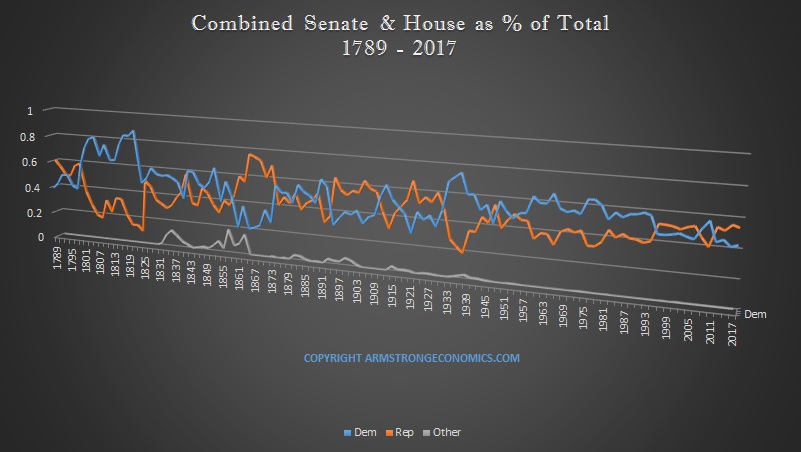
The chart presented above shows that on a combined Senate & House basis, they have been losing ground. When people are young, they are generally socialists until they graduate and begin to see the real world and have to pay taxes. The ones who cannot mature, live forever in their little bubble and blame everyone else for their failures.

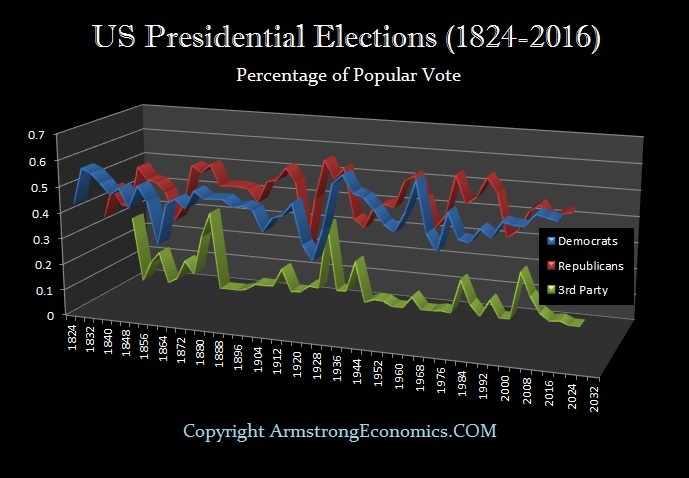
If we look at the Presidential elections, the Democrats peaked with FDR and have been making lower and lower highs ever since. This is the basis of that forecast that the Democrats have been in a bear market. They have lost touch with the core of the people.


Sunday Talks: Kevin McCarthy -vs- Maria Bartiromo…


House Minority Leader Kevin McCarthy appears on Sunday Morning Futures with Maria Bartiromo to discuss several ongoing political issues.

In the first two-thirds of the interview Leader McCarthy discusses Iran attacking the Saudi oil facility, and the ramifications therein. Speaker Nancy Pelosi holding back the USMCA hoping to get past the Canadian election; and the current field of 2020 democrat candidates. McCarthy holds the opinion that Elizabeth Warren will be the Democrat candidate for President.

In the last third of the interview (@11:15) McCarthy discusses the upcoming IG report on FISA abuse.  McCarthy believes: Andrew McCabe will be indicted; the IG report will identify culpability for James Comey, and the construct of a soft coup will be highlighted.

.

Sunday Talks: Kellyanne Conway -vs- Bill Hemmer…


Counselor to the president Kellyanne Conway appears on Fox News Sunday for an interview.  Bill Hemmer is filling in for Chris Wallace.  The recent Iranian attacks on Saudi Arabia oil production is the top issue covered.

Additionally, Ms. Conway discusses John Bolton’s replacement as National Security Adviser, current WH positions on legislation to restrict firearm ownership, the ongoing negotiations with China on trade, the impeachment nonsense and the democrat 2020 race.

Goldman Sachs Analysis: Good Grief, Trump Might Be Serious About China…


This is funny in so many ways; especially for CTH readers who have a far better-than-ordinary understanding of the big picture Trump goals around China.

(1) CNBC tweeted this story last night (note the date/time). (2) It is written exclusively from the perspective of the Goldman Sachs analysts who represent the U.S. multinational position. (3) However, the article was actually written on May 12, 13, 2019.

What is funny about CNBC pushing this story, NOW, is how the claims within the CNBC story can be fact checked; and their predictions are, well, absurd (especially in hindsight).   Keep in mind this was written in May, and tweeted last night for some reason:

(Via CNBC“Goldman Sachs said the cost of tariffs imposed by President Donald Trump last year against Chinese goods has fallen “entirely” on American businesses and households, with a greater impact on consumer prices than previously expected.

The bank said in a note that consumer prices are higher partly because Chinese exporters have not lowered their prices to better compete in the US market.” (link)

This Goldman Sach’s claim –made in May– can now be reviewed for accuracy by actual results on import pricing assembled by the Bureau of Labor Statistics in September:

(BLS Link to Data)

As you can see, four months after the Goldman Sach’s claim, the results are entirely false.  The price of imported goods has decreased; additionally, China has further devalued their currency since May, creating an even a larger price offset.

Further in the Goldman Sach’s claims:

“Goldman also said the risk of a final round of tariffs on the roughly $300 billion of remaining imports from China has now risen to 30%.”

In their May 2019 analysis, Goldman put the odds of President Trump following through on more tariffs at 30 percent.   They really just don’t believe President Trump is committed to the China confrontation.  From their analytical perspective, no U.S. President would ever go into a full economic confrontation with China.  Remember, Goldman Sachs represents the majority opinion of the Wall Street ‘multinational’ community.

This analysis from Goldman Sachs underwrites the majority of their multinational investment planning and loans to multinational Wall Street corporations.  Laughably, we know the end result is that Trump did execute more Chinese tariffs and the Goldman Sachs analysis was/is 100 percent wrong.

And here’s the kicker:

“Our baseline expectation is that the U.S. and China will strike a deal later this year. We think this would come in the form of a gradual, staggered reduction in tariffs on a last-in, first-out schedule,” the bank said.

“There is, however, a risk of further escalation,” Goldman said. (link)

Again for emphasis, Goldman Sachs controls the investment direction for tens-of-billions for U.S. multinational corporations.   The quotes and opinions above represent their outlook, their actual belief, and what they were selling their clients in May 2019.

  • They were wrong about price impacts.
  • They were wrong about Trump following through on additional tariffs.
  • And it’s almost certain they are wrong about a pending deal before the end of this year. (It’s now mid September).

What’s the takeaway?   Well first, Goldman Sachs controls hundreds-of-billions. Goldman is the predominant voice that all of the other Wall Street multinationals’ look toward.  Goldman is the incubator for almost all of the financial experts at the Fed. Goldman is also the baseline for all of the main Wall Street pundits….

Goldman is also 100% demonstrably wrong.

If you wonder why the Federal Reserve looks like they are running around with one foot nailed to the floorboard… well, look no further than Goldman Sach’s analysis.

Second, think about what will happen when these multinationals finally realize that President Trump is serious; and there will be no U.S-China trade deal that retains any semblance of the current trade relationship (if at all).

As soon as these Wall Street knuckleheads wake up to reality (likely dragging, kicking and screaming will be involved), they will have to shift their investment planning and strategic advice to those who want loans and investment. When that happens a much larger portion of the “multinational” money starts flowing back into the United States, and is no longer “multinational”.

It’s just too darn funny not to point out…..

More Fake MAGA Hate – Georgia Business Owner Busted Creating Fake Hate Crime…


Ex-NFL football player Edawn Coughman, 31 of Buford Georgia owns several pizza and ice-cream restaurants.  When police responded to a 911 call about a suspicious person and break-in they discovered Mr. Coughman had just staged a burglary and vandalism of his own business, including the spray painting of “Monkey”, “MAGA” and Swastikas on the walls.

GEORGIA – […]  “It’s possible he was trying to stage this as a hate crime,” Pihera said. “We don’t know if he was trying to get attention for this. What we do know is, if that witness had not called us and if those officers had not responded as quickly as they did, we would probably be sitting here talking about a completely different crime in which Mr. Coughman would be trying to say he’s a victim.”

[…]  Coughman was arrested and taken to Gwinnett County Jail, charged with false report of a crime, insurance fraud and concealing a license plate. He has since bonded out. Pihera said there is a possibility additional charges will be filed. (read more)

The Competence Vote…


From the first moment when he announced his intent to run for President of the United States in 2015, Donald Trump was very clear on one specific aspect to his view of why people would vote for him.  As a candidate, he repeated it often:

So the reporter said to me the other day, “But, Mr. Trump, you’re not a nice person. How can you get people to vote for you?”

I said, “I don’t know.” I said, “I think that number one, I am a nice person. I give a lot of money away to charities and other things. I think I’m actually a very nice person.”

But, I said, “This is going to be an election that’s based on competence, because people are tired of these nice people. And they’re tired of being ripped off by everybody in the world.”

President Donald J Trump continues to highlight that message today:

It’s funny, from time-to-time people ask “how is CTH consistently able to predict what Donald Trump will do about a complex issue”?  In reality the answer is simple, go back and re-read his hour long campaign kick-off speech. [See Here]

Donald Trump, now President Trump, is one of the most consistent people in history when it comes to his big picture views; and also his big picture solutions.  There are small shifts, and slight changes in the direction toward the solution, but ultimately the big picture destination is consistent.

Specifically because President Trump works on optimal solutions toward the goal destination, his objective, the non-politician takes a different approach than would be expected from a typical politician.  Ultimately this is how Trump is able to accomplish so much more in a similar amount of time; he’s not poll-testing the route.

Each big goal, each major objective, has a series of way-points.  The process for reaching those way-points is independent and entirely based on the goal itself.  Politicians look at this approach and think of it as inconsistent, because the travel is not subject to a specific map that is always followed.

Because President Trump’s search for ‘optimal travel’ is not based on a prior path – but based on each unique destination, the goal is more predictably reached.  In many ways it is just common sense.

Competence in policy is not measured by endless planning, discussion and debate… it is measured by results.  Achieving results requires action.  Start the journey and head to the way-point; reach the initial objective – evaluate, and immediately measure the next way-point; repeat until you reach the destination.

[…] So we need people— I’m a free trader. But the problem with free trade is you need really talented people to negotiate for you. If you don’t have talented people, if you don’t have great leadership, if you don’t have people that know business, not just a political hack that got the job because he made a contribution to a campaign, which is the way all jobs, just about, are gotten, free trade terrible.

Free trade can be wonderful if you have smart people, but we have people that are stupid. We have people that aren’t smart. And we have people that are controlled by special interests. And it’s just not going to work.

[…]  I love China. The biggest bank in the world is from China. You know where their United States headquarters is located? In this building, in Trump Tower. I love China. People say, “Oh, you don’t like China?”

No, I love them. But their leaders are much smarter than our leaders, and we can’t sustain ourself with that. There’s too much— it’s like— it’s like take the New England Patriots and Tom Brady and have them play your high school football team. That’s the difference between China’s leaders and our leaders.

They are ripping us. We are rebuilding China. We’re rebuilding many countries. China, you go there now, roads, bridges, schools, you never saw anything like it. They have bridges that make the George Washington Bridge look like small potatoes. And they’re all over the place.

We have all the cards, but we don’t know how to use them.

We don’t even know that we have the cards, because our leaders don’t understand the game.

We could turn off that spigot by charging them tax until they behave properly. (Cont…)

This is where Petsche’s progressive world started


A basic primer on UN Agenda 21 aka Sustainable Development

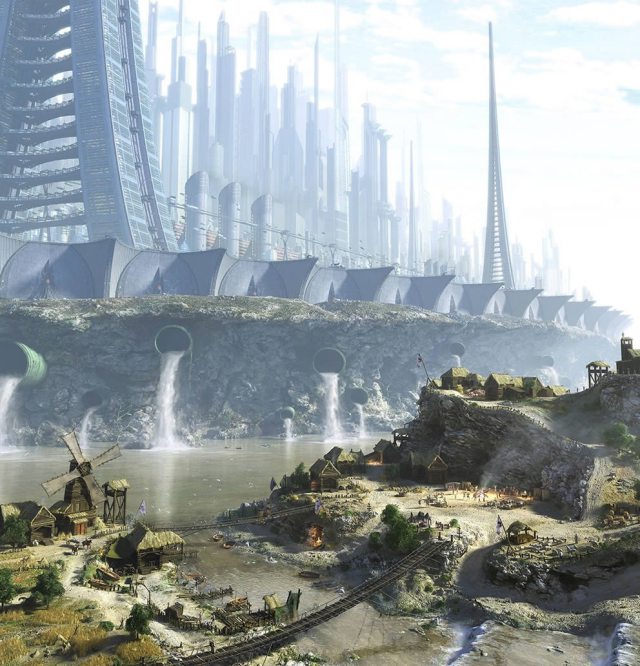
This image is of Petsche’s world with him in the shining city and the rest of us in poverty. Brecksville has been targeted for take over and we must resist. Agenda 21 in all of its various flavors is nothing more than a clever means of implementing communism in America.

In One Easy Lesson

Awareness of Agenda 21 and Sustainable Development was started by Bill Clinton in 1993, 26 years ago and its US implementation is now at the local level across the nation. Bike paths are a key part of the program. Some citizens in community after community are learning what their city planners are actually up to. As awareness grows many complain that elected officials just won’t read detailed reports or watch long videos.

So here is some help. A starter kit  of information on Agenda 21 that can be used to get started. A word of caution, use this as a starter kit, but do not allow it to be your only knowledge of this very complex subject. To kill it you have to know the facts. Research, know your details; discover the NGO players in your community; identify who is victimized by the policies and recruit them to your fight; and then kill Agenda 21. That’s how it must be done. The information below is only your first step. Happy hunting.

What is Sustainable Development?

According to its authors, the objective of sustainable development is to integrate economic, social and environmental policies in order to achieve reduced consumption, social equity, and the preservation and restoration of biodiversity. Sustainablists insist that every societal decision be based on environmental impact, focusing on three components; global land use, global education, and global population control and reduction.

Social Equity (Social injustice)

Social justice is described as the right and opportunity of all people “to benefit equally from the resources afforded us by society and the environment.” Redistribution of wealth. Private property is a social injustice since not everyone can build wealth from it. National sovereignty is a social injustice. Universal health care is a social injustice. All part of Agenda 21 policy.

Economic Prosperity

Public Private Partnerships (PPP). Special dealings between government and certain, chosen corporations which get tax breaks, grants and the government’s power of

Eminent Domain to implement sustainable policy. Government-sanctioned monopolies.

Local Sustainable Development policies

Smart Growth, Wildlands Project, Resilient Cities, Regional Visioning Projects, STAR Sustainable Communities, Green jobs, Green Building Codes, “Going Green,” Alternative Energy, Local Visioning, facilitators, regional planning, historic preservation, conservation easements, development rights, sustainable farming, comprehensive planning, growth management, consensus.

Who is behind it?

ICLEI – Local Governments for Sustainability (formally, International Council for Local Environmental Initiatives). Communities pay ICLEI dues to provide “local” community plans, software, training, etc. Additional groups include American Planning Association, The Renaissance Planning Group, International City/ County Management Group, aided by US Mayors Conference, National Governors Association, National League of Cities, National Association of County Administrators and many more private organizations and official government agencies. Foundation and government grants drive the process.

Where did it originate?

The term Sustainable Development was first introduced to the world in the pages of a 1987 report (Our Common Future) produced by the United Nations World Commission on Environmental and Development, authored by Gro Harlem Brundtland, VP of the World Socialist Party. The term was first offered as official UN policy in 1992, in a document called UN Sustainable Development Agenda 21, issued at the UN’s Earth Summit, today referred to simply as Agenda 21.

What gives Agenda 21 Ruling Authority?

More than 178 nations adopted Agenda 21 as official policy during a signing ceremony at the Earth Summit. US president George H.W. Bush signed the document for the US. In signing, each nation pledge to adopt the goals of Agenda 21. In 1993, President Bill Clinton, in compliance with Agenda 21, signed Executive Order #12852 to create the President’s Council on Sustainable Development in order to “harmonize” US environmental policy with UN directives as outlined in Agenda 21. The EO directed all agencies of the Federal Government to work with state and local community governments in a joint effort “reinvent” government using the guidelines outlined in Agenda 21. As a result, with the assistance of groups like ICLEI, Sustainable Development is now emerging as government policy in every town, county and state in the nation.

Revealing Quotes From the Planners

“Agenda 21 proposes an array of actions which are intended to be implemented by EVERY person on Earth…it calls for specific changes in the activities of ALL people… Effective execution of Agenda 21 will REQUIRE a profound reorientation of ALL humans, unlike anything the world has ever experienced… ” Agenda 21: The Earth Summit Strategy to Save Our Planet (Earthpress, 1993). Emphases – DR

Urgent to implement – but we don’t know what it is!

“The realities of life on our planet dictate that continued economic development as we know it cannot be sustained…Sustainable development, therefore is a program of action for local and global economic reform – a program that has yet to be fully defined.” The Local Agenda 21 Planning Guide, published by ICLEI, 1996.

“No one fully understands how or even, if, sustainable development can be achieved; however, there is growing consensus that it must be accomplished at the local level if it is ever to be achieved on a global basis.” The Local Agenda 21 Planning Guide, published by ICLEI, 1996.

Agenda 21 and Private Property

“Land…cannot be treated as an ordinary asset, controlled by individuals and subject to the pressures and inefficiencies of the market. Private land ownership is also a principal instrument of accumulation and concentration of wealth, therefore contributes to social injustice.” From the report from the 1976 UN’s Habitat I Conference.

“Private land use decisions are often driven by strong economic incentives that result in several ecological and aesthetic consequences…The key to overcoming it is through public policy…” Report from the President’s Council on Sustainable Development, page 112.

“Current lifestyles and consumption patterns of the affluent middle class – involving high meat intake, use of fossil fuels, appliances, home and work air conditioning, and suburban housing are not sustainable.” Maurice Strong, Secretary General of the UN’s Earth Summit, 1992.

Reinvention of Government

“We need a new collaborative decision process that leads to better decisions, more rapid change, and more sensible use of human, natural and financial resources in achieving our goals.” Report from the President’s Council on Sustainable Development

“Individual rights will have to take a back seat to the collective.” Harvey Ruvin, Vice Chairman, ICLEI. The Wildlands Project

“We must make this place an insecure and inhospitable place for Capitalists and their projects – we must reclaim the roads and plowed lands, halt dam construction, tear down existing dams, free shackled rivers and return to wilderness millions of tens of millions of acres or presently settled land.” Dave Foreman, Earth First.

What is not sustainable?

Ski runs, grazing of livestock, plowing of soil, building fences, industry, single family homes, paved and tarred roads, logging activities, dams and reservoirs, power line construction, and economic systems that fail to set proper value on the environment.” UN’s Biodiversity Assessment Report.

Hide Agenda 21’s UN roots from the people

“Participating in a UN advocated planning process would very likely bring out many of the conspiracy- fixated groups and individuals in our society… This segment of our society who fear ‘one-world government’ and a UN invasion of the United States through which our individual freedom would be stripped away would actively work to defeat any elected official who joined ‘the conspiracy’ by undertaking LA21. So we call our process something else, such as comprehensive planning, growth management or smart growth.” J. Gary Lawrence, advisor to President Clinton’s Council on Sustainable Development.

“False Choice” – How Sustainable Development is Transforming Property Rights *NEW!*

U.S. House of Representatives Approves Participation in Agenda 21

In this October 2, 1992 session, the House of Representatives passed HC 353, a resolution calling for the U.S. to assume a strong leadership role in implementing the sustainable development recommendations of the Rio Earth Summit including Agenda 21. Hear sponsors E. Engel (D-NY), N. Pelosi (D-CA) and W. Bloomfield (R-MI).

How Agenda 21 Affects Your Property Rights:

Explanation of The Wildlands Project:

Downloadable Documents

(Scroll down to see the categories below)

  1. Understanding Agenda 21/Sustainable Development
  2. Tracing the History of Agenda 21/Sustainable Development
  3. Legislation Addressing the Threat of Agenda 21/Sustainable Development
  4. Taking Action to Expose Agenda 21/Sustainable Development
  5. Examples of Agenda 21/Sustainable Development’s Impact on Property Rights
  6. Links to United Nations Websites
  7. Sources for Further Information

1. Understanding Agenda 21/Sustainable Development

A Sustainable Development Q&A

This simplified Q&A answers basic questions about how a seemingly good idea like sustainable development can be bad for private property owners.

Unraveling the “Sustainability” Paradox

This single sheet makes the step by step connection between UN Agenda 21, sustainable development, Smart Growth and local planning activities. It includes sources so you can do your own checking.

The “Sustainability” Solution

Citizens can present the following two page document to their public officials. It contains suggestions for how to protect the rights of property owners and still keep the environment safe.

Example of How Conservation Easements can be Detrimental to Property Owners

While conservation easements are widely praised as a way to save the environment and keep property rights, in fact, in the long term they often do neither. The article, “Big Meadows, Big Mistake” tells the “rest of the story” on Conservation Easements.

7 Facts You Should Know About Conservation Easements

These are facts you need to know before entering into a Conservation Easement Agreement.

The Hazards of Conservation Easements

Here are more details about the pitfalls of Conservation Easements.


2. Tracing the History of Agenda 21/Sustainable Development

The UN Conference on Human Settlements – Vancouver Plan of Action – 1976

This conference created the baseline for the UN’s viewpoint and future actions regarding individual property rights. See pdf page 2 [document page 28] under, Land – Preamble, for their stance on private property. This position is reflected in policies being enacted across the U.S. today.

Excerpt from The Brundtland Commission Report: “Our Common Future” Defining Sustainable Development

This definition easily identifies UN Agenda 21 related initiatives as it traversed from various reports to the U.S and into our federal agencies. The full report can be found here.

Jeb Brughmann Founds ICLEI to Implement Agenda 21 Worldwide in Local Communities

In this candid 1997 interview, ICLEI founder explains how he was tapped to create an organization to “make sure this agreement [Agenda 21/sustainable development] among nations actually will get implemented…”

The United Nations Rio Declaration from Agenda 21

The Rio Declaration outlines the framework of Agenda 21. It was agreed to by President George H.W. Bush in 1992, thereby establishing official recognition of Agenda 21 by the U.S.. The complete 40 chapter United Nation’s Agenda 21 report can be found here.

Executive Order 12852

President Clinton signed Executive Order 12852 in 1993, which created the President’s Council on Sustainable Development. Here is a copy of that Executive Order.

Institutional Aspects of Sustainable Development in the United States of America

This UN document shows that the President’s Council on Sustainable Development was created for the purpose of implementing Agenda 21 in the U.S..

The Millennium Papers

This article in the Millennium Papers describes how the name Agenda 21 was replaced with terms such as Smart Growth, Growth Management and Comprehensive Planning to prevent Americans from recognizing the connection to the United Nations. See highlighted page 5.

Sustainable Development Challenge Grant Program – Federal Register

These pages from the Federal Register clearly indicate that the EPA’s Challenge Grant Program was created for the purpose of implementing Agenda 21 in the U.S.. See the highlighted section on page 2.

EPA: The Path Forward

This scientific document shows, under the highlighted section,s how the EPA today still follows the basic definitions of sustainable development as defined by the UN’s Brundtland Commission, in their newest decision making process.

HUD-DOT-EPA Partnership for Sustainable Communities

In 2009, these three federal agencies partnered using ‘livability’ principles to gain greater involvement in local planning and regulations. Read the ‘Livability Principles” and the “Partnership Agreement.” Notice the affect the federal government can have on your community. See more below.

HUD NOFA – Sustainable Regional Planning Grants 2010

This HUD Notice of Funds Available clearly shows that along with the grant money come mandates and requirements for social engineering in the form of social equity.

Executive Order 13575

Pres. Obama signed this EO in June of 2011 giving each of the Federal agencies authority over the “food, fiber and energy” for all of rural America or 16% of the US. Control of resources is a key requirement of sustainable development as it enables the governing authority the power to manage their useage more efficiently than individuals and communites.

Executive Order 13602

In March 2012, Pres. Obama signed this EO giving HUD the authority to engage in city, community and regional planning to “augment their vision for stability and economic growth…” This EO insures that “Federal assistance is more efficiently provided and used.” HUD now has the ability to create regulations to enforce that local and regional planning the government feels is beneficial to the fiscal stability of the US.

The Partnership for Sustainable Communities

This partnership is changing the landscape of rural America. Once allowed into your community, the HUD-DOT-EPA partnership defines what qualities your “liveable” locality must include. More transportation choices invariably means more light rail transit and bicycles. The government defines the character, context and needs of each community with token input from citizens. Social enguineering is inherent in what the government calls, “equitable housing, sustainable strategies and value communities.” Most of the plans look appealing in slide presentations, but, once implemented, local citizens are stuck with regulations imposed by the government that offer little future variation and minimal if any opportunity to return to a way of living you may find more desirable. As one planner said, “You will be able to live in a rural area if you want to…but it will cost you.”

Partnership for Sustainable Communities – Top Down Control

Here, in friendly sounding terms, the Secretaries of HUD, DOT and the EPA make it clear the federal government intends to manage your commuunity design, make it livable and environmentally green, all according to their needs and definitions. Each of the projects and grants, though verbally and graphically enticing, precisely echo the Vancouver Plan of Action. The results are exactly as defined in Vancouver in 1976.

EPA – EJ2014 or Environmental Justice 2014

In January of 2012, the EPA changed their decision making process to embrace sustainable development as defined in the UN’s 1987 Brundtland Report. In April 2012, the agency created plans to incorporate civil rights regulations in their environmental policy to establish a basis for environmental justice.


3. Legislation Addressing the Threat of Agenda 21/Sustainable Development

RNC Resolution Exposing United Nations Agenda 21 – January 13, 2012

In January, 2012, the Republican National Committee unanimously approved an historic resolution exposing the dangers of United Nations Agenda 21, ICLEI and the loss of private property ownership, single family homes, private car ownership, individual travel choices and privately owned farms under the banner of “sustainable development” and Smart Growth.

For the first time, the leadership of one of the two major American political parties acknowledged that so-called “social justice” is robbing our society and the environment and replacing our sovereignty with a socialist/communist wealth redistribution scheme. Please read this document carefully and share it freely.

Wisconsin Assembly Bill 303

This bill enables the repeal of local comprehensive plans found to tamper with individual’s property rights.

New Hampshire Bill 1634

New Hampshire’s bill prevent the state, counties, cities and towns from contracting with or accepting money from ICLEI, a large non-governmental orgnaization[NGO] implementing Agenda 21 throughout the U.S.

New Hampshire Bill 514

This bill prevents federal agents from inspecting or gathering information on private property wtihout a warrant.

Tennessee Bill HJR 587

This bill rejects the radical policies promoted by United Nation’s Agenda 21 and rejects any grant monies attached to the UN’s program.

Bonner County, ID Property Rights Council

The Property Rights Council provides a committee to review planning documents and agreements prior to acceptance to assure that property owner’s rights are not exploited by planners or governmental agencies. For further information, go here.

Defense of Environment and Property Act of 2012 (S.2122)

The EPA, under the Clean Water Act, expanded its control over citizen’s private property by redefining navigable waters to include certain artificially irrigated areas, artificial lakes and ponds used for irrigation, non-navigable tributaries to navigable waters, wetlands abutting relatively permanent waters and more. This bill defines “navigable” waters as those that are actually “navigable.”

Alabama Protects Private Property Rights from Agenda 21 Intrusions (SB477)

This bill prohibits Alabama and its political subdivisions from adopting environmental and developmental policies that, without due process, infringe or restrirct private property rights of property owners. Further, it prohibits policies that are traceable to “Agenda 21″ as adopted by the United Nations in 1992 at its Conference on Environment and Development.

Florida Bill Protects Private Property Rights

This Florida bill protects all state subdivisions from adopting any developmental policies that, without due process, infringe or restrict the private property rights of the property owner. It specifically mentions any policy recommendations traceable to Agenda 21 as adopted by the UN at the 1992 Conference on Environment and Development. This would include those policies recommended by Non-Governmental Organizations and Federal Agency regulations that are Agenda 21 related.


4. Taking Action to Expose Agenda 21/Sustainable Development

What You Can do to Stop Sustainable Development – Agenda 21

This handout provides information and links that will help you get active in stoppng Agenda 21/Sustainable Development in your community.

The Coordination Strategy

The Coordination Strategy can slow or stop planning processes that may endanger individual property rights. Most federal agencies are required by law to coordinate their plans that will impact the local community with local governments. Often this does not happen as most local governmens are not aware of this requirement, or do not know how to implement the process. When local governments assert coordination authority, the federal agencies must respond.

APA’s Agenda 21: Myths and Facts Revisited

Recently, the American Planning Association circulated a fact sheet titled, Agenda 21: Myths and Facts. The APA is a large and highly respected planning organization, that often does exemplary work. But their “fact” sheet is rife with distortions, misconceptions and inaccuracies. This document provides information to respond to the APA’s errors.

APA’s Glossary for the Public

The American Planning Association, rather than address critics’ concerns for private property rights, chose to re-brand their information by creating a new vocabulary. This transparent attempt to confuse the public while making it easier to implement their own chosen plans sidesteps citizens’ genuine concern for individual rights.


5. Examples of Agenda 21/Sustainable Development’s Impact on Property Rights

Form-Based Code is the Problem, Not the Solution

Form-based codes are a programmed method for replacing existing zoning regulations with boilerplate zoning and development code models. They make it easier to implement Agenda 21 type plan enforcement. Form-based codes often replace the need for local zoning ordinances and reduce the role of public officials. Once installed, form-based codes become the new laws governing a wide range of activities in your community.

Form Based Code Planning Guide

Here is the introduction to a book describing form-based codes. When promoting this method of codification, promoters often show audiences live PowerPoint presentations of their current community followed by dazzling pictures of what their town can become. Most citizens are so impressed with the stunning design work, they overlook the draconian regulations and potential loss of rights that accompany the plans. Notice the fifth paragraph on page 14 in which Peter Katz, Pres. of the Form-Based Codes Institute, describes how to use the “charette” process to manipulate public responses.


6. Links to United Nations Websites

Action Plan from the Vancouver Conference on Human Settlements – 1976*

*Note the Preamble to “Land” under section “D”

United Nations Agenda 21

Brundtland Commission Report – “Our Common Future”*

*Note Chapter Two – “Towards Sustainable Development.”

Rio + 20 “The Future We Want – Zero Draft of Outcomes”

Draft International Covenant on Environment and Development


7. Sources for Further Information

America Don’t Forget

American Policy Center

American Stewards

CO2 Science

Conservative Society for Action

Democrats Against UN Agenda 21

Freedom Advocates

Sovereignty International

Taking Liberty


More Articles to Read

Top Climate Change Figure Calls Sustainable Development “Meaningless Drivel!”

EPA Uses New “Sustainability” Method for Regulatory Decision Making

Sustainable Development: What’s in A Name?

EPA “Urban Green Grants” Cover Environmental Justice

EPA Ignored Own Guidelines in Declaring CO2 A Threat