The entire West will face higher energy prices due to climate initiatives and Russian sanctions. The British energy regulator Ofgem released a troubling report citing that the average household will pay $4,200 on energy over the next year, compared to the current $2,330 annual average.
The UK raised its energy price cap in April by 54% and is expected to raise it once more this October by 80%. “This will be devastating for many families,” Jonathan Brearley, chief executive of Ofgem, told the BBC. “The difficult news I have to give today is that prices look like they are continuing to rise.” This is a drastic understatement.
An Ipsos poll found that one in 10 people already find it “very difficult” to afford energy costs over the past three months, and two in 10 found it “fairly difficult.” Over a third have installed a smart meter, and two in five have tried price comparison websites to no avail. People are already unable to afford energy costs, and 29% admitted to dipping into savings to do so, while another 15% said they missed payments entirely.
The term “fuel poverty” is now commonplace and is used for households that spend over 10% of their net income on energy bills. The University of York forecast that two-thirds of households in the UK will face fuel poverty by the beginning of next year. Families with children are the most vulnerable. This is a direct result of lawmakers pushing the climate change agenda with ZERO alternative solutions in addition to blindly supporting Ukraine at the expense of their own people.
It seems as if everyone is supplying Ukraine with money and weapons. I would not blink if I saw Russia itself had provided Ukraine with weapons as everything has become so absurd. Yet, nothing seems to be enough. Ukrainian Foreign Minister Dmytro Kuleba called out the two European countries that have not supplied weapons for the proxy war. “With the exception of Hungary and Austria, the supply of weapons to Ukraine is not a taboo for any other European country, although it was (before),” said Kuleba.
Levente Magyar, Hungary’s Deputy Minister of Foreign Affairs, explained their reasoning for staying neutral. “Unlike many Western partners, we have experienced for ourselves what it is like to confront this huge Eastern state. At the same time, Hungary itself will not supply weapons — this is our strategic position. However, third countries can use our territory,” Magyar noted. Hungary simply does not wish to engage in war with a large Eastern power. They are protecting the Hungarian population living in the far-western Transcarpathia region from Russian attacks.
Austria has also committed to neutrality and has made that clear since the beginning of the war. First, Austria is not officially a NATO country and does not have that protection. According to Al Jazeera, 80% of Austrians do not want any involvement in the Western alliance. We all know of a certain dictator who grew up in Austria and started the last world war. Austria attempted to act as a diplomat between the East and West, with Chancellor Karl Nehammer visiting Moscow earlier in the year. The trip produced no results.
Both nations have offered humanitarian resources or opened their borders to Ukrainian refugees. They should not be shamed for steering clear of war. Look at their not so distant histories. The oldest generations have experienced untold suffering. There is no benefit for either country to become involved in a growing global conflict.
QUESTION: Dear Mr. Armstrong, First, thank you for all the wonderful work you do. I have been following your blog for many years and am always amazed at your insight and historical knowledge. I had a question regarding your assertion that the WEF/ Globalists will not win. I am assuming you mean that their vision of a worldwide Chinese-style technocracy run by the United Nations will not take hold. But if we are also looking at the certain breakup of the United States from which there is no turning back, a defeat in WWIII with China and Russia as they win and rise to be the main players on the world stage, are we not losing everything, anyway? How will we ever hope to restore peace, liberty, democracy, and prosperity as most American citizens understand it if China and Russia end up controlling everything, and our country is left permanently fractured and therefore weaker? Again, thank you for everything you do to help people understand what’s coming down the road. Your insight is always invaluable.
EM
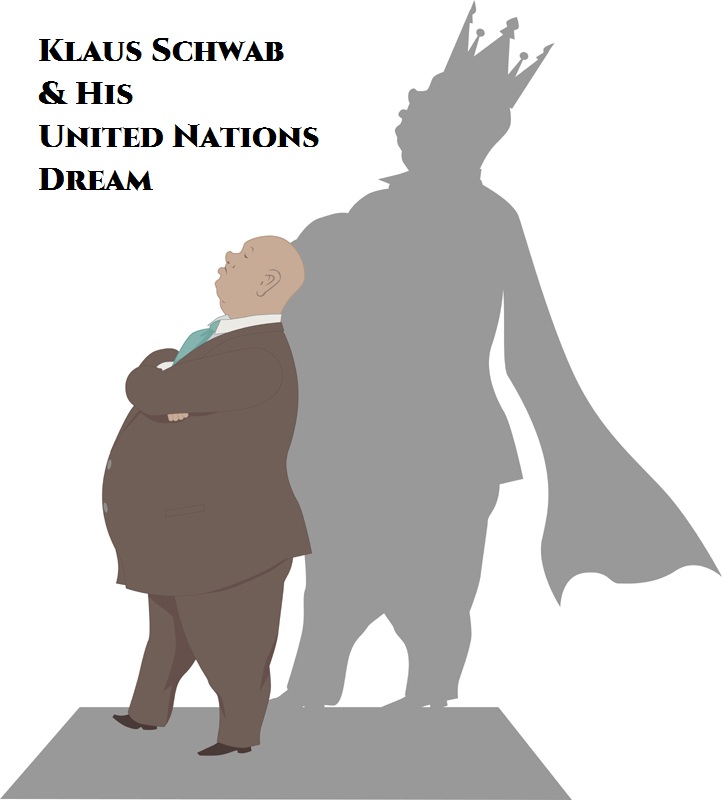
ANSWER: All we can do is look at history. As my mother used to say, “There’s a time and place for everything.” What we are looking at is simply the natural cycle of the rise and fall of nations. Schwab will fail with Soros, and their dream of a one-world government is absolutely stupid, and it illustrates that both are totally ignorant of history or humanity. Just look at Congress. They vote on party lines. There is no agreement, and you really expect that the world can be brought to a one-world government?
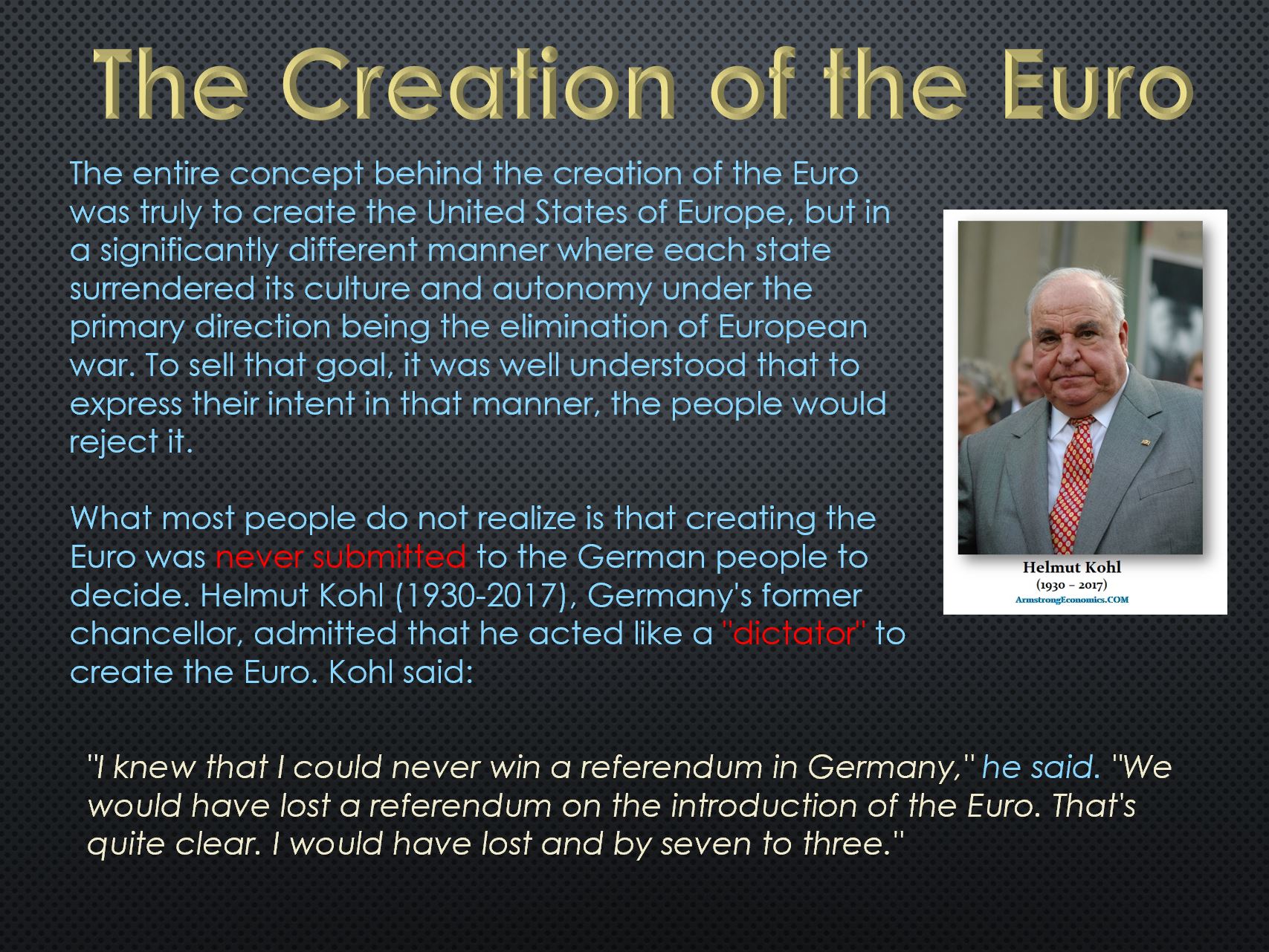
The EU is not working, and that was the very same theory. The old tensions and distrust go back centuries in Europe. The Germans refused to join if all the debts were combined, and now you have countries complaining that one pays more in interest rates than another. Here is the former head of France stating in Parliament that the entire idea of the EU was that this one-European government would end all European wars. This was pushed by Schwab and Soros.
The EU Commission came to our 1997 WEC in London. I warned them that this would fail without the consolidation of the debts. They said that they just had to get the euro in and then worry about the debts later. I tried to explain the crisis to Kohl, but he would not listen. He would not even put joining the euro to a vote, knowing that the German people would reject the whole idea.
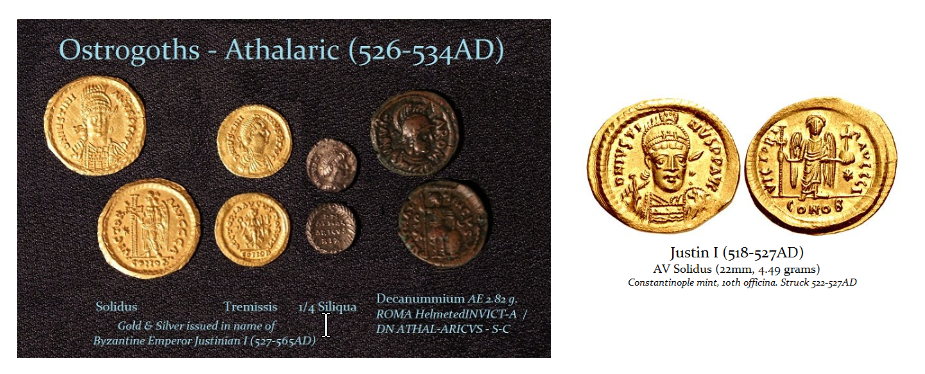
When Rome fell, it broke up into fiefdoms. The barbarians issued coins that imitated that of Rome. They pretended to be Roman, for they wanted the air of that civilization. There was no unity — all separated enclaves. It was not until Charles Martel (c. 688–741), who established the Caroline dynasty, where Charlemagne (747–814 AD) was eventually crowned as Emperor of the Holy Roman Empire by the Pope. Do you see the trend to create unified states once more?
Therefore, following the collapse of Rome, it was the typical cycle of 31.4 x 8.6 years = 270 years before we began to see the rise once again of formal civilizations. Europe had broken apart into simple fiefdoms that were not united. The unification came only because the Arabs began to seek the conquest of Europe and Charles Martel began to rise up to defend when became Europe once again after the Battle of Tours. He unified the Franks into a nation-state.
When Charles died, he divided Francia between his sons, Carloman and Pepin. Charlemagne came to power under Pepin. Pepin’s death opened the door to civil war as the conflict between his heirs and the Neustrian nobles who in turn sought their own political independence.
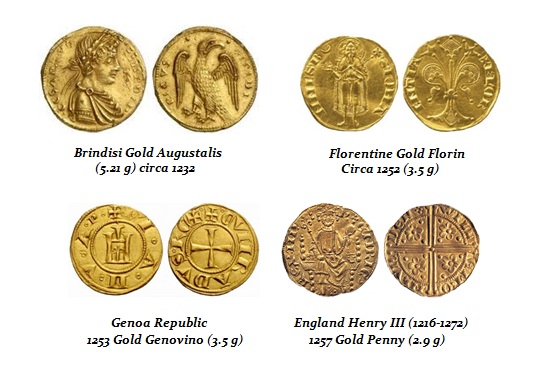
While the silver denier became the coin of Europe during the 8th century, it was not until the 13th century that we see gold reemerge as coinage. In actual Europe, that took nearly 800 years to pass before gold coinage reappeared.
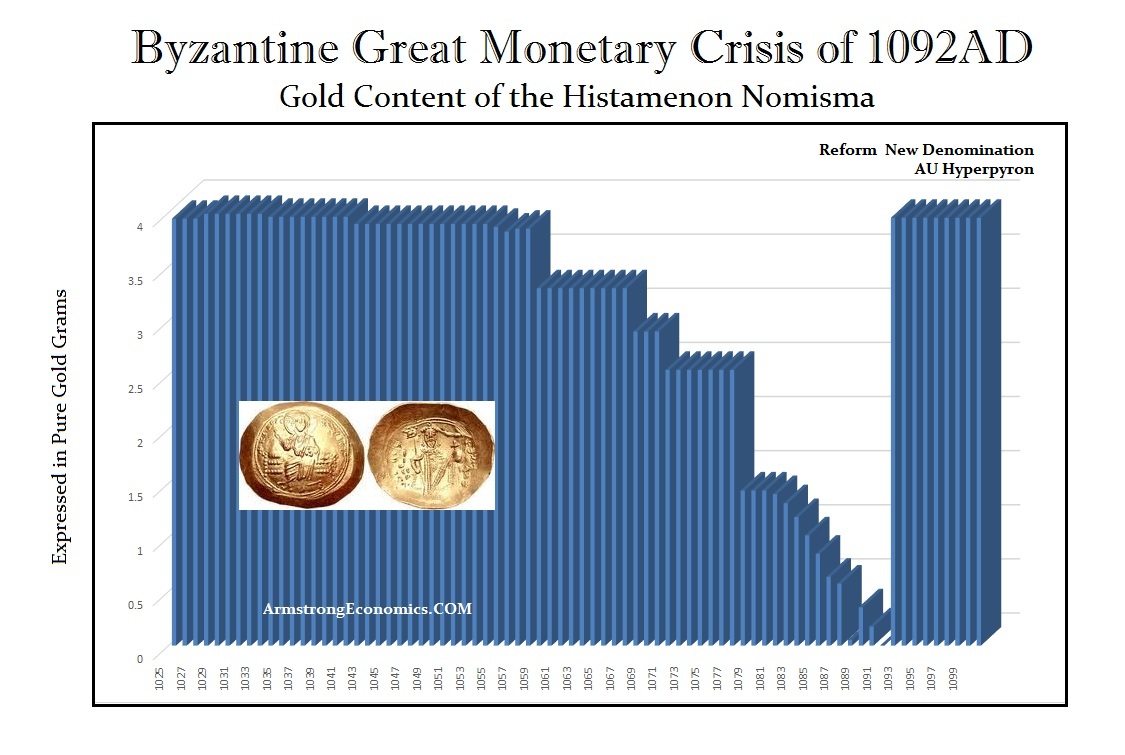
However, after the Great Monetary Collapse of gold in the Byzantine Empire in 1092, it took 172 years for good gold to reappear in Europe. When Constantine founded Constantinople in 330 AD and moved the capital of the Roman Empire from Rome to his new city, which is now Istanbul, the seat of power shifted from Byzantium back to Europe. That interval was again about 800 years.
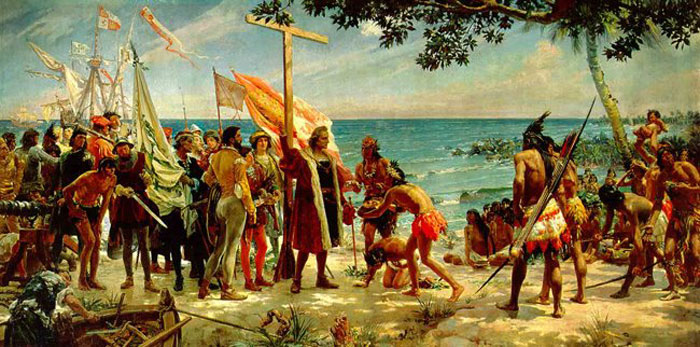
Columbus was trying to get to India, which was the financial capital, for it moved to Asia after the fall of Byzantium. That is why he calls the Americans “Indians.” He chose the wrong Greek mathematical who thought the world was round but smaller than it actually is. Columbus’ discovery of America was by sheer accident.
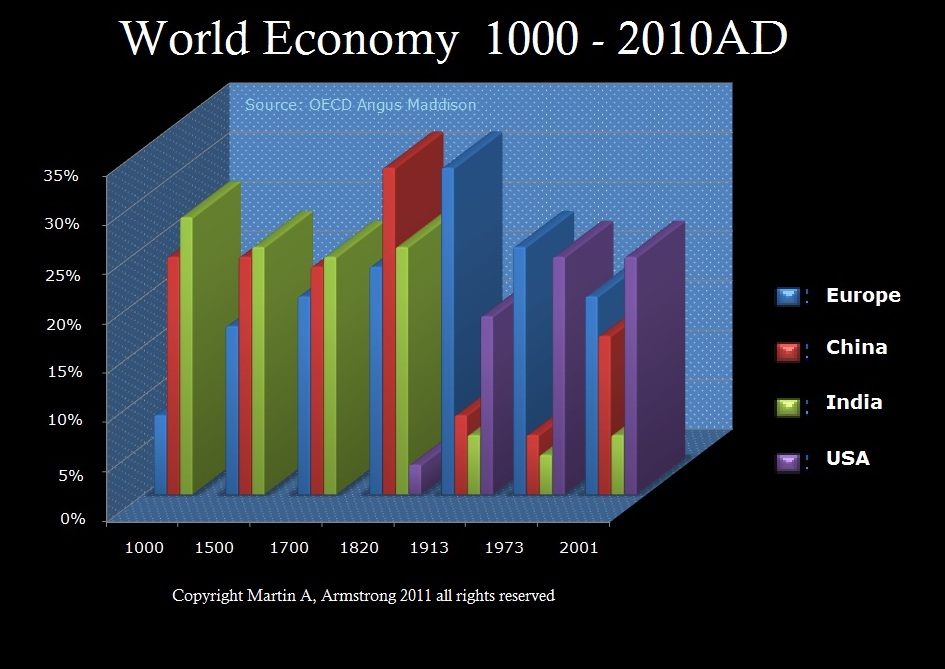
The West will fall and fragment. I do not see the US being occupied by Russia and China. There will be no one-world government. That is NEVER going to take place. Even in the aftermath, when the West has fallen, you will then see Russia and China become foes. Cycles are inevitable. So the world, according to Schwab, is the dream of a fool who ignores human nature and history.
Posted originally on the conservative tree house on August 18, 2022 | Sundance
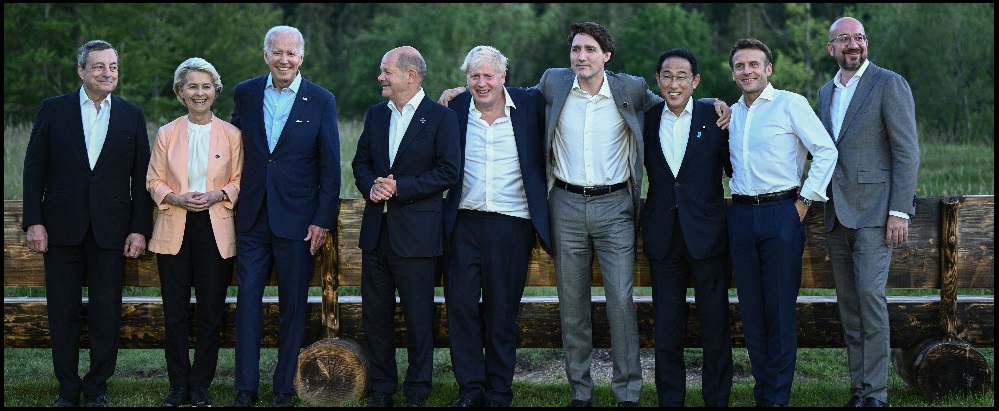
As a result of western governments’ taking collective action under the auspices of a ‘climate change’ agenda, we are on the cusp of something happening with ramifications that no one has ever seen before.
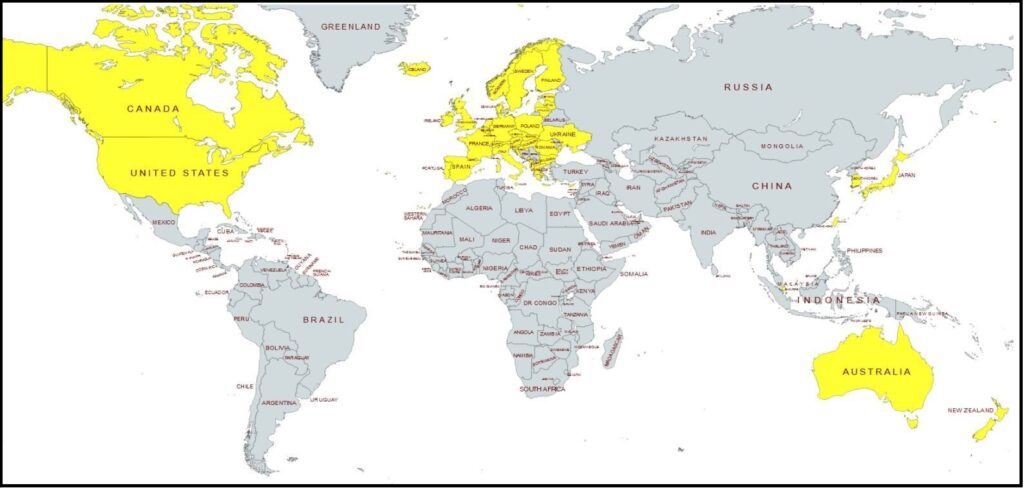
Western governments’, specifically western Europe, North America (U.S-Canada) and Australia/New Zealand, are intentionally trying to lower economic activity to meet the intentional drop in energy production.
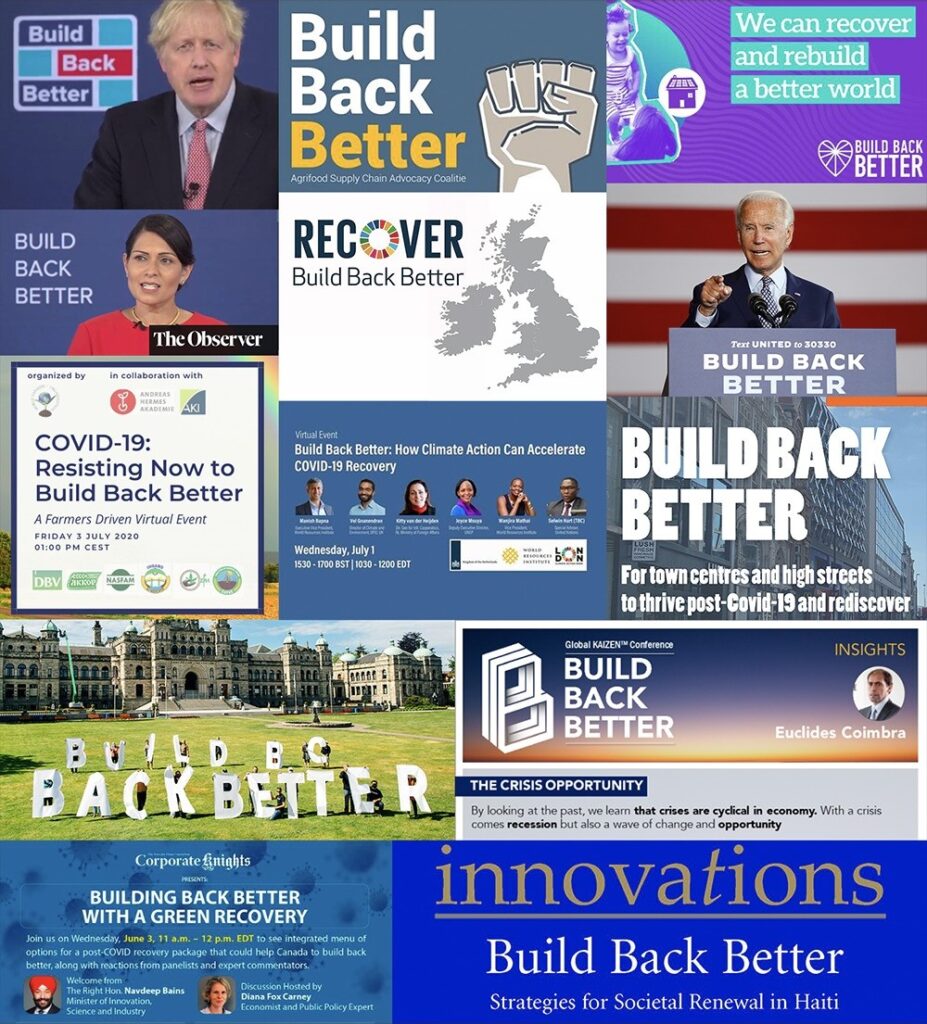
This is the core consequence of the Build Back Better agenda as promoted by the World Economic Forum.
Anyone who says there is a reference point to determine both the short-term and long-term consequences is lying. There is no precedent for nations’ collectively and intentionally trying to reduce economic activity.
Hiding behind the false justification that current inflation is driven by too much demand, central banks in Europe, the Bank of England, Bank of Canada and U.S. federal reserve are raising interest rates. The outcome we are currently feeling is an intentional economic contraction and global recession.
The Build Back Better monetary policy is successfully shrinking western economic activity; however, the impacted nations that produce goods for markets in North America and Europe, specifically southeast Asia, Japan and China, are not raising interest rates in an effort to try and offset the drop in demand. China has announced they are dropping their central bank rates in a desperate effort to lower costs and keep their export dependent economy working.
Underneath all of this, is a drop in energy production in the same nations trying to lower economic activity. The political policymakers are attempting to manage this process without informing the citizens of the unspoken goal. Shortages of oil, coal and natural gas are self-inflicted problems, all part of the BBB agenda.
Beyond the massive increases in energy costs, which is the true source of inflation and a direct/intentional outcome of the BBB effort, Europe is now facing a looming winter without the energy resources to heat homes and sustain people. Things are going to be very uncomfortable in Europe this winter as roaming brownouts are now predicted.
As the collective west attempts to, using their words, “manage the transition,” they do not have mechanisms to control an outcome of this magnitude. It is simply too big a situation to manage. Where the rubber meets the road, the think-tanks and high-minded climate change ideologues do not have the ability to manage a transition and still meet the needs of people. Beyond the esoteric thinking, there are real consequences from these actions.
Many people have discussed the potential for longer-term food shortages and recently, shorter-term winter heating. However, beyond that, the downstream geopolitical consequences are seemingly being ignored. Instead, what we see is an effort to keep pretending the climate change ends will justify the means (disruption of energy production).
In this connected world, when the western nations stop buying things, we find ourselves domestically with economic trouble. Businesses fail, unemployment rises, financial stress ripples throughout the economy, dependency on government subsidy increases and real pain is felt. However, beyond the domestic issues the supplier nations run into even bigger problems.
Unemployment in Malaysia, Vietnam, South Korea, Japan, Taiwan and even China, creates an entirely different set of regional stability issues on a geopolitical level.
There is no precedent for this. Never before in the history of industrialized nations has any government intentionally tried to lower its economic activity. It has never been done with intent before because within the contraction nations get more poor, people suffer.
Not only has no single nation ever tried to intentionally shrink its wealth, but there is no precedent whatsoever for an alliance of nations to join together with the same purpose. While this might seem like an academic economic modeling exercise, unfortunately it is very real. What I am describing is happening right now, and we had better start talking about it before the unforeseen consequences start to become a crisis.
In North America (U.S-Canada), Europe and Australia, there will continue to be massive increases in food prices as a result of the collapse in energy production. Beyond the western nations there will be food shortages as a result of lowered harvest yields and less industrial food production. This is not controversial.
It is also not controversial that regions with harsh winter climates are going to be paying much more for scarce heating resources.
That being accepted, what happens geopolitically, even militarily, when the entire global economy starts to feel the impacts from western nation economic contraction on a scale -created by collective action- that has never been seen before.
I have no idea what that big picture consequence looks like, but whatever “that” is, will be happening at the same time as people everywhere will be more desperate as an outcome of their economic position. I don’t have the answers, but I sure as hell can see the problem coming.
Political leadership in the aforementioned western nations are seemingly, perhaps intentionally, keeping people distracted with domestic shiny things to occupy time. However, someone needs to start talking about, and seriously challenging, the big picture consequence of this Build Back Better future, before it’s too late.
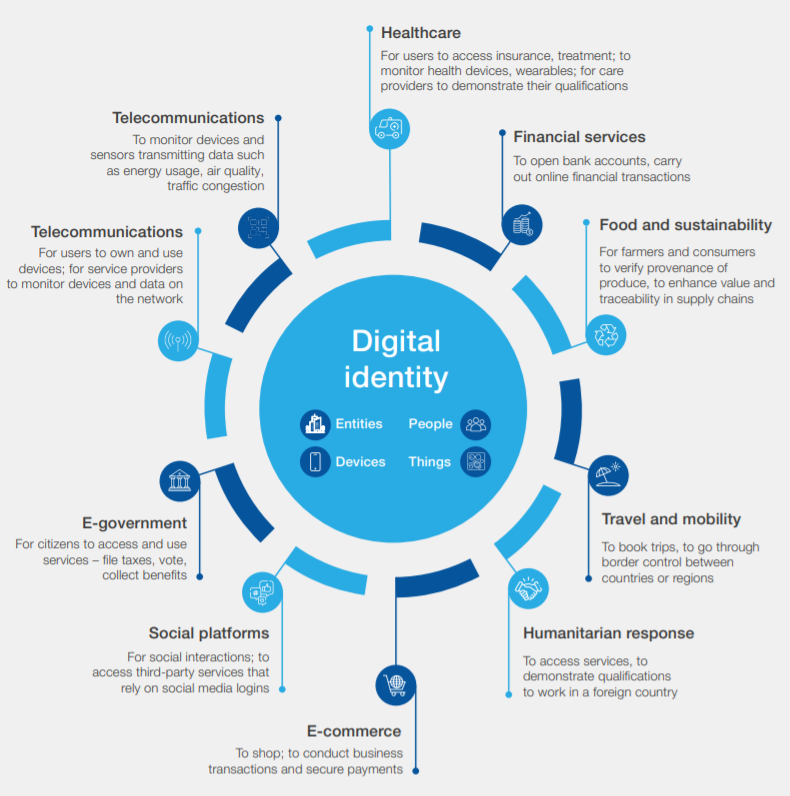
Trudeau is pushing forth the Great Reset at any cost. Canada will impose a federal “Digital Identity Program” to help the World Economic Forum develop a global ID system. Since the COVID passports failed, they are outright demanding that everyone carry proof of their digital identity.
“Now more than ever, we have work to do to make it easier for Canadians to interact with the Government of Canada, and we are committed to better serving Canadians in a digital age. This will require modern, integrated systems and an unwavering focus on the needs and experience of citizens. We have made progress, but we must continue to improve.

During the pandemic, the government quickly deployed new and innovative programs to support Canadians, but we have also seen examples where we can do more to deliver secure, reliable, and easy to use digital services.

Building on the vision outlined in Canada’s Digital Government Strategy, I am pleased to introduce the Government of Canada’s Digital Ambition (GC's Digital Ambition) which has been developed with this service imperative in mind… The GC's Digital Ambition will provide a solid foundation for the ever-evolving digital transformation of government. It will serve as an important tool to support the focus shared across ministers and departments to identify and implement better ways to ensure Canadians receive high quality, accessible, and efficient government services.”
We saw the power that digital IDs provided to governments. China was able to freeze bank accounts and prevent the freedom of movement by simply changing a QR code. As we saw in numerous countries with the COVID passport, people were unable to access public buildings and facilities. They were unable to leave their countries or provinces. Governments can effectively banish people from participating in society with digital IDs. This is simply one step away from actually microchipping the people as if we were owned by the government.
The Canadian government will be able to track every citizen’s movement. They will surely implement digital IDs into every facet of government, so the people will be required to carry their digital ID as if it were Nazi Germany. Freedom and privacy have been lost to tyranny.
Argentina is out of options. I reported on the ongoing widespread protests occurring across the country. The majority of the nation is unemployed, and the currency is basically worthless. The people can no longer rely on the socialistic promises as the government is unable to fund its programs. Basic necessities are no longer available, and the people are suffering.
Estimates state that inflation could reach 90% in Argentina by the end of the year. The government has run the economy into the ground, 6 feet under, and it will need a complete overhaul for the people to begin living comfortably again.
Consumer price gains hit their highest level since January 1983 in Canada. The news comes one week after the Canadian central bank surprised the markets by implementing a 100 basis point rate hike. June’s 8.1% inflation rate acted as another indicator that the Canadian economy is in trouble. The BoC is expected to raise rates by an additional 75 bps at the next meeting, but the central bank cannot solve this problem alone.
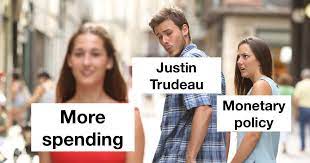
Canada is expected to post a 2% deficit in GDP this year, making it the poorest among the G7 nations. Finance Minister Chrystia Freeland announced that the nation would pull back on pandemic spending, which doubled Canada’s national debt. The Bank of Canada is relying on Freeland and the Trudeau Administration to reduce spending. Who will vote for Trudeau if he stops providing free handouts?
Rising interest rates are hiking up the price of debt servicing. Canada is still pushing for additional health and military spending and sending endless funds to Ukraine. Inflationary pressures will lead the people to look to the government for additional relief as they have provided it in the past.
Gas prices have increased 54.6% in the past year, natural gas and oil rose 38.8%, and food has spiked 8.8%. The hashtag #JustInflation has been spreading across social media as people are increasingly frustrated with Trudeau’s lack of response to the rising cost of living.
Yet another shake-up among Schwab’s leaders. Estonia’s Prime Minister Kaja Kallas stepped down from her role on a technicality before being reappointed a day later. Kallas’ Reform Party reached an agreement with the Social Democrats and Isamaa Party to form a new three-party coalition.
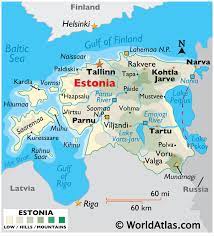
Estonia shares a 180-mile border with Russia and has strongly supported Ukraine before the war began. Estonia is a small nation with a population of around 31 million and a GDP of $36.29 billion USD. Their inflation rate is among the highest in Europe after spiking to 22% in June.
Estonia has a large Russian population but has the comfort of being a NATO nation. The new government is aiming to eliminate their Russian ties by banning Russian from being spoken in school. Russians and Belarusians now have a more difficult time immigrating to Estonia or even traveling there without a visa.
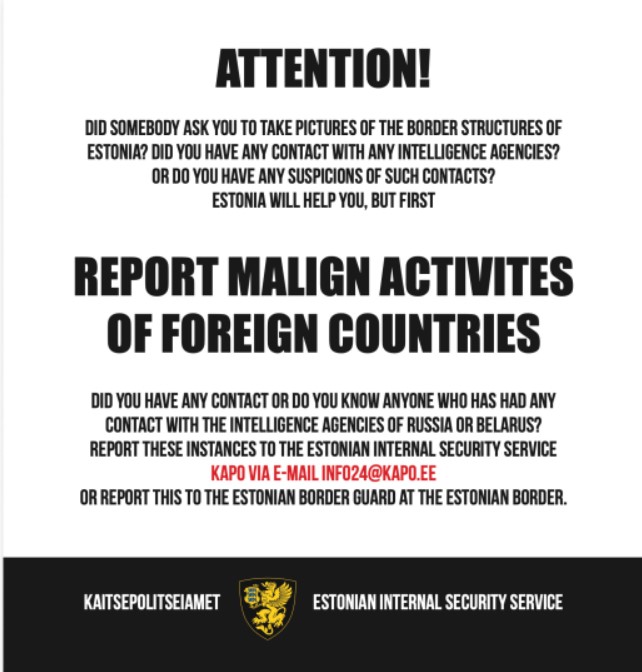
Estonia is cracking down on potential spies or intelligence agencies at the border. The poster above has appeared around the border, with the government encouraging people to turn in anyone who they suspect is involved with Russian intelligence agencies. Kallas also has the epigenetic fear of her neighbor as her mother, grandmother, and great-grandmother were once deported to Siberia. The small nation will use its strategic position to help the West’s proxy war, and Kallas herself said that negotiating a peace deal with Putin is off the table.
Housing availability dropped by nearly 50% from December 2021 to March 2022. The situation worsened once borders reopened as visa holders and tourists re-entered the nation. The vacancy rate, according to the CBD, has declined to 1.5% after peaking at 5.7% during the pandemic.
Some estimate that the “economic time bomb” of under-investment in affordable housing will cost taxpayers A$25 billion per year by 2051. Housing All Australians founder Rob Pradolin believes this figure is closer to A$110 billion, and believes a $55 billion investment could deliver a 2:1 cost-benefit ratio. At least 2 million Australian low-income households will be under “housing stress” by 2051. That is an optimistic forecast.
Similar to America, the UK, and many other nations, shelter inflation has caused housing costs to become one of the biggest budget expenses.
Prime Minister Scott Morrison has been accused of being out of touch by suggesting Australians simply buy a house. That is simply not possible for many, especially after the government-imposed lockdowns and shuttered countless businesses during COVID. Morrison has suggested allowing people to access their super (similar to pensions) early in order to purchase a home. Superannuation Minister Jane Hume said that this would result in rising home prices. Labor leader Anthony Albanese also criticized the plan by calling it a desperate “attack on future savings” and future generations. “If you take super away from people, then you’ll have higher deficits and bills from the government in the future,” he told reporters.
Oddly enough, Mr. Morrison vacated his own home, branded “Squat Morrison,” after losing the election to Albanese and taking his time leaving the property.
Unfortunately, Albanese has a worse plan in mind. Low-income residents will have the opportunity to buy a home, with the help of Big Brother government. The government will pay between 30% to 40% of total housing costs for 10,000 buyers annually. Instead of paying back the banks, the people must pay the government back if they can afford to do so.
Posted originally on the conservative tree house on July 10, 2022 | Sundance
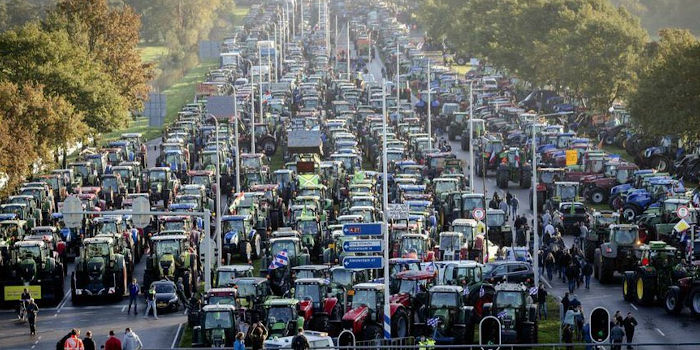
Despite the U.S. media not giving any time, attention or discussion to the rise of farmer protests in Europe, everyone should pay attention because the same climate change goals being enforced in the European Union are coming to North America.
The global food manipulators within the World Economic Forum have established the farming policy that aligns with their climate change goals. As noted in this Sky News discussion this is the Great Reset. It’s not just Netherlands Prime Minister Mark Rutte pushing the agenda, in 2020 Canadian Prime Minister Justin Trudeau gave an identical outline, with an identical timeline, for the exact same process [SEE HERE]. The collective WEF political leaders are all singing from the same hymnal.
In this discussion and interview segment, the spokesperson for Netherlands, Agricultural and Horticultural Organization Wytse Sonnema, outlines why there is such a broad sense of “frustration, anger, even despair” amongst farmers amid proposals for nitrogen reduction target plans. This will be coming to North America soon. WATCH:
In very simple terms, the politicians cannot reduce the farming process for industrial food production without reducing the farming yield. It is just commonsense.
You do not need to be a farmer to understand that nitrogen/phosphorus-based industrial fertilizer has been the reason why farm yields have generated massive amounts of food on a global basis. The United States, U.K. and places like the Netherlands have massively increased their ability to generate food for export, in large part due to the success of improved fertilizer and crop saving modern pesticides.
Larger discussion continues below….
It is a simple matter of math that if North American and European farmers are forced by climate policy to reduce their food production, there will be a shortage of food.
There will be a significant gap between the food needed and the new climate driven limits on commercial food production.
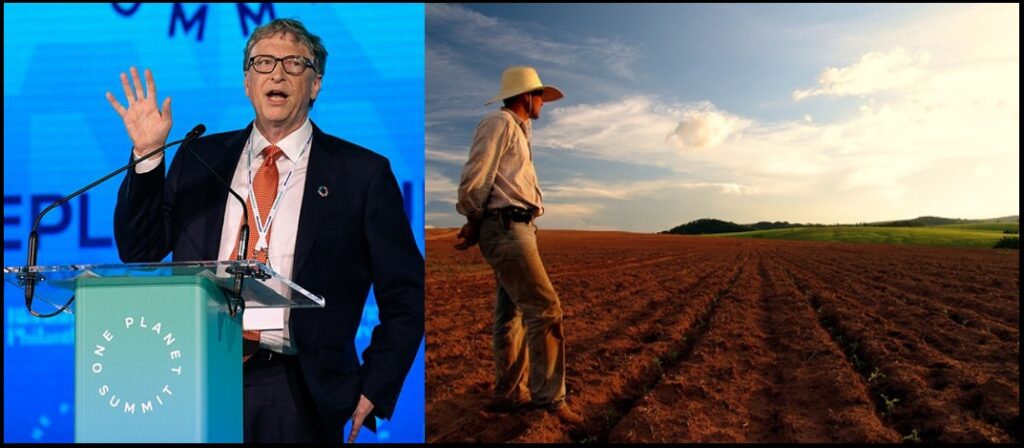
This intentional curtailing of food production, that creates the purposeful shortage of food, is where Bill Gates, the WEF and the synthetic meat and bugs for food advocates enter the picture. It appears the plan is to replace the missing global calories by changing the food supply. Changing what and how people eat.
Lab grown (synthetic) meat, nut/soy milk to replace dairy and bugs being used as replacements for protein sources are three approaches advocated by the climate change advocates that you are likely familiar with. However, as we saw in the pandemic response to food consumption, there is going to be a massive problem as the WEF attempts to shift food delivery within their Great Reset.
Think of the United States like a massive global farm and in this context the parallels between the U.S. and the Netherlands are quite remarkable.
Specifically, because of advancements in farming over the past two decades the United States food production has increased massively. The same is true for North America as a whole with Mexico and Canada included. Industrial farming advancements have made it possible to export billions of tons of food every year from our farms in North America to the rest of the world.
The Dutch farmers are like the U.S. farmers in their high productivity. In fact, the Netherlands is the second biggest agriculture and food exporter in the world. Even with a small population of 17 million people, the Netherlands has consistently been among the top contenders in the food export market {LINK}. The reason is simple, they are good at it.
Dutch farmers, like American farmers, are excellent at producing food. The Netherlands is one of the largest countries in the world when it comes to the export of agricultural goods such as meat, dairy, eggs, vegetables, and fruit. Unfortunately, this is why the climate change activists in the World Economic Forum have targeted them.
The Dutch farmers do not have as good a political shield as the U.S. farmer have via lobbyists. The reason the Dutch farmers have more vulnerability on a political front is because there are far more independent farmers who operate without the influence of large multinational agricultural corporations.
In the United States farming is Big Corporate Agriculture. Those massive ‘for profit’ multinational corporations have massive lobbying power in congress. If Biden wants to drop U.S. food production, for now he is going to run up against the interests of Big Ag, who make money from exports and control of U.S. farm harvests. In the Netherlands, the farmers are more independent, that makes them more vulnerable to the political influences.
It’s a weird dynamic, but U.S. farmers are both exploited by, and somewhat protected by, the Big Ag mafia. The Dutch farmers have remained stubbornly independent in their operations with less multinational influence. Unfortunately, right now that makes them less represented in the politics of the European Union.
The Dutch farmers are fighting back against the climate change politicians in the only way they can, a grassroots uprising. This is the battle right now in the EU, and the Dutch are being joined by their brothers and sisters in Germany, Poland and Italy. {Source}
This is not just a battle within the Netherlands and the EU to save farmers, this is a battle over the future of food in the world.
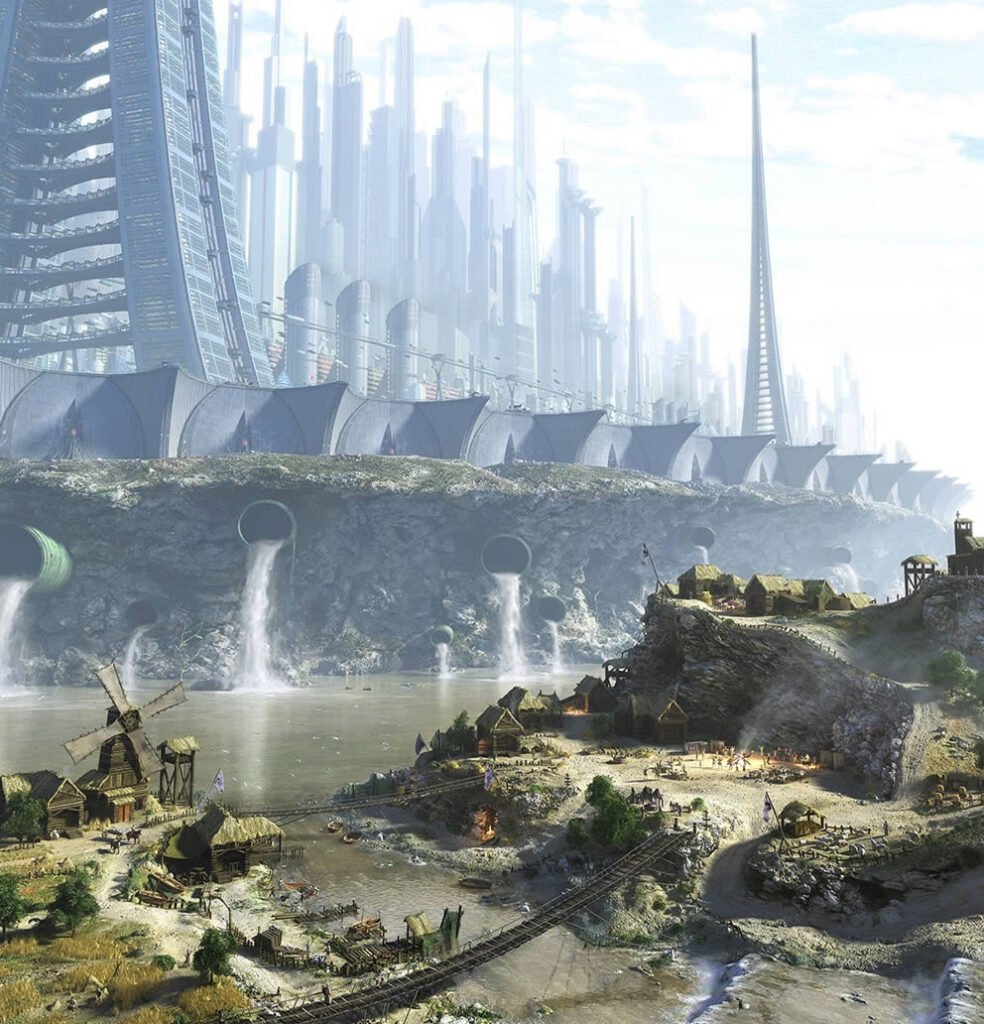
The western politicians, those who assemble under the banner of the World Economic Forum, want a world where ‘climate change’ policy drives the dictates of all human activity. Essentially, a government policy position that allows politicians to control the behavior of humans under the guise of climate mitigation. Ultimately it is the control part of this dynamic that is more important than the climate aspect.
The stakes in this Dutch farming protest are much bigger than just Dutch farmers.
If the farmers lose this war, we are all one step closer to eating bugs and fake meat.
.
Can you see how all of these ideological policies converge?
I have created this site to help people have fun in the kitchen. I write about enjoying life both in and out of my kitchen. Life is short! Make the most of it and enjoy!
This is a library of News Events not reported by the Main Stream Media documenting & connecting the dots on How the Obama Marxist Liberal agenda is destroying America




 Centinel2012