The Senate voted Thursday to confirm CIA chief Mike Pompeo as President Trump’s next secretary of state. Secretary Pompeo was confirmed on a 57-42 vote. All Republicans present voted to confirm Pompeo. Seven Democrats voted yes.
After the vote, Pompeo was sworn in by Supreme Court Justice Samuel Alito in the West Conference Room of the Supreme Court:
I am pleased with the Senate’s confirmation of Mike Pompeo to serve as our country’s top diplomat. Having a patriot of Mike’s immense talent, energy, and intellect leading the Department of State will be an incredible asset for our country at this critical time in history. He will always put the interests of America first. He has my trust. He has my support. Today, he has my congratulations on becoming America’s 70th Secretary of State.
An interesting discussion this morning on CNBC with White House economic adviser Larry Kudlow beings to highlight the principal purpose of his forte’.
President Trump is the first U.S. president who came to the table of economic policy with a plan of action that is uniquely his own. POTUS doesn’t need “advisers” to frame possible policy, he already has the program mapped out; POTUS needs ‘advisers” who are not actually “advisers” per se’ but rather a sales-force to explain and advance his program agenda to the world markets as the policies are implemented….
.
…Because this is such a substantial shift from historic reference, President Trump’s unique position of actually creating the economic policy must be emphasized and continually repeated. It’s not Kudlow creating the policy; these are President Trump’s policies. The granular details are carried out by U.S.T.R Lighthizer, Commerce Secretary Ross, Treasury Secretary Mnuchin.
Trade explainer Peter Navarro and Economic explainer Larry Kudlow are people specifically enlisted by President Trump to explain Main Street action (policy) and Main Street consequence (outcomes) to Wall Street markets.
It’s easier to understand the importance of Navarro and Kudlow when you remind yourself MAGAnomic policy is operating in a space between two historic economic engines. As Trump de-emphasizes multinational interests, and re-emphasizes domestic Main Street interests, a generation of financial and economic media have no frame of reference.
MAGAnomics operates in the space between two entirely divergent economic engines.
Go through the archives and you’ll note a strategy unfolding that few, including us, could fully conceptualize when it first appeared. Way back when candidate Trump first began to put his economic plans into platform outlines the subtle signature was there, but few were paying attention.
In order to reverse three decades of middle-class economic erosion, there were indicators that Trump’s strategy was a radical change in approach. In essence the strategy was to split the economic policy into two areas and sequence the policy: highly-consumable goods (first) and durable goods (second).
Both product sectors have historically been viewed and approached by economic policy makers using a single financial strategy. That singular approach gave rise to Wall Street benefiting and Main Street suffering. Investment-class gained; middle-class suffered.
Trump outlined an approach –albeit vaguely– that was multidimensional.
His policy would first target multinational corporations, using the U.S. Treasury (Mnuchin) to weaken their grip and influence; simultaneously, he would use energy policy to drive down domestic prices in highly-consumable products (fuel, food, energy sector). These sectors are not measured in fed inflation indexes; however, if lowered, these facets of consumer spending can also increase the amount of disposable income available for workers.
In essence, expand the economy by lowering the aggregate cost of living for the middle-class who live paycheck-to-paycheck. Use monetary policy, fiscal policy and trade policy to entice domestic investment and create jobs; and ultimately put upward pressure on wages.
When the tax cut and reform package passed in December 2017, phase-one cemented and a new phase immediately began. Phase II, 2018.
The second aspect, or second phase of Trump economic policy, is geared toward ‘durable goods’. That’s where the trade imbalance plays a larger role in the strategy.
As the economy expands, Americans can now afford rises in the prices of durable goods. However, as with all manufacturing systems -geared toward retaining market share inside a consumer economy (ie. the U.S. market)- the foreign creators will first seek to retain competitive pricing structure by making efficiencies within their own business models.
When foreign manufacturers entering a phase of cost-cutting analysis (note what happened when Trump left Asia after visit) you immediately hit them with stronger forecasted trade rules on their products.
The financial analysis and five-year-plans, being conducted by the manufacturers, then has to contain the possibility of new rules. That’s where Commerce Secretary Wilbur Ross and U.S. Trade Representative Robert Lighthizer come in:
On Oct. 5, 2017 the ITC [International Trade Commission] voted unanimously in favor of Whirlpool, which brought a complaint forward accusing Samsung and LG Electronics, its South Korean competitors, of flooding U.S. markets with cheap washing machines and pricing out domestic manufacturers. While the ITC didn’t say material harm was coming from South Korea in particular, Whirlpool alleged the country’s manufacturers shifted production into other countries (Thailand and Vietnam) in order to avoid U.S. anti-dumping tariffs imposed in previous years.
The ITC’s recommendations will be sent to President Donald Trump, who will have two months to make a final decision.
This second phase is where the two economic engines: Wall Street and Main Street; begin to come into parity again. The FED (monetary policy) does measure the cost of durable goods in their inflation index. Rises in durable goods are recorded in inflation indexes and monetary policy (interest rates) is influenced accordingly.
Trump’s phase-one befuddled the FED who were perplexed over inflation being virtually non existent. Most of the reason for this disconnect has been the downward price pressure on (non-measured) highly-consumable goods; and static prices on (measured) durable goods. The FED could see the economy expanding, but they cannot, or at least couldn’t until now, reconcile the lack of inflation.
Wages are growing, albeit modestly at first – but now gaining speed, as a result of economic expansion and increased employment. This wage growth, in combination with keeping downward pressure on high-consumable prices, allows Trump to begin a series of aggressive trade policies that will slowly raise durable good prices.
The trade policy, tightly executed by Trump, Mnuchin, Ross and Lighthizer, will put increased pressure on manufacturers to make products in the U.S. In turn this puts further demand on U.S. workers; which, in turn, drives up the wages – to afford the prices of durable goods as they increase. This action/consequence is not accidental, it is planned.
Simultaneously, it must be remembered that every dollar removed from imports actually increases the GDP. The value of all imported goods is deducted from the combined value of all goods and services we produce. If we drop $1 billion in imports on Washing Machines, and simultaneously manufacture $1 billion on Washing Machines in the U.S., the U.S. GDP gains $2 billion in value. The U.S. economy actually expands by more than $2 billion because the attached manufacturing wages are also inside the U.S.
This multi-prong approach is one of the reasons why it still doesn’t seem to be part of the strategy to keep the U.S. inside NAFTA as it currently is constructed. Perhaps, just perhaps, the NAFTA exercise is more optical than actual. Perhaps, it’s more about the outside world seeing the U.S. trade position as executed, than actually negotiating. Regardless of motive we shall soon find out.
President Donald Trump called-in to ‘Fox & Friends’ morning show for a wide-ranging interview on numerous subjects. Topics included: the Iranian nuclear agreement; Ronny Jackson’s withdrawal decision; Michael Cohen and possible North Korea summit.
Additionally, President Trump shared his disappointment with the Justice Department; noted James Comey’s book was likely a big mistake; and also thanked Kanye West for his support.
Earlier today President Trump hosted the Wounded Warrior Project at the White House:
[Transcript] East Room – 11:00 A.M. EDT – THE PRESIDENT: Please. Thank you very much. I’m thrilled to kick off the Wounded Warrior Project Soldier Ride, and to be in the presence of — really, to be with you folks is such an honor. I know some of you. We’ve been dealing together for more than a year. I’ve watched you get better and stronger, and you’re stronger than all of us. So I want to thank you all for being here. Thank you. Thank you very much. (Applause.)
So on stage with me are Wounded Warriors from the Air Force, the Army, the Navy, and the Marine Corps. We salute you, we thank you, and we will forever be grateful for the sacrifices you made for all of us. Really incredible sacrifices. A nation is sustained through the service and sacrifice of patriots. Each of you is part of the long, unbroken chain of courageous Americans who have answered the call in every generation, defending our families, our freedoms, and our great American flag, which we love. Right? (Applause.)
You are the backbone of our liberty. You are the protectors of our community. And you are the proud and beating heart of our magnificent nation.
I want to welcome the many members of Congress who are with us and joined us today to cheer on these incredible, brave warriors, and give special recognition to members of my Cabinet who are with us. Secretary Zinke. Where’s Ryan? Ryan, stand up. (Applause.) Sit down. (Laughs.) Thank you, Ryan. (Applause.) Secretary DeVos. Betsy, thank you. (Applause.) And Acting Secretary Robert Wilkie, who is doing a great job over at the VA. I can tell you that. Thank you. (Applause.)
And a great friend of mine, and a woman who — I’m getting reports from everybody, who’s doing well. Who’s doing — I always ask “Who’s doing the best?” And always right near the top or at the top is Linda McMahon. Thank you, Linda. Great job you’re doing. Thank you very much. (Applause.)
And, Bill, Senator, please stand up, and Congress — Bill, stand up. Please. A lot of good congressmen. My friends. There’s a brave one. (Applause.) These guys — and they fight for you. They fight for you. You fought for them; they fight for you. That I can tell you. Especially this group. Thank you, Bill. Thanks, everybody.
We also want to thank our really amazing — these are amazing people — the military spouses and families. Could the families and spouses please stand up? Incredible people. Incredible people. (Applause.) Their love and dedication and support is really the foundation of our military might. We give them a lot of credit. Right?
So I especially want to thank Mike Linnington and everyone at the Wounded Warrior Project. Thank you, Mike. And Mike has done an incredible job. Mike spent 35 years leading soldiers as an infantry soldier, reaching the rank of lieutenant general. And I know Mike agrees that there is no more important job than supporting the warriors who have fought and bled to keep us free. So I want to thank you very much. We all want to thank you. (Applause.)
That’s why we are fighting to reform the VA. And that is why we signed VA accountability legislation into law. I want to thank you folks, because that’s been — they’ve been trying to get that through for over 30 years. Accountability. We want accountability. They don’t treat our vets good, we want them out. And that’s what we can do now. We couldn’t do it before.
That was a tough one to get through, but we got it through. And now we’re going for choice. And we’re going to get choice. And that’s another one that I’ve wanted right from the beginning. And we’ll get that done too.
So I’m so happy with accountability. It’s been worked on so long. We have people that were terrible working there and they’re gone. And before we couldn’t do anything about them. But we’re very happy and we’re going to have the finest choice program that you’ve ever seen. In fact, we turned down one program because we truly didn’t think it was good enough. Is that right? We could have gotten it passed, and I said, “Nope, not good enough. We’re going to go for the real deal.”
So we’re going to have choice. There’s no more waiting on lines for 12 weeks, and you can’t get the doctors, you can’t get what you need. So we’re going to have choice. It’s going to be a really good one and these folks are going to be responsible for it. So I want to thank you all.
This month marks the fourth anniversary of the Phoenix VA scandal. Horrible scandal. And we must make sure that this kind of tragedy never ever happens again. We must always protect those who protect us. The heroes in this room today come from every background and every single walk of life. But they are united by the sacred bonds of duty and loyalty that hold us together as one nation, under God. Your devotion, your endurance, and your unbreakable will are all a great inspiration to every single American.
Each of you has endured life-changing injuries. Each of you has conquered adversity with resolve — never giving in, never giving up, and never ever backing down. Have you ever given in, anybody here? I don’t think so. (Laughter.) This is not a stage of those that gave in. Is that right? Would you say — do we have any giver-iners? I don’t think so. (Applause.)
They don’t know what that word — those words — mean. They don’t know. They are winners.
As the nation and all nations watch you ride today, they will see the fighting warrior spirit that thrives in your souls. And by the way, our military — recent budget — General Mattis asking — $700 billion — never happened before. And next year — we don’t’ even talk about it — already approved $716 billion. So that’s really something. That’s what we had to get. That was number one on our list even though we had to approve a couple of things that we weren’t so happy with because of some folks that are not friendly to our military. $700 billion, and $716 million, and $6 million for opioid.
We’re going to fight that opioid situation harder than anyone has fought it before. We’ve already begun. But $6 billion for opioid and stopping that scourge, and also for working with those that have unfortunately met with the opioids in a very bad fashion. So we’re going to spend a lot of time, a lot of effort, and now we have the money. So thank you all, fellas. That’s great. (Applause.)
With that, we will be able to see you through — that brave example, that out nation can defeat any hardship, meet any challenge, beat any setback, and rise from our trials stronger and more determined by far, by far, than ever before. Our military will be stronger, more powerful than at any time ever before. Better equipment — we make the greatest equipment in the world.
It also means jobs. By the way, far secondarily, jobs. Jobs are a benefit, but that’s far secondarily.
One warrior with us today is someone I first met years ago. His name is Dan Nevins and his incredible story embodies the long journey of recovery and triumph that each of you represent so beautifully. Each of you just represent it beyond what anybody can do. It’s incredible.
Dan served as an Infantry squad leader of Task Force Tacoma in Iraq, in 2004. While on a combat mission, his vehicle was struck by a roadside bomb. Dan was severely injured, ultimately losing both legs. Through countless surgeries, Dan refused to give in. He is a fighter and he is a champion. (Applause.)
And the Wounded Warrior Project was there to help Dan along his difficult journey, where he’s had such tremendous success. Dan is now a nationally-recognized motivational speaker, and works to serve other veterans and their families.
I also know from personal experience that Dan is a great golfer. (Laughter.) How do you think that makes me feel? (Laughter.) He’s a great — he really is, he’s a really good golfer. Right? (Applause.)
So, Dan, I want to thank you for everything. You’re really an inspiration — everything you’ve done and will continue to do for our beloved nation. We love this nation. We’re in your debt, and we are in the eternal debt of every single person on this stage — the Wounded Warriors. These are our most incredible people, our most incredible people.
As you set out on your Soldier Ride, all of America will be cheering you on and watching. And all of America will be celebrating your strength, and your tenacity, and your unwavering love of your country. My pledge to you, our noble warriors, is that my administration will support you, and your loved ones, and your amazing families every single day, now and always. We’re never going to forget. That is our sacred commitment.
As Dan comes to the podium, I want to again thank you all for honoring us with your presence today. Thank you all, and thank you all for the help, everybody. It’s a tremendous help. This group, in particular, has been of great help.
May God bless you. May God bless our Wounded Warriors. May God bless our military. And may God bless America. Thank you very much. Thank you. (Applause.)
STAFF SERGEANT NEVINS: Thank you, Mr. President. You know, I actually remember the first time meeting you, Mr. President. It happened to be at one of your golf properties, and you were hosting a charitable fundraising tournament for Wounded Warrior Project.
And I remember coming up to the par 3, and you were stationed there greeting all your guests and saying thank you, and being a gracious host. And I stepped up and just felt all this pressure. I have to hit a good golf shot.
And I stepped up to the tee, I hit a beautiful shot. And I was, like, just remembering the reality of the situation. (Laughter.) It nestled maybe two feet from the pin. And I was so excited I just — under all the pressure of you watching, I just nailed it. (Laughter.) And then everybody else went, and then it was your turn. And you hit your golf shot, and it landed on the green well away from mine. (Laughter and applause.) Wait, it gets better. But then the ball released and starting rolling right past mine and almost in the hole. (Laughter.) So great. It was a great shot. Like, really a great shot is a great shot. And it was an honor to be on the tee box with you then.
THE PRESIDENT: Thank you.
STAFF SERGEANT NEVINS: And it’s even a greater honor to share the stage with you now as you graciously host Wounded Warrior Project Soldier Ride and these amazing warriors who’ve served the cause of freedom with distinction.
And it really — it’s truly a privilege for me to be here to celebrate 15 years of Wounded Warrior Project, an organization that has done so much for me and countless other warriors and families through the lifesaving programs and services that they provide every single day.
You know, Soldier Ride, what we’re here for, this event is very near and dear to my heart, as it is for thousands of warriors who’ve graced the roads and bike paths across this great nation from right here in our nation’s capital, and from sea to shining sea. This event has been changing and saving lives since its creation.
You see, as you heard, I’m a Wounded Warrior. And my life was changed forever 13 years ago when an improvised explosive device detonated beneath my vehicle and shattered life as I knew it. As a result of the blast, I lost my good friend, Sergeant First Class Mike Ottolini. I ultimately lost both legs below the knee, and I live with the effects of a traumatic brain injury. And if it weren’t for the quick action of my brothers on the battlefield and my brothers and sisters in the military medical community, I would not be standing here today. I’m so very grateful for all the love, support, and help I received in my transition from the battlefield back to civilian life.
And I’m certainly grateful for how Wounded Warrior Project intervened and showed up for me. From my first day at Walter Reed to how they show up for me right now, these are the ones that helped me learn that disability didn’t define me, but that I get to define what the rest of my life was going to be like. And they helped me learn that anything is possible when I put in the work.
And I vividly remember my first Soldier Ride in 2006. And I was a recent amputee and I was wrestling with the visible and invisible wounds of war. And I thought that I couldn’t. And then, through their motivation, I put in the work. And I finished the almost-400 miles with a new understanding with what was possible for my life, and what was possible for everything that laid out as a journey defining my new normal.
Wounded Warrior Project has been helping our nation’s finest in the journey to healing since 2003, when they delivered backpacks filled with comfort items to our Wounded Warriors in military hospitals in Germany and across the nation. Today, they deliver over a dozen life-changing and lifesaving programs that deal with mental health, physical health and wellness, economic empowerment, and engagement with each other as warriors, with our families, and our communities when we return home.
They’ve invested more than $1.1 billion into these life-saving programs and services. They ensure and they are ensuring that we have the most successful, well-adjusted generation of Wounded Warriors in our nation’s history. And I couldn’t be more proud to stand on this stage and represent this organization here today. And this is a message to the amazing Wounded Warrior Project team, to the volunteers and the technicians that make the impossible happen on each and every single Soldier Ride: You are all my heroes, and I love you. (Applause.)
And to the warriors here today, thank you for everything you’ve done, and for who you are and everything you continue to do, and how you continue to serve and be an example of the very best our nation has to offer.
Mr. President, it’s been an absolute honor to be here with you today. And on behalf of myself, the warriors and our families, and Wounded Warrior Project, thank you for hosting us so graciously and for continuing to champion the men and women that have proudly defended this great nation.
THE PRESIDENT: Thank you, Dan.
STAFF SERGEANT NEVINS: Thank you. (Applause.)
And now I have the distinct honor to introduce the lead of Wounded Warrior Project — the team that is Wounded Warrior Project. An outstanding man and a great friend, Lieutenant General Mike Linnington. (Applause.)
LIEUTENANT GENERAL LINNINGTON: Thank you. Thank you, Dan. Dan is what really is the epitome of success in our warrior population. His service, his sacrifices, his inspiration, and most importantly, his commitment to his fellow warriors — brothers and sisters in arms that earned our great thanks and deserve our very best efforts to assist in their continued recovery and rehabilitation.
Mr. President, thank you.
THE PRESIDENT: Thank you very much.
LIEUTENANT GENERAL LINNINGTON: On behalf of our Wounded Warriors, and their families, and their caregivers, our Wounded Warrior Project team, and all our amazing partners, thank you for graciously hosting us as we celebrate and honor these brave Americans and the families and caregivers that love and support them.
These men and women are truly exceptional, strong, capable, and successful. As the President said, “their strength and resilience in the face of insurmountable odds is an inspiration to all Americans and a reminder — a stark reminder of our responsibilities to assist in their journeys of recovery.” And that’s exactly why we’re here at the White House today.
What a great honor it is to do what we do to provide support, healing, and hope to our Wounded Warriors who have made our very freedoms we enjoy as Americans a reality. Mr. President, thank you for your leadership, and taking the time to honor and empower our nation’s finest, and the work you have done and will continue to do on behalf of our military and our veteran’s community. Thank you, Mr. President. (Applause.)
THE PRESIDENT: Thank you very much, Mike.
LIEUTENANT GENERAL LINNINGTON: Thank you, Mr. President.
THE PRESIDENT: I thought while we were here — first of all, hello, Elizabeth Dole. Hi. How you are sweetheart? Thank you very much for being here. Such a great, great husband and a great family. We appreciate it and all you do. Thank you very much. (Applause.)
And I thought I could just bring up to the stage for a second our great representatives who have — Bill, everybody, Brian — if you could just come up for a second. I think you certainly deserve to be on this stage. You’ve really worked so hard to get all of this done and we appreciate it. Come here.
REPRESENTATIVE PETERSON: Thank you, Mr. President.
THE PRESIDENT: Thank you. Thank you very much. Go on up. Thank you much. Thank you. You ran for office, nobody’s going to beat him. I’ll tell you. Right? (Laughter.) Nobody.
REPRESENTATIVE MAST: That’s right. Yes sir.
THE PRESIDENT: How about saying a word on behalf of —
SENATOR CASSIDY: I have the privilege to speak on behalf of Congress. (Laughter.)
THE PRESIDENT: It’s not easy.
REPRESENTATIVE ISSA: Don’t screw it up.
THE PRESIDENT: Not easy. (Laughter.)
SENATOR CASSIDY: We have at least two men of combat here and maybe more. I don’t know your story. Oh, hey, Ted. (Laughter.) I didn’t recognize Ted since he became a skinhead. (Laughter.)
And it’s hard to speak for Congress — not because we’re different, not because we’re Congress, but because when you’re in the presence of folks such as these, no word is adequate to express our appreciation, our humility between our fellow Americans who sacrificed so much, and for their families who sacrifice so much to truly bless us all.
From the founding of our nation until now it has been those such as these who have made this country the greatest — the greatest in the world.
And I will close by saying this: First, Mr. President, it was an incredible state visit that you just hosted for President Macron. And President Macron, as he spoke to Congress, emphasized that of all the challenges facing our world, without U.S. leadership, none of our — it is not possible to have the success that we need.
I would add to that — as I think both President Trump and President Macron would — at some point, U.S. leadership becomes the U.S. military enforcing values on those who would seek to destroy us. As long as we have those such as these protecting our values, we will win. And more importantly, so will the cause of freedom, the cause of equality, the cause of — the cause of the average man and woman being able to achieve his or her dreams. On behalf of that average man and woman, I once more thank you all. (Applause.)
THE PRESIDENT: Thank you. Thank you, fellas. We’re with you always. Thank you very much. Thank you. (Applause.)
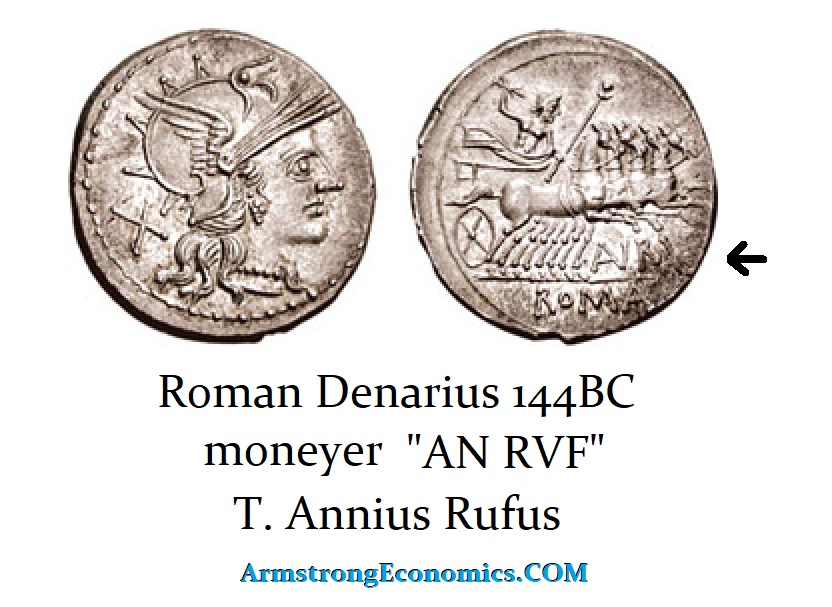
QUESTION: I found your article on the theory of money supply is not the source of inflation very fascinating. I was taken back by the fact that there were moneyers who signed the coins for their term each year as we still do today. Are there any other traditions from Rome that we still maintain with respect to money?
PF
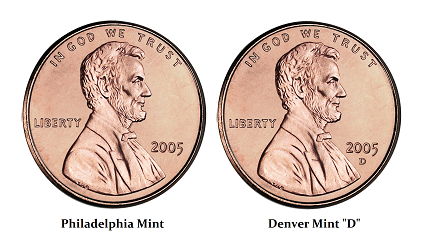
ANSWER: That is an actually a good question for it demonstrates how traditions lose the purpose for what they were originally introduced as a solution. You will notice that some pennies or quarters, for example, have mint marks. There will be no mint mark reflecting it was coined in Philadelphia, “D” for Denver, and “S” for San Francisco. The Denver Mint was established to process the silver finds in Colorado and San Francisco was established because of the California Gold Rush. Those events are long since past but the mints still remain. Mints were also established in New Orleans (O) and Carson City Nevada (CC). They were closed after the roaring bullion days.
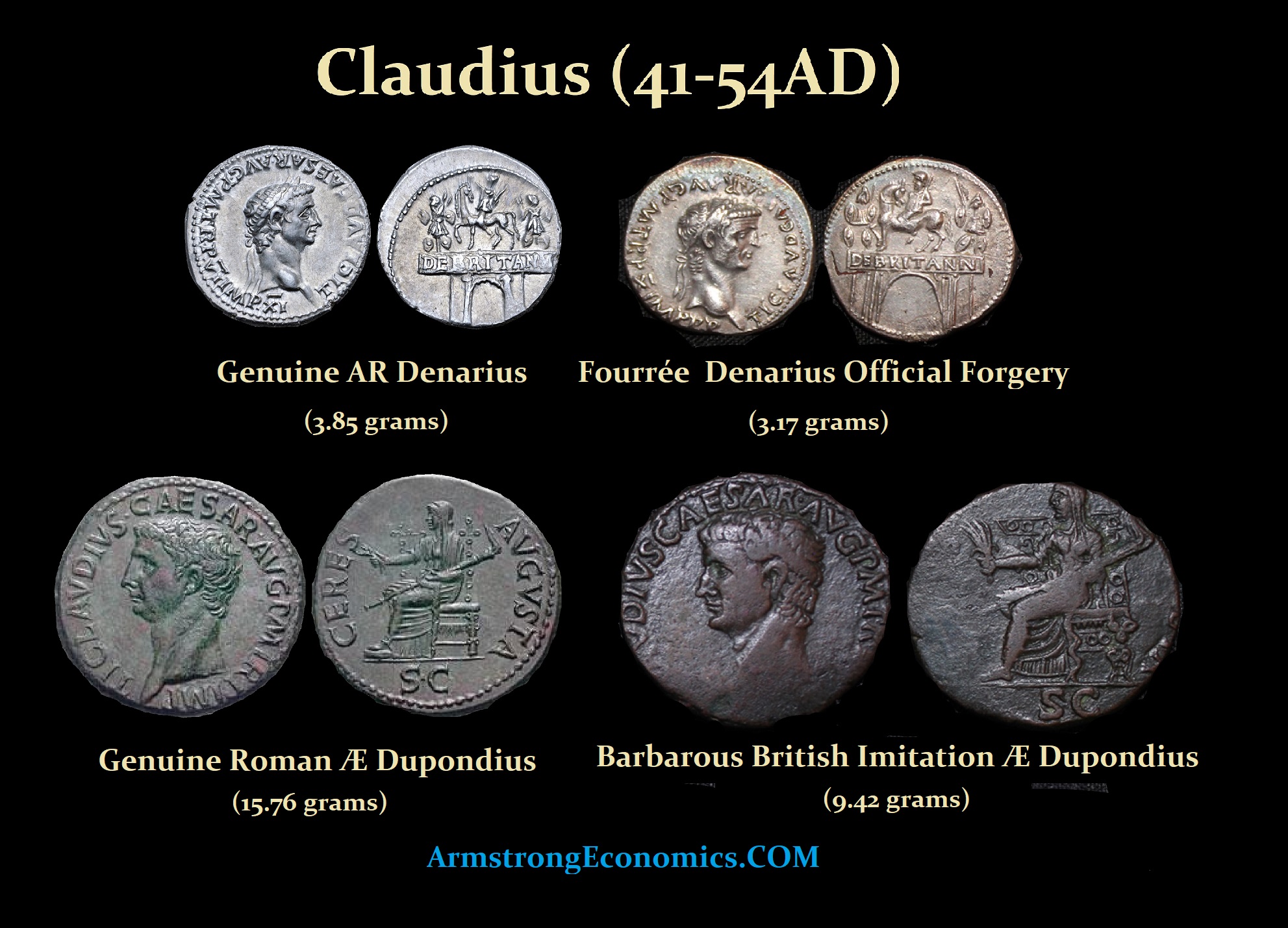
There were forgeries of coins in the precious metals as well as bronze just about as soon as coins were invented. When you look at the counterfeits that were being made in the outer regions surrounding the Roman Empire, we can easily distinguish such forgeries based upon style looking at the bronze Dupondius of Claudius (41-54AD). The forgers obviously lacked people with talent to copy the dies. Now, look at the silver denarius forgery. Here the style is professional. Such forgeries are made from bronze and silver plated. They are called Fourrée Denarii being plated in silver. The dies are professional. Because these are known throughout the entire run of Roman coins, it is believed that this high level of quality was probably “officially” produced in the various mints. It is most likely that they were frauds by the mint staff rather than officially sanctioned.
When Government No Longer Accepts Its Own Money
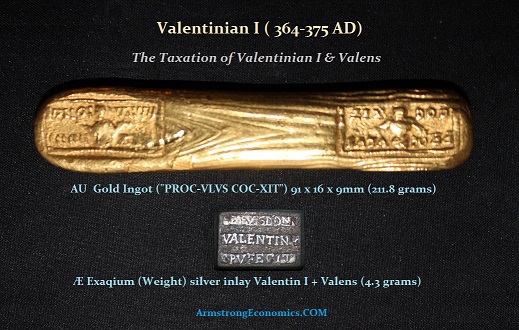
Despite the fact that the Emperor Valentinian I (364-375 AD) faced constant frontier wars, he addressed the finances of the Empire head-on. In 366 AD, Valentinian carried out an important reform of the tax-collection system which was enacted whereby payments to the Imperial Treasury would no longer be made in coin but in refined bullion. All coins were to be melted down and refined being poured in the form of officially certified gold and silver bars as pictured here. Taxes were to be paid in bullion and not coin to ensure the highest metal content. Effectively, the government would no longer accept its own coinage as legal tender. The existing coinage was melted down as a necessity because of the quality of the metal content and the underweight of the coinage in addition to the pervasive counterfeit coinage in circulation, undermined the confidence in the circulating currency.
Additionally, some mints were engaged in outright fraud as mentioned above. Mint staff had become very corrupt by this point in time during the 4th century and the problem was so acute that the anonymous author of the “De Rebus Bellicis”, which was a work that suggested remedies for the military and financial problems in the Roman Empire at that junction in history, recommended action against the mint staff. This work recommended isolating all the monetary staff producing coinage and prosecuting them for their frauds. The new system of melting down the coinage introduced by Valentinian I ensured that the treasury was refilled with the added advantage of restoring both the public and foreign confidence in the precious metal coinage once again. New arrangements were also put in place for the making of gold and silver denominations under the control of the Emperor. Previously, this had been in the hands of the various mintmasters. Valentinian’s reform was aimed at limiting the activities of the mint staff to the production of base metal coinage while gold and silver denominations were to become the prerogatives of potentially mobile minting establishments operating in the environments of the Imperial palaces where ever the Emperor happened to be in residence.
Rome during the 3rd century introduced mint marks to keep track of what coins were produced from what mint. In this way, they were able to identify any mint that was cheating the people. Aurelian (270275AD) returned to Rome in 271 AD, where he had to pacify a terrified city. He immediately halted the rioting and restored order to the capital. The controller of the mint in Rome began a rebellion over the monetary reforms laid out by Aurelian. He ordered that all the debased currency be purchased back and replaced with a new currency of higher content in silver. The rebellion was led by Felicissimus. It appears that those who had been running the mint were embezzling the intended silver and issuing the debased coinage at least in part on their own authority. Obviously, any reform to the monetary system that called for an increase in silver content would have been unprofitable for those running the mint for personal gain. In the rebellion, as many as 7,000 soldiers died when Aurelian was forced to trap and execute them and their allies, some of the senatorial rank, in a terrible battle on the Caelian Hills. Now that is what you call monetary reform!
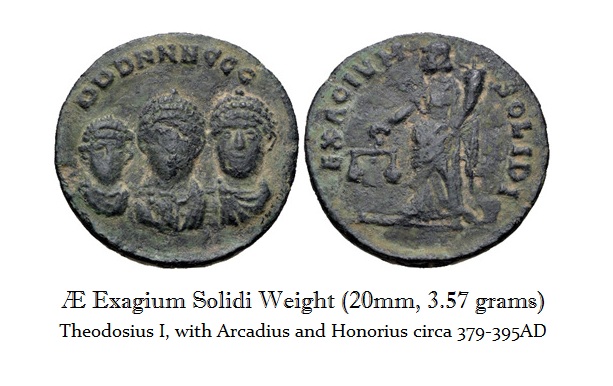
Currently, the advantage of paper money is that there are far fewer counterfeits in circulation today compared to Rome during the 4th century AD. The emperor who followed Valentinian I was still facing problems with the currency. Here is an Æ Exagium which is a Solidi Weight (20mm, 3.57 grams) for testing gold coins issued under Theodosius I. Clearly, the idea of a gold standard was not all that it was cracked up to be. Counterfeits were always a problem in addition to clipping and shaving the coinage to lighten the weight.
They often say the more things change, the more they remain the same. Some artists who were proud of their work signed the dies for coins. We find the artist who created the Lincoln penny signed the die in 1909 engraving his initials V.D.B. as did the artist Kimon in ancient Sicily on the Decadrachms of Syracuse during the 4th/5th century BC engraving his initials “KI” on the headband.
The Hunt for taxes
Just to bring to your attention a scandal coming out with the Tax office in Australia pursuing aggressive revenue targets, and using unethical practices to generate it.
D
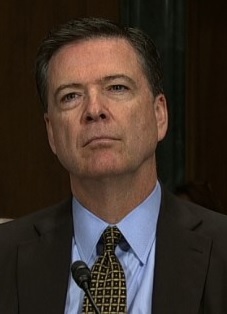
ANSWER: The scandal in Australia with the head of the Tax office is shocking involving a $165 million tax-fraud syndicate scandal. The police have arrested people in Australia which is admirable. The 2013 US scandal about the United States Internal Revenue Service (IRS) doing similar acts of abuse of power was never prosecuted or really investigated. It was revealed back then that the IRS had selected political groups applying for tax-exempt status for intensive scrutiny based on their names or political themes. This led to a pretend investigation by Attorney General Eric Holder. In January 2014, James Comey, who at the time was the FBI director and walks on water, told Fox News that its investigation had found no evidence warranting criminal charges in a neat cover-up.
Finally, in late September 2017, a report by the Treasury Department’s inspector general found that from 2004 to 2013, the IRS used both conservative and liberal keywords to choose targets for scrutiny. Finally, in October 2017, Trump agreed to settle a lawsuit filed on behalf of more than 400 conservative nonprofit groups who claimed that they had been discriminated against by the Internal Revenue Service. The settlement included an apology from the IRS and a very substantial monetary settlement. That’s how they do it in the States. Government is always above the law and people like Comey always protect the bureaucracy. He is now doing everything in his power to take down Trump for the bureaucracy.
The Australian Taxation Office and all its tax-avoidance investigations are now in jeopardy since the deputy commissioner is facing criminal charges and four of its officials stood down as well. This would NEVER happen in the United States.
COMMENT: I read your piece on taking the profit out of prostitution to end kidnapping young girls. That has been a huge problem in Eastern Europe and girls were even getting kidnapped in Western Europe on vacation. Here in Italy, there was a huge problem of kidnapping people and demanding money from their families. The government passed a law that if a family member was kidnapped, they froze the accounts of the family to prevent people from paying. At first, it seemed cruel. But once it was no longer profitable to kidnap people, it stopped. I think your idea would probably work.
VSZ, Rome
REPLY: When they tried prohibition in the USA, it did not stop people from drinking. What it did do was establish the Mafia in the USA. Suddenly booze was profitable. When prohibition ended, the Mafia was well funded and expanded into other ventures. When you make anything illegal, it becomes tax-free and there is the incentive to expand whatever that business might be. We are talking about human nature. During a crisis, legal goods are suddenly going for a premium. They call it price gauging which is illegal in Florida but it still goes on in a storm.
They are now warning Americans traveling to some parts of Mexico for they are starting the same scheme – kidnapping people for ransom. If there is a profit to be made from any illegal activity, it will be exploited. It does not matter what the subject might be from drugs, booze, to prostitution. Just follow the money.
U.S. President Donald Trump and French President Emmanuel Macron hold a joint news conference at the White House celebrating the historic U.S.-France relationship and discussing ongoing issues that are priorities for both countries.
.
[*take note* The closing remark by President Trump at the end of this press conference is straight out of central casting for principle centered leadership; the art of the authentic close; Wharton School CEO leadership 401; ie. ‘How to expand your influence‘.]
On June 29th, 2017, CTH drew attention to the advanced U.S. energy policy as it was being announced, and the media avoided coverage. At the time our headline was: “Stratospheric in Consequence – Trump Policy: Unleashing American Energy Independence”.
The bottom-line was simple. It was clearly visible that POTUS Trump had a plan to unleash the U.S. energy sector as part a much larger larger economic and national security strategy. The concept was so radical, and the potential ramifications so consequential, it was stunning how no financial media were putting the dots together.
Trump’s geopolitical energy strategy actually underpinned the national security interests with Russia, China, Iran and North Korea. Additionally, the same energy policy was one of the four corners of the MAGAnomic trade policy; currently becoming more visible.
Check out today’s headline from Reuters, and think about how outside-the-box thinking has brought about these results:
From the article: MOSCOW/LONDON (Reuters) – As OPEC’s efforts to balance the oil market bear fruit, U.S. producers are reaping the benefits – and flooding Europe with a record amount of crude.
Russia paired with the Organization of the Petroleum Exporting Countries last year in cutting oil output jointly by 1.8 million barrels per day (bpd), a deal they say has largely rebalanced the market and one that has helped elevate benchmark Brent prices close to four-year highs.
Now, the relatively high prices brought about by that pact, coupled with surging U.S. output, are making it harder to sell Russian, Nigerian and other oil grades in Europe, traders said.
“U.S. oil is on offer everywhere,” said a trader with a Mediterranean refiner, who regularly buys Russian and Caspian Sea crude and has recently started purchasing U.S. oil. “It puts local grades under a lot of pressure.”
U.S. oil output is expected to hit 10.7 million bpd this year, rivaling that of top producers Russia and Saudi Arabia. (more)
Yes, that article is describing exactly what you think it does. U.S. oil exports are countering the coordinated activity of OPEC and Russia. This trade strategy greatly diminishes the geopolitical influence of Russia and Iran who are dependent on oil exports to leverage policy of dependent nations.
Because economies of Russia and Iran are so heavily dependent on oil revenue to subsidize military expansion, any alternative by the U.S. reduces the militaristic ability of our geopolitical adversaries.
We noted the possible consequences in in two prior articles June 28th and June 29th 2017, in the lead-up to the Baltic Summit attended by President Trump:
2017: “Let me be clear about one crucial point. The United States will never use energy to coerce your nations, and we cannot allow others to do so,” President Trump said at a press conference flanked by European leaders. “You don’t want to have a monopoly or a monopolistic situation.” (NBC article link)
President Trump and Energy Secretary Rick Perry, together with EPA Secretary Scott Pruitt and Interior Secretary Ryan Zinke, are doing something with energy independence that was long discussed but never acted upon. Forget the Paris Climate Treaty, this Trump action on energy development is in a stratosphere thought almost unimaginable.
Together the entire cabinet has studied, formulated and instituted an executive American energy policy platform to go beyond mere energy independence, and actually start using energy resources as an export commodity for economic growth.
Pause for a moment and consider just how monumental that approach actually is; and also overlay the independent national security ramifications therein. The intensely consequential outcome is a visible representation of ‘America-First’ principles applied to deliver MAGA level shifts in the future of our nation. Massive possibilities for wealth creation at local and state levels; and simultaneous national security interests. Win – Win – Win… And yet stunningly this result is only in one sector of national security and national economics.
Lastly, not only does the U.S. go beyond energy independent into being an energy export nation…. but, also remember how GDP growth is factored?
GDP is the combined value of all U.S. goods and services, minus our imports. The less we import the less is deducted from our GDP growth. The more we export, the more we add to the GDP growth and/or offset any imports. Beyond the consequential geopolitical value, exporting oil means we gain massive domestic economic value.
COMMENT: Hi Martin, reading your article about the SPD imposing Marxism on Germany is horrifying. To see established political parties so greedy that they’re willing to partner with fringe parties to maintain control is nuts.
We’re currently seeing this in British Columbia where the Liberal party lost its majority due to a government formed by new Democrats and the Greens. Now, this handful of green party MLAs wield enormous powers. They’re impeding the expansion of kinder Morgan’s pipeline to Vancouver, despite FEDERAL regulatory approval.
How can so few, be so greedy, as to crush the economic activity and benefits that this creates for thousands of workers? Bring on the crash and reboot, I’m sick of this.
Mike C.
Calgary
REPLY: This is what is wrong with the Parliamentary System. There should be a run-off with a second election between the two top candidates. This is what they do in France. The systems employed in most other countries allow fringe groups to get control. Do not forget that Hitler won during the 1932 German election less than 36.8%. This is what is wrong with such political systems. You would think that we have learned our lessons from the past by now.
I have created this site to help people have fun in the kitchen. I write about enjoying life both in and out of my kitchen. Life is short! Make the most of it and enjoy!
This is a library of News Events not reported by the Main Stream Media documenting & connecting the dots on How the Obama Marxist Liberal agenda is destroying America