How Capital Moves – Outward then Inward


USA Net Cap 1960-1990 Annotated

QUESTION: Hello Martin, In your ‘Why the Crash & Burn is Public not Private’ post of 18 March, you have an image showing World Capital Investment. Is that the sequence money usually follows at this time? And, what exactly is the ‘alignment’ you mention towards the end of the post as well as elsewhere? Best Regards and my condolences on the loss of your friend, Mr. Edelson.

BH

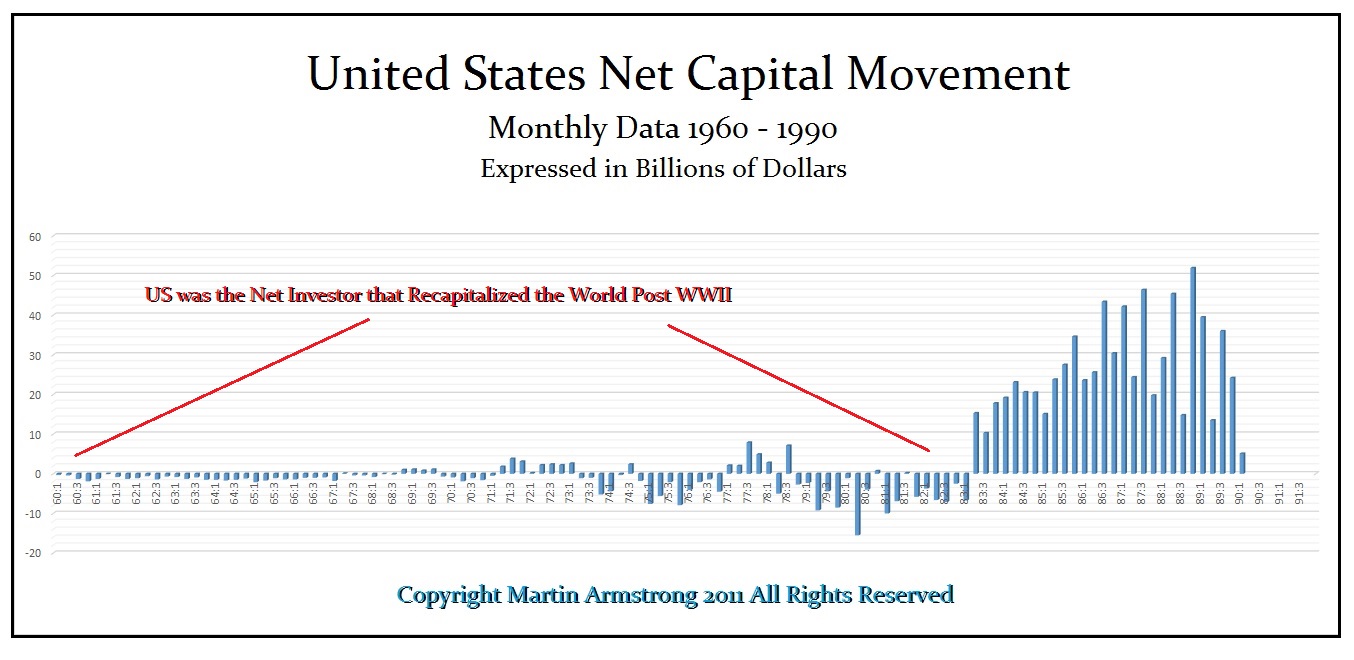
ANSWER: Historically, capital tends to flow first from the financial capital of the world to the outer provinces or state. This was how it functioned in the Roman times as was the case for postwar when US capital flowed outward to rebuild the rest of the world. Then what happens is as an empire begins to die (in this case Western Culture), the capital flow reverses and then moves back toward the core economy which is the financial capital of the world.

UBLST-25 MAHere is a chart of all the bonds listed on the New York Stock Exchange. When the Sovereign Debt Crisis hit in 1931, government simply defaulted. The bonds were then delisted never to come back again.

What transpires at that moment when government moves into a Crash & Burn, is that all tangible assets rise together, albeit at different rates of advance. This is what I call the Great Alignment. Therefore, we will see gold rise WITH the stock market – not counter-trend. Likewise, real estate survives provided you do not enter into a Dark Age when not even gold survives – only food.

German-1925-Rentenmark

If we look at the German Hyperinflation caused by the Communist Revolution in Germany in 1918 inviting the Communists of Russia to take Germany and the formation of the Weimar Republic, all of this political-economic chaos ended with a new currency being issued following the fall of the Weimar Republic. That currency was not backed by gold, but instead real estate.

Confidence in Real Estate Crashes in Australia


Australia-Behind Curtain

The rush of foreign capital that has caused real estate in major cities to soar coming out of China has hit Australia, Canada, and the USA. The laws against foreign ownership in Australia have been the harshest in the world. They have confiscated property owned by foreigners and are forcing it to be sold at losses. All of this craziness has resulted in public confidence in the housing market in Australia to collapse. The number of Australians describing property as the wisest place to put their savings has fallen to its lowest level in more than 40 years. This is the report of the Melbourne Institute of Applied Economic and Social Research which has been asking about the wisest place to store savings since it began its consumer confidence survey in 1974. With cutting off foreign investment, the “speculative boom” is being taken out of prices.

How OPEC Lost The War Against Shale, In One Chart


Tyler Durden's picture

At the start of March we showed a fascinating chart from Rystad Energy, demonstrating how dramatic the impact of technological efficiency on collapsing US shale production costs has been: in just the past 3 years, the wellhead breakeven price for key shale plays has collapsed from an average of $80 to the mid-$30s…

… resulting in drastically lower all-in breakevens for most US shale regions.

Today, in a note released by Goldman titled “OPEC: To cut or not to cut, that is the question”, the firm presents a chart which shows just as graphically how exactly OPEC lost the war against US shale: in one word: the cost curve has massively flattened and extended as a result of “shale productivity” driving oil breakeven in the US from $80 to $50-$55, in the process sweeping Saudi Arabia away from the post of global oil price setter to merely inventory manager.

This is how Goldman explains it:

Shale’s short time to market and ongoing productivity improvements have provided an efficient answer to the industry’s decade-long search for incremental hydrocarbon resources in technically challenging, high cost areas and has kicked off a competition amongst oil producing countries to offer attractive enough contracts and tax terms to attract incremental capital. This is instigating a structural deflationary change in the oil cost curve, as shown in Exhibit 2. This shift has driven low cost OPEC producers to respond by focusing on market share, ramping up production where possible, using their own domestic resources or incentivizing higher activity from the international oil companies through more attractive contract structures and tax regimes. In the rest of the world, projects and countries have to compete for capital, trying to drive costs down to become competitive through deflation, FX and potentially lower tax rates.

The implications of this curve shift are major, all of which are very adverse to the Saudis, who have been relegated from the post of long-term price setter to inventory manager, and thus the loss of leverage. Here are some further thoughts from Goldman:

  • OPEC role: from price setter to inventory manager In the New Oil Order, we believe OPEC’s role has structurally changed from long-term price setter to inventory manager. In the past, large-scale developments required seven years+ from FID to peak production, giving OPEC long-term control over oil prices. US shale oil currently offers large-scale development opportunities with 6-9 months to peak production. This short-cycle opportunity has structurally changed the cost dynamics, eliminating the need for high cost frontier developments and instigating a competition for capital amongst oil producing countries that is lowering and flattening the cost curve through improved contract terms and taxes.
  • OPEC’s November decision had unintended consequences: OPEC’s decision to cut production was rational and fit into the inventory management role. Inventory builds led to an extreme contango in the Brent forward curve, with 2-year fwd Brent trading at a US$5.5/bl (11%) premium to spot. As OPEC countries sell spot, but US E&Ps sell 30%+ of their production forward, this was giving the E&Ps a competitive advantage. Within one month of the OPEC announcement, the contango declined to US$1.1/bl (2%), achieving the cartel’s purpose. However, the unintended consequence was to underwrite shale activity through the credit market.
  • Stability and credit fuel overconfidence and strong activity: A period of stability (1% Brent Coefficient of Variation ytd vs. 6% 3-year average) has allowed E&Ps to hedge (35% of 2017 oil production vs. 21% in November) and access the credit market, with high yield reopen after a 10- month closure (largest issuance in 4Q16 since 3Q14). Successful cost repositioning and abundant funding are boosting a short-cycle revival, with c.85% of oil companies under our coverage increasing capex in 2017.

That said, the new equilibrium only works as long as credit is cheap and plentiful. If and when the Fed’s inevitable rate hikes tighten credit access for shale firms, prompting the need for higher margins and profits, the old status quo will revert. As a reminder, this is how over a year ago Citi explained the dynamic of cheap credit leading to deflation and lower prices:

Easy access to capital was the essential “fuel” of the shale revolution. But too much capital led to too much oil production, and prices crashed.  The shale sector is now being financially stress-tested, exposing shale’s dirty secret: many shale producers depend on capital market injections to fund ongoing activity because they have thus far greatly outspent cash flow.

This is the key ingredient of what Goldman calls the shift to a new “structural deflationary change in the oil cost curve” as shown in chart above. As such, there is the danger that tighter conditions will finally remove the structural pressure for lower prices. However, judging by recent rhetoric by FOMC members, this is hardly an imminent issue, which means Saudi Arabia has only bad options: either cut production, prompting higher prices and even greater shale incursion and market share loss for the Kingdom, or restore the old status quo, sending prices far lower, and in the process collapsing Saudi government revenues potentially unleashing another budget c

Liquidity Suddenly Collapses As Stocks Tumble


Tyler Durden's picture

This is the biggest drop for Bank stocks since Brexit, as investor concerns over Trump’s reform agenda grow…


And, as Nanex points out, S&P 500 futures liquidity is collapsing today.


Why? Because whereas the BTFDers have been willing to jump in and, well, BTFD, on days where there is a sharp move lower, both the HFTs and the carbon-based traders step aside and pull their bids, unsure if this is “the start” of the selloff.  Maybe this time they are right, as the bank bloodbath continues:

Why The 2017 French Election Could Trigger A Major Market Drop


Tyler Durden's picture

In 1981, the French stock market dipped in fears over François Mitterrand’s presidency win and the same could happen again, says Saxo Bank’s head of macro analysis Christopher Dembik.


In the 30 days following the first round in the 1981 election, the French stock market dropped by over 20% as a result of concerns about the economic policies of Mitterrand, who eventually became president from 1981 to 1995.

Dembik says that if Marie Le Pen – who has an anti-Eurozone stance – wins, the same steep dive could happen to the CAC 40 by 20% after the election. The first round of voting is on April 23 and the second round is on May 7.

Bank Bloodbath Batters Stocks; Bonds, Bullion Bounce As Trumpcare Vote Doubts Rise


Tyler Durden's picture

Does this look like policy ‘success’ or ‘failure‘?


VIX is jumping as stocks sink…


And Bank stocks are collapsing…


With the Financials ETF breaking below a key technical level…Bank stocks have now gone nowhere since Dec 8th.


Lots of chatter about selling due to doubts on TrumpCare passing on Thursday – which will delay the tax reform foundation that the market is settled on (and any banking system reform).

Analysis of Global Temperature Trends, February, 2017, what’s really going on with the Climate?


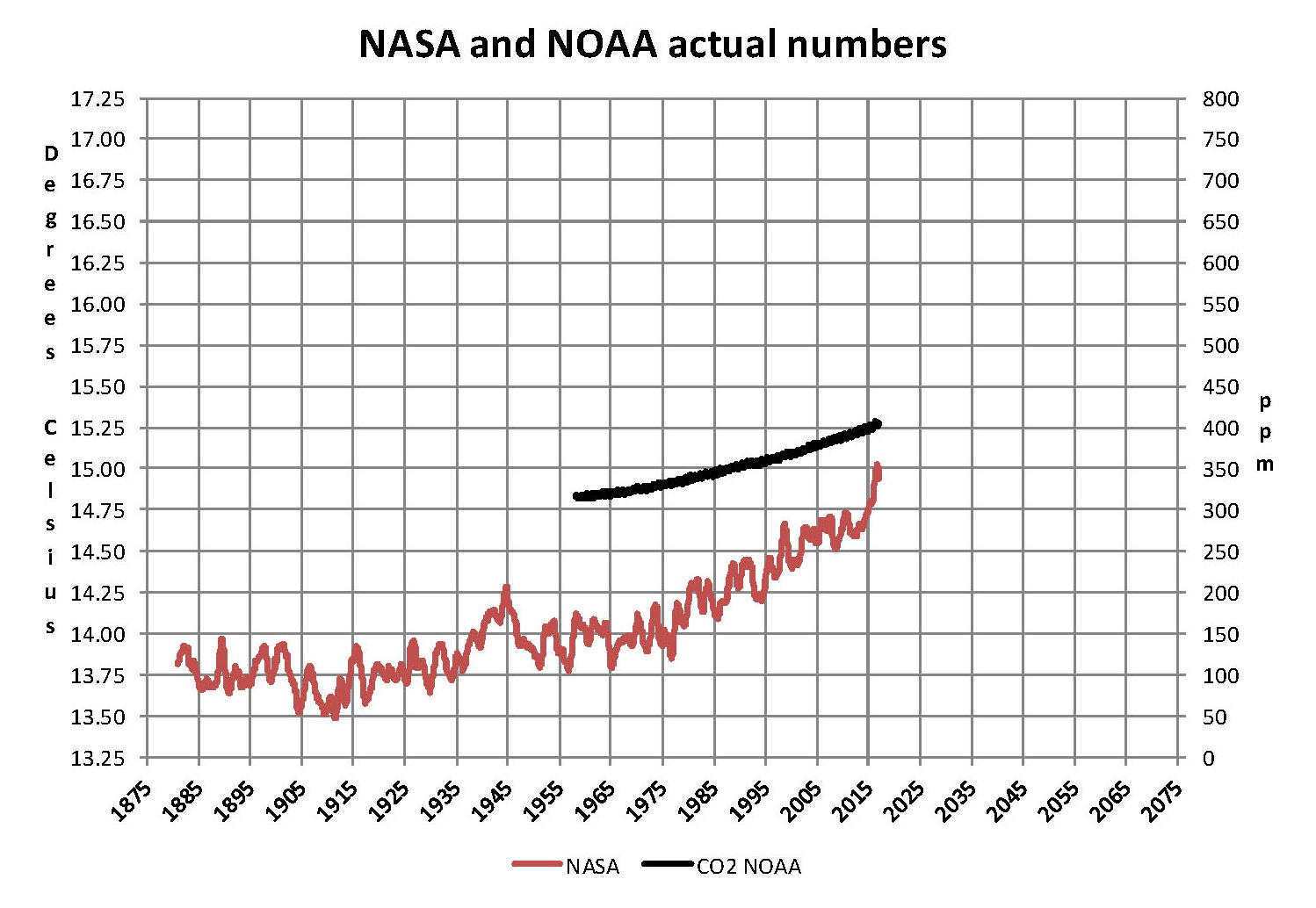
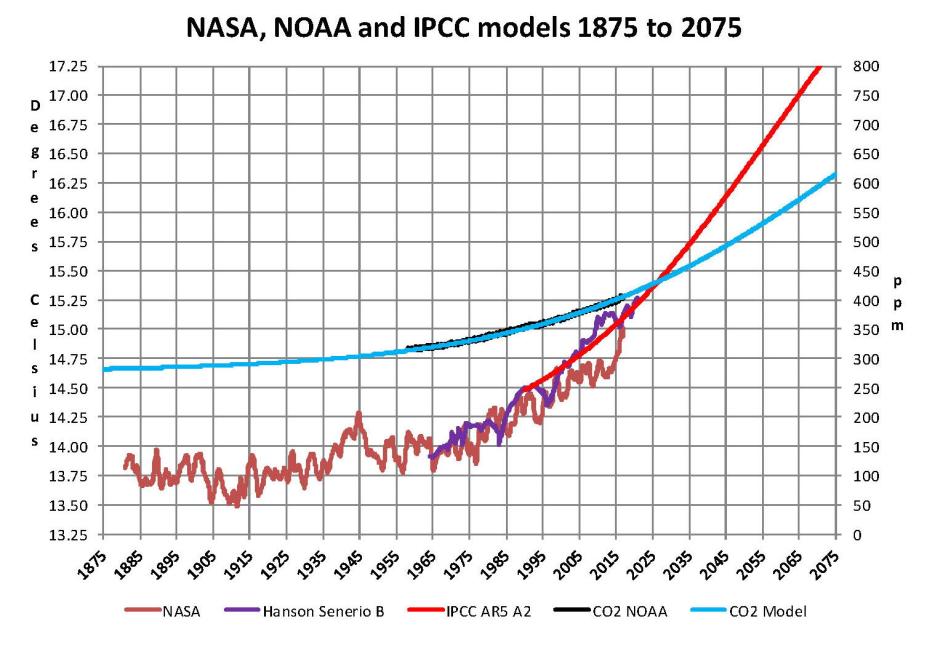
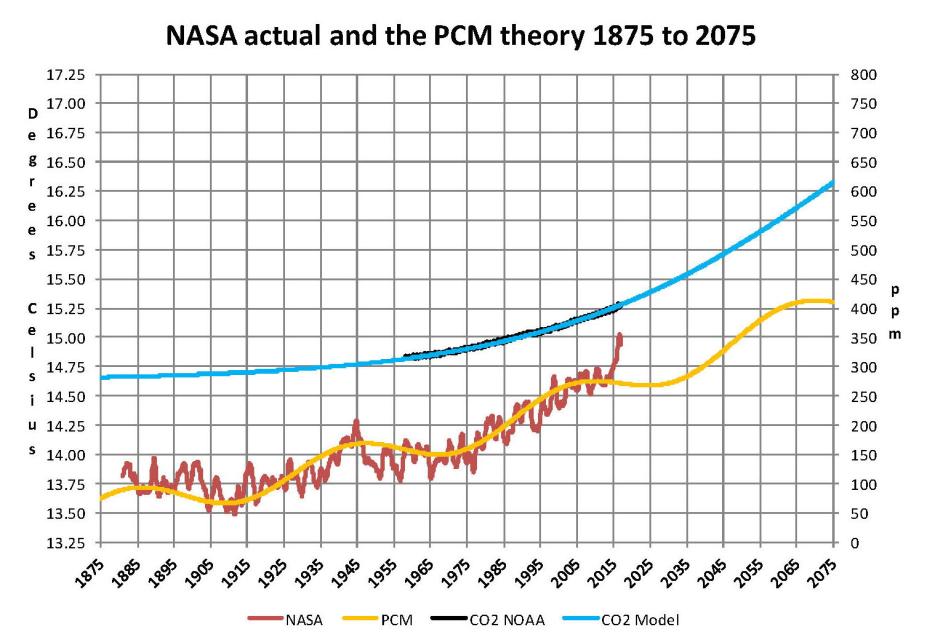
The analysis and plots shown here are based on the following two data series. First NASA-GISS estimates of a global temperature shown as an anomaly (converted to degrees Celsius) as shown in their table Land Ocean Temperature Index (LOTI) and shown in the following Chart as the red plot labeled NASA. This plot is shown as a twelve month moving average to minimize the large monthly swings and better show trends; the scale for the temperatures is on the left. Second NOAA-ESRL Carbon Dioxide (CO2) values in Parts Per Million (PPM) which are shown in the following Chart as a black plot labeled NOAA. This plot is shown exactly as the data from NOAA is presented and there is no need for a moving average the scale for CO2 is shown on the right.

NASA published data as stated in the first paragraph is shown as an anomaly, but what is a temperature anomaly?  An anomaly is a deviation from some base value normally an average that is fixed. There were two problems with the system that NASA picked which were number one there is no “actual” global temperature and two since climate is a variable there cannot be a real base to measure from. NASA known for its science and engineering expertise back in the day thought it could get around these issues and created a system to do so. First they developed a computer model which took readings from all over the planet and made significant adjustments to them called homogenization and came up with the estimated global temperature. Second they picked the period 1950 to 1980 (30 years) and averaged the values and came up with 14.00 degrees Celsius and make that their base.  Then they took the calculated temperature and subtracted the base from it which gave them the anomaly. The problem is that both the base and the anomaly are arbitrary.

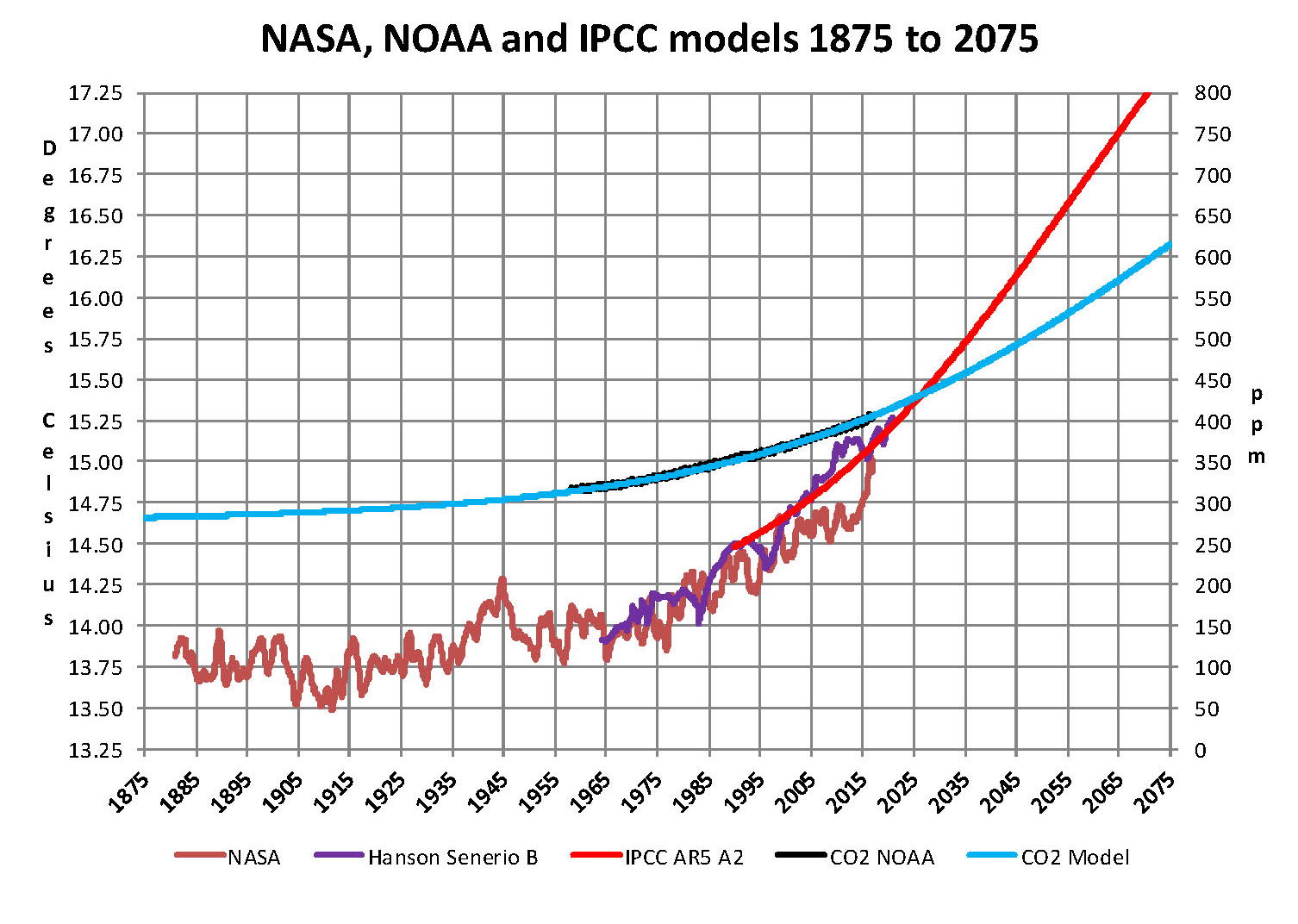
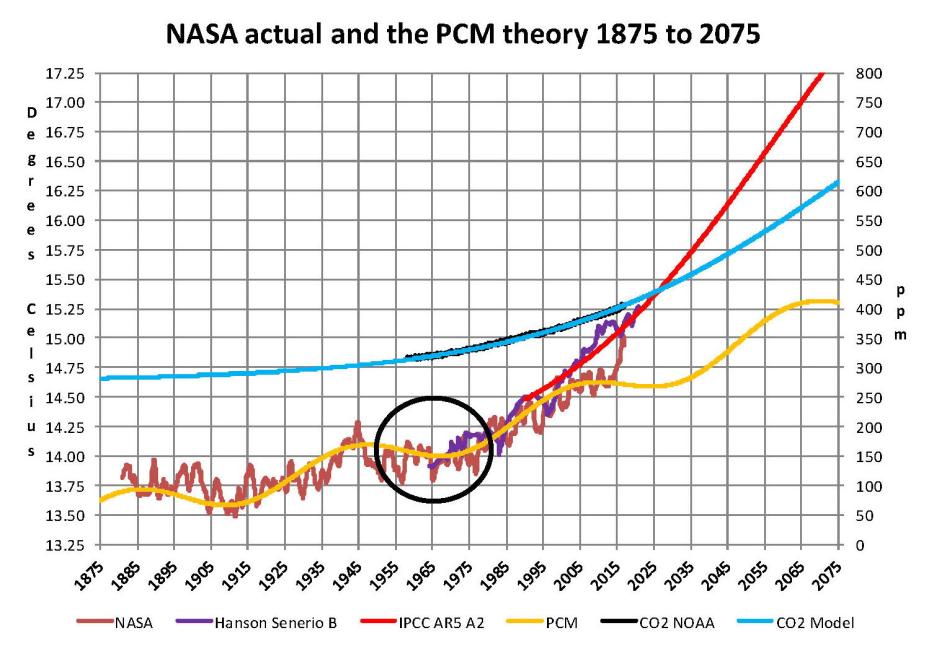
Now that we have a base to work with we are going to add to the previous Chart three things. The first is a trend line of the growth in CO2 since that is the entire basis for climate change according to the government through NASA and NOAA. That plot is superimposed over the black plot of the actual NOAA CO2 values as the cyan line labeled as the CO2 Model and one can see there is a very good fit to the actual NOAA values so there should be no dispute about its validity.  This plot allows us to make projections as to future global temperatures according to the level of CO2. The second added item is James E. Hansen’s Scenario B data, which is the very core of the IPCC Global Climate models (GCM’s) and which was based on a CO2 sensitivity value of 3.0O Celsius per doubling of CO2. This plot is shown here in lavender and is part of a presentation that Hansen showed to congress in 1988 when the UN was about to set up the International Panel on Climate Change (IPCC) and this plot is labeled as Hansen Scenario B which Hansen stated was the most likely to happen based on his theories’.  The third item is the current plot of the most likely temperature of the planet based on the growth of CO2 published by the IPCC. This plot is shown in Red and is labeled as IPCC AR5 A2 as that is the table where the data was found. This plot is a GCM computer projection of the planets temperature based to the complex relationships developed on the levels of CO2 by the IPCC through NASS and NOAA.

It can be seen in this Chart that the lavender plot and the Hansen plot are very close from 1965 to around 2000 after that, from 2000 to 2014, there is a very large and growing deviation reaching close to .5 degrees Celsius in 2014, which is not an insubstantial number.  Also of note is that there doesn’t seem to be a good correlation between the growth in CO2 and the increase in the planets temperature. The CO2 is going up in a log function and the Temperature was going down in a log function until recently where it reversed and is now going up in a log function. That major change in direction that occurred between 2013 and 2014 is the subject of this paper.
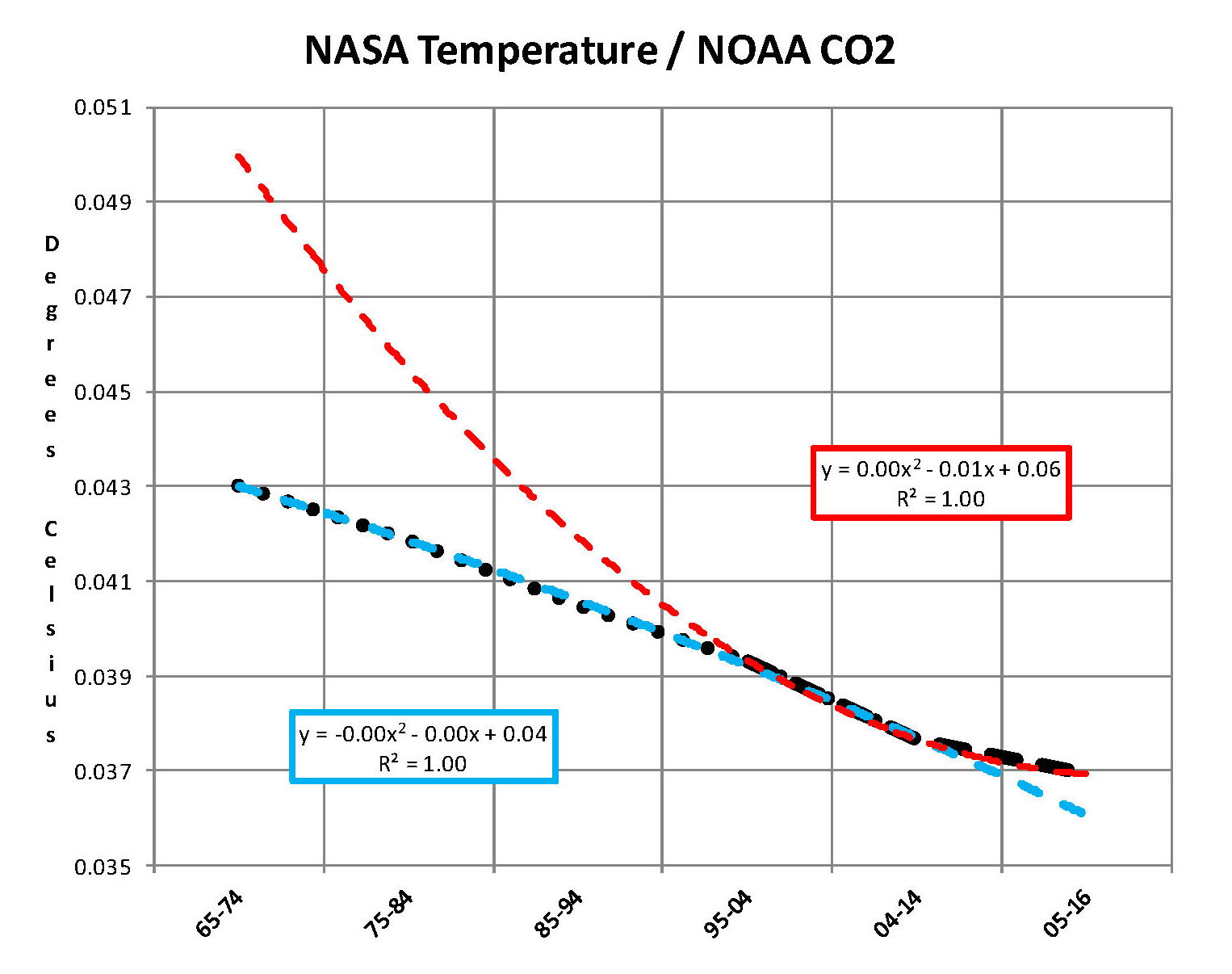
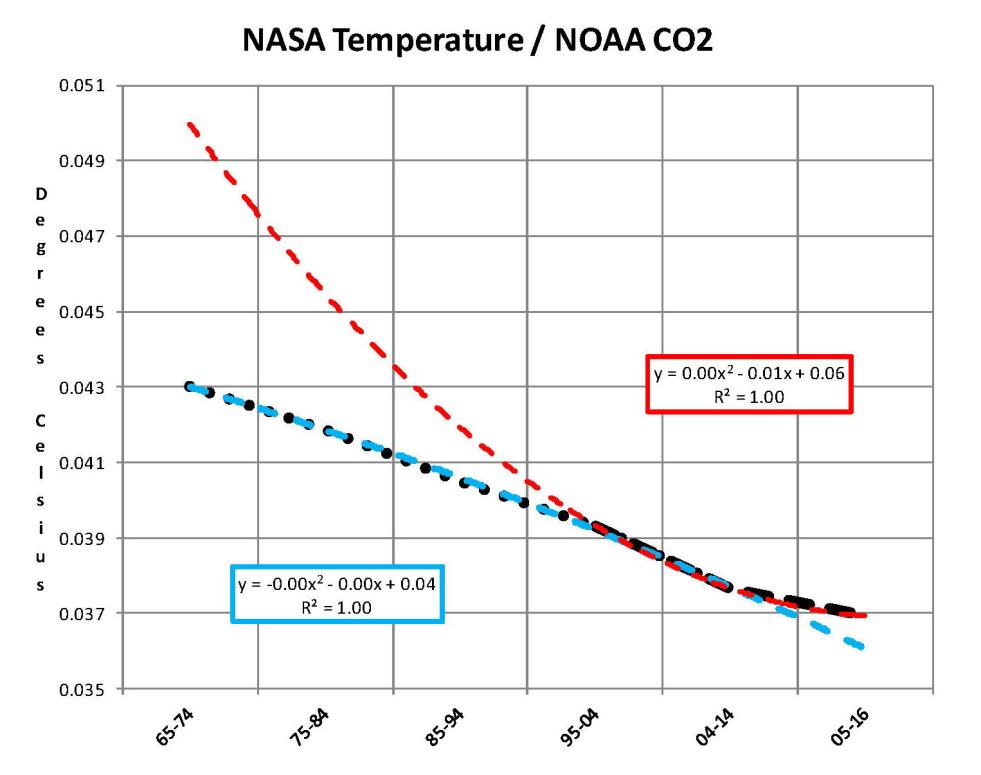
The next Chart is developed from the raw data from NASS and NOAA as shown in the first Chart.  This plot was made first by adding ten years blocks of temperature and CO2 as indicated in the Chart and diving by 120 to give an average for each.  Then the average Temperature was divided by the average CO2 to give degrees of temperature increase per PPM of CO2. After that was plotted it appeared that there were two different curves the first was from block 1965-1974 through block 2004-2014 shown as Black Dots and the second was from block 1995-2004 through block 2005-2016 shown as Black Dashes. When trend lines were added they were both almost perfect fits to the raw data and so you cannot see the data points very well on the Chart.  These blocks were picked to represent the entire period of time where we had both NASA temperature data and NOAA Co2 levels.

On the following Chart are two sets of color coded information. The first is Cyan plot and the Cyan box with the equation in it along with the R2 value 0f 1.0 are for the first series from block 1965-1974 through block 2004-2014. The other is the Red plot and the Red box with the equation in it along with the R2 value of 1.0 which are for the first series from block 1965-1974 through block 2004-2016. We can speculate on how this change has happened but it cannot be said that the plot change is not real; however additions data over the next few years will be required to actually prove that something has changed.

In summary the Cyan data set indicates a diminishing effect of CO2 on global temperature for about 54 years and the Red data set represents an increasing effect of CO2 on global temperature for the past 2 years. Since both data sets have an R2 value of 1.00 the trend lines cannot be in question.
Before we get into a possible explanation to the drastic change from the Cyan data to the Red data that occurred in 20014 we need to consider other factors than CO2 on Climate change.  The fault that occurred in the work that was done in the 1980’s was in assuming that there was an optimum or constant global temperature and therefore any change that was being observed was from the increasing amount of CO2 in the atmosphere.  There may have been correlation but it was never proved that there was causation (high R2 value) between CO2 and global temperatures. With that assumption, which limited options, we moved from true science into the realm of political science.  True science has an open mind and finds relationships that work in matching observations with predictions.  Political science changes history and/or facts to match the desires of the politicians. Since the politicians control the money political science is what we get; which means that what we get may not be technically correct.

A decade ago when I started looking at “climate” change the first thing I did was look at geological temperature changes since it is well known that the climate is not a constant; I learned that 52 years ago in my undergrad geology and climatology courses in 1964. The next paragraph explains currently observed patterns in climate related to this subject.

Ignoring the last Ice Age which ended some 11,000 years ago when a good portion of the Northern hemisphere was under miles of ice the following observations give a starting point to any serious study on the subject. First, there is a clear up and down movement in global temperatures with a 1,000 some year cycle going back at least 3,000 to 4,000 years; probably because of the apsidal precession of the earth’s orbit of about 20,000 years for a complete cycle. However about every 10,000 years the seasons are reversed making the winter colder and the summer warmer in the northern hemisphere. 10,000 years from now the seasons will be reversed. Secondly, there are also 60 to 70 year cycles in the Pacific and the Atlantic oceans that are well documented. These are known as the Atlantic MultiDecadal Oscillations (AMO) in the Atlantic and as La Nina and El Nino in the Pacific. Thirdly, we also know that there are greenhouse gases such as carbon dioxide that can affect global temperatures. Lastly the National Academy of Sciences (NAS) estimated that carbon dioxide had a doubling rate of 3.0O Celsius plus or minus 1.5O Celsius in 1979 when there were only two studies available and one for sure and maybe both were not per reviewed.

The result of looking objectively at the three possible sources of global temperature changes was a series of equations based on these observations that when added together produced a sinusoidal curve that seemed to follow NASA published temperatures very closely.  Since this curve was based on observed temperature patterns it was called a Pattern Climate Model (PCM) which has been described in previous papers and posts on my blog and since it is generated by “equations” many assume it is some form of least squares curve fitting, which it is not. It does seem to be related to ocean currents.

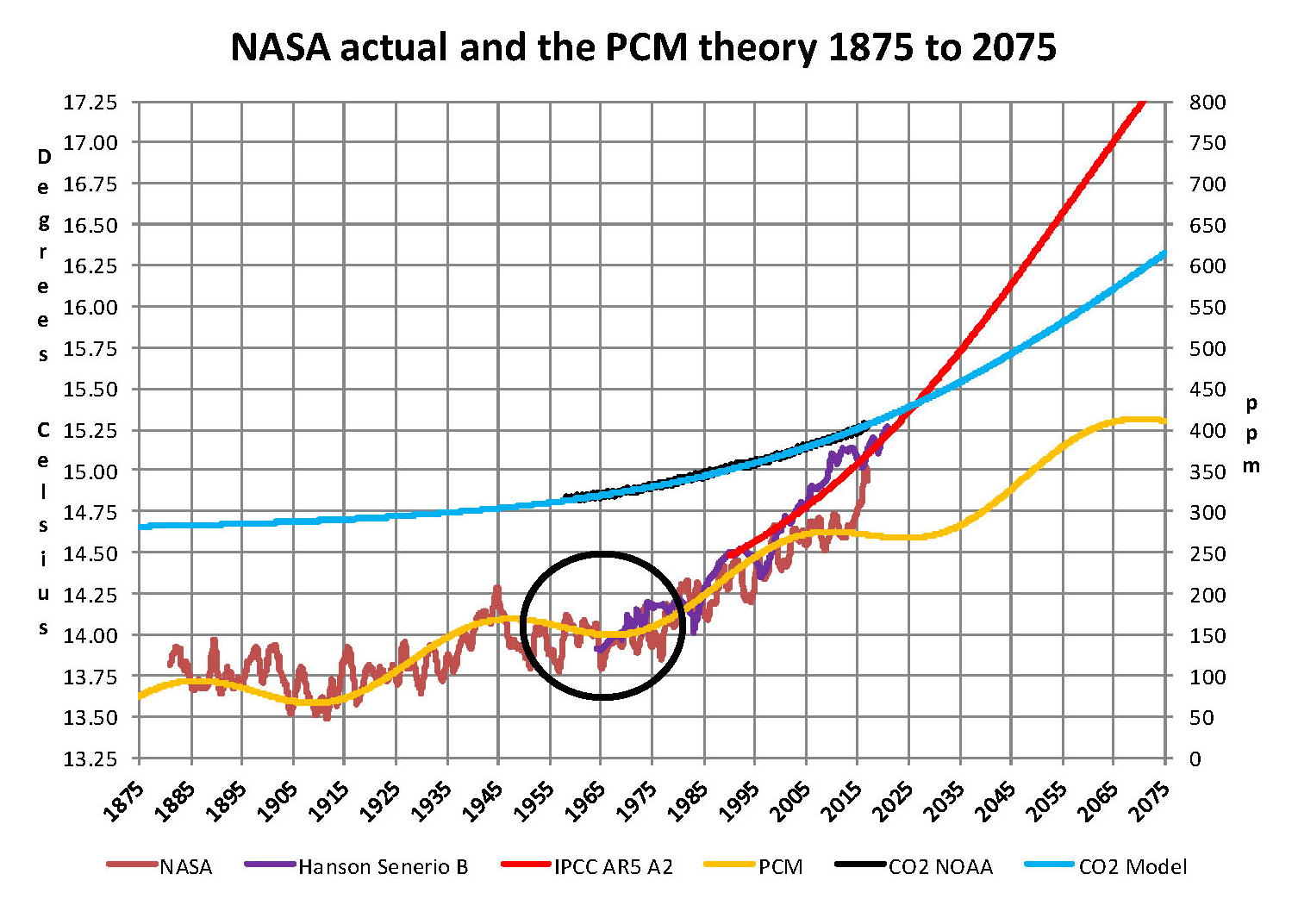
As can be seen in the following Chart the PCM there is a 69.1 year cycle that moves the trend line up and then down a total of 0.29O Celsius and we are now in the downward portion of that trend (-.01491O C per year) which will continue until around ~2035.  This short cycle is clearly observed in the raw NASA data in the LOTI table going back to 1880. Then there is a long trend, 1036.7 years with an up and down of 1.65O Celsius (.00396O C per year) also observed in the NASA data. Lastly, there is CO2 adding about .0079O Celsius per year so currently they all basically wash out at -.0039O C per year, which matches the current holding pattern we are experiencing. After about 2035 the short cycle will have bottomed and turn up and all three will be on the upswing again.  Note: the values shown here are only representative as the actual model uses many more places than what are shown here.

When using the 12 month running average for global temperatures up until 2014 the PCM model was within +/- .01 degrees of what NASA was publishing in their LOTI table since the early 1960’s as shown in the next Chart. Further the back projection of the PCM plot matched historical records and global temperatures going back past the time of Christ. It should also be consider that geologically CO2 levels have reached levels many times that of the current 400 ppm without destroying the planet so the current hysteria over the current small numbers can only be explained by political science not real science.
The nest step in this analysis is to put all of the known data and projections into one Chart which will contain: NASA’s table LOTI global temperature estimates, NOAA’s actual CO2 values, the CO2 model projections, the PCM model global temperature plot, Hansen’s Scenario B 1988 global temperature plot, and lastly the IPCC AR5 A2 global temperature plot. With that done we can look at the results and try to make some sense of what is going on with the various arms of the federal government that are promoting that carbon based fuels be eliminated since they are responsible for the global temperature level  going up.  As previously started when the government pours money into the sciences the sciences respond with technical papers the support the governments views, this is what I call political science verses real science as was done prior to the 1980’s; money talks and BS walks as everyone on the street knows.  This Chart views a good overview of the current situation showing all the facts and all the projections.

This Chart contains no manipulation of the data and the only change that was made was to convert the NASA anomalies back to degrees Celsius to make it more readable to lay people.  This is only a change in units and has no bearing on the look.  A subject not broached here is that of the NASA homogenization process itself and the base period from 1950 to 1980. The portion in the black circle contains the NASA base period of 14.00 degrees Celsius and the reason it’s brought up here is that the Homogenization process causes the global temperatures to move around since the entire data base all the way back to 1880 is recalculated each month.  But since the base has to stay at 14.00 degrees Celsius the program must be set to not allow changes in that period of time. I’m sure the programmers have fun with that. Prior work here has shown how this creates a teeter totter effect with the data plots, some of which have recently been significant.
The next Chart will be a look at the period from 2010 to 2020 so we can see the detail of the past few years where a change in CO2 of only a few ppm has caused a major change in the global temperature way beyond anything previously shown in any published NASA data. There are two black ovals on the Chart one at the top of the Chart which is a black oval around the CO2 levels for 2012, 2013, 2014, 2015 and part of 2016 and it’s very obvious that there has been very little change, maybe 7 ppm or about 1.9%. Then at the bottom of the Chart is another black oval around the NASA global temperature levels for 2012, 2013, 2014, 2015 and part of 2016 and its very obvious that there has been a very large change, almost .45 degrees Celsius or about 3.1%. There has never been such a large increase in temperature from such a small increase in CO2.

By contrast the previous comparable period of the last part of 2010 through 2013 shows about the same increase for CO2 at 1.1% but no increase for global temperature but actually small decrease. Worse it appears that this current strange upward trend will continue as the values shown here are based on a 12 month moving average and the current values being published by NASA have been very high for the past 7 months and therefore I would expect the NASA plot to be well over 15.00 Celsius within a few months and certainly before the end of 2016. After COP21 the need for Fake Warming was no longer needed and so we are seeing a downward trend developing. With the new administration we may see the end of data manipulation from NOAA and NASA and a return to real science political science.

In summary, the IPCC models were designed before a true picture of the world’s climate was understood. During the 1980’s and 1990’s CO2 levels were going up and the world temperature was also going up so there appeared to be correlation and causation. The mistake that was made was looking at only a ~20 year period when the real variations in climate all move in much longer cycles of decades and centuries.  Those other cycles can be observed in the NASA data but they were ignored for some reason.  By ignoring those trends and focusing only on CO2 the models will be unable to correctly plot global temperatures until they are fixed.

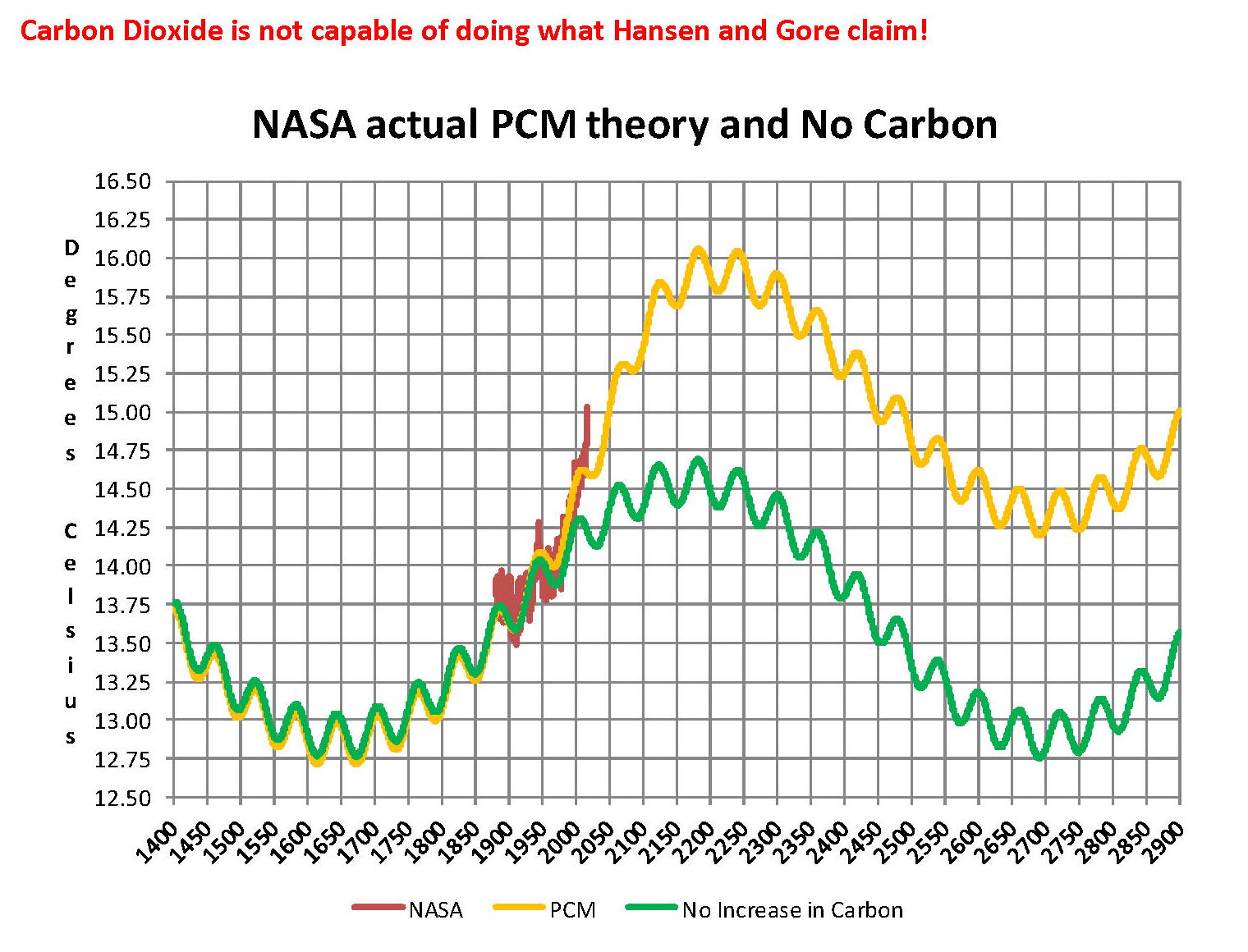
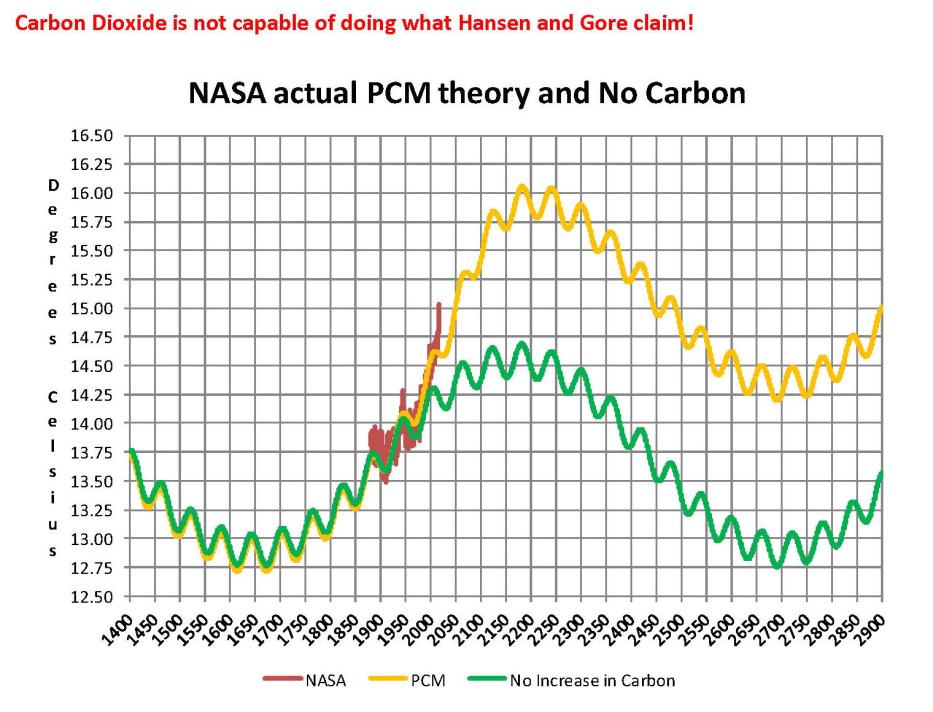
Lastly, the next chart shows what a plot of the PCM model, in yellow, would look like from the year 1400 to the year 2900. This plot matches reasonably well with recorded history and fits the current NASA-GISS table LOTI data, in red, very closely, despite homogenization.  I understand that this model is not based on physics but it is also not true curve fitting. It’s based on observed reoccurring patterns in the climate. These patterns can be modeled and when they are, you get a plot that works better than any of the IPCC’s GCM’s. If the conditions that create these patterns do not change and CO2 continues to increase to 800 ppm or even 1000 ppm than this model will work well into the foreseeable future.  150 years from now global temperatures will peak at around 15.750 to 16.000 C and then will be on the downside of the long cycle for the next ~500 years.

The overall effect of CO2 reaching levels of 1000 ppm or even higher will be about 1.50 C which is about the same as that of the long cycle.  The Green plot on the Chart shows the observed pattern with no change in CO2 from the pre-industrial era of ~280 ppm. CO2 cannot affect global temperatures more than 1.500 C +/- no matter what the ppm level of CO2is. The reason being that the CO2 sensitivity value is not 3.00 per doubling of CO2 but under 1.00 C per doubling of CO2 as shown in more current scientific work.
The purpose of this post is to make people aware of the errors inherent in the IPCC models so that they can be corrected. 

The Obama administration’s “need” for a binding UN climate treaty with mandated CO2 reductions in Europe and America was achieved as predicted at the COP12 conference in Paris in December 2015. To support this endeavor NASA was forced to show ever increasing global temperatures that will make less and less sense based on observations and satellite data which will all be dismissed or ignored.  Within a few years the manipulation will be obvious even to those without knowledge in the subject, but by then it will be to late the damage to the reputation of science will have been done.


Sir Karl Raimund Popper (28 July 1902 – 17 September 1994) was an Austrian and British philosopher and a professor at the London School of Economics. He is considered one of the most influential philosophers for science of the 20th century, and he also wrote extensively on social and political philosophy. The following quotes of his apply to this subject.

If we are uncritical we shall always find what we want: we shall look for, and find, confirmations, and we shall look away from, and not see, whatever might be dangerous to our pet theories.

Whenever a theory appears to you as the only possible one, take this as a sign that you have neither understood the theory nor the problem which it was intended to solve.

… (S)cience is one of the very few human activities — perhaps the only one — in which errors are systematically criticized and fairly often, in time, corrected.

The Exchange Stabilization Fund – What Is It?


US Treasury Bldg

Apparently, some people have discovered the Exchange Stabilization Fund and are now touting this as some major power in manipulating the world economy. This is simply an emergency reserve fund of the US Treasury Department, which is typically used for foreign exchange intervention. This arrangement really goes back to the birth of the G5 and is the alternative to having the central bank intervene directly in foreign exchange. This is a Treasury function, which allows the US government to try to influence currency exchange rates without affecting domestic money supply created by the Federal Reserve.

Unlike those who are trying to sell newletters touting this as the new great manipulator, it holds less than $125 billion in funds which includes special drawing rights (SDR) from the International Monetary Fund. Trust me, there is no such great power that can manipulate the world economy. They have done their best to try to prevent the dollar from rising. They will fail as they did in 1987 and every other attempt to peg currencies. They are INCAPABLE of altering the capital flows.

Are Cycles Universal or Regional?


PopulationOfRome

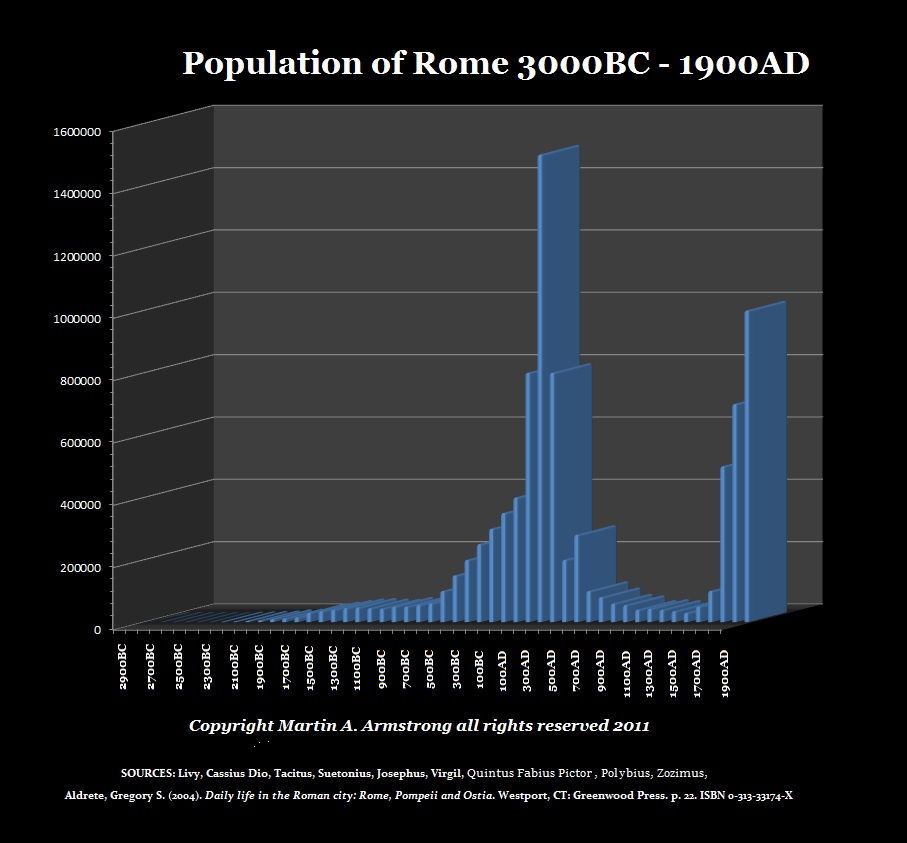
QUESTION:  I have a question regarding cycles. You provide some very detailed, historic references showing why certain events are occurring now (again). Is there a disposition for something that occurred in the past to be destined re-occur for a particular region/country (i.e. Greeks abandoning property due to excessive taxation) because it happened once and now the propensity to repeat that causal action again is “in their DNA”. Is that something we as Americans do not yet possess because we have not been around long enough to experience a “fall of Rome” type event?

SM

ANSWER: Cycles are based upon two element – (1) nature and (2) human nature. Some regions will be prone to natural disasters while others are not. Ironically, many of the best ports where cities grew such as Tokyo and San Francisco just as examples, were great harbors because of earthquakes. The landscape in California is strikingly beautiful compared ot the flat plain in Oklahoma, again because of earthquakes. The rocks that appear in Central Park in New York City are there because an earthquake fault runs through New York City making the harbor what it was. Hence, there are cycles that impact only on a regional basis due to nature.

With regard to Greeks walking away from inheritance because they cannot pay the tax, this is inherent to all societies when government goes too far. They imposed harsh laws in Vancouver against foreign real estate buyers and the market crashed. Because it was a local law, they moved to Victoria and Toronto. In Australia, they are seizing properties own by foreigners and selling them off. All of these types of interventions are reactions to events set in motion externally.

realestate

That said, this is the US cycle for real estate as a national whole. I just bought a house in Florida at about 50% of its 2007 high value. Trophy spots for the high end where people are just parking money we warned would make new highs going into 2015.75 – but that is not the bulk of the market. Why is the US market (minus trophies) down hard when that is not the case in other countries? The difference is the regional issue. In the USA, many people have 30 year mortgages. In Canada, the best you can get is a 10-year fixed mortgage. In Germany, you can get up to a 15-year fixed mortgage.

We must understand that property values are LEVERAGED, so if the money for fixed rate loans dries up because of interest rate hikes and political uncertainty, then real estate prices MUST fall. This is all because of the leverage that was deliberately injected into the real estate market during the Great Depression for property fell  in value so far, only cash buyers could buy anything. Farm land fell in value to below what it was sold for by the government more than 80 years before.

Real estate is different from stocks and gold. Yes it is a place to park money. However, be careful because without mortgages available, it falls further than other tangible assets because it has been LEVERAGED! Moreover, it is a fixed asset meaning you cannot leave with it. Therefore, people are forced to simply walk away when (1) the tax burden is too high and (2) there is war and the region is being invaded.

Deutsche Bank: “The Probability Of A Negative Shock Is High”


Tyler Durden's picture

For the second week in a row, Deutsche Bank’s strategist Parag Thatte has a somewhat conflicted message for the bank’s clients: on one hand, he writes that positive economic surprises continue “but are getting less so”, and although the divergence between har data surprises and sentiment is diminishing the bank is somewhat confident that a “pullback in the very near term is unlikely” (here DB disagrees with Goldman Sachs). However, Thatte is increasingly hedging, and notes that because a “rally without a 3-5% sell-off that is typical every 2-3 months is now running over 4 months and is in the top 10% of such rallies by duration”, he cautions that “the probability of seeing a negative shock is high” especially since Q1 buyback blackout period has begun.

Here are the key observations from the Deutsche Bank strategist:

  • The equity market rally has been going uninterrupted for a long time, driven by the unusual resurgence of positive data surprises. Strong data surprises drove equity inflows and fund positioning, adding to the steady support from buybacks. An expectation that positive data surprises were likely to persist underpinned DB’s call 2 weeks ago that a pullback was unlikely in the very near term. The bank takes stock of the current situation below:
  • Duration of rally now in top 10%. The rally without a 3-5% sell-off that is typical every 2-3 months is now running over 4 months and is in the top 10% of such rallies by duration.

  • Data surprises positive but getting less so. While incoming data in the last week has continued to surprise to the upside relative to consensus, it has done so at a more modest rate and DB’s data surprises index, the MAPI, is now declining off its highs.

  • Divergence between sentiment and hard data surprises diminishing. Attention has focused on the divergence between sentiment data which has run up strongly and hard data which has so far lagged. In terms of surprises, i.e., relative to what’s priced into consensus forecasts, hard data surprises have fallen back to neutral over the last two weeks, while sentiment surprises have declined this week but remain elevated. The surge in sentiment data is getting built into consensus forecasts and sentiment surprises also moving down to neutral over the next 3-4 weeks.

  • Fund positioning already trimmed in line with neutral hard data surprises. US funds have already been trimming equity exposure for the last three weeks in line with the decline in hard data surprises suggesting funds may already be anticipating a modest slowdown in overall data. Real money equity mutual funds are already close to neutral but asset allocation funds and long-short equity hedge funds are still overweight. Macro hedge funds are exposed to short rates positions in our view, not long equities.

  • Inflows accelerate. The pace of US equity fund inflows has accelerated over the last 4 weeks ($36bn). However flows have been closely tied to overall data surprises and could start to moderate in turn.

  • Buyback blackout period has begun. Heading into the Q1 earnings season, the pace of buybacks will slow as an increasing number of companies enter earnings blackout periods starting this week.

* * *

DB’s summary take on near-term equity moves:

Continued muddle through most likely in the near term. The fundamental drivers as well as demand-supply considerations for equities point to a continued muddle through in the near term. However history suggests that with the duration of the rally already in the top 10% by duration, the probability of seeing a negative shock is high. But the medium term outlook remains robust with the unfolding growth rebound having plenty of legs while from a demand-supply point of view flow under-allocations to US equities and robust buybacks remain very supportive.

* * *

Away from equities, the picture in rates, commodities and currencies based on trader flows is as follows:

  • Oil falls but still expensive and long positioning still elevated. Following the November OPEC supply-cut announcement oil prices became very expensive on our medium term valuation framework for oil and commodities based on the trade-weighted dollar and global growth (Trading The Commodity Underperformance Cycle, Apr 2013). The decline in oil prices over the last two weeks has trimmed the extent of overvaluation but leaves oil prices slightly above the upper-end of the historical 30% overvaluation band which has marked extremes (currently $48). Net long positions are off of recent record highs but remain quite elevated.
  • Extreme short positions remain an overhang for rates moving up. Bond yields fell sharply after the rate hike this week much like they did after the December one. While real money bond funds remained close to neutral going into the FOMC this week, leveraged funds shorts in bond futures remained near extreme highs. Outside of HY funds which saw a large outflow as oil prices fell this week, bond funds have continued to receive robust inflows. Indeed duration sensitive funds have this year completely recouped all of the outflows seen in the aftermath of the elections.
  • Gold valuations stretched again. Gold prices have rallied on the back of a return of inflows into gold funds this year reversing the modest outflows in Q4. Massive cumulative inflows since early 2016 ($40bn) remain an overhang. Gold longs had been declining heading into the FOMC meeting. Gold prices have again disconnected sharply to the upside from the historical drivers of the dollar and the 10y yield as well as global growth. Copper long positions continued to slide for a 6th straight week.

  • Shorts in the Mexican peso, the best performing currency this year, have collapsed to neutral. Mexican peso shorts fell sharply last week to the lowest levels in over 15 months as gross shorts fell sharply while longs also rose. Aggregate long dollar positions had been rising going into the FOMC meeting reflecting rising shorts in the yen and sterling even as euro shorts were pared.