Who is the Fool? The Borrower or the Lender?


Many people worry about over-indebtedness and point to a default of borrowers. It is interesting how the view of debt is always the low-life borrower. In reality, the real stupidity rests with the lender. Many are pointing to US corporate debt and stating that it has grown to an estimated US $ 7 trillion and they paint this as high-risk bonds and corporate loans which have been issued over the past decade. Of course, there were some who were foolish to issue variable interest rate bonds. Those companies are likely to find themselves in trouble. But there are others who issued long-term fixed bonds at low rates. Our advise to corporate clients was to borrow as much as possible at fixed rates for 50 to 100 years while the fools were willing to buy. Other major corps issued 100-year bonds including Walt Disney Company (DIS) and Coca-Cola (KO). The loser will be the BUYER, not the ISSUER.  It was a fool’s market to buy such fixed rate bonds for 100 years.

When Greece got in trouble, what is the first solution economists ALWAYS recommend? A debt haircut!. , which in most cases is based on the Libor benchmark interest rate, which has increased significantly in recent months. The first thing they did was extend the Greek debt by 10 years to avoid a default and the ECB agreed that any profits made by central banks in the Eurozone on Greek bonds would be returned to Athens in two equal tranches every year, between 2018 and 2022. You always extend maturity to avoid a default and you take a haircut in the value of the bonds you bought.

We are also witnessing this at the municipal level in Germany where about 50% of municipal governments are effectively bankrupt. The President of the German Institute for Economic Research (DIW), Marcel Fratzscher, came out and called for fundamental reforms where the holders of their debt would take a haircut. He has made it clear that a reduction in more than half of the state investments was made by the municipalities. The German grand coalition was supposed to organize a haircut to reduce the value of outstanding debt from the federal states on down to the municipalities. In reality, they are hopelessly over-indebted not unlike Illinois and California in the USA.
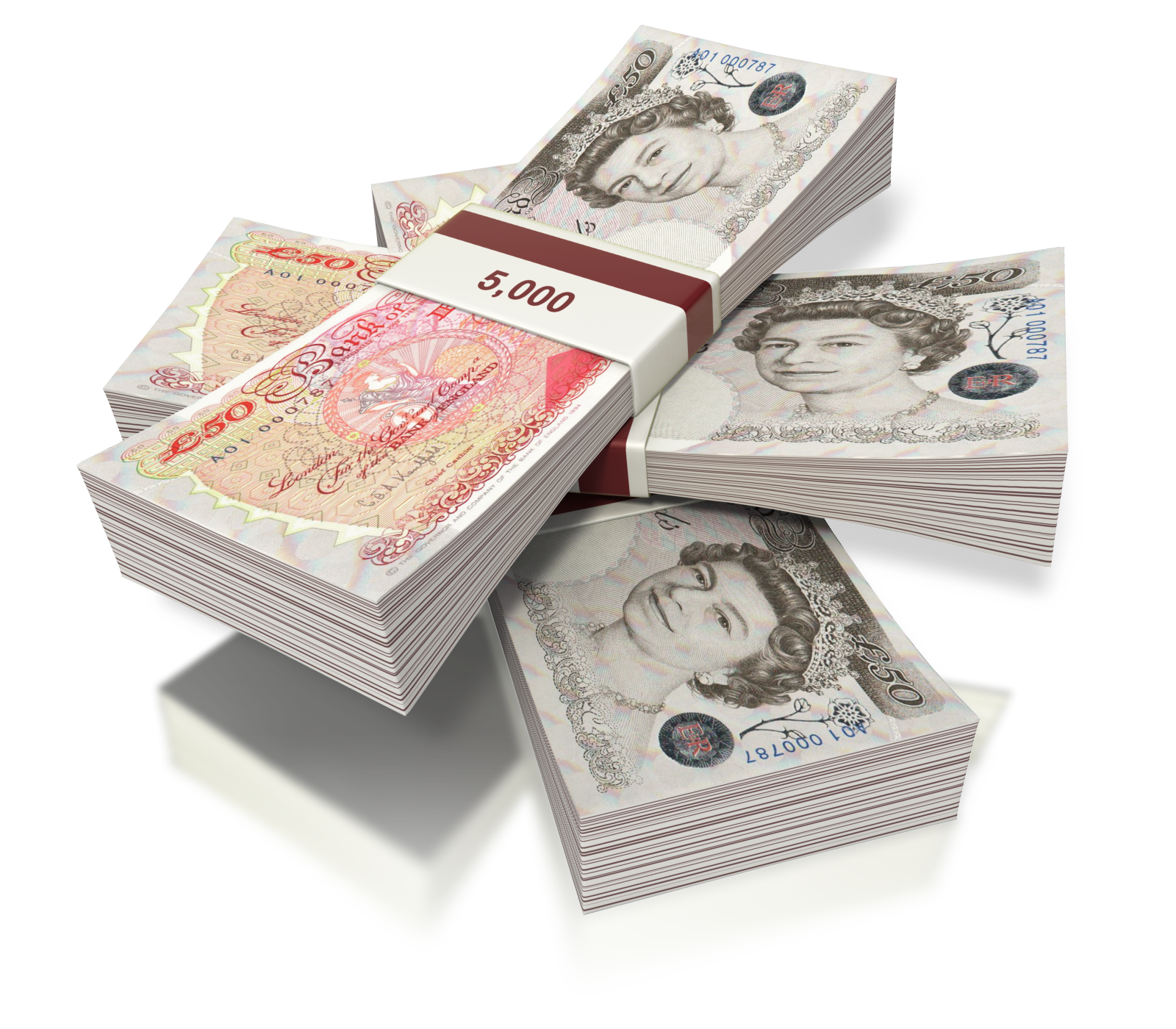
Even when we look at the war loans from the USA to Europe, it was not until 2015 that Britain finally repaid it war loans. There were still 38,000 holders of UK war bonds with amounts less than £100 as well. They actually cut the 5% coupon in 1932 reducing it by agreement to 3.5%. So you see, taking 100 years to repay a debt meant that the value of the pound when the money was lent was $4.86 and when it was paid off less than $2. Actually, the French never even paid interest on the $4 billion they owed the USA after World War I and the only country to pay the United States back during the 1930s was Finland.

So when we look at the indebtedness of even Emerging Markets, keep in mind that the loser will be the lender – not the borrower. It seems that no matter how many times a government defaults like Spain, seven times, the fools rush right back in and buy again. The famous bank of the Medici had a rule “to deal as little as possible with the court of the Duke of Burgundy and of other princes and lords, especially in granting credit and accommodating them with money, because it involves more risk than profit” (Raymond de Roover Professor of History at Brooklyn College: The Rise and Decline of the Medici Bank was first published in 1966. id/ p 343). The Medici failed because later generations did not follow that rule
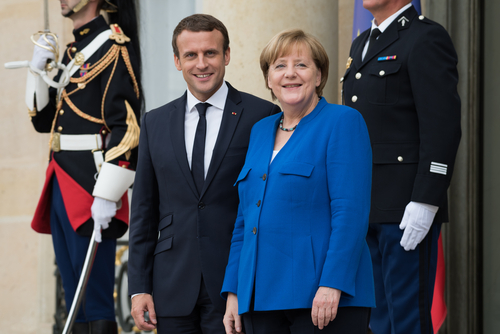

Merkel Objects to France’s Vision of a EU Finance Minister


Chancellor Angela Merkel has rejected France’s Macron’s proposal for the establishment of a euro finance minister. Merkel has also stated that she wants a planned EU budget for the Eurozone area as part of the EU budget. She does not want an independent budget for the 19 countries of the monetary union. Merkel is still adhering to her view that the quantity of money causes inflation and it has been that policy which has suppressed the European economy for the last decade. A Euro finance minister she argues would lack both a budget as well as there would be no parliamentary control.

The British Pound & The Conservative Split


QUESTION: Mr. Armstrong, It seems that the conservatives have split into two parties here. It is the same nonsense that they pulled to overthrow Margaret Thatcher. I really do not understand why they think we have to be part of the EU which is so obviously a sinking ship. As we always said here, when there is a good fog in the Channel, you would never know Europe was even there.

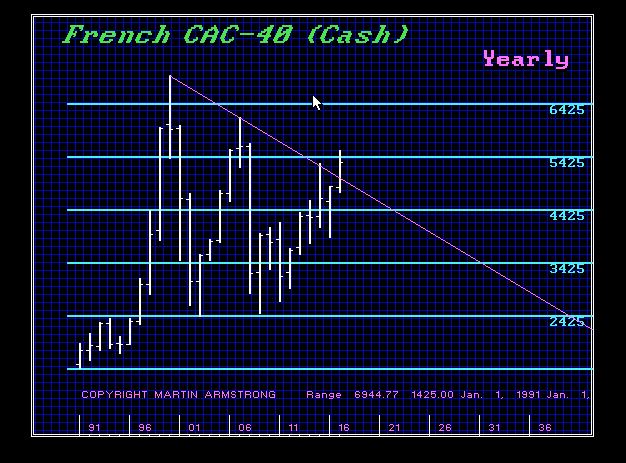
I read your piece on how France can object and prevent a trade deal for rest of the members. France is a hopeless communist country. Their stock market is not even worthy of investment. It has never made a new high since 2000. My question is simple. Does your forecast for the pound necessitate that the conservatives really mess up this Brexit escape from the EU?

LN


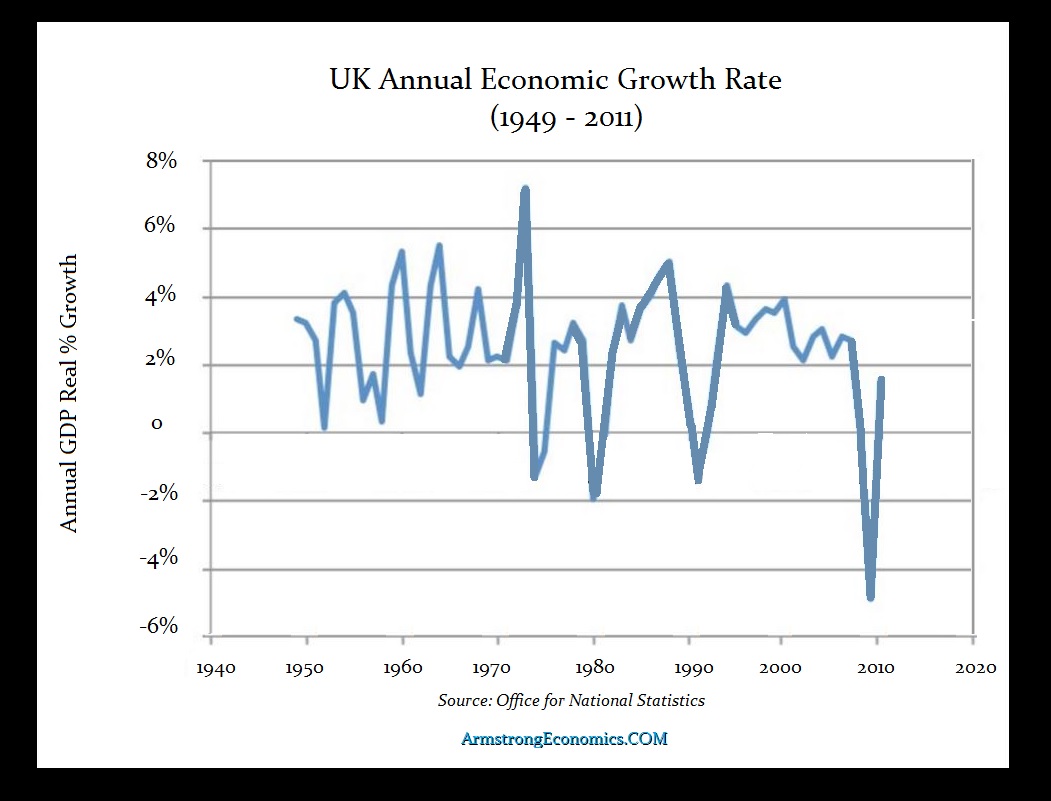
ANSWER: The basic trade numbers show that the United States received the most British export goods last year, followed by Germany and France. The top trade partner for imports was Germany, followed by the United States and China. The UK exported £31.7bn worth of products to the US. Britain has NEVER benefited from the EU. Your economic growth has declined ever since joining back in 1973. I use to have detailed conversations about this with Margaret Thatcher. Britain’s biggest trading partner is the USA yet she cannot negotiate trade with the USA as long as it remains inside the EU. It is absolute insanity.


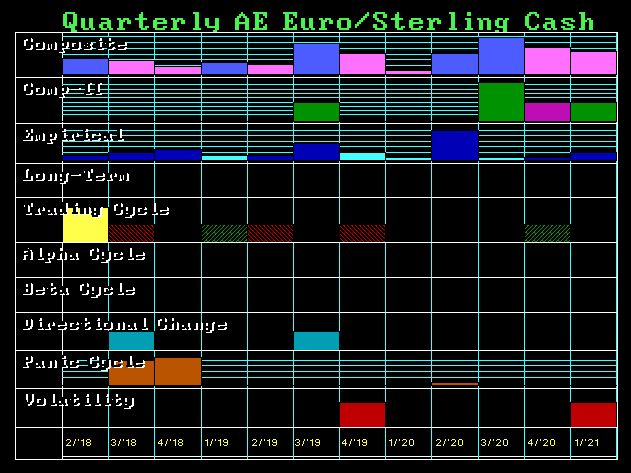
Now, as for the pound, unfortunately, it continues to point lower against the dollar. Interestingly, the computer pinpointed the crisis in the Euro would begin during the 3rd quarter here in 2018 where we had both a Directional Change and the beginning of a Panic Cycle. Brexit will end Friday, March 29th, 2019. Note that there is a turning point showing up in the 1st quarter next year but the big one will be the 3rd quarter 2019.


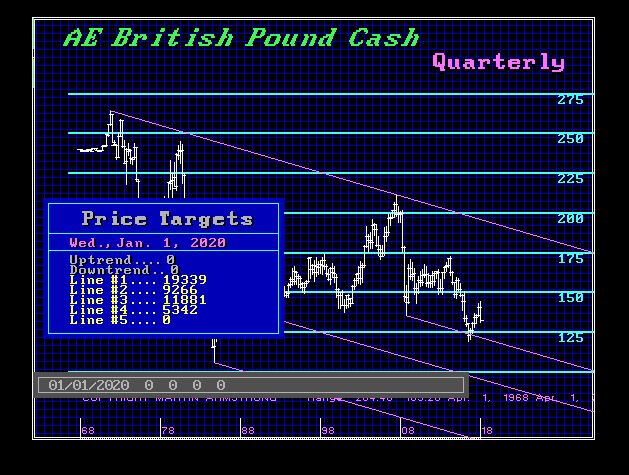
As far as price against the dollar, there is support technically in the 92 area. The very worst support is at 53, but that does not seem likely absent war in Europe.

Will Inflation Return to the Eurozone?


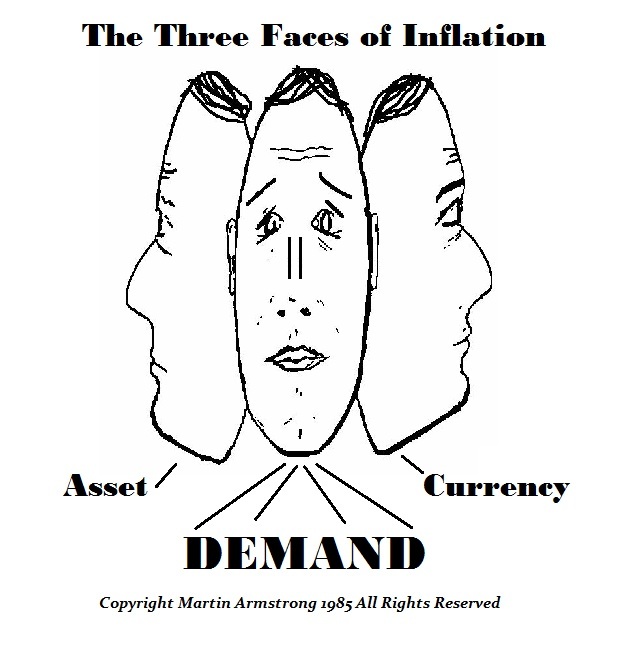
There are three distinct types of inflation – Demand, Asset & Currency. The major type of inflation that everyone assumes is DEMAND. This unfolds when there is actually an economic boom and people have confidence in the economy. Asset Inflation is when there is no real demand from the consumer but the asset values rise primarily from foreign investment. This is normally witnessed in real estate, stocks, and bonds. There is a subdivision of Asset Inflation that is concentrated to a single area such a food that is driven by a collapse in supply due to perhaps a drought or flooding. The third type is Currency Inflation. This is when the actual nominal value of assets do not change, but the currency fluctuation will attract or detract foreign investors because of the large fluctuation in the value of the currency on world markets.

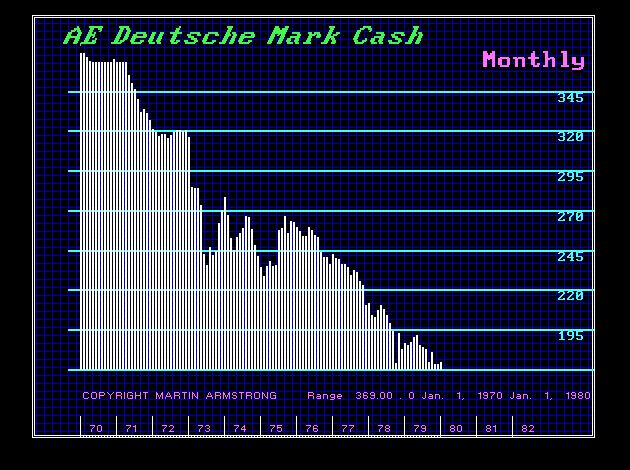
During the 1970s, I always bought German cars. A Porsche in 1970 was about $12,000 and by 1980 it was $50,000. The rise was really created by the decline in the dollar which created the perception that German cars would so well built, they would appreciate. I would drive one for 2-years and sell it used for a profit. This was the net result of CURRENCY INFLATION. As the Euro declines, we will see inflation in the Eurozone rise sharply. The ECB will proclaim victory after 10 years, but this has nothing to do with Quantitative Easing.

Real Estate – Leverage – Transition to the Reset


QUESTION: Hi Mr. Armstrong,

Thank you for the daily blogs on world events with an independent analysis that makes sense. I find them better than investment bank reports that just make up the pages.
Could you please elaborate on what happens to properties when the monetary reset comes? If people lose confidence in fiat money and hoard real assets, wouldn’t that be a positive thing for properties? Or only if they are bought out in full (i.e. no mortgage)?
Thank you.
Regards,
S
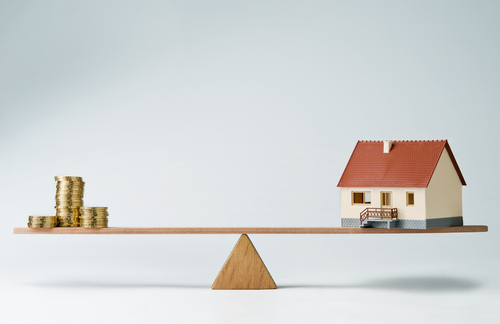
ANSWER: The problem with real estate is the LEVERAGE. The value of a house has been escalated due to the fact that in the USA you can borrow using 30 years of future income. The crisis that unfolds is the collapse in the mortgage market. Then we will see a deleveraging of real estate. However, that said, real estate makes the transition as a hedge during a reset.  For example, during the German hyperinflation that led to a currency reset, that new currency that was issued was backed by real estate – not gold. Keep in mind that as the currency declines, then the repayment cost of a mortgage declines. On the one hand, mortgages will be unavailable but those who hold the mortgage lose the most. Therefore, you should be able to pay off your mortgage with cheap currency assuming you have hedged and make it through the transition.

California Real Estate Peaks and Begin a Crash


California has joined the states with not just the highest taxes in America, but it has become one of those states that people are just leaving resulting i9n a net outward-migration. There is a logical consequence when a state becomes a place people are trying to flee from – real estate MUST decline in value. Already, sales of both new and existing houses and condominiums in Southern California has declined 11.8% year over year. Prices rallied and reached a record high in 2018. The median price paid for all Southern California homes that were sold in June 2018 was a record high reaching $536,250, according to CoreLogic. This was reported as a 7.3% increase compared to June of 2017. When you see such short-term surges in a market, that is often the sign of how every market peaks. Real estate is no exception.

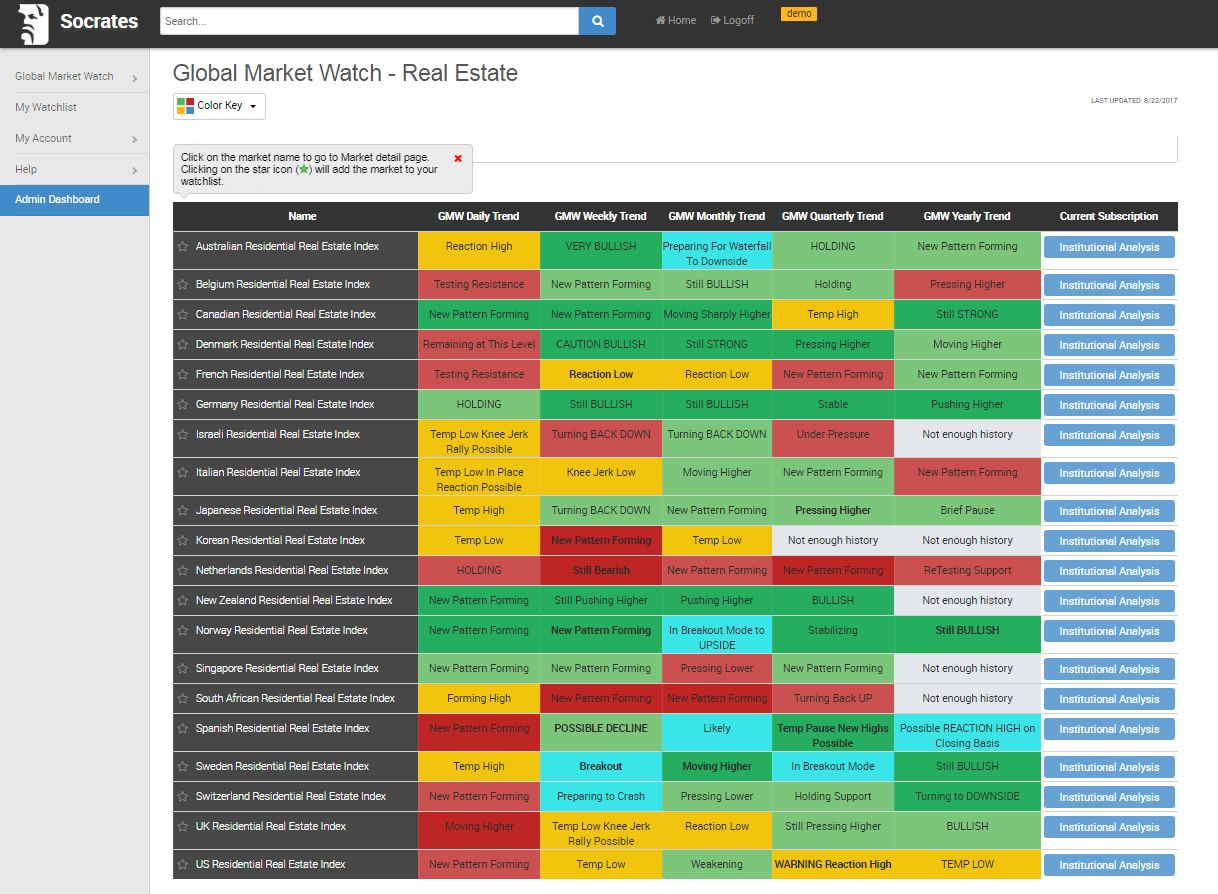
Many have touted for years that California property leads the nation. Therefore, whatever trend appears they will spread to the rest of the nation. While we do not necessarily agree with that statement, nonetheless, real estate will be on the decline in most states where taxes are rising. Property is still going to rise in the 7 states without income tax. For those who are unfamiliar with Socrates, we have created indexes for real estate on a worldwide basis. Here is the page you can view what is available.

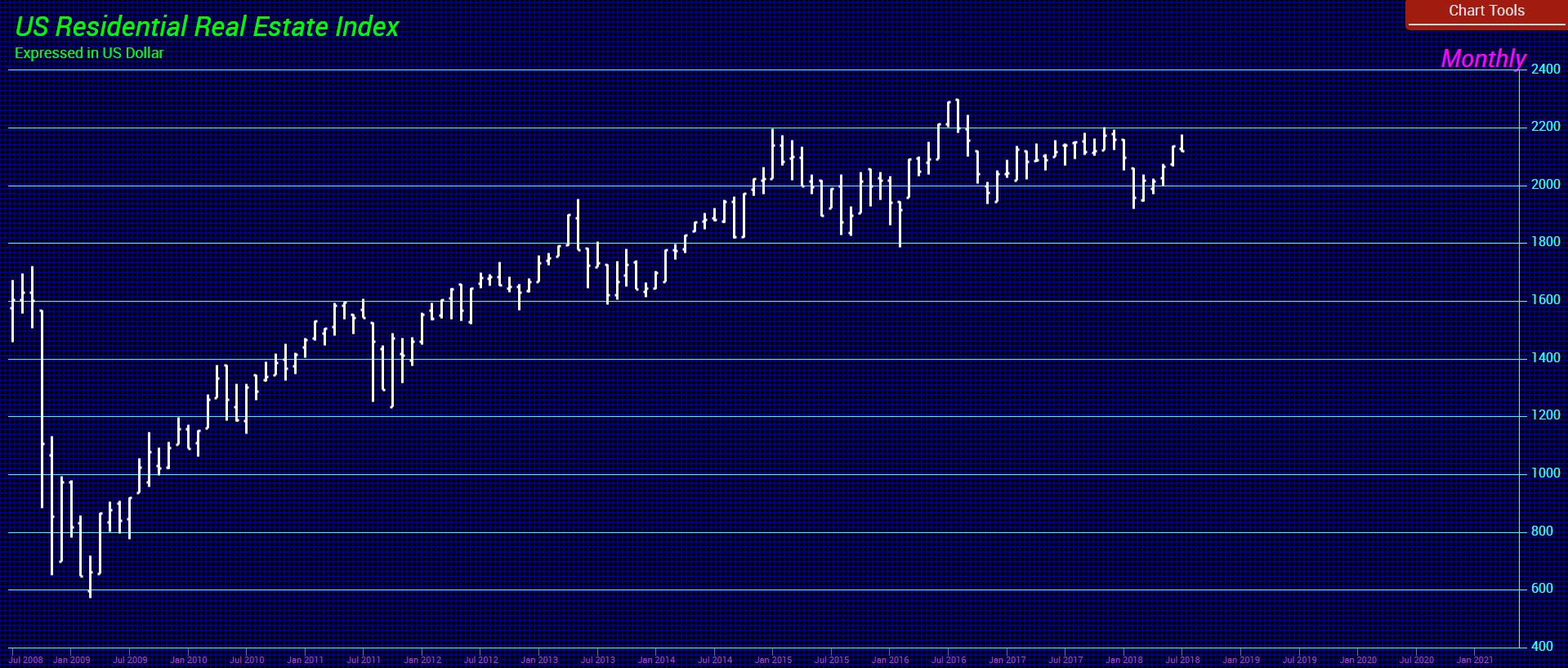
California may seem to be a leading indicator, but this appears to be with respect to direction only. While Southern California reached record highs in property values in 2018, this appears NOT to be a leading factor, but a lagging one. Our index for the nation as a whole with a limited focus to Residential peaked in August 2016. We have NOT yet elected a Monthly Bearish Reversal. Trump has clearly made a major economic difference. Capital has been returning home and this has helped to create jobs and soften the economic decline in the USA compared to Europe and Asia. This will also have a fundamental backdrop to the dollar.

Gold & the Changing Fundamentals


QUESTION: Mr. Armstrong; You are obviously the person worth listening to when it comes to gold. Every fundamental these people have argued to support gold has proven completely false. Confusion in gold is really very high. You have to be really stupid at this point to listen to this nonsense. Can you express any opinion on gold?

It would be very helpful


PL


ANSWER: You are correct, that concerns over U.S.-Russian relations, coming talks on the Korean Peninsula, action in Syria over a suspected chemical weapons attacks and uneasiness over trade conflicts would normally be the battle cry to buy gold.  Traditionally, this would form a cocktail of geopolitical uncertainty that would lead to screams buy gold! The uncertainty has not led to support for gold. They are proving to be a narrative that no longer seems to be factors for the bulls.

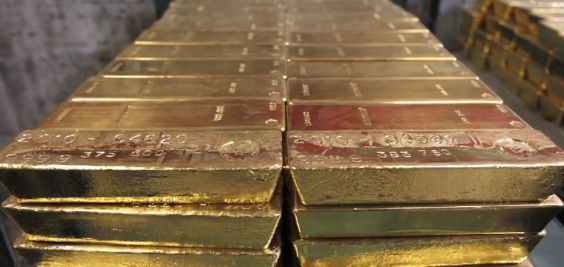
We have to understand one thing. The younger generations do not see gold as money as do the aging generation. The older generations remember being taught that is school and the days of the gold standard. The younger generation does not even bother with paper money and pays with their cell phones. This is raising the question of whether gold will remain as a safe-haven instrument in the future if the younger generation does not even consider gold suitable for anything other than a trinket.


There are cycles to yet cycles to cycles. Just as we moved from gold to paper, we have then moved from paper to electronic. With each passing trend, there are always people who refuse to leave behind the old ideas and traditions. The real question emerging shall be: Will people even regard gold as anything but jewelry 300 years from now? Of course, there will be those who immediately will argue that gold has always been money. They are simply wrong. Money has been many things to many different societies. The real issue is not whether gold is money, silver, copper, bronze, seashells, sheepskins or cattle.  The real question is will money be COMMODITY based (Tangible) with its roots in barter or will it be simply a representative of economic output that can be electronic? That is the real question. Are we headed into a future as in Star Trek where physical money is obsolete?

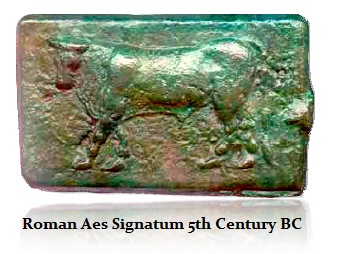
When we look at these transition periods in the monetary system throughout history, we see how money takes shape of a representation of what it once was. The Minoans fashioned their bronze ingots in the shape of a sheepskin because that is what use to be a symbol of value before the Bronze Age. We see the same transition in Rome with ingots of bronze with a picture of a cow because cattle was once money.

The real question is blunt. Are we also passing from a COMMODITY based monetary system to a purely electronic based system with the passing of the generations? Even the pitch that India buys gold because it is a tradition is starting to show it to moves with cycles. The younger generations do not share the same view of gold as the older generation. Things do change with the generations and the problem has always been that those of one generation judge the future ONLY by its own belief system. So, despite all the yelling and screaming that I was wrong and that gold would NEVER retest the $1,000 level, we have broken sharply falling to 1180 yesterday in the fact of a strong dollar as we approach the pending Benchmarks in September. Gold trades inversely to the dollar because it is now just a commodity-based asset class – not money. When we had a gold standard, it traded opposite against all asset classes. It will rally when the dollar backs off and decline as the dollar rallies until everything begins to enter the Great Aligment.