QUESTION: Marty; I am trying to understand your comments that the Canadian real estate has peaked in real terms. Does this mean it will still rise as the currency declines as a hedge against the government in your shift from public to private confidence?
HG
ANSWER: Canada will benefit from the capital inflows to North America which will not be as intense as those into the USA because of your government’s punitive actions against foreign investors and its sheer stupidity in understand international trends.
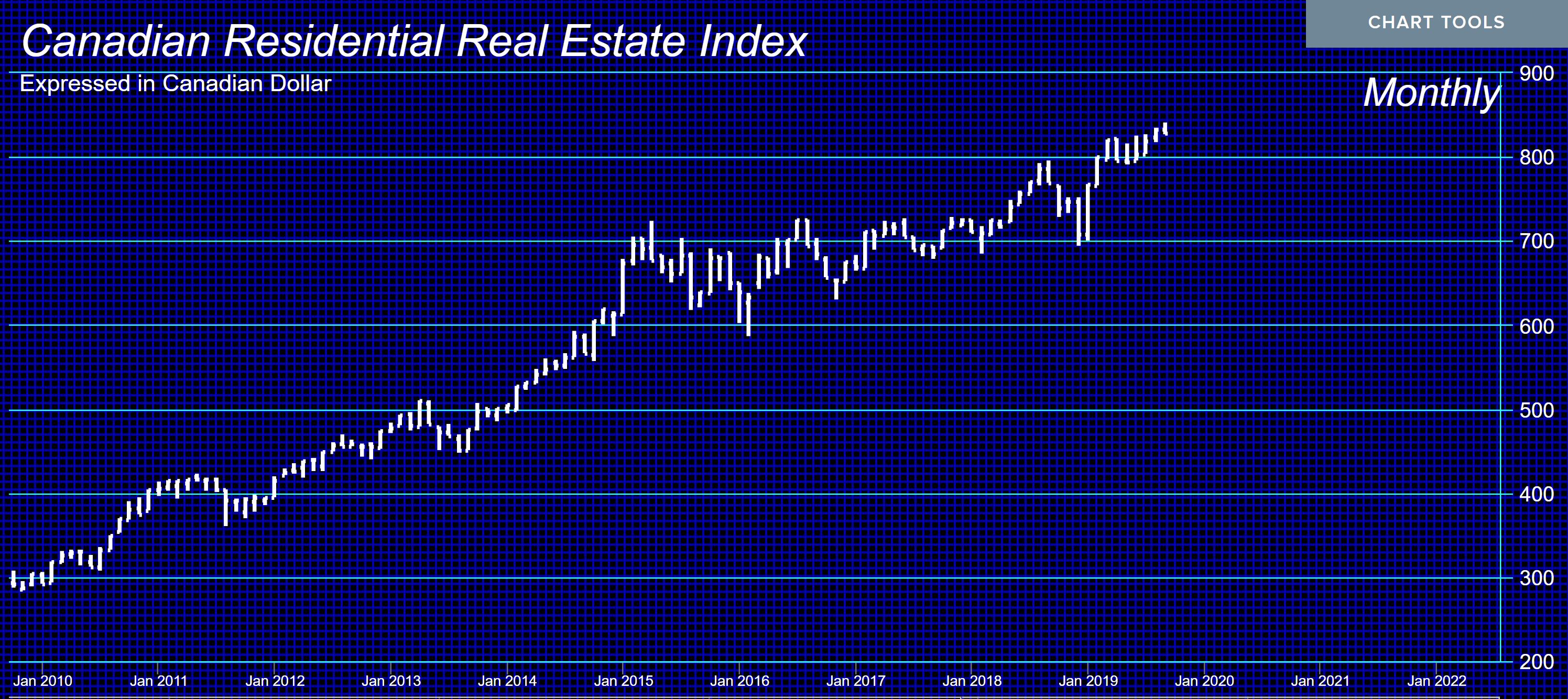
What I mean in “real terms” relates to the Canadian investor in terms of purchasing power. Here is an illustration of our Canadian Real Estate Index in both Canadian dollars and in Chinese yuan. You can see that from the Chinese perspective, Canadian real estate is still rising as a hedge against their currency. This means that the crazy laws being imposed against foreign investors and Justin Trudeau’s latest campaign promise to impose a 1% national 1% tax on foreigners owning property in Canada which he says will be applied to speculation and vacancy on applicable residential properties owned by “non-resident, non-Canadians.” Once he imposes the tax, you can bet it will rise rapidly from 1% because there is a complete misunderstanding of what is driving the real estate markets.
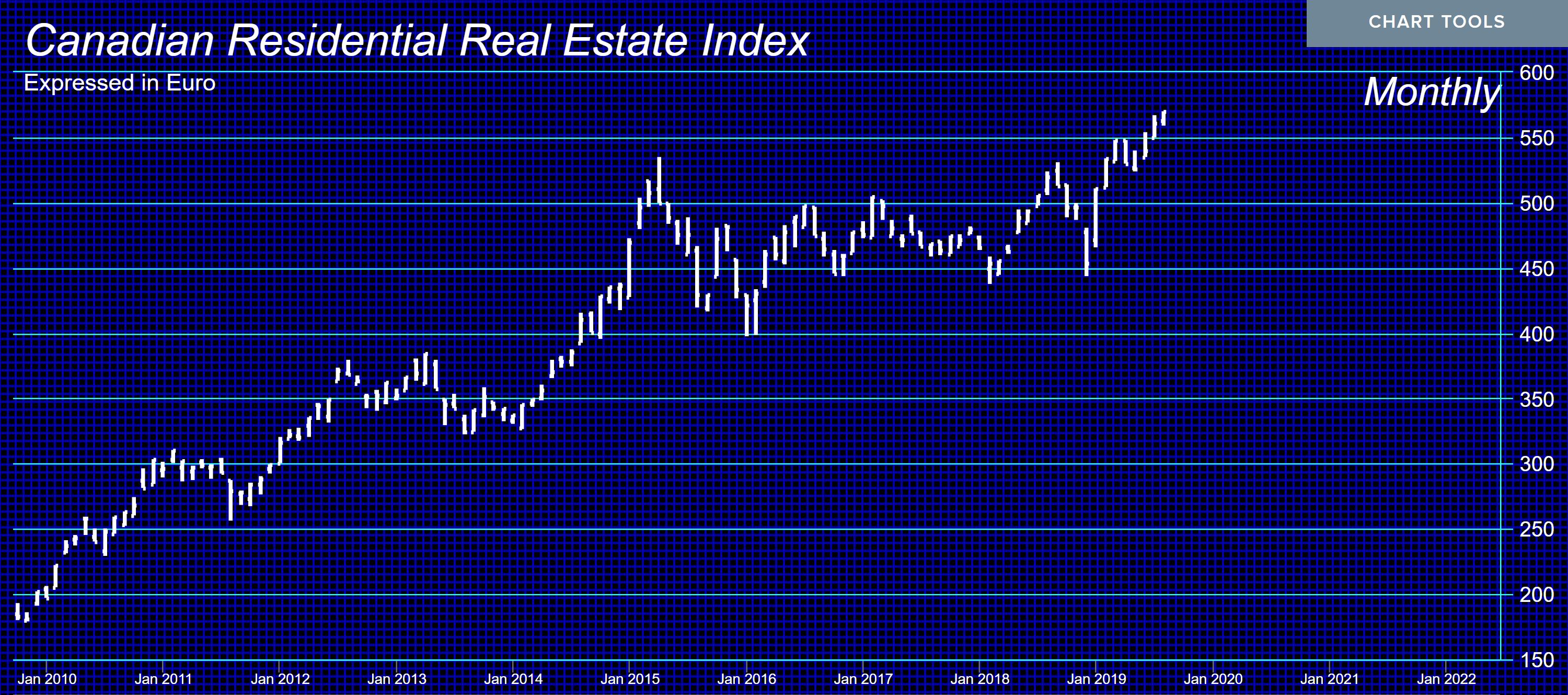
Here is the Canadian Real Estate Index in terms of Euro. Again, we are witnessing breakouts that are stronger in foreign currency than in Canadian. As we head into the Monetary Crisis Cycle, capital flight from Asia and Europe will continue and this will distort the profits they think they are making in real estate not understanding that they are playing the currencies.
Nevertheless, the is all part of the shift from Public to Private assets. While the “real terms” perspective of “value” may not be making new highs in purchasing power, this is still part of the shift from public assets. Some people will buy equities, others will go into real estate, and still others gold or other precious metals. The end game is to divest yourself of public assets and stay away from “fixed rate” investments where you are the creditor. Borrowers should be fixing their loans.
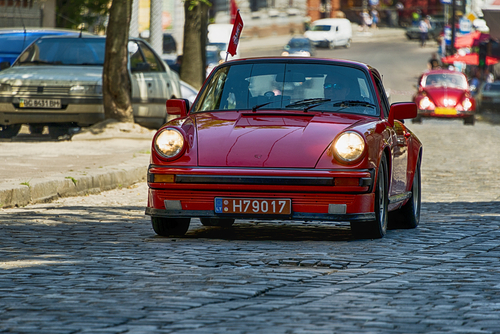
I worked with auto manufacturers in Japan and Germany. Their biggest problem was misunderstanding currency. A 911S Porsche in 1970 sold for $8,675 (31,579DM). In 1980, the same year the German automaker pulled its Turbo edition 911 in the United States, a new fifth-generation 911 cost $27,700 (46,507DM). The appreciation in dollars was 219% compared to an increase in Deuschemarks of only 47%. This created the image that German cars were better than American because they held their value. It was currency – not quality.
The majority of people just look at the price and do not understand that the currency swings can make a bad investment look good. You must always look at this from an international perspective.
The hunt for money is moving into high gear in Germany. Prior to 2017, it was possible to buy gold anonymously in quantities up to €15,000. In 2017, this limit was reduced to €10,000. Now, Merkel has drastically reduced this limit to just €2,000 beginning in 2020. Any transaction greater than that amount requires the buyer to prove their identity and give their data to the gold trader.
While Merkel has allowed the refugees to pour into Germany, denying there are terrorists hidden among them, she has justified this reduction in anonymous gold purchases by arguing against money laundering to stop terrorism. This means that terrorist would be buying gold inside Germany, which on the other hand she denies letting them in to start with.
Merkel is not satisfied with imposing just a price limitation. She also wants to introduce the 50-gram rule, which would apply regardless of price. For physical gold buyers, this means they will not be able to buy a 50-gram ingot (1.60754 troy ounces) without the gold trader taking personal data and saving it for five years. This certainly applies if you tried to buy just two one ounces coins.
Merkel has formally justified this change in the laws on gold as a step in the fight against money laundering and terrorist financing. The government studies show that out of 77,252 cases registered in 2018 that suspected terrorism financing, only 175 cases involved precious metals.
Terrorism has been a real windfall for governments since 9/11. They have increased their powers globally and probably send thank you cards to the terrorists for handing them the excuse to create total financial surveillance that they use in the hunt for taxes.
The Merkel government has been making a concerted effort to introduce a total surveillance state and track the finances of its citizens. There is chaos in Europe with negative and punitive interest rates, high bank charges, and a declining euro. All of this is mixed with a prolonged economic recession in Europe since 2007 as we approach a 13-year decline in 2020. More and more Europeans are looking for ways to safely and anonymously invest their savings, which have been under direct assault by the government. This has been leading to the hoarding of US dollars and now the change in legislation on gold is only going to increase the switch to dollars.
The Washington Post says Democrat presidential candidates have deep policy divisions, but do policies even matter in a battle with incumbent Republican President Donald Trump, the post-policy president? He’s a force of nature, but Elizabeth Warren, Bernie Sanders, Andrew Yang, Beto O’Rourke, and the rest of the gang, debate by magnifying policy preferences that distinguish them from each other. And which policies should Republicans campaign on to ensure the president enjoys majorities in the House and Senate come 2021? During the past year, Members have produced more than 250 episodes of Bill Whittle Now with Scott Ott, each designed to meet the challenge of progressive Democrats with the immutable force of time-tested conservative ideas. Not content to re-hash talking points in an echo chamber, or to read from a pre-written script to make him look polished, Bill Whittle invites Scott Ott to ambush and antagonize him, because that’s the kind of treatment YOU get in the marketplace of ideas. If you’re not afraid to meet the other side’s best arguments head on, perhaps you should be one of us. Join today at https://BillWhittle.com/register/
Tonight President Trump is holding a massive campaign rally in Rio Rancho, New Mexico. According to local media people from across the state have been lining up for hours to attend the event.
The anticipated start time for President Trump is 9:00pm ET / 7:00pm MT with pre-rally speakers and events ongoing. [**Note** YouTube has blocked RSBN from livestreaming the Trump rallies; so we are providing multiple alternate links below].
Chopper pressers are the best pressers. President Trump is traveling from Washington DC to New Mexico for a campaign rally. As the President leaves the White House he stops for impromptu remarks and questions from the press pool. [Video and Transcript Below]
.
[Transcript] – THE PRESIDENT: So, if you look at what’s happening with respect to the stock market, it’s been holding pretty firm, considering what happened with respect to Saudi Arabia. But I think we’re doing very well.
Okay? Question?
Q Is federal mediation — is federal mediation possible, as it relates to ending the GM auto strike?
THE PRESIDENT: Federal mediation is always possible, if that’s what they want. Hopefully, they’ll be able to work out the GM strike quickly. We don’t want General Motors building plants outside of this country, and we’re very strong on that.
The UAW has been very good to me. The members have been very good, from the standpoint of voting. The relationship is good. Hopefully, they’re going to work that out quickly and solidly.
Now, I just gave a pretty big news conference inside, and we’re going to be late for New Mexico. We can’t do that, ever, to New Mexico.
So, go ahead, David.
Q Mr. President, Mike Pompeo is very certain Iran is behind the attack, and you’re not. Why does he know more than you?
THE PRESIDENT: I think we’re the same. I think we just want to find out the final numbers and see. You look at a vector, and you look at — there are lots of different things we can look at, David. And we’ll know for certain over the next pretty short period of time.
Q If you become sure — if you become sure, are we going to see military action?
THE PRESIDENT: Well, then we’re going to decide. Then we’re going to decide.
Q After the drone downing, you said it wouldn’t be proportionate to do a lethal strike on Iran where you kill a bunch of people for the drone.
THE PRESIDENT: Say it again, louder.
Q After the drone was shot down in June, you said it wouldn’t be proportionate to do a lethal strike that would kill people. An attack on an oil facility, even though it’s big —
THE PRESIDENT: Would this be proportionate? Is that what you’re asking?
Q Yes.
THE PRESIDENT: I would say yes. I would say —
So, I don’t know who’s going to New Mexico with me, but I’ll see you on the plane.
Q Mr. President, can you trust Saudi Arabia on Iran, since they lied to you about Khashoggi?
THE PRESIDENT: Can I what?
Q Can you trust Saudi Arabia when it comes to what they say about Iran?
THE PRESIDENT: Oh, I think so. Look, they want to find out also. And I think they probably feel they know. But we’re going to know very — very quickly. We have pretty much all the material we need. We’ll know very quickly.
Q Mr. President, do you think the New York Times should fire the individuals responsible for claiming that Kavanaugh committed sexual misconduct without including exculpatory information?
THE PRESIDENT: I think the New York Times made another terrible mistake. It’s a shame that a thing like that could happen. I see they’re making a big correction today. They’ve just announced there’s a correction.
But to do that about a Supreme Court justice is a terrible thing. It’s a false accusation. Whatever happened with the New York Times — I mean, I can tell you personally that they never check. They never do — we used to have a thing called “fact-checking.” They don’t do fact-checking anymore. They used to call and say, “What about this? What about that?” How can they do a thing like that and destroy somebody’s life? I mean, they’re destroying lives.
And it’s fake news. It’s just fake news.
But it’s a very fair question. I mean, they have to be very embarrassed. But much more importantly, what they do is wrong, and they do it all the time.
Q Oil went up $15 today. How concerned are you about that?
THE PRESIDENT: Well, we have the Strategic — if you look at what we have, we have tremendous amounts of oil in our country. We’re independent of everybody now. We have more than anybody else. We’re the number-one energy producer in the world, which took place very recently. And we will soon be substantially more than anybody else.
So it won’t affect us. And ultimately, I don’t think it will affect the world either. But it won’t affect the United States.
Q Are you worried about it affecting the economy?
THE PRESIDENT: I don’t think so. No, I think it’s going to be fine.
Q Mr. President, (inaudible) any African leader at UN? Any —
THE PRESIDENT: We’re going to see some of the African leaders at the UN, yes.
Q You are traveling to Texas to address 50,000 people. You will be addressing 50,000 people, along with Prime Minister Modi, in Houston next weekend. What is the message you are sending to the world?
THE PRESIDENT: So, I’ll see Prime Minister Modi and I will — we’ll be meeting with India and Pakistan. And I think a lot of progress has been made there. A lot of progress. Thank you.
Q Mr. President, is it legal for the New York Attorney General to subpoena your accountant?
Against the backdrop of Iranian attacks on Saudi oil fields, earlier today President Trump delivered remarks with Crown Prince Salman Bin Hamad Al-Khaifa of Bahrain in the oval office; and held an impromptu press conference. [Video and Transcript below]
.
[Transcript] PRESIDENT TRUMP: Well, thank you very much. It’s a great honor to be with the Crown Prince of Bahrain. He is a friend of mine, and the country is a friend of ours. We’re always going to be with them, and I know they’re always going to be with us. We have a tremendous relationship militarily, but we have also a tremendous economic relationship — trade. And we’re going to be discussing all of those things. We’ll certainly be discussing what took place over the last two days in Saudi Arabia.
CROWN PRINCE SALMAN: Absolutely.
PRESIDENT TRUMP: And we’ll be discussing the Middle East. But our relationship has never been stronger than it is right now. And I think that is largely based on the relationship that we have. So I look forward to having our discussion.
CROWN PRINCE SALMAN: Thank you, Mr. President. It’s a great pleasure to be here.
PRESIDENT TRUMP: Thank you. Thank you very much. Please. Would you like to say something?
CROWN PRINCE SALMAN: Well, I would like to say — thank the President for receiving me and my delegation here today. I’m here to convey the greetings of His Majesty and the people of Bahrain; to strengthen the relationship, which is based on shared values where they overlap, ideals.
We primarily, as the President said, are going to focus on discussions related to security enhancement and trade enhancement.
We signed today a agreement to purchase additional — or to purchase our first Patriot Missile Battery Systems.
PRESIDENT TRUMP: Right.
CROWN PRINCE SALMAN: And it couldn’t have come at a better time.
PRESIDENT TRUMP: Good timing.
CROWN PRINCE SALMAN: Absolutely. And we seek to strengthen America’s ability to trade with the world, and we have some concrete ideas on how we can do that.
PRESIDENT TRUMP: Well, thank you very much.
CROWN PRINCE SALMAN: Thank you, Mr. President.
PRESIDENT TRUMP: I look forward to the day and spending time with you.
And thank you all very much. I’ll be doing a news conference outside in a little while. Just part of the trip. We’re going to New Mexico and to other places for two and half days. And many of you will be with us, and I look forward to that. But in particular, I look forward to our meeting.
CROWN PRINCE SALMAN: Thank you.
PRESIDENT TRUMP: Thank you very much.
Q Mr. President, have you seen evidence, proof, that Iran was behind the attack in Saudi Arabia?
PRESIDENT TRUMP: Well, it’s looking that way. We’ll have some pretty good — we’re having some very strong studies done, but it’s certainly looking that way at this moment. And we’ll let you know. As soon as we find out definitively, we’ll let you know. But it does look that way.
Q Do you want war with Iran, Mr. President? Do you want war with Iran?
PRESIDENT TRUMP: Do I want war? I don’t want war with anybody. I’m somebody that would like not to have war. We have the strongest military in the world. We’ve spent more than a trillion and a half dollars in the last short period of time on our military. Nobody has even come close. We have the best equipment in the world. We have the best missiles. And as you say, you just bought the Patriot system.
CROWN PRINCE SALMAN: We did.
PRESIDENT TRUMP: There’s nothing even close.
But, no, I don’t want war with anybody. But we’re prepared more than anybody. Two and a half years ago, I will tell you, it was not the same thing. And with what we’ve done, we’ve totally rebuilt our military in so many different ways, but we’ve rebuilt it. And there’s nobody — it has the F-35. We have the best fighter jets, the best rockets, the best missiles, the best equipment. But with all of that being said, we’d certainly like to avoid it.
Q What are the options, Mr. President? What are the options if not a military (inaudible)?
PRESIDENT TRUMP: Well, we have a lot of options, but I’m not looking at options right now. We want to find definitively who did this. We’re dealing with Saudi Arabia. We’re dealing with the Crown Prince and so many other of your neighbors, and we’re all talking about it together. We’ll see what happens.
Q Mr. President, will you meet with President Rouhani in New York, as it was speculated that you might meet?
PRESIDENT TRUMP: Say it?
Q Will you still meet with President Rouhani in Iran? Is this — in New York, I mean.
PRESIDENT TRUMP: Well, I have no meeting scheduled. I know they want to meet. I know they’re not doing well as a country. Iran has got a lot of problems right now that two and a half years ago — and even a little bit more than that — when I came in — it’s hard to believe it’s almost three years — but two and half to three years ago, they were causing a lot of trouble. And we’ll see what happens.
But we’ll let you know definitively if there were — as you know, there are ways to see definitively where they came from, and we have all of those ways. And that’s being checked out right now.
Q Are you still willing to meet with the Iranians without preconditions? Still willing to meet with President Rouhani?
PRESIDENT TRUMP: Well, you know, there were always conditions, because the conditions — if you look at it, the sanctions are not going to be taken off. So if the sanctions — that’s a condition. So, you know, that’s why the press misreported it. The biggest thing you can talk about are the sanctions, and the sanctions are massive. There’s never been sanctions put on a country like that. And I think they have a tremendous future, but not the way they’re behaving.
We’ll see what happens in terms of this attack. Secretary Pompeo and others will be going over to Saudi Arabia at some point to discuss what — they feel they’re going to make a statement fairly soon. But they also know something that most people don’t know, as to where it came from, who did it. And we’ll be able to find that out. We’ll figure that out very quickly. We pretty much already know.
Q (Inaudible) prepared for war?
PRESIDENT TRUMP: Say it?
Q You said the United States is prepared for war.
PRESIDENT TRUMP: The United States is more prepared than any country in the history of — of — in any history, if we have to go that way. As to whether or not we go that way, we’ll see. We have to find out definitively who did it. We have to speak to Saudi Arabia. They have to have a lot of — they have to have a lot in the game also. And, you know, they’re willing to do that. I think everybody knows they’re willing to do that.
So we’ll be meeting with Saudi Arabia. We’ll be talking to Saudi Arabia. We’ll be talking to UAE and many of the neighbors out there that we’re very close friends with. We’re also talking to Europe, a lot of the countries that we’re dealing with — whether it’s France, Germany, et cetera. Talking to a lot of different folks. And we’re figuring out what they think.
But I will tell you, that was a very large attack and it could be met with an attack many, many times larger, very easily, by our country. But we’re going to find out who definitively did it, first.
Q Can you clarify, Mr. President? So you said that you think that Iran is responsible for the attack. Do you think that the attack —
PRESIDENT TRUMP: I didn’t say that. Why do you say that?
Q You said — you said that you think you might —
PRESIDENT TRUMP: I said that we think we know who it was, but I didn’t say anybody.
Q And then you said it was Iran.
PRESIDENT TRUMP: But, certainly, it would look to most like it was Iran, but I did not say it the way you said. Go.
Q So do you think it was launched from Iran, is the second question.
PRESIDENT TRUMP: You’re going to find out in great detail in the very near future. We have the exact locations of just about everything. You’re going to find out at the right time. But it’s too early to tell you that now.
Q Do you want to release the oil reserves to help cushion the oil prices that are rising now?
PRESIDENT TRUMP: Well, they haven’t risen very much. And we have the Strategic Oil Reserves, which are massive. And we can release a little bit of that. And other countries, including Bahrain — but other countries can be a little bit more generous with the oil, and you’d bring it right down.
So, no, that’s not a problem. It went up five dollars, and that is not a problem.
And you have to remember, we’re now the largest producer of oil and gas in the world. So a lot of people in the old days — and this happened over the last very short period of time. We’re number one in the world, by far.
CROWN PRINCE SALMAN: Yes, you are.
PRESIDENT TRUMP: By far. So I never want to be benefitted that way. But the fact is, there are those that say we benefit. I don’t view that as a benefit. But we are certainly — we take in more money than anybody else from energy. Not even close.
Q Mr. President, do you still think it’s the responsibility of the Saudis to defend themselves? Or should the United States be —
PRESIDENT TRUMP: I think it’s certainly the responsibility of them to do a big — a big deal of their defense, certainly. I also think it’s the responsibility of the Saudis to, if somebody like us — which are the ones — are going to help them, they, I know, that monetarily will be very much involved in paying for that.
This is something that’s much different than other Presidents would mention, Jon. But the fact is that the Saudis are going to have a lot of involvement in this if we decide to do something. They’ll be very much involved, and that includes payment. And they understand that fully.
But they’re going to be — look, they’re very upset. They’re very angry. They know pretty much what we know. They know pretty much where they came from. And we’re looking for the final checkpoints, and I think you won’t be surprised to see who did it.
Q Mr. President, will you discuss the Israeli-Palestinian peace plan with the Crown Prince, since Bahrain hosted the first —
PRESIDENT TRUMP: We’ll be discussing it, yeah. We’ll be discussing.
Q And (inaudible), is it soon — before or after the Israeli election?
PRESIDENT TRUMP: Well, we’re going to see. I mean, it’s — the election is on Tuesday.
CROWN PRINCE SALMAN: Tomorrow.
PRESIDENT TRUMP: So —
CROWN PRINCE SALMAN: It’s tomorrow.
PRESIDENT TRUMP: So you have an election tomorrow, so I would think it would be afterwards, okay? But we — you do have an election. Big election tomorrow in Israel. And that’ll be a very interesting outcome. It’s going to be close. It’s going to be a close election.
Q Did Chairman Kim invite you to North Korea in that (inaudible)?
PRESIDENT TRUMP: I don’t want to comment on that.
Q Okay.
PRESIDENT TRUMP: The relationship is very good, but I don’t want to comment on it.
Q Would you be willing to go there?
PRESIDENT TRUMP: I just don’t think it’s appropriate for me to comment.
Q Would you be willing to go to North Korea?
PRESIDENT TRUMP: Probably not. I don’t think it’s ready. I don’t think we’re ready for that. I would do it sometime at — sometime at a later future. And depending on what happens, I’m sure he’ll love coming to the United States also. But, no, I don’t think it’s ready for that. I think we have a ways to go yet.
Q Do you stand with the autoworkers in the strike against GM?
PRESIDENT TRUMP: Well, I have a great relationship with the autoworkers. I got tremendous numbers of votes from the autoworkers. I don’t want General Motors to be building plants outside of this country. As you know, they built many plants in China and Mexico, and I don’t like that at all.
My relationship has been very powerful with the autoworkers — not necessarily the top person or two, but the people that work doing automobiles. Nobody has ever brought more companies into the United States. You know, I have Japan and Germany, and many countries have been bringing car companies in and opening plants and expanding plants. And big things are happening in Ohio, including with Lordstown. Very positive things are happening.
We have many plants that are either being renovated or expanded or built new, right now, in the United States — many more than we’ve had for decades and decades. So nobody has been better to the autoworkers than me.
I’d like to see it work out, but I don’t want General Motors building plants in China and Mexico. This was before my watch. And I don’t think they’ll be doing that, I don’t think.
I had meetings with Mary Barra, the head of GM, and I don’t want them leaving our country. I don’t want them building in China. I don’t want to build them in other countries. I don’t want these big, massive auto plants built in other countries. And I don’t think they’ll be doing that anymore.
You know, General Motors makes most of its money in the United States, and it’s too bad they spent billions and billions of dollars outside of the United States, before I got here. One of the things very important in the USMCA, which we have to have approved for the — not only for the unions, for the autoworkers, but for the farmers and for the manufacturers — for everybody. Everybody wants USMCA. It’s very important, even more so now than it was two weeks ago. But people really want it.
I’m sad to see the strike. Hopefully, it’s going to be a quick one.
Q Mr. President, has diplomacy been exhausted when it comes to issues of Iran? Diplomacy — has it been exhausted?
PRESIDENT TRUMP: No. It’s never exhausted. In fact, the Crown Prince can tell you, especially in your part of the world, it’s never exhausted until the final 12 seconds. Is that right?
CROWN PRINCE SALMAN: That is correct.
PRESIDENT TRUMP: You never know what’s going to happen. No, it’s not exhausted. Nothing is exhausted. And we’ll see what happens.
I think they would like to make a deal. I know they’d like to make a deal. They’d like to do it, but they’d like to do it on certain terms and conditions, and we won’t do that. But at some point, it will work out, in my opinion.
The problem was, the deal that was signed by the previous administration was a disaster — which, by the way, would be expiring in a very short period of time also. So you really don’t have a deal. You know, that deal was a very short-term deal. So they made a deal, but it was for a very short period of time. So that deal would be expiring very soon.
Q Mr. President?
PRESIDENT TRUMP: Yes.
Q Sorry. Are you encouraging Israel and the Saudis to work together on this issue, particularly since they have a shared common goal?
PRESIDENT TRUMP: Always. I encourage everybody. I want everybody to work together. The Middle East is an interesting place. They, historically, have not been working together too well.
But, no, Israel is starting to work together with a lot of countries that you wouldn’t have thought possible two years ago.
Yes, Steve.
Q Have you promised the Saudis that the U.S. will protect them in this case?
PRESIDENT TRUMP: No, I haven’t. No, I haven’t. I haven’t promised the Saudis that. We have to sit down with the Saudis and work something out. And the Saudis want very much for us to protect them, but I say, well, we have to work. That was an attack on Saudi Arabia, and that wasn’t an attack on us.
But we would certainly help them. They’ve been a great ally. They spend $400 billion in our country over the last number of years. Four hundred billion dollars. That’s a million and a half jobs. And they’re not ones that, unlike some countries, where they want terms; they want terms and conditions. They want to say, “Can we borrow the money at zero percent for the next 400 years?” No. No. Saudi Arabia pays cash. They’ve helped us out from the standpoint of jobs and all of the other things. And they’ve actually helped us.
I would call and I would say, “Listen, our oil prices, our gasoline, is too high. You got to let more go.” You know that.
CROWN PRINCE SALMAN: Yeah.
PRESIDENT TRUMP: I would call the Crown Prince and I’d say, “You got to help us out. You got to get some more.” And, all of a sudden, the oil starts flowing and the gasoline prices are down. No other President can do that. No other President was able to do that, or maybe they didn’t try. But I’ve done it.
So now they’re under attack, and we will work something out with them. But they also know that — you know, I’m not looking to get into new conflict, but sometimes you have to.
Q Mr. President, what’s your message to Iran right now?
PRESIDENT TRUMP: Excuse me?
Q What’s your message to Iran right now?
PRESIDENT TRUMP: I think I’ll have a stronger message, or maybe no message at all, when we get the final results of what we’re looking at. But, right now, it’s too soon to say. There’s plenty of time. You know, there’s no rush. We’ll all be here a long time. There’s no rush.
But I’ll have a message — whether it’s a strong message or maybe no message at all, depending on the final results.
Q And how concerned are you about the risk of an all-out war in the Middle East?
PRESIDENT TRUMP: I’m not concerned at all.
Q You don’t think that we’re a step closer to that, given what Iran just did?
PRESIDENT TRUMP: No. I’m not. Personally, I’m not concerned at all. We have military power the likes of which the world has never seen. I’m not concerned at all. I’d like to avoid it.
You know, when I came here three years ago almost, General Mattis told me, “Sir, we’re very low on ammunition.” I said, “That’s a horrible thing to say.” I’m not blaming him; I’m not blaming anybody. But that’s what he told me. Because we were at a position where, with a certain country — I won’t say which one — we may have had conflict. And he said to me, “Sir, if you could, delay it, because we’re very low on ammunition.” And I said, “You know what, General? I never want to hear that again from another general.” No President should ever, ever hear that statement, “We’re low on ammunition.”
And we now have more ammunition, more missiles, more rockets, more tanks, more — we have more of everything than we’ve ever had before. More jet fighters. When I came here, 50 percent of our jet fighters didn’t fly. You know that. And they were in bad shape. And now we have the best fighters in the world. Everybody wants to buy them. Are you buying our jet fighters?
CROWN PRINCE SALMAN: We are, sir.
PRESIDENT TRUMP: Which one?
CROWN PRINCE SALMAN: The F-16.
PRESIDENT TRUMP: That’s great.
CROWN PRINCE SALMAN: Signed it here.
PRESIDENT TRUMP: You have good taste. (Laughter.)
CROWN PRINCE SALMAN: Thank you, sir.
PRESIDENT TRUMP: That’s a great one.
So, we are very high on ammunition now. That’s a story I’ve never told before. Breaking news. But we have — we were very low. I could even say it stronger. I don’t want to say, “No ammunition,” but that gets a lot closer.
I said, “I never want to hear that again. And I never want another President of the United States to hear that again.” Could you imagine, as President, when they say, “We’re very low on ammunition?” By the way, stronger than that, but I’m not going to go there. That was what I was told. And I said, “I never want to be in a position like that again.” And he said, “Could you delay if we do something, sir? Could you delay it as we fill up?” And that is what I inherited from the past administration. And, in all fairness, to President Obama, to administrations before President Obama. That’s what I got stuck with. And we fixed it, and we fixed it good.
The Crown Prince understands $700 billion; the next year, $718 billion; and the next year, which is right now, we just got approved, $738 billion. And that’s a lot of money even for Bahrain. Right?
CROWN PRINCE SALMAN: It’s a lot of money, sir.
PRESIDENT TRUMP: It’s a lot even for Bahrain.
CROWN PRINCE SALMAN: It’s a lot of money.
PRESIDENT TRUMP: And Bahrain has a lot of money. Okay?
Q You have the Israeli election coming up tomorrow. How does that affect the timing of your Middle East peace plan?
PRESIDENT TRUMP: Well, we’ll have to see what happens, Steve. I just don’t know. I can’t tell you what’s going to happen. I can make a prediction; I sort of have a feeling. But we’re going to have to see what happens. That’s a big election. That’s one we’re all going to be watching.
Q Do you think Netanyahu will pull it out?
PRESIDENT TRUMP: Well, certainly he has a good chance. But it’s a very — you know, it’s a 50/50 election. A lot of people, if you look at the polls and everything else, it’s going to be very close. So we’ll see what happens. Polls — polls are often wrong.
Q Netanyahu called for annexing all settlements in the West Bank. Is that something your government would (inaudible)?
PRESIDENT TRUMP: Yeah, I don’t want to talk about that, but certainly it’s something we were told about that they’d like to do. But, no, I don’t want to be talking about that. It’s too soon.
Q Mr. President, can you, kind of, elaborate a little bit on why the decision was taken yesterday to release the Strategic Reserves? Why did you decide right away to do that?
PRESIDENT TRUMP: Well, just in case we ran a little bit low on oil. We have so much with the Strategic Reserves. Plus, being the number one producer, we can fill them up very quickly. Very, very quickly.
And one of the things I’m doing also is I’m approving the pipelines in Texas. We have a tremendous pipeline system that’s being held up by various agencies for a very good reason, for it — going through the normal process.
And we’re going to have to avoid the normal process, because if we do that — Texas is a massive distributor, a massive producer of oil, far bigger than anybody would have even thought five years ago. So what I’m going to do is expedite the pipeline approvals. That will get us another 25 percent energy — additional energy.
I know this is exactly the opposite of the Democrats. They want to have wind, solar, and, I guess, make-believe would be the third alternative, right?
No, this is something we have to do. We have the greatest wealth in the world, and we want to be able to capitalize on it, especially when it comes to safety. Okay?
Thank you all very much. Thank you.
Q Just for one more second. You talked about an urban agenda when you ran for President the first time. You went to Baltimore last week. What are your plans for Baltimore and cities like Baltimore? Instead of pointing fingers, what are you trying to do to help the city rise up from the “rodent-infested place” that you say it is?
PRESIDENT TRUMP: Well, I think what I’ve done for the inner cities is more than any President has done for a long time. We’ve created Opportunity Zones. In fact, I did that with Tim Scott, who you know very well, who is, I think, a tremendous guy. It was his initiative. And he came to see me.
They’re having a tremendously positive impact on the inner cities, including Baltimore, including a lot of other cities that you wouldn’t necessarily think. Oakland, California, is an example. We’re having tremendous success in the inner cities because of the Opportunity Zones.
Criminal justice reform — I was the one that got it. Nobody else. I mean, we had people that helped, but a group of extremely liberal Democrats came to the office and they said, “We cannot get it.” President Obama was unable to get it, as you know. President Bush — they were all unable to get it, and I got it.
And I got it with some very conservative senators and people that wanted it to happen. And nobody else could have done it. And it’s sort of interesting, because they don’t like mentioning my name, although, I guess now people are understanding.
But we got it. We got it done. We formed a coalition with some very conservative people, as you know, and some people that are very far left. And we did a thing called, “criminal justice reform,” something that nobody thought. The Crown Prince has seen this. Nobody thought this could possibly happen. And I’m very proud of criminal justice reform. So, we did that. We did the Opportunity Zones and a lot of other things.
Our job numbers for African Americans are the best in history. You saw the new ones came out; they’re even better than they were two months ago. Hispanic, the best in history. Asian, the best in history. Overall, they’re phenomenal. The best in 51 years. And I think we’ll soon be historic on that one too.
The economy is doing great. And that’s the best thing I can do.
Q Did you look at Baltimore when you flew over? Did you see what you —
PRESIDENT TRUMP: No, when I drove through I looked at it. And we flew over. But we also — no, you have some sections that need a lot of help.
And, you know, what people don’t know — I had a great meeting with Elijah Cummings in this office very early in my tenure. And it was a meeting on drug prices. And I saw him get emotional talking about drug prices. Seriously emotional. And I was really impressed. He cared about it. And I would certainly be willing to meet with Elijah and other people, if they’d like.
But I saw the emotion and the feeling that he had for reducing drug prices. And we’ve worked hard, and we’ve actually had the first year in 51 years where prices went down. But we can get them down much further if we can get the help from Congress.
So I think we’re going to do much lower drug prices over the next year. And I think that if Elijah Cummings would want help, I am here. But I did see him at a moment that was actually, I thought, a very beautiful moment. I’ve talked about it often because I see the political rhetoric every once in a while. And I said, “That’s not the same guy I had in my office.” That was a very caring man that wanted to see drug prices lowered. And he wanted that for the community — for his community.
So, I look forward to working with Elijah, but I look forward to working with a lot of people. But I think Opportunity Zones have been tremendous for the inner cities.
And criminal justice reform is something we’re very proud of. Thank you all very much.
The dance with the dragon is a complex geopolitical relationship between two large economies. China’s view within the dynamic is shaped by their own internal ideology and outlook. The panda mask dynamic was/is strategic and has served them well for decades; but now President Trump -while engaging a structural confrontation- has used the panda strategy against Beiing’s interests. China is flummoxed.
Each of President Trump’s trade team members have a specific role; each member also has a specific opponent within the dance:
♦Peter Navarro is the blue-collar hawk. He focuses on the the administration’s Wall Street adversaries; and the U.S. multinationals -American companies- who have aligned their interests with Beijing. Navarro’s focus is internal to U.S. interests. Navarro confronts U.S. corporations, Wall Street interests, who are working against Main Street.
♦Treasury Secretary Steven Mnuchin carries the economic financial weapons (represents the dollar), and he faces toward global adversaries (IMF, World Bank, European Central Bank etc.) who have also aligned their interests with Beijing and the status quo.
♦Commerce Secretary Wilbur Ross, coordinates the punitive actions that keep Beijing in a position of compromise. Ross reviews prior agreements, trade legal specifics, searches through contractual obligations and ultimately controls the tariffs, if/when triggered by President Trump. Secretary Ross faces down the World Trade Organization (WTO).
♦U.S. Trade Representative Robert Lighthizer is the contract writer; the primary negotiator; and he is at the center of the trade group where the details are constructed. Lighthizer writes the terms based on the objectives of President Trump. Only POTUS approves the new agreements.
♦White House Economic Council Chairman Larry Kudlow is the explainer, the trade diplomat. The communication bridge between what is happening in the big picture and what the subsequent consequences mean. Chairman Kudlow is to remain affable, optimistic and approachable by any interests who have concerns. The PR guy.
“It must be remembered that there is nothing more difficult to plan, more doubtful of success, nor more dangerous to manage than a new system. For the initiator has the enmity of all who would profit by the preservation of the old institution and merely lukewarm defenders in those who gain by the new ones”
Navarro, Mnuchin, Ross and Lighthizer bear the economic teeth. After all, their job is serious… they have all the confrontational challenges… they face those who want to stop President Trump’s global trade reset. Their goal is to ‘change the status-quo‘ toward greater reciprocity for the U.S. and to stop the one-sided nature from decades of trade agreements which eroded the U.S. middle-class. Because their objective is change, they face the adversaries head-on. Their tasks make them targets. This group are hard men.
Kudlow is the soft-one. That’s his job. Be approachable by those who don’t like confrontation. Kudlow calms nerves and keeps the nellies‘ less nervous.
Within this dance, there is an important place where East/West negotiations require respect. The panda mask is part of the dynamic, perhaps the cunning and positioning part, but beyond the mask actual terms need respect from both parties.
Beijing violated that central component of respect in May, 2019, when they rebuked the terms of an agreement that were 80 percent negotiated and accepted by their own emissary. China is paying the price for that violation now. They likely did not anticipate the severity of punishment, now they are living with consequences.
President Trump has delivered punishment but continued to praise the opponent in hopes of encouraging Chairman Xi to rethink the dragon position.
There are many U.S. hawks celebrating the pain within China; and some of those same voices are calling for continued policy that will lead to the collapse of the central Chinese communist government. That ain’t going to happen.
If there are going to be terms, there needs to be a middle position. President Trump has always expressed hope that terms can be reached; however, he has also expressed pragmatically that successful terms likely involve too much loss for Beijing to accept.
President Trump has done all he can to encourage U.S. multinationals to think about the impossibility of structural change in Beijing against the severity of their own experiences. In essence President Trump has warned U.S. companies to plan for the worst, and get out.
The complaints from U.S. and allied interests about Chinese trade practices are not likely be fixed; the issue is structural. China will not change the structure of their totalitarian controlled economic model. They are communists.
However, that said, within this ongoing dance there needs to be panda dialogue – because the global downsides are severe…. Enter Michael Pillsbury:
Today President Trump will be recognizing a career of accomplishment by presenting the Presidential Medal of Freedom to former New York Yankee Hall of Fame pitcher Mariano Rivera. The anticipated start time is 2:00pm EDT.
Update: Video Added
(White House) Today, President Donald J. Trump will present the Presidential Medal of Freedom to Mariano Rivera. During his 19 seasons in Major League Baseball, Mariano Rivera established himself as the greatest relief pitcher of all time. Signed by the New York Yankees in 1990, Mr. Rivera would become a 13-time All-Star and 5-time World Series champion. He was the first player in the history of the sport to be elected unanimously into the National Baseball Hall of Fame. Off the field, through the Mariano Rivera Foundation, he has provided education and inspiration to children from low socioeconomic backgrounds, empowering them to achieve better futures. The United States proudly honors Mariano Rivera for being a legend of the game of baseball and for his commitment to improving America’s communities.
House Minority Leader Kevin McCarthy appears on Sunday Morning Futures with Maria Bartiromo to discuss several ongoing political issues.
In the first two-thirds of the interview Leader McCarthy discusses Iran attacking the Saudi oil facility, and the ramifications therein. Speaker Nancy Pelosi holding back the USMCA hoping to get past the Canadian election; and the current field of 2020 democrat candidates. McCarthy holds the opinion that Elizabeth Warren will be the Democrat candidate for President.
In the last third of the interview (@11:15) McCarthy discusses the upcoming IG report on FISA abuse. McCarthy believes: Andrew McCabe will be indicted; the IG report will identify culpability for James Comey, and the construct of a soft coup will be highlighted.
Counselor to the president Kellyanne Conway appears on Fox News Sunday for an interview. Bill Hemmer is filling in for Chris Wallace. The recent Iranian attacks on Saudi Arabia oil production is the top issue covered.
Additionally, Ms. Conway discusses John Bolton’s replacement as National Security Adviser, current WH positions on legislation to restrict firearm ownership, the ongoing negotiations with China on trade, the impeachment nonsense and the democrat 2020 race.
I have created this site to help people have fun in the kitchen. I write about enjoying life both in and out of my kitchen. Life is short! Make the most of it and enjoy!
This is a library of News Events not reported by the Main Stream Media documenting & connecting the dots on How the Obama Marxist Liberal agenda is destroying America


 I worked with auto manufacturers in Japan and Germany. Their biggest problem was misunderstanding currency. A 911S Porsche in 1970 sold for $8,675 (31,579DM). In 1980, the same year the German automaker pulled its Turbo edition 911 in the United States, a new fifth-generation 911 cost $27,700 (46,507DM). The appreciation in dollars was 219% compared to an increase in Deuschemarks of only 47%. This created the image that German cars were better than American because they held their value. It was currency – not quality.