Should Argentina Peg its Currency to the Dollar?


Posted originally on Dec 6, 2023 By Martin Armstrong 

Monetary System 2

QUESTION: What about Argentina willing to peg pesos to USD? THANKS for all you are doing for us! ALL THE BEST TO YOU AND FAMILY

TD

ANSWER: First and foremost, what collapsed Bretton Woods and the gold standard was persistent deficit spending. They fixed the price of gold to $35 but then spent recklessly every year. you CANNOT have a fixed exchange rate, a pegged exchange rate, or any sort of a gold standard as long as you retain a Marxist/Socialist agenda where you spend more than you have.

In addition, any Pegging of a currency is significantly different than a Fixed Exchange Rate. Under a Fixed Exchange Rate, the main purpose is to facilitate trade. However, you are not expressly subordinating your economy to the economic trend of everyone else in the system. Each nation is still independent, and if their balance of payments falls out of line, then they alone have a monetary crisis.
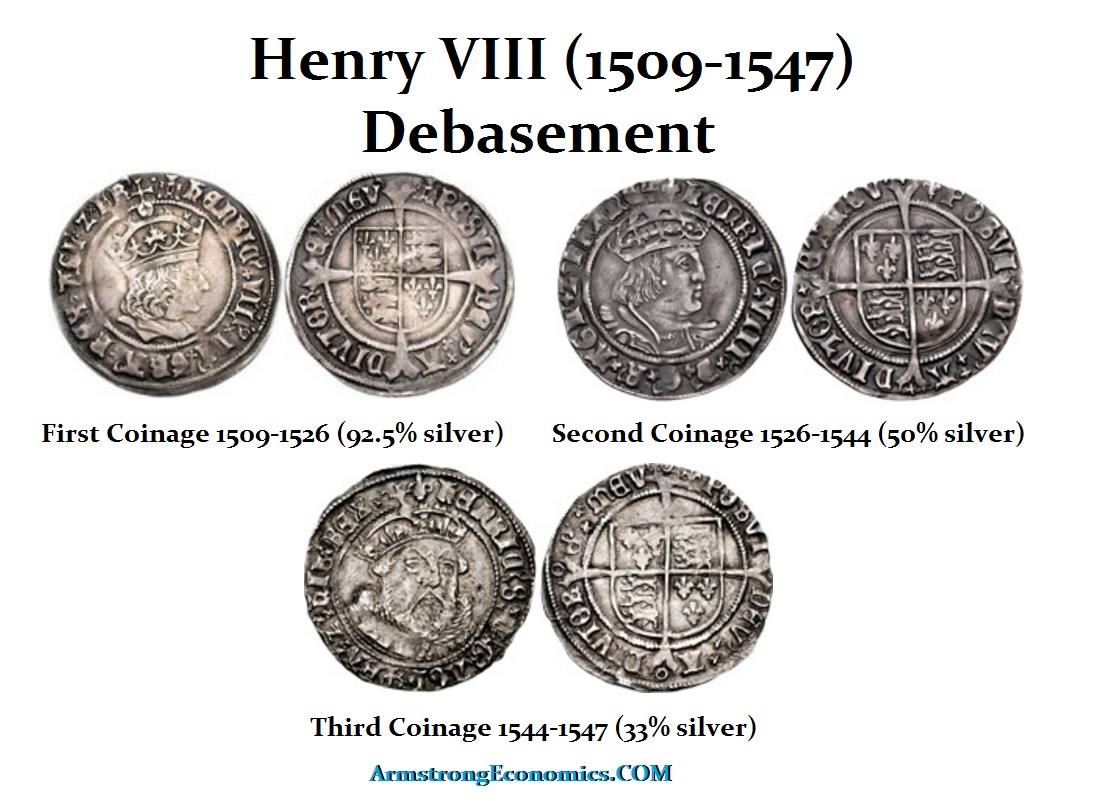
Henry VIII Debased Groats

Sir Thomas Gresham was the agent for the English Crown in Amsterdam, the Wall Street of Europe at that time. Henry VIII was debasing the currency, and nobody wanted to lend money to him, fearing that what they would be repaid with was debased. Hence, Gresham’s law.
Pegging to the dollar Pegged

A Pegged currency is far worse for the host currency’s economic conditions are imported. If Argentina pegs to the USD, then raising or lowering interest rates by the Fed and the boom-bust business cycle are automatically exported to Argentina. It would be better to peg to a basket of currencies that would be a hybrid system closer to a fixed currency regime for trade.
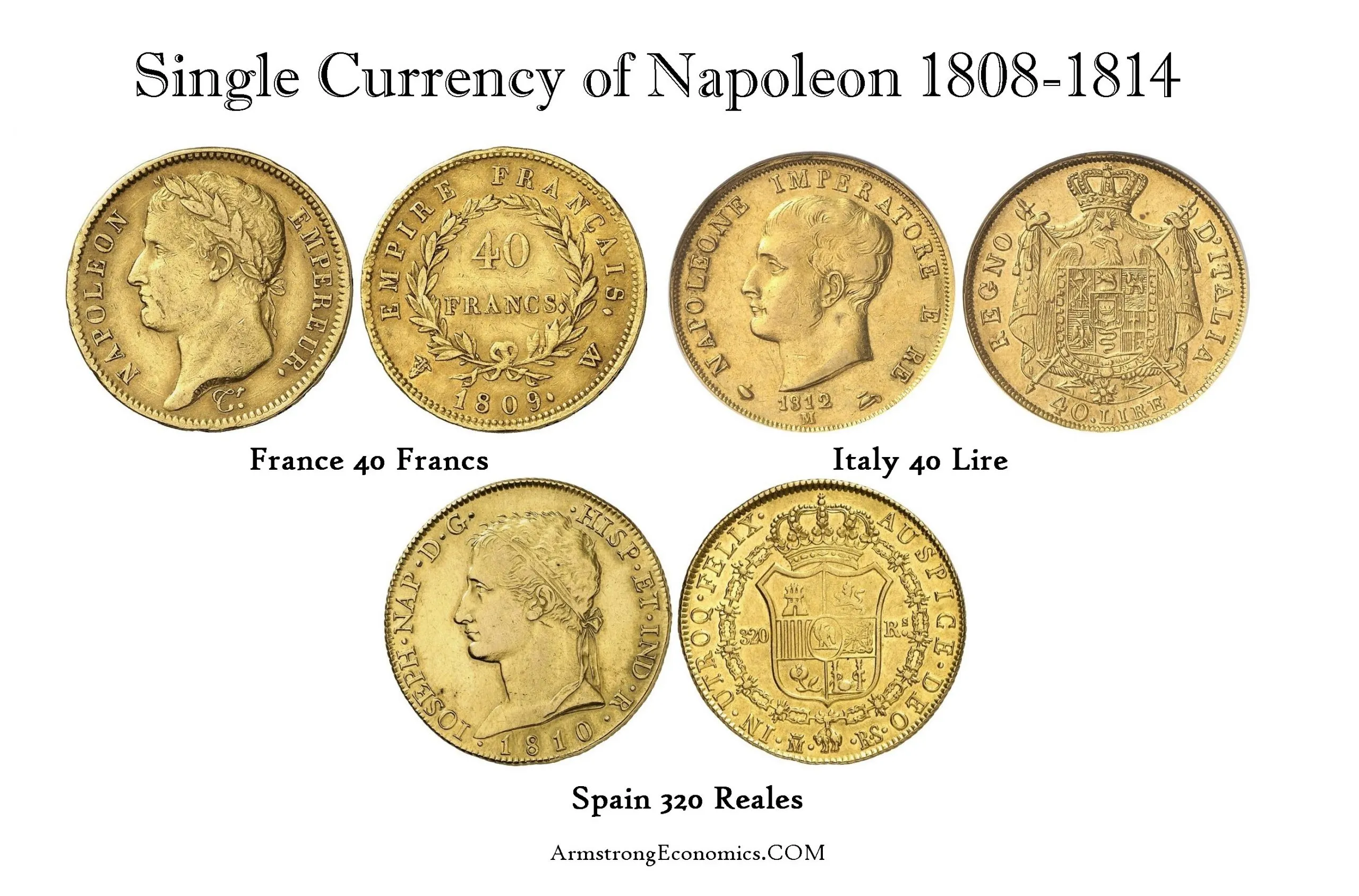
Napoleon Single Currency 1024x675
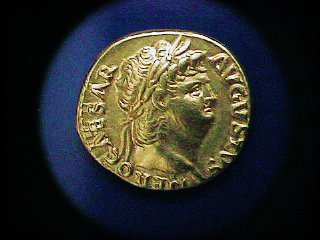
970 Nero

Napoleon had actually summoned the best minds and talents from all over Europe into his service. His court was deliberately filled with able men from all over Europe: Dutch, German, Italian, and even Polish. These foreigners worked in the highest offices of his imperial civil service – not exclusively French.

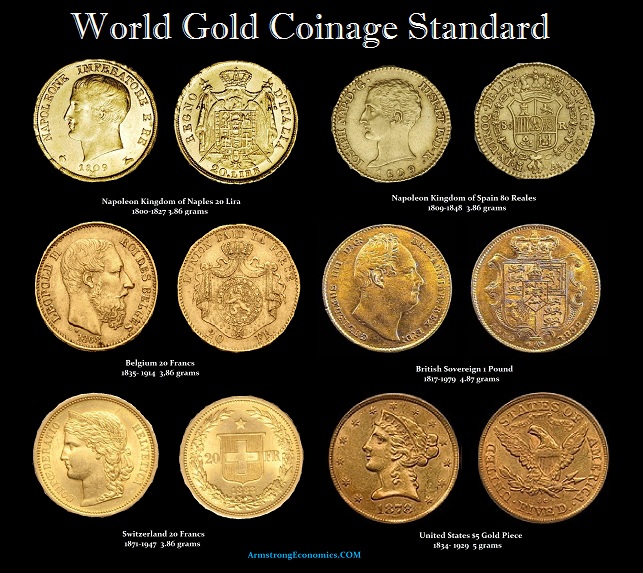
It was Napoleon who created the first single currency in Europe following the Roman Empire. He standardized the weight of the coins so that 40 francs equaled 40 Lire in Italy and 320 Reales in Spain. This was really Napoleon’s idea of resurrecting the Roman empire. Please take note of his coinage. He is pictured wearing a laurel wreath as a Roman emperor. He was far more than just a general. The new movie was interesting, but they overlooked his economic decisions, which were decades ahead of anyone else in Europe.
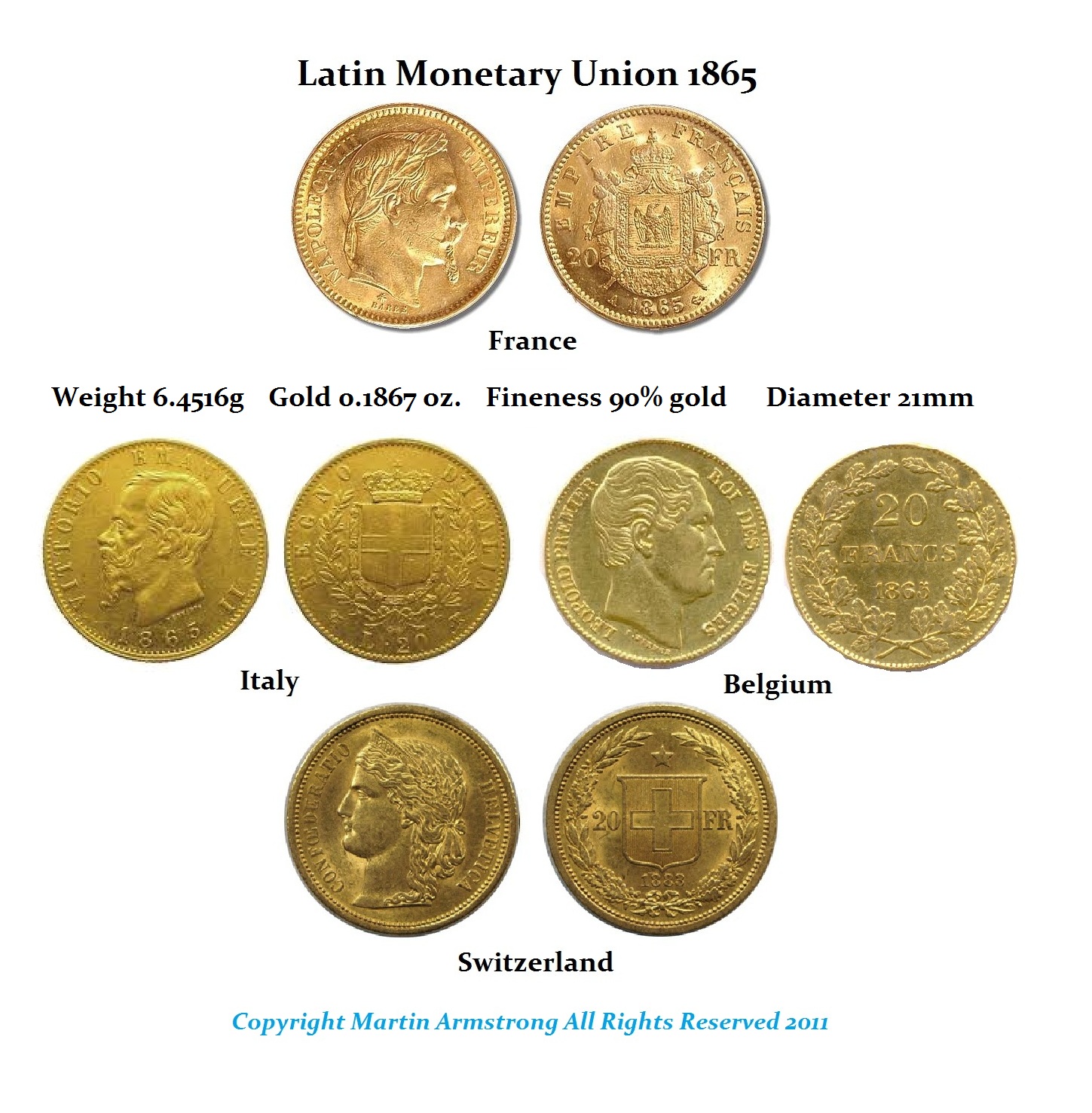
Latin Monetary Union

The unification of Europe was the accomplishment of Julius Caesar. However, it was Napoleon who standardized the monetary system post-Rome after the Dark Age, which became the inspiration for the Latin Monetary Union by 1865 and later the Gold Standard post World War II.
EuropeanGoldCoinage 1803 1947 R

Even the United States’ $5 gold coinage was equivalent to the standardization of world coinage during the 19th century.

Black Friday – A Key Weekend for Retailers


Posted originally on Nov 24, 2023 By Martin Armstrong 

Recession

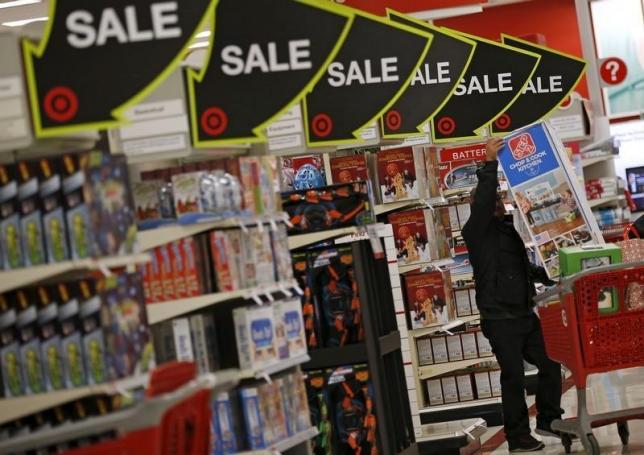
Retailers have been preparing for Black Friday and Cyber Monday all year. The tradition of post-Thanksgiving shopping has spread internationally with companies throughout the world promoting special sales. The National Federation of Retailers in America predicts that 2023 will be one of the busiest shopping holidays in the nation’s history.

Around 182 million shoppers are expected to make purchases from Thanksgiving Day through Cyber Monday, marking a 15.7 million uptick from 2022. This also marks the highest estimate since the organization began compiling data in 2017. Despite inflation, 61% of 8,424 respondents to a poll said the deals presented are too good to pass on.

The bulk of spending is expected to occur on Black Friday with 130.7 million participants, followed by Cyber Monday which is expected to attract 71.1 million shoppers. Half of shoppers will be searching for presents for the upcoming holidays. In total, retail spending in November and December will reach up to $966.6 billion.

“The Thanksgiving holiday weekend marks some of the busiest shopping days of the year, as consumers enjoy the tradition of shopping for the perfect gifts for friends and loved ones,” NRF President and CEO Matthew Shay said. “Retailers have been preparing for months for this occasion. They are stocked and ready to help customers find the gifts and other items they want at great prices during the entire holiday season.”

Although consumer spending accounts for 2/3 of GDP, the majority of Americans are living off of credit due to record inflation. So while people are spending during this 5-day holiday in anticipation of tomorrow’s price being higher, consumer spending at this point in time merely adds to the private debt crisis sweeping the nation.

Interview: Gold and the Dollar will Rise Together Re-Posted Nov 5, 2023 By Martin Armstrong 


Watch the video above or click here to watch my latest interview with Goldseek Radio.

Head of Armstrong Economics, Martin Armstrong, outlines his gold market projections in lieu of unraveling geopolitical conditions.

Armstrong says, “You have a lot of uncertainty and confusing trends developing. When this materializes in people understanding what’s happening…the dollar and gold would go up together. Because you are looking at a flight of capital. Some people want to buy gold, some people want to get out of Europe, etc. Not everybody does the same thing. The two trends will come together. That’s what our computer is projecting, and it’s happened many times in history.”

– Epic gold breakout ahead!
– Convergence of economic themes – recession next year and escalating conflicts?
– Comments on crude oil.
– On the cusp of WWIII by 2025?
– How to foment de-escalation within the ranks of the power-hungry elite.
– Might societal decay accelerate?
– Tangible assets are key to surviving collapse.
– 90% silver coins remain an ideal survival investment.

A Strong Possibility Twitter Will IPO and Go Public Again, Here’s Why


Posted originally on the CTH on October 3, 2023 | Sundance 

I wasn’t going to write about this, but so many requests and contacts have come in, and considering that my background conversations with people are leading to actionable positioning, that I feel it is only fair to share publicly what I am analyzing privately.

The predicate for all assumptions is several fold: {Go Deep One} and {Go Deep Two}. Most of the financial groundwork for analysis already exists. In summary, Elon paid $44 billion for the platform. Current valuations are around $15 billion.  Current debt service is $1.5 billion/yr (roughly $100m/mo).  Current expenses include $100m/yr AWS, $100m/yr Goog cloud (both contracts), +payroll and misc.

Approximately 9 months ago, Musk had $1 billion in cash reserve for Twitter.  The burn rate deficit was roughly $100m/month. That put timeline estimates for an inflection point on/around October 2023.  It is now October 2023.

Approximately a week ago, Twitter CEO Linda Yaccarino made a bold statement.  Yaccarino stated that from her review of the current status, Twitter would start to turn a profit in the first quarter of 2024 {link}.  However, with $100 million per month in debt service alone, this statement seemed too far of a stretch.  At pre-musk levels of revenue, maybe; but that $1.5 billion debt service is a heavy nut to carry.

Timing – Remember, it’s October.  Last Friday, the Securities and Exchange Commission (SEC) gave special regulatory approval to Bill Ackman’s firm, Pershing Square (hedge fund), for a new investment vessel called SPARC, whose purpose is to invest in private companies in order to take them public.  As noted by CNBC, “In a SPARC, investors will know what company the financing vehicle would be used to merge with before they have to pledge their investments.”  The financial mechanism avoids some of the issues with typical IPO’s.

•It’s October, inflection time.  •Yaccarino says a strategy is underway for profitability in Q1 2024.  •Ackman gets SPARC approval, and then suddenly:

[…] “The answer is I have a lot of respect for Musk. I think Twitter is a really important platform,” Ackman told CNBC. “I think he’s made tremendous improvements to the platform, and I think it’s a unique, very difficult-to-disrupt, kind of asset and one that could grow.” 

[…] Though Musk hasn’t expressed any interest in working with Ackman to take X public, and despite the $13 billion in debt tacked to the company, Ackman has worked out a loose plan to make it happen, if Musk were interested. 

“What’s interesting here is we could commit $2 billion to a transaction, set the rights price to $121 million, set it at $100 a share and announce a transaction,” he said. 

“And then we tell the story and then the rights holders have a chance to decide whether to invest. As long as the rights have positive value, they’re all going to get exercised, and the IPO raises $13 billion.” (read more)

The heavy nut disappears.

Investors roll the debt into discounted shares of stock.  If Ackman can generate a $17-$20 billion outcome for Twitter, Musk nets $5b and retains 20-25% of shares.  Yaccarino gets well compensated.  It’s a win/win/win.

Critics would say the IPO would mean Musk compromising on the free speech commitment.  However, in reality Musk has already reinstalled many of the control mechanisms of the previous “safety council,” along with the “freedom of speech, not freedom of reach” outlook.  Musk and Yaccarino have also partnered with the Global Disinformation Index.

The compromises are already baked into the platform, and seemingly have been since Yaccarino became CEO.  The 2024 election is next year, and influence is a lucrative business.

Frances Fox Piven vs. Milton Friedman, Thomas Sowell (Video 1980)


Armstrong Economics Blog/Uncategorized R-Posted Sep 30, 2023 by Martin Armstrong

The Birth of the US Dollar


Armstrong Economics Blog/USD $ Re-Posted Sep 17, 2023 by Martin Armstrong

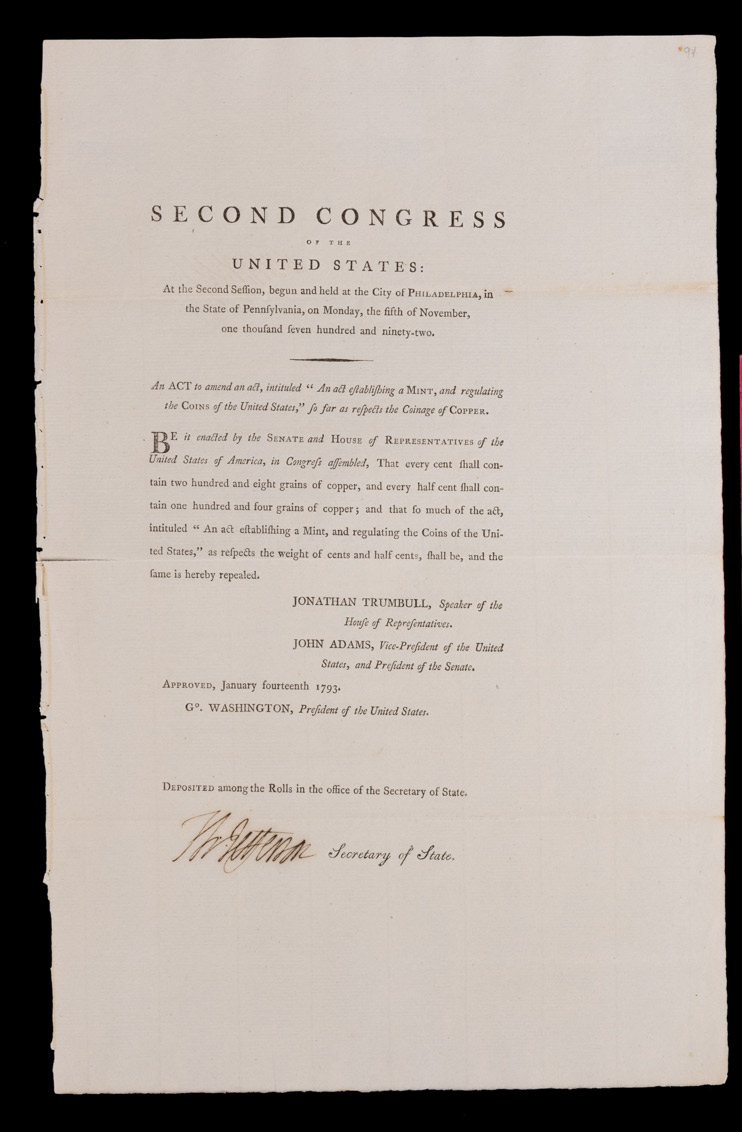
Thomas Jefferson Act of Congress Signed as Secretary of State, January 14th, 1793,

Second Congress of the United States (1743-1826)

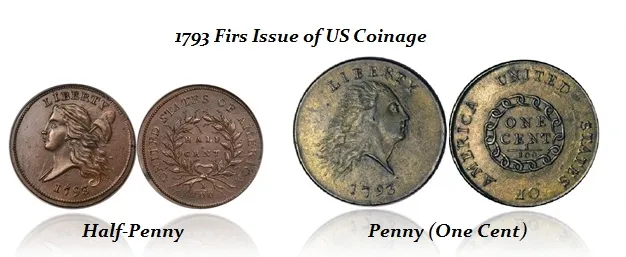
As Secretary of State, Thomas Jefferson amended a previous Act, “establishing a Mint and regulating the Coins of the United States,” establishing the copper weight specifications for the first US coins issued in 1793 – the Cent and Half Cent. This is a document from our collection on the Monetary System of the World, establishes the birth of the US dollar authorizing the first issue of the coinage of the United States. It is unique and of tremendous historical importance.

The first copper coins created by the new United States of America were introduced into circulation in March of 1793. This document is signed “Th’ Jefferson” as Secretary of State and countersigned (in type) by George Washington as President, John Adams as Vice President and President of the Senate, and Jonathan Trumbull as Speaker of the House of Representatives.

“Second Congress of the United States: At the Second Session, begun and held at the City of Philadelphia, in the state of Pennsylvania, on Monday, the fifth of November, one thousand seven hundred and ninety-two. An act establishing a Mint, and regulating the coins of the United States, so far as respects the Coinage of Copper.”

“Be it enacted by the Senate and House of Representatives of the United States of America in Congress assembled, That every cent shall contain two hundred and eight grains of copper, and every half cent shall contain one hundred and four grains of copper; and that so much of the act ‘An act establishing a mint, and regulating the coins of the United States,’ as respects the weight of cents and half cents, shall be, and the same is hereby repealed…. Approved January fourteenth 1793…”

Teaching Hedging


Armstrong Economics Blog/Trading Re-Posted Aug 27, 2023 by Martin Armstrong

COMMENT: Marty, I just wanted to thank you. I attended your 1985 World Economic Conference, and you taught me how to hedge. That made my career, and now I am about to retire. Nobody was teaching hedging in the early 1980s. You have impacted the world far more than you realize.

I will be at the WEC this year in my official capacity. Next year, it will be for me personally. I sincerely wanted to thank you, and you should post this. The newbies need to know you were there decades before anyone else.

God bless.

GK

REPLY: George, it has been a long journey. I am glad I helped you in your career. You have always been there for me and I appreciate old friends. BTW, they still do not teach hedging in universities. Just amazing.

Japan Exports Fall in July, Driven by 14.3% Decline in Shipments to China


Posted originally on the CTH on August 17, 2023 | Sundance 

Some economic data released by the land of the rising sun points to a larger global weakness in manufacturing demand.   Within the data year-over-year exports from Japan fell in July by 0.3%, which is the first time since 2021 the contraction was noted.

Digging a little deeper, the weakness in Japanese exports is driven primarily by a decline in exports to China of 14.3% in July, which follows a 10.9% decline in June.  Japan is a component supplier to China, which would indicate the demand for Chinese products globally is substantially less than Beijing has previously admitted.

That said, Japan’s direct export of finished goods to the U.S. actually increased 13.5%, mostly driven by the export of electric vehicles.

However, 13.5% is identical to the overall decrease in Japanese imports.

Essentially, component parts to China are down, but completed finished goods to the U.S. are up.  Overall, the results from Japan point to a soft overall global economic status, the result of continued contraction of Western economic activity.

TOKYO, Aug 17 (Reuters) – Japan’s exports fell in July for the first time in nearly 2-1/2 years, dragged down by faltering demand for light oil and chip-making equipment, underlining concerns about a global recession as demand in key markets such as China weaken.

Japanese exports fell 0.3% in July year-on-year, Ministry of Finance (MOF) data showed on Thursday, compared with a 0.8% decrease expected by economists in a Reuters poll. It followed a 1.5% rise in the previous month.

[…] Japanese policymakers are counting on exports to shore up the world’s No. 3 economy and pick up the slack in private consumption that has suffered due to rising prices.

However, the spectre of a sharper global slowdown and faltering growth in Japan’s major market China have raised concerns about the outlook.

The World Bank has warned that higher interest rates and tighter credit will take a bigger toll on global growth in 2024. (read more)

Meanwhile, I would not bet against Michael Burry.

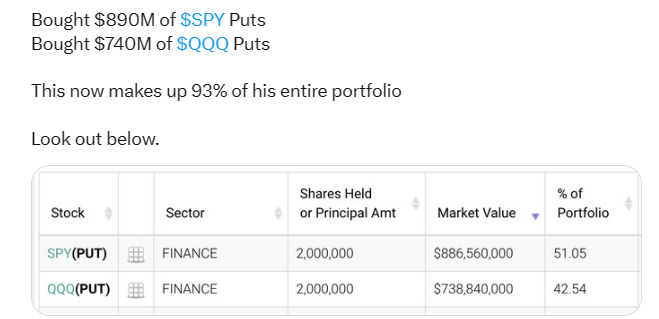
Burry is betting against the S&P 500 and Nasdaq 100 this week, according to his fund’s latest releases. Securities and Exchange Commission filings.  The filing shows that he is now holding options against the S&P 500, hedging $886.6 million against the index.

The filing also revealed that Burry sold his shares in Capitol One, First Republic, PacWest Bancorp, Wells Fargo and Western Alliance after betting on them earlier this year in Trying to make money from the regional banking crisis.  Burry also sold his stakes in Chinese e-commerce giants Alibaba and JD.com.

In addition, he bought $738.8 million in put options against the Invesco QQQ Trust ETF – a fund made up of popular high-tech Nasdaq companies, such as big tech companies Apple and Microsoft as well as Nvidia, Tesla and PepsiCo.

Burry has pulled money out of China investments and U.S. banks and is hedging against tech and the S&P.  He took these positions before the data from Japanese exports to China was released.

Left Declares White Males as Most Dangerous Demographic in USA


Armstrong Economics Blog/USA Current Events Re-Posted Aug 2, 2023 by Martin Armstrong

“Squad” member Ilhan Omar was interviewed by Al Jazeera in February 2018 prior to taking a seat in Congress. When asked whether Islamophobia was due to “jihadist terrorism,” the openly racist politicians said “our country should be more fearful of white men across our country because they are actually causing most of the deaths within this country.”

This was during the time that Trump imposed a travel ban on people from Islamic countries. Her full quote stated: “I would say our country should be more fearful of white men across our country, because they are actually causing most of the deaths within this country. And so if fear was the driving force of policies to keep America safe, Americans safe inside of this country, we should be profiling, monitoring and creating policies to fight the radicalization of white men.” That’s right – she wants to profile and monitor white males in America. White men do not commit the most murders in America, but the statistics fail to fit the narrative.

Omar said that Trump’s ban was masqueraded as national security, and said her own country, Somalia, has never posed a threat. The interviewer reminded Omar that over 20 young Somali Americans in Minnesota alone had fled the US to fight for ISIL or Al Shabab jihadist groups. There is a travel ban to Somalia as well. The US government has informed Americans that they will not send anyone to rescue them when they are taken prisoner, and encourage anyone dumb enough to visit to arrange kidnap negotiators. There is a book entitled “A House in the Sky” detailing on Canadian journalist’s ordeal after a trip to Somalia that explains the landscape there quite well.

A member of Congress defending terrorists is alarming. Asking the US to profile and track nearly half of the population is beyond troublesome. “She hates our country. She comes from a place that doesn’t even have a government, and then she comes here tells us how to run our country,” Trump warned before she was appointed to Congress.

Climate Change & Taxes


Armstrong Economics Blog/The Hunt for Taxes Re-Posted Jul 29, 2023 by Martin Armstrong