Posted originally on the conservative tree house on March 1, 2022 | Sundance | 387 Comments
There comes a time in every performance of the United Nations production when the arch villain bombs the milk factories. Today, Russian President Vladimir Putin takes his turn.
As we return to our seats from the lobby during commercial interlude, we discover the model U.N. interns have left the blue and yellow ribbons on our seats. We know exactly what segment of the melodrama comes next; the children are suffering.
The well attired gentlemen in the mezzanine know this is the moment when they must position their freshly pressed pocket kerchief for quick access. Heart strings will be pulled, and silk gowns do not fare well as the tears begin to flow. Well educated chivalry, passed down from father to son, has prepared them for this moment. It’s not quite time for the checkbooks yet; first they must feel the sound of the violins.
Surprisingly, Bono and Geldorf have not yet made their appearance. However, with the speed of modern social media, and knowing the technology of our time means we cannot wait, the EU assembly must lay the groundwork for the great American oration that is center stage from the Capitol later tonight.
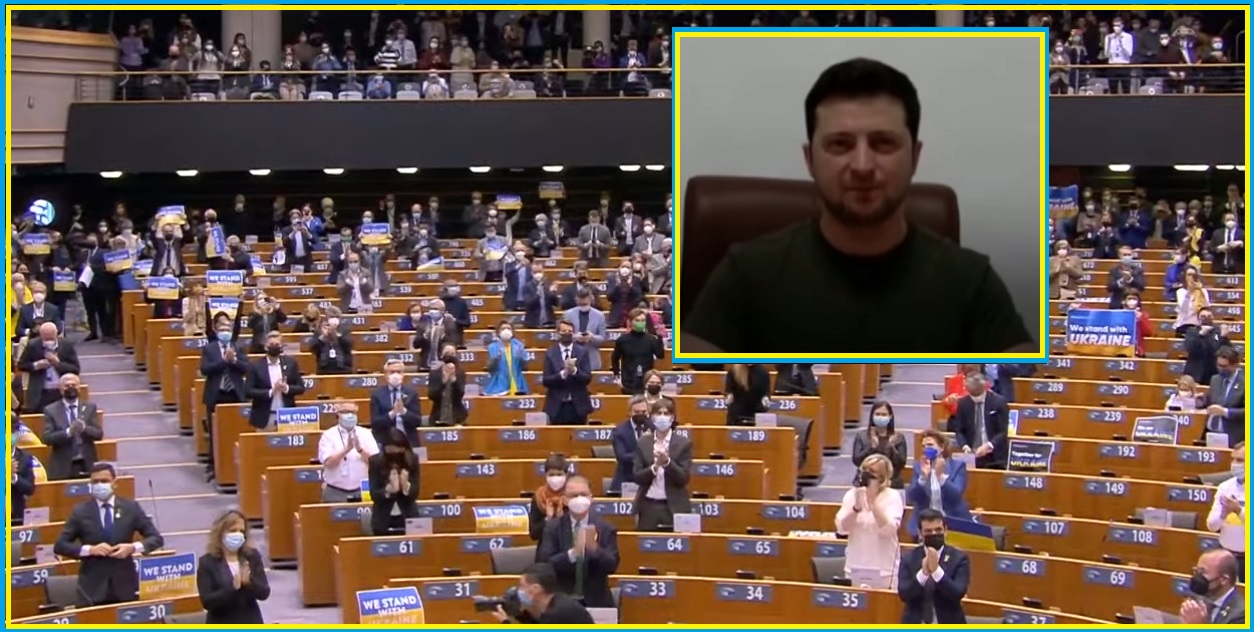
New York – Ukraine’s president Volodymyr Zelensky urged the EU to “prove you are with us” in a defiant speech on Tuesday.
Mr Zelenesky, who has become a symbol of defiance for his country, issued an impassioned speech via video link, where he called on the EU to stand with Ukraine as Russia continues its deadly advance on the country.
During his speech, Mr Zelensky described the missile strikes on Kharkiv, as an act of terror against the city, and indeed Ukraine.
As he spoke of the country’s fight to defend its “freedom” and land from the Russian invaders, the bloc’s official Ukrainian-English interpreter seemingly becomes emotional as he listened to Mr Zelensky’s defiant speech. Mr Zelensky said: “Without you, Ukraine is going to be lonesome. We have proven our strengths. We are exactly the same as you. (more)
New York II – […] The Ukrainian president’s rallying cry brought members of the European Parliament, many wearing t-shirts emblazoned with #standwithUkraine or wearing blue and yellow rubbons, to their feet.
It also brought the English interpreter to tears, with his voice audibly faltering as he translated the speech, in which Mr Zelensky declared: ‘Nobody is going to break us. We are strong. We are Ukrainians.’
The rousing reception was in stark contrast to scenes over in Geneva, where ambassadors and diplomats staged a mass walkout as Russian foreign minister Sergei Lavrov addressed a UN human rights forum. (read more)
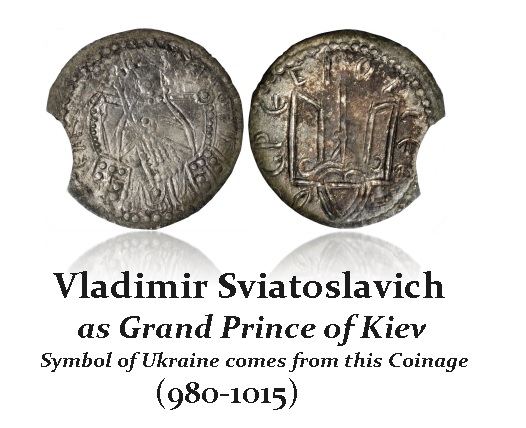
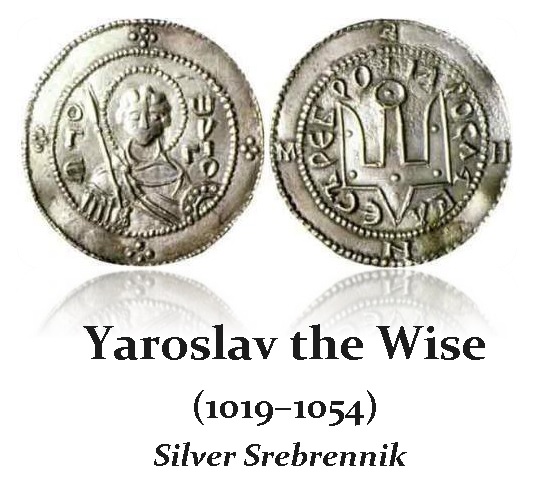
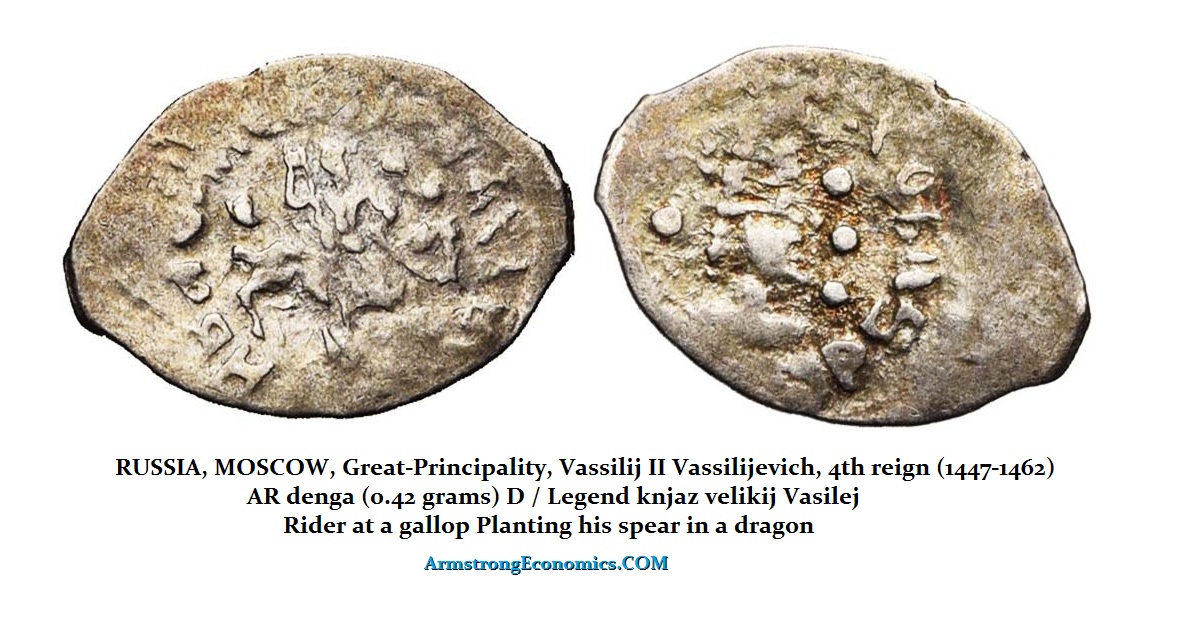
The Russian Monetary System began also with cattle (skot) during the Kievan period. Skins of small animals and precious metals were used as fixed-value exchange rate based upon barter goods. Up until the end of the 12th century, cattle was the unit of account but commerce took place with the skins of small animals. Actually, furs became the common method of payment for they were valued in terms of cattle, but were much easier for transport and divisibility for small transactions. This made small furs much more suitable for money and they were also an important item of export. Written sources began to speak of such units of payment as kuna (marten’s fur, from kunitsa, a marten), belka or veksha (squirrel), veveritsa (ermine) and nogata (fur with legs, from Arabic nagd, a good or full-value coin), and also of pieces of fur (resana), muzzle furs (mordka) and paw furs (lapka).
The word for silver was “serebro” which became more and more common to denote money as trade with the Byzantine world increased. The Old Russian words kuna and nogata, come from the old “fur money” or “leather money,” thereby retaining their meaning as metal money began to emerge. The names continued in use even though the money began to change to metals given the trade with the Byzantine world. The Rus relied upon foreign produced money. Both Byzantine silver coins and the silver dirhems of the Arab Caliphate are found in Ukraine and parts of Russia confirming trade existed.
It is clear that there was a change from “fur money” to silver and the oldest Russian unit of value was the “grivna”, which was based on the Arab coinage system. We begin to find only from the 10th century onwards that local coinage began to be struck and once this took place, then coins became the actual unit of payment in markets. This enabled the expansion of the economy and really the rise of Russia out of the barter age. The “grivna” became both a unit of account an money by weight. Its value equaled to that of 96 gold dinars (s[o]lotniki) or 144 silver dirhems (s[e]rebreniki).
The ruble has been the Russian unit of currency for about 500 years. It was The monetary reform system instituted by Peter the Great (b 1672;1682-1725) that was a century ahead of most others in that it was based on the decimal system. The basic monetary unit, first coined in 1704, was the silver ruble of 100 kopecks. Other silver coinage consisted of the poltina (one-half ruble), polupoltina (one-fourth ruble), grivennik (ten kopecks), altyn (three kopecks) and kopeck. There were two copper sub-multiples of the kopeck: den’ga (one-half kopeck) and polushka (one-fourth kopeck); and three gold multiples of the ruble: double ruble, chervonets or “ducat” (about 2 and one-half rubles), and dvoinoi chervonets (double chervonets). Unfortunately, Peter’s profligate expenditures steadily eroded most of the value of this otherwise admirable currency. Still, Peter’s reforms made a lasting impact on Russia and many institutions of Russian government traced their origins to his reign.
The amount of precious metal in a ruble varied over time. In a 1704 currency reform, Peter the Great standardized the ruble to 28 grams of silver. While ruble coins were silver, there were higher denominations minted of gold and platinum. By the end of the 18th century, the ruble was set to 4 zolotnik 21 dolya (almost exactly equal to 18 grams) of pure silver or 27 dolya (almost exactly equal to 1.2 grams) of pure gold, with a ratio of 15:1 for the values of the two metals.
In 1817, the ruble was reduced from .986 find gold to .917. This would be further reduced to .900 by Alexander III in 1886. The gold 5 ruble weighed .1929 oz. This was actually nearly the same net weight of the 1802 issue at .986 finess with a net weight of .1928 oz.
In 1825, platinum coins were introduced with 1 ruble equal to 77⅔ dolya (3.451 grams). The denominations were 3, 6, and 12 rubles.
On December 17th, 1885, a new standard was adopted which did not change the silver ruble but reduced the gold content to 1.161 grams, pegging the gold ruble to the French franc at a rate of 1 ruble = 4 francs.
This rate was revised in 1897 to 1 ruble = 2⅔ francs (0.774 grams gold). A 15 ruble gold coin was issued with a weight of .3734 oz. Effectively, this was a revaluation whereas the coin was the same weight as the 10 ruble, wihch had been issued since 1886. The 5 ruble weighing .1867 of an oz under Alexander III from 1886 had been reduced to .1244 oz.
The ruble was worth about .50 USD in 1914.
With the outbreak of World War I, the gold standard peg was dropped and the ruble fell in value, suffering from hyperinflation in the early 1920s. With the founding of the Soviet Union in 1922, the Russian ruble was replaced by the Soviet ruble. The pre-revolutionary Chervonetz was temporarily brought back into circulation from 1922-1925
Before November 1, 1990, the dollar cost 63 kopecks, but there was no opportunity to buy it at such a rate. November 1 of the year 1990 established a commercial rate of 1.8 rubles per dollar. The first trading session was opened on April 9, 1991, in one of the premises of the USSR State Bank, where a blackboard had providently been brought in order to record deals. Following the only concluded transaction (for 50 thousand cashless dollars) the ruble was for the first time ever rated commercially. The real exchange rate of the US dollar against the ruble made up 32.35 rubles per dollar. By the end of the year one dollar was estimated at 169.20 rubles under inflation of about 160% (the percentage is very approximate, as there is no accurate statistics). Prices were set free, people felt lack of products in shops, the USSR collapsed but the Russian Federation hadn’t been formed yet. This period turned to be the time of troubles for former Soviet people.
At the same time stock exchanges entered the market, though the process of their formation was quite spontaneous. The first Russian Exchange was registered in May of 1990 and was called Moscow Commodity Exchange. November 21, 1990, Moscow Central Stock Exchange was the second on the list. The first valuable securities trading session in the USSR was held only several months later.
In general by the end of 1991 Russia registered 182 commodity and stock exchanges. The RF left behind the whole planet by number of exchanges and variety of concluded transactions. That time Russian exchanges used to trade any possible commodities and security papers. When the Soviet supply system wrecked, exchanges took on a role as middlemen. The majority of goods were in deficit, even money: the president of the State Bank complained in his secret letter to M.S. Gorbachev that the Finance department failed to mint enough money to keep pace with inflation.
New Russian exchanges traded wood, sugar, paper, building materials, cars, computers and even bread! Very soon Russia numbered over 1000 exchanges, though most of them couldn’t be called traditional stock structures, as essentially they operated as trade fairs.
First rare bidders had to face an absolute lack of legislation regulating trading sessions and transactions. One of the most intrinsic legislative initiatives of 1990 happened to be the Commodity Exchange Activity Resolution of the RSFSR Cabinet Council. The resolution maintained the order of exchanges’ registration and heir functions. The distinctive feature of laws passed then is their laconism. The most significant laws regulating the stock market appeared in December of 1991.
Despite the chaos ruling the market after the USSR collapse, there had already existed companies, which later came to prominence. It’s hard to define the field of their activity then, but it is known that January 18, 1991, the today’s Russian leading investment company Troika Dialog was founded, and in 1991 the information agency AK&M was established.
Princes of Novgorod
Rurik (b ?-879; 862-879) Oleg of Novgorod (regent) (b ?-912)
Grand Princes of Kiev
Askold and Dir (non-Rurikids) (b ?-882; 842/862-882) Oleg of Novgorod (regent) (b ?-912) Igor I (b ?-945; 913-945) Saint Olga of Kiev (regent) (b ?-969) Sviatoslav I the Great (b 942–972; 962-972) Yaropolk I (b 958/960–980; 972-980) Saint Vladimir I the Great (b 958–1015; 978-1015) Sviatopolk I the Accursed (b 980–1019; 1015-1016) Yaroslav I the Wise (b 978–1054; 1016-1018) Sviatopolk I the Accursed (b 980–1019; 1018-1019) Yaroslav I the Wise (b 978–1054; 1019-1054) Iziaslav I (b 1024–1078; 1054-1068) Vseslav of Polotsk (b 1039–1101; 1068-1069) Iziaslav I (b 1024–1078; 1069-1073) Sviatoslav II (b 1027–1076; 1073-1076) Vsevolod I (b 1030–1093; 1077-1077) Iziaslav I (b 1024–1078; 1077-1078) Vsevolod I (b 1030–1093; 1078-1093) Sviatopolk II (b 1050–1113; 1093-1113) Vladimir II Monomakh (b 1053–1125; 1113-1125) Mstislav the Great (b 1076–1132; 1125-1132) Yaropolk II (b 1082–1139; 1132-1139) Viacheslav I (b 1083/2-1154; 1139-1139) Vsevolod II (b ?-1146; 1139-1146) Igor II (b ?-1146; 1146-1146) Iziaslav II Panteleimon (b 1097–1154; 1146-1149) Yuri I the Long Arms (b 1099–1157; 1149-1150) Viacheslav I (b 1083/2-1154; 1150-1150) Iziaslav II Panteleimon (b 1097–1154; 1150-1150) Yuri I the Long Arms (b 1099–1157; 1150-1151) Iziaslav II Panteleimon (b 1097–1154; 1151-1154) Viacheslav I (b 1083/2; 1151-1154) Rostislav I (b 1110–1167; 1154-1155) Iziaslav III (b ?-1162; 1155-1155) Yuri I the Long Arms (b 1099–1157; 1155-May 15, 1157) Iziaslav III (b ?-1162; May 1157-December 1158) Mstislav II (b 1125–1170; December 1158-Spring 1159) Rostislav I (b 1110–1167; April 1159-February 1161) Iziaslav III (b ?-1162; February 1161-March 1161) Rostislav I (b 1110–1167; March 1161-March 1167) Vladimir III (b 1132–1173; Spring 1167-Spring 1167) Mstislav II (b 1125–1170; May 1167-March 1169)
Grand Princes of Vladimir
Saint Andrei I Bogolyubsky (b 1110–1174; May 1157-June 1174) Mikhail I (b ?-1176; 1174 September 1174) Yaropolk (b ?-after 1196; 1174-June 1175) Mikhail I (b ?-1176; June 1175-June 1176) Vsevolod III the Big Nest (b 1154–1212; June 1176-April 1212) Yuri II (1189–1238; 1212-April 1216) Konstantin of Rostov (b 1186–1218; Spring 1216-February 1218) Yuri II (b 1189–1238; February 1218-March 1238) Yaroslav II (b 1191–1238; 1238-September 1246) Sviatoslav III (b 1196–1252; 1246 1248) Mikhail Khorobrit (b 1229–1248; 1248-January 15, 1248) Sviatoslav III (b 1196–1252; 1248-1249) Andrey II (b 1221–1264; December 1249-July 1252) Saint Alexander I Nevsky (b 1220–1263; 1252-November 1263) Yaroslav III (b 1230–1272; 1264-1271) Vasily of Kostroma (b 1241–1276; 1272-January 1277) Dmitry of Pereslavl (b 1250–1294; 1277-1281) Andrey III (b 1255–1304; 1281-December 1283) Dmitry of Pereslavl (b 1250–1294; December 1283-1293) Andrey III (b 1255–1304; 1293-1304) Saint Michael of Tver (b 1271–1318; 1304-November 1318) Yuri (III) of Moscow (b 1281–1325; 1318-November 1322) Dmitry I the Terrible Eyes (b 1299–1326; 1322-September 1326) Alexander of Tver (b 1281–1339; 1326-1327) Alexander of Suzdal (b ?–1331; 1327-1328) Ivan I of Moscow Kalita (b 1288–1340; 1328-March 1340)
Grand Princes of Moscow
Ivan I Kalita (b 1288; November 1325-March 1340)
Simeon the Proud (b 1316; 1340-1353)
Ivan II the Handsome (b 1326; April 1353-November 1359)
Saint Dmitry I Donskoy (b 1350; November 1359- May 1389)
Vasily I (b December 1371; May 1389-February 1425)
Vasily II the Blind (b 1415; February 1425-March 1462)
Ivan III the Great (b 1440; April 1462-November 1505) Vasily III (b 1479; November 1505-December 1533)
House of Rurikovich
Ivan IV the Terrible (b 1530; January 1547-March 1584)
Feodor I (b 1557; March 1584-January 1598)
House of Godunov
Irina (disputed) (b 1557?; Feodor I’s daughter January 7-15, 1598; d October 1603)
Boris I (b 1551?; February 1598-April 1605)
Feodor II (b 1589; April 1605-June 1605)
Pseudo-Rurikovich usurpers
False Dmitry I (Grigory Bogdanovich Otrepyev) (b 1581?; June 1605-May 1606)
False Dmitry II (b. 1582?; July 1607-December 1610)
False Dmitry III (Sidorka) (b ?; March 1611-May 1612)
House of Shuysky
Vasiliy IV (b 1552; May 1606-July 1610)
House of Vasa
Vladislav I (b 1595; September 1610-November 1612 (deposed))
House of Romanov
Michael I (b 1596; July 1613-July 1645)
Alexis I the Quietest (b 1629; July 1645-January 1676)
Feodor III (b 1661; January 1676-May 1682)
Sophia (regent) (b September 1657; May 1682-August 1689; d July 1704)
Ivan V jointly with Peter I (b September 1666; June 1682-February 1696)
Emperors of Russia
(Also Grand Princes of Finland from 1809 until 1917; and Kings of Poland from 1815 until 1917)
Peter I the Great (b June 1672; with Ivan V 1682–1696; June 1682-November 1721; February 1725, St. Petersburg, Russian Empire)
Catherine I (b April 1684; February 1725-May 1727)
Peter II (b 1715; May 1727-January 1730)
Anna (b 1693; February 1730-October 1740)
Ivan VI (disputed) (b 1740; October 1740-December 1741; murdered July 1764)
Shlisselburg, Russian Empire
Elizabeth (b 1709; December 1741-January 1762)
Peter III (b 1728; January 1762-July 1762 (murdered))
Catherine II the Great (b 1729; July 1762-November 1796)
Paul I (b 1754; November 1796-March 1801 (assassinated))
Alexander I the Blessed (b 1777; March 1801-December 1825)
Constantine I (disputed) (b 1779; December 1-26, 1825) d June 27, 1831)
Nicholas I (b 1796; December 1825-March 1855)
Alexander II the Liberator (b 1818; March 1855-March 1881 (assassinated))
Alexander III the Peace-Maker (b 1845; March 1881-November 1894)
Saint Nicholas II (b 1868; November 1894-March 1917; July 17, 1918 (executed))
Michael II (disputed) (b 1878; March 15-16 March 1917; June 12, 1918 (murdered))
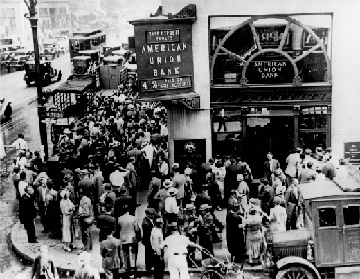
(Image of Americans lining up to withdraw cash during the Great Depression)
The Central Bank of the Russian Federation is speaking carefully and confidentally to prevent an official bank run. “In recent days, the demand for cash has grown. To meet the increased demand, the Bank of Russia increased the issuance of cash to banks, and replenishment of ATMs will continue this weekend,” the bank announced the day after the war began. Historically, people have withdrawn their cash during times of war and political uncertainty. Human nature remains the same no matter what time period or country we view. We hoard wealth we when are fearful of the future, and when everyone rushes to the banks to withdraw their money they soon realize that there is not some safe inside the bank neatly stacking their money. The liquidity simply does not exist.
Russia’s central bank is also providing financial support to all sanctioned banks. “Banks will perform all ruble operations and provide relevant services to all customers as normal. All customer funds in foreign currency will be preserved and may be withdrawn in the currency of account. The Bank of Russia is prepared to provide banks with financial support in rubles and foreign currency,” the press release stated. “Banks remain highly resilient and have great potential to develop lending to the Russian economy. The balance sheet of each bank is predominantly (over 80%) denominated in rubles. Foreign currency loans have been granted mainly to solvent Russian companies that will continue to service them.” The Kremlin likely factored sanctions into their war plan, but it remains to be seen if they underestimated the impact those sanctions would have on their overall economy.
Russia’s media has promoted the “military action” in Ukraine as a necessary measure in an attempt to mislead the people from seeing this as an all-out invasion. Russia’s communications regulator (Roskomnadzor) has banned media outlets from using the words “assault, invasion, or declaration of war” to describe the attack on Ukraine. Disobeying could be punishable by a fine of five million rubles ($60,000). Roskomnadzor said that “official Russian information outlets” are the only source for “reliable information.” Numerous social media platforms are now restricted or disabled in Russia in an attempt to shield citizens from the truth.
The internet has become a major tool to prevent and promote misinformation. Hackers worldwide have waged cyberattacks against Russia. Russian TV networks suddenly began playing Ukrainian songs over the weekend and the Kremlin’s government networks were disabled. Six outlets including Kremlin.Ru were impacted by the hack. The mysterious group Anonymous has taken credit for the repeated attacks on the Kremlin. The group has urged all Ukrainians to turn off their phone location tracking features as the Russian Army is able to see where large groups have amassed.
Videos have been posted to private chat forums of hackers interrupting Russian soldiers’ radio frequencies. Hackers have also destroyed sensitive information within the ministry buildings prior to Russian invasions. The Ukrainian government has taken to social media to beg for help from hacktivists worldwide to join their fight on the cyber battlefield.
This is only a small poke in terms of a cyberattack. Some may recall that in 2015, a cyberattack disabled Ukraine’s power plants, leaving 225,000 people without electricity. On Ukrainian Constitution Day in 2017, NotPetya, a ransomware attack, caused $10 billion in damages. Everyone is familiar and exhausted of hearing how the Russians may have hacked into international political elections in recent years. Hackers have become modern-day spies as they have the ability to cause significant damage to the point where separate military branches could be dedicated to cyberwarfare in the future.
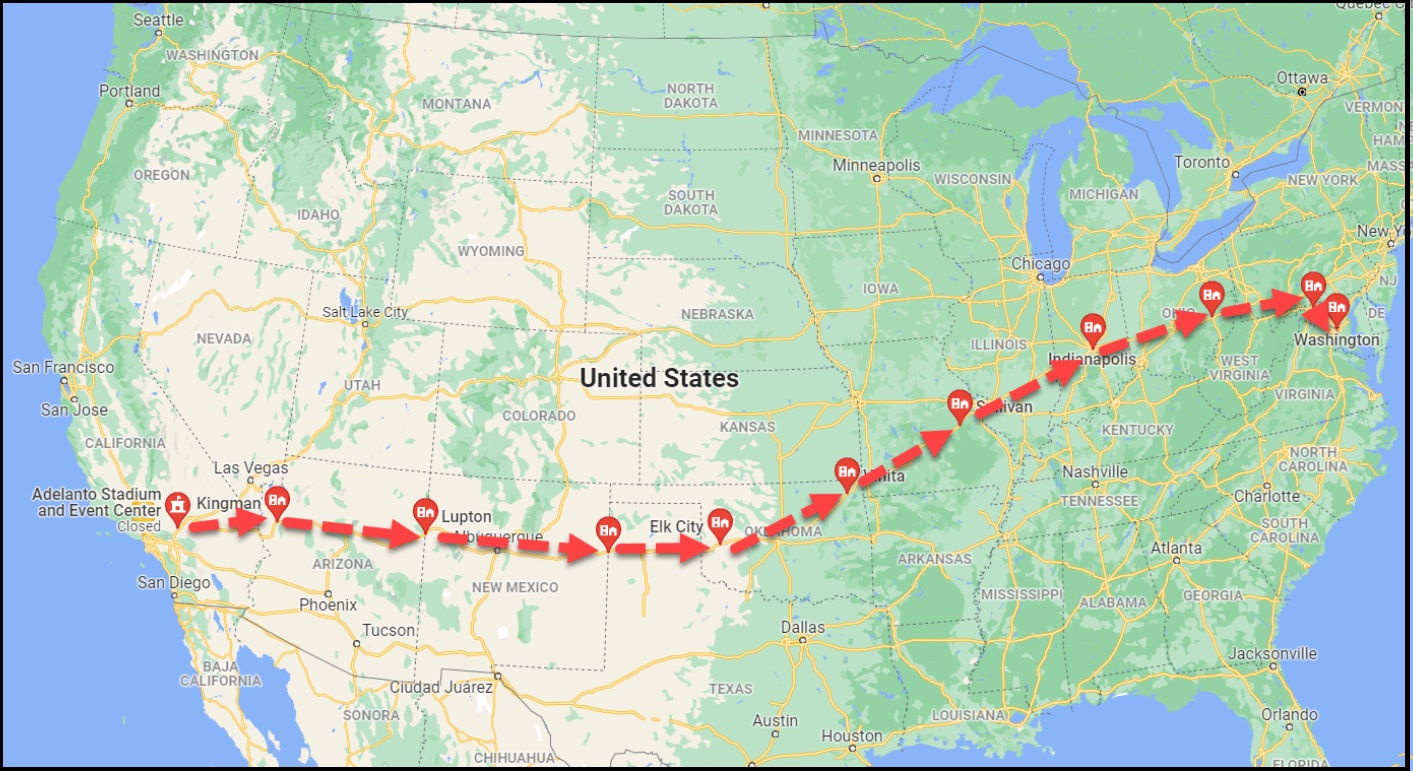
John has reported today, the convoy is gathering participants along the route and now encompasses approximately 20 miles of trucks. The truckers drive anywhere from a minimum of 250 to 375 miles a day. Travel times range from a minimum of three and a half hours of driving to a maximum of five and three quarters hours of driving a day.
As John shares, “the People’s Convoy, now more than 20 miles long, rolls through Oklahoma to cheering crowds at overpasses across the state.” The overpasses along the route are filled with cheering supporters. Here’s the Day Five report. WATCH:
John also appeared on the War Room with Steve Bannon (below):
Day 6: Monday, February 28 Morning – Depart Vinita, OK area Evening – Arrive in Sullivan, MO area for overnight stay
Day 7: Tuesday, March 1 Morning – Depart Sullivan, MO area Evening – Arrive in Indianapolis, IN area for overnight stay
Day 8: Wednesday, March 2 Morning – Depart Indianapolis, IN area Evening – Pause for rest in Indianapolis, IN area for overnight stay
Day 9: Thursday, March 3 Morning – Depart Indianapolis, IN area Evening – Arrive in Cambridge, OH area for overnight stay
Day 10: Friday, March 4 Morning – Depart Cambridge, OH area Evening – Arrive in Hagerstown, MD area for overnight stay
Day 11: Saturday, March 5 Morning – Depart Hagerstown, MD area Evening – Arrive in the DC Beltway area
The People’s Convoy will abide by agreements with local authorities, and terminate in the vicinity of the DC area, but will NOT be going into DC proper.
Posted originally on the conservative tree house on February 28, 2022 | Sundance | 1 Comment
Perhaps people will pause and recognize that just about every totalitarian leftist and globalist in the world is on the side of U.S. increased intervention in Ukraine. Then again, given the scale of the war propaganda playing out, maybe not.
Question everything. Take nothing at face value. It is very easy to become a victim of psychological warfare intended to manipulate our opinions. Almost everything being transmitted from corporate news into our psyche is part of a battle for your mind.
Posted originally on the conservative tree house on February 28, 2022 | Sundance | 246 Comments
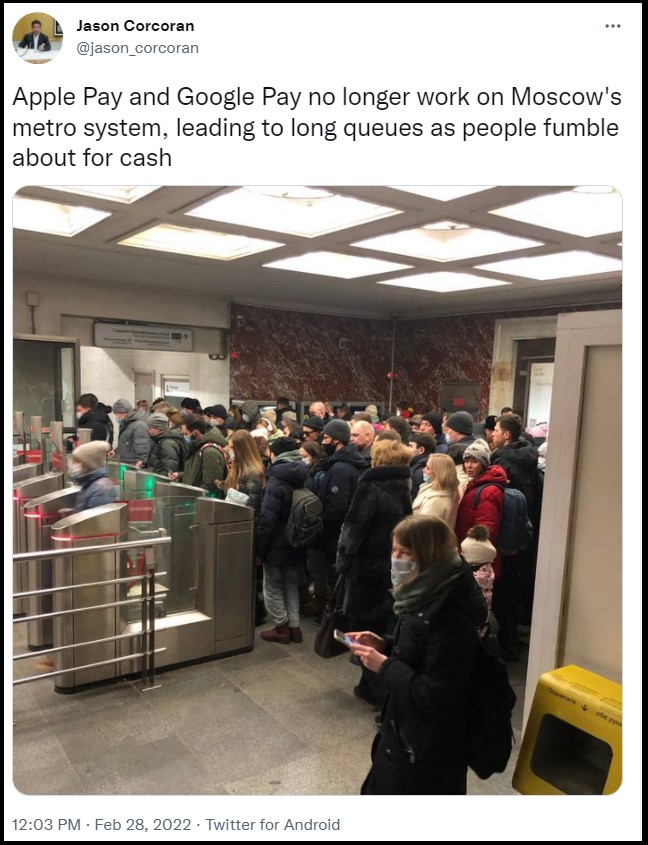
A recent image attributed to the Moscow subway system presents some consideration for a potentially larger problem.
Increasingly, people everywhere have stopped using cash to pay for simple purchases. The electronic payment systems shifted to credit cards and debit cards, and then, eventually as technology merged with phone platforms, the linking of your portable transponder to your financial institution in order to make purchases became an efficient way to make transactions.
However, as governments start using definitions of who is good and who is bad to create sanctions against the bad actors, and with Russia representing the most expansive modern targeting of the global financial system, the control of monetary transactions enters the sphere of integrated payment systems like VISA, Mastercard, Apple Pay, Google Pay and others. With Russia being essentially “de-banked” on the world stage, this happens:
There’s an irony to this surfacing now… so soon after the Canadian government began targeting their political opposition for de-banking.
Essentially, what is happening in Russia, on an entire citizen scale, is the same issue that happened in Canada to the individuals targeted. The financial mechanisms in this integrated system of payment are now creating havoc for the individual.
The SWIFT transfer system sanction(s) against the Russian government, end up debanking everyone in the country. These are remarkable times, and this is an example of something that needs to be factored into how you can retain individual liberty and freedom.
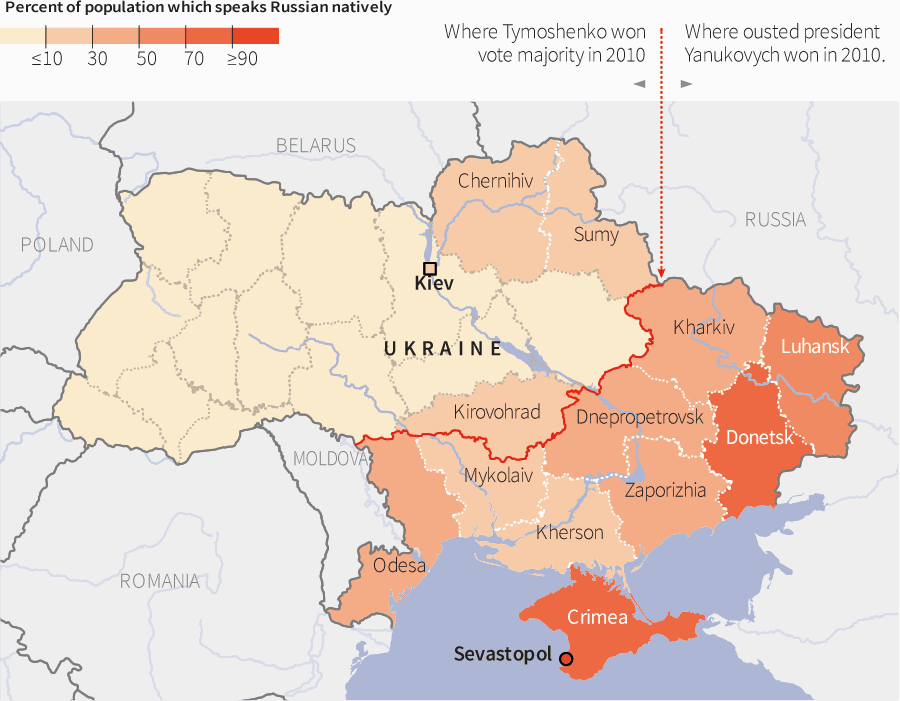
The talks between Russia and Ukraine have produced nothing because Zelensky is unwilling to let the two Russian provinces be independent, yet at the same time, he passed the Ukrainian language-only law. Everyone has a right to separate just as Americans did from Britain. That is a human right.
While he gets the West to spin this as Ukraine is fighting for freedom, Zelensky refuses to allow the Eastern portion which is virtually entirely Russian ethnically to separate and has allowed shelling of their regions. The question is why is he pushing his country into an obstinant war and refusing any compromise? Is he really being told by Western powers who need war right now as the diversion from COVID? Some are claiming that both Zelensky and Putin are Schwab’s Young Global Leaders. This is not true.
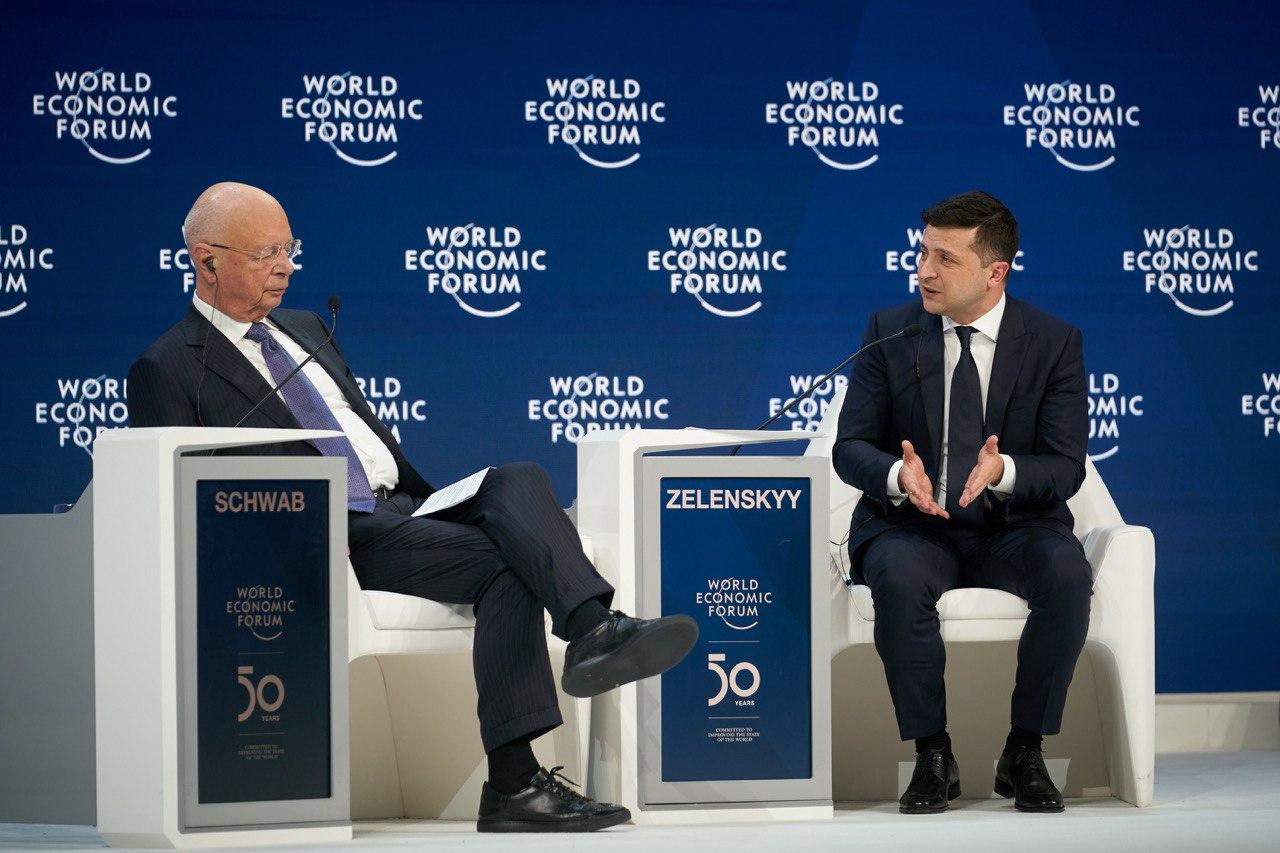
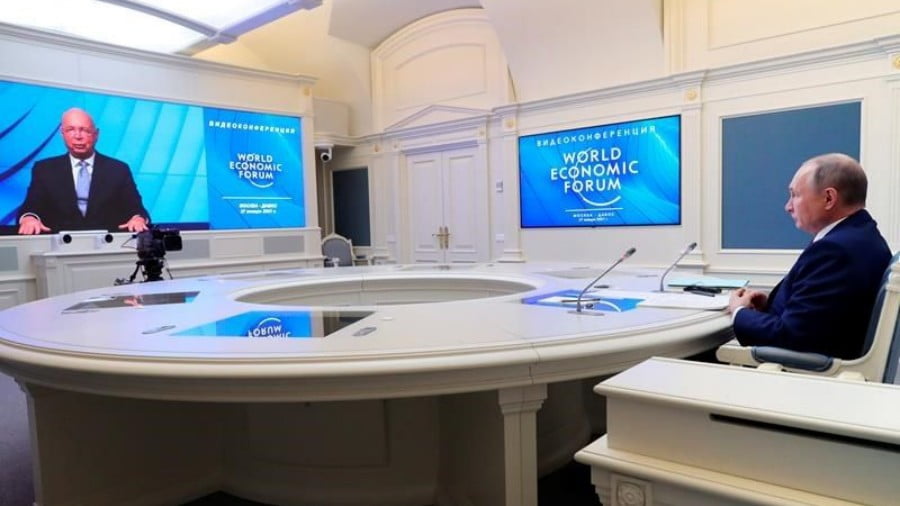
In 1992, Klaus Schwab and World Economic Forum launched a program initially called Global Leaders of Tomorrow. In 2004, this program was turned into the Forum for Young Global Leaders which was a 5-year program of indoctrination into WEFs principles, Schwab’s authoritarian rule where he himself has a ZERO error tolerance in the WEF, his economic theories and nobody else, and his goals for the end of capitalism as we have known it. However, Schwab is also a marketer. He nominated existing career politicians with originally 43 that including Angela Merkel, He even nominated Putin. But these people DID NOT go through a 5-year indoctrinating process. This has been a marketing ploy on his part and then claims some people are his Young Global Leaders despite the fact they are by no means young nor are they just starting. Neither Zelensky nor Putin have undergone some 5-year program and Putin would never take any direction from Schwab – that I know for a fact. So let us set those rumors aside. Schwab was interested in promoting suitable future leaders for the emerging global society he intended to create. The program has since its inception has included politicians, business leaders, royalty so he could pitch that to young people who would be indoctrinated.
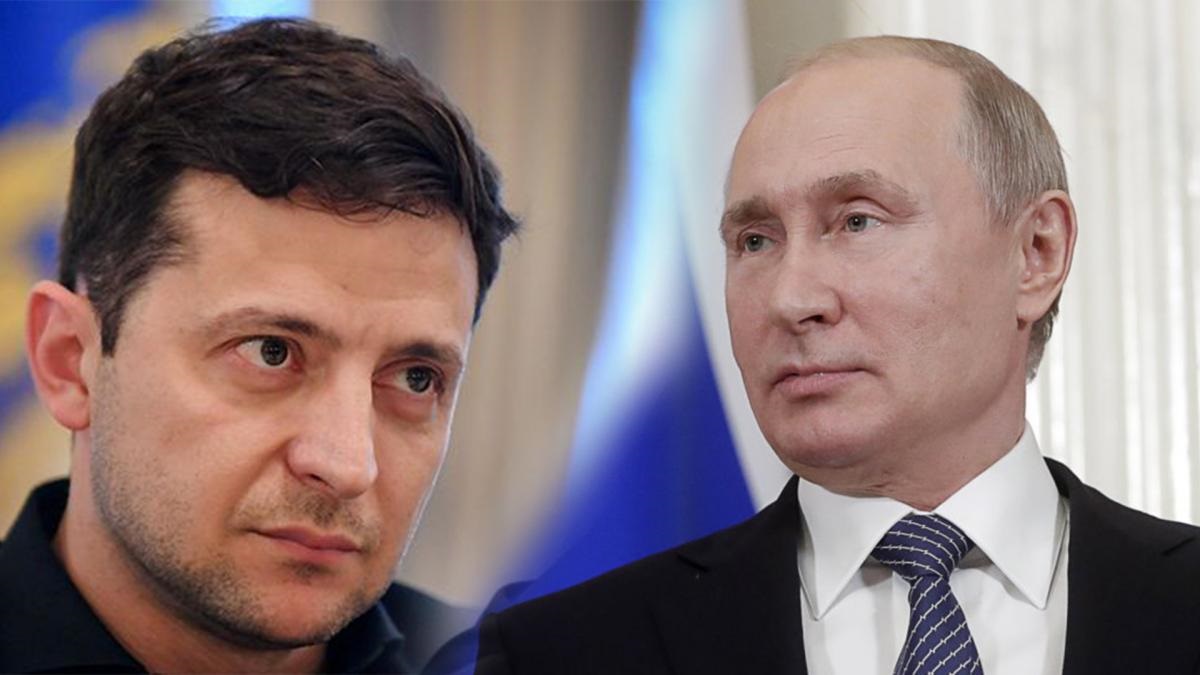
Russian President Vladimir Putin and Ukrainian President Volodymyr Zelensky both sent top officials to negotiate in Belarus, which has allowed Russian forces to pass through during the war. Putin has no interest in conquering Ukraine. He wants to secure the independence of the Russian provinces. There has been a civil war raging that the press will never report the truth because they are anti-Russian. I do not see why Zalensky is punching the world to the brink of war all on this issue. It’s very nice PR put beauty queens on the front like who will be taken out in a heartbeat by professional soldiers. They think they are fighting for the freedom of Ukraine when that is a given if Zelensky compromised.
Zelensky has been calling world leaders to get them to go against Russia. Besides Turkey, he has even called on India to turn against Russia. Zelensky is pushing the world to war. He is trying to every nation to goes against Russia when in fact he is dangerously dividing the world just Western governments divided the people between vaccinated and unvaccinated. Except this time, they are playing with nukes if pushed too far.
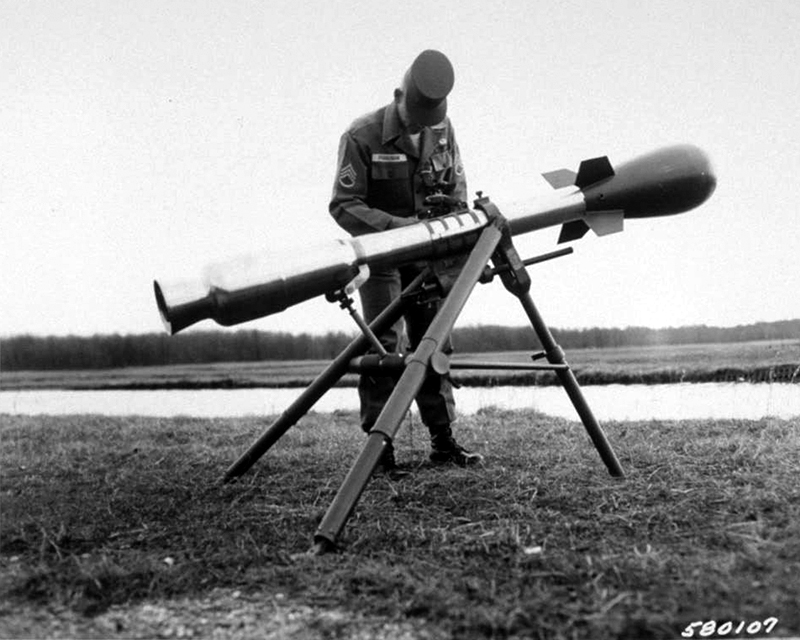
Let me explain something here and Ukrainians should remove Zelensky from power NOW! The risk of nuclear war is real, but we are not talking about Hiroshima-type attacks. There are also small-range tactical nuclear weapons. Even the US has had such systems since 1961 known as the M-28 or M-29 Davy Crockett Weapon System which are tactical nuclear recoilless weapons. They are small and intended to be surgical strike weapons.
I suspect that Zelensky is being told what to do by Western powers who are begging for a war with Russia. China will NOT sit by idly. Biden has come out to say that Americans should not fear a nuclear war in Ukraine. The very fact that he is making such a public statement is confirming that there is a risk.
Putin is by far the smartest leader in the world right now. That does not mean he is not ruthless, cunning, or strategic. He is deliberately avoiding attacking cities because (1) he knows the West will love dead civilians on the streets to serve as a rallying cry, and (2) he does not want to conquer Ukrain or he would have done so in 3 days and sent in 100% of his troops – not 30%.
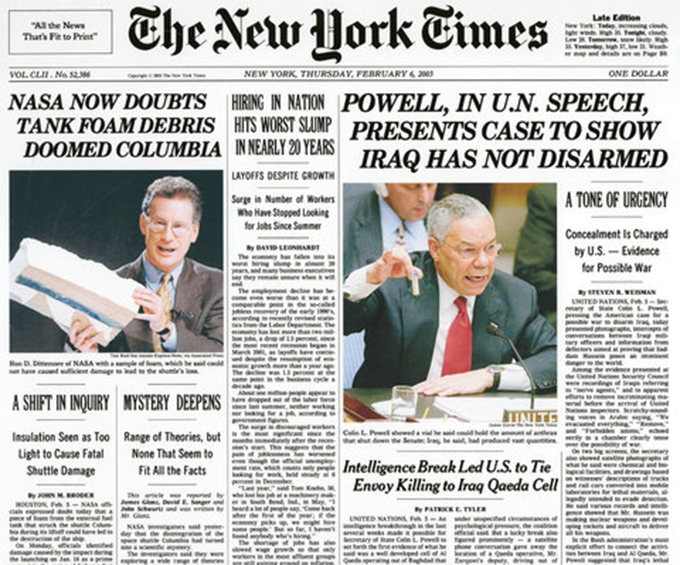
We must understand that war never appears to be what the press says. Remember the Weapons of Mass Destruction in Iraq? Almost 35,000 American troops died or were wounded for that fake news. There were over 200,000 Iraqi civilian deaths. Some are claimed over 1 million Iraqis died in total. All of this for Weapons of Mass Destruction that did not exist and Saddam Husein had nothing to do with religious terrorism.
Be careful believing anything the media claims or government. There are attacks as hate crimes against Asians all because the press called this the Chinese COVID.
Posted originally on the conservative tree house on February 28, 2022 | Sundance | 33 Comments
A fantastic piece by Peter Beinart on substack {SEE HERE} puts excellent clarity on the people around Joe Biden baiting Russian President Vladimir Putin to enter Ukraine.
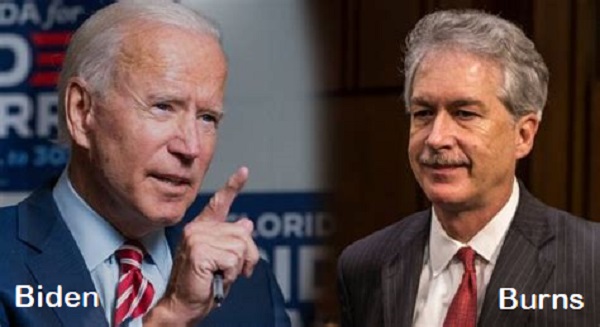
Current CIA Director William “Bill” Burns was the former ambassador to Russia and Jordan. Bill Burns had a 33-year career at the State Department under both Republican and Democratic presidents and speaks fluent Russian. If the people in the background of Joe Biden wanted an intelligence operative to trigger a specific result from Russia, there’s no one more strategically perfect for the job than CIA Director Bill Burns.
The article by Beinart is mainly focused on pointing out the irreconcilable nature of Joe Biden implying Ukraine could join NATO, while his own CIA Director has a history of giving serious warnings emphasizing the “brightest of all red lines” about that specific point.
[…] “Two years ago, Burns wrote a memoir entitled, The Back Channel. It directly contradicts the argument being proffered by the administration he now serves. In his book, Burns says over and over that Russians of all ideological stripes—not just Putin—loathed and feared NATO expansion. He quotes a memo he wrote while serving as counselor for political affairs at the US embassy in Moscow in 1995. ‘Hostility to early NATO expansion,” it declares, “is almost universally felt across the domestic political spectrum here.”
On the question of extending NATO membership to Ukraine, Burns’ warnings about the breadth of Russian opposition are even more emphatic. “Ukrainian entry into NATO is the brightest of all redlines for the Russian elite (not just Putin),” he wrote in a 2008 memo to then-Secretary of State Condoleezza Rice. “In more than two and a half years of conversations with key Russian players, from knuckle-draggers in the dark recesses of the Kremlin to Putin’s sharpest liberal critics, I have yet to find anyone who views Ukraine in NATO as anything other than a direct challenge to Russian interests.” (read more)
Against this backdrop of Bill Burns, the details about the lead up to the Russia-Ukraine crisis gain quite a bit of clarity.
The CIA Director is crystal clear that Russia would be seriously triggered about any prospect of Ukraine entering NATO.
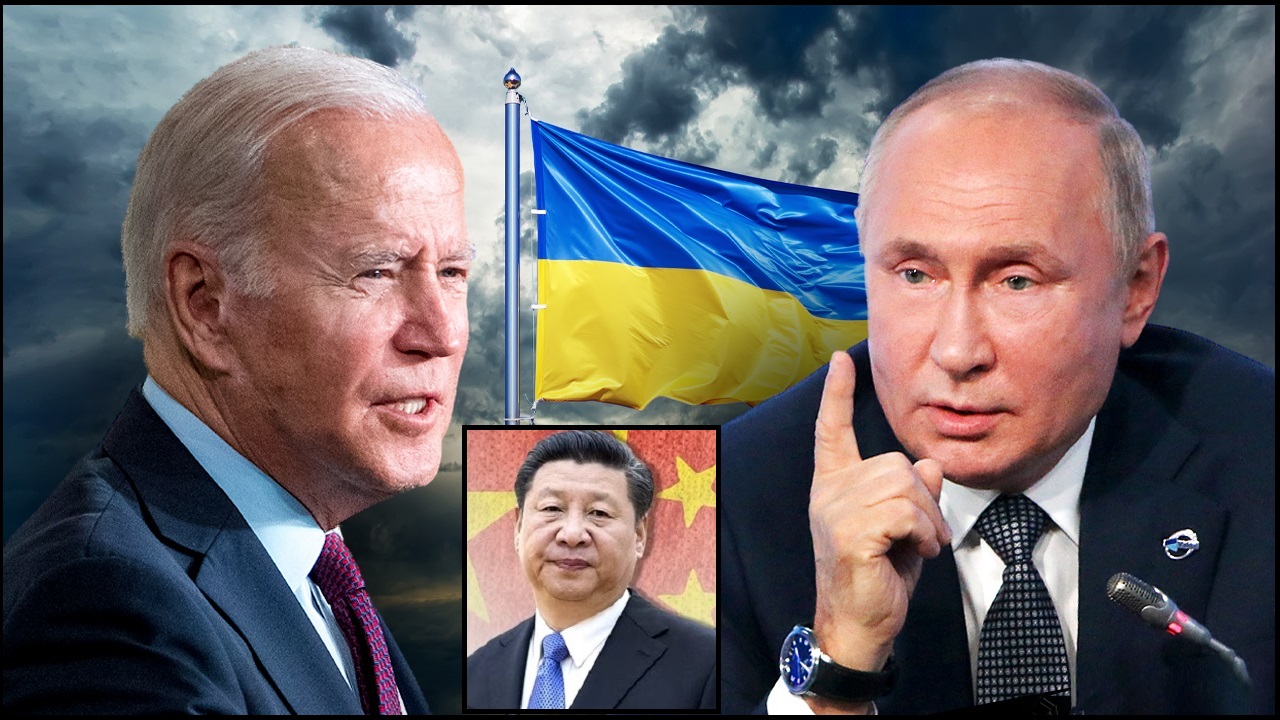
Yet in December of 2021, the exact same time when U.S. backchannel intelligence was being shared with China about Russian troop movements on the border with Ukraine, Joe Biden was telling Ukraine that membership in NATO was in their hands.
“U.S. President Joe Biden assured Ukrainian President Volodymyr Zelenskiy that Kyiv’s bid to join the NATO military alliance was in its own hands, Zelenskiy’s chief of staff said after the two leaders spoke on Thursday. (link)
Joe Biden was publicly saying something his CIA Director knew to a certainty would trigger Russian President Vladimir Putin.
This is not a mistake.
This is not a strategic blunder, or internal messaging error.
This level of provocation now seems completely purposeful.
As noted by ABC during the announcement of Bill Burns as a nominee for CIA Director:
Burns called intelligence the first line of defense for the country and the basis for making sound policy decisions. He also said he would deliver the intelligence to Biden and policymakers “without a hint of partisanship.”
Burns is perhaps an unconventional choice for the CIA job that many thought would go to a career intelligence officer.
However, he is also deeply experienced in the kind of cloak-and-dagger secret contacts that is a hallmark of the agency and won plaudits for his analysis and reporting abilities while he served as an American diplomat overseas. Burns was the author of some of the most insightful State Department cables that were published by Wikileaks in 2010 and is widely respected throughout the national security community. (read more)
If the U.S. was simultaneously influencing Ukraine military to keep targeting the breakaway regions in Eastern Ukraine, well, put it all together and a picture emerges of the people in/around the White House setting up a scenario for months that led up to Russia finally taking the bait and going into Ukraine.
The New York Times expose’ of U.S. intelligence contacting China should be reviewed from the perspective that U.S. intelligence and State Dept operatives were planting information into China, knowing it would be shared with Russia. The U.S. intelligence apparatus, with CIA Director Bill Burns in place, was seeding information into Russia via China for three months prior to the triggering point. Bill Burns would know exactly what type of intelligence would be needed to create maximum anxiety for Vladimir Putin.
WHY?
The Biden team were getting pummeled for negative economic outcomes, massive inflation, skyrocketing energy costs and gas prices set to double. Support for the administration was/is collapsing as the policy outcomes of the administration were felt.
Within the book of instructions for the ideological crew, the Alinsky people behind Biden, there are chapters on how to create off-ramps to cloud their agenda.
If they need a bigger cloud, they create a crisis. The crisis then becomes the cover, the justification to explain the outcomes of their agenda.
As we have witnessed, the White House is shifting blame for the collapsing economy, surging oil prices, massive gas price increases and overall U.S. inflation.
The manufactured crisis in Ukraine then takes on a geopolitical angle and a domestic angle. The rate of inflation, rising oil and gas prices, are now being blamed on Russia-Ukraine.
It is not coincidental that ABC (think George Stephanopolous) took the lead in helping to push this narrative as a cover story for the problems in the economy that are specifically driven by U.S. energy policy (chasing Green New Deal objectives), environmental policy, regulatory policy and massive spending.
The politics of policy are to blame for inflation, so it is the deployment of politics again used to create the cover. WATCH:
The manufactured Russia-Ukraine crisis now becomes the cover story for why the U.S. economy is collapsing. The pain being felt by middle class, blue-collar workers is now shifted to be an outcome of geopolitical events that are Vladimir Putin’s fault. It’s always someone else’s fault.
Do not underestimate how many people in the U.S. will buy into this nonsense, and keep in mind the Republican wing of the UniParty has a vested interest in allowing the narrative to embed in the psyche of voters. Both wings of the DC vulture will help promote this fraud, just as both wings of the DC uniparty sold out our Main Street economy on behalf of their multinational benefactors.
The ruse of the European crisis around Russia-Ukraine also helps the manipulative ideologues in the World Economic Forum (WEF), World Bank (WB), International Monetary Fund (IMF) and central banking system create a deflection of the bigger economic crisis created by their COVID agenda and the Great Reset.
The influence agents and multinationals, those who direct the politicians on what policies to execute on a domestic and geopolitical scale, benefit from these obfuscations and false narratives.
The amount of money the multinationals have taken from the economy into their centralized (and sometimes personal) control is obscured by the deployment of these distractions.
Q What should Americans be braced for? What could they possibly be facing? The President has already said Americans will be facing some economic fallout or some hardships. Can you explain to Americans what exactly will they face if this happened?
KAMALA HARRIS: Sure. As the President talked about in his speech, we are aware that, again, when America stands for her principles and all of the things that we hold dear, it requires sometimes for us to put ourselves out there in a way that maybe we will incur some cost. And in this situation, that may relate to energy costs, for example. But we are taking very specific and appropriate, I believe, steps to mitigate what that cost might be if it happens. (LINK)
The economic consequences from climate change policy were always considered the biggest hurdle by the Davos elite.
The economic and financial pain that would be felt by the working-class folks, would need to be managed. This is the reason why false justifications for economic pain are collectively pushed by media. The media do not need to be told what to do, they already know the larger goal is pretending not to know things.
As a result, the domestic political elites are managing the pitchforks by distracting voters about the cause. If you do not buy into their obtuse justifications, well, you then become a target – ergo, a conspiracy theorist.
Climate change policy is a tool, a means to an end.
COVID-19 policy is a tool, a means to an end.
Behind all the layers of obfuscation you find all the individual roadmaps converge onto a single path that leads to centralized control.
Posted originally on the conservative tree house on February 28, 2022 | Sundance | 412 Comments
As the beatification of Saint Zelenskyy continues in the west, the Ukrainian president signs a request for EU membership. The propaganda is thick obviously as these things take years; however, when the social media optics of World War Reddit need an angle, well, the selfie star is mandated to comply.
The western propaganda campaign continues in stunning form as the U.S. State Department coordinates the collaboration of global elites in their campaign against Russia. However, there are a few conservative voices in the U.S, and the people outside the beltway who have started figuring this all out, beginning to wonder if the assembly of global leftists is really the Ukrainian cocktail party they want to attend.
Everything surrounding the propaganda push continues unabated, as the public image of Volodymyr Zelenskyy is maintained by the very best efforts of Madison Avenue, Hollywood and Silicon Valley. All the best people, you know, the ‘elites’, are flowing in one direction.
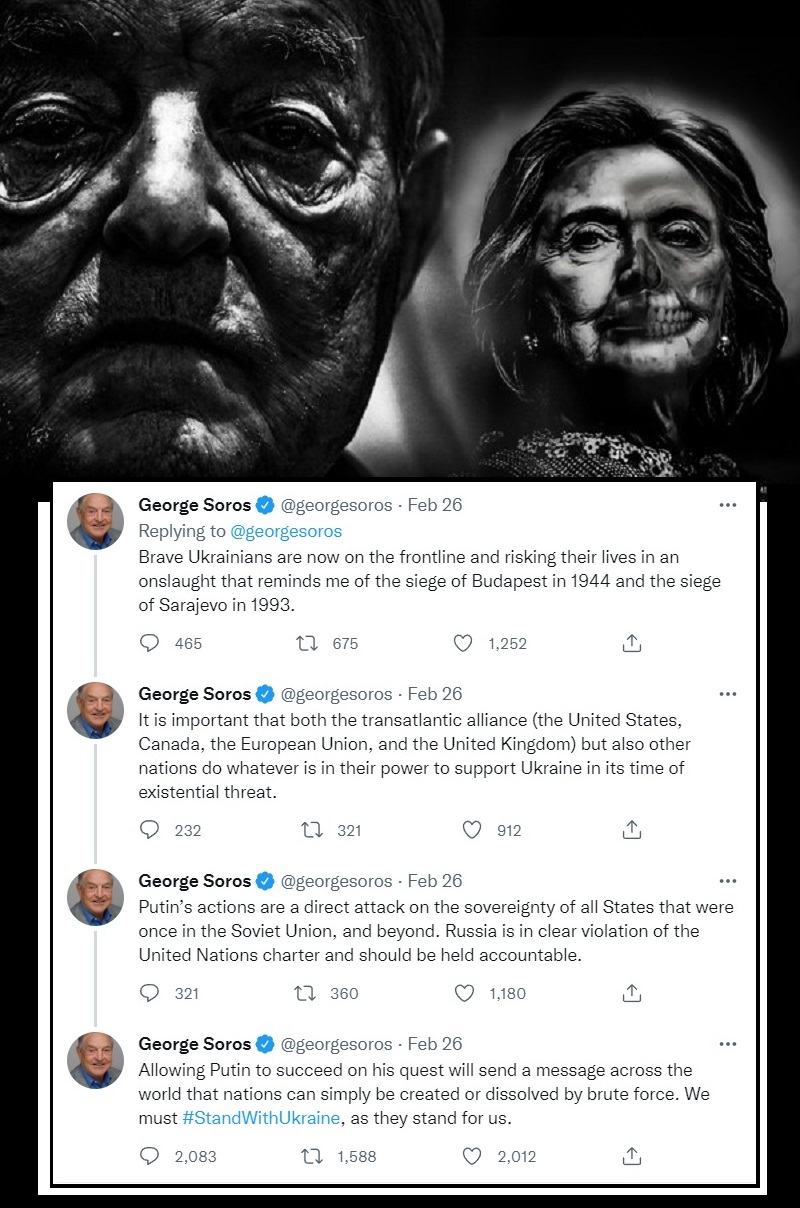
At this point in the dynamic, the Big Tech social media groups have fulfilled the demands of the White House, State Dept, intelligence agencies, United Nations, EU, NATO, World Economic Forum, George Soros and U.S. Foreign Relations Committee, and rallied the collective west to defeat Russia using the cultural weapon of social likeability.
It is verboten to speak about warrior Zelenskyy with anything other than heroism. References of David and Goliath are recommended.
BRUSSELS, Feb 28 (Reuters) – European Union leaders may discuss the possibility of Ukrainian membership at an informal summit in March, a senior EU official said on Monday, adding the issue was important for Ukraine in discussions with Russia on ending the conflict.
Ukrainian President Volodymyr Zelenskiy said on Monday that he had signed an official request for Ukraine to join the bloc. “I think one of the reasons that this is important for President Zelenskiy is also potentially in some of the discussions with Russia on a way out,” the official said referring to talks to end the conflict.
“On the application (of Ukraine for EU membership) I think it’s important not to get ahead of ourselves,” the official, who asked not to be named, said. “It obviously has not yet been received, but this whole question of the Ukraine situation is something that’s very much on the minds of the leaders.”
The bloc’s top diplomat Josep Borrell said the immediate priority was to provide practical support to Ukraine to counter the Russia invasion, rather than discussing long-term issues which could take years. (read more)
As the western political battle for the hearts and minds of the world continue, the villain in the script, Russian President Vladimir Putin, appears to be concentrating his efforts in ridding eastern Ukraine of the military units who have been shelling the Donbas region for approximately 8 years.
Unlike the approach to the population centers, it appears unlikely there will be any mercy for the Ukrainian army in that sector of the country.
I have created this site to help people have fun in the kitchen. I write about enjoying life both in and out of my kitchen. Life is short! Make the most of it and enjoy!
This is a library of News Events not reported by the Main Stream Media documenting & connecting the dots on How the Obama Marxist Liberal agenda is destroying America







 Centinel2012