Posted originally on the conservative tree house on April 24, 2022 | Sundance
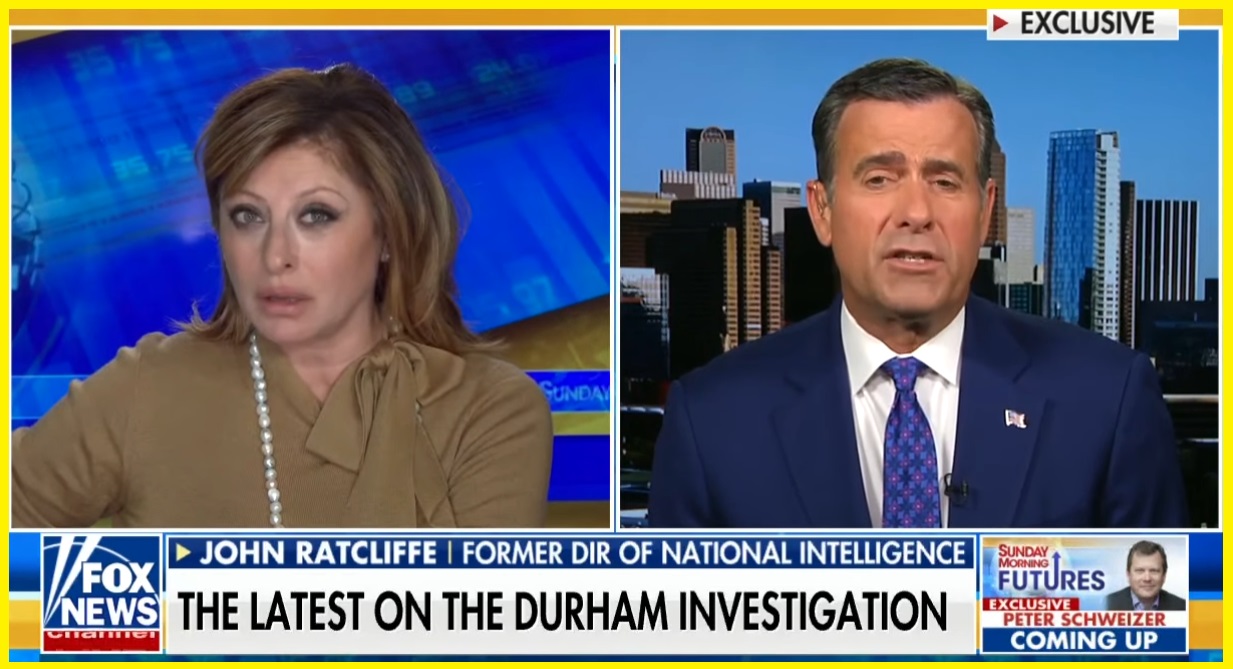
In the discussions surrounding John Durham’s investigation, eventually conversations end up sounding like Charlie Brown’s teacher. Blah, blah, blah, – blah, bla, blah blah. This interview is a case study. However, in the interest of fairness for those retaining hope that John Durham is going to deliver accountability, former Director of National Intelligence John Ratcliffe whips up a batch of hopium.
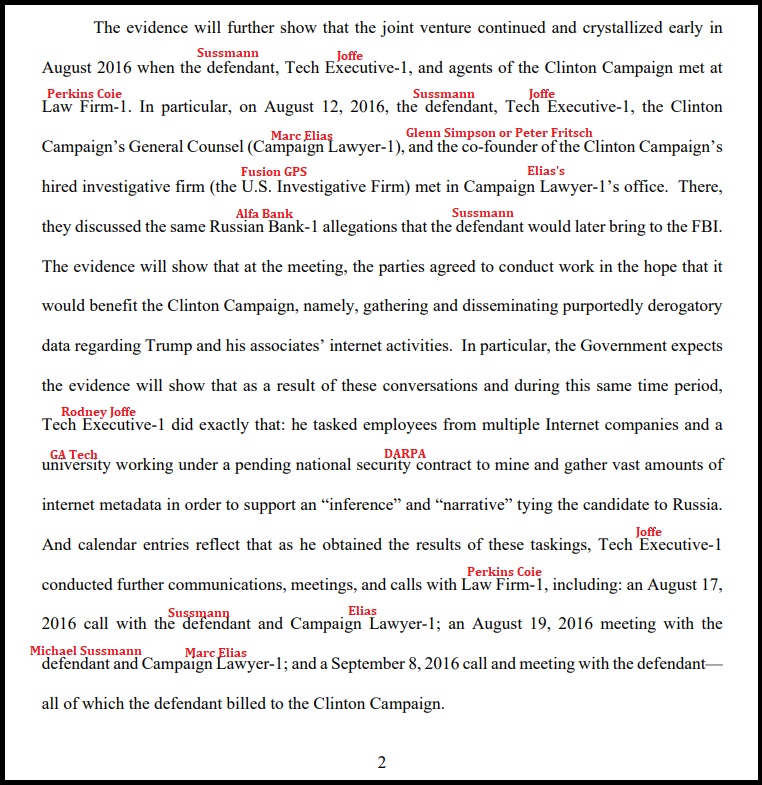
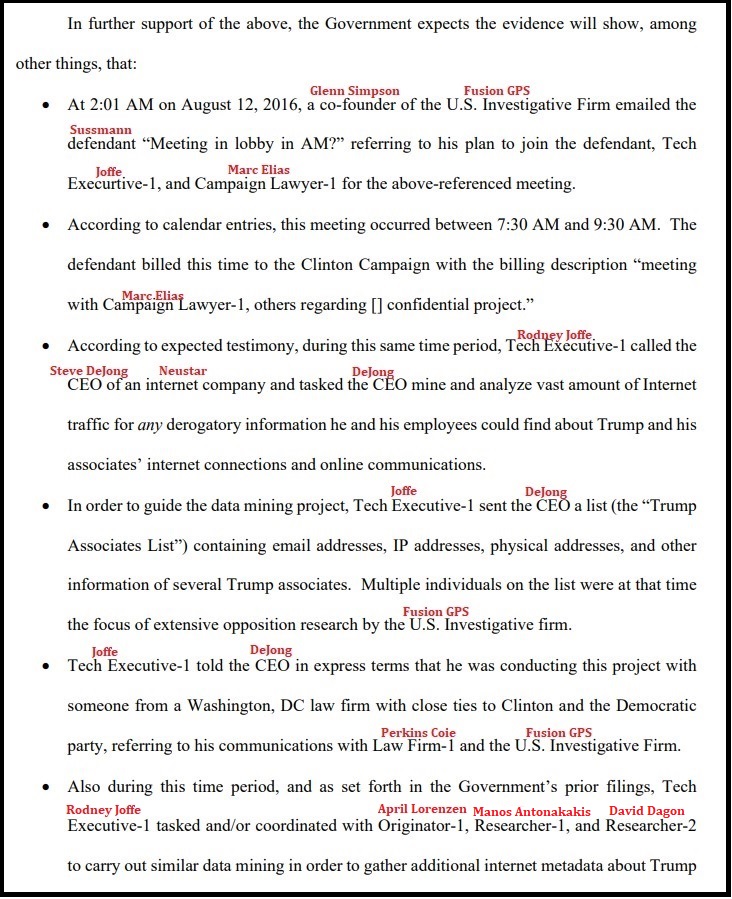
Video prompted to 09:40 where the subject of the latest court filings by John Durham surfaces. Ratcliffe is optimistic that John Durham intends to charge more characters from the Clinton group with a “conspiracy to commit fraud” against the government. WATCH
Posted originally on the conservative tree house on April 24, 2022 | Sundance
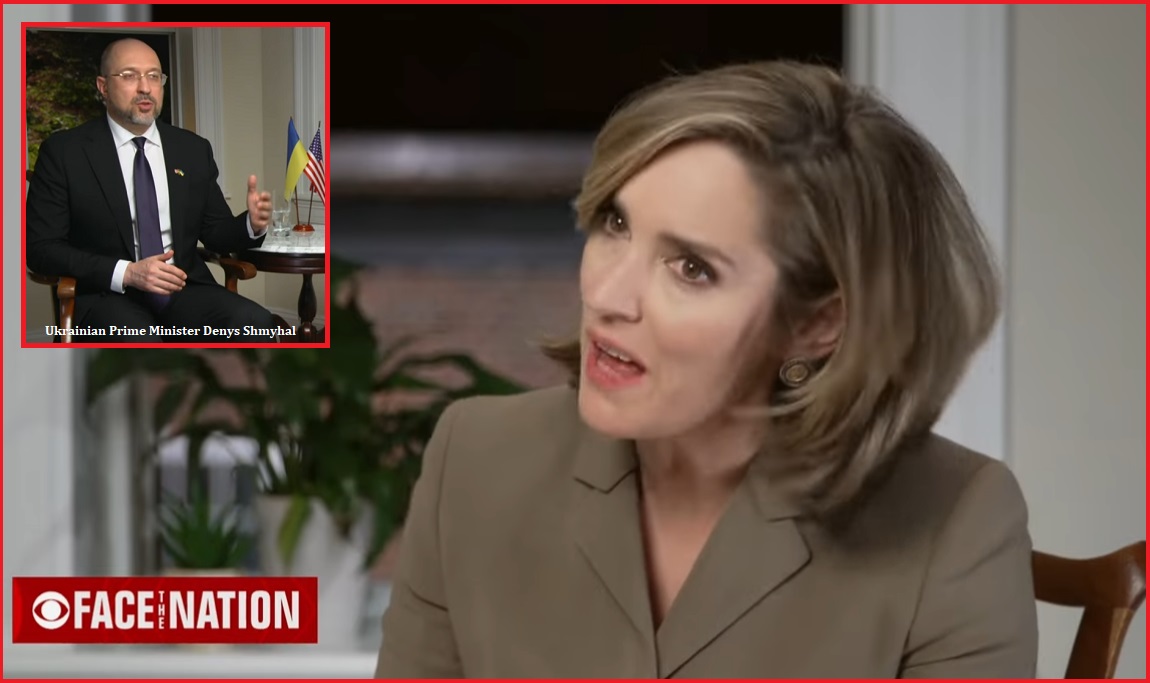
Given the scale of the stakes for western government; and given the professed intentions of govt-aligned big tech to control the story; it is almost impossible to have an honest and open dialogue on the internet about what is happening in Ukraine. That said, for those who have been using independent resources to form their own opinion of the events in/around Ukraine, this interview highlights some important aspects.
First, notice how Prime Minister Shmyhal is not the least bit bashful about saying cash is important because American taxpayers, the working American people, have a duty to fund the pensions and retirement accounts of the Ukrainian people, including govt politicians. [03:37] Indeed, much of the financial assistance Joe Biden has been sending to Ukraine (beyond the weapons to support the proxy war) is going toward paying the wages and salaries of corrupt Ukranian leadership.
Let that first point settle in deeply, as we consider how working Americans are being financially destroyed by U.S. monetary/fiscal policy, yet the same U.S. officials wiping out your bank account are funding the bank accounts of people in Ukraine. Interview WATCH:
Second point. Notice [06:02] how Prime Minister Shmyhal hedges, pauses and thinks about the response to the question of ‘what is victory’, a stalemate or Russian exit? In the U.S. proxy war against Russia, Shmyhal is not the person who can answer that question, only the White House can.
This CBS interview is pure propaganda intended to keep the U.S. audience believing a false premise about the Russian war in Ukraine. The pearl clutching faux empathy from Margaret Brennan is enough to make an intellectually honest person very angry. This narrative engineering effort from the American corporate media is sickening, genuinely sickening.
The level of narrative control in combination with the extreme media promotion of government propaganda is totalitarian in scale. U.S. govt sponsored censorship and the collaboration with on-line Big Brother tech controls have reduced the internet discussion to a series of coded messages, and carefully scripted word assemblies in order to avoid the looming eye of Sauron.
It was only a few decades ago when the former Soviet Union was famous for their propaganda against their own citizens. Now, with the multinational corporations dictating policy to western government via the World Economic Forum, that entire dynamic has flipped.
In 2022 we have even worse media propaganda against the U.S. citizens than Pravda ever attempted over the former Soviet states. At least in the former Soviet Union the propaganda effort was laughed at by the citizens on the streets. If you point out the media dynamic today in America, you become a target for the totalitarian political state and their FBI state police units. It’s remarkable how the dynamic has flipped.
We, the free-thinking American people, are now intellectual dissidents in our own country.
Posted originally on the conservative tree house on April 24, 2022 | Sundance
Dinesh D’Souza has released an expanded trailer for the upcoming release: “Here’s the official trailer for “2000 Mules.” It’s the movie we’ve all been waiting for. Please share! And go to 2000Mules.com to buy your ticket to see the movie in its premiere week.”
The movie documentary showing how the 2020 election was manipulated through the use of mail in ballots will be released in select theaters May 2nd and May 4th, virtual premier May 7th and released on-line May 8th. WATCH:
Posted originally on the conservative tree house on April 24, 2022 | Sundance
This interview is gag-worthy as two condescending leftists wax philosophically about how progressive U.S. foreign policy should dictate global society. However, it does show just how flawed the ideology of the interventionist political leftists has become, and why their expansionist ideology always culminates in conflict.
Example: Right now, China is threatening to put military bases in the Solomon Islands. Australia and the collective west are aghast and ready to draw “red lines.” At the same time the U.S/NATO put military forces ever closer to Russia and are shocked that Putin would eventually respond to the red lines he previously drew. The geopolitical hypocrisy is ridiculous.
That hypocritical example above highlights the ironic point made in an interview between Margaret Hoover and former US Ambassador to Ukraine Marie Yovanovitch as they discuss President Trump.
If Trump had won reelection, there was no reason for Putin to invade Ukraine because Donald Trump was not trying to expand pressure on Russia or any other foreign government. Yovanovitch admits directly that Trump foreign policy did not create conflict; yet, Yovanovitch pretends not to see the cause and effect in her leftist intervention advocacy. WATCH (prompted to 14:42):
Steve was a very intelligent man who specialized in Russia. Steve knew a lot about history and I always found that very inspirational. Sadly, Steve is no longer with us.
Armstrong Economics Blog/France Re-Posted Apr 22, 2022 by Martin Armstrong
The French election this weekend really does hold the fate of the world in balance. The victory of Macron will set the fate of Europe on its course with destiny and the end of the West as we know it. Macron wants a European army and he really believes that the EU can defeat Russia. A Macron victory will indeed set Europe on course for war and 2023 will not look very bright. From a realistic model projection, Le Pen should win, but from a practical perspective, Macron will win because Europe must simply face its destiny.
A mere month-end close below 6385 on the CAC40 will signal that capital is indeed concerned and we can see the European markets decline into 2023. The CAC40 has penetrated into the broad uptrend channel but it has yet to closed back into that channel holding on for dear life.
Posted originally on the conservative tree house on April 23, 2022 | Sundance
Robert Lighthizer was the U.S. Trade Representative (USTR) under the Trump administration. Lighthizer was exceptionally strong in developing and structuring the America First trade policy that included the effective use of tariffs to get fair trade outcomes.
In this video Ambassador Lighthizer discusses the current trade policy of the Biden administration with former National Economic Council Chair Larry Kudlow. The discussion centers around U.S-China trade policy, the phase-1 trade deal that was interrupted by the pandemic, and the future of the existing trade tariffs against Beijing that Biden is reportedly going to remove. WATCH:
As noted by Lighthizer, if Biden drops the Chinese tariffs, it will only make the trade imbalance worse and push the U.S. deeper into the cycle of lost jobs and economic contraction. He’s correct.
Indeed, there has been a significant increase in fires and explosions from furnaces, industrial fryers, boilers and some other rather odd incidents with aircraft hitting food processing. The frequency even gathered attention from Fox News host Tucker Carlson. WATCH:
Addressing the lesser frequent impact incidents from airplanes etc. Keep in mind that major industrial food processing facilities are generally located around major transportation hubs – large arteries for commercial trucking and railway lines for inbound good deliveries. These are the same zoned commercial regions where you find small regional airports.
So, let’s put those airplane ‘accidents” aside for a moment and look at the bigger picture.
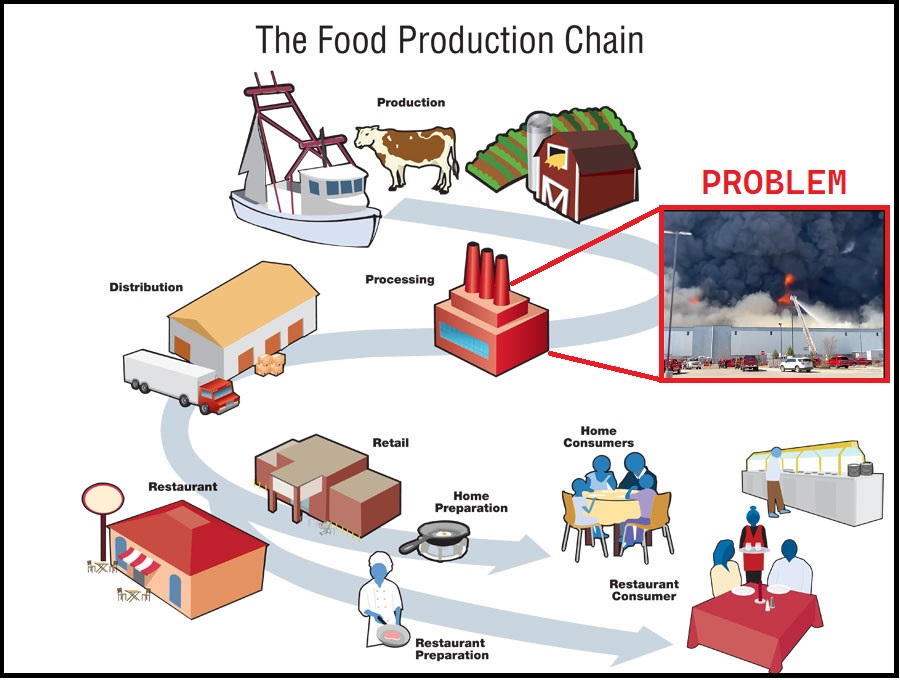
Yes, there has been an increase in industrial accidents at some major and regional food processing plants. However, this may be the cumulative effect of what CTH was warning about since early 2020 when the food processing supply chain was completely screwed up by govt intervention.
When the restaurant, hotel, cafeteria, school lunchroom, food trucks and hospitality venues were shut down by government COVID mitigation, they represented about 60% of all food consumption. That pushed everyone into the retail side, grocery stores and supermarkets for food purchases.
When 60% of the demand shifted into the system that represents the other 40% of total food delivery, the processing side of the total food supply chain went into maximum stress and overdrive. CTH warned about the limits and capacities of this sector and the potential future problems that would surface.
Commercial food operations, industrial kitchens and massive food processing organizations were forced to increase food production on a scale that is almost unimaginable. Empty store shelves were the immediate result of massive increases in demand. The entire supply chain was pushed beyond capacity and remained beyond operational capacity for well over 18 months.
Two shift processing operations added a third and fourth shift for workers. Unlimited overtime with everyone working round the clock was the outcome. The food processing and distribution supply chain went into 24/7 emergency operations to try and compensate for the extreme demand.
What we are seeing now is likely, in large part, a downstream consequence from industrial kitchens putting preventative maintenance on the side in order to keep the processing going.
Boilers never turned off, furnaces running 24/7, exhaust fans and industrial turbines running all day and night along with all the attached equipment. I suspect much of the equipment that keeps the industrial processing and kitchens operating were not given the appropriate amount of down-time and deep maintenance that would normally take place.
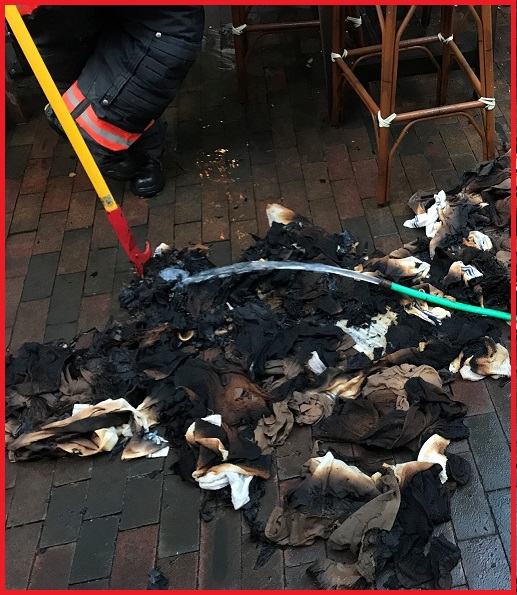
Think of it like your clothes dryer at home. Instead of running two loads of laundry a day, now you are operating that dryer 24/7 to keep up with the mounting piles of soiled linens. You generate several years’ worth of lint buildup in your exhaust vent each month you continue. If you pause to clean out the vent, the linens pile up. A similar scenario happens in industrial kitchens and food processing.
Suddenly, the 30-gal tub of oiled/soiled rags fills up faster, and the contract for pickup doesn’t compensate or arrive with a faster rotation schedule.
An old cloth filled with food grade mineral residue triggers a chemical reaction….
Industrial fryers that must be purged every 6-hr cycle of operation don’t get purged because the retention system for the old grease is full and not getting pumped as fast to keep up with the increased production cycles.
Stuff like this starts to happen when you run an industrial system beyond capacity. Perhaps the grease is loaded into buckets or drums as an offset, but that needs to be stored somewhere…. where they are not used to storing it… etc.
Industrial vents don’t get cleaned more frequently to keep up with the new 24/7 operation. Regular maintenance schedules are deferred for massive furnaces that need time to cool, clean and restart.
The same applies to boilers and HVAC systems that were not designed for the capacity now required. In short, there’s a whole lot of maintenance that gets put down the priority list when everyone in the organization is shouting to keep everything running.
I’m not trying to justify the issue, excuse or blame the facility. I’m just explaining how all kinds of industrial accidents can spike when the operational systems within a specific industry are running maximum throttle, month after month after month.
Then there’s the exhausted people; literally the workers who are physically and mentally drained from the overcapacity issues. And don’t think the regulatory agencies (USDA, health inspectors, etc) wouldn’t also tell their compliance officers to give the industry a little slack. I guarantee they did.
The added hours, the added shifts, the days off that can’t take place. All of that leads to short cuts and things left undone that would normally be done under regular operations. People burn out just like equipment, and tired people take shortcuts.
I’ll look closely to see if there is an uptick in workers comp claims within the industrial food processing sector, but I suspect there is. Heck, why wouldn’t there be? It would be natural to see more worker injuries along with industrial accidents under these conditions.
Does that explain all of the incidents? Maybe not, but the fact that U.S. food processing has been running beyond capacity, might put a better context on why that same specific segment of U.S. industrial output would be seeing more industrial accidents.
Another downstream consequence could be an uptick in food recalls as an outcome of increased bacteria within the food processing equipment, because the break-down-time, sanitation and hygiene might be impacted by excessive operational run times. There’s a myriad of issues from any industrial operation that goes from ordinary capacity to seriously over-stressed maximum capacity… and then remains in the emergency phase for months.
Like I said two years ago, the downstream ramifications of those decisions were going to be a major problem.
March 15, 2020 – […] “A government cannot just shut down 30 to 50 percent of the way civil society feeds themselves, without planning and advanced preparation for an alternative. Those who ARE the alternative, the processors and retail food grocers, need time to prepare themselves (and their entire logistical system) for the incredible impact. Without preparation this is a man-made crisis about to get a lot worse. (LINK)
FUBAR…
… or it could be something nefarious. Suspicious Cat always remains, well, suspicious.
I have created this site to help people have fun in the kitchen. I write about enjoying life both in and out of my kitchen. Life is short! Make the most of it and enjoy!
This is a library of News Events not reported by the Main Stream Media documenting & connecting the dots on How the Obama Marxist Liberal agenda is destroying America









 Centinel2012