Shrinking the Economy is a Feature, Not a Flaw – Massive Layoffs and Unemployment Likely Hits in September


Posted originally on the conservative tree house on July 29, 2022 | Sundance 

The distance between Wall Street and Main Street has never been as brutally obvious as it is today.  It is simply stunning to watch the cheerleading and casual nature of the economic and financial pundits as they speak esoterically about how policies intended to reduce the U.S. economy are so wonderful.

Seriously, the disconnect in life impact has never been as stark.  At least in previous times of economic contraction there was a smidgen of appreciation for the pain that unemployment and rising costs bring to the blue collar and middle-income working class.  In this new era, the financial stress and visible outcomes of destroyed families are simply shrugged aside as if these are abstract consequences.

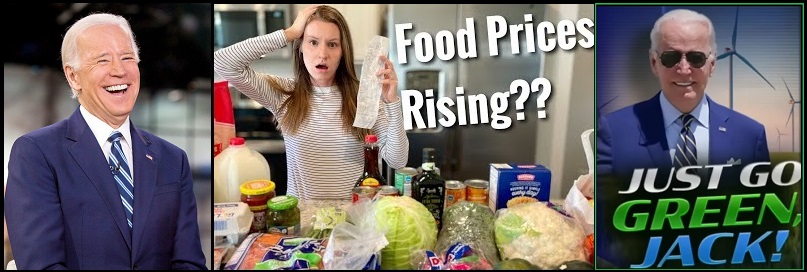
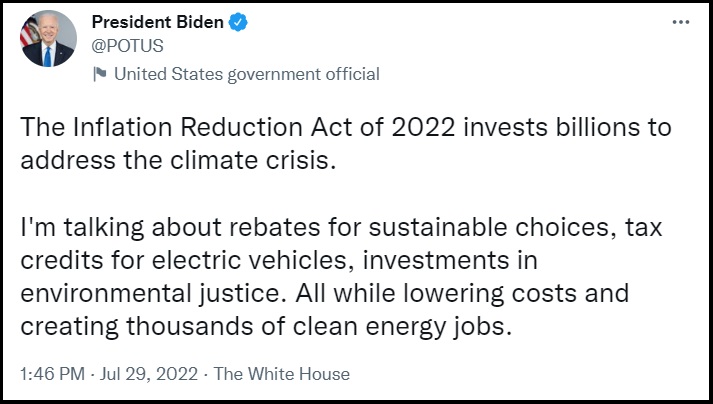
In this segment former Federal Reserve vice-chair Randal Quarles, notes with a casual flippance how the economic policies of the Biden administration are simply doing what needs to be done in order to intentionally reduce the U.S. economy.  Sure, massive unemployment, in direct correlation to the scale of the inflation that precedes it, is almost certain, but hey…. the economy must be collapsed if the Build Back Better, Green New Deal, agenda is to be fully implemented. WATCH:

Maybe this flippancy seems starker because those who consider themselves outside the collateral damage impact zone were not visible in prior generations.  Perhaps it is because modern technology and the information era allows us to see conversations that were previously only described in print newspapers and journals.  Whatever it is, the shameless disconnect between the unaffected rulers and the proles who have to live with the consequences are far more visible today than before.

Smiling while describing a future where working men are emasculated by their inability to support their families. Smiling and shrugging while explaining a landscape where moms are worried about how to feed their children, as the checkbook in the household creates a type of stress these ‘betters’ have likely never experienced, is almost psychotic in its detachment.

Desperation is not a good situation for any society.

Worse yet, laughing in the face of desperation leads to the type of outcomes that eventually hits the ‘betters.’
[ SOURCE ]

Interview: The World According to Martin Armstrong


Armstrong economics Blog/Armstrong in the Media Re-Posted Jul 30, 2022 by Martin Armstrong

Click here to listen to Martin Armstrong’s latest interview. 

By Kerry Lutz:

“We’re seeing oil price shocks, commodity booms and busts, and various factors that are threatening to de-throne the US dollar. Why is this happening, and what does this mean for the global economy? I have Martin Armstrong on the show to discuss this, and he explains the various changes that have occurred—such as sanctions in Russia and countries opting to not borrow in dollars—that put the dollar at risk. Not only is the dollar in danger in these conditions—this shift in currency use greatly affects the world economy. Tune in for more information.”

First Major German City Turns Off Hot Water and Public Building Electricity to Save Gas


Posted originally on the conservative tree house on July 28, 2022 | Sundance 

Hanover, a city in the northwest of Germany, has become the first major metropolitan area to try and reduce the use of natural gas by removing hot water from public buildings.  The move comes as natural gas supplies from Russia are reduced to 20% of capacity.  Germany is attempting to fill up storage facilities of natural gas in order to survive the winter.

Germany, together with several European countries, are telling their citizens to expect large increases in their electricity bills as energy costs continue to skyrocket.

Germany does not have any LNG terminals to receive shipments of natural gas into ports, they are dependent on pipelines from Russia.  They are urgently trying to reduce the current amount of natural gas being consumed.

(Via Daily Mail) – […] Other desperate gas-saving measures include switching off public fountains and blacking out night-time lights on major buildings such as the town hall and museums. The city’s mayor, Belit Onay, spoke of an ‘imminent gas shortage’ that meant they had to reduce the city’s energy consumption by 15 per cent.

[…] There will also be a ban on portable air conditioners, heaters and radiators among the general populace as the average German begins to pay a price for standing up to the Russian dictator.

[…] Germany, like most of Europe, has been enjoying a hot summer which should soften the blow of the cold showers, but public officials are introducing the measures now in fear of what awaits them when the season turns.

Gazprom, the Russian state energy giant, has been giving European leaders sleepless nights by disrupting the flow of gas via its Nord Stream 1 pipe line.

They cut the flow to 40 per cent in June, citing maintenance issues, and this week they reduced the gas supply through the pipe to just 20 per cent.

These reductions, which EU energy chief Kadri Simson dismissed as ‘politically motivated’, have seen energy bills soar, governments struggle to fill gas storage facilities and energy-intensive heavy industries wondering if they can keep the factories running.

Russia denies that it is deliberately throttling supply to cause pain and instability in Europe, but few doubt that it is a deliberate ploy to punish what it calls ‘unfriendly countries.’

In response, European Union countries agreed to a controversial, bloc-wide 15 per cent reduction in gas usage on Tuesday that is hoped will reduce the pressure on European countries most vulnerable to Russian energy blackmail. (read more)

To Lower Natural Gas Use World’s Largest Chemical Company Announces Making Less Ammonia, Fertilizer Production Will Shrink Further


Posted originally on the conservative tree house on July 28, 2022 | Sundance 

The energy crisis in Germany is now a confluence of terrible events that will snowball well into next year.

The world’s largest chemical company, BASF, has announced they will cut down the production of ammonia in order to use less natural gas.

In the short term this will help Germany build up natural gas supplies to survive a cold winter with predicted rationing still planned.  However, in the long term the shortage of ammonia means less fertilizer which will mean future shortages and increased costs for farmers; ultimately creating lower yields next year.

FRANKFURT, July 27 (Reuters) – Germany’s BASF (BASFn.DE), the world’s largest chemical company, is cutting ammonia production further due to soaring natural gas prices, it said on Wednesday, with potential ramifications from farming to fizzy drinks.

Germany’s biggest ammonia maker SKW Piesteritz and number four Ineos also said they could not rule out production cuts as the country grapples with disruption to Russian gas supplies.

Ammonia plays a key role in the manufacturing of fertiliser, engineering plastics and diesel exhaust fluid. Its production also yields high-purity carbon dioxide (CO2) as a byproduct, which is needed by the meat and fizzy drinks industries.

“We are reducing production at facilities that require large volumes of natural gas, such as ammonia plants,” BASF Chief Executive said in a media call after the release of quarterly results, confirming an earlier Reuters report.

[…] Unlike many European countries, Germany has no liquefied natural gas (LNG) port terminals to replace Russian pipeline gas. That means companies are under political and commercial pressure to reduce gas intensive activities if gas deliveries are cut further.

[…] Russia resumed pumping gas via its biggest pipeline to Europe, Nord Stream 1, on July 21 after a 10-day maintenance outage, but Gazprom (GAZP.MM) on Monday said supplies to Germany would drop to just 20% of capacity. (read more)

Like I told Olaf, food is so overrated…

Pretending Continues, However El Erian Admits U.S. Economy Weakening Faster Than Expected


Posted originally on the conservative tree house on July 28, 2022 | Sundance 

The great pretending continues in order to protect the Federal Reserve from sunlight upon them.  Central banks (U.S. Fed Reserve included) are raising interest rates into a recession, which is specifically against their legislative mandate. Therefore, in order to protect the bankers, the pundits and politicians must deny a recession exists.

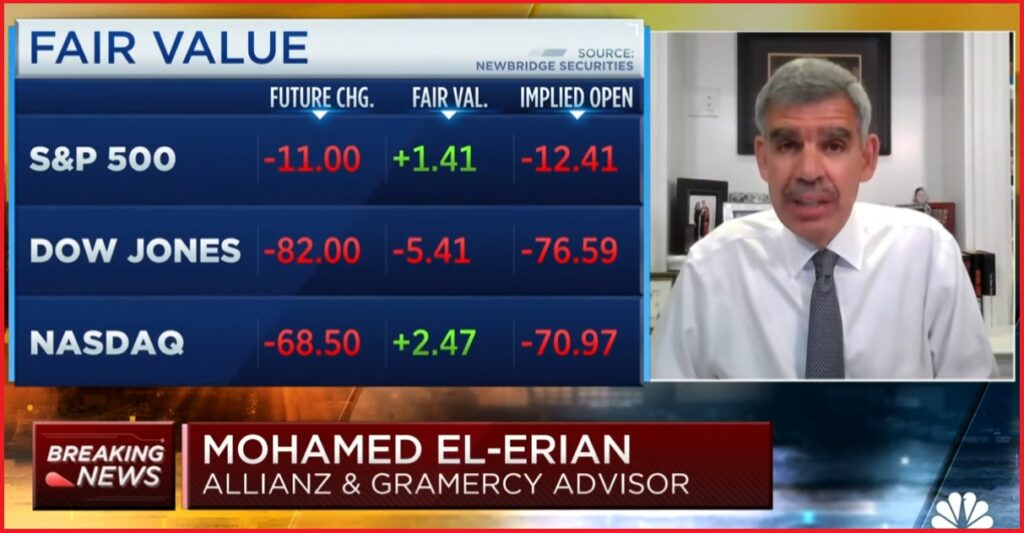
Pundit Steve Liesman spins the data, says we need to wait longer, and circles the wagons to protect the policy makers, specifically the White House.  Mohamed El-Erian tries to split the baby (02:00 video); while not admitting directly that the economy is in a recession, he states the “economy is weakening much faster than expected.”  WATCH:

At a certain point all of this pretending and denial is going to come crashing down.  The “economic transition” to a new “green future” they are all pretending not to see as the root cause of the economic collapse, has unavoidable consequences.

The dam is breaking around them and they are running out of fingers and toes to stop the inevitable collapse.  Meanwhile the Davos crowd has purchased all the scuba gear and awaits the final outcome.

By claiming there is not a recession, the Federal Reserve can continue taking action that lowers economic activity.  The lowering of economic activity drops the use of energy inside the economy.  They are managing the economic transition inside the Build Back Better or Green New Deal agenda.  They are managing a purposeful decline in economic activity in order to support the energy transition.

The only way the Federal Reserve and central banks can raise interest rates into a recession, is if they deny a recession exists.

That is why they are denying a recession exists.

FUBAR, Second Quarter GDP Contracts 0.9%, The U.S. Economy is Officially in Recession


Posted Originally in the conservative tree house on July 28, 2022 | Sundance 

Jumpin’ ju-ju-bones, CTH did not expect the BEA to admit the U.S. economy was in recession.  CTH originally predicted the BEA would use lower import data as the primary tool to modify the GDP result.

Factually, in this report, import data -in combination with lower consumer spending- was the primary sector that led to the result.  However, even with drops in the valuation of imports which lift GDP calculations, the economy still contracted.

Things must be much worse than officially admitted (details below), if the BEA is going to admit things are bad.

Gross Domestic Product (GDP) is the dollar value of all goods and services produced in the economy, minus the dollar value of goods and services we import. The percentages discussed are percentages of change over time.

The Bureau of Economic Analysis (BEA) released their first estimate of the second quarter GDP [Data Here] reflecting a 0.9% drop in U.S. economic activity. The second quarter contraction follows a 1.6% drop in the first quarter, which means we now have two consecutive quarters of declining economic activity, the technical definition of a recession.

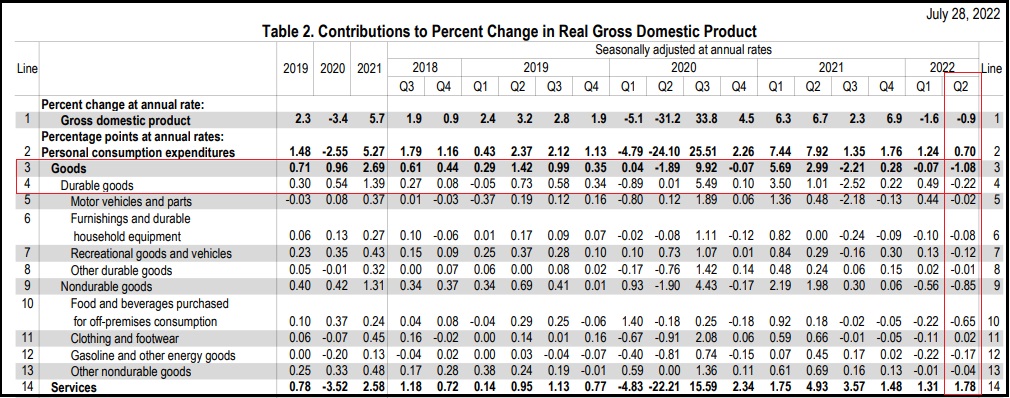
The two primary data points which show the economic contraction are: (1) Lowered consumer spending; and (2) much lower imports as a result of lower consumer spending on durable goods and non-essential items.  High Q1 inventories of goods were also flushed out by companies and not replaced.  Starting with the consumer spending, here’s the data [Table-2, BEA report]:

Consumer spending, also called “personal consumption expenditures” declined 1.08% for goods overall in the second quarter.

Consumer spending represents two-thirds of all GDP in the United States.  Americans buy lots of stuff, and when Americans stop spending on goods the economy stalls.  As you can see in Table-2, consumer spending on goods dropped 1.08% and spending on services increased 1.78%.  The net difference is 0.70%, a massive drop in consumer spending compared to prior quarters/years.

The next component with major impact is the result of the drop in spending.

Domestic Exodus from US Cities


Armstrong Economics Blog/Real Estate Re-Posted Jul 28, 2022 by Martin Armstrong

The US Census Bureau reported that 8.4% of Americans moved in 2021, beneath the 9.3% who moved at the height of the pandemic panic in 2020. Numbers for 2022 may show an uptick in migration to the suburbs or rural areas. Our models indicate that overheating in the housing market will be less prevalent in less populated areas as we are not merely dealing with housing inflation but also mass domestic migration.

Housing may be cheaper in rural areas, but there are additional costs associated with living in the country. There is no public transportation, and people must travel longer distances for work, groceries, shopping, health care, and more. Energy prices are sky-high, and simple trips cost significantly more. Iowa State University professor Dave Peters, as reported by the AP, has been studying the impact inflation has had on rural America. Peters estimates that rural households pay $2,500 more per year for gas alone compared to those living in cities.

Still, prices for housing in the country v the city more than makeup for increased energy costs. Remote work has made rural living a prospect for many Americans. The National Association of Realtors found that rural areas saw a 54.6% uptick in inbound moves in 2021, followed by micropolitan areas (i.e., small towns) at 53.8%.

In January, the Association of Equipment Manufacturers (AEM) said that certain remote workers were enticed by rural life after pandemic burnout. They found that people were seeking to abandon the hustle and bustle of city living, citing lower living costs, safer environments, fewer people, no traffic, lower housing prices, different cultures, and politics.

Gone are the days of people flocking to the cities for opportunities. As long as there is an internet connection, the modern American can work from anywhere. As the average potential buyer is priced out from their hometown, the prospect of rural or small town life is increasingly enticing.

Tucker Carlson Outlines Dueling Insurrections and Two Tiers of Justice


Posted originally on the conservative tree house on July 27, 2022 | Sundance 

Tucker Carlson used his opening monologue to compare and contrast the different responses from the DOJ to Donald Trump vs Joe Biden.  Carlson outlined the different response from the DOJ/FBI toward the pro-violence statements by various democrat politicians to the DOJ/FBI response currently underway to target Donald Trump.

Essentially, what this boils down to is a system of two-tiered banana republic style justice.  All efforts are exhausted to avoid targeting democrat politicians, and all DOJ/FBI efforts are exhausted to manipulate the targeting of republicans.  The same selective targeting and investigating holds true based on the geographic venue for criminal conduct. WATCH: 

.

Chinese on US Real Estate Spending Spree


Armstrong Economics Blog/Real Estate Re-Posted Jul 27, 2022 by Martin Armstrong

The Chinese are keen on investing in tangible assets, namely real estate. Canada implemented restrictions on foreign buyers after accusing them of the real estate shortage and sky-high prices. Chinese buyers are now targeting the American housing market. In fact, Chinese buyers outnumbered buyers from any other foreign country and spent over $6 billion on US real estate from April 2021 to March 2022. Canadians came in second for foreign home buyers, spending $5.5 billion in the same period.

The National Association of Realtors also noted that Chinese buyers tend to purchase more expensive properties, averaging over $1 million at a time when home prices were averaging under $400,000 (prices have risen since then). Around 31% of Chinese buyers selected properties in California and tend to choose wealthier areas for investments.

This is simply a means to park cash. Around 44% of foreign buyers purchased homes in all-cash deals. Non-resident foreign buyers were 60% likely to pay in cash compared to 30% of resident foreign buyers. Yes, this does mean that home prices will rise as foreign buyers can outbid most domestic buyers. This is good news for sellers who may have found themselves with no bid but disastrous for the average citizen who is struggling to find permanent shelter while paying for high rental properties that further remove them from the dream of homeownership.

One thing to consider is geopolitical relations. Look at how the US and others treated  Russian “oligarchs” this past year by seizing all their assets under the pretense of conspiracy. No actual crime needed to be committed for bank accounts and assets to be forfeited. Tensions are rising with China, namely over Taiwan, and it is not unreasonable to think that the US could pull the same move on another nation. The Chinese government is selling off US debt and slowly putting distance between itself and the current top economy. Private investors may follow suit if geopolitical tensions continue to rise.

US Military Failing to Meet Recruitment Goals


Armstrong Economics Blog/War Re-Posted Jul 27, 2022 by Martin Armstrong

Non-voluntary military recruitment is not off the table in the US. The current Commander in Chief is not patriotic and does not inspire young men to join the military. We abandoned operations in Afghanistan, forced service members to undergo vaccinations, and continue to heighten tensions with foreign nations to a level where another world war is possible.

The US military, under the Biden Administration, has also implemented woke policies that deter future members from enlisting or re-enlisting. Elaine Donnelly, president of the Center for Military Readiness, said prioritizing the woke agenda has alienated the once core conservative, traditional members. “It sends a message that if your son or daughter joins the military, if they’re not of a certain skin complexion or sex, they might be investigated for extremism,” she stated. “They alienated their constituency.”

The Army is now stating that it could fail to reach its recruitment goal by an alarming 25% in 2022. The Army is set to decline by 10,000 troops this year, and an additional 14,000 to 21,000 in 2023. All branches of the military are failing to recruit members, but these figures have not been seen since the end of the Vietnam War. The Army has until September 30 to meet its recruitment goal of 60,000 soldiers. So far, they have only achieved 50% of that figure.

“On the spending issues, Congress should start asking very specific questions about the costs of LGBT mandates, experimental training like the Army Combat Fitness Test (ACFT) fiasco, replacements for personnel discharged due to COVID issues, etc.,” Donnelly stated. “Woke attitudes and mandates are not free.”