The Coming Great Crash? Re-Posted Nov 6, 2023 By Martin Armstrong 


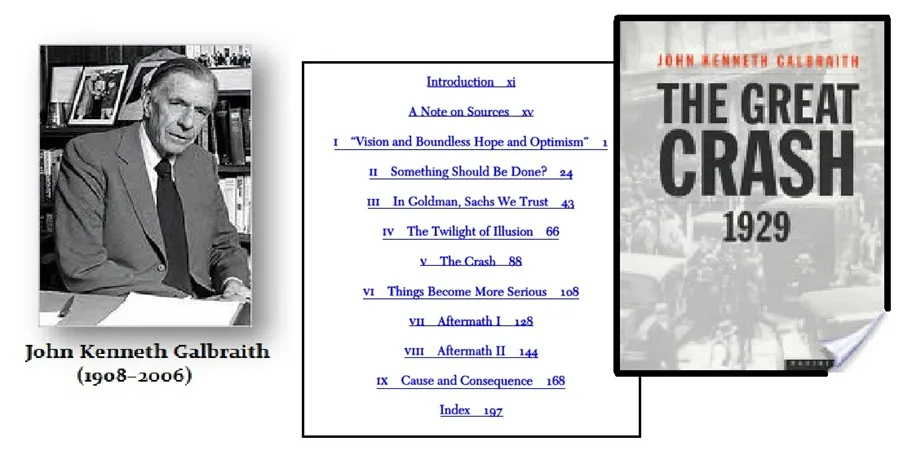
Galbraith Great Crash

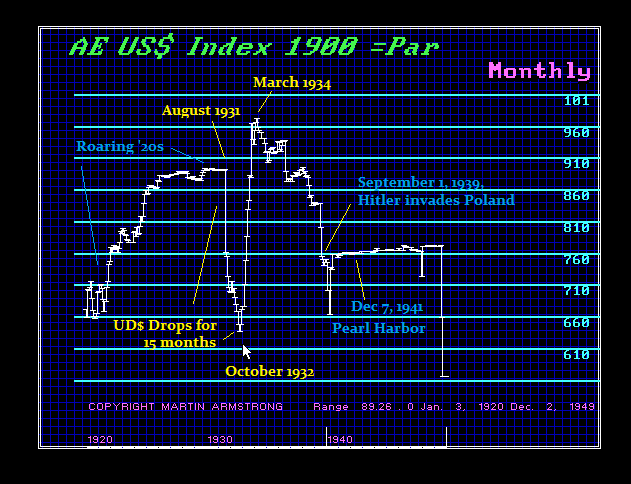
I fully understand that there are now so many calling for a Great Crash of all time as they have during each correction, big and small, for over 30 years, and they just never get it right, even once. Some tout the rise in interest rates. Others look at this chart and nothing else. If there is a Great Crash, then the dollar rises, for you are selling assets for cash. They overlook the fact that in 1929, the US had a balanced budget. The world was buying dollars because Europe defaulted on its debt, which rippled through the financial system, causing 9,000 US bank failures in the United States just as the Mortgage Crisis in the US hit European banks.

So, if there was a Great Crash, does that mean you want to sell all tangible assets, from stocks to real estate, and go to the dollar and government bonds? Is that what you really want to do with Biden throwing money out the window in every direction BUT the domestic economy?

US 1920 1950
FED Interest Rate 1929 1932

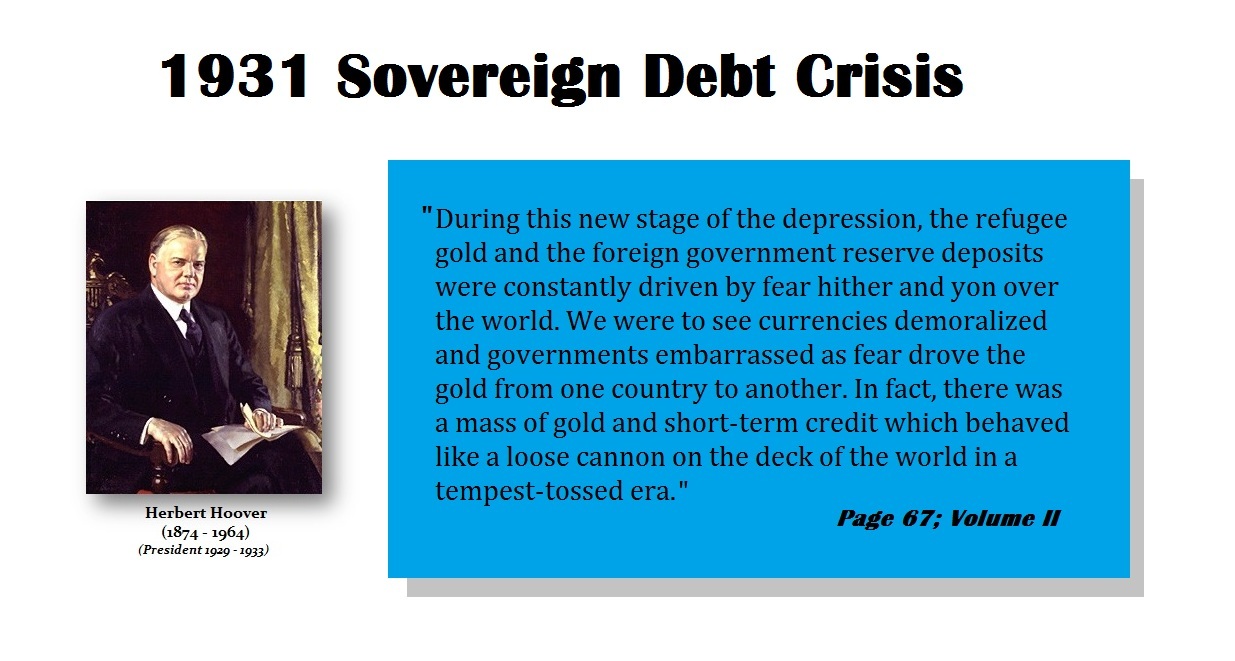
Most of these pretend analysts only look at the chart of 1929 and keep predicting a 90% crash. The dollar went up from 1929 into 1931 when the Sovereign Debt Crisis occurred. I had to read The Great Crash in high school. It was not until I found a copy of Herbert Hoover’s memoirs in an antique bookstore in London that changed my life.  Nowhere in Galbraith’s book was there ever any mention of a Sovereign Debt Default because, like FDR, they were trying to see Marxism and blame everything on the private sector, so the government was the promised land.

Between 1929 and 1931, you sold private assets and moved to cash. However, look at what happened when the Sovereign Debt Crisis hit in 1931. The dollar fell with the stock market into 1932. People did not want either and assumed that most of Europe defaulted on their debt, so surely the US would be next. The fall in the dollar meant GOLD declined since there was a gold standard. Roosevelt was elected, and then he CONFISCATED gold BECAUSE he planned to devalue the dollar to inflate his way out of the Depression.

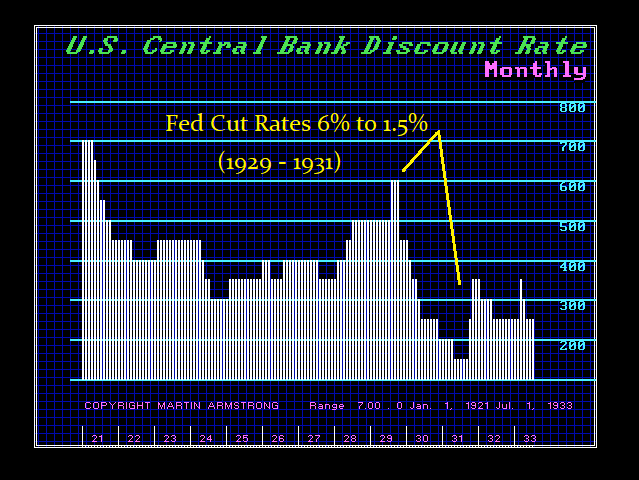
Most of what you hear about the coming Great Crash is distorted history. Some tout rising interest rates. Well, the Fed lowered rates from 6% to 1.5%, and it did NOT support the market. In fact, as always, the Bull market into 1929 took place with rising interest rates. When Trump took office, they called it the Trump Bull Market, and the Fed raised rates throughout his administration.

There is a lot more to this than superficial analysis. We will include a detailed review at the WEC.

Hoover Quote
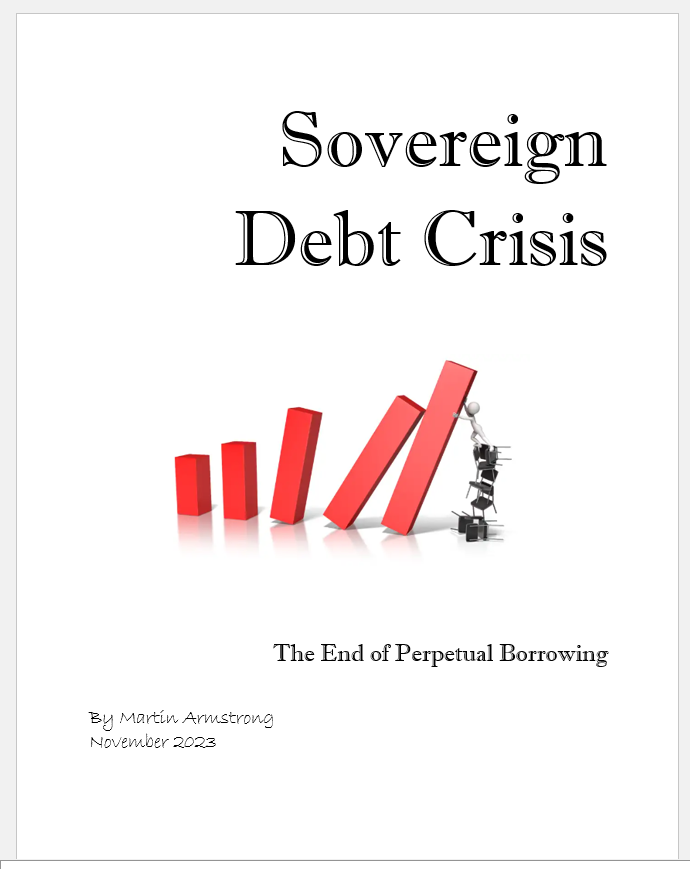
WEC_2023_Sovereign Debt Crisis

Jobs, Wages and Official Labor Reports Continue Showing Major Disconnects from Reality on Main Street


Posted originally on the CTH on November 3, 2023 | Sundance 

I have not written as much about the economic analysis coming from the official institutions of government because, well, quite frankly, none of it has made sense for several months.  In this era of great pretending, I am reminded of the official catchphrase which began in 2021, “managing the transition.”

When you contemplate that “managing the transition” can also equate to controlling public opinion, and when you overlap the dynamic of large U.S. institutions manipulating information in order to control that opinion, then suddenly the trust in the data evaporates.   When the reality of the economic situation you can measure, gauge, and sense on Main Street is increasingly detached from the government data about what’s happening on Main Street, things get weird.

EXAMPLE TODAY – Bureau of Labor and Statistics: “Total nonfarm payroll employment increased by 150,000 in October, and the unemployment rate changed little at 3.9 percent.” That’s the topline as announced.

Then you drop to the adjustments on the same report: “The change in total nonfarm payroll employment for August was revised down by 62,000, from +227,000 to +165,000, and the change for September was revised down by 39,000, from +336,000 to +297,000. With these revisions, employment in August and September combined is 101,000 lower than previously reported.”

September and October are generally significant upticks in labor, as the process for holiday preparation (shipping, transport, etc.) are underway.  However, that historic pattern is no longer applicable.  We see consumer trends in a downward direction, general uneasiness of the economic situation is relayed by businesses and consumers who are the key to reality, and yet the official reporting reflects something entirely different.  Thus, you must ask yourself if this is part of the aforementioned “managing the transition.”

Additionally, staying with the bigger (non-pretending) picture, the U.S. government intentionally imports 7.5 million illegal aliens.  Where are they in the data of employment conditions?   Is there a metric that can evaluate the impact of a non-skilled labor influx that takes place simultaneous to a negative economic reality of inflation and diminished wages felt by those traditionally measured.

When you look carefully at the data provided by the Bureau of Economic Analysis (BEA), the Dept of Labor (DoL) and the Bureau of Labor and Statistics (BLS), what you come away with is the data-driven impression of something that you cannot actually see in the reality of the economic world around you.  Quite simply, none of it makes sense.

If you begin talking about the disconnect, you enter a sphere of sounding like a conspiracy theorist.   Would the official institutions of economic analysis actually manipulate data as an outcome of the larger goal to “manage the transition”?  For me the answer is an emphatic, yes.   However, how do you quantify that disconnect when the people with a vested interest in hiding any conflict are the same people who control the release of the data?

It is a reality that 75% of the American people feel their economic situation has worsened and continues to be worse.  Many people are increasingly incapable of staying ahead of increases in cost of living.  Govt institutions say inflation has come under control, yet the prices continue skyrocketing and everyone can feel it.  Financial insecurity is the new normal amid a growing population, while the managers of the transition say, ‘all is well.’

The only thing that brings a person back from the world of crazy speak, is a review of actual ground reports on Main Street from people who are living their daily lives and trying to cope with the costs of maintaining that standard.  Almost everyone expresses having more difficulty keeping their financial head above water.  Yet the data released by government paints a different picture.   The distance between reality and ‘official data’ has never been wider than it is today.

Fewer goods are being manufactured.  Fewer goods are being shipped.  Fewer sales are taking place.   In a naturally contracting cycle this would mean less jobs.  However, the data shows job growth.

♦Health care added 58,000 jobs in October, in line with the average monthly gain of 53,000 over the prior 12 months. Over the month, employment continued to trend up in ambulatory health care services (+32,000), hospitals (+18,000), and nursing and residential care facilities (+8,000).
♦Employment in government increased by 51,000 in October and has returned to its pre-pandemic February 2020 level. Monthly job growth in government had averaged 50,000 in the prior 12 months. In October, employment continued to trend up in local government (+38,000).
♦Social assistance added 19,000 jobs in October, compared with the average monthly gain of 23,000 over the prior 12 months.
♦In October, construction employment continued to trend up (+23,000), about in line with the average monthly gain of 18,000 over the prior 12 months. Employment continued to trend up over the month in specialty trade contractors (+14,000) and construction of buildings (+6,000).
♦Employment in manufacturing decreased by 35,000 in October, reflecting a decline of 33,000 in motor vehicles and parts that was largely due to strike activity.
♦In October, employment in leisure and hospitality changed little (+19,000). The industry had added an average of 52,000 jobs per month over the prior 12 months.
♦Employment in professional and business services was little changed in October (+15,000) and has shown little net change since May. Employment in temporary help services changed little over the month (+7,000) but is 229,000 below its peak in March 2022.
♦In October, employment in transportation and warehousing was little changed (-12,000) and has shown little net change over the year. Over the month, warehousing and storage lost 11,000 jobs, while air transportation added 4,000 jobs.
♦Information employment changed little in October (-9,000). Employment in motion picture and sound recording continued to trend down (-5,000); the industry has lost 44,000 jobs since May, at least partially reflecting the impact of an ongoing labor dispute.

DATA

What do you see happening in/around your area?   How are the employment conditions nearest you?

US Treasury Secretary Unclear on the Concept of a “Deficit” Re-Posted Nov 2, 2023 By Martin Armstrong 


I have both good and bad news. The bad news is that the US government is continually spending with no end in sight. The proxy wars have eliminated even a level-headed discussion of anything akin to a real budget. In a move that angered Treasury Secretary Janet Yellen (also good news) Republicans introduced legislation to reduce funding toward Biden’s IRS army through the Inflation Reduction Act. They still plan to spend billions of taxpayers’ money, but that money will now go toward Israel instead of hunting down those who fund the organization.

IRS.FootballField

A bit of luck for those who do not want to be harassed throughout the year by 87,000 new IRS agents for something trivial like selling something over $600. The proposal will redirect $14.3 billion in funds to Israel instead of doubling the IRS, angering Treasury Secretary Janet Yellen, who insists America has money for two wars and a standing IRS army. The news comes one week after Biden pledged $105 billion to fight the West’s war in the Middle East. Per usual, these aid packages drastically increase weekly and our elected officials are able to make these crucial decisions without approval from the people.

“We cannot let our national security be undermined in an attempt to weaken our efforts to modernize the IRS – efforts which reduce the deficit, improve customer service for Americans, and make sure that wealthy tax cheats pay what they owe,” Yellen posted to the social media platform, X.

I always question how this woman has a job. She insists Americans are happy with their economic situation, and called the US debt downgrade “arbitrary.” Above she is promoting the propaganda about inflation being transitory. Do not dare to mention the deficit when you continually support massive spending packages with hidden agendas. Yellen herself admitted that the Inflation Reduction Act was really a method to support climate change. “The Inflation Reduction Act is, at its core, about turning the climate crisis into an economic opportunity,” Yellen admitted.

US national debt spiked by $4.8 trillion since Biden took office, and yet he continues to pass multi-billion dollar spending packages that in no shape or form benefit Americans. It is safe to say that those in charge see the people, the Great Unwashed, as enemies of the state. Yellen wants to spend billions on harassing law-abiding Americans because she believes what you earn belongs to the government.

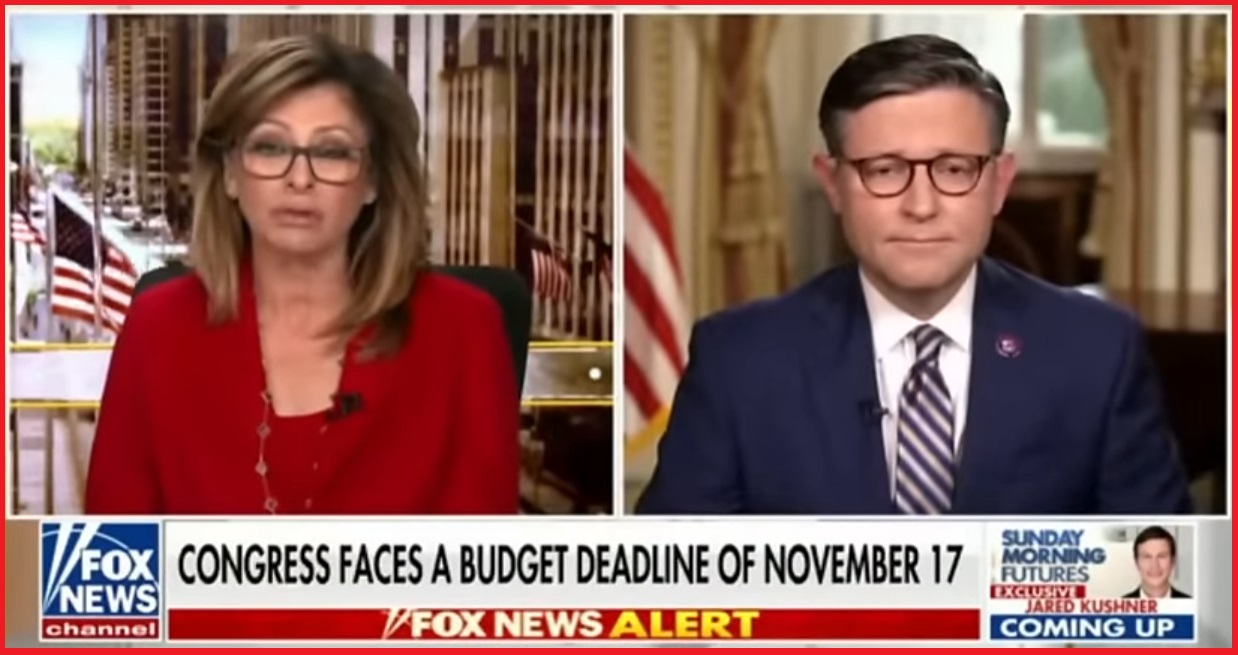
Sunday Talks, New Speaker Mike Johnson Discusses Israel Support Bill and Looming Budget Deadline


Posted originally on the CTH on October 29, 2023 

Within the budget process there are two different facets. Congress is charged by the Constitution with making decisions about how to spend public money. Those spending decisions are split into two parts: authorization and appropriations.  In the recent political era the “authorization” process has essentially been nulled; no one ever asks if the program (Ukraine, Israel, FBI, etc.) should be funded. 

Authorization” is done by Congress via legislation that “can establish, continue, or modify an agency, program, or activity for a fixed or indefinite period of time,” per the Congressional Research Service. In other words, authorization is Congress saying that money can be spent on a given item — not that it necessarily will be spent on that item.

Appropriations” are done by Congress via legislation that authorizes agencies to make payments from the federal Treasury (i.e. it allows them to spend the money that had previously been authorized). Appropriations bills are ordinarily passed each year, but in recent years it has been common for Congress to fund the government “on autopilot” via continuing resolutions that simply allow agencies to continue spending the same amount of money they were spending under the previous funding bill.

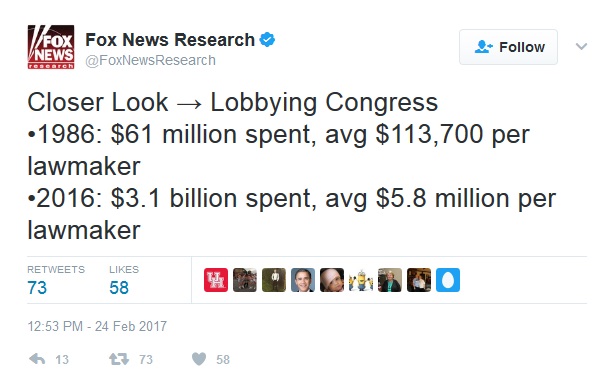
Matt Gaetz has been trying to change this dynamic because the external recipients of the appropriation spending, the lobbyists, are the ones driving the continuation of the CR approach. The lobbyists pay congress via campaign donations. Those donations come from congressional appropriation. The CR process maintains the largesse.

.

Business Deportations


Armstrong Economics Blog/World Trade Re-Posted Oct 27, 2023 by Martin Armstrong

The world will become a more hostile place in the months ahead as we move toward 2024. Governments have identified their enemies that have embedded themselves within Western society. First, governments will ask businesses owned by unfriendly nations to leave, and next, they will target individuals.

Syngenta has owned 160 acres of farmland in Arkansas for three decades. Arkansas Gov. Sarah Huckabee Sanders raised concerns over the company’s ties to China and the CCP. “Seeds are technology. Chinese-owned state corporations filter that technology back to their homeland, stealing American research and telling our enemies to target American farms,” Huckabee explained. The company is now being forced to leave America due to fears of national security. Additionally, they must pay a $280,000 fine for failing to disclose foreign ownership.

The state is providing Syngenta with a 30-day evacuation notice before they attempt to confiscate their land. A spokesperson for the company stated that they have been in operation since 1988 with no issue. “Syngenta’s work in the US — including in Arkansas — continues to benefit American farmers, strengthens American agriculture and makes the US a more innovative and competitive participant in the global agricultural marketplace,” the spokesman said, calling the move “shortsighted.”

However, the government knew this was a Chinese-run business years ago, as the US Department of Defense compiled a watchlist of companies connected to China in 2017. The growing fear of global warfare has gifted government the power to deport businesses on short notice. Slowly but surely, these companies will be asked to leave the US.

As a reminder, China is America’s largest trading partner. China is not currently at war with America. The government is opening Pandora’s box as this will lead to an exodus of foreign-run businesses and China will retaliate. We remember the ongoing trade war with China during the Trump administration with sanctions matched with sanctions. The globalists scream “Inclusivity!” left and right but plan on removing businesses simply because they’re connected to a foreign nation deemed unfriendly without a thorough investigation.

There are already discussions of deporting individuals for their religious and/or political beliefs. This will not be limited to the US. France’s Macron is attempting to deport those with “extremist beliefs.” Other countries will follow, especially with violently charged protests growing throughout Western nations that opened the doors to countless refugees since 2015 when Syrians were fleeing. The issue here is that the government has the sole discretion to decide who can stay and who must leave. If only those in charge would use history, recent history, as an example.

Mercantilism v Consumerism – China’s Direction


Armstrong Economics Blog/World Trade Re-Posted Oct 26, 2023 by Martin Armstrong

Mercantilism is the economic theory that trade generates wealth and is stimulated by the accumulation of profitable balances, which a government should encourage by means of protectionism, according to the Oxford Dictionary. We see nations like Germany rely on this model as they produce various products to export through trade. German manufacturing has provided the nation with Europe’s strongest economy, but this is not the model China is following to become America’s successor as the financial capital of the world.

Italy may have a lower GDP than Germany, but the average Italian has a higher net worth than the average German. The average Italian has a household net of $295,020. In contrast, the average German household is worth $304,317. Yet Italy has half the GDP of Germany at 2.108 trillion compared to 4.26 trillion. A few short years ago, the average Italian or Spaniard had a higher net than the average German despite Germany having the strongest economy in the continent.

Germany has clung to inflationary fears in the aftermath of the hyperinflation that arose post-World War II. The government has kept taxes high as a result. What made America great was consumerism – people lined up to sell products to Americans. Germany, on the other hand, focuses on producing products to sell to someone else.

China understands what Germany does not. China is moving in the direction of the US to create a consumer-based economy. It will take time, but in 15-20 years, nations will line up to sell to the Chinese.

Why Was the 1987 Crash Important Even for Today


Armstrong Economics Blog/Training Tools Re-Posted Oct 18, 2023 by Martin Armstrong

COMMENT: I watched a pretend analyst who claimed the 1987 Crash was nothing. It is amazing how these people claim to be analysts yet do not understand the first thing about what took place behind the chart. I was there at your WEC in Princeton the weekend of the crash. I don’t remember if it was videoed. If so, you should post that.

Dan

See you in Orlando.

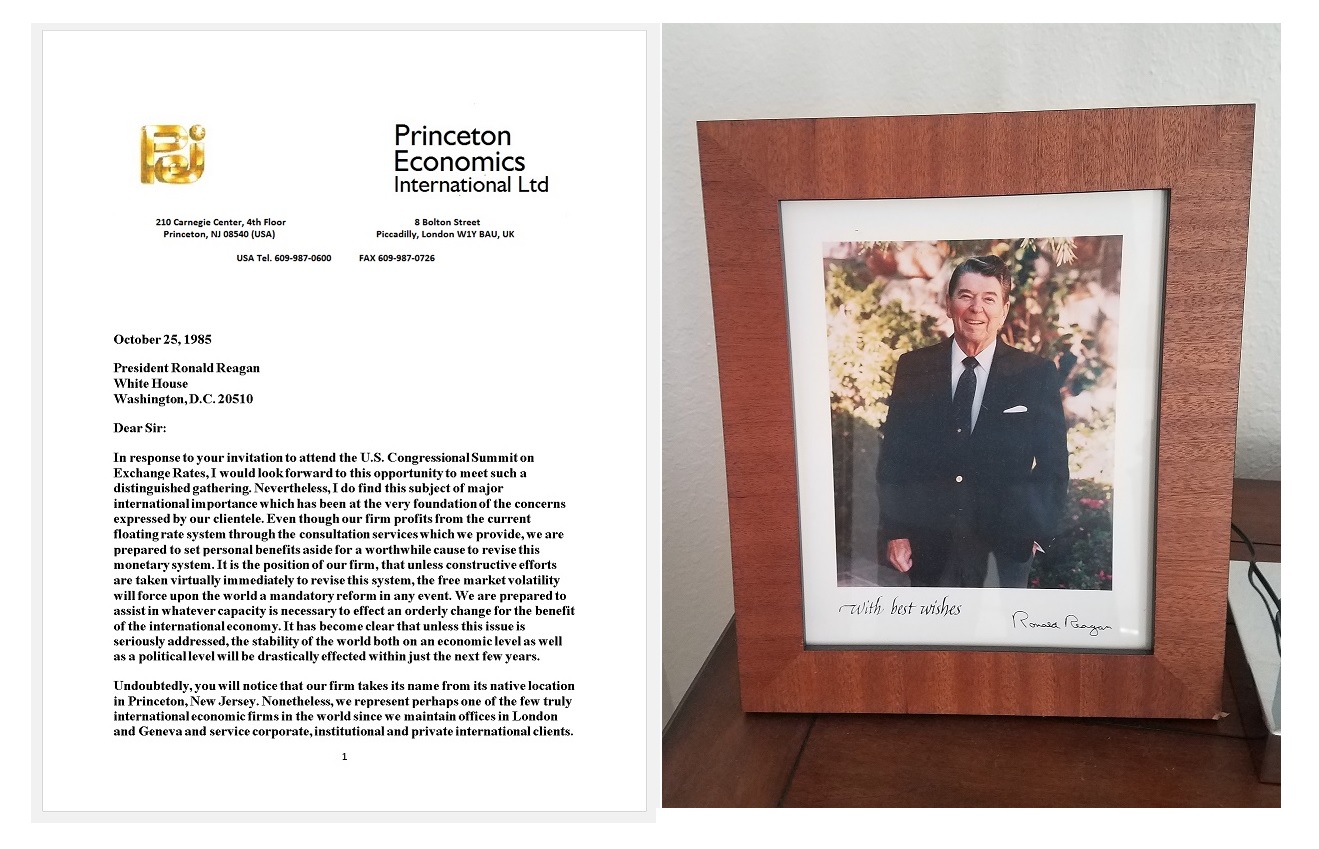
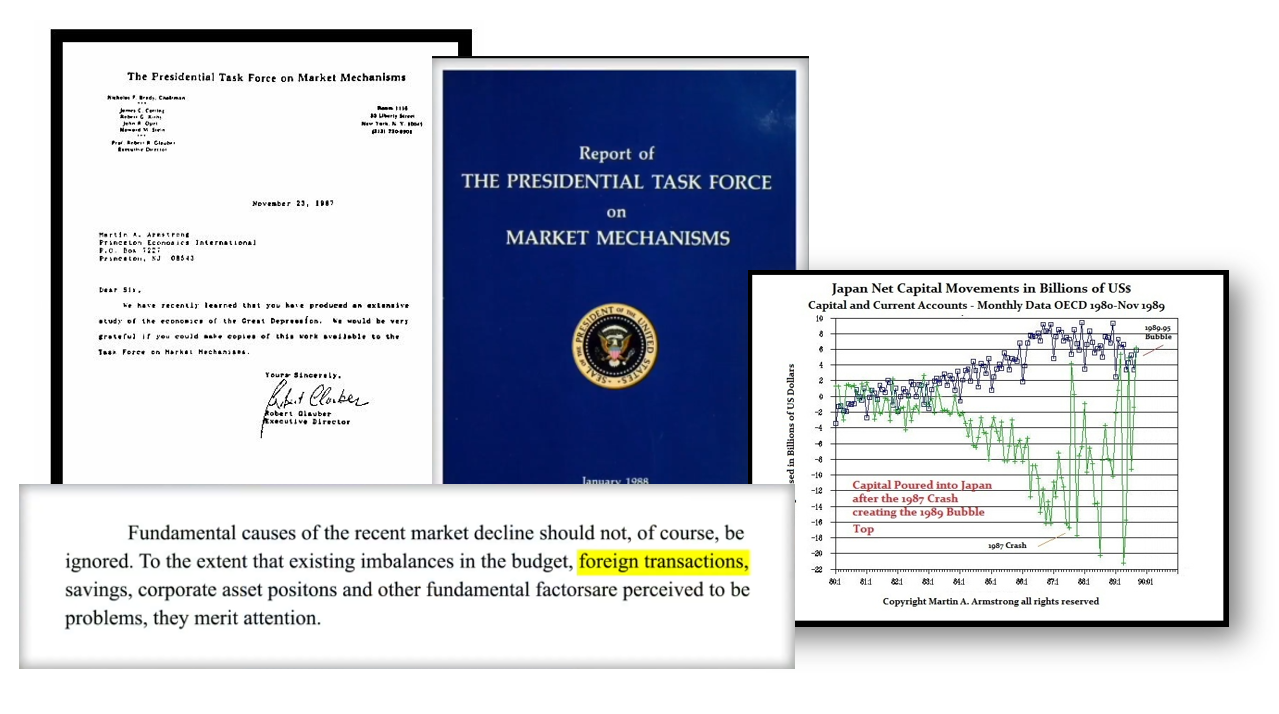
REPLY: Your statement is a sad epitaph on analysis these days. The “pretend analyst” is a Fed watcher who never looks beyond the shore. There is nothing you can do with these people. If they cannot look beyond a domestic economy, they are not analysts – plain & simple. Because I warned them back in 1985 that they would create a crash within 2 years by manipulating the dollar down 40%, when the Crash Came in 1987, that is when they were forced to call me.

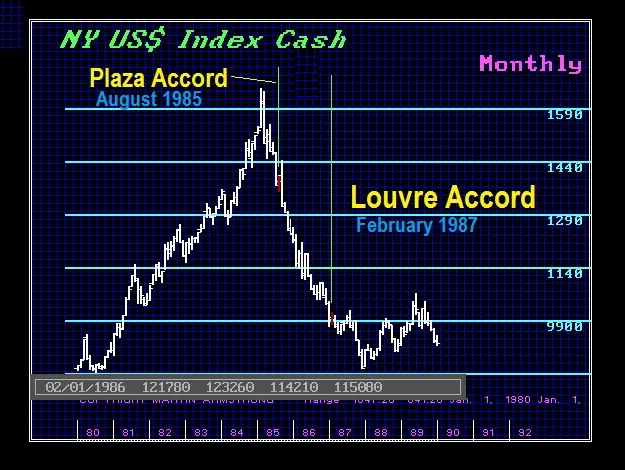
When they began to realize that lowering the dollar by 40% also created a bear market in US assets for foreign investors, including US debt, they held the Louve Accord.  Yet, look closely at the chart. The dollar had already bun its decline. It had nothing to do with the central banks. Those in charge know less than the average investor. They proceed, always assuming they have power – but over what they do not comprehend.

They then announced that the dollar had fallen far enough. When the dollar continued to decline, that is when the market realized that the CENTRAL BANKS COULD NOT CONTROL THE WORLD ECONOMY. Once that took place, that is what unfolded as the 1987 Crash. My biggest accomplishment was to persuade the Brady Commission not to impose restrictions on the market when the formation of the G5 created the crisis. But the government will NEVER blame itself. The most significant accomplishment I was able to do was to get the Brady Commission to at least imply that foreign exchange had something to do with it.

The lesson of 1987 is NOT in the chart. It is behind the chart. Once the public realized that the central banks were not actually in control, that is when the panic took place. Today, when interest rates rise without the Fed’s actions because of the Neocons constantly threatening the world and China over Taiwan, that is when panic will strike. It all goes nuts once people realize that the government is just a ship of fools with ZERO sailing experience. That is when gold will break out. It is that CRACK IN CONFIDENCE that will cause the panic.

That is the Significance of the 1987 Crash

Burger King Accepts Credit Cards (1993)


Armstrong Economics Blog/Humor Re-Posted Sep 24, 2023 by Martin Armstrong

The Problem with Goldbugs


Armstrong Economics Blog/Books Re-Posted Sep 16, 2023 by Martin Armstrong

COMMENT: Mr. Armstrong, I just wanted to say thank you so much. I was listening to the perpetual gold analysts for years who never changed their tune. It was always buy, buy, buy, and the dollar would go to zero any day now. They always looked at the Fed and the balance sheet, and when they were wrong, they blamed the bankers for manipulating gold.

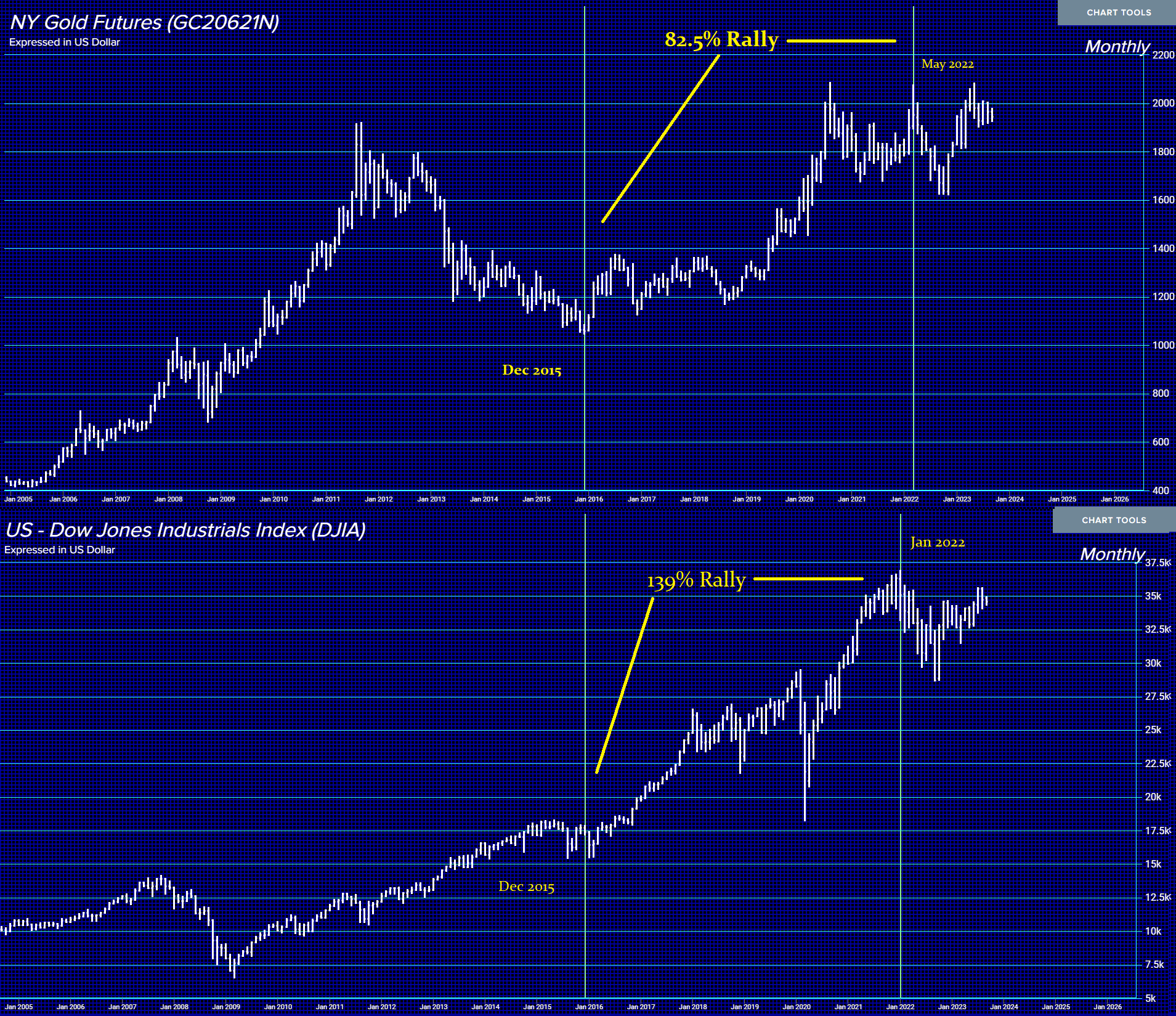
I sold out in 2013, and you said gold would decline for two years. It did not crack $1,000 as you hoped, but it elected two monthly bullish reversals within two months of that low, and you said it would rally to test $2,000. You also projected that the stock market would outperform gold, and contrary to all the gold bugs, you said they would rise together. Nobody made that forecast.

I had two friends who did not listen to you. They took home equity loans to buy more gold and did not sell in 2013. The gold bugs ruined the marriages of my former friends, and both lost their houses. We no longer talk because they lost everything when I followed you. The stock market did much better. People need to understand that when you forecast the world, you see things are all connected.

Thank you so much for the education.

ED

REPLY:  I am glad you understand that you cannot forecast a single market to the exclusion of everything else. The world economy is all connected. As I have said, without World War I & II, the USA would still be an agrarian society. The capital shifted, transforming the USA into the world’s financial capital. The problems with the goldbugs’ view of the world is that:

  1. They have broken rule #1 of investing – NEVER MARRY THE TRADE.
  2. They are prejudiced by old economic theories that have not been updated since the 16th century.

When Sir Thomas Gresham  (c. 1519 – 1579) devised his Law that bad money drives out good, the metal content determined foreign exchange on the Amsterdam Exchange. Today, the backing of a currency has returned to the days of the Roman Empire. Rome was militarily superior, as is the case of the United States, when it became the #1 military power after WWII. Yet more importantly, Rome had a consumer-based economy, so everyone was proud to be Roman, for it gave them access to the largest consumer market in history. The Emperor Marcus Aurelius (161-180 AD) had even sent an ambassador to meet with the emperor of China. The United States currency is NOT backed by gold or any commodity. It is supported by a consumer-based economy, the same as Rome.

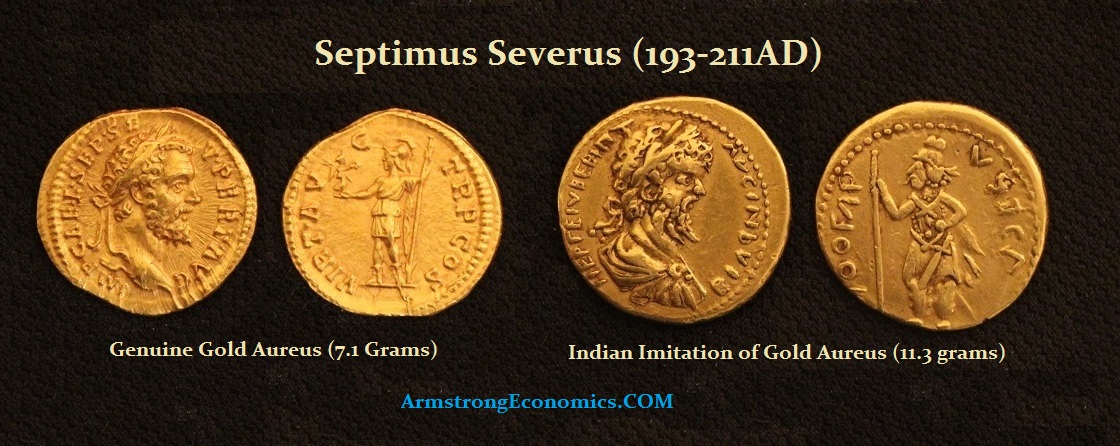
India traded with Rome. That is where the silk from China moved through India to Rome. However, India was also the supplier of dyes and spices. Rome’s coinage was worth more than the metal content of the time of Gresham during the 16th century, for there was no significant military power nor a consumer-based economy. For over 200 years, Southen India imitated Roman gold and silver coins; at times, they even weighed more in gold than genuine coins.

Here we have an imitation gold aureus of Septimus Severus (193-211AD), which weighs 11.3 grams compared to 7.1 grams for a genuine Roman aureus. That meant that the Indian imitation was nearly 60% heavier. The coinage had a premium because of the consumer-based economy in Rome, and that attributed a premium to the coinage that had NOTHING to do with the metal content. Southern India NEVER issued their own gold coinage. They imitated that of Rome. Today, many emerging markets use the US dollar and borrow in dollars.

The world has changed – I hate to tell them. The old theory of the Quantity of Money does not hold up under any correlation. The nonsense that gold rises with inflation has ruined many and bankrupted others. The central banks have used this theory supported by Keynesian Economics, and it has utterly failed. We have ballooning national debts thanks to Austrian Economics, which propagated the idea that borrowing rather than printing would be less inflationary because you were not creating more money – you were supposed to be draining the money supply.  Everything is connected. If a foreign investor buys property in the United States, his money, be it in euro, yen, or yuan, is converted to dollars, and the domestic “real” money supply increases, for the seller, now has that cash to spend. This is not accounted for in any of these antiquated theories.

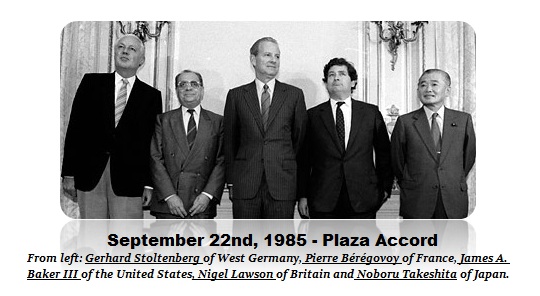
It is time we reassess how the modern economy of the 21st century truly works. Currency pegs, gold standards, and schemes like the G5 Plaza Accord, which tried to lower the value of the dollar to reduce the trade deficit being oblivious to the fact that they also lowered the value of foreign investment in the dollar, have done nothing but create confusion and economic chaos. Central banks have nothing other than the old-fashioned 16th-century theory of the quantity of money to play with.

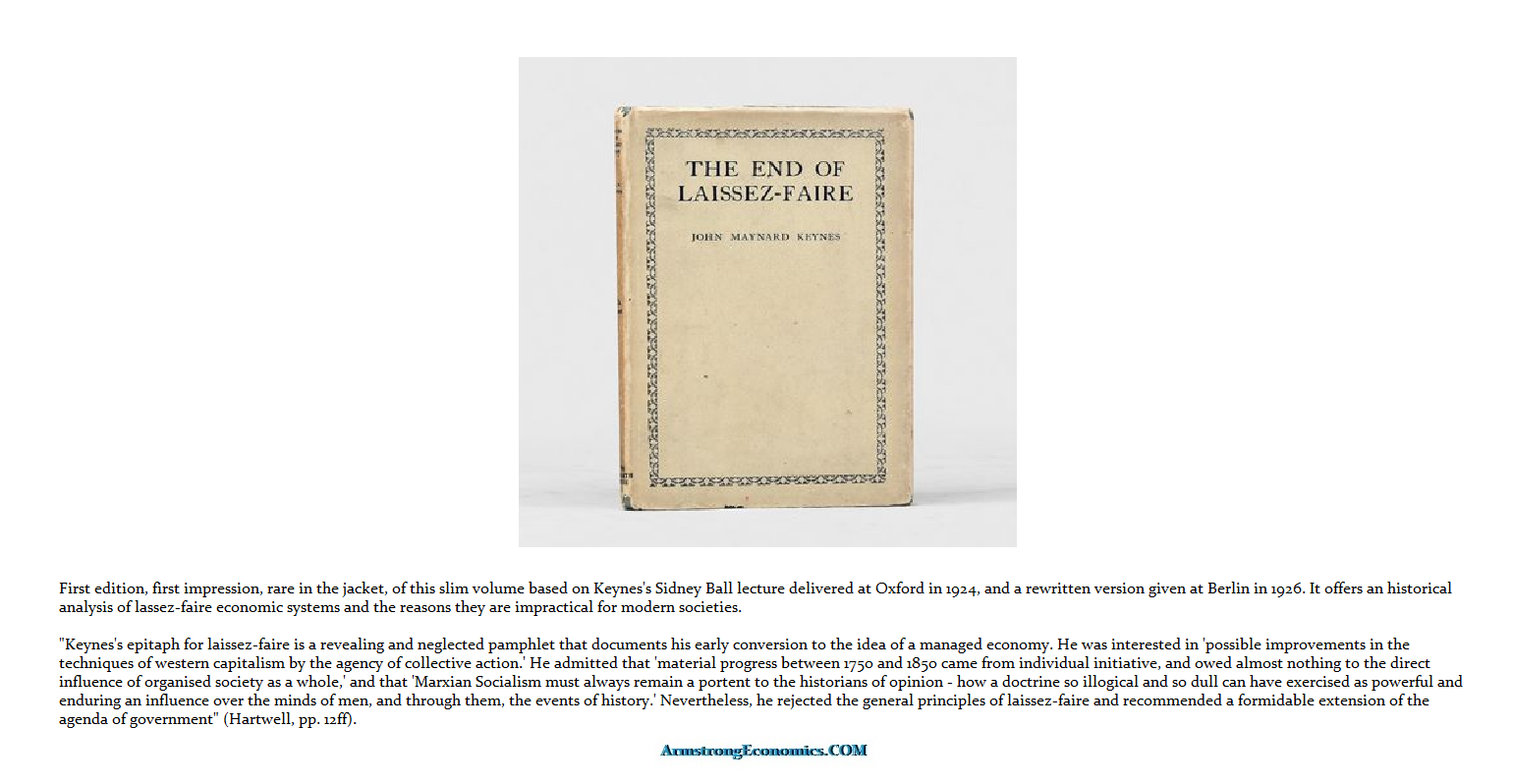
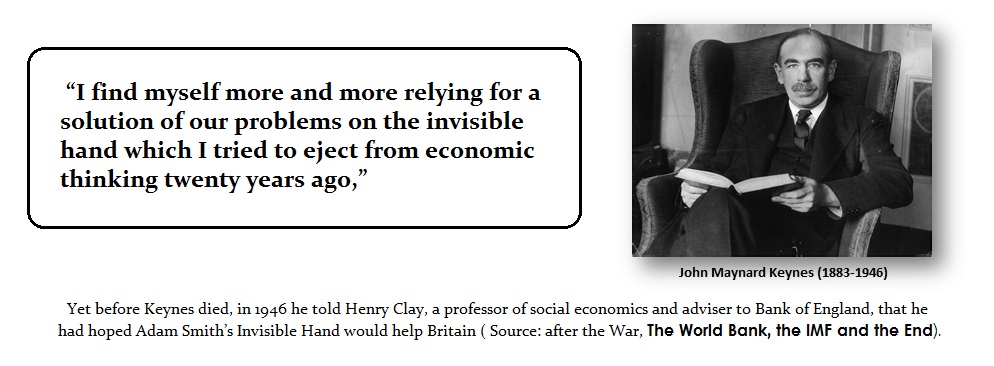
Keynes added to the chaos by advocating, like Marx, that the government had the power to control the economy. Keynes advocated the end of Laissez-Faire in 1926. Yet, before he died, Keynes admitted that he was wrong. Nobody paid attention because once the government seized that power, they refused to hand it back to the people.

Gold is NOT a hedge against inflation. It declined for 19 years after 1980 when inflation rose, as did the national debt. Gold is a hedge against the government. That will be why it will make new highs on the 4th run – not because of the Fed or the CPI.

I am finishing up a new book on this crisis in theory. Not only have the godbugs been wrong, but so have the central bankers and those in government. It is time we take a closer look at how things truly function that apparently, like Thomas Gresham, it takes someone to observe reality from a trader’s perspective.

The Cost of Homeownership in the US Spiked 91% in Two Years


Armstrong Economics Blog/USA Current Events Re-Posted Sep 1, 2023 by Martin Armstrong

The US housing market has not been this unaffordable since 1984, a new study finds. Analysts at Black Knight analyzed home prices, income, and interest rates on a monthly basis going back to 1975 and found that the average mortgage today would cost $2,423 per month on a 30-year fixed with 20% down. This marks a 91% increase in housing costs over the past two years alone.

The $2,423 figure represents 38.3% of the median household income, despite home ownership costing only 24% of the median household income for the past 25 years. This study does not take into account that many do not put down the 20% downpayment due to rising closing costs, insurance costs, and taxes. The current 30-year fixed mortgage is around 7.23% at the time of this writing, marking a 20-year high. For housing affordability to reach 24% of the median income, the average household would need to earn 60% more or home prices would need to decline by 27%.

Home prices are at their highest level in 30 of the 50 largest metros. People are continuing to flee to more desirable areas for financial and political reasons, and with historically low inventory, prices will not decline any time soon in those areas.

Worse still, 344,000 US homeowners owe more than their home is worth, which is a 70% uptick from last year. In Florida, insurance rates alone are causing many longtime residents to flee. I will discuss that in more depth in another post. The housing crisis is in full swing, but this is by design. The globalists have said countless times that they want the world to become perpetual renters who own nothing. Never before has the average man had to go to battle with investment firms to own a piece of the American dream.