Federal Reserve & Elastic Money & NY Clearing House Certificates


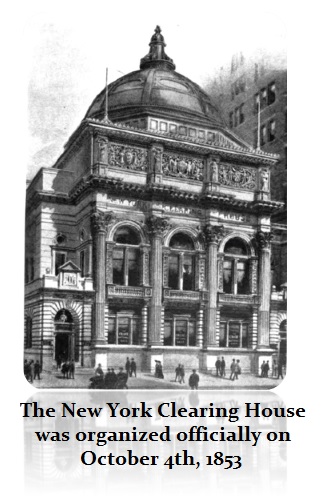
NY Clearing House

QUESTION: Why do you support the fed in what you call elastic money and not a gold standard?

ANSWER: As usual, you listen to the nonsense about how the Fed is owned by the banks and is responsible for probably everything evil from creating wars to probably killing JFK. The entire use of “elastic money” was not invented by the government or the Fed. It began in 1853 with a little known group to try to help in the middle of a crash for what you are advocating is precisely what Europe has done – impose austerity.

The Panic of 1873 saw the government make a small gesture to try to calm the panic. They did the same thing as Quantitative Easing back then – Yes, not even that is new. The US Treasury injected cash by purchasing government bonds. It did NOTHING to help the economy. Why? When confidence crashes, people HOARD money and will not spend it if they fear the future. The cash they injected was hoarded by the banks just as it has been post-2007. Quantitative Easing in this manner NEVER produces inflation nor does it stimulate the economy.

1907 Clearing House Scrip San Fran

The banks got together to create their own “Elastic Money” using the New York Clearing House. Failing to increase the money supply meant that the value of money in purchasing power rises and all assets decline. This is the hallmark of EVERY recession or depression. During the Panic of 1873, the national banks of New York pooled their cash and collateral into a common fund, and placed this in the hands of a trust committee at the New York Clearing House, which had been founded on October 4th, 1853. The New York Clearing House then issued loan certificates that were receivable at the Clearing-house against this collateral. These certificates were absorbed like cash and could be used to pay off debt balances. Ten million dollars’ worth of these certificates were issued at first, but the sum subsequently doubled. This Clearinghouse paper served its purpose admirably.

By October 3rd, 1873 confidence had been returned and $1,000,000 of these certificates was called in to be canceled. The next day, another $1,500,000 more of these certificates were recalled. In the end, not much of this issue was outstanding very long. The Clearing-house scheme was successfully applied also in Boston, Philadelphia, Pittsburgh and other cities, but not in Chicago.

This was the birth of “Elastic Money” that makes sense. This prevents wholesale liquidation of assets to get cash in short supply. The problem is neither the Fed nor the concept of Elastic Money. The Fed was originally established in 1913 to act like the New York Clearing House but for all assets outside of Wall Street. Then came World War I the next year in 1914 and Congress ordered the Fed to buy only US government bonds. They never returned the structure of the Fed to what it was originally designed to do.

Hence, today we have Quantitative Easing when central banks buy government paper attempting to stimulate as they tried and failed every time previously. The difference was that the New York Clearing House Certificates were good among security dealers. They were not expanding the money supply nor could they be used for groceries at home.

The certificates were redeemed and those from 1873 are non-existent today because they were used among institutions. If you want to blame anybody or anything – blame the right person or group. What you are doing is blaming a murder on the person who manufactured a gun rather than the person who pulled the trigger. Blame Congress! Not the Fed!

We need a central bank and elastic money is an excellent tool. However, I would issue it in a two-tier manner. The normal tier is money commonly used. The second is the elastic money, but this automatically should expire in 6 years. Therefore, it will be redeemed as was the case in 1873.

*PS If anyone has such a New York Clearing House Certificate from 1873, I would be a buyer.

Austria Wants to Tax Any Search, Like, or Communication via Internet


Schieder Andreas

Andreas Schieder (born 1969) is the parliamentary head of Austrian Chancellor Christian Kern’s Social Democrats. He is a typical career politician since 1997 and the very type of person who has no idea about the world economy no less human nature. He is a highly dangerous bureaucrat who only looks at people like cattle from which the government can extract greater and great sums.

Schieder is obviously a Marxist who wants to now tax human behavior and any interaction you have with Twitter Inc., Google or Facebook among others. He wants to tax every time you do anything from searching, posting, tweeting or just liking someone’s post.

He claims this is really a barter transaction where it appears to be free but you are giving them your personal data that they sell to advertising. That arrangement is a form of bartering and any barter transactions is subject to the value-added tax. He said according to Bloomberg:

“The business transaction that’s going on here is that users are paying with their personal data,” Schieder told journalists in Vienna. “The business model of those internet companies is based on massive revenues that are generated with the help of those data.”

Andreas Schieder is a highly dangerous man. He only looks at what government can extract from people, never how government can reduce its size and cost to save money. It’s always just raise more and more taxes without end.

Soros At it Again – Trying to Overthrow Polish Government?


Tokyo-3-1999

Tokyo March 1999 Institutional Seminar

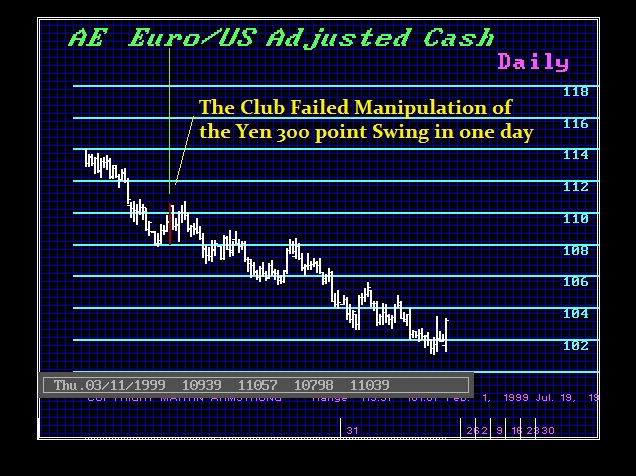
QUESTION: Mr. Armstrong, I attended your March 1999 conference in Tokyo when I worked for ______ bank. I remember you called out Soros and crew and said they were trying to manipulate the yen for fiscal year end. You warned the Japanese how to defeat the Club. If I remember, he and his crew lost $1 billion when everyone in Tokyo followed your advice. Many assumed what they did to you 6 months later was retribution. Now he is at it in Poland funneling money he made from such trading in through Norway to create political unrest. What is it with this guy? Why does he play God?

KE

Japanese Manipulartion March 1999

ANSWER: Oh yes. I remember that event very clearly. That why they started calling me Mr. Yen because it was me and our clients against the Club and the Club lost. They were trying to to push the yen down for the fiscal year-end roll of March 31st and then run it up into April 1st. They had our clients lock it in and that forced the manipulators out. That was a wild day. 3 big figures in a single day in an outside-reversal was a big move back then.

I know the rumor was that Soros was in on that and the Club lost $1 billion. Not sure how much they lost on that one. It was the good-old fun days of confrontations.

The Polish government wants to stop the distribution of Norwegian money flowing into Poland coming from Soros’ funded Batory Foundation, which manages over 800 million euros with a target of overthrowing the Polish government by 2020. Since 2014, the Batory Foundation has distributed some 130 million zlotys (around 31.7 million euros) to various associations and organizations within Poland to change the government. According to Bloomberg, this includes organizations for the promotion of “parliamentary democracy”,  but only if it agrees with Soros’ agenda. Effectively, Soros is trying to defeat Catholic values ​​in Poland which are supported by the population and government.

Norway is refusing to stop Soros’ agenda being implemented against Poland from inside Norway. Meanwhile, Poland and the head of the EU have been is a battle rejecting the EU policies on refugees and Brussel’s totalitarian position where he has even told Poland to accept the refugees or get out of the EU. The main concern is that the Polish government wants to determine its own future and security. The situation escalated as the EU reelected Poland’s Donald Tusk against Poland’s.

Krakow-Night

Poland should exit the EU and strike its own trade deal with the USA. Many US companies have established back-office operations there in Krakow including New York Banks. It is a very beautiful city on its own besides being a quiet place for back-office operations. Poland has well educated students, fluent in English, and they are free from the Euro. If Poland were to adopt the Euro, there are numerous companies that have expressed they would have to leave Poland or cease any further expansion under such conditions.

Soros has publicly stated he does not believe in God. Many who worked for him said they think he believes he is a god with the right to reshape the world in his image. So have many throughout history and they are responsible for the murder of countless millions. Money does not give you the right to fund revolutions to recast the world in your image.

Explaining Why Republicans in Congress Need To Undercut Trump’s Budget Objectives, Wilbur Ross and NAFTA…


If you didn’t read the Part-V explainer of how we got to this point in congressional history stop and go read it.  This stuff is all connected and cannot be absorbed without a thorough understanding of motives behind the advancing agenda-writers.

Make Sure You Watch The Embed Video (below) from Wilbur Ross.

The interim Continuing Resolution (CR) is fraught with demands of the “Big Club”.  That is: Wall Street, their lobbyists, and those who have created the UniParty for over three decades.   The “Big Club” is fighting back against the insurgent presidency of Donald Trump and is using the Republican wing of the UniParty to do it.

It is Republicans, not just Democrats, in congress who are putting the most toxic spending priorities within the $1+ trillion spending bill and forcing a spending bill onto President Trump’s desk which factilitates the needs of the lobbying class and undermines parts of the structural agenda of President Trump.

The outrage should be rightly focused on the UniParty in congress, and more specifically the Republicans therein, not President Trump.

What would the ankle-biters and antagonists (gnats) have President Trump do?  Veto a bill constructed by bipartisan legislation in congress?   Shut down government?  That’s exactly the dynamic the “Big Club” has set up through their paid opposition represented by Paul Ryan and Mitch McConnell.

It is understandably frustrating to most CTH readers that the larger electorate cannot yet bring themselves to see the nature of Trump’s political opposition is not Democrats, it is the UniParty.  However, you should always remember that your knowledge is in the minority and not thoroughly understood by the larger voting electorate.

When Rush Limbaugh begins to tell his audience about the legislative construct within DC that is controlled by the UniParty apparatus, that’s a good thing.  Because that level of understanding is what will be needed in the future if the larger U.S. electorate are ever going to comprehend the challenge and opposition.  It does not matter that Limbaugh cites or recognizes our research and insight; what matters is that a larger audience begins to comprehend the scope and scale of the problem.

Within the current spending bill, both the Republicans and Democrats inject the needs of their financial class benefactors.  This is not Republicans acquiescing to spending or legislative additions they do not support; that is simply the fallacy of false choice.

Break the “battered conservative syndrome” and admit to yourselves and others that the republicans fully support the toxic items that have been placed in the spending bill.   From that position you can begin to make progress toward understanding the bigger issues.

The reality then becomes: what can President Trump leverage out of those Republicans, knowing he cannot politically thwart their intention so long as the voting electorate remain oblivious to the nature of it?

Trump needs congress, specifically the senate, and even more specifically Senator John Thune (Chairman of the Senate Commerce Committee) to accept the letter of intent to renegotiate NAFTA.

For more than a month McConnell, Thune and the members of the Senate Commerce Committee (including Ted Cruz and Mike Lee) have refused to accept the letter because their financial donors and lobbyists don’t want to see NAFTA re-opened.

Perhaps President Trump can get Republicans to accept the intent letter by signing the interim spending bill.   Opening and renegotiating NAFTA will provide infinitely more benefits to middle-class workers than the spending priorities within the CR congress has constructed.

Again, the republicans and democrats in congress are leveraging their short-term CR to push the legislative priorities of K-Street.  Unfortunately, most Americans don’t understand this dynamic and therefore direct their frustration toward President Trump who is put into a position of accepting the CR or vetoing it.

Most of the voting population of the U.S. would look at a Trump veto as a rogue president trying to shut down government and the corporate media would gleefully sell this narrative.

Now Listen to Secretary Wilbur Ross today:

.

Additionally, the BIG CLUB fight against the administration is also playing out in corporate media as Rupert Murdoch, Mr. Wall Street, positions his media enterprise alongside the left-wing mainstream media in opposition to the economic nationalism of President Trump.

Again, this stuff is all connected.

Fortify yourself with an intellectual armory making your keen insight the tip of the spear for your friends and your family.


Part V – Trump Policy Building Toward Crescendo on Multiple, Simultaneous Fronts…


President Trump’s economic and foreign policy agenda is jaw-dropping in scale, scope and consequence.  There are multiple simultaneous aspects to each policy objective; they have been outlined for a long time even before the election victory in November ’16.

If you get too far into the weeds the larger picture can be lost.  CTH objective is to continue pointing focus toward the larger horizon, and then at specific inflection points to dive into the topic and explain how each moment is connected to the larger strategy.

Today is a big news day where action on multiple policy fronts becomes visible.  Here’s an interview with Treasury Secretary Steven Mnuchin which notes some of the critical financial angles to economic policy.

An important reference here is the earlier understanding of how then ‘candidate Trump’ personally put a platform plank of a Modern 21st Century Glass-Stegall banking reform into his economic policy agenda, and why it is important.

.

Here’s the dive:

“We support reinstating the Glass-Steagall Act of 1933 which prohibits commercial banks from engaging in high-risk investment,” said the platform released by the Republican National Committee. (link)

Trump thumbs up

CONTEXT – Beyond the larger context of Globalists -vs- Nationalists (Americanism), the internal opposition to Common Sense economic conservatism (Americanism) can be broken down into two categories:

♦ The first group are those who are fundamentally naive about large and historic economic issues; and how the economy was changed, forced to change through the past forty years, by financial interests who created a second, “false“, paper economy.

This first group is generally young, pseudo-intellectual, and their only reference is while formally educated within the last thirty years (they’re under 50).  Most of the oppositional (conservative) punditry falls into this category.  [Important to note, this group is also joined by the majority of politicians who are approximately the same age.]

Never trump crowd

♦ The second group are those who truly know better. They are older and wiser, they know the truth because they saw it unfold. However, they are also financially dependent on retention of a global narrative that sold the change in the past 40 years. These are the willfully blind who have sold-out to the benefit of, and enrichment from, the false economy.

This second group is intent on retaining a historic set of false assumptions by fraud and deception. Mark Levin, Rush Limbaugh, Chris Matthews and Hugh Hewitt fit into this second grouping. Their framework echo-chambered and passed down to the younger group #1.

Exhibit “A” would be conservatives standing at 2016 CPAC to applaud Speaker Paul Ryan who passed a $2+ trillion Omnibus spending bill (December 2015) to ensure 8 straight years without a budget.  See the disconnect?

ben shapirorich lowry

The world-view of the first group (younger voices, CPAC seal-clappers) is fundamentally seeded on social issues.  They are in no position to speak accurately about economic matters because they don’t have a reference point underpinning their expressed outlook. Their economic arguments are esoteric opinions, and they never experienced the era of industrial giants.

♦ In most of the modern post-war industrial era (1950-1980) banking was a boring job and only slide rule bean-counters and actuarial accountants moved into that sector of the workforce. Most people don’t like math – these were not exciting jobs. Inside the most boring division of a boring banking industry were the bond departments within the larger bank and finance companies.

The excitement was in the actual economy of Main Street business. The giants of industry created businesses, built things, manufactured products, created innovation and originated internal domestic wealth in a fast-paced real economy. Natural peaks and economic valleys, as the GDP expanded and contracted, based on internal economic factors of labor, energy, monetary policy and regulation.

Main Street generated the pool of politicians because the legislative conduct of politicians had more impact on Main Street.

The business agents had a vested interest in political determinations. Political candidates courted industrialists, business owners, and capitalist giants to support them. Main Street USA was in control of DC outcomes.

Despite the liberal talking points to the contrary, this relationship was a natural synergy of business interests and political influence. It just made sense that way, and the grown-ups were generally in charge of it.

government-money♦ Commercial banks courted businesses because bankers needed deposits. Without deposits banks could not generate loans; without loans banks could not generate profits…. and so it was. By rule only 10 percent of a commercial bank’s income could stem from securities.

One exception to this 10% rule was that commercial banks could underwrite government-issued bonds. Investment banks (the bond division) were entirely separate entities. The Glass-Steagall banking laws of 1932 kept it that way.

However, mid 1970’s bank regulators began issuing Glass–Steagall interpretations -that were upheld by courts- and permitted banks and their affiliates to engage in an increasing variety and amount of securities activities. After years of continual erosion of the Glass-Steagall firewall, eventually it disappeared.

This became the origin of the slow-motion explosion of investment banking. If you look back historically from today toward the mid-’80’s (ish) what you will find is this is also the ultimate fork where economic globalism began overtaking economic nationalism.

Banks could now make money, much more money, from investment divisions issuing paper financial transactions, not necessarily dependent on actual physical assets. The transactions grew exponentially.

A few decades later the bond market portion ultimately led to the ’07/’08 housing collapse, and derivative trading (collateralized debt obligations or CDO’s) generated trillions of paper dollars. Business schools in the 1980’s began calling this the second economy (a false economy, or the invisible economy).

The second economy, which ultimately became the global economy, is also the Wall Street investment economy. Two divergent economies: Wall Street (paper), and Main Street (real).

There is no real property, real capital, real tangible assets in the Wall Street economy. The false economy is based on trades and financial transactions, essentially opinions. Paper shifts, and buys and sells based on predictions and bets (derivatives).

Insurance products create an even larger subdivision within the false economy as hedgers wagered on negative outcomes. The money wagered is exponential – some say more than a quadrillion currently floats.

IMPORTANT ♦ Now you realize, in hindsight, there had to be a point where the value of the second economy (Wall Street) passed up the first economy (Main Street). Investments, and the bets therein, needed to expand outside of the USA. hence, globalist investing.

However, a second more consequential aspect happened simultaneously.

a17b2-hip-replacement-recall-briberyThe politicians became more valuable to the Wall Street team than the Main Street team, and Wall Street had deeper pockets because their economy was now larger.

As a consequence Wall Street started funding political candidates and asking for legislation that benefited their interests.

When Main Street was purchasing the legislative influence the outcomes were beneficial to Main Street, and by direct attachment those outcomes also benefited the average American inside the real economy.

When Wall Street began purchasing the legislative influence, the outcomes therein became beneficial to Wall Street. Those benefits are detached from improving the livelihoods of main street Americans because the benefits are “global” needs. Global financial interests, investment interests, are now the primary filter through which the DC legislative outcomes are considered.

There is a natural disconnect.

♦ When Speaker Paul Ryan says: “Donald Trump and I come from two different wings of the party”, he is specifically pointing out this disconnect, yet few draw attention to it.

Trump represents the Main Street wing, Ryan represents the Wall Street wing.

Going back to the opening paragraphs. The news and opinion punditry never take the time to explain the root cause of the disassociation, because: A) Group one doesn’t understand it; and B) Group two is compensated to remain willfully blind, and to ignore it.

Yes, there is a fundamental ideological conflict within this 2016 election:

Part I – Why Congress is not providing President Trump legislation in 2017

Part II – What it means when congress is not providing Trump legislation

Part III – A possible solution to the larger problem – A Prediction.

Part IV – DC Lobbyists Admit they control the legislation.

Part IV – 2016 Prescient DC Lobbyists Talk Trump: “the end of life as we know it here”…


…“Literally 30-thousand jobs could be lost if Trump is sworn in. Washington as we know it, and how business is conducted, will change instantly.”… ~DC Lobbyist

Over the past few days we have been providing background explainers on why congressional legislation is frozen.   The lack of legislative action in the era of Trump is one of the least understood political realities.  Corporate media cannot discuss the issue because they are part of the system itself. The election of President Trump threw a wrench into the gears of the entire DC legislative and lobbying machine.

Part I HERE -and- Part II HERE -and- Part III HERE.

The entire political and legislative apparatus is frozen, and it is genuinely impossible to predict what happens next.  Where we stand is the outcome building a very targeted system over the course of three decades.  The entities and institutions which assembled the system became functionally obsolescent overnight on November 8th 2016.

To fully grasp the tectonic shift, and understand the current challenge, it helps to revisit the words by a key DC machine operator, lobbyist Jack Burkman, who was contemplating the unthinkable prior to the unthinkable becoming a reality:

DC Public Relations2016 […]  seismic panic has ensued on K Street as lobbying firms brace for a reality of a possible Donald Trump presidency and what that might mean for them and their futures.

Prominent D.C. lobbyist Jack Burkman said today that he started assembling a delegation of lobbyists and lobbying firms to meet with the New York billionaire and begin building a bridge to the Trump organization.

“Trump is a Washington outsider. We need the outreach now or Trump will bring in a whole new team made up exclusively of New Yorkers, effectively ending our grip on the White House and The Capitol which will bring about the end of life as we know it here,” says Burkman, who represents a diverse set of national and multi-national clients.

Since Trump has no experience as a politician, not a single D.C. lobbying firm has any ties to Donald Trump.

“More than $4 billion in lobbying business could be lost overnight should Donald Trump become president,” says Burkman. “Decades of relationship-building in politics could be lost. And make no mistake every lobbyist in the town is worried.”

Lobbyists routinely use money to gain access and buy influence. They leverage their connections for wealthy clients who want access. But The Donald has said he won’t accept their money.

“Literally 30-thousand jobs could be lost if Trump is sworn in. Washington as we know it, and how business is conducted, will change instantly.”

[…]  “Asking him to accept contributions in the general must be order number one. It is critical to our survival. We must also make him understand that the Capitol city simply cannot be run without us. We, in fact, make things happen.”  (more)

Well, the unthinkable happened.

Think about the institutional shock.  As the 2016 article outlined, 30,000 people who make a living funneling $4 billion of financial influence into the organizational swamp are now doing what?

The media is focused on ‘shiny things’ and ‘palace intrigue’ and no-one is discussing the larger ramifications of the influence machine shutting down.

If you step back and look at the overall direction of action from the White House it becomes evident the first 100 days of the Trump administration can be summed up as: laying out all the tools for a grand dis-assembly.

Using mostly executive orders, the Trump administration is requesting data and ordering reviews of various federal and institutional constructs.  SEE ORDERS HERE

In addition to a review of merit or worth, OMB director Mick Mulvaney has also begun a full-scale review of every sub-agency within the federal apparatus to find duplication of action.  Identified duplicates will either be removed or reassigned.

For all of the aforementioned reasons the legislative side is at a stand still.  There’s nothing to indicate that will change in the foreseeable future.

President Trump needed only three legislative items to fulfill his policy mission:

  • Repeal of ObamaCare.
  • Passage of Tax Reform. -OR- Just the targeted portions of the tax proposal.
  • Passage of a budget.

Despite all the media protestations to the contrary, these are the only three essential ingredients in the President Trump domestic policy agenda.   That said, the larger direction of the agenda can continue even without them.

Passage of legislation for the three initiatives most certainly enhances and amplifies the effects of Trump’s executive action, exponentially so; but passage in-and-of-itself is not mandatory for President Trump’s larger institutional deconstruction to continue.

Then again, didn’t we always know this?...

Part III – Prediction: Jim DeMint Will Join The Trump Administration…


♦In Part-I we explained how legislation is actually constructed in 2017. NOT how most people think it is constructed – SEE HERE

♦In Part-II we explained what that modern reality means with a Trump administration, and what will be needed to overcome the corrupted swamp – SEE HERE

The final paragraphs include accepting the reality and pondering:

[…] President Trump is not going to sit and wait for congress to evolve in their ability to turn away from existing lobbyists hanging around to defend their interests.  Sooner or later President Trump is going to do something dramatic to break the impasse within the broken legislative system.

Considering that Trump is not a politician, that “something” could get rather ugly.

We are not going to get bogged down in the weeds and loose the capacity to see the larger, more consequential, picture.  Staying elevated – However, as if guided by a prescient cue, part of the possible answer to the quagmire becomes evident today:

The controversial president of The Heritage Foundation, former Sen. Jim DeMint, may soon be out of a job, following a dispute with board members about the direction of conservative think tank, according to three people with knowledge of the situation.

Some Heritage board members believe that DeMint has brought in too many Senate allies and made the think tank too bombastic and political — to the detriment of its research and scholarly aims.

[…]  “If Heritage pushes Jim DeMint out, it was because a few board members, who are close to the Republican establishment, never wanted him to be president and have been working to push him out ever since,” said one operative who has worked with Heritage. “DeMint is one of the most respected and selfless conservative leaders in the country and pushing him out would be a big mistake.” (link)

During his keynote remarks at the NRA convention in Atlanta today, President Trump noted the high regard carried for Jim DeMint:

[…] And also from Heritage, Jim DeMint.  It’s been amazing.  I mean, those people have been fantastic.  They’ve been real friends.

Former South Carolina Senator Jim DeMint, now head of the Heritage Foundation has been pushing the organization toward more political activism because it is necessary for the exact reason we have outlined in the previous discussions:  “There are almost zero organizational entities within K-Street presenting any legislative constructs or legislative briefs intended to advance any of Trump’s policy objectives.” (link)

Virtually all of the K-Street policy and lobbying influence is targeted to grow government and present legislation that grows the scale, scope and interests of the financial political class.  DeMint’s efforts toward providing a counter-balance to the influence of the singular policy agenda is exactly what’s needed to begin to deconstruct the UniParty institutions.

The House and Senate, and all of the membership therein, are mired in the swamp by the legislative priorities of the financial influences and lobbyists upon them.  The scale of the lobbying is jaw-dropping when you consider over $3 billion spent in 2016 alone.

The Citizens United SCOTUS decision injected massive fuel into the swamp to expand the scale and scope of multinational corporate influence.   There is now virtually unlimited money pouring in to Super-PAC’S who target politicians for legislative influence.

If President Trump is going to make inroads to advance his America-First agenda, he is going to have to find a way through the financial network pressure now leveraging and choking all members of congress.  The UniParty dynamic cannot be broken without directly confronting this issue.

Senator Jim DeMint, founder of the Senate Conservative Fund (SCF), is the original Tea Party politician who generated support for grassroots conservative politicians.  It was specifically through DeMint’s pre-CU fund many of the modern leaders of conservatism gained their office.

Senator DeMint began slaying incumbent GOPe candidates and raising up challengers to GOPe preferred primary candidates.   He was remarkably successful, and the professional republican class hated him for wiping out their establishment next-in-liners.

However, empowered by the SCOTUS Citizens United decision (2010), the professional GOPe machine changed their strategy and began fighting back against DeMint’s firebrand of conservative primary politics.

The establishment GOP (McConnell, Hatch, Cornyn, Blunt, Thune etc) used the CU decision to coordinate with lobbyists like CoC President Tom Donohue and fund Super-PAC’s with tens of millions of dollars for attacks against republican primary candidates they viewed as outside the party norms.

By the 2012 election the GOPe strategy was working and most of the incumbent republicans were considered safe and secure.  The defeat of Mitt Romney didn’t matter to the UniParty republican leadership; what mattered most was their ability to remain in power.

If the UniParty republicans lose an election to a democrat nothing changes; the leadership remains in power and influence regardless of the flag color atop the spire.  However, if the UniParty republicans lose an election to a real conservative their power is threatened; this is why the professional GOPe attack their own.

For all of these reasons it just makes sense for Jim DeMint to join the Trump administration.  DeMint could be a great Chief-of-Staff replacement for Priebus, or DeMint could be the COO inside DC to guide the architecture of legislative constructs that are in line with Trump’s policy objectives.   Jim DeMint and Mike Pence are strong allies and good friends from all earlier battles on Capitol Hill.

Jim DeMint would be a natural asset to the administration because the battle has now evolved beyond party affiliation; and the UniParty, including the GOPe, must be confronted if any success is to be achieved.

To fight this:

…You Need This:

….Because ultimately the battle looks like this: 

.

Advertisements

Part II – Why President Trump Has Not Received Legislative Action From Congress – and What Can Be Done…


In Part I we explained why President Trump has not received any legislation:

To Wit: President Donald Trump winning the election threw a monkey wrench into the entire DC system…. The modern legislative machine is frozen in place.

The “America First” policies represented by candidate Donald Trump are not within the legislative constructs coming from the authors of the legislation.   Congress has no bills to advance because all of the myriad of bills and briefs written are not in line with President Trump policy.

That’s why congress has not passed any legislation for President Trump to sign.

There’s no entity within DC writing legislation that is in-line with President Trump’s economic and foreign policy agenda.  Exactly the opposite is true.  All of the DC pipeline legislative briefs and constructs are antithetical to Trump policy.

There are almost zero organizational entities within K-Street presenting any legislative constructs or legislative briefs intended to advance any of Trump’s policy objectives.

Think about how much money is behind the legislative business when those who control the legislation are willing to spend $3.1 BILLION in a single year to achieve their needs.

♦The “Associated American Southern Border Wall and Security Builders” – special interest and lobbying group – simply doesn’t exist. Nor are there any entities creating legal briefs (bills) to facilitate the southern border wall construction.

♦There is no “Associated Illegal Immigrant and Deportation Enforcement” group lobbying for the removal of undocumented illegal aliens; or writing legislation to fast-track deportation of illegal aliens.

♦There’s also no official corporate political action committee or group office on K-Street creating legislation to repeal ObamaCare, or lobby for the removal of government interventionism into the healthcare system.  etc.

The DC legislative pipeline is devoid of any bill, brief or construct for any of the platform priorities of the Trump administration.   Quite the opposite is true.  Almost all of the K-Street institutions -which create the legislative priorities- are capable of producing a product that flows in one direction.

This reality is the epicenter of the UniParty problem.

Voters can demand change and switch the House of Representatives from Democrat to Republican control, but politicians don’t actually write legislation.  The legislative product coming through the system remains the same regardless of which party is in control of the House of Representatives.

Voters can go further and change out the Senate from Democrat to Republican control; but again, you find little difference because the legislative product hasn’t changed.  K-Street may (usually they don’t) modify the special interest ingredients a little – but the progressive sausage is still a progressive sausage; it’s not a hamburger.

Voters go one step further and change the Executive Branch away from progressive control.  However, there again, the legislative product has not changed.  The DC system is creating the same ideological product regardless of the dynamic of party affiliated politics.

The problem in 2017 is systemic because there’s no counter-balancing legislative or lobbying enterprise within the epicenter of the DC Swamp, K-Street.  There’s virtually no alternative legislative product being generated which would coincide with the change in representative political ideology.

This UniParty system is why Paul Ryan and Mitch McConnell voted to fund and approve every one of President Obama’s priorities.  Omnibus, Bailouts, Porkulous, DACA, Healthcare Exhanges, Stimulus etc. are the only game in town with support – there simply are no alternatives being pushed by interest groups.

Yes, there are a few modestly sized groups like Heritage Foundation who can generate alternate legislative products and some advertizing. But for every one of them there’s a hundred going in the other direction.

When you think about it, it simply makes sense.  It’s a self-fulfilling prophecy. Why would there be an organizational entity inside the system whose primary purpose would be to spend money in order to generate less spending or smaller government?  They would essentially be advocating against their own interests.

Remember the grand fiasco that was the 2013/2014 Comprehensive Immigration Reform bill (Gang-of-Eight)?

That Go8 bill was an outcome of the same lobbying process, same K-Street legislative construct etc.  The controversial bill was not majority supported outside the beltway.  Despite the electorate lack of support it passed the Senate and Speaker Boehner, Paul Ryan, Eric Cantor and Kevin McCarthy were only two days from a vote in the House when Cantor was primaried.

When ObamaCare was passed on December 23rd at 1:38am a full 70% of the country when polled did not support it.  But the DC lobbying and legislative system created it and found a way to get it passed.

Jump to 2017 – President Trump takes over the White House in January, and there’s really no Pro-Trump legislative product from congress because there’s no Pro-Trump legislative construct coming from the people who write legislation, K-Street.

Instead, crickets.

The only special interest group that President Trump advocating for him are the voters.

The DC swamp (writ large) is a singular organism with multiple visible components that seem disconnected; but in direction or pathway they are not dissimilar.  Under the visible surface the UniParty roots are all intertwined and connected around principles of self-sustaining common interest.  Their commonality lies in growth of government.

President Trump’s fiscal and economic policies are adverse to those UniParty interests.  President Trump’s first full-year budget proposal was a trillion dollar reduction in spending.  As a consequence the combined weight of all visible DC interests immediately aligned toward diminishment of the proposal.

Within the DC Swamp the flow of legislative interest travels in only one direction.  Albeit there are multiple organizations able to construct legislation for sale; the direction of the product they are producing is going in one progressive direction.

There are no K-Street lobbyists demanding smaller/lesser government.  There are no lobbyists walking in to House and Senate offices and asking for representatives to spend less money.  The only people doing that are voters.   How do reps generally deal with those annoyances?  They turn off the phone, disconnect the fax machine and ignore the emails.

Accepting the reality of who controls legislative constructs also helps to understand why those same entities will not allow prior legislative accomplishments to be undone.  Modern K-Street considers prior legislation ‘paid-for investments‘, they will not allow removal.

Retention priorities:

♦Retention of ObamaCare. ♦Deep Federal Spending. ♦NO border wall. ♦Open-ended immigration until congress delivers comprehensive immigration reform to include amnesty. ♦Tax Cuts (corporate revenue enhancements) are permitted.

They did however suffer defeats on legislation that had not yet passed, but were prepped for Hillary Clinton, like: Trans-Pacific-Trade (TPP) and Common Core federalization of education.

So the next obvious question is: what can be done about it?

The only viable solution, under the current system in place, is for the Trump Administration to generate their own legislative product to deliver to congress for passage.  It sounds weird, but essentially that appears to be what is taking place right now with the White House staffing up with their own groups of bill authors, constructionists and administration lobbyists.

President Trump’s team will create the legislative product, and hopefully the republican controlled house and senate will pass it.

However, even this process also runs head first into the positions of the UniParty.

Example: Commerce Secretary Wilbur Ross sends the Senate Committee on Commerce, Science and Transportation a statutorily required “letter of intent” to renegotiate NAFTA (North American Free Trade Association) mid-March, and the Republican Committee Chairman John Thune doesn’t accept it. (Today is 4/28/17).

Now what?  The GOP wing of the UniParty is beholden to lobbying interests (U.S. CoC) who are adverse to NAFTA renegotiation.   See who is on the committee HERE.

This example is not even a legislative product that needs a vote.  This example is simply a statutorily required notification that requires being accepted.  What do you think would be the outcome if Senator McConnell was given a legislative product containing similar pre-paid lobbying conflicts for his membership?

This reality also helps to explain the frustration from the White House when they do have a legislative product that moves the needle (ie. healthcare), road-mapped primarily by HHS Secretary Tom Price, and yet the House of Reps can’t even bring it to a vote.

The Freedom Caucus can wax philosophically about the Price/Ryan bill not being a full repeal; and they can argue accurately about the bill having flaws remaining from the influence of the ObamaCare lobbyists, but what is the actual alternative?  Nothing.

Nothing is not an option.

The White House paying for their own staff to hire outside people to write legislation because congress doesn’t have an ideological enterprise to create their own is what has lead to this ridiculous situation we are in right now.

This DC quagmire might improve over time as new enterprises (legislation builders) move into DC to do work with a more favorable ideological outlook in-line with the new administration.  But in the interim nothing is getting done, the simple tasks of budgets are at loggerheads, and time is wasting.

Fortunately for congress, right now foreign policy is taking up a lot of intellectual and administrative energy.  The current domestic economic policy outcomes are being driven by the executive office alone without congress having to do any work.

However, understandably, President Trump is not going to sit and wait for congress to evolve in their ability to turn away from existing lobbyists hanging around to defend their interests.  Sooner or later President Trump is going to do something dramatic to break the impasse within the broken legislative system.

Considering that Trump is not a politician, that “something” could get rather ugly.


Part I – Understanding Why President Trump Has Not Received Legislative Action From Congress…


There are many new commentators at CTH, and even more new people taking notice of politics for perhaps the first time in their lives.   There is also some confusion noticed between two distinct groups who appear to be talking above and around each other.  Two groups trying to communicate from two entirely divergent sets of understanding.

Perhaps it is valuable to reset the larger frames of reference and provide clarity.

Many, heck, most people think when they vote for a federal politician -a representative- they are voting for a person who will go to Washington DC and write or enact legislation. This is the old-fashioned “schoolhouse rock” perspective based on decades past.

There is not a single congress person who writes legislation or laws.

In 2017 not a single member of the House of Representatives or Senator writes a law, or puts pen to paper to write out a legislative construct.  This simply doesn’t happen.

Over the past several decades a system of constructing legislation has taken over Washington DC that more resembles a business operation than a legislative body.  Here’s how it works.

Outside groups often called “special interest groups” are entities that represent their interests in legislative constructs.  These groups are often corporations, banks, financial groups or businesses; or smaller groups of people with a similar business connection who come together and form a larger group under an umbrella of interest specific to their like-minded affiliation.

Sometimes the groups are social interest groups; activists like climate groups, environmental interests etc.   The social interest groups are usually non-profit constructs who depend on the expenditures of government to sustain their cause or need.

The for-profit groups (mostly business) have a purpose in Washington DC to shape policy, legislation and laws favorable to their interests.   They have fully staffed offices just like any business would – only their business is getting legislation for their unique interests.

These groups are filled with highly-paid lawyers who represent the interests of the entity and actually write laws and legislation briefs.  In the modern era this is actually the origination of the laws that we eventually see passed by congress.  Within the walls of these buildings within Washington DC is where the ‘sausage’ is actually made.

Again, no elected official is usually part of this law origination process.

Once the corporation or representative organizational entity has written the law they want to see passed they hand it off to the lobbyists.  The lobbyists are people who have deep contacts within the political bodies of the legislative branch, usually former House/Senate staff or former House/Senate politicians themselves.

The lobbyist takes the written brief, the legislative construct, and it’s their job to go to congress and sell it.

“Selling it” means finding politicians who will accept the brief, sponsor their bill and eventually get it to a vote and passage.   The lobbyist does this by visiting the politician in their office, or, most currently familiar, by inviting the politician to an event they are hosting.  The event is called a junket when it involves travel.

Often the lobbying “event” might be a weekend trip to a ski resort, or a “conference” that takes place at a resort.  The actual sales pitch for the bill is usually not too long and the majority of the time is just like a mini vacation etc.

The size of the indulgences within the event, the amount of money the lobbyist is spending, is customarily related to the scale of the bill the sponsoring business entity needs to get support for.   If the sponsoring business or interest group can gain a lot of financial benefit for the legislation they spend a lot on the indulgences.

Recap:  Corporations (special interest group) writes the law.  Lobbyists take the law and go find politician(s) to support it.  Politicians get support from their peers using tenure and status etc.  Eventually, if things go according to norm, the legislation gets a vote.

Within every step of the process there are expense account lunches, dinners, trips, venue tickets and a host of other customary way-points to generate/leverage a successful outcome.

But the important part to remember is that the origination of the entire system is EXTERNAL to congress.

Congress does not write laws or legislation, special interest groups do.  Lobbyists are paid, some very well paid, to get politicians to go along with the need of the legislative group.

When you are voting for a Congressional Rep or a U.S. Senator you are not voting for a person who will write laws.  Your rep only votes on legislation to approve or disapprove of constructs that are written by outside groups and sold to them through lobbyists who work for those outside groups.

While all of this is happening the same outside groups who write the laws are providing money for the campaigns of the politicians they need to pass them.  This construct sets up the quid-pro-quo of influence, although much of it is fraught with plausible deniability.

This is the way legislation is created.

If your frame of reference is not established in this basic understanding you can often fall into the trap of viewing a politician, or political vote, through a false prism.  The modern origin of all legislative constructs is not within congress.

“we’ll have to pass the bill to, well, find out what is in the bill” etc.  ~ Nancy Pelosi 2009

“We rely upon the stupidity of the American voter” ~ Johnathan Gruber 2011, 2012

Now, think about this reality against the backdrop of the 2016 Presidential Election.  The entire system within DC was not structurally set-up to receive a Donald Trump presidency.

If Hillary Clinton had won the election, her Oval Office desk would be filled with legislation passed by congress which she would be signing.  Heck, she’d have writer’s cramp from all of the special interest legislation that would be flowing to her desk.

Why?  Simply because the authors of the legislation, the special interest and lobbying groups, were spending millions to fund her campaign.  President Hillary Clinton would be signing K-Street constructed special interest legislation to repay all of those donors/investors.  Congress would be fast-tracking the passage because the same interest groups also fund the members of congress.

President Donald Trump winning the election threw a monkey wrench into the entire DC system…. The modern legislative machine is frozen in place.

The “America First” policies represented by candidate Donald Trump are not within the legislative constructs coming from the authors of the legislation.   Congress has no bills to advance because all of the myriad of bills and briefs written are not in line with President Trump policy.

That’s why congress has not passed any legislation for President Trump to sign.

There’s no entity within DC writing legislation that is in-line with President Trump’s economic and foreign policy agenda.  Exactly the opposite is true.  All of the DC legislative briefs and constructs are antithetical to Trump policy.

There are hundreds of file boxes filled with thousands of legislative constructs that became worthless when Donald Trump won the election.

Those legislative constructs (briefs) representing tens of millions of dollars worth of time and influence and are now just sitting there piled up in boxes under desks and in closets amid K-Street and the congressional offices.

Any current legislation must be in-line with an entire new political perspective, and there’s no-one, no special interest or lobbying group, currently occupying DC office space with any interest in synergy with Trump policy.

Think about the larger ramifications within that truism.

That is also why there’s so much opposition.

No legislation by outside interests means no work for lobbyists who sell it.   No work means no money.  No money means no expense accounts.  No expenses means politicians paying for their own indulgences etc.

However, no K-Street expenditures -because of the futility of it- also means more money available for opposition and activist activity.

Lastly, when you understand this reality you begin to see the difference between legislation with a traditional purpose and faux-legislation with a political agenda.

Remember, politicians don’t write laws – outside groups do.

If you asked a DC Senator or House Member to actually write a law they’d look back at you like a cow just licked them on the forehead.  The politician would have no clue what you are asking them to do, and would immediately look to their staff as their closest reference point (the go-betweens) for outside lobbyist assistance.

This helps to understand when Senator Rand Paul, Mike Lee or Ted Cruz are “pitching” a “bill they’ve written”, it’s a gimmick – a ruse – a pure fundraising ploy.  Nothing more.  That’s why the bills they talk about (ie. El Chappo, Clean Repeal etc.) never actually materialize…. they are raising money, not legislation.

And that’s why Trump’s legislative inbox is empty.

Staffers with nothing to do…

Economic Reality: Bottom 50% Of Americans No Longer Matter


Tyler Durden's picture

Authored by Mike Shedlock via MishTalk.com,

The Fed likes to brag about the “We saved the world” recovery.

However, the unfortunate truth of the matter is a record Half of American Families Live Paycheck to Paycheck.

Does it Matter? Let’s investigate.

Unprepared for Nearly Anything

  • 50% are woefully unprepared for a financial emergency.
  • Nearly 1 in 5 (19%) Americans have nothing set aside to cover an unexpected emergency.
  • Nearly 1 in 3 (31%) Americans don’t have at least $500 set aside to cover an unexpected emergency expense, according to a survey released Tuesday by HomeServe USA, a home repair service.
  • A separate survey released Monday by insurance company MetLife found that 49% of employees are “concerned, anxious or fearful about their current financial well-being.”

Deleveraging? Where?

A Fed study shows U.S. Households Will Soon Have as Much Debt as They had in 2008.

The Federal Reserve announced Friday that the U.S. has $1 trillion in credit-card debt. Consumers hit that number in the fourth quarter of 2016, but eased on revolving credit during January 2017. The Fed announcement showed revolving consumer credit hit more than $1 trillion once again in February 2017.

“Credit card debt is rising quickly, but delinquencies are still really low,” said Matt Schulz, a senior industry analyst at the credit cards site CreditCards.com. “Many Americans are doing a good job of controlling their debts, but eventually with big debts and rising interest rates, it’s likely that something will have to give.”

Paycheck to Paycheck “Good Job”

Excuse me for asking but if half the nation lives paycheck to paycheck, is that really indicative of doing a good job at managing debt.

And as for “low delinquencies”, I remind you of my April 26 article Subprime Credit Card Losses Bite Capital One: Income Down 20%, Charge-Offs Up 30%.

Nonetheless, I remind you of an important perception.

We Saved the World

Two Reasons Not to Worry

  1. The stock market and housing are still going strong. We heard the same thing in 2007 but it’s different this time.
  2. The bottom 50% of the economy simply do not matter.

The real crux of the matter is point number two.

The Fed does not give a damn about the bottom half of the economy even though it spouts continual lies about “income inequality.

The Bottom 50% Do Not Matter

As long as the Fed can keep stocks and home prices elevated, there is no concern about the food-stamp, rent-subsidized, Medicaid-supplement, disability-income, Obamacare-subsidized 50% of Americans struggling paycheck-to-paycheck.

That money rolls in guaranteed, month after month!

That 50% cannot afford a house is irrelevant as long as suckers keep paying $500,000 to two-bedroom shacks in LA.

The game is to keep asset prices up so that the top 50% keep spending. The bottom 50% are taken care of by government (taxpayer) subsidies noted above.

Here’s the real deal: Fed Expects a Second Quarter Rebound, Higher Equity Prices.

Repeat Performance

The Fed needs to keep asset prices elevated even though it’s pretty clear concerns are mounting over bubbles.

Can the Fed save the world again?

Previously, the bottom third did not matter. Then the bottom 40% did not matter. Now the bottom 50% do not matter.

That statement is a bit over the top. By how much I don’t know. But the trend is clear, as is the fly in the ointment.

Brexit was the first warning shot. Trump was the second.

As soon as the bottom 65% don’t matter, those 65% may vote to take matters into their own hands.