China Purchased $38B from the US in Semiconductor Chips


Posted originally on Oct 9, 2025 by Martin Armstrong |  

Semiconductor.Chip_

Taiwan’s global dominance of semiconductor chip manufacturing has been at the forefront of the US-China technology war. The focus has been on Taiwan, leaving other avenues of Chinese influence ignored. China used loopholes in US law to purchase over $38 billion in chip-making technology in the last year alone, marking a 66% rise in imports since 2022, when legislation was passed to restrict Chinese access to US chip technology.

Military modernization has become the focal point of concern. These advanced chips have been utilized to develop highly detailed surveillance systems, hypersonic weapons, and cutting-edge AI technology. US intelligence believes national security is at risk and there must be an effort to  “impede the PRC’s ability to procure and produce the technologies necessary for its military modernization” to “protect our world-leading technologies and know-how so they aren’t used to undermine our national security.”

The US House of Representatives Select Committee on China is calling for a broad ban on importing US chip technology to China, following the release of a report detailing how Chinese firms have bypassed loopholes in US law to purchase this technology legally.

“These are the sales that made China increasingly competitive in the manufacture of a wide range of semiconductors, with profound implications for human rights and democratic values around the world,” the report said. China accounted for 39% of aggregate sales to Applied Materials, Lam Research, KLA, ASML, and Tokyo Electron. Legislation has curbed but not deterred sales to China.

A spokesman for Tokyo Electron stated that sales to China have declined since 2022, when the U.S. Department of Commerce’s Bureau of Industry and Security (BIS) implemented a law entitled “Export Controls on Advanced Computing and Semiconductor Manufacturing Items to the People’s Republic of China.” The legislation expanded on Export Administration Regulations (EAR) to include foreign-produced advanced computing items and semiconductor chips.

US businesses seeking to conduct business with Chinese semiconductor companies must obtain a license that is notoriously difficult to acquire. The latest report revealing the $38 billion in sales has raised bipartisan concern, and increased restrictions are expected.

This brings the attention back to Taiwan. China may not purchase advanced technology from the US, and if Taiwan were to move 50% of production to US soil, China would certainly lose its competitive edge. Furthermore, China is also not willing to share technology with the US–why would enemy nations share the most crucial components needed to engage in next-generation warfare? China reclaiming Taiwan would eliminate America’s access to semiconductors. Both China and the US can tariff each other to death, but neither can afford to lose the jewel of Taiwan.


Chaebols and Youth Unemployment in South Korea


Posted originally on Oct 6, 2025 by Martin Armstrong |  

chaebols han quoc ty le phan tram dong gop gdp 1660560681

Nepal, Morocco, Madagascar, and now South Korea—the youth are not accepting economic hardships quietly. South Korea passed a “public intimidation law” that criminalizes threats or acts of crime against the general public with a penalty of 20 million won ($13,700) or five years imprisonment. New data has found that half of the suspects are in their 20s and 30s, according to ministry data obtained by Representative Song Seok-jun.

The most common motive noted in around one-third of cases is anger or resentment toward society. The law went into effect back in March and there have been over 70 cases of public intimidation. Authorities have arrested over 50 people, mostly men in their 20s. Crimes vary from online hate to bomb threats.

Seoul National University’s School of Public Health reported in May that 55% of adults in South Korea are living in a state of “prolonged emotional frustration,” and 70% reported that society is “fundamentally unfair.”

Youth unemployment in South Korea has reached 15%, with the national average sitting at 5%. Over 1.2 million young people are unemployed, despite South Korea having one of the highest rates of higher education. Working for a family-run conglomerate or a chaebol is seen as prestigious compared to small and medium enterprises (SMEs) where working conditions and pay are less desirable. SK, LG, Samsung, and Hyundai alone accounted for 40.8% of the national GDP in 2023. In fact, 84.3% of all GDP can be traced to 64 companies ,but they compose only 10% of available jobs.

“The figures make clear that the chaebols’ impact on the Korean economy cannot be easily disregarded. But the 64 chaebol’s share of employment is lower than their share of revenue, which means they need to more aggressively expand their hiring,” said Oh Il-seon, director of the Korea CXO Institute.

Over 70% of Koreans between 25 and 34 hold a college degree, which is 20 points higher than the OECD average. Studies show that only 24% of college graduates in South Korea earn more than those with a high school diploma. In contrast, 69% of college graduated in America are employed.

South Korean children begin training for a position at a chaebol. The market is saturated with educated, eligible employees. Housing and the overall cost of living have skyrocketed. The youth followed the playbook and lost the game. South Korea already has a plethora of political turmoil, but no one is more vocal or willing to cause unrest than the youth.

Chopper Presser – President Trump Delivers Impromptu Remarks Departing the White House


Posted originally on CTH on October 5, 2025 | Sundance

President Trump pauses to answer press pool questions as he departs the White House to attend a Navy celebration event in Virginia.

President Trump took questions on Ukraine, Russia, Gaza, Chicago ICE efforts, Portland Antifa activity, Venezuela drug combat efforts and Israeli hostages getting released.  WATCH:

.

Taiwan Forced to Move Chip Production to the US to Maintain Protection


Posted originally on Oct 2, 2025 by Martin Armstrong |  

Semiconductor.Chip_

Taiwan will lose protection if it fails to move semiconductor chip manufacturing to the United States. The nation must determine which is more valuable—US  protection against Chinese threats or maintaining 95% of the world’s chip production.

The Taiwan Semiconductor Manufacturing Company (TSMC) agreed to invest $100 billion in manufacturing plants in the US earlier in the year, but that has not been a sufficient deal for the current administration. Cornering 95% of the market, the US cannot risk losing its main semiconductor manufacturer in the event that China fulfills its promise to absorb Taiwan as a Chinese province.

US Commerce Secretary Howard Lutnick admitted it is a “herculean task” to move 95% of the world’s chip production 9,000 miles away. “The model is: if you can’t make your own chips, how can you defend yourself, right?” Lutnick argued. Only 2% of Taiwan’s chip manufacturing occurs on US soil.

Nvidia CEO Jensen Huang said it could take up to two decades for supply chain independence, adding, “It’s not a really practical thing for a decade or two.” TSMC has emphasized that its most advanced processes will remain in Taiwan to preserve the “silicon shield”—its economic leverage against Chinese aggression. America will need to guarantee securities to Taiwan, otherwise, what good is it to move production? US facilities will begin to focus on mid-to-high-end nodes that should meet 30% to 50% of US consumer demand by 2030. However, Taiwain demands that the overall global supply remain on the island.

President Tsai Ing-wen is wanted by the Chinese government for defying the One China policy. He has been eager to form a strong alliance with the US as he knows China can only be kept at bay for so long. “In the face of authoritarian expansionism and the challenges of the post-pandemic era, Taiwan seeks to bolster cooperation with the United States in the semiconductor and other high-tech industries. This will help build more secure and more resilient supply chains. We look forward to jointly producing democracy chips to safeguard the interests of our democratic partners and create greater prosperity,” Taiwan’s president stated in 2024.

Trump told Taiwan that it must raise its own defense budget from 2.45% of GDP to around 10%. He has likened America to “an insurance company” for Taiwan and believes the nation should pay for protection.

A large semiconductor chip manufacturing just so happened to host a conference at the same venue in Orlando, Florida, where we held the World Economic Conference in 2024. An employee of mine spoke with one attendee who said shareholders were concerned that their manufacturing headquarters were located in Taiwan. I’m told the general consensus was that even in the event of China following through with its One China policy, the company believed that China would not want to lose such a lucrative business deal with the United States. Yet, what would happen if two nations were at war? Cutting off America’s supply of semiconductors would cripple the tech industry.

Nvidia, Advanced Micro Devices (AMD), Broadcom, Intel, MediaTek, Qualcomm, and others, with North America purchase over 65% of Taiwanese chips. The US-China tensions and Taiwan’s fragile geopolitical position make “Made in Taiwan” a risky bet for Western countries despite the critical importance of its semiconductor manufacturing. Taiwan must decide if the risk of foreign invasion is surrendering half of its share of production.

Why Britain Has Destroyed the English Bill of Rights & is Doomed


Posted originally on Sep 28, 2025 by Martin Armstrong |

The entire English Legal System has abandoned everything that once made Britain the beacon of human rights and liberty in the world. There is absolutely nothing left for Britain even to hold its head upright. This man, pretending to be a judge, ASSUMES what he said is racist, without acknowledging that the immigrants are NOT all of a particular race. Then he PRESUMES that those words instigated someone else to violence with ZERO evidence of that being the case at all. This is NOT the rule of law, and when that crumbles, the ONLY solution becomes revolution and violence, for there is no court of law that can ensure that society remains civilized.

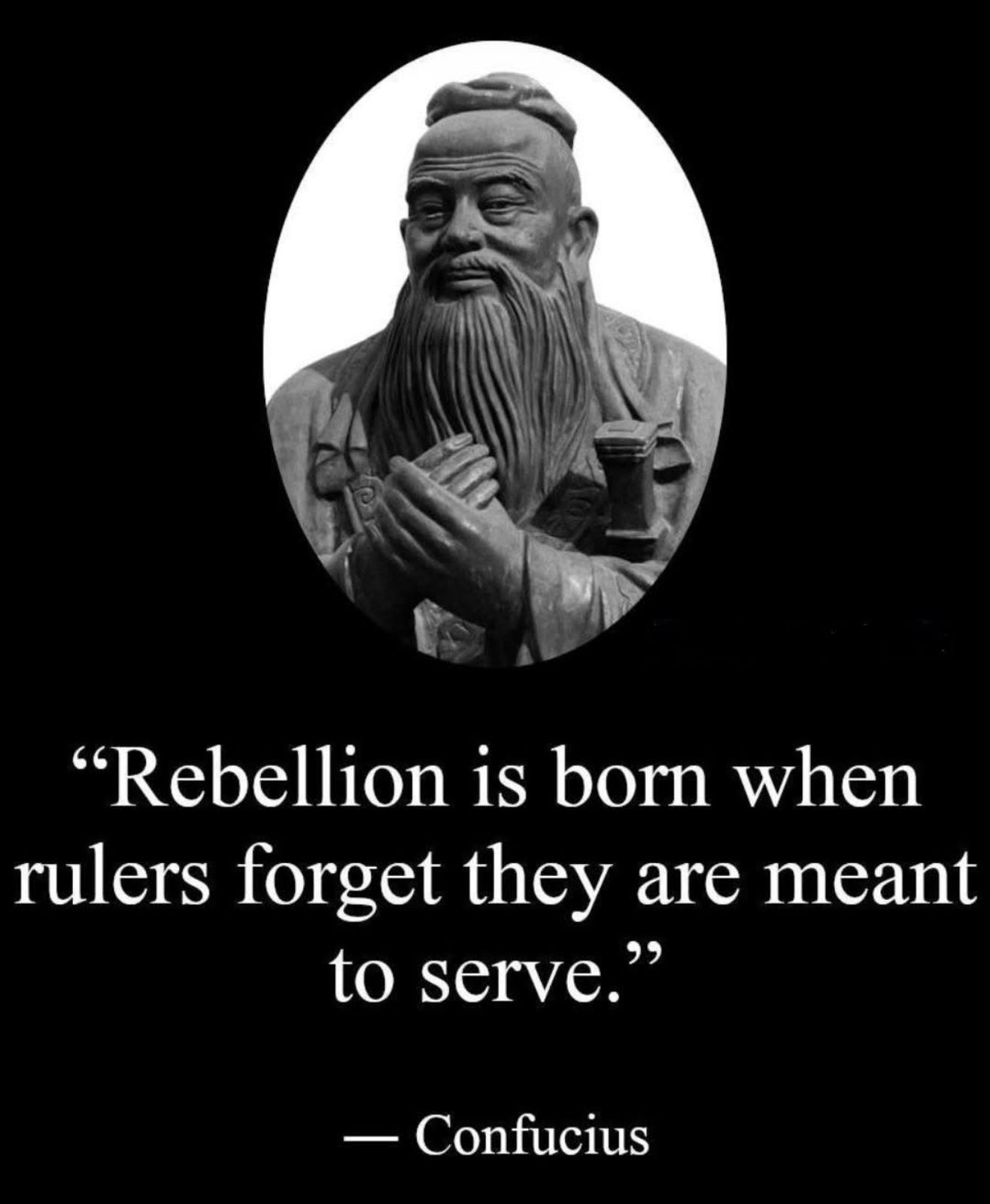
Confucius

Perhaps this “judge” who is obviously violating the English Bill of Rights should turn to Confusus. His legal doctrines are far better than this nonsense. Even Jesus Christ addressed a gathering of Jews and told them: “And you shall know the truth and the truth shall make you free.” Not in Britain. The truth will get you tax-free living in prison for 7 years.

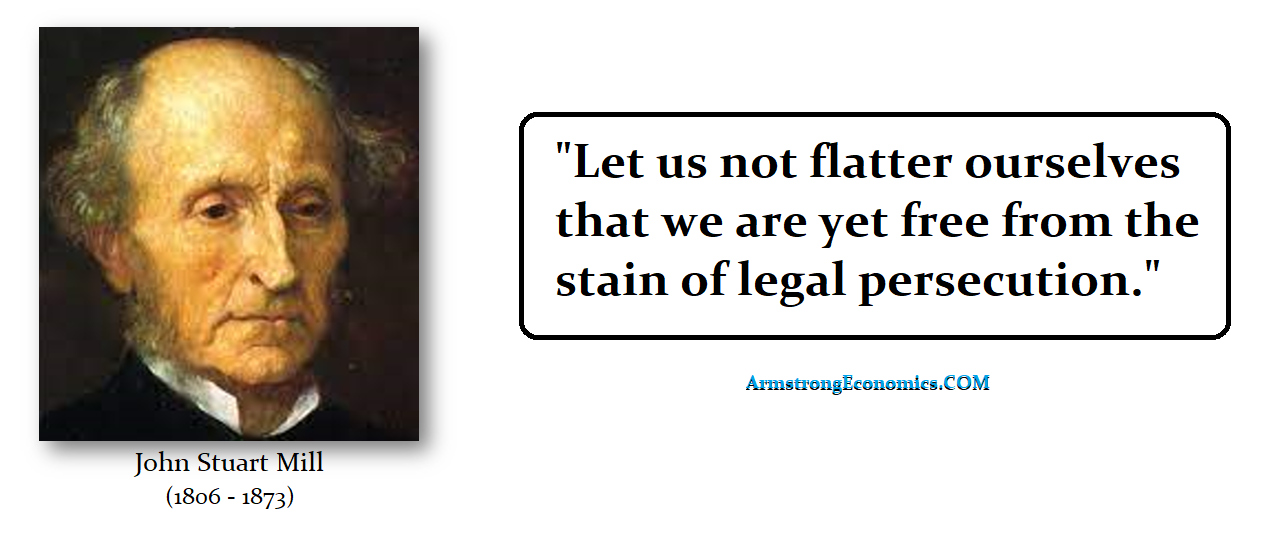
Mill John Stuart Legal Persecution
Juy Nullification
Trial William Penn
Wm Penn Trial

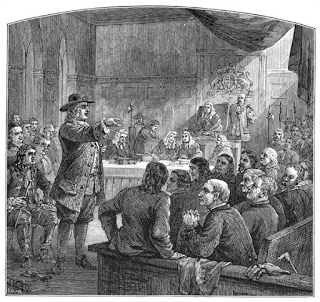
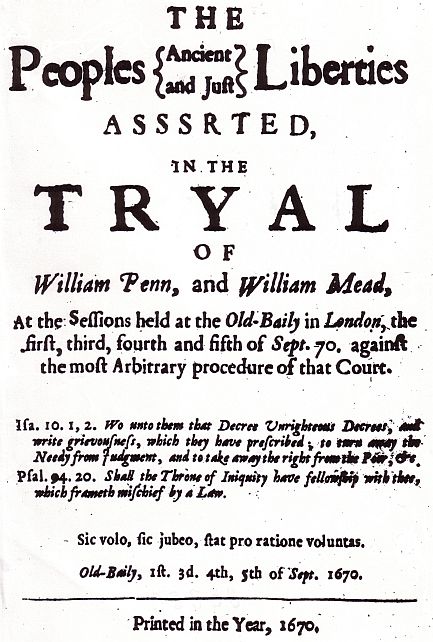
The most famous trial where a jury stood up refusing to find the defendant guilty in the face of a corrupt government was that of William Penn  (1644-1718), the founder of Pennsylvania. Penn was the leader of the Quakers in London, and you can see why people fled to America. The sect was not recognized by the government and was forbidden to meet in any building for the purpose of worship. In 1670, William Penn held a worship service on a quiet street, which a peaceful group of fellow Quakers attended. Penn and another Quaker, William Mead, were arrested for disturbing the king’s peace and summoned to stand trial.

As the two men entered the courtroom, a bailiff ordered them to put their hats, which they had removed, back on their heads. When they complied, they were called forward and held in contempt of court for being in the courtroom with their hats on. Penn discovered that contempt of court is a personal prerogative of the judge and an infliction of punishment by a judge who becomes the legislator, jury, and sentencing judge.

Penn demanded to know what crime he was being charged with preaching – the cornerstone of Due Process. The judge refused to supply any information as to his crime and instead referred vaguely to common law. When Penn protested that he was entitled to a specific indictment (NOTICE), he was removed from the presence of the judge and jury and confined in an enclosed corner of the room known as the bale dock.

Penn could neither confront the witnesses who accused him of preaching to the Quakers nor ask them questions about their charges against him. Several witnesses testified that Penn had preached to a gathering, which included Mead, but one showed some hesitancy as to whether Mead had been present. The judge turned to Mead and questioned him directly. In effect, the judge became the prosecutor, as he asked Mead if he was guilty. Mead invoked the common-law privilege against self-incrimination, which provoked hostile comments from the judge. The court then sent Mead to join Penn in the bale dock out of the sight of the jury and witnesses.

Finally, after the testimony, the court concluded that the judge had instructed the jury to find the defendants guilty as charged, dictating what verdict he had expected. Penn tried to protest but was silenced and again sent out of the courtroom. The jury, for its part, proved sympathetic to the two defendants and refused the judge’s command to find the defendants guilty.

At this point, the judge became so enraged, as I would expect from Judge Juan Merchan, and sent the jury back to reconsider their verdict. When they returned with the same verdict, the court criticized the jury’s leader, Bushnell, and demanded “a verdict that the court will accept, and you shall be locked up without meat, drink, fire, and tobacco…We will have a verdict by the help of God or you will starve for it.”

After that, the jury was sent back three more times but returned with the same verdict. Finally, the jury refused to reconsider. The judge then fined each jury member forty marks and ordered them imprisoned until the fine was paid. Penn and Mead went to prison anyway, held in contempt for obeying the bailiff’s order that they put on their hats.

Later, the jury members won a writ of habeas corpus and were released from prison. Penn and Mead left England after their release from prison, having a taste of English justice, and sailed to America. (Earl Warren, “A Republic, If You Can Keep It”, p. 113-115). Thus, Pennsylvania was founded. This was the Bushel’s Case (1670) 124 E.R. 1006, a famous English decision on the role of juries and that they possessed the independence to decide the validity of the law being prosecuted.

Where is the Magna Carta Right to a Trial by Jury of Your Peers?

This guy is forced to plead guilty to a non-crime because if he dares go to trial and the Judge refuses to allow the jury to nullify this insane Starmmer law, then he will be given the maximum time of 7 years+ for demanding a fair trial.

Britain is No Longer a Free Society!

I will NEVER go to Britain ever again!

Interview: Insider Sources Reporting MASSIVE Global Event Imminent


Posted originally on Sep 28, 2025 by Martin Armstrong |  

HARNWELL: the third-world illegal INVASION is the engine of the transformation of British politics


Posted originally on Rumble on By Bannon’s War Room on: September, 26, 2025

British media legend Matt Goodwin breaks down three principal “revolutionary” phenomena in the UK


Posted originally on Rumble on By Bannon’s War Room on: September, 26, 2025

Walsh: China Is Flooding Our Market With Solar Panels To De-Power The United States


Posted originally on Rumble on By Bannon’s War Room on: September, 26, 2025

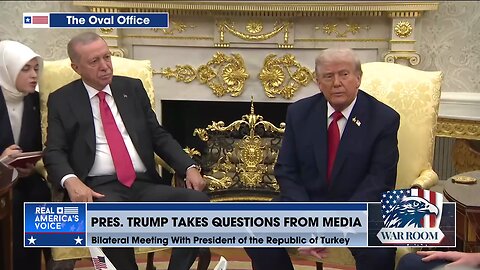
President Of Turkey Has Bilateral Meeting With President Trump


Posted originally on Rumble on By Bannon’s War Room on: September, 25, 2025