Bank Acquisitions Coming 


Posted Originally on Dec 1, 2023 By Martin Armstrong 

Bank Broken

A recent report by KBW Regional Banking Index (KBW) suggests that Comerica, Zions, and First Horizon are at risk of being acquired by greater competitors. Larger banks with strong returns, such as Huntington, Fifth Third, M&T, and Regions Financial, are positioned to grow by acquiring smaller lenders. Additionally, KBW analysts noted that Western Alliance and Webster Financial could also consider selling themselves. The report highlights that regional banks with assets between $80 billion and $120 billion are facing increasing pressure on returns and profitability, making them potential targets for acquisition by larger rivals.

This analysis underscores the challenges faced by banks in this asset range, as they have the lowest structural returns among banks with at least $10 billion in assets, necessitating growth to help pay for upcoming regulations. The report also mentions that banks with higher returns, such as East West Bank, Popular Bank, and New York Community Bank, could end up as acquirers rather than targets. This analysis reflects the evolving landscape of the banking industry and the potential for consolidation among regional banks.

Three banks have already collapsed in the US this year. New proposed regulations would require banks with over $100 billion in assets to hold onto long-term debt equal to 3.5% of total assets or 6% of risk-weighted assets. Now banks just below the $100 billion mark will potentially face the burden of adhering to these new regulations. Regional bank shares have fallen by over 20% this year. Smaller banks are already struggling to remain profitable, while midsized banks will be forced to join a larger banking organization to stay afloat.

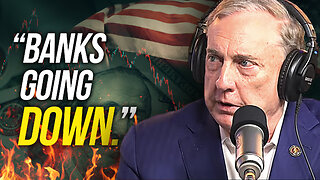
Col. MacGregor’s Dire Warning: “I Think The Banks Are Going Down For 2-3 Weeks”


POsted originally on Rumble on: Man in America Nov 6, 9:00 pm EST

US Govt Shutdown Over Ukraine?


Armstrong Economics Blog/Politics Re-Posted Sep 22, 2023 by Martin Armstrong

It happens every year – the US Congress cannot disagree so they may simply shut down. They’re our public servants but we permit them to throw their hands up and shrug that they cannot work together. One of the hot topic items right now is Ukraine, and with good reason as we are $3.3 trillion in debt but those in charge believe we have unlimited funds for Ukraine.

https://x.com/RandPaul/status/1704485590085812595?s=20

Senator Rand Paul refuses to continually aid Ukraine in the proxy war. “Today I’m putting congressional leadership & @POTUS on notice that I will oppose any effort to hold the federal government hostage for Ukraine funding,” Paul said on X, the social media platform formerly known as Twitter. “I will not consent to expedited passage of any spending measure that provides any more US aid to Ukraine.” Rand double-downed on his views in front of his peers, saying, “It’s as if no one has noticed that we have no extra money to send to Ukraine,” he said. “Our deficit this year will exceed $1.5 trillion. Borrowing money from China to send it to Ukraine makes no sense.”

We do not have the money to spend on Ukraine – period. The money funneled to the most corrupt European country comes from US taxpayers. Biden asked for another $24 billion for Ukraine last month. Some Republicans scoffed but there are neocons on both sides who want this war. “When will the aid requests, and when will the war end?” Rand asked the Senate. “Can someone explain what victory in Ukraine looks like? President Biden certainly can’t. His administration has failed to articulate a clear strategy or objective in this war, and Ukraine’s long-awaited counteroffensive has failed to make meaningful gains in the east.” There is no victory for Ukraine. The aftermath will be bloody and expensive, and people on both sides of the fight have declared that this will be a long war.

Republicans are a minority in the Senate. Schumer will do what it takes to push through all of Joe’s reckless spending budgets that he always exceeds. Congress needs to be held accountable. A business couldn’t simply say, “Hey, we do not know what to do. Let’s shutdown operations until we figure it out.” The No Pay for Congress During Default or Shutdown Act introduced by Brian Fitzpatrick (R-PA), and Abigail Spanberger, (D-VA), that would prevent members of Congress from receiving a paycheck in the event of a shutdown. Imagine that – having to work for your pay! James Lankford (R-PA) introduced a stricter bill dubbed the Prevent Government Shutdowns Act of 2023 that would forbid these politicians from returning home until a final decision is made. There are numerous measures on the table that should be signed into law to prevent lazy government workers from holding the United States hostage.

Let us not forget that America’s credit rating was downgraded by Moody’s because our politicians are incapable of running the country. Smart money has fled the public sector. There is absolutely no confidence in government anymore. The hundreds of billions to Ukraine must stop. One must wonder why government would threaten to shutdown over the topic of funding a foreign unaffiliated nation when the war does not benefit Americans in any way.

Interview: Martin Armstrong Predictions / Digital Currency & The End of Your Liberty


Armstrong Economics Blog/Armstrong in the Media Re-Posted Sep 3, 2023 by Martin Armstrong

Moody’s Slashes Bank Ratings


Aemstrong Economics Blog/Banking Crisis Re-Posted Aug 10, 2023 by Martin Armstrong

Moody’s has cut the credit ratings of ten small and mid-sized banks. The agency cited higher funding costs, rising interest rates, and increased risked due to the failing commercial real estate sector. M&T Bank, BOK Financial, Webster Financial, Pinnacle Financial, Old National Bancorp, and Fulton Financial were among the banks that received downgraded ratings.

But it does not stop there. Moody’s is also reviewing six giant banks, including Trist Financial, Bank of New York, Cullen/Frost Bankers, State Street, Northern Trust, and US Bancorp, as they may also be downgraded. Eleven other banks such as Capital One, Citizens Financial, and Fifth Third Bancorp has their ratings changed to negative. Moody’s predicts a “mild recession” on the horizon for 2024. They believe the quality of assets will decline with certain banks facing increased risks due to their commercial real estate (CRE) portfolios.

“U.S. banks continue to contend with interest rate and asset-liability management (ALM) risks with implications for liquidity and capital, as the wind-down of unconventional monetary policy drains systemwide deposits and higher interest rates depress the value of fixed-rate assets,” Moody’s analysts wrote in an accompanying research note explaining the decision. The agency also noted that investors are vulnerable “to a loss of confidence.”

The US banking system is failing. Moody’s noted that rising interest rates would “exacerbate” the ongoing banking crisis, and they foresee the Federal Reserve continuing with hikes for longer than anticipated since inflation was never transitory. The Fed maintained artificially low rates for too long, and their attempts to ease inflation by hiking rates are failing, as is the ECB’s. We will see the behemoths like JPMorgan Chase sypher in failing banks, making it easier for agencies to switch to CBDC. European banks will be the first to fail, so keep an eye on Europe.

New Interview with Laura-Lynn Tyler Thompson


Armstrong Economics Blog/Armstrong in the Media Re-Posted Aug 5, 2023 by Martin Armstrong

Martin Armstrong joins us today. We’ll talk about the real motivations behind the war in the Ukraine and the future of fiat (paper) currency and why tangible assets like gold and silver should be considered as part of your financial planning.

They See It Coming – Fitch Joins S&P to Downgrade USA Credit Rating


Posted originally on the CTH on August 2, 2023 | Sundance 

Collapse is never a sudden occurrence; it is an outcome of gradual erosion over time. A weakening that takes place almost invisible to those who pass through the construct, until eventually, at an uneventful time in the mechanics of history, the process gives way.

Fitch has joined with the prior position of Standard & Poors to downgrade the USA credit rating. The weight of debt, in combination with reverberations from the continued hammering deep inside the political fundamental change operation, has triggered another flare.

In the bigger picture, this is a self-fulfilling prophecy driven by the latest focus on unsustainable economic policy, aka The Green New Deal. The efforts of the fiscal, monetary and economic policy are all aligned to shrink the U.S. economy, thereby creating the era of “sustainable energy” a possibility. Unfortunately, this is akin to a household intentionally shrinking their income while at the same time taking on credit card debt. The process itself is not sustainable.

(Reuters) – Rating agency Fitch on Tuesday downgraded the U.S. government’s top credit rating, a move that drew an angry response from the White House and surprised investors, coming despite the resolution of the debt ceiling crisis two months ago.

Traders’ immediate response was to embark on a safe-haven push out of stocks and into government bonds and the dollar.

Fitch downgraded the United States to AA+ from AAA, citing fiscal deterioration over the next three years and repeated down-the-wire debt ceiling negotiations that threaten the government’s ability to pay its bills.

[…] “In Fitch’s view, there has been a steady deterioration in standards of governance over the last 20 years, including on fiscal and debt matters, notwithstanding the June bipartisan agreement to suspend the debt limit until January 2025,” the rating agency said in a statement.

U.S. Treasury Secretary Janet Yellen disagreed with Fitch’s downgrade, in a statement that called it “arbitrary and based on outdated data.”

[…] In a previous debt ceiling crisis in 2011, Standard & Poor’s cut the top “AAA” rating by one notch a few days after a debt ceiling deal, citing political polarization and insufficient steps to right the nation’s fiscal outlook. Its rating is still “AA-plus” – its second highest.

After that downgrade, U.S. stocks tumbled and the impact of the rating cut was felt across global stock markets, which were in the throes of the euro zone financial meltdown.

In May, Fitch had placed its “AAA” rating of U.S. sovereign debt on watch for a possible downgrade, citing downside risks, including political brinkmanship and a growing debt burden. (read More)

What do Barack Obama and Joe Biden have in common?  They were both in office, executing an identical economic, fiscal and monetary policy, when the USA credit was downgraded.

The Bankers Who Are De-Banking Those They Just Disagree With


Armstrong Economics Blog/Politics Re-Posted Jul 28, 2023 by Martin Armstrong

I want to stress that I have been getting emails that the same trend is emerging in the United States. Some banks have embraced WOKE, and with it, they are engaging in DISCRIMINATION. This equality only works when you agree with them. If you disagree, you are to be cast out of society, de-banked, and unable to even survive, pay a mortgage, or food.

Chase had debanked Dr. Mercola. I too was debanked by Chase after sending bonuses to our overseas employees. They did not ask for any explanation – they just closed the account. This is becoming common these days.

US Households Paid an Additional $10K Under Biden Regulations


Armstrong Economics Blog/Politics Re-Posted Jun 30, 2023 by Martin Armstrong

University of Chicago professor Casey Mulligan recently compared regulatory records from the Obama Administration to now. Mulligan found that Biden has imposed the most costly regulations in recent history at a rate of $617 billion annually. Her research concluded that the average American household now pays $9,600 more under Biden.

This uptick in spending found in this study is solely due to regulation. If we were to factor in inflation, which Biden poured gasoline on (no pun intended), the figure would be even higher. The Build Back Better agenda comes at a cost to the people. Auto fuel and emissions standards compose one-third of total regulatory costs alone.

Trump attempted deregulation and saved the average American household $11,000 during his four-year term. Trump’s main regulatory initiative that was a costly mistake was Operation Warp Speed, which cost over $300 billion. “President Trump showed that regulatory costs can be subtracted rather than perpetually added,” the report states. “Four years of President Trump reduced regulatory costs by about $11,000 per household. Eight years would have saved a total of more than $21,000, which is a gap of $61,000 to $80,000 from the Biden trajectory.”

Biden had the audacity to tote “Bidenomics” at a recent speaking engagement. Clearly, his economic policies have put America in a dire situation. Biden plans to continue implementing costly regulations. Mulligan’s estimates also do not account for the coming war his administration is thrusting us into without just cause. The nation simply cannot afford to keep him in power. Too bad we don’t have the ability to determine our own elections.

Credit Card Debt on the Rise


Armstrong economics Blog/USA Current Events Re-Posted Jun 5, 2023 by Martin Armstrong

Credit card debt in the US spiked to its highest quarterly level in Q4 2022 after increasing by $85.8 billion. The average American household has about $10,000 in credit card debt, marking an 8.9% YoY increase. Now, Americans are facing $1 trillion in credit card debt due to rising APR and inflation.

The Federal Reserve reported that credit card debt has risen by $250 billion over the past two years amid record inflation. Consumer spending declined during the pandemic, as did credit card debt. However, inflation was nowhere close to what it is today. Credit balances declined by $100 billion from Q1 of 2020 to Q2 of 2021. Consumers were paying off their debts during this time, aided by numerous stimulus packages provided by the government.

Everything changed when Biden took office, killed America’s energy independence, and inflation began to spike. The central bank raised rates right before the war in Ukraine broke out, and have continued to do so at every meeting since. Various data collectors noted that consumers are not using their credit cards for luxury goods – they’re using credit to simply get by and pay for essentials.

Bankrate reported that 46% of cardholders cannot pay off their monthly credit card payments, up 7% from last year. The average APR is around 24% as of May 2023. The US Bureau of Labor Statistics claims that the CPI rose 0.4% in April after increasing 0.1% in March. I reported how the true inflation rate is over 30%; they do not want to scare the public by posting the real data. Food, energy, shelter, and all the essentials to survival have reached historic levels. If nearly half of people cannot pay their credit card balances off each month, and interest is at a record high, consumer debt is guaranteed to rise continually. Nothing is more inflationary than war, and our war cycle is picking up going into 2024. So not only is the US government drowning in debt, but the average American is also struggling to make ends meet.