Professor Desmet, Dr Malone & Dr McCullough on Mass Psychosis


First published on JAN 4, 2022

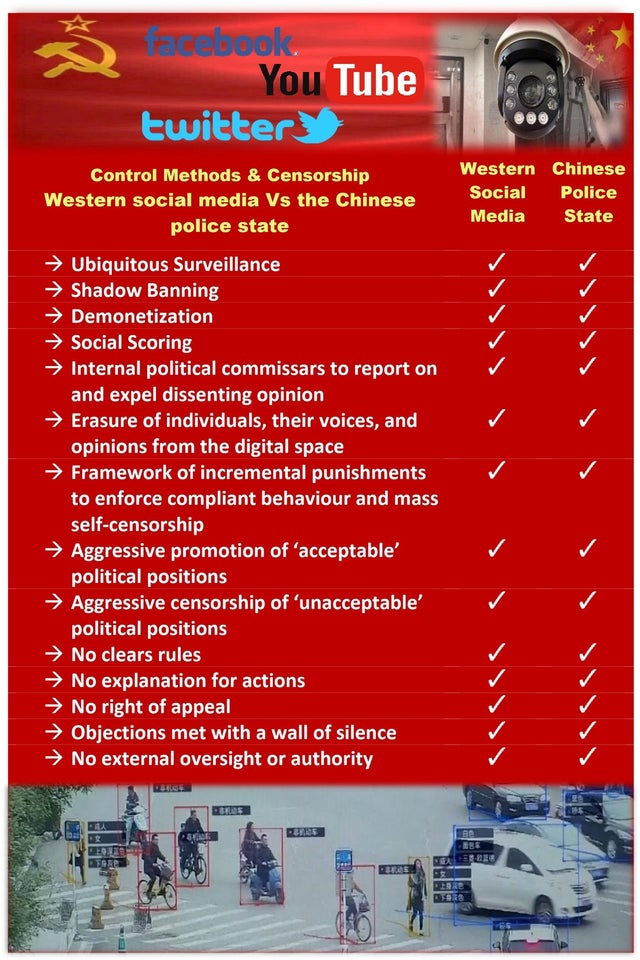
Western Social Media v Chinese Communist Party Media


Armstrong Economics Blog/Media Re-Posted Jan 9, 2022 by Martin Armstrong

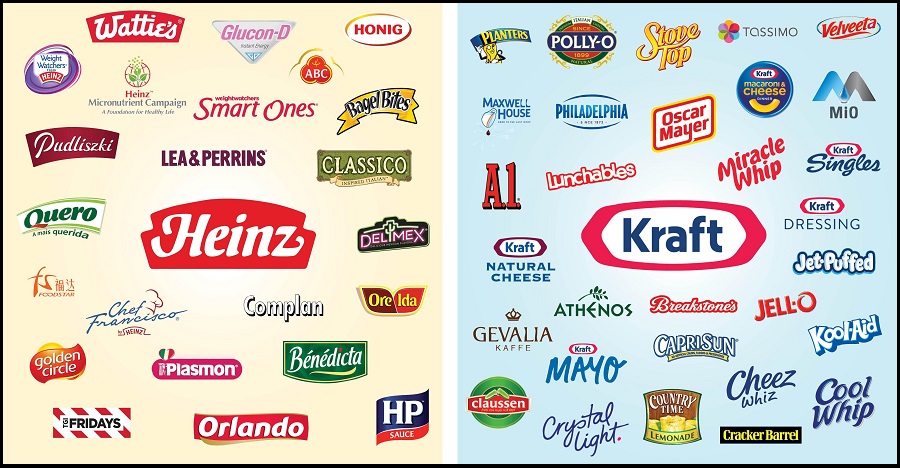
A reader sent this image in and asked me to spot the differences. A few independent news sources remain in America, but they are not part of what we consider the “mainstream media.” So seek out the truth because what is presented to you will be an altered version of reality.

Is Trudeau in Bed with Big Pharma?


Armstrong Economics Blog/Canada Re-Posted Jan 9, 2022 by Martin Armstrong

FOLLOW THE MONEY. 

Japan Restricts Exports of AI Facial Technology


Armstrong Economics Blog/Technology Re-Posted Jan 8, 2022 by Martin Armstrong

Spread the lovemore

(The video above shows Chinese university students using facial recognition technology to pay for their meals)

The Japanese government is restricting facial recognition exports over growing concern of China’s extreme surveillance measures. A recent report from Tokyo’s Central News Agency (CNA) states that China has been using AI-powered facial recognition technology to “deploy large-scale surveillance systems to restrict people’s movement in Xinjiang Uyghur Autonomous Region and other places.” In addition to citing national security, the nation is aiming to prevent advanced technology from infringing upon human rights.

Japan is not alone in its plight as numerous countries, including the US, are now assessing whether technology ranging from facial recognition to cameras coming from China are safe for use. This is mainly for the government’s safety; your government is already tracking you.

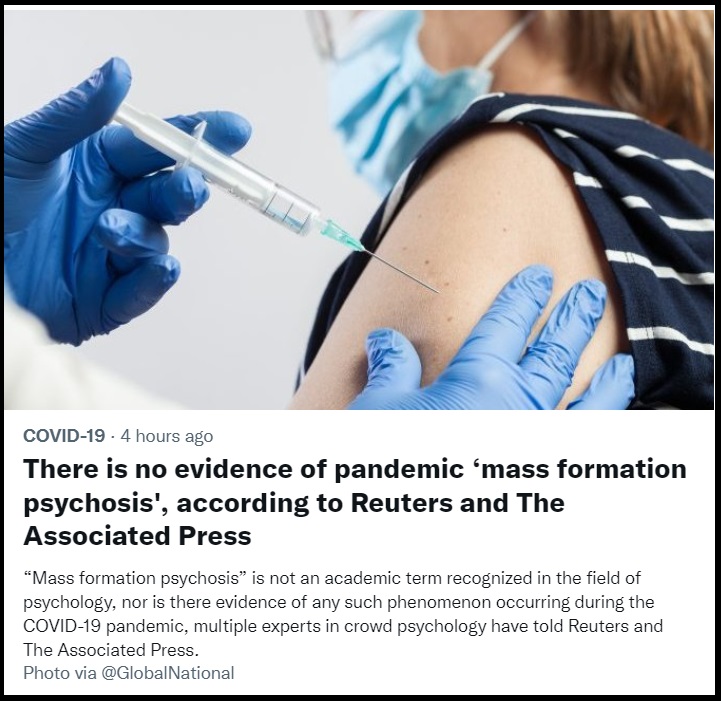
You Know the Global Elites are Triggered When the Propaganda Institutions Collaborate to Refute “Mass Formation Psychosis”


Posted originally on the conservative tree house on January 8, 2022 | Sundance | 280 Comments

Well, butter my buns and call me a biscuit… if this ain’t the biggest revealing tell in years.

Apparently Big Tech and big propaganda media, Reuters and the Associated Press, have joined together to refute the concept of “Mass Formation Psychosis”, and pushed their collective narrative into the narrative engineering system:

The Associated Press – SEE HERE and Reuters – SEE HERE, quickly rush to the “fact check” typeset to stop people from recognizing what is most likely the cause of their own psychosis.   In a world where things are no longer shocking, this is, well, a little shocking, in a weird and seemingly Orwellian kind of way.

Yes Alice, the same “experts” and media who are credibly accused of creating/enabling the mass formation psychosis would like to assure us that no such reality exists.  This is almost too funny.

(AP) – […] “The concept has no academic credibility,” Stephen Reicher, a social psychology professor at the University of St Andrews in the U.K., wrote in an email to The Associated Press.  The term also does not appear in the American Psychological Association’s Dictionary of Psychology.

“Psychosis” is a term that refers to conditions that involve some disconnect from reality. According to a National Institutes of Health estimate, about 3% of people experience some form of psychosis at some time in their lives.

[…]  The description of “mass formation psychosis” offered by Malone resembles discredited concepts, such as “mob mentality” and “group mind,” according to John Drury, a social psychologist at the University of Sussex in the U.K. who studies collective behavior. The ideas suggest that “when people form part of a psychological crowd they lose their identities and their self-control; they become suggestible, and primitive instinctive impulses predominate,” he said in an email.

That notion has been discredited by decades of research on crowd behavior, Drury said. “No respectable psychologist agrees with these ideas now,” he said.

Multiple experts told the AP that while there is evidence that groups can shape or influence one’s behaviors — and that people can and do believe falsehoods that are put forward by the leader of a group — those concepts do not involve the masses experiencing “psychosis” or “hypnosis.” (read more)

Reuters offers this simultaneous rebuttal:

(Reuters) – “Mass formation psychosis” is not an academic term recognized in the field of psychology, nor is there evidence of any such phenomenon occurring during the COVID-19 pandemic, multiple experts in crowd psychology have told Reuters.

[…] There is no evidence to suggest a “mass formation psychosis” has occurred during the pandemic, experts told Reuters. The term itself is not recognised among academics, and modern research into crowd psychology has shown that crowds do not behave in mindless or non-individualistic ways. (more)

Once a collective group creates an alternate reality of itself, in this case a totalitarian reality based on government needing to create an irrational illusion of fear that becomes part of the accepted national identity, how can anyone call attention to the outcomes without finding themselves in front of the board of inquisition who organizes the collective?

Put another way… if the pod under your bed malfunctioned, but the pods under all the other beds in the city worked, what happens when you awaken and realize you are not one of them, but you must engage in the world of them while looking for others -like yourself- whose pods hopefully malfunctioned?   That is the current challenge for anyone trying to communicate on contrary evidence and yet avoid the ire from the collective board of COVID compliance who have successfully brainwashed the audience.

As a rather prescient Lewis Carroll shared so brilliantly in his novel of Alice, Through The Looking Glass:

“If I had a world of my own, everything would be nonsense. Nothing would be what it is, because everything would be what it isn’t. And contrary wise, what is, it wouldn’t be. And what it wouldn’t be, it would. You see?”

So here we are.

Cheers !

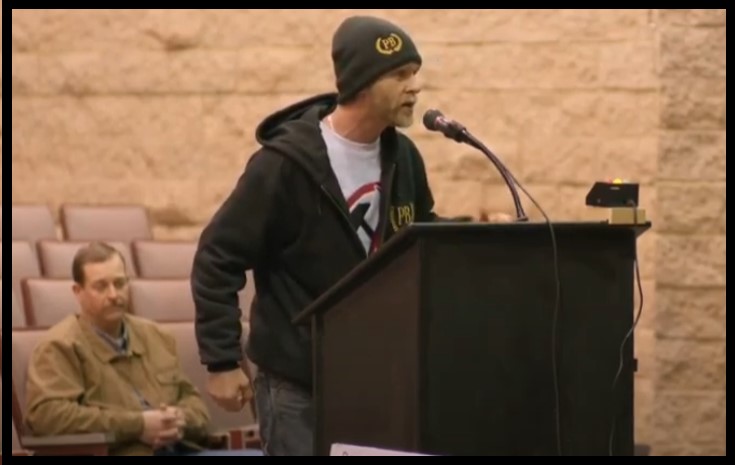
Epic, Jeff Perrine 3 Minute Remarks to Lincoln, California, School Board Go Viral


Posted originally on the conservative tree house on January 8, 2022 | Sundance | 181 Comments

Jeff Perrine is a California dad who has had enough.  A December confrontation with the Lincoln, California, school board is going viral on Twitter because his words speak for so many.   Jeff Perrine Twitter HERE.   Jeff Perrine YouTube HERE.

Only has 294 views on YouTube, but LOL that won’t last long.  There are a few salty words amid the speech.  As noted by Mr. Perrine: “I give an extemporaneous impromptu talk at the local School Board meeting in Lincoln CA Dec. 21st 2021. About the mask mandate and other things, they want to mandate.”  ENJOY:

Another viewpoint showing the faces of the board members.

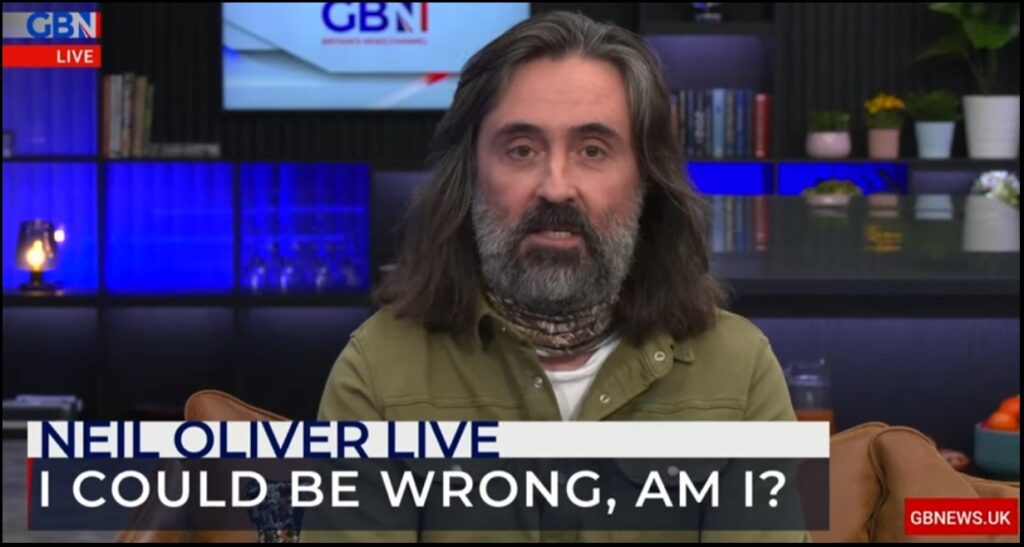
Brilliant, Neil Oliver Goes There


Posted originally on the conservative tree house on January 8, 2022 | Sundance | 235 Comments

Neil Oliver goes there, directly to the epicenter of “build back better.”   In this monologue not only does Oliver highlight the connective tissue and motives of the elite, but he also references their words to point out the bigger leftist agenda at work.  WATCH:

Point One – The “Build Back Better” agenda (in every nation) was never about anything except radical climate change legislation.  Once you accept that baseline, things start to become much clearer.

Point Two – The “Build Back Better” phrase came from the World Economic Forum and was promoted by a multitude of international leaders and left-wing organizations.   That reality then brings up the most important point.  To get to “building back better”, you first need to destroy something.  That thing they needed to destroy was the global economic dependency on carbon-based fuel supplies (oil, gas, coal, etc.).

Point Three – In order to destroy the ‘something of that scale’, the energy program for the entire world, something massive is needed to fundamentally change the entire world approach toward energy production.  Something is needed to create the crisis that provides the origin for the process to initiate.

Point Four – That triggering mechanism was/is SARS-CoV-2, or what we now call COVID-19 and all variants therein.

There you have it.  That’s the summary soup to nuts explanation of why a virus was created, and the subsequent panic pushing to create social structures that would facilitate the global acceptance of an entire new economic system that would be designed around saving the planet.

Through the prism of that motive, all irreconcilable panic-selling from government entities starts to make sense.

You don’t have to be a true believer at the top of the climate change pyramid to see the massive financial opportunities created by an agenda to structurally change the entire foundation of energy use on a global scale.

Factually, I would be surprised if the biggest people within Klaus Schwab’s WEF believed in anything even resembling climate change.  However, they would see the opportunity for a massive shift in global wealth, and with that comes a myriad of mechanisms and more opportunities to control it.

As I have repeated on these pages for a decade, everything is downstream from the economics of everything.  The love of money and power is at the root of all evil.

Fascism was traditionally defined as an authoritarian government working hand-in-glove with corporations to achieve objectives. A centralized autocratic government headed by a dictatorial leader, using severe economic and social regimentation, and forcible suppression of opposition.

That system of government didn’t work in the long-term, because the underlying principles of free people reject government authoritarianism.  Fascist governments collapsed, and the corporate beneficiaries were nulled and scorned for participating.  Then, along came a new approach to achieve the same objective.

The World Economic Forum (WEF) was created to use the same fundamental associations of government and corporations.  Only this time it was the multinational corporations who organized to tell the government(s) what to do.  The WEF was organized for multinational corporations to assemble and tell the various governments how to cooperate with them, in order to be rewarded by them.   Corporatism was/is the outcome.  The government now doing what the multinationals tell them to do, and in return the multinationals install the compliant politicians

Fascism, the cooperation between government and corporations, is still the underlying premise; the World Economic Forum simply flipped the internal dynamic putting the corporations in charge of handing out the instructions.

What results is a slightly modified definition of fascism:

A massive multinational corporate conglomerate; telling a centralized autocratic government leader what to do; and using severe economic and social regimentation as a control mechanism; combined with forcible suppression of opposition by both the corporations and government.

Doesn’t that define our current reality, especially in the era of COVID?

The instructions from the multinationals to government would be called “Build Back Better”.

The triggering mechanism to create the crisis (BBB is designed to solve), is called SARS-CoV-2.

The program to control backlash and ensure sheeple compliance from various populations would be called “a vaccine.”

Driving fear of the Rona would be needed and disproportionate to the risk itself.   This keeps backlash in line (lockdowns, regulations etc).  If any opposition to the agenda begins to mount, the same people pushing the originating narrative then create and push a variant.  The variant, real or imagined, is then pushed forward in order to get compliance (acceptance of the BBB objective) back on track.

In my opinion, structurally changing the global economy around the threat of climate change is what this entire Coronavirus mess is all about.  They needed the virus to trigger the crisis.  The crisis then creates the roadmap to rebuilding all society -on a global level- away from fossil fuels.

Put another way: the motive behind the origin of the Coronavirus is climate change.

Things to Look For…


Posted originally on the conservative tree house on January 8, 2022 | Sundance | 524 Comments

Things that seem disconnected, but ain’t.

(1) A shortage of processed potatoes (frozen specifically).

And/Or a shortage of the ancillary products that are derivates of, or normally include, potatoes.

(2) A larger than usual footprint of turkey in the supermarket (last line of protein).

(3) A noticeable increase in the price of citrus products.

(4) A sparse distribution of foodstuffs that rely on flavorings.

(5) The absence of non-seasonal products.

(6) Small to little price difference on the organic comparable (diff supply chain)

(7) Unusual country of origin for fresh product type.

(8) Absence of large container products

(9) Shortage of any ordinary but specific grain derivative item (ex. wheat crackers)

(10) Big brand shortage.

(11) Shortage of wet pet foods

(12) Shortage of complex blended products with multiple ingredients (soups etc)

(13) A consistent shortage of milk products and/or ancillaries.

These notes above are all precursors that show significant stress in the supply chain.

At first, each retail operation will show varying degrees of the supply chain stress according to their size, purchasing power, and/or private manufacturing, transportation and distribution capacity.

Remember, the dairy farmers in 2020 dumping their milk because the commercial side of milk demand (schools, restaurants, bag milk purchasers) was forcibly locked down?   Plastic jugs were in short supply, and the processing side of the equation has a limited amount of operational capacity.

Potato farmers and fresh food suppliers were also told to dump, blade or plough-over their crops due to lack of commercial side demand.  These issues have longer term consequences than many would understand.  These are fresh crops, replenishment crops, which require time before harvest and production.

The retail consumer supply chain for manufactured and processed food products includes bulk storage to compensate for seasonality. As Agriculture Secretary Sonny Perdue noted in 2020, “There are over 800 commercial and public warehouses in the continental 48 states that store frozen products.”

Here is a snapshot of the food we had in storage at the end of February 2020: over 302 million pounds of frozen butter; 1.36 billion pounds of frozen cheese; 925 million pounds of frozen chicken; over 1 billion pounds of frozen fruit; nearly 2.04 billion pounds of frozen vegetables; 491 million pounds of frozen beef; and nearly 662 million pounds of frozen pork.

This bulk food storage is how the total U.S. consumer food supply ensures consistent availability even with weather impacts.  As a nation, we essentially stay one harvest ahead of demand by storing it and smoothing out any peak/valley shortfalls. There are a total of 175,642 commercial facilities involved in this supply chain across the country

The stored food supply is the originating resource for food manufacturers who process the ingredients into a variety of branded food products and distribute to your local supermarket. That bulk stored food, and the subsequent supply chain, is entirely separate from the fresh food supply chain used by restaurants, hotels, cafeterias etc.

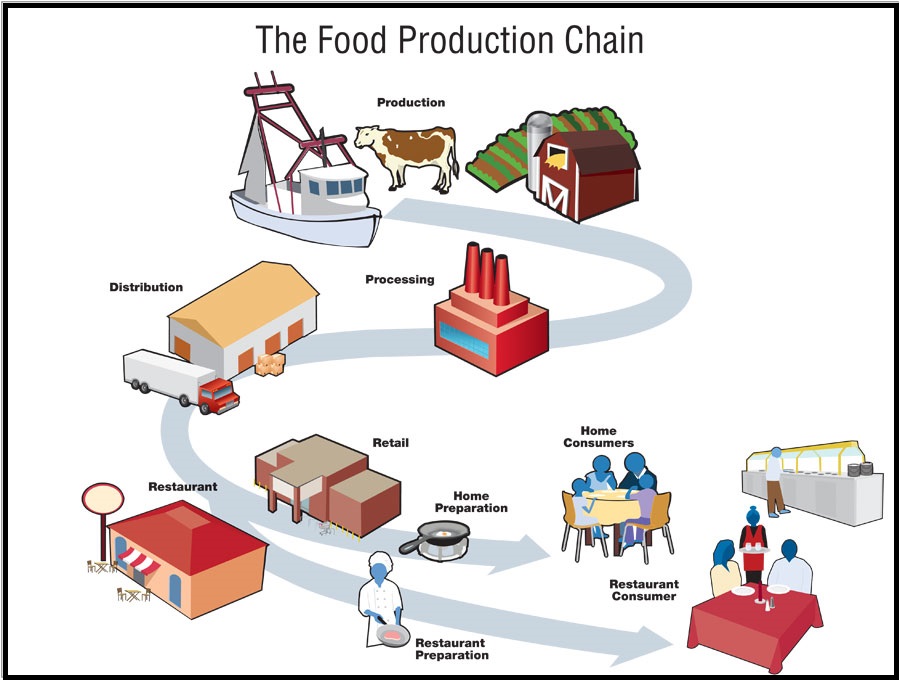
Look carefully at the graphic.  See the fork in the supply chain that separates “food at home (40%)” from “food away from home (60%)”?

Food ‘outside the home’ includes restaurants, fast food locales, schools, corporate cafeterias, university lunchrooms, manufacturing cafeterias, hotels, food trucks, park and amusement food sellers and many more. Many of those venues are not thought about when people evaluate the overall U.S. food delivery system; however, this network was approximately 60 percent of all food consumption on a daily basis.

The ‘food away from home‘ sector has its own supply chain. Very few restaurants and venues (cited above) purchase food products from retail grocery outlets. As a result of the coronavirus mitigation effort, the ‘food away from home’ sector was reduced by 75% of daily food delivery operations. However, people still needed to eat. That meant retail food outlets, grocers, saw sales increases of 25 to 50 percent, depending on the area.

Covid regulations destroyed this complex supply chain in 2020.  It takes time to recover because the replenishment is based on harvest cycles.  This stuff must be grown.

When the food at home sector was forced to take on the majority of food delivery, they immediately hit processing constraints.  The processing side of the supply chain to funnel food into suppliers for the grocery store has “x” amount of capacity.  That system cannot (not feasible) and did not expand to meet the 20 to 50% increase in demand.

Think about potatoes.  A potato farmer sells into one of the two paths “food at home” (retail stores, or a processing supplier) or “food away from home” (commercial food or commercial food processors).   Other than bulk raw potatoes, the harvest goes into: (1) processing or (2) storage.

(1a) processing for retail sales (40%), ex. Ore Ida frozen potatoes, canning, or any of the other thousand retail products that use potatoes, whole or mashed.

(1b) processing for commercial sales (60%), ex. McDonalds french fries, or any of the thousand restaurant, lunchroom and cafeteria needs that use potatoes, whole or mashed.

♦ Processing – When 1b was shut down in 2020, 1a quickly reached maximum retail processing capacity.  Massive multi-million machines and food processing systems have a capacity. The supplies they use also have a capacity: plastic bags, cardboard, trays, bowls, etc.  The 1a processing system can only generate “X” amount of retail product at maximum capacity.

The remaining 1b commercial product was shut down.  A massive percentage of 1b (commercial) potatoes have nowhere to go, except waste.

♦ Storage – Each processor in 1a stores product (deep cold or frozen storage) for 365-day processing and distribution.   Those storage facilities have a limited amount of capacity.   The 1b customers need fresh product for the majority of their outlets. Ergo storing for 1b customers who might eventually be allowed to open later only works for a short period of time.  The fresh potato sales missed by 1b outlets = the 1b discard by potato farmers.

When you restart 1b suddenly the 1b short-term (fresh) storage product is quickly depleted.  Refilling that 2020 storage is dependent on a new 2021 harvest, which simultaneously has a greater immediate demand because the supply chain on the processing side was boxcar’d (over capacity) and then reset to a higher capacity playing catchup.

The amount missing from 2021 storage, because it was used instead of saved, is essentially equal to the amount that was wasted in 2020.

Now you end 2021 will less reserves because storage is depleted, because a greater percentage of the current harvest was immediately used.  You enter into the beginning of 2022 (winter) in a race to try and spread out the stored potatoes as you cross your fingers and race against the clock for the next harvest before running out.

You probably noticed, but there’s another motive to keep people (employees) away from large industrial cafeterias and even students from school lunchrooms.   The total food supply chain needs time, and harvests, to catch up.

In the example above you can replace *potato* with just about any row crop or retail/commercial food commodity like milk.

The reason I list potato as the #1 precursor is because every food outlet sells a potato in some form.  Every supermarket and every single restaurant (fancy or fast food) sells some form of potato.   Potatoes are demanded by every single food outlet; therefore, a shortage of potatoes is the first noticeable issue.

The 2020 demand disruption problem now becomes a 2021/2022 supply chain problem on both the fresh and processing side (depleted inventories), with each vector now competing for the same raw material: wheat, soybeans, grains, beans and stored row crops.

Making matters worse, the protein suppliers also need grain as feed for cattle, pigs, cows, chickens, etc.

[Note: who gets the short straw? The pet food manufacturers]

That’s the nub of the background supply chain issue in the food sector.   Additionally, recovery is not a single-issue problem.

The recovery price and shortages relate to everything from current oil and gas prices to diesel engine oil prices, to fertilizer and weed killer costs, to plastic costs and petroleum packing shortages (Styrofoam especially), to cardboard and sustainable packaging costs, to energy costs and transportation/delivery costs.   All along this complex supply chain there’s also workers and higher payroll costs.

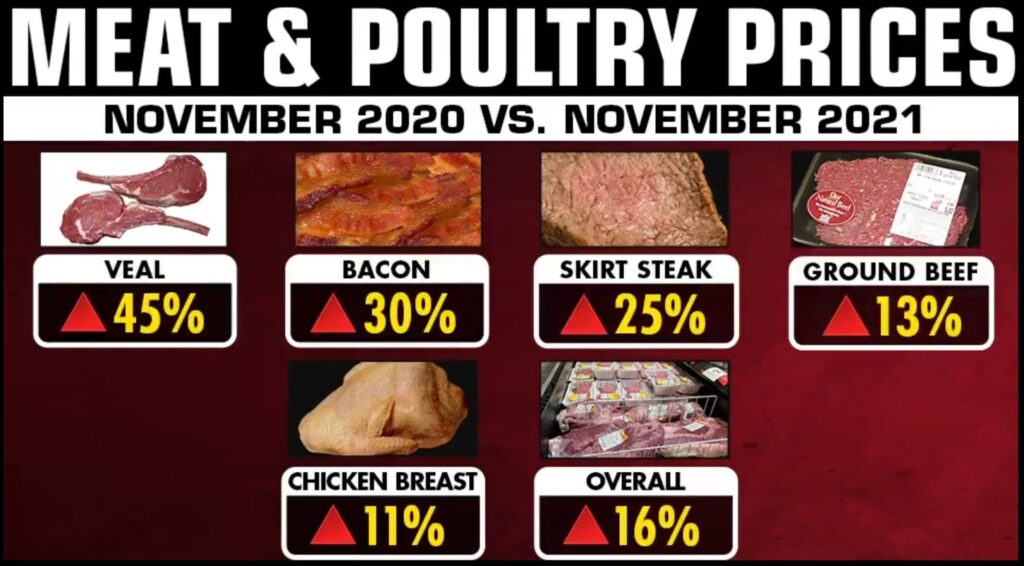
Thus, we get the double-edged sword of higher prices (inflation) and simultaneous shortages.

Here’s what you can do to offset shortages (while possible):

(1) Buy the generic or store brand equivalent (sub-set inside retail supply chain)

(2) Purchase the organic version (another sub-set inside retail supply chain)

(3) Purchase the powered/dehydrated version (potatoes, milk, etc) and experiment (jazz it up).

Each retail operation, or chain of stores, will show varying degrees of the supply chain stress according to their size, purchasing power, and/or private manufacturing, transportation and distribution capacity.

This is where field to fork supplier relationships can make a big difference.  However, every outlet regardless of their operational excellence, is going to have significant shortages in their inventory.   It’s an unavoidable outcome of the previous chaos.

On average the retail shortages will last for about the same time as one full harvest schedule (4 to 6 months) depending on the commodity.   By September of 2022 the sector should be relatively recovered, depending on how government responds when people get seriously stressed in a few weeks.

The short-term prices will likely go up again, another 10, 20 up to 50% depending on item.  Those prices will eventually level off, but it’s doubtful they will be able to come back down until supply and demand find some equilibrium again, if ever.  Right now, that’s too far off to even fathom.

1976 Vaccine Mandate Disaster


Armstrong Economics Blog/Vaccine Re-Posted Jan 8, 2022 by Martin Armstrong

This is why vaccine MANDATES are simply unconstitutional and a violation of human rights. We are not all the same.

Minnesota Trucking Company CEO Warns About What Vaccine Mandate Will Do to Economy


Posted originally on the conservative tree house on January 7, 2022 | sundance | 110 Comments

Here’s a solid reference point for just one of the multitude of aspects related to the mandatory COVID vaccine and overall COVID mitigation rules that will come together to present an unavoidable outcome within the supply chain.

As CEO Eric Lawrence notes, even without the vaccine mandate, the testing mandate itself becomes an issue.  How and where exactly are truckers supposed to get these weekly, and depending on state, perhaps daily, Covid-19 tests.   How are they expected to modify their cross country routes, to avoid running afoul of the law, without having any idea where this testing is supposed to take place?

Follow the implementation of all these mandate tentacles across multiple industries & sectors, and what you end up with is a merging of unworkable nonsense into a logistical and supply chain mess.   For the U.S. economy, a SNAFU of that significance only ends with one result.