No U.S-Canada Trade Deal Likely – Canada Deploys Media To Frame Political Cover for Failed Negotiations…


Continual emphasis on the severity of Canadian politics is needed to understand the latest developments in the U.S-Canada trade negotiations.

The Trump administration set a deadline of today for Canada to join the U.S-Mexico trade agreement and make the NAFTA replacement agreement a three-way pact.  The concessions needed by Justin Trudeau and Chrystia Freeland to join the agreement were politically devastating.

In order for Canada to accept or join, via a NAFTA 2202 modification, they would need to agree to the U.S-Mexico modification terms. For Canada they would have to:

  • open their telecommunications and banking sector (eliminate non tariff barriers).
  • eliminate soft-wood (lumber) and aeronautics subsidies.
  • begin a process of lowering their assembly use of Chinese/Asian goods.
  • accept the rules of origin for North American manufacturing.
  • eliminate protectionist tariffs on dairy and farm products.
  • accept the U.S-Mexico terms for arbitration and dispute resolution.

President Trump and U.S. Lighthizer are holding all the cards.  As we previously highlighted they don’t care if Canada doesn’t join; the U.S. would likely prefer to send congress a NAFTA 2205 withdrawal notification removing the U.S. from the original 1993 NAFTA construct in combination with a simultaneous 2202 modification notification for the U.S-Mexico side of the agreement.

This would allow the U.S. to go into a one-on-one trade negotiation where six months and a day from the 2205 notice. The U.S. would then apply 25% auto tariffs on Canadian made vehicles while negotiating a bilateral deal. Canada is in a very weak negotiating position; politics are paramount for the Canadian team; their exit needs political cover.  Media need to help the optics for the Canadian team.

Bloomberg Editor-in-Chief John Micklethwait and Jennifer Jacobs interview President Trump in the Oval Office

Earlier this morning The Toronto Star reported on leaked ‘off-the-record’ comments from a Bloomberg interview with President Trump.  In essence, a brutally honest President Trump said there was no need for the U.S. to compromise, all concessions were likely to come from the Canadian position. However, knowing the political prism for Justin Trudeau and Chrystia Freeland, President Trump did not want to embarrass Trudeau politically with public comments toward that end.

…”Here’s the problem. If I say no — the answer’s no. If I say no, then you’re going to put that, and it’s going to be so insulting they’re not going to be able to make a deal … I can’t kill these people.”…

This was a genuinely honest and factual summary of the current status.

Prime Minister Trudeau and Canadian Foreign Minister Freeland simply cannot accept the terms outlined within the U.S-Mexico trade agreement.  Left-leaning sympathetic media needed a way to assist the Canadian team and attempt to remove the responsibility for any failure in negotiation from the northern liberals.  Hence the Toronto Star leak.

There are simply too many carved-out and protected liberal constituents (trade sectors), within Canadian economic policy to allow for any trade agreement based on open markets and free/fair trade.   The dairy segment is one well known and protected agricultural sector; there are many others.

WASHINGTON (Reuters) – Canada has made no agriculture concessions to the United States in bilateral trade talks aimed at reaching deal in principle to modernize the North American Free Trade Agreement, a spokeswoman for the United States Trade Representative’s office said.

“The negotiations between the United States and Canada are ongoing. There have been no concessions by Canada on agriculture,” the spokeswoman said in a brief emailed statement. (link)

The U.S. and Mexico have agreed to manufacturing origination terms; wage and labor improvements; elimination of AG subsidies and non tariff barriers; and removal of all protectionist tariffs – so long as the structural terms of commerce are upheld.

There’s almost no-way, given the politicization of the Canadian plan, for Justin and Chrystia to agree to those terms and keep their fragmented political support base appeased.

Therefore, absent total acquiescence, it is likely U.S.T.R. will file a 2205 notification dissolving the U.S and Canada trade agreement while simultaneously filing a 2202 notification to modify the U.S. and Mexico agreement to the new terms.

Under dissolution Canada will keep their soft-wood lumber and aeronautics subsidies; keep their protectionist Dairy tariffs; keep their banking and telecommunication rules blocking U.S. access; and six months from now face a 25% duty on U.S. auto imports – effectively destroying their auto manufacturing sector.  Car companies (ex. Toyota) will simply leave Canada and return to building/assembling in the U.S.

This looks like the most reasonable scenario at this moment.

Dual-Purposed Trump Doctrine Squeeze #3 Continues – Pentagon Cancels Financial Aid to Pakistan…


The Trump Doctrine is easiest to describe as: deploying economic leverage to achieve national security interests.  The Trump Doctrine is unique and stunningly effective.

Many of the geopolitical decisions have multiple facets which connect like small gears on a much larger machine.  One of those small dual-purpose gears is the Doctrine as it is applied to Pakistan.  The downstream moves impact China, our #1 geopolitical and economic adversary, then Russia, and also support new alliances with India and the broader Middle-east.

Toward China = ♦Squeeze #3. In 2017 Trump and Secretary Tillerson, now Secretary Pompeo, put Pakistan on notice they need to get involved in bringing their enabled tribal “extremists” (Taliban) to the table in Afghanistan. Pakistan’s primary investor and economic partner is China. The U.S. removed $900 million in financial support to pressure Pakistan toward a political solution in Afghanistan, China has to fill void.  [NOTE: Last month the World Bank began discussions about a financial bailout for Pakistan.]  Again, more one-way bleed for China. {Go Deep}

When President Trump removed the $900 million in aid to Pakistan, he empowered the Pentagon via Defense Secretary James Mattis, with an option to give $300 million to Pakistan if Mattis felt positive steps were being taken to change behavior.  Today the Pentagon announces no change in behavior is noted:

[…]  U.S. Defense Secretary Jim Mattis, in particular, had an opportunity to authorize $300 million in CSF funds through this summer – if he saw concrete Pakistani actions to go after insurgents. Mattis chose not to, a U.S. official told Reuters.

“Due to a lack of Pakistani decisive actions in support of the South Asia Strategy the remaining $300 (million) was reprogrammed,” Pentagon spokesman Lieutenant Colonel Kone Faulkner said.

The disclosure came ahead of an expected visit by U.S. Secretary of State Mike Pompeo and the top U.S. military officer, General Joseph Dunford, to Islamabad. Mattis told reporters on Tuesday that combating militants would be a “primary part of the discussion.”

Experts on the Afghan conflict, America’s longest war, argue that militant safe havens in Pakistan have allowed Taliban-linked insurgents in Afghanistan a place to plot deadly strikes and regroup after ground offensives.  (read more)

The nature of the Trump foreign policy doctrine, as it has become visible, is to hold manipulative influence accountable for regional impact(s), and simultaneously work to stop any corrupted influence from oppressing free expression of national values held by the subservient, dis-empowered, people within the nation being influenced.

There have been clear examples of this doctrine at work.  When President Trump first visited the Middle-East he confronted the international audience with a message about dealing with extremist influence agents. President Trump simply said: “drive them out.”

Toward that end, as Qatar was identified as a financier of extremist ideology, President Trump placed the goal of confrontation upon the Gulf Cooperation Council, not the U.S.

The U.S. role was clearly outlined as supporting the confrontation.  Saudi Arabia, Kuwait, Egypt, Bahrain and the United Arab Emirates needed to confront the toxic regional influence; the U.S. would support their objective.  That’s what happened.

Another example:  To confront the extremism creating the turmoil in Afghanistan, President Trump placed the burden of bringing the Taliban to the table of governance upon primary influence agent Pakistan.  Here again, with U.S. support.  Pakistan is the leading influence agent over the Taliban in Afghanistan; the Trump administration correctly established the responsibility and gives clear expectations for U.S. support.

If Pakistan doesn’t change their influence objective toward a more constructive alignment with a nationally representative Afghanistan government, it is Pakistan who will be held accountable.  Again, the correct and effective appropriation of responsibility upon the influence agent who can initiate the solution, Pakistan.

The process of accurate regional assignment of influence comes with disconcerting sunlight.  Often these influences are not discussed openly.  However, for President Trump the lack of honesty is only a crutch to continue enabling poor actors. This is a consistent theme throughout all of President Trump’s foreign policy engagements.

The European Union is a collective co-dependent enabler to the corrupt influences of Iran.  Therefore the assignment of responsibility to change the status is placed upon the EU.

The U.S. will fully support the EU effort, but as seen in the withdrawal from the Iran Deal, the U.S. will not enable growth of toxic behavior.  The U.S. stands with the people of Iran, but the U.S. will not support the enabling of Iranian oppression, terrorism and/or dangerous military expansion that will ultimately destabilize the region.  Trump holds the EU accountable for influencing change.   Again, we see the Trump Doctrine at work.

Perhaps the most obvious application of the Trump Doctrine is found in how the U.S. administration approached the challenging behavior of North Korea.   Rather than continuing a decades-long policy of ignoring the influence of China, President Trump directly assigned primary responsibility for a reset to Beijing.

China held, and holds, all influence upon North Korea and has long-treated the DPRK as a proxy province to do the bidding of Beijing’s communist old guard.  By directly confronting the influence agent, and admitting openly for the world to see (albeit with jaw-dropping tactical sanction diplomacy) President Trump positioned the U.S. to support a peace objective on the entire Korean peninsula and simultaneously forced China to openly display their closely-guarded influence.

While the Red Dragon -vs- Panda influence dynamic is still ongoing, the benefit of this new and strategic approach has brought the possibility of peace closer than ever in recent history.

No longer is it outlandish to think of North Korea joining with the rest of the world in achieving a better quality of life for its people.

Not only is President Trump openly sharing a willingness to engage in a new and dynamic future for North Korea, but his approach is removing the toxic influences that have held down the possibility for generations.  By leveraging China (through economics) to stop manipulating North Korea, President Trump is opening up a door of possibilities for the North Korean people. This is what I mean when I say Trump is providing North Korea with an opportunity to create an authentic version of itself.

What ultimately comes from the opportunity President Trump has constructed is entirely unknown.  However, the opportunity itself is stunning progress creating a reasonable pathway to prosperity for the North Korean people.   Chairman Kim Jong-un has the opportunity to be the most trans-formative leader within Asia in generations; but it is still only an ‘opportunity’.

The commonality in all of these foreign policy engagements is the strategic placement of responsibility upon the primary influence agent; and a clear understanding upon those nation(s) of influence, that all forward efforts must ultimately provide positive results for people impacted who lack the ability to create positive influence themselves.

One of the reasons President Trump is able to take this approach is specifically because he is beholden to no outside influence himself. It is only from the position of complete independence that accurate assignments based on the underlying truth can be made.

A U.S. foreign policy that provides the opportunity for fully-realized national authenticity is a paradigm shift amid a world that has grown accustomed to corrupt globalists, bankers and financial elites who have established a business model by dictating terms to national leaders they control and influence.

When you take the influence of corporate/financial brokers out of foreign policy, all of a sudden those global influence peddlers are worthless. Absent of their ability to provide any benefit, nations no longer purchase these brokered services.

As soon as influence brokers are dispatched, national politicians become accountable to the voices of their citizens. When representing the voices of citizens becomes the primary political driver of national policy, the authentic image of the nation is allowed to surface.

….And that my friends is why Senator John McCain hated President Trump.

Positioning for Politics – Prime Minister Justin Trudeau Gives Remarks on Trade Negotiations…


Prime Minister Justin Trudeau speaks Friday, August 31, 2018 about the Canadian perspective on trade negotiations with the U.S. – Everything about the Canadian position is framed through the prism of politics not economics. Virtue signalling is the primary tactic.

Trudeau and Foreign Minister Chrystia Freeland are in a tenuous position, they cannot accept the terms of the U.S-Mexico deal because they cannot afford to drop the protections and carve-outs within their highly controlled and subsidized economy. Canada would have to: drop telecommunications and banking barriers; drop protectionist tariffs on Dairy and agricultural products; and drop subsidies for the lumber and aeronautics industry.

Canada: ‘When it comes to negotiating “Robert Lighthizer is a vicious son of a bitch”…


Well, there’s yet another promise kept.  Candidate/President Trump always said he would deploy the “killers” to renegotiate trade deals:

…‘When it comes to negotiating, “Robert Lighthizer is a vicious son of a bitch.”…

~Gordon Ritchie

Somehow I think this type of criticism will only elevate U.S. Trade Representative Robert Lighthizer in the eyes of President Trump.

.

The US Share Market Reality Exposed


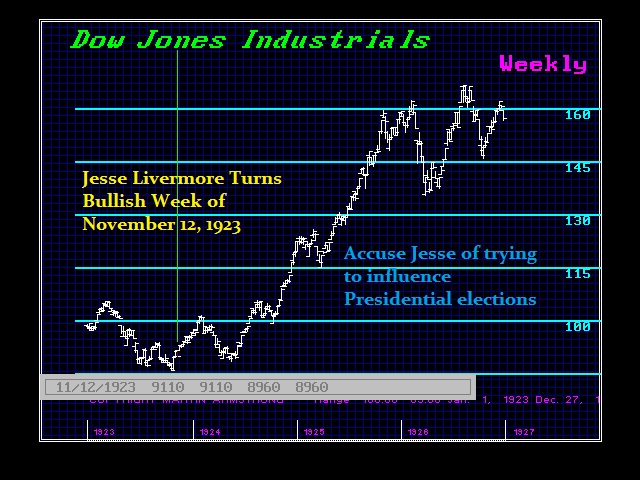
The US share markets are being driven up by two main factors. First, institutions have sold the market assuming there would be a major crash. In February at the lows, Goldman Sachs was forecasting that the market could plunge another 25%. In May, Goldman Sachs again was warning that the next crash will be worse because of computerized trading. Investopedia published an article last January: Why The 1929 Stock Market Crash Could Happen In 2018. Fox Business reported on October 18, 2017: Stock market crash inevitable, financial historian saysThe number of forecasts that keep calling for a major crash has been truly amazing. This has been one reason why I have said that this is the Most Hated Bull Market in History! For at least the final 18 months going into the high on September 3rd, 1929, the general consensus turned bullish. People were also bearish and in fact, the Wall Street Journal even accused Jesse Livermore of turning bullish to try to influence the presidential election. Strangely reminiscent of Russian hackers in 2016. As long as the major remain bearish calling for every top to be the last one, you know we are nowhere near the high yet.

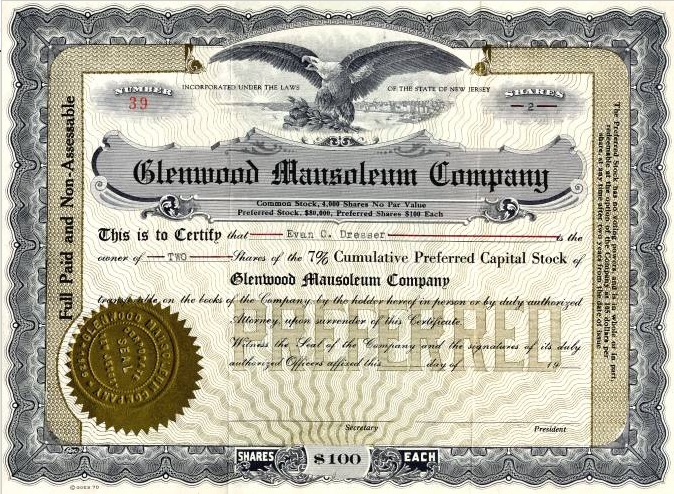
Besides the constant selling that has led to repeated short-covering, we also have the excuse that the rally is primarily being caused by massive buybacks by corporations of their own shares. They point out that corporate-buy-backs will also reach an all-time high in 2018. They present this as evidence that somehow these purchases are not legitimate. In truth, the excess cash has led companies to buy back shares which will have two interesting impacts. First, it actually creates a shortage of shares. This was one factor in creating the 1929 bubble.  Indeed, some of the last stocks to be floating going into the high of 1929 were Mausoleum companies.

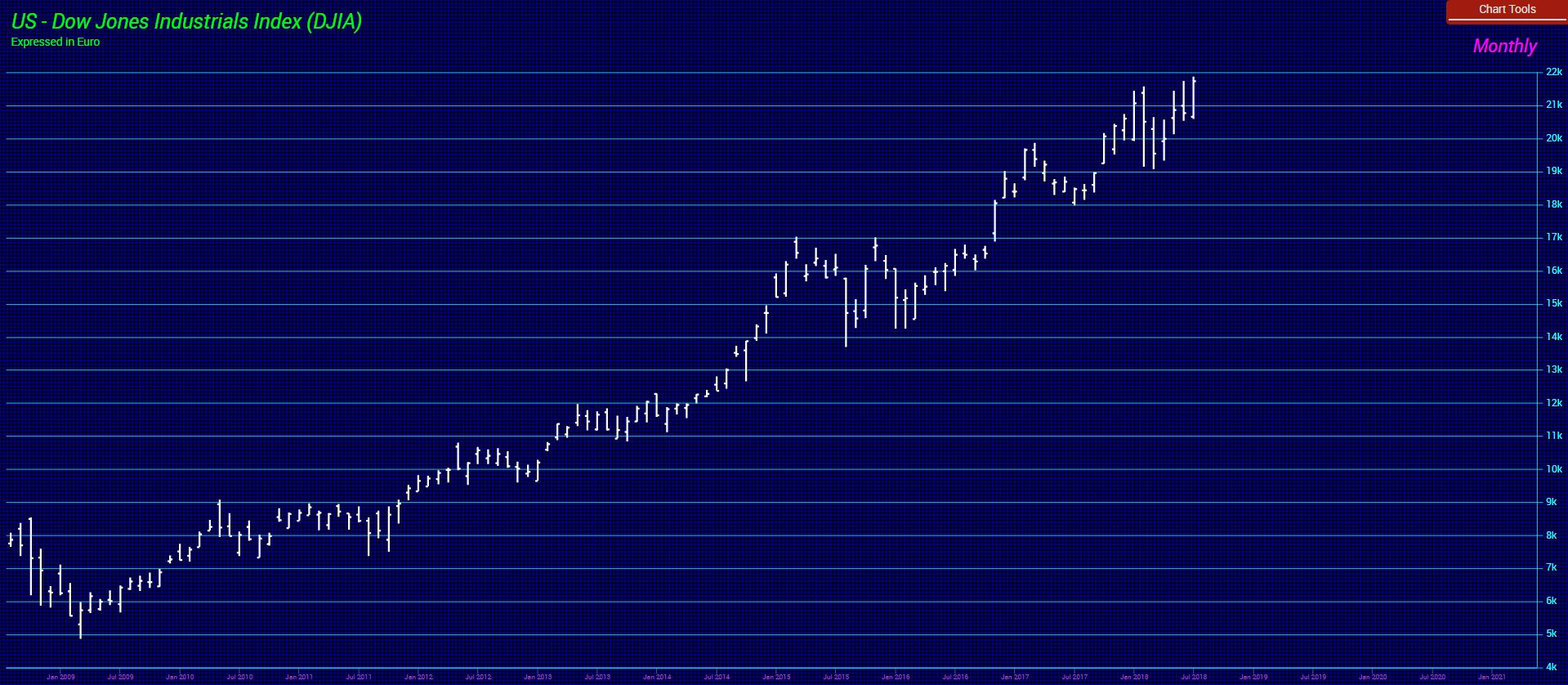
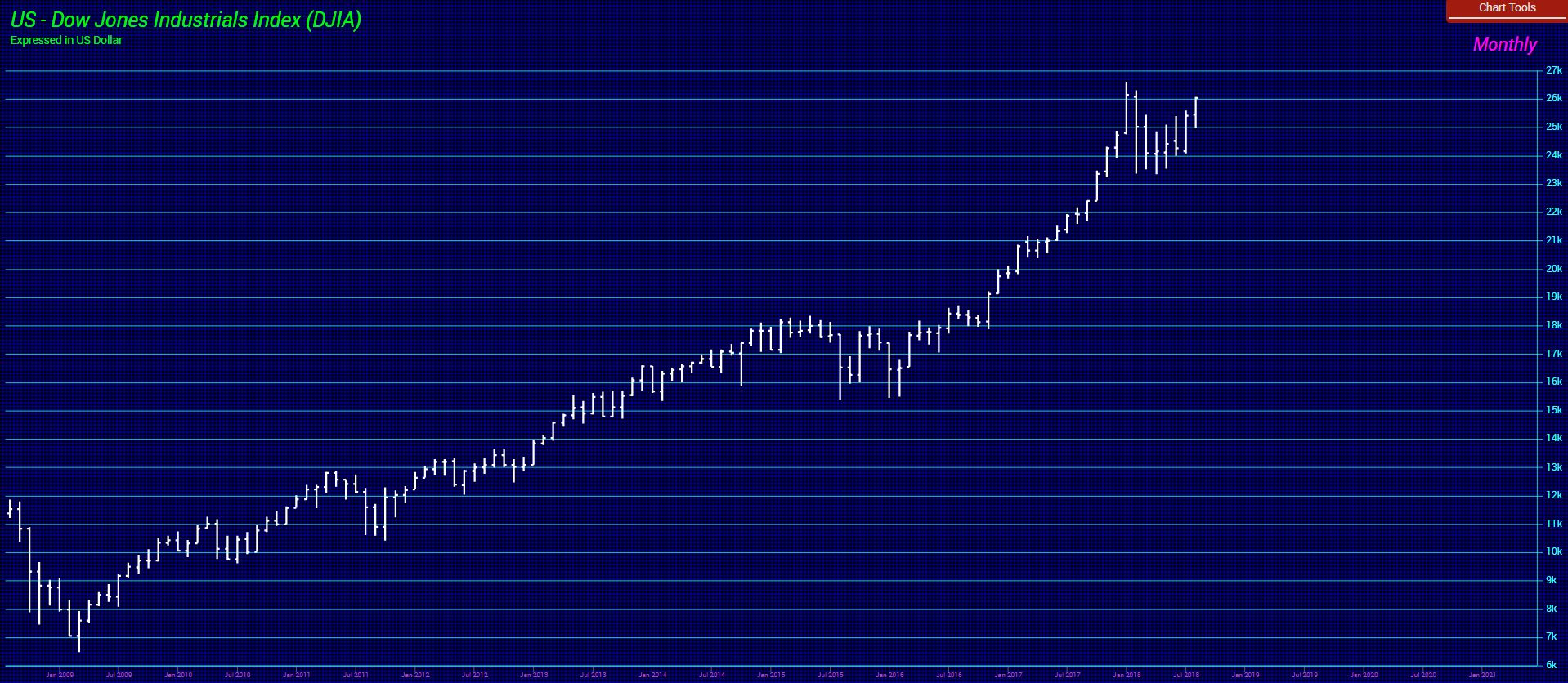
Additionally, the US share market has benefited from the political-economic turmoil outside the USA – especially in Europe. Even IMF acknowledged that the European Central Bank’s pledge to buy government bonds set in motion a capital flight and the financial fragmentation of the eurozone back on October 9th, 2012 the return of global dollar capital to the US as a result of the central bank’s interest rate hikes also contributed to the positive trend. When we look at the Dow Jones Industrials, we can easily see that it continues to make new highs in Euro. This foreign buying has absorbed domestic selling.

The Significance of the Velocity of Money


QUESTION: Greetings Marty,

I have followed you since the old Money Radio days!

Can you help me understand the disparity between the declining velocity of money, the growth of the economy and what the natural consequence may be?

Thank you for your willingness to share your knowledge!

Regards,

MRM


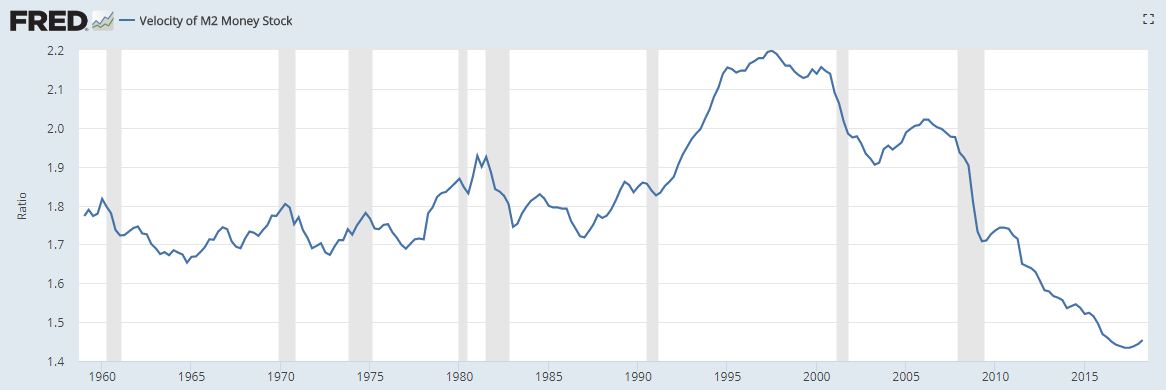
ANSWER: Oh yes. Buzz Schwartz was a fantastic guy. I enjoyed doing his show there in California. The economic growth has been declining for decades as has the velocity of money, As the velocity declines, it shows that people are either saving more or they do not have disposable income after taxes to spend.  Normally, the velocity will decline and that is a sign of a recession. This is the normal reaction when people save and do not spend. However, if you are not in an economic recession/depression there is no FEAR FACTOR of what the future will bring, then the velocity declines because people really do not have the money after taxes to spend. This is one reason I keep harping on – it’s the taxes stupid!

In the USA, the velocity bottomed during the 2nd quarter of 2017 and has started to turn up with Trump lowering taxes. This is the first uptick since the decline began from the 3rd quarter of 1997 when the capital flows began to shift creating the 1997 Asian Currency Crisis. When Obama raised the tax rate from 35% to 39.6% in 2013, that began the real sharp decline.

The decline in the velocity of money and the rising burden of taxation is very alarming. That has been the worst combination which has suppressed the Euro zone economy. We see this with central banks setting targets for 3% inflation and they cannot reach that level.

President Trump MAGA Rally – Ford Center in Evansville, Indiana – 7:00pm Livestream…


Tonight President Trump heads to Evansville, Indiana for a MAGA rally at the Ford Center.  President Trump is in Indiana on behalf of Senate candidate Mike Braun. Anticipated start time 7:00pm EST with pre-rally speakers and events ongoing.

With all of the ongoing trade news circling Washington DC, in combination with the latest testimony from DOJ and FBI officials, this is a rally speech not to be missed.

RSBN Livestream LinkFox News Livestream LinkFox10 Livestream Link

Bloomberg Reports: POTUS Trump Considering $200 Billion in Chinese Tariffs…


The financial media is all a flutter based on a Bloomberg report that President Trump is likely to apply tariffs on $200 billion in Chinese goods.  DUH !  Why do they think U.S.T.R. Lighthizer has been conducting open section 301 tariff hearings for the past week?  Of course President Trump is considering tariffs on $200 billion in trade goods; this approach is not exactly a secret.

Then again, most of the financial media are clueless about the larger economic strategy and how China ties into the negotiations with North Korea.  I digress.

The proposed tariffs are a supplemental action in response to China’s unfair trade practices related to technology transfer, intellectual property, and innovation, based on the findings in USTR’s investigation of China under Section 301 of the Trade Act of 1974. Tariffs on $34 billion in goods from China are currently in effect, and tariffs on an additional $16 billion took effect on August 23rd, 2018.

The issue is not *if* President Trump will apply the 301-tariffs, the question is *how* and *when*?

Only President Trump knows the answer to that question because everything about the larger strategy is only known by the person making the ultimate decisions, President Trump.

The goals are clear: leverage a more fair, equitable and reciprocal trade relationship with China; and also gain national and regional security for Southeast Asia with a denuclearized and stable Korean peninsula.

The $200 billion in 301-tariffs is a tool, leverage, nothing more.  President Trump is following a very logical sequence with multiple simultaneous actions.  Finalize the North American Trade Bloc using U.S-Mexico terms (possibly with Canada); then focus on the EU trade element, possibly doing a bilateral deal with the U.K. at the same time; then shift to Asia and specifically China.

The advancing Trump trade agenda has multiple fronts all coordinated by President Trump and his team: Commerce Secretary Wilbur Ross; Treasury Secretary Steven Mnuchin; U.S. Trade Representative, Ambassador Robert Lighthizer; with input and targeted messaging from NEC Director Larry Kudlow and Trade Advisor Peter Navarro.

Each member of the team has a specific region for review and strategy.  However, the larger direction of the team, and every specific action within each move, is coordinated by President Trump.

Canada Enters Day #2 of “Intense Conversations”….


For Canada it’s all about politics and face-saving. How to tell? Well, after Canadian Foreign Minister Chrystia Freeland went out of her way last night to tell the media she would not conduct negotiations in the press, Freeland runs back to the press to discuss the ongoing negotiations. She is signaling to a domestic audience…. nothing more.

Domestically Justin and Chrystia from Canada have seen complete collapse in support from the Canadian electorate. Canadians have little confidence that Chrystia and Justin are capable of negotiating a deal that will benefit their economy. Trudeau and Freeland rolled the political dice; played political games; and crapped out.

Mexico (Seade) and the U.S. (Lighthizer) have structured a strong trade agreement that benefits both countries and creates an actual manufacturing and commerce bloc. Canada has no option except acquiescence, if they want to avoid Lighthizer sending a 2205 notification to dissolve the Canadians from the U.S-Mexico deal.

.

In January 2018, when still attempting the political use of the negotiations, Freeland burned Lighthizer. The U.S. Trade Rep has not forgotten. Canada’s ability to enter the deal is now dependent on Lighthizer allowing them a way to save face.  Robert Lighthizer, like Trump, really doesn’t care…. The U.S. is in an overwhelming winning position either say…. Hence, Freeland’s continual appearances in the media, she’s shook.

I am reminded how badly Chrystia Freeland screwed up the negotiations in January of 2018 when she demanded that Canada be allowed to arbitrarily set their own trade import standards with China… This was right after idiot Justin signed Canada on to the TPP trade agreement.

Any canucklehead could see that signing on to TPP and simultaneously demanding to set your own standards for manufacturing origination was a poison pill. It would make the NAFTA fatal flaw infinitely worse for the U.S….. any idiot could see that problem. That was the moment when Lighthizer gave up on Canada.

In order for Canada to accept or join, via 2202 modification, they would need to agree to the U.S-Mexico modification terms. For Canada they would have to:

  • open their telecommunications and banking sector (eliminate non tariff barriers).
  • eliminate soft-wood (lumber) and aeronautics subsidies.
  • begin a process of lowering their assembly use of Chinese/Asian goods.
  • accept the rules of origin for North American manufacturing.
  • eliminate protectionist tariffs on dairy and farm products.
  • accept the U.S-Mexico terms for arbitration and dispute resolution.

Trump and Lighthizer are holding all the cards.  They don’t care if Canada doesn’t join; they would likely prefer to go into a one-on-one trade construct where the U.S. will apply auto tariffs on Canadian made vehicles.

The financial media are pushing optimism because Wall Street wants to protect prior Canadian investment, and the professionals know how badly Justin/Chrystia have been outmatched.

POTUS Trump is heading to Indiana today for a MAGA rally.  Don’t anticipate any breaking information (of substance) until tomorrow morning when Lighthizer can debrief with President Trump.

Chrystia From Canada Recaps Canadian Trade Position At the End of Wednesday…


The *tell* is within: “we have agreed not to conduct our negotiations publicly.”

Remember, U.S.T.R. Lighthizer, Jared Kushner, Secretary Ross and the U.S. team have never made a public comment about internal negotiations, ever.  The only trade team that has discussed the dialogue, and specifically their individual terms within the dialogue, is Justin from Canada’s team, specifically Chrystia Freeland.  This has been a weakness of team sparkle socks all along because it highlights their political prism.

So when princess rainbow sparkles and Justin back away from talking about their unicorn demands they are signaling a shift from a political prism toward a more economic-based set of determinations.  Essentially, their political approach has failed; they are weakened.

.

what both sides need” interpreted: Justin and Chrystia are trying to gauge the best retreat from the position of political damage. I’m going to hold-off on expanding consequences to Canada joining until I see if they *actually* do join. However, the biggest part of the U.S./Mexico agreement would eliminate Canada’s ability to use the NAFTA loophole.

The auto-sector (rules of origin) requirements are factually more difficult for Canada to meet than Mexico. Auto companies in Canada will have to change their supply chain completely because Canadian auto assembly plants have a higher content of Asian parts.

Here’s the part of the new agreement that applies:

The United States and Mexico have concluded substantive discussions on new rules of origin and origin procedures, including product-specific rules for passenger vehicles, light trucks, and auto parts. This update to the rules of origin will provide greater incentives to source goods and materials in the United States and North America.

Key Achievement: Increasing Regional Value Content Rule

This deal encourages United States manufacturing and regional economic growth by requiring that 75 percent of auto content be made in the United States and Mexico.

The rules will:

Incentivize billions annually in additional United States vehicle and auto parts production.

Help to preserve and re-shore vehicle and parts production in the United States.

Transform supply chains to use more United States content, especially content that is key to future automobile production and high-paying jobs.

Close gaps in the current NAFTA agreement that incentivized low wages in automobile and parts production.

If Canada joins on to the above agreed terms, they will save most of their current auto-manufacturing.  However, many Canadian car manufacturers will likely have to open ancillary component manufacturing to meet the rules-of-origin threshold; that will likely lead to more component manufacturing and assembly in the U.S.

Think about it? If you are a company supplying an auto manufacturing plant currently in Canada: where are going to safely put your facility (physical plant expansion), given the renewed regulatory and compliance process; and the nature of a six year review for trade-deal continuance?  Answer: In the U.S.

In addition to the above, to join the U.S-Mexico agreement Canada will have to:

  • open their telecommunications and banking sector (eliminate non tariff barriers).
  • eliminate soft-wood (lumber) and aeronautics subsidies.
  • begin a process of lowering their assembly use of Chinese/Asian goods.
  • eliminate protectionist tariffs on dairy and farm products.

The bottom line is that Canadian workers will gain considerably if Justin and Chrystia sign on to the current deal.  Yes, it would require several industries within Canada to restart (Steel, Aluminum, Coal, etc.); however, that’s a benefit to the Canadian worker, not a loss.

The big challenge is within the protectionist barriers Canada would have to give up.  Liberal Canada likes to have governmental control over several segments of their economy; loosening regulations and opening up to a free market means less control for the planning authority…. you know, that pesky free enterprise thing.