Jerome Powell Says Fed Effort to Make U.S. Economy Smaller Will Create “Some Pain” for Americans During Biden Transition to Clean Energy


Posted originally on the conservative tree house on August 26, 2022 | Sundance

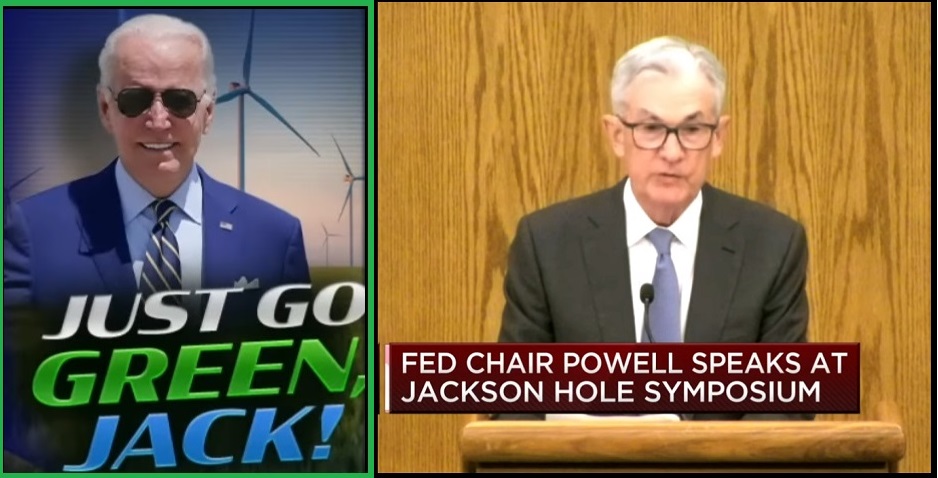
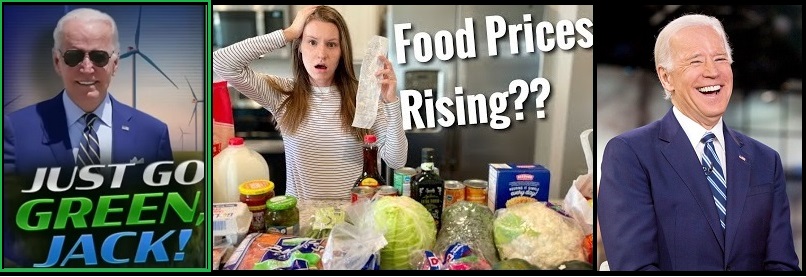
When Chairman Powell says things are really, really going to suck as monetary policy tries to support Biden’s goals to reduce energy supplies, will people believe him?

The agenda of the federal reserve was clearly outlined today in the remarks from Chairman Powell in Jackson Hole, Wyoming.  The Fed chair is trying to manage the economic policy transition by reducing economic activity to match intentionally diminished energy supplies.  Lowering economic activity drops demand for energy. Unfortunately, as admitted by Powell today, this means a period of “some pain” for Americans as the central banks join together in an effort to lower consumption.  WATCH:

What does “some pain” mean?  It means lower incomes, higher prices, lowered standards of living and more scarce resources.   During this transition to owning nothing and being happy about it, the pain is your wealth being stripped as the economy is intentionally diminished.

We will not be able to afford much; we won’t be able to afford the foods we want; we will not be able to purchase anything except the essentials, and those essentials will cost much more; we won’t be able to vacation, travel, or enjoy recreational activities; we won’t be able to afford any indulgences; but at the end of the process, we will learn to live more meager existences based on lowered expectations needed for sustaining the planet.   Pay no attention to the elites who don’t have those concerns, comrade.

[Transcript] – POWELL: “At past Jackson Hole conferences, I have discussed broad topics such as the ever-changing structure of the economy and the challenges of conducting monetary policy under high uncertainty. Today, my remarks will be shorter, my focus narrower, and my message more direct.”
The Federal Open Market Committee’s (FOMC) overarching focus right now is to bring inflation back down to our 2 percent goal. Price stability is the responsibility of the Federal Reserve and serves as the bedrock of our economy. Without price stability, the economy does not work for anyone. In particular, without price stability, we will not achieve a sustained period of strong labor market conditions that benefit all. The burdens of high inflation fall heaviest on those who are least able to bear them.

Restoring price stability will take some time and requires using our tools forcefully to bring demand and supply into better balance. Reducing inflation is likely to require a sustained period of below-trend growth. Moreover, there will very likely be some softening of labor market conditions. While higher interest rates, slower growth, and softer labor market conditions will bring down inflation, they will also bring some pain to households and businesses. These are the unfortunate costs of reducing inflation. But a failure to restore price stability would mean far greater pain.

The U.S. economy is clearly slowing from the historically high growth rates of 2021, which reflected the reopening of the economy following the pandemic recession. While the latest economic data have been mixed, in my view our economy continues to show strong underlying momentum. The labor market is particularly strong, but it is clearly out of balance, with demand for workers substantially exceeding the supply of available workers. Inflation is running well above 2 percent, and high inflation has continued to spread through the economy. While the lower inflation readings for July are welcome, a single month’s improvement falls far short of what the Committee will need to see before we are confident that inflation is moving down.

We are moving our policy stance purposefully to a level that will be sufficiently restrictive to return inflation to 2 percent. At our most recent meeting in July, the FOMC raised the target range for the federal funds rate to 2.25 to 2.5 percent, which is in the Summary of Economic Projection’s (SEP) range of estimates of where the federal funds rate is projected to settle in the longer run. In current circumstances, with inflation running far above 2 percent and the labor market extremely tight, estimates of longer-run neutral are not a place to stop or pause.

July’s increase in the target range was the second 75 basis point increase in as many meetings, and I said then that another unusually large increase could be appropriate at our next meeting. We are now about halfway through the intermeeting period. Our decision at the September meeting will depend on the totality of the incoming data and the evolving outlook. At some point, as the stance of monetary policy tightens further, it likely will become appropriate to slow the pace of increases.

Restoring price stability will likely require maintaining a restrictive policy stance for some time. The historical record cautions strongly against prematurely loosening policy. Committee participants’ most recent individual projections from the June SEP showed the median federal funds rate running slightly below 4 percent through the end of 2023. Participants will update their projections at the September meeting.

Our monetary policy deliberations and decisions build on what we have learned about inflation dynamics both from the high and volatile inflation of the 1970s and 1980s, and from the low and stable inflation of the past quarter-century. In particular, we are drawing on three important lessons.

The first lesson is that central banks can and should take responsibility for delivering low and stable inflation. It may seem strange now that central bankers and others once needed convincing on these two fronts, but as former Chairman Ben Bernanke has shown, both propositions were widely questioned during the Great Inflation period.1 Today, we regard these questions as settled. Our responsibility to deliver price stability is unconditional. It is true that the current high inflation is a global phenomenon, and that many economies around the world face inflation as high or higher than seen here in the United States.

It is also true, in my view, that the current high inflation in the United States is the product of strong demand and constrained supply, and that the Fed’s tools work principally on aggregate demand. None of this diminishes the Federal Reserve’s responsibility to carry out our assigned task of achieving price stability. There is clearly a job to do in moderating demand to better align with supply. We are committed to doing that job.

The second lesson is that the public’s expectations about future inflation can play an important role in setting the path of inflation over time. Today, by many measures, longer-term inflation expectations appear to remain well anchored. That is broadly true of surveys of households, businesses, and forecasters, and of market-based measures as well. But that is not grounds for complacency, with inflation having run well above our goal for some time.

If the public expects that inflation will remain low and stable over time, then, absent major shocks, it likely will. Unfortunately, the same is true of expectations of high and volatile inflation. During the 1970s, as inflation climbed, the anticipation of high inflation became entrenched in the economic decisionmaking of households and businesses. The more inflation rose, the more people came to expect it to remain high, and they built that belief into wage and pricing decisions. As former Chairman Paul Volcker put it at the height of the Great Inflation in 1979, “Inflation feeds in part on itself, so part of the job of returning to a more stable and more productive economy must be to break the grip of inflationary expectations.”2

One useful insight into how actual inflation may affect expectations about its future path is based in the concept of “rational inattention.”3 When inflation is persistently high, households and businesses must pay close attention and incorporate inflation into their economic decisions. When inflation is low and stable, they are freer to focus their attention elsewhere. Former Chairman Alan Greenspan put it this way: “For all practical purposes, price stability means that expected changes in the average price level are small enough and gradual enough that they do not materially enter business and household financial decisions.”4

Of course, inflation has just about everyone’s attention right now, which highlights a particular risk today: The longer the current bout of high inflation continues, the greater the chance that expectations of higher inflation will become entrenched.

That brings me to the third lesson, which is that we must keep at it until the job is done. History shows that the employment costs of bringing down inflation are likely to increase with delay, as high inflation becomes more entrenched in wage and price setting. The successful Volcker disinflation in the early 1980s followed multiple failed attempts to lower inflation over the previous 15 years. A lengthy period of very restrictive monetary policy was ultimately needed to stem the high inflation and start the process of getting inflation down to the low and stable levels that were the norm until the spring of last year. Our aim is to avoid that outcome by acting with resolve now.

These lessons are guiding us as we use our tools to bring inflation down. We are taking forceful and rapid steps to moderate demand so that it comes into better alignment with supply, and to keep inflation expectations anchored. We will keep at it until we are confident the job is done.” [Transcript End]
The Last Two Neutral European Countries


Armstrong Economics Blog/War Re-Posted Aug 25, 2022 by Martin Armstrong

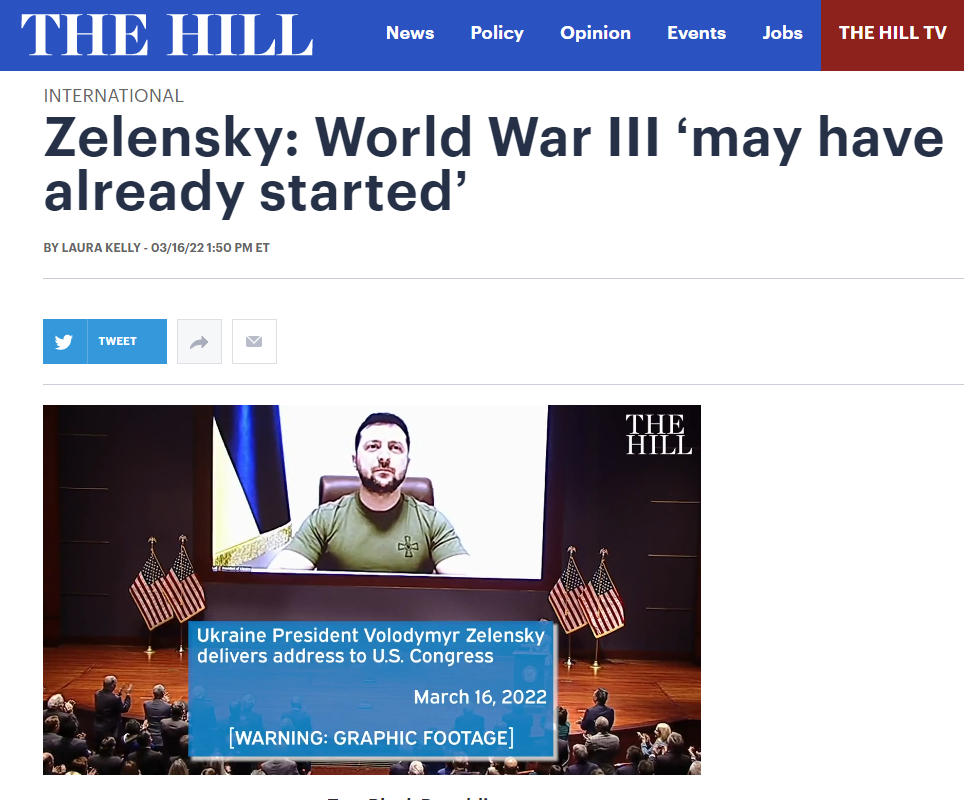
It seems as if everyone is supplying Ukraine with money and weapons. I would not blink if I saw Russia itself had provided Ukraine with weapons as everything has become so absurd. Yet, nothing seems to be enough. Ukrainian Foreign Minister Dmytro Kuleba called out the two European countries that have not supplied weapons for the proxy war. “With the exception of Hungary and Austria, the supply of weapons to Ukraine is not a taboo for any other European country, although it was (before),” said Kuleba.

Levente Magyar, Hungary’s Deputy Minister of Foreign Affairs, explained their reasoning for staying neutral. “Unlike many Western partners, we have experienced for ourselves what it is like to confront this huge Eastern state. At the same time, Hungary itself will not supply weapons — this is our strategic position. However, third countries can use our territory,” Magyar noted. Hungary simply does not wish to engage in war with a large Eastern power. They are protecting the Hungarian population living in the far-western Transcarpathia region from Russian attacks.

Austria has also committed to neutrality and has made that clear since the beginning of the war. First, Austria is not officially a NATO country and does not have that protection. According to Al Jazeera, 80% of Austrians do not want any involvement in the Western alliance. We all know of a certain dictator who grew up in Austria and started the last world war. Austria attempted to act as a diplomat between the East and West, with Chancellor Karl Nehammer visiting Moscow earlier in the year. The trip produced no results.

Both nations have offered humanitarian resources or opened their borders to Ukrainian refugees. They should not be shamed for steering clear of war. Look at their not so distant histories. The oldest generations have experienced untold suffering. There is no benefit for either country to become involved in a growing global conflict.

The World According to Schwab?


Armstrong Economics Blog/Economics Re-Posted Aug 25, 2022 by Martin Armstrong

QUESTION:  Dear Mr. Armstrong,
First, thank you for all the wonderful work you do. I have been following your blog for many years and am always amazed at your insight and historical knowledge. I had a question regarding your assertion that the WEF/ Globalists will not win. I am assuming you mean that their vision of a worldwide Chinese-style technocracy run by the United Nations will not take hold. But if we are also looking at the certain breakup of the United States from which there is no turning back, a defeat in WWIII with China and Russia as they win and rise to be the main players on the world stage, are we not losing everything, anyway?
How will we ever hope to restore peace, liberty, democracy, and prosperity as most American citizens understand it if China and Russia end up controlling everything, and our country is left permanently fractured and therefore weaker?
Again, thank you for everything you do to help people understand what’s coming down the road. Your insight is always invaluable.

EM

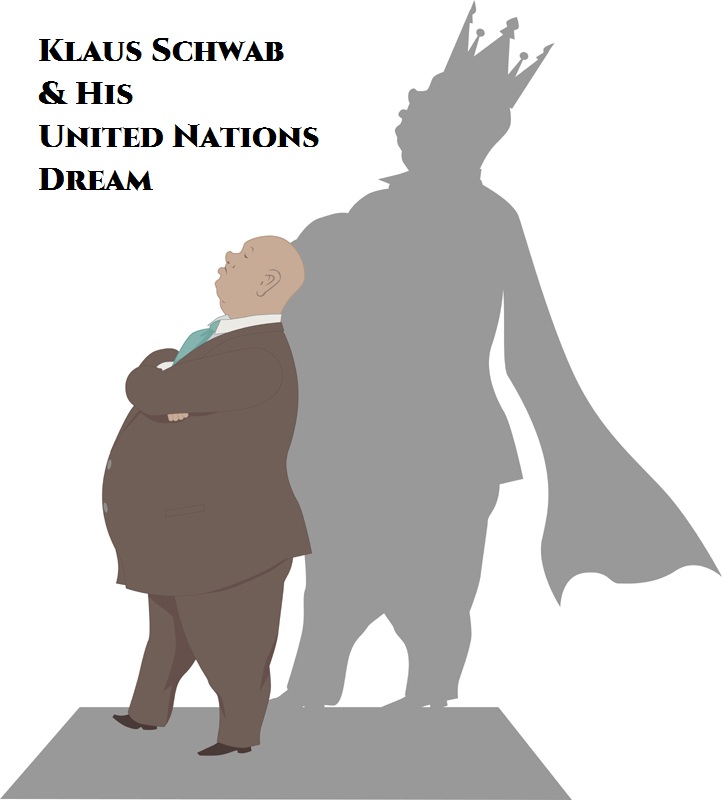
ANSWER: All we can do is look at history. As my mother used to say, There’s a time and place for everything.” What we are looking at is simply the natural cycle of the rise and fall of nations. Schwab will fail with Soros, and their dream of a one-world government is absolutely stupid, and it illustrates that both are totally ignorant of history or humanity. Just look at Congress. They vote on party lines. There is no agreement, and you really expect that the world can be brought to a one-world government?

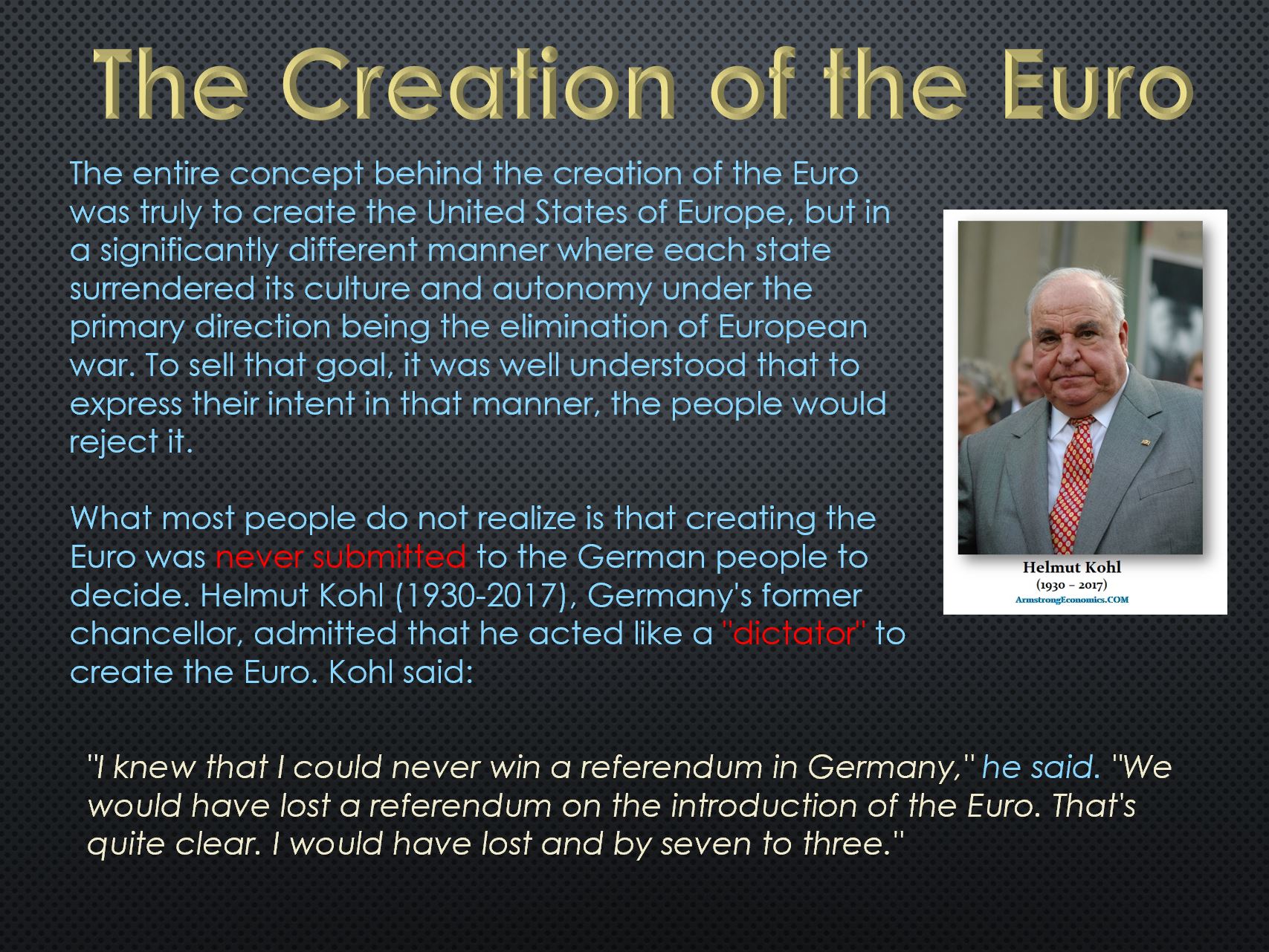
The EU is not working, and that was the very same theory. The old tensions and distrust go back centuries in Europe. The Germans refused to join if all the debts were combined, and now you have countries complaining that one pays more in interest rates than another. Here is the former head of France stating in Parliament that the entire idea of the EU was that this one-European government would end all European wars. This was pushed by Schwab and Soros.

The EU Commission came to our 1997 WEC in London. I warned them that this would fail without the consolidation of the debts. They said that they just had to get the euro in and then worry about the debts later. I tried to explain the crisis to Kohl, but he would not listen. He would not even put joining the euro to a vote, knowing that the German people would reject the whole idea.

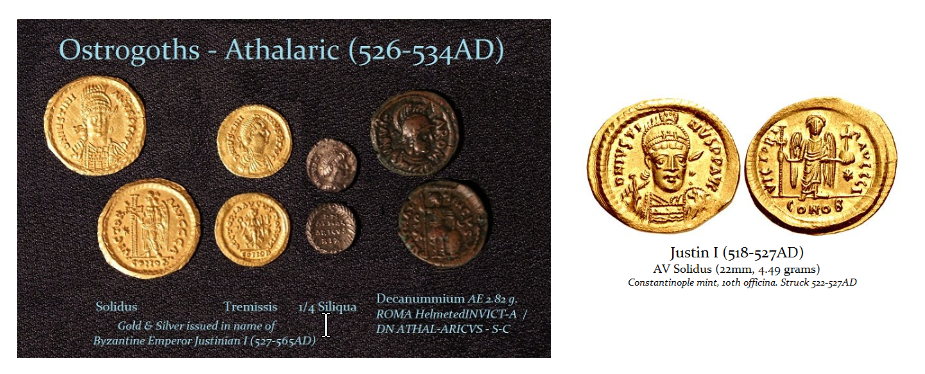
When Rome fell, it broke up into fiefdoms. The barbarians issued coins that imitated that of Rome. They pretended to be Roman, for they wanted the air of that civilization. There was no unity — all separated enclaves. It was not until Charles Martel (c. 688–741), who established the Caroline dynasty, where Charlemagne (747–814 AD) was eventually crowned as Emperor of the Holy Roman Empire by the Pope. Do you see the trend to create unified states once more?

Therefore, following the collapse of Rome, it was the typical cycle of 31.4 x 8.6 years = 270 years before we began to see the rise once again of formal civilizations. Europe had broken apart into simple fiefdoms that were not united. The unification came only because the Arabs began to seek the conquest of Europe and Charles Martel began to rise up to defend when became Europe once again after the Battle of Tours. He unified the Franks into a nation-state.

When Charles died, he divided Francia between his sons, Carloman and Pepin. Charlemagne came to power under Pepin. Pepin’s death opened the door to civil war as the conflict between his heirs and the Neustrian nobles who in turn sought their own political independence.

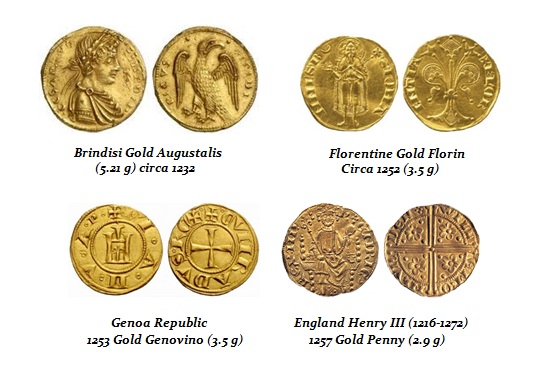
While the silver denier became the coin of Europe during the 8th century, it was not until the 13th century that we see gold reemerge as coinage. In actual Europe, that took nearly 800 years to pass before gold coinage reappeared.

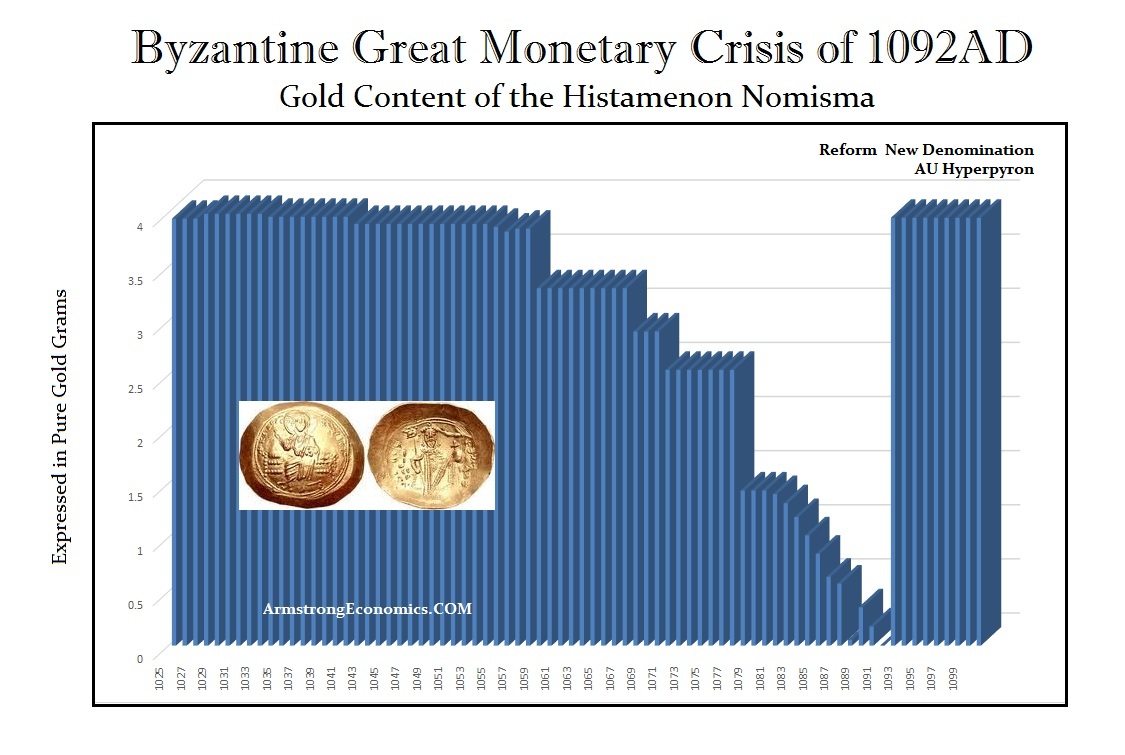
However, after the Great Monetary Collapse of gold in the Byzantine Empire in 1092, it took 172 years for good gold to reappear in Europe. When Constantine founded Constantinople in 330 AD and moved the capital of the Roman Empire from Rome to his new city, which is now Istanbul, the seat of power shifted from Byzantium back to Europe. That interval was again about 800 years.

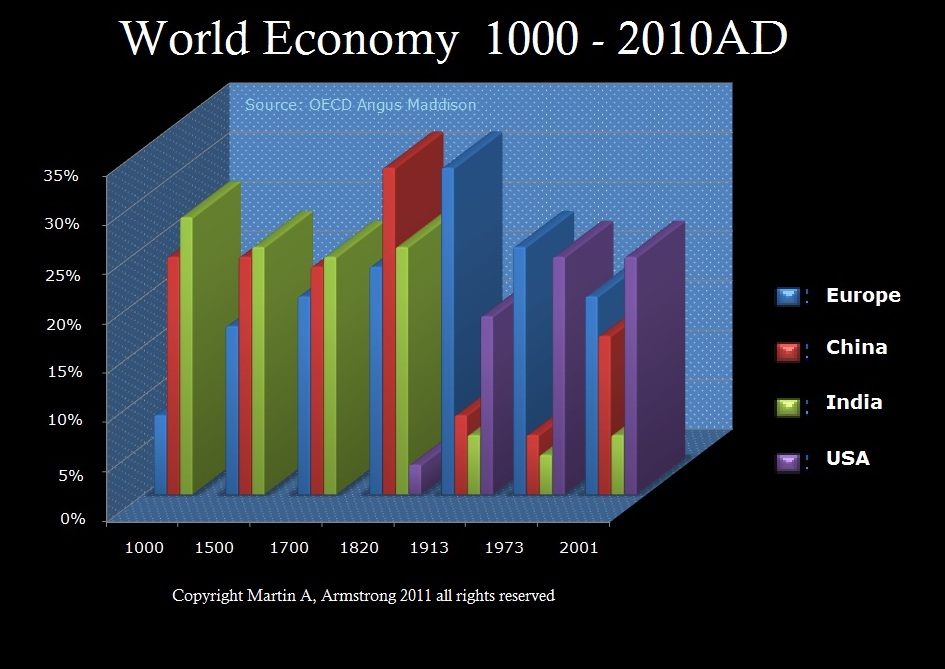
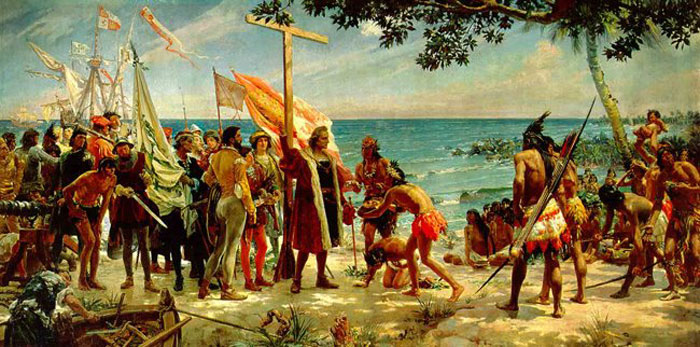
Columbus was trying to get to India, which was the financial capital, for it moved to Asia after the fall of Byzantium. That is why he calls the Americans “Indians.” He chose the wrong Greek mathematical who thought the world was round but smaller than it actually is. Columbus’ discovery of America was by sheer accident.

The West will fall and fragment. I do not see the US being occupied by Russia and China. There will be no one-world government. That is NEVER going to take place. Even in the aftermath, when the West has fallen, you will then see Russia and China become foes. Cycles are inevitable. So the world, according to Schwab, is the dream of a fool who ignores human nature and history.

Not a Democracy, State Dept Funds Ukraine Govt Disinformation Conference Labeling Disinformation as a War Crime


Posted originally on the conservative tree house on August 23, 2022 | sundance

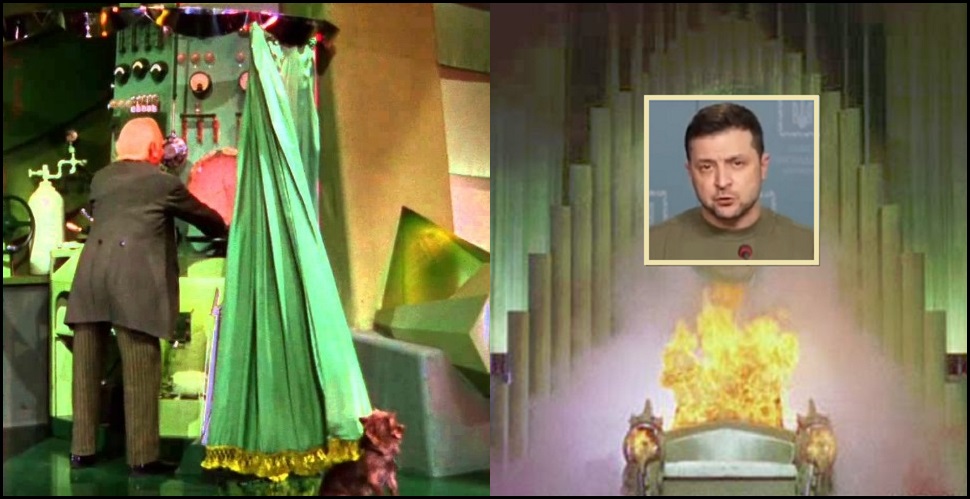
Ukraine President Volodymyr Zelenskyy previously took control over all broadcast media discontinuing any media that was not under government control.  Taking the anti-democracy movement another step further, Zelenskyy then banned any political opposition party and confiscated the funds of his political opposition.

These totalitarian actions were taken while the U.S. State Department was simultaneously claiming defense of Ukraine as vital to democracy.  Meanwhile, U.S. taxpayers are being forced by congress to send $60 billion in aid into the corrupt country in order to cover the wages, salaries and benefits of Ukraine government officials. Apparently, a strange and twisted definition of democracy exists in the dictionary of Washington DC.

The latest anti-democracy revelation is even more stark.  The U.S. State Dept funded a govt/NGO Ukraine conference on ‘disinformation’.

(UKRAINE) – Representatives of public authorities, NGOs, the media and international experts took part in a round table on countering disinformation. The participants discussed the methods used in Ukraine and abroad, as well as the legal framework and features of interaction between civil society and government agencies to counter fakes and disinformation in the context of cybersecurity.

During the discussion, Acting Head of the Center for Countering Disinformation Andriy Shapovalov insisted that persons who deliberately spread disinformation are information terrorists. He noted that in order to protect the information space, it is necessary to amend the legislation.

“Information terrorists need to know that they will have to answer to the law as war criminals,” he said.

Also during his speech, the acting Head of the Center noted that Ukraine is confidently winning the information struggle.

The round table was organized by the National Academy of the Security Service of Ukraine, the US Civil Research and Development Fund (CRDF Global Ukraine), the NGO “International Academy of Information”, the coordination platform “National Cybersecurity Cluster”. The event was supported by the U.S. Department of State. (LINK)

zelensky freaking out, putin wins big


The Dive With Jackson Hinkle Published originally on Rumble on August 22, 2022 

Unvaccinated Mothers Forced to Pay Back Maternity Leave in BC


Armstrong Economics Blog/Canada Re-Posted Aug 22, 2022 by Martin Armstrong

Mothers (also known as “birthing people” to the woke) in BC are no longer entitled to maternity leave unless they cave and take the vaccine. This is the very vaccine that has provenly caused issues in fertility and comes with a plethora of side effects. The vaccine does absolutely nothing to prevent transmission and infection. But the government is so eager to retain power under the guise of COVID while pushing forth the Great Reset that they are continuing to force the public into dangerous situations.

“The vaccination policy stipulates that BC Public Service employees who do not receive two doses of vaccination against COVID-19, or refuse to disclose their vaccination status, and do not have an approved exemption request, are to be placed on a leave without pay for a period of at least three months, after which they may be terminated,” the BC government writes on their website. The province required employee mandates on November 8, 2021.

The government offers around 80% salary compensation for mothers on leave. How else do they expect women to exist in the workforce (looking at you, America)? Any mother who disobeyed the vaccine mandate and did not receive an exemption may be forced to forfeit their maternity pay.

The COVID hysteria may have ended, but the tyranny continues. Canadians are continually losing their jobs for making independent health decisions. What will happen when they mandate more boosters? The collective must rebel against such tyranny.

Our Plan is More OBVIOUS Than Ever! – News Update


Awaken With JP Published originally on Rumble on July 26, 2022

Klaus Schwab and the World Economic Forum are trying to block the sun? This and more news that should worry you in this week’s update!

Op Ed, DC Foreign Policy Crowd Demands More Weapons and Money for Ukraine, U.S. Southern Border Not So Much


Posted originally on the conservative tree house on August 19, 2022 | Sundance

Amid a lengthy op-ed published in The Hill, you will find this paragraph:

[…] “Although the Biden administration has successfully rallied U.S. allies and provided substantial military assistance, including this month, to Ukraine’s valiant armed forces, it has failed to produce a satisfactory strategic narrative which enables governments to maintain public support for the NATO engagement over the long term.” (link)

Doesn’t that paragraph basically say Biden hasn’t been doing enough to produce good propaganda to keep the public interested?

The signatories of the op-ed are a veritable who’s who of U.S. foreign policy intervention, including the same crew involved in the first Trump impeachment effort.

Apparently, they are losing World War Reddit.

The UK has a Refugee Problem


Armstrong Economics Blog/BRITAIN Re-Posted Aug 19, 2022 by Martin Armstrong

Migrants are risking their lives by boarding small boats to cross the English Channel to the UK. Over 600 people on 14 ships reached Britain last Saturday alone. About 1,843 illegal immigrants crossed into the UK in 2019, but that number quickly multiplied to 28,526 in 2021. Now, the nation is bracing for 60,000 undocumented illegal immigrants in 2022.

The government does not know how to handle the giant influx. Former Prime Minister Boris Johnson did recognize the problem, but his strategies failed. Brexit allowed us to take back control of legal immigration by replacing free movement with our points-based system, we are also taking back control of illegal immigration, with a long-term plan for asylum in this country,” Johnson said in a prepared speech. Yet, the woke crowd will not let the UK expel immigrants despite not having the capacity to handle such a sharp uptick in arrivals.

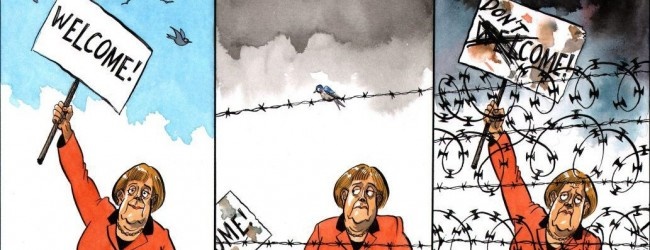
There was the failed flagship Rwanda policy that suggested flying migrants to Rwanda, Africa. One flight was attempted before it was grounded at the last minute by the European Court of Human Rights. Some in the UK blame France for allowing migrants to pass their waters into the UK. The real culprit is former German Chancellor Angela Merkel, who opened Germany up to all Syrian refugees and, therefore, the EU’s borders to any asylum seeker years ago. The Mediterranean nations in the EU have been asking for help to no avail.

The UK has more options since Brexit but must tread lightly. The Royal Navy cannot simply sink ships filled with women and children. Smugglers are running the seas and navigating these small boats to UK shores from the EU or Turkey. The potential of a life sentence for smuggling does not seem to be enough of a deterrent. The UK has a broken asylum system that needs to be fixed as the radical uptick in undocumented arrivals is unsustainable.

Oliver’s Twist, Policymakers Legislating Against the People – It’s Not About Going Green, It’s About Going Without


Posted originally on the conservative tree house on August 18, 2022 | Sundance

Last Saturday’s weekly monologue by Neil Oliver was a tremendous hit, helping to awaken millions of people from multiple nations about the true intent of this new governing system as promoted by policymakers on behalf of corporate interests [SEE HERE].

Earlier today (UK time) GBNews host Mark Steyn had Mr Oliver appear in studio to expand the conversation.  What results from Steyn and Oliver is a brilliant segment outlining the nature of this new governing system.  A system structured on the standard that disconnected policymakers are legislating to the needs of corporations.

When you remove the old “representative democracy” scales from your outlook and replace the lens with an understanding that representation now means representing the needs of multinational interests, almost all of the contradictions reconcile.

From that perspective, the Build Back Better or Green New Deal (climate change) agenda is not about replacing the system of energy production with a green system that duplicates the output. The intent of the new program is to produce less energy and then modify the uses of the now limited resource.  In one of the examples given, 30 million gasoline powered cars are not expected to be replaced by electric vehicles, a personal transportation system of far fewer vehicles is the goal.  WATCH (prompted):

.