Bidenomics – Multiple Key Performance Indicators Spell Trouble Ahead


Posted originally on the CTH on August 10, 2023 | Sundance 

Several people have made queries about the current state of our national economic condition against the backdrop of disconnected data points that seemingly conflict. Here’s my review.
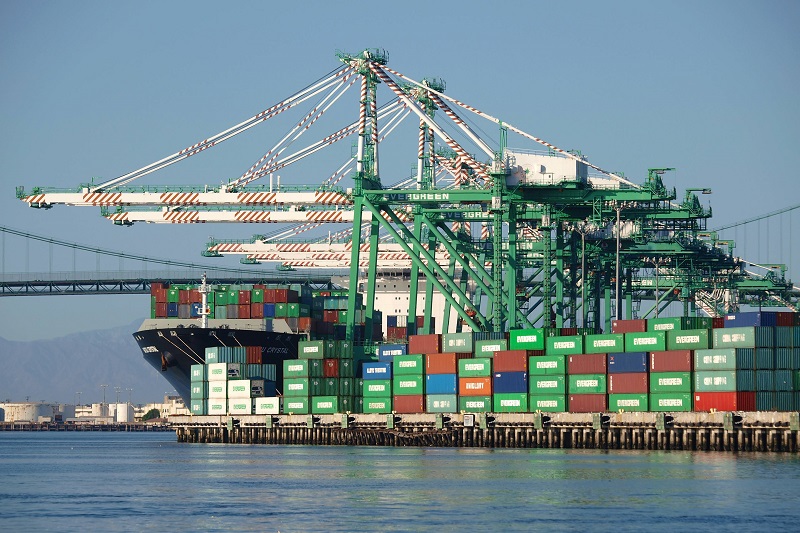
July and August are key months to gauge the prior six months of U.S consumer positioning.

Why?

Because all advance purchase orders for the U.S. holiday season are made in May, June and July for inventory builds and delivery schedules for September.  The decisions made by purchasing officers in late spring and early summer, reflect their predictive analysis for the holiday season.

Inventories are evaluated, critical financial discussions are held, and orders are placed for September arrival and distribution.  This predictive activity is what we see in the July and August data that flows from the global, multinational and shipping corporations who facilitate the transfer of the goods.  Check what is happening in distribution, and you can see what eventually creates the boxcar effect in the supply chain that ultimately leads to shuttered manufacturing.

Those who are involved in the business of shipping goods are signaling the flares around the state of the consumer economy and what will happen.  At the same time, the wording is almost hilarious in this era of great pretending.  Instead of saying ordinary words like “poor sales results for durable goods,” the parseltongue calls sales, “destocking.”  Example:  “CEO Vincent Clerc said he saw no sign that the destocking which has curbed global trade activity would end this year.”

Global shipping company Maersk is warning that shipping volume is low because warehouse inventories are high.  The goods are unsold.

(Reuters) – […] CEO Vincent Clerc said he saw no sign that the destocking which has curbed global trade activity would end this year.

“We had expected customers to draw down inventories around the middle of the year, but so far we see no signs of that happening. It may happen at the beginning of next year,” Clerc said at a media briefing.  “Consequently, the uptick in volumes we had expected in the second half of the year has not occurred,” he said. (read more)

The lack of shipping leads to a review of inventory status for the warehouses who would receive the goods.

Bulging Warehouses – […] A review of corporate statements and briefings shows more than 30 U.S. and European companies, including Hugo Boss, Heineken and A.P. Moller-Maersk, 3M Co and Stanley Black & Decker complained that destocking hurt their second-quarter performance.

Retailers particularly have struggled with stocks of clothing and footwear as consumers splurge on holidays rather than goods as they did during pandemic lockdowns.

The downbeat outlook comes amid low expectations for second-quarter results as China’s post-pandemic recovery slows. Refinitiv I/B/E/S data shows U.S. and European companies are expected to report their worst quarterly results in years.

Companies which stockpiled last year are finding it harder to shed inventories when higher borrowing costs and inflation crimp consumer demand, corporate executives and analysts said.

In the euro zone, stocks of finished products hit records in August last year and destocking only started in May, based on latest euro-zone manufacturing data.

In the U.S., an analysis of U.S. Bureau of Labor Statistics by CFRA Research showed business inventories soared by 20% in mid-2022, the biggest jump on record based on data that goes back to 1993. Retailers led the trend – raising inventories by a quarter from a year earlier.

The date in this next paragraph is key:

[…] The U.S. inventory-to-sales ratio was 1.4 in May, up from 1.33 a year ago, which means retailers, manufacturers and wholesalers have more inventory than they can sell at a higher rate than a year ago. (link)

When purchase order decisions for the holiday season of 2023 were being made, the inventory levels were higher than 2022.  This is KPI (Key Performance Indicator) data, because the holiday of 2022 was a total mess.

Holiday sales last year were exceptionally weak as wage earners were struggling to pay for higher prices in essential goods and services, fuel, oil, heating, energy, gasoline, food and shelter.  The lack of consumer purchasing for non-essential goods and/or luxury items resulted in poor sales last year, and the inventory levels are actually higher this year than last year when this year’s purchasing decisions were being made.  That reality drops purchase orders.  The dropped purchase orders lead to Maersk saying they are shipping less goods.

Now, let’s get USA domestic…. because it’s all connected.  For that let’s turn to the U.S. Postal Service:

USPS DATA – First-Class Mail revenue increased $221 million, or 4.0 percent, on a volume decline of 678 million pieces, or 5.9 percent, compared to the same quarter last year. Shipping and Packages revenue remained relatively flat while volume declined 41 million pieces, or 2.4 percent, compared to the same quarter last year.

Marketing Mail revenue decreased $333 million, or 8.8 percent, on a volume decline of 2.6 billion pieces, or 16.0 percent, compared to the same quarter last year. The Marketing Mail decreases were driven by the continued decline in advertising spending due to economic pressures experienced throughout most of the fiscal year, a higher inflationary environment affecting print media production costs. (link)

So, let’s put it all together….

Consumers did not buy stuff.  As a result, spring inventories were high.  Purchasing managers forecast weak sales. Summer purchase orders were very low.  Shipping companies reflect declines in shipping because the purchase orders were low. Advertising and marketing budgets were cut to meet the decrease in consumer spending.  Consumers are not forecast to spend this holiday season.

The economic pie is getting smaller.

Keep in mind, this is all intentional.  This is all part of the outcome from “managing the transition” to a new energy economy.

As you are well aware the various western nation central banks including the U.S. Federal Reserve, are raising interest rates into a global economic contraction, a drop in demand.  Raising interest rates into a contracting economy is counterintuitive, it runs against the expressed interest of government to grow economic conditions.  However, there is a purposeful design to the contradiction.  [A TLDR Version Here]

The central bankers are trying to support western government policy.  Unfortunately, the government policy they are under obligation to support is the fundamental energy shift, or what the World Economic Forum (Davos Group) has called the “Build Back Better” climate change agenda.

Monetary policy can only impact one side of the inflation challenge.  The western bankers (EU central bank, U.S. federal reserve bank, and various banking groups) are raising interest rates in order to “tame inflation” by “taming demand.”  However, as you know the global economic demand has been declining for several quarters.  Raising interest rates into an already contracting economy only does one thing, it speeds up the rate of economic contraction.

Economic contraction is the lowering of economic activity.  Raise interest rates -in a general sense- and businesses invest less, borrowers borrow less, consumers purchase less, employers expand less, and the economy overall slows down. When the economy turns negative, meaning less products and services are produced, we enter a recession. Some businesses and employers do not survive a recession and subsequently unemployment rises.

During recessionary periods people buy less stuff, people have less income stability, and economic activity drops.  When the banks raise interest rates into an economy that is already stalled or contracting, unemployment and general pain on Main Street increases.  Workers are laid-off, incomes shrink, consumer spending drops and that leads to less employment.  Recessions are bad for middle-class and working-class people.

However, that said, there is one benefit from a recession…. Energy use drops.

Homelessness in the US at All-Time High


Armstrong Economics Blog/Real Estate Re-Posted Aug 10, 2023 by Martin Armstrong

The housing crisis has become a massive issue in America. People with decent jobs are unable to afford housing, and those who were already down and out have little chance of survival. Then we poured the migrant crisis on top of the fire and have created a situation that is turning America into a second-world nation. Not so coincidentally, most of the homeless population lives in blue cities. The US spent over $51 billion on the homeless crisis last year, but where has the money gone?

Homelessness in the US has spiked by 65% since 2016! The Annual Homelessness Assessment Report said it is common for half a million people to be experiencing homelessness on any given night. The data is not in for 2023 when the migrant crisis really took hold after title 42 came to an end, so these figures I will present are nothing compared to our current reality in 2023. For every 10,000 Americans, 18 do not have a home. Around 72% are single adults, but an alarming 28% are families living with children. Five percent of the homeless population are unaccompanied youth under 25. Our veterans compose 6% of the homeless population as well.

Native Hawaiian or Pacific Islanders have the highest rate of homelessness with 121 out of every 10,000 people living in crisis. The Black community has a disproportionate amount of homeless too with 48.2 of every 10,000 experiencing homelessness. Native Americans come in at a close third with 44.9 out of every 10,000 having no place to call home. Sixty-eight percent of all homeless individuals are male.

The US Federal government spent over $51 billion to combat the homeless crisis in 2022, but then our government took measures to worsen the matter, and economic conditions have made it nearly impossible for those with nothing to find shelter. The National Alliance to End Homelessness estimates that a chronically homeless person will cost the taxpayers an average of $35,578 per year. Yet, where is this money going? When the migrants came through, we managed to find housing and convert buildings into temporary shelters until cities became overrun and it was impossible to manage — the federal bill for homelessness in FY22-23 will be astonishing.

As of March 2022, these cities saw the largest populations of unhoused individuals:

  • Los Angeles City & County 65,111
  • New York City 61,840
  • Seattle/King County 13,368
  • San Jose/Santa Clara City & County 10,028
  • Oakland, Berkeley/Alameda County 9,747
  • Sacramento City & County 9,278
  • Phoenix, Mesa/Maricopa County 9,026
  • San Diego City and County 8,427
  • San Francisco 7,754
  • Metropolitan Denver 6,884

We can see a pattern here, given that these are blue cities. Politicians touted many of these areas as “sanctuary cities” and encouraged tens of thousands of people to use the last of their resources to relocate there. And now, these people have nowhere to stay and no resources to leave. Promising sanctuary should have been a crime in itself. Criminalizing homelessness will not solve the solution and will only further burden the taxpayers. Anyone living in a major American city will tell you first-hand that the number of unhoused people has exploded in the past year. This is a SERIOUS and growing problem that is not being addressed. The government is continually throwing more money at the problem, but it is only worsening.

Self-Defense Illegal in Blue Cities


Armstrong Economics Blog/USA Current Events Re-Posted Aug 10, 2023 by Martin Armstrong

Criminals have the right of way in the US where they are permitted to commit crimes with absolutely no repercussions. I advise you to read my article on the Cloward-Piven Strategy if you want to know the real reason this is all happening. Overburden the bureaucracy to break the system, create controlled chaos, usurp power as civil unrest peaks, and offer government aid as the only solution. This was the basis behind the Cloward-Piven strategy created by sociologists Frances Fox Piven and her husband, Richard Cloward. The couple published their theory in The Nation Magazine on May 2, 1966, entitled “The Weight of the Poor: A Strategy to End Poverty.”

The four steps of the Cloward-Piven Strategy:

  1. Overload and Break the Welfare System
  2. Have Chaos Ensue
  3. Take Control in the Chaos
  4. Implement Socialism and Communism through Government Force

In Chicago, we see mobs of people absolutely destroying small businesses and personal property. It is not safe there. Yet, the mayor refuses to call these groups “mobs” and urges the public to have compassion for the criminals.

In Oakland, California, the police are advising residents to place security bars on their doors and windows due to the uptick in crime. Burglaries have risen over 41% in Oakland and robberies are up 20%. Instead of properly telling residents that their 2A rights may be the only difference between life and death, the police have advised residents to use airhorns. Breitbart reported on a recent incident that went as expected:“On Sunday, July 30, 2023, a 75-year-old Oakland woman was home alone and armed with more than an airhorn when two alleged armed intruders entered her home. The woman had a .357 Magnum revolver, which she used to fire one shot at the alleged intruders, KTVU reported. The alleged intruders fired multiple shots then fled the scene.”

Clearly, the airhorns did not cause the criminals to flee. This woman is lucky that she was armed when criminals, likely career criminals who fail to contribute to society in any meaningful way, broke into her home.

In Stockton, California, a 7-Eleven convenience store owner was robbed by the same man on multiple occasions. The police did not assist the clerk after he pleaded for help numerous times. There are videos showing the same man casually robbing the store. “Look how relaxed he is. That’s the Democratic law in California where the criminal is the victim because, you know, ‘the system is racist‘,” Fox News contributor Leo Terrell commented.

The store owner finally decided to fight back. He did not use lethal force but began beating the career criminal with a broomstick as another man held him down. They can’t cry racism because the store owner is Sikh. The criminal began complaining that he was in pain and cried on camera, causing the tables to turn, and the store owner was placed under investigation. You are permitted to steal up to a certain amount in California; Newsom has ensured it by law. So technically this “criminal” is a law-abiding citizen in the state of California.

Self-defense in Biden’s America is now considered vigilantism. They are following the Cloward-Piven model and ensuring that chaos ensues across the nation. Then they will cry that we need gun control – so that these vigilantes who don’t want to be harmed by criminals cannot protect themselves and must rely on the police who are not permitted to protect them. Blue cities in this country are absolutely ruined and people need to consider this at the polls.

Western Sanctions Not Impacting Russian Economy as Much as Expected


Posted originally on the CTH on August 9, 2023 | Sundance 

I have been researching the MACRO economic dynamic in Russia quite deeply for the past six months.  Essentially looking to discover not only what impact the western imposed sanctions might be having, but more broadly looking to see what happens to self-sustainability when essentially locked out from the world of commercial imports.

The research is fascinating, not simply because it is a unique opportunity, but also because national economic issues play a big role in the overall social dynamic.  That said, I can say the social aspect is stunningly more interesting than the data driven outcomes.  When you really dig deep into actual life of the ordinary people in Russia, far away from the geopolitical contexts, you get an entirely different perspective.  My worldview of the average Russian person/family has completely changed.

There is a really good thread on how the western sanctions against Russia are having a much lesser impact than initially thought [SEE HERE].  On the economic side, one thing I would point to is how the economy is essentially an outcome of two facets: (1) the internal production strength, and (2) the service side of the ledger.

[READ HERE]

The author makes the accurate point that from a production side perspective, Russia actually has a larger economy now than Germany, the largest EU nation.  The cause for this is “autarchy” or self-sufficiency.  Indeed, as the timeline of the sanctions closes in on the second year completing, the Russian production economy is even stronger than when the sanctions began.  Quite simply, they are making even more of their own goods now.

The sanctions hit what would typically fall into the service side of the economy, as well as financial and economic roadblocks.  However, that aspect of the Russian economy was much smaller than most suspected and there were sanctions going back to 2014 which made the outcome of the 2022 western imposed restrictions less impactful.

I will be finishing my review of the economic data once Q3 is over, that will give me an entire year of data to share.  However, the social stuff is even more fascinating.

I have a new understanding of why former NSA contractor Edward Snowden was so comfortable using Russia as the place to hide after his release of classified intelligence showing how the U.S. government was spying on Americans via social media and metadata collection.

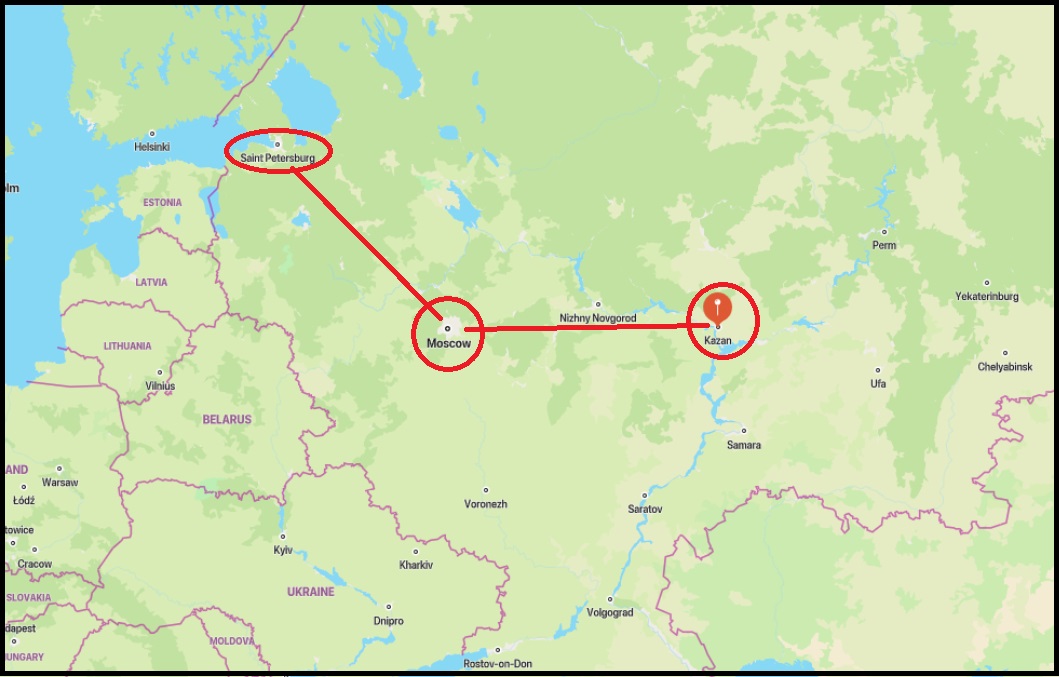
I have mostly been looking at three areas in Western Russia.  Kazan, Moscow and St Petersburg (formerly Leningrad).  Of the three generally large metropolitan areas, St Petersburg is by far the most interesting.  It’s beautiful there and the city is alive and vibrant.

In many ways you might compare Russia in 2023 to the USA in/around 1988.  Life is just not complicated and far more socially engaged.

I’ll have more on this later, but if you are ever bored check out the Russian YouTubers who livestream broadcast “a day-in-the-life” type of activity.  The infrastructure is in generally good repair, the people seem warm and friendly and there is a strong social value placed on family and kids.

There are certainly negatives and the cultural dynamic of the former USSR is still evident.  Technologically they are somewhat behind in some details, but the overall cohesion of their value system is something I did not fully appreciate until I started down this road of research.

I can see why the average Russian could be wide-eyed during a visit to the USA and fascinated with the overall quality of life that might be considered indulgent.  However, I can also see how reciprocally the average American could be wide-eyed and smiling at the overall sense of the Russian people.

Strip out the politics, and we are all much more similar than we are different.

The Intercept Publishes Diplomatic Cable Highlighting U.S. Pressure on Pakistan to Remove President Imran Khan


Posted originally on the CTH on August 9, 2023 | Sundance 

What do Pakistan’s Imran Khan, Brazil’s Jair Bolsonaro, USA’s Donald Trump, Hungary’s Viktor Orban and Mexico’s Lopez-Obrador all have in common?

First, they are all strong nationalists. Second, the U.S. government has either influenced the removal and judicial incarceration or is currently seeking the removal and judicial incarceration of each of them.

As the U.S. State Dept. (Tony Blinken), USAID (Samantha Power) and CIA (Director Burns) conduct influence operations around the world to advance the interests of the multinationals; newly released diplomatic cables from inside Pakistan reveal the U.S. influence effort to remove former Pakistan President Imran Khan.

It sucks to wake up every day and accept the USA are the bad guys.

THE U.S. STATE DEPARTMENT encouraged the Pakistani government in a March 7, 2022, meeting to remove Imran Khan as prime minister over his neutrality on the Russian invasion of Ukraine, according to a classified Pakistani government document obtained by The Intercept.

The meeting, between the Pakistani ambassador to the United States and two State Department officials, has been the subject of intense scrutiny, controversy, and speculation in Pakistan over the past year and a half, as supporters of Khan and his military and civilian opponents jockeyed for power.

The political struggle escalated on August 5 when Khan was sentenced to three years in prison on corruption charges and taken into custody for the second time since his ouster. Khan’s defenders dismiss the charges as baseless. The sentence also blocks Khan, Pakistan’s most popular politician, from contesting elections expected in Pakistan later this year.

One month after the meeting with U.S. officials documented in the leaked Pakistani government document, a no-confidence vote was held in Parliament, leading to Khan’s removal from power. The vote is believed to have been organized with the backing of Pakistan’s powerful military. Since that time, Khan and his supporters have been engaged in a struggle with the military and its civilian allies, whom Khan claims engineered his removal from power at the request of the U.S.

The text of the Pakistani cable, produced from the meeting by the ambassador and transmitted to Pakistan, has not previously been published. The cable, known internally as a “cypher,” reveals both the carrots and the sticks that the State Department deployed in its push against Khan, promising warmer relations if Khan was removed, and isolation if he was not. (read more, including cable)

European Companies Lost Over €100 Billion on Russia Amid War


Armstrong Economics Blog/World Trade Re-Posted Aug 8, 2023 by Martin Armstrong

The Financial Times estimates that European companies have lost at least €100 billion ($110 billion) since the Russia-Ukraine war began. Around 176 European companies noted significant losses in their fiscal year reports for 2022, and the future remains grim as tensions continue to grow.

Naturally, energy-related industries faced half of those losses, followed by banking, chemicals, industrial, and automotive. BP, TotalEnergies, and Shell lost 40.6 billion euros due to the war, but the spike in energy costs helped them to post favorable earnings reports. Numerous European companies cited “asset impairments, foreign exchange-related charges and other one-off expenses as a result of the sale, closure or reduction of Russian businesses.” Britain, Germany, and France reported the steepest losses, attributing to at least 20 billion of the 100 billion euros lost.

Half of the 1,871 European companies previously operating in Russia are still conducting full or limited business there, according to the Kyiv School of Economics. Russia has since required foreign companies fleeing Russia to pay a 10% exit fee and sell their assets to Russian companies at a 50% discount. It is nearly impossible for companies to operate in Russia due to high sanctions, logistics, and public pressure. Businesses that did not flee will be faced with massive charges from Moscow and are practically stuck between forfeiting their businesses or attempting to operate amid an escalating war.

Big Picture Interview of Martin Armstrong


Armstrong Economics Blog/Armstrong in the Media Re-Posted Aug 7, 2023 by Martin Armstrong

The following image is what the WEF and the Neocons have planed for us.

Planned Parenthood – Eugenics and Population Control Report


Armstrong Economics Blog/USA Current Events Re-Posted Aug 7, 2023 by Martin Armstrong

Planned Parenthood released its annual report for 2021-2022, congratulating themselves for the work they have done. Bans off our bodies – sure. I do not take the authoritarian route on any personal choice. But there is no mistaking the targeted eugenics program at the foundation of Planned Parenthood. They have been openly targeting Black and Brown babies since the beginning. Margaret Sanger, the founder of Planned Parenthood, who Hillary Clinton calls her idol, openly believed that minorities were unfit to have children. Sanger attended KKK rallies to promote abortions and gain funding. She endorsed the 1927 Buck v. Bell decision that allowed the US government to forcibly sterilize “unfit” mothers without consent, resulting in thousands of women losing their right to reproduce.

It could not be more obvious. Sanger began the “Negro Project” in 1939, where she hired Black nurses and doctors to eliminate fears of racism. She even recruited Black religious leaders. Sanger opened clinics in the South in predominately Black neighborhoods, and to this day, Planned Parenthood clinics are in predominately Black neighborhoods.

In 2022, Planned Parenthood ACTIVELY MARKETED its services to “reach new audiences,” predominately in the Black and Latino communities. Page 25 of their report discusses how they enrolled the help of Black, Latina, and non-binary creators to reach minorities and successfully received over 20 million views and 135,000 new followers. They specifically want minorities to walk through their doors. They make no mention of marketing to the White or Asian communities for a reason. This is not merely about abortion; it’s a eugenics program.

So in 2021, Planned Parenthood performed 374,155 abortions, amounting to 1,200 abortions per day. Only 1,803 women opted to put their babies up for adoption. The clinics saw fewer clients but performed more abortions, meaning the education piece is not a priority. They now offer the abortion pill through telemedicine as well. They are promoting gender transitioning services to reduce further the number of people who can reproduce, and even have a guideline on how to talk to your PRESCHOOLER about gender identity.

So sure, make your decision based on your own circumstances. The government need not tell us what to do on any level. That is between you, your doctor, and God. But this organization was never intended to empower women. From the beginning, their mission has been to rid the world of those deemed undesirable and unfit to live by the founders. Hence, the US government supplements 35% of its funding as reducing the global population is the goal.

Modern Analysis for the 21st Century


Armstrong Economics Blog/Reports and DVDs Re-Posted Aug 4, 2023 by Martin Armstrong

QUESTION: Hello Martin. I’ve been a long-time follower and one of the first subscribers to Socrates “Basic.” Your information is always valuable! I’d classify myself as a retired, middle class fellow, who has put away enough funds to be comfortable. But, I got very uncomfortable when you just posted “We cannot rule out the Biden Administration canceling the dollar before the 2024 election.” My fears for myself and my family are being caught offguard in investment, location, and security. I can’t afford going to your annual events; would you consider a large treatise or book on how to survive in the middle class?

LC

ANSWER: These are the next two books. The first, Modern Analysis for the 21st Century, dives into technical analysis and why fundamental analysis has been so wrong. I am trying to make an authoritative work that perhaps after I am dead will force academia to change the course of its methodology, particularly in economic analysis. The Geometry of Time will deal with cyclical analysis. I think we are all here for some purpose and then we get to leave. I hope this is what I leave behind.

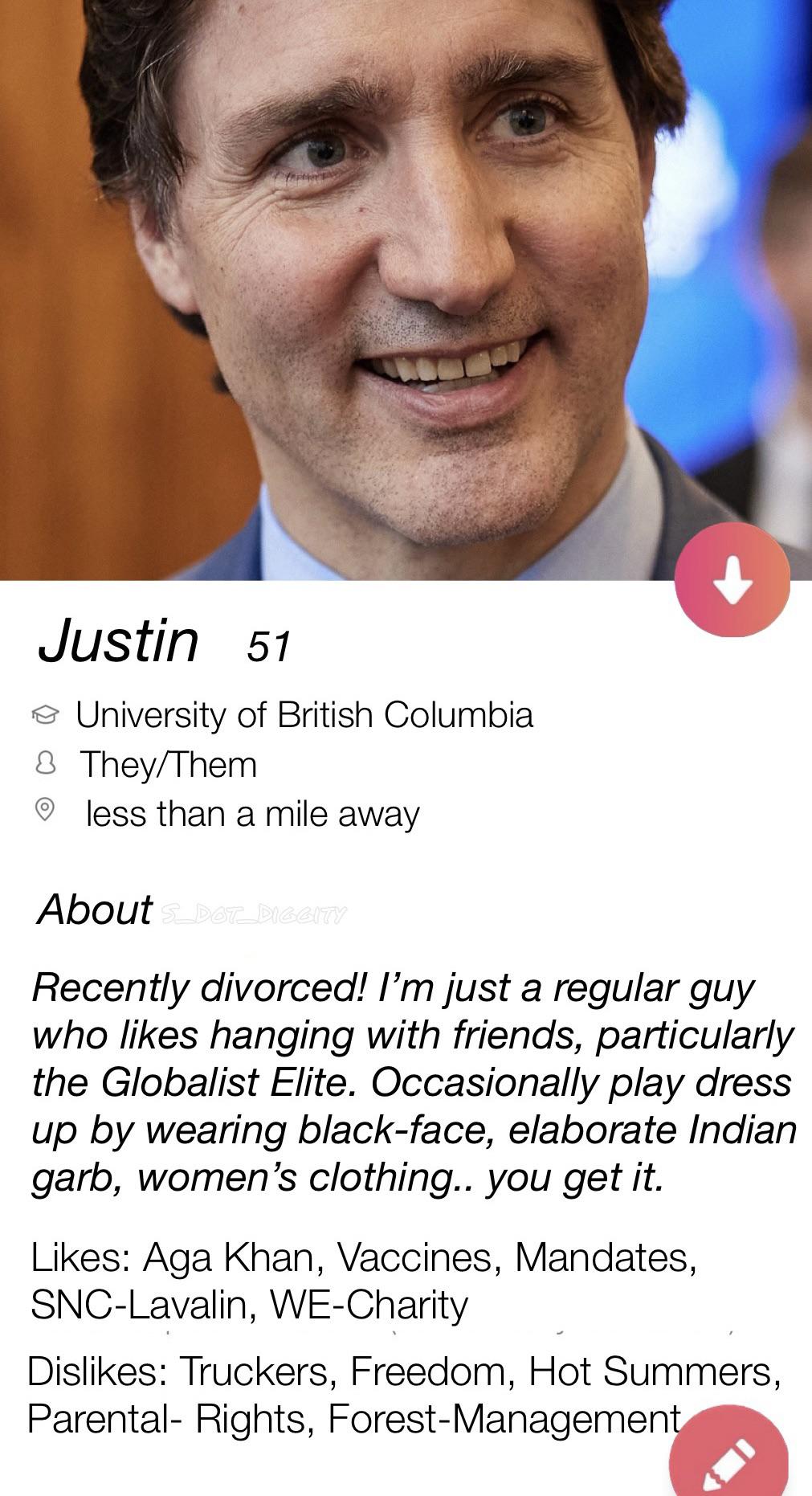
Trudeau’s Tinder Profile


Armstrong Economics Blog/Humor Re-Posted Aug 4, 2023 by Martin Armstrong

Must be a quadruple-vaccinated conformist who rejects all freedoms. Open to all genders or non-genders! Must enjoy long plane rides to Davos, the occasional lockdown, and be interested in implementing the New World Order with me and my friends at the World Economic Forum. Absolutely no truckers or family members of truckers — swipe left if you even own a large vehicle. My friends would say I am overprotective and controlling. I will likely freeze your bank account if you break up with me. Swipe right if you want to be remembered as the next Eva Braun of Canada!