Posted originally on May 12, 2025 by Martin Armstrong
Germany has become increasingly tyrannical in its fight to combat dissenters who do not believe in abandoning nationalism for Brussels. Not only does the German government want to banish political parties who dissent from its narrative, but it has implemented a hotline where citizens may report others who spread “disinformation” and “conspiracy theories.”
The Violence Prevention Network, the Amadeu Antonio Foundation, and the Center for Applied Deradicalization Research launched “Advice Compass on Conspiracy Thinking” (Beratungskompass Verschwörungsdenken) in 2024 as part of the “LivingDemocracy!” project. “Conspiracy theories are accompanied by lies and disinformation. They are deliberately spread to divide our society and destroy trust in independent science, free media, and democratic institutions. Conspiracy theories can lead to extremist ideologies and drive perpetrators to commit crimes and acts of violence. Antisemitic conspiracy theories are particularly often spread,” Federal Interior Minister Nancy Faeser said.
The government’s own website discusses how important it was to silence “disinformation” during the COVID-19 pandemic. The government is urging citizens to be on the lookout for anyone spreading conspiracies surrounding the war in Ukraine
Their website warns the public to look for “people in the immediate environment. Such as family, friends, or school” as they may reveal their independent thinking to the people closest to them. “Open dialogue on equal terms often seems impossible because the other person is not receptive to arguments,” the government states, warning citizens that they should report these free thinkers to authorities who are trained to combat extremism.
“Those seeking advice will receive initial orientation and help in finding suitable counseling services nearby. After a confidential initial consultation, those affected will be referred to a specialized agency if necessary. In this way, we provide very concrete support to those affected and their families while simultaneously strengthening prevention efforts to protect our society from the growing dangers of conspiracy theories,” stated Federal Minister for Family Affairs Lisa Paus, who called conspiracy theories “poisonous to democracy.”
Germany calls their long-term counseling for conspiracy theorists holistic in nature, but it is a re-education and forced indoctrination program. The government does not want the people to have independent thoughts or beliefs that challenge their authority. Loyalty should lie with the government over family, friends, and classmates, all of whom could pose a threat to the government. Be suspicious of thy neighbor.
It is comical that the leftists honestly believe Germany is “finally on the right side of history” when history is in fact repeating. The economy is declining, and the nation is on the precipice of global warfare. The Germans live in fear of World War II repeating, yet, re-education programs are precisely what occurred in Nazi Germany. Schools were transformed into indoctrination centers, and textbooks were revised. Propaganda appeared in every form of media, and stern rhetoric was the primary tool that the Third Reich used to control the masses ahead of warfare. While the government’s current ideological requirements certainly differ from that of the Third Reich, the government is once again forcibly indoctrinating the people, silencing dissent, and forcing family and friends to turn on one another to protect the government above all else.
Posted originally on May 10, 2025 by Martin Armstrong
QUESTION: Mr. Armstrong, a friend of mine attends your conferences and said you’re the only person who understands the economy because you have international experience and have met with many central banks around the world. He said inflation is no longer the simplistic expansion of the money supply, and anyone who said that is still trapped by Keynesian economics. If inflation is not the quantity of money anymore, then can you explain what inflation is all about? Why have you not appeared on Tucker Carlson to explain your theory?
I appreciate your patience.
Rob
ANSWER: The people who put out this theory have ZERO international experience.
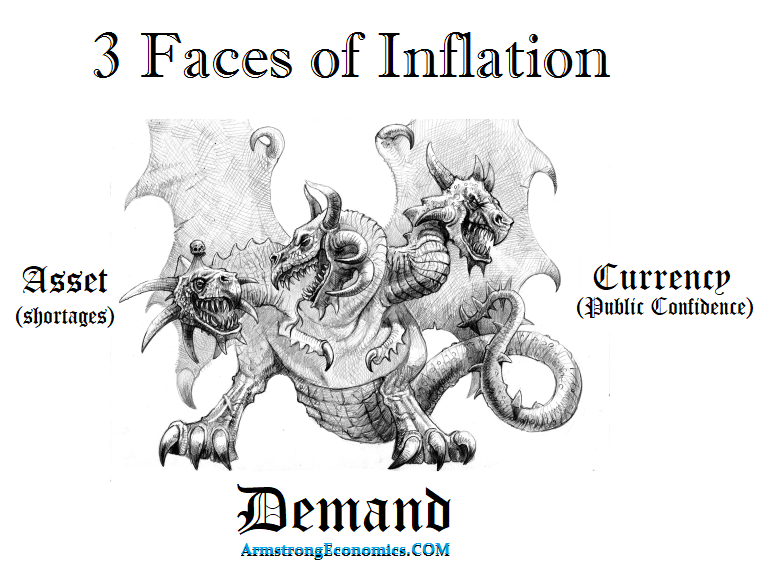
CURRENCY INFLATION:
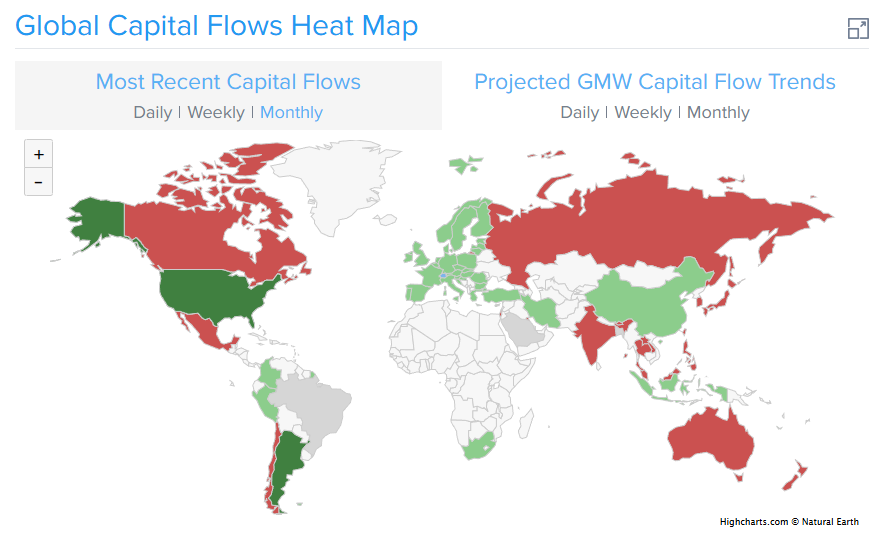
Currency inflation can take place in primarily two ways. First, the currency declines in value, and this attracts foreign capital to rush in for bargains. I did that myself when the British pound fell to $1.03 in 1985. It was like the country on sale at Harrods.
Secondly, let’s say you have a building in it, and I buy it for $10 million. The money supply is not altered. However, let’s say I’m British and I buy your building in the United States. I have to bring British pounds, convert them into dollars, and then pay you your $10 million. I have just increased the domestic money supply and assets, and the central bank had no impact.
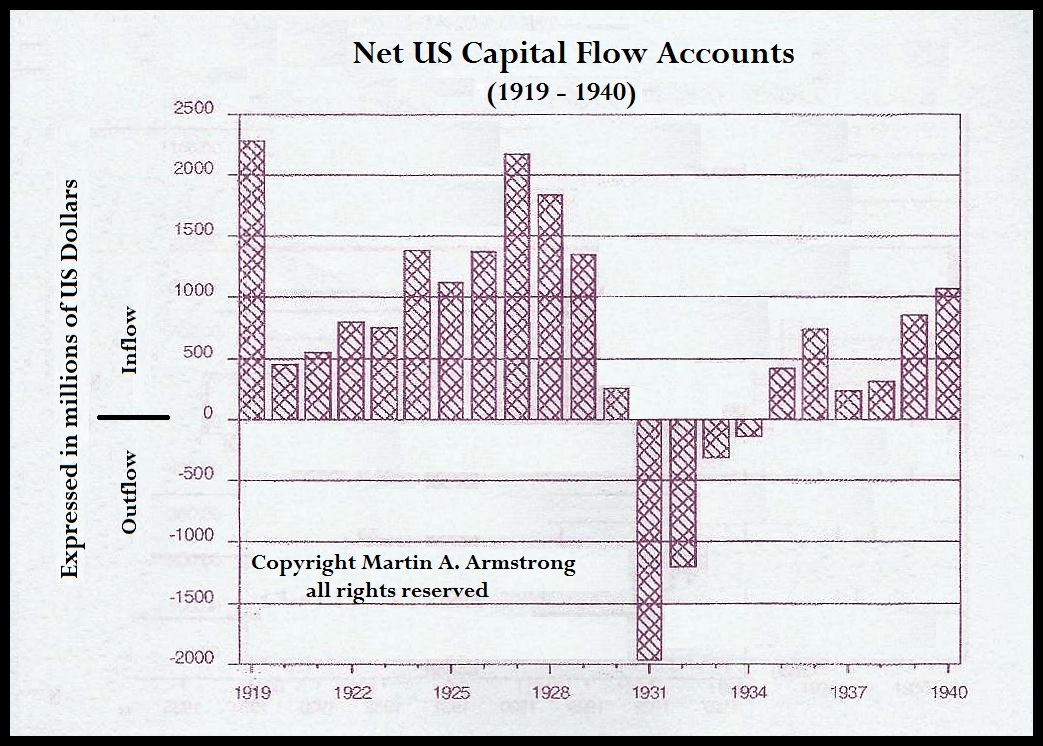
Here are the capital flows during the Great Depression. You see a massive exit of capital in 1931, which was caused by the Sovereign Debt Defaults of 1931, as all of Europe, including Britain and the British Commonwealth, such as Canada, suspended their debt payments. That is what took down 9,000 banks, not tariffs.
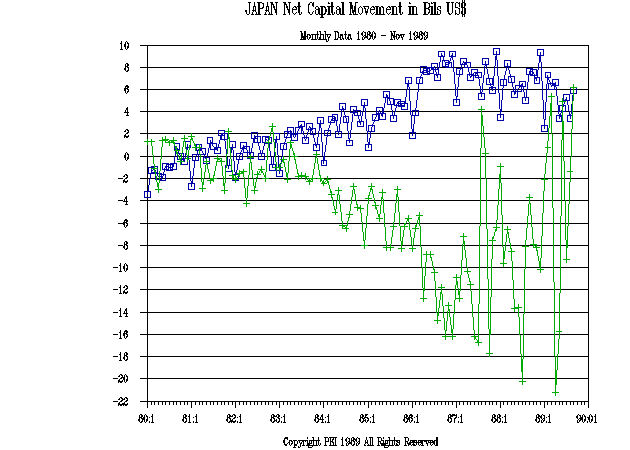
Here are the capital flows for the 1987 Crash, which was also caused by capital outflows. Even looking at the 1989 Japanese Bubble, what made it similar to the 1929 bubble in the USA? Capital inflows and concentration from around the world cause the assets to rise, and money pours into the economy. Currently, Canada has seen a 300% rise in real estate, largely due to foreign capital flowing into the country.
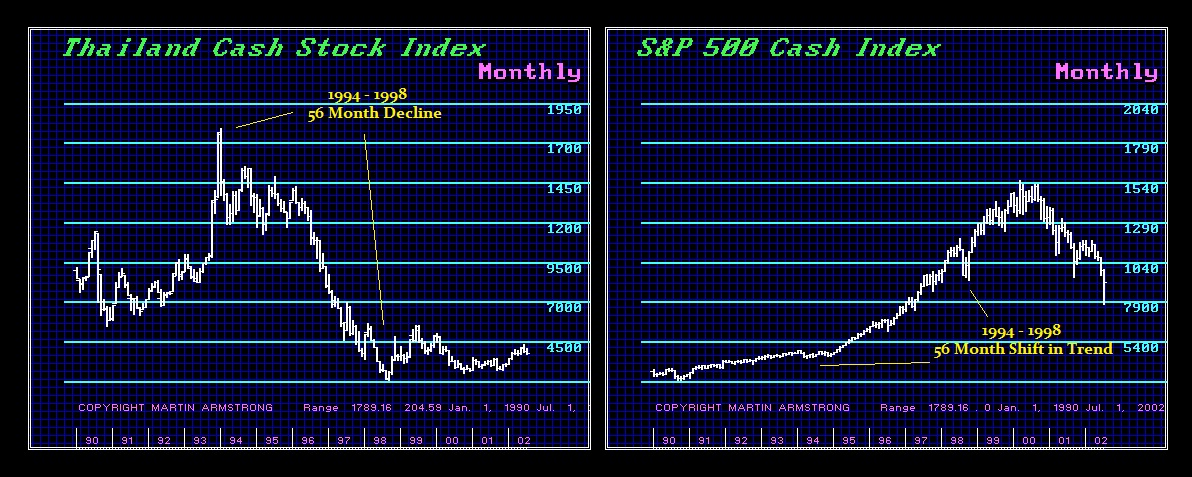
After the 1989 Bubble in Japan, capital then shifted to Southeast Asia. Thailand’s assets soared, both in real estate and stocks. Then it crashed in 1997, as capital was then expected to be the next hot market in 1999. Here you see Thailand’s peak and the US market rose into July 1998. Thailand then passed real estate legislation, which prohibited foreigners from owning land. Foreigners generally cannot own land outright in Thailand, even since the 1997 Asian Currency Crisis. However, exceptions exist for significant investments (e.g., a 2022 cabinet-approved proposal allowing land purchase with a 40 million baht investment in specified sectors, subject to parliamentary processes). This aims to stimulate the economy rather than restrict access.
Foreigners may own up to 49% of the total unit area in a condominium project, provided the funds are imported from abroad, which increases the money supply. Foreigners can lease property for up to 30 years in the classic British system, with potential renewals, although this does not confer ownership – only the right to use. While setting up a Thai company (majority Thai-owned) to hold land is a common workaround, authorities actively scrutinize such arrangements to prevent misuse.
Recent discussions (2022–2023) focused on easing restrictions for high-value investors rather than imposing bans. Thus, Thailand maintains its historical framework: it restricts land ownership but permits certain property investments under regulated conditions. Always consult legal experts for current, case-specific advice. All of this was a response to the 1997 Asian Crisis caused by capital concentration, and then it moved on to the next hot topic.
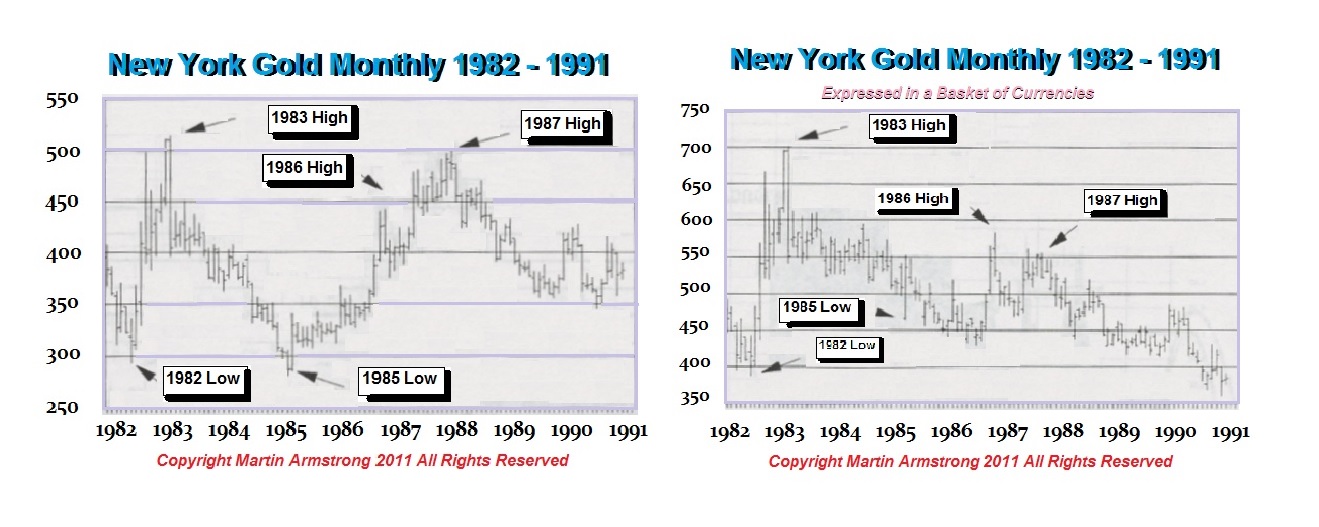
Here, you can see that the price of gold varies by currency, all based on its value. Are you genuinely looking at a chart of gold, or are you only looking at it in relation to the local currency?
DEMAND INFLATION:
This was Keynes’ misconception, who assumed the bull market up to 1929 was purely driven by domestic demand. He proposed raising interest rates to make borrowing more costly and lowering interest rates to encourage borrowing. The idea was seriously myopic. He did not understand capital flows, and that higher interest rates sometimes attract capital, as was the case when Volcker raised interest rates to insane levels in 1981, which sent the dollar soaring to a record high in 1985.
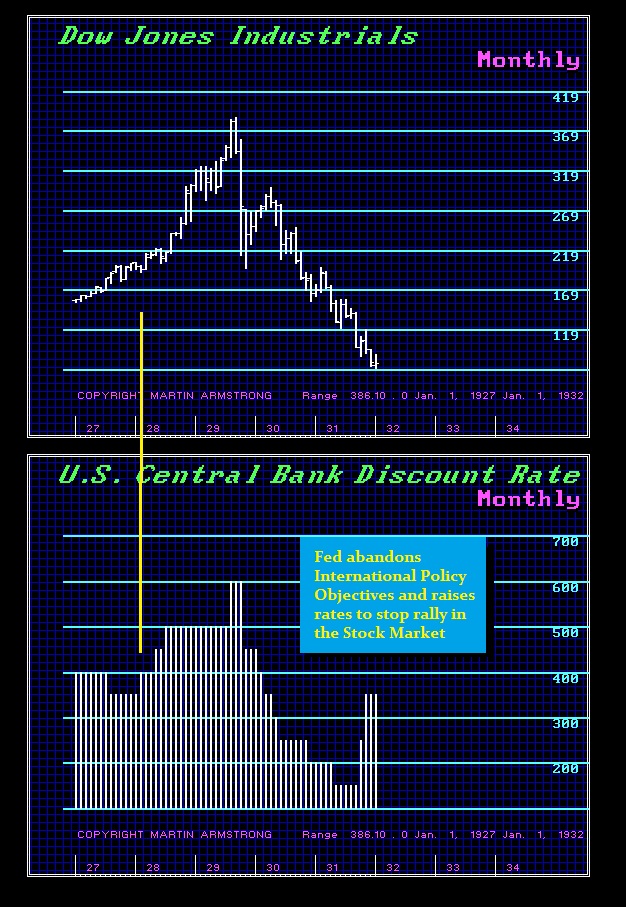
Lowering rates in 1927 to try to deflect the capital inflows back to Europe failed. The Fed raised rates from 3.5% to 6%, and it did not stop the rally in the share market. The Fed then lowered rates from 6% to 1,5% in 1931, and it had no impact on supporting the market. So, again, all we have are failed theories, yet people lacking international experience mouth the same old stuff over and over again because everyone else does.
ASSET INFLATION:
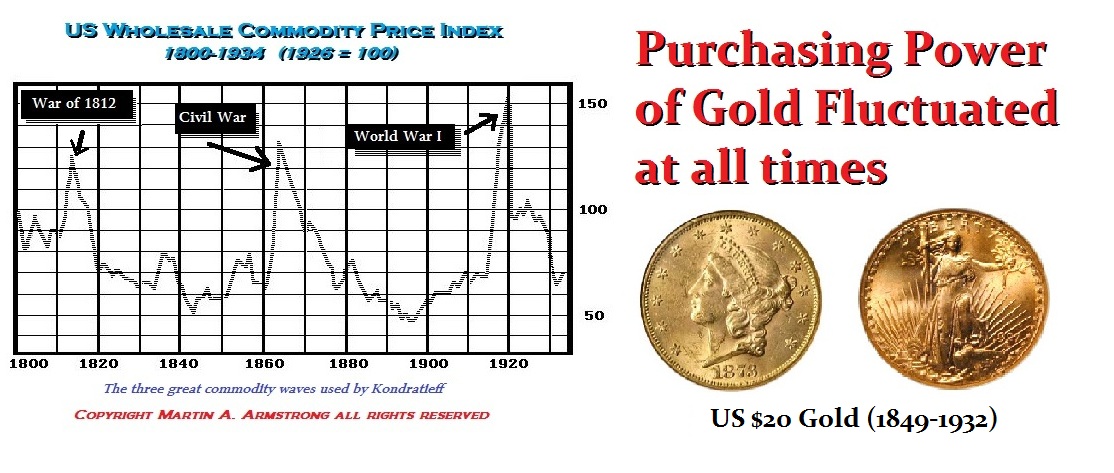
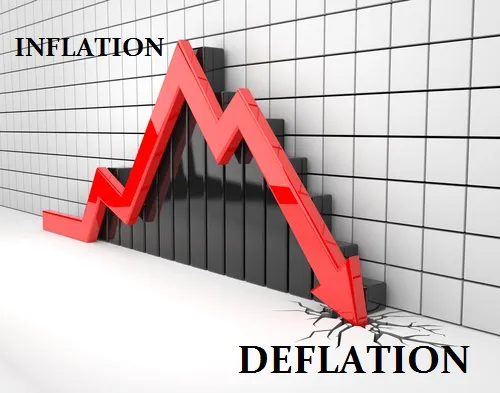
Then you have raw shortages or oversupply. The purchasing value of gold dropped significantly thanks to the 1849 California Gold Rush. During inflation, assets rise in value, and money declines. That took place during the 19th century when a gold coin was money. MONEY has NEVER been of a constant value – NEVER! These people yelling fiat simply do not comprehend that for thousands of years, there has always been a business cycle, and that means money rises and falls in purchasing power, REGARDLESS of whatever it has been. The fiscal irresponsibility of governments is well-documented throughout history, long before the introduction of paper money.
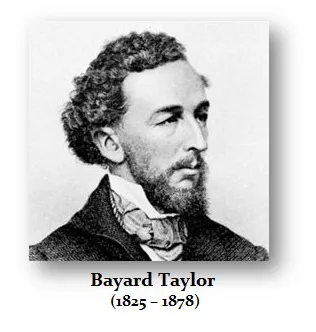
Even under a gold standard, there were periods of inflation and deflation. Read the history of the California Gold Rush. During the 1849 Gold Rush in California, the journalist for the New York Tribune, Bayard Taylor (1825-1878), arrived in San Francisco by ship during the summer of 1849. He was shocked at what he encountered and did not think that anyone would even believe what he was going to write. His dispatches about the gold rush economy in California stunned many and helped to create the 1849 Gold Rush.
The average wage for a laborer in New York was about one or two dollars a day. In California, individual hotel rooms were rented to professional gamblers for upwards of $10,000 a month, which is the equivalent of about $300,000 today. The degree of inflation in terms of gold was astounding and lacks comparison in modern times. There was so much gold that the value of goods rose even though they did not in New York. The inflation phenomenon was local – akin to the Tulip Bubble.
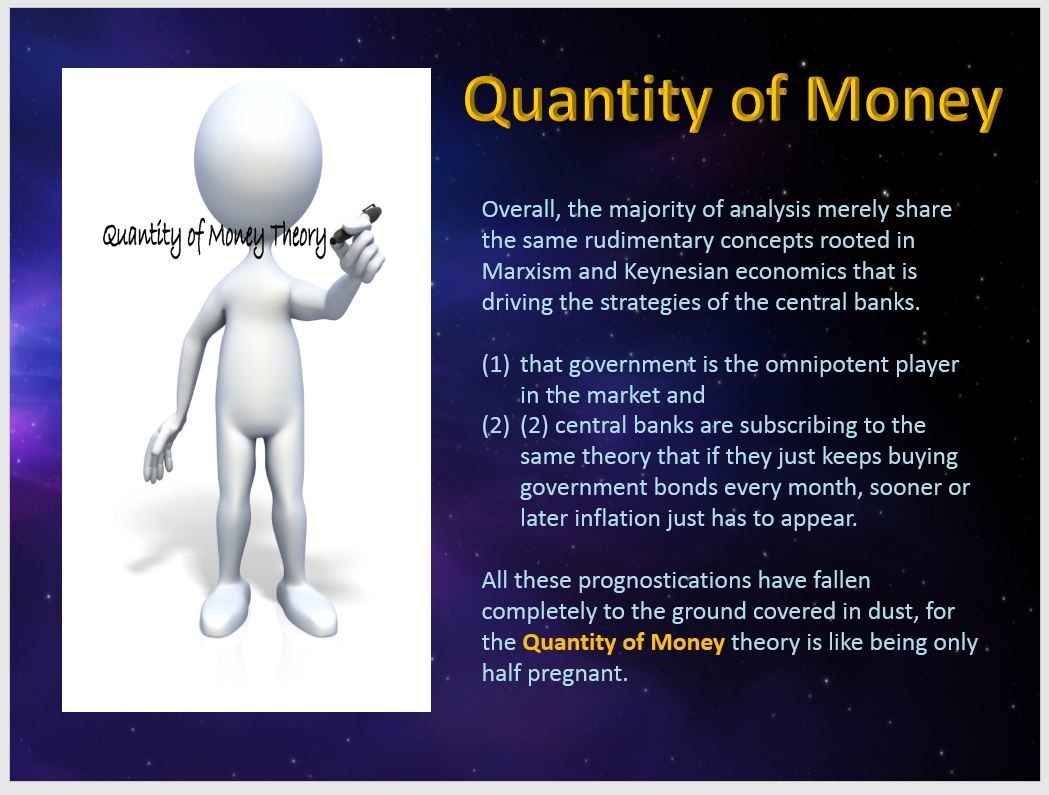
There is a lot more to this than simply the quantity of money. In case you haven’t noticed, some Marxist economists who propose MMT (Modern Monetary Theory) claim that since the U.S. borrows in its own currency, it can print dollars to cover its obligations and can’t go broke. The theory has won converts among freshman Democrats, like Alexandria Ocasio-Cortez, as a way to finance social policies like the Green New Deal and Medicare for All. They pointed to the vast Quantitative Easing (QE) in 2008-2009, and inflation was not created. The European Central Bank expanded the money supply and lowered interest rates to negative in 2014, despite no inflation.
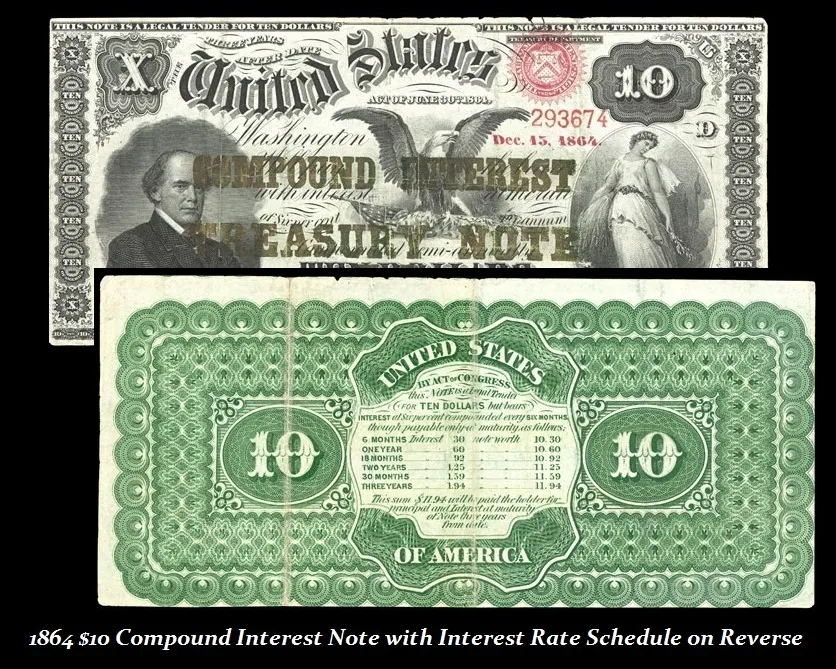
Quantitative Easing (QE) does not increase the Supply of Money—it is only a maturity swap. Today’s total money supply includes debt, unlike during the pre-19th century. This has erroneously given rise to Modern Monetary Theory, for they pointed to QE and said there was no inflation, so that we could print without repercussions. It was merely a swap of maturities when you finally realized that debt is now money that earns interest, as paper money was introduced during the Civil War.
When paper money stopped paying interest, the term “Greenback” emerged, meaning there was no interest payment schedule on the reverse, just green ink. Paper money began as essentially debt or bonds that circulated as a form of cash. Today, people blame the central bank, but remain clueless that the money created by the central bank is only a tiny fraction of the money supply. Because debt issued after 1971 is now legal to use as collateral, posting T-Bills to trade futures, the $34 trillion debt is part of the money supply that dwarfs the central bank. Shutting down the Federal Reserve will make things worse. The real source of inflation under this theory of the Quantity Theory of Inflation is the debt itself.
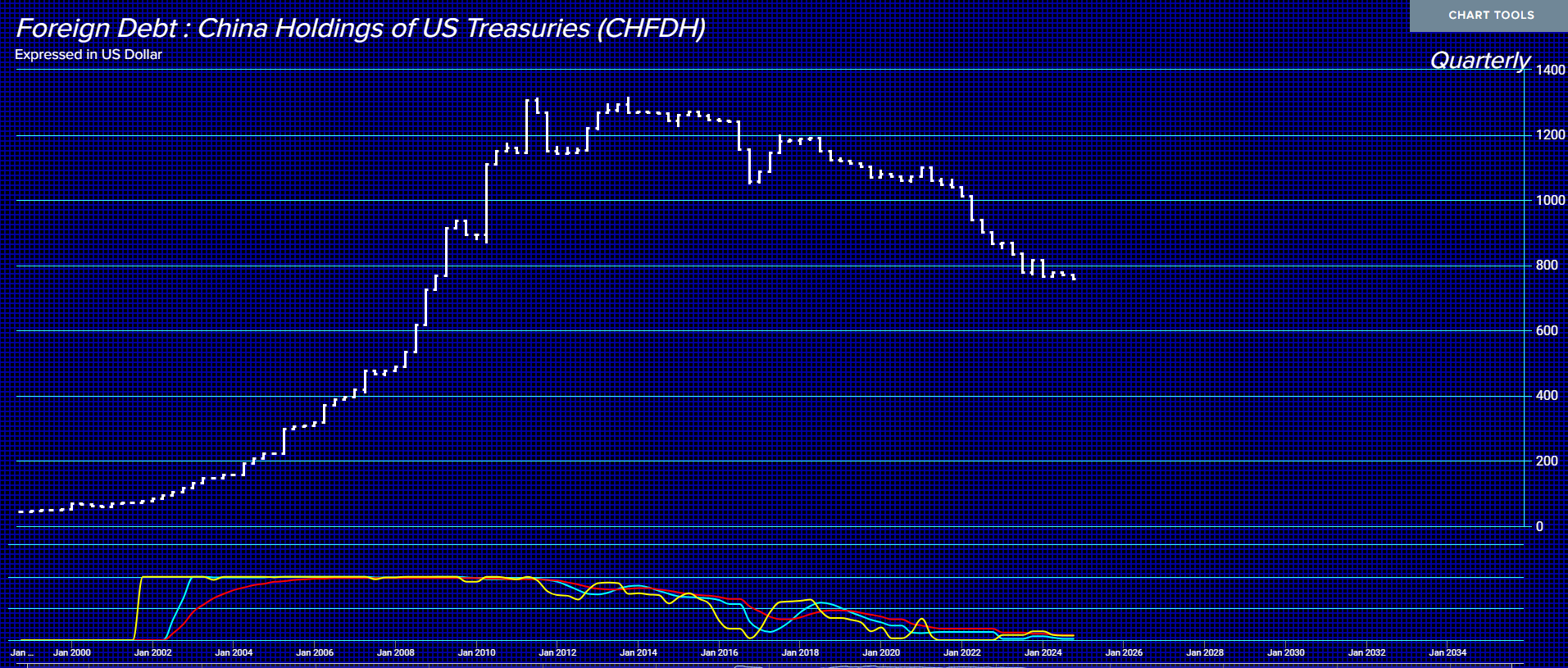
Moreover, we pay interest, and that no longer stimulates the economy because much of it is held offshore. China has 10% of the US debt, which accounts for 10% of the $1 trillion in interest payments that flow to China, not the domestic economy.
If your Definition of Money is Wrong, So is Everything Else that Follows
As far as Tucker is concerned, I haven’t been invited, and I’m not sure he would want someone who doesn’t agree with 99% of the analysts on this subject.
And by the way, this is not theory – it’s plain experience and observation.
Posted originally on Apr 24, 2025 by Martin Armstrong
QUESTION: A recent analysis by Allianz economists claimed that, ordinarily, when yields on Treasuries rise, the U.S. dollar strengthens as foreign capital pursues those higher yields. However, the dollar weakened as yields rose. They said that in this instance, it “suggests major holders were not only selling Treasuries but also converting the proceeds into currencies – possibly reallocating to European markets.”
This does not seem to be correct. It looks like an opinion. Could you comment on this, please?
Thank You
Greg
ANSWER: I think a lot of people fail to appreciate the stark difference between the US markets and Europe. The NYSE is worth MORE in total capitalization than all of Europe COMBINED! The US consumer spending on a bad day is still 25% of global consumer spending. Europe accounts for $1.20 out of every $10 spent. Europe CANNOT be a reservoir for big capital. It is so socialistic, it is a joke. We invented capital flow analysis, and we have the actual data.
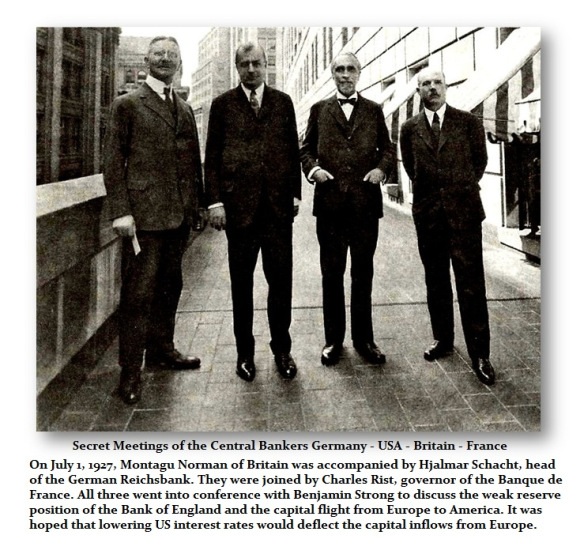
This idea is not original about interest rates and capital flows. This is the typical academic theory they still teach in schools today. In 1927, that was the FIRST G4 meeting where Britain, France, and Germany petitioned the NY Fed to lower interest rates in hopes that that would send capital back to Europe. When they did that, it CONFIRMED that there was a debt crisis, and even more money poured into the USA.
The Fed cut rates in the US to help Europe, and the markets continued to rise as capital flows into the US intensified. The money was pouring into the US equities, and the Dow more than doubled as the Federal Reserve raised rates from 3.5% to 6%.
China has been reducing its holdings of US debt ever since the 2014 Ukrainian War began and the Biden Administration threatened China with sanctions if it helped Russia. This is what I have spoken about the BRICS is all about: geopolitical theater, not economics. China saw removing Russia from SWIFT as using the world financial system as a geopolitical tool. The Biden Administration was run by the Neocons, who do not care about the people or the economy, only their myopic desire to destroy Russia.
This is why FOX News or any mainstream news organization would NEVER invite me because I rain on their parade. This is all about feeding people the narrative they agree with. This is never about news.
BLOOMBERG
Bloomberg has crossed to the dark side of propaganda; They are more concerned about hating Trump than they are about reporting just the facts, ma’am. They reported:
“The rotation by investors out of American assets will go on for years if President Donald Trump persists with his global trade war.”
“The Trump administration has arguably opened the door for the country’s financial dominance to be challenged, with the dollar and Treasury bonds losing appeal in what may be a dire shift of fortunes for America. US equities also have been underperforming global peers this year amid fear that Trump’s strategy of tariff chicken will damage growth and stoke inflation.”
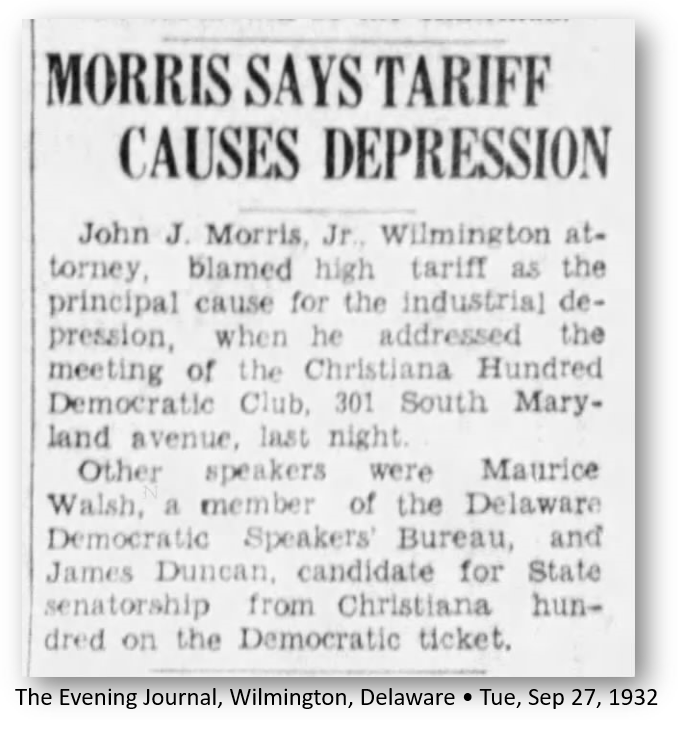
This is all based on the Democrats’ propaganda during the 1932 presidential election. As I have said, there is no serious economist I have ever heard blame the Great Depression on the tariffs, which did not come into effect until June 1930, and they were a response to Europeans raising taxes 33 times after World War I.
By the way, Japan and China have also been dumping European Debt. With Europe pushing for World War III, you have to be insane to buy European debt. European shares hold the risk of capital controls, and you will not get your money out when the first bullet is fired.
So, people are selling US shares and debt and moving to Europe as a safe haven? They must be the same people who are still driving alone in their car with a mask on to feel safe.
Posted originally on Apr 15, 2025 by Martin Armstrong
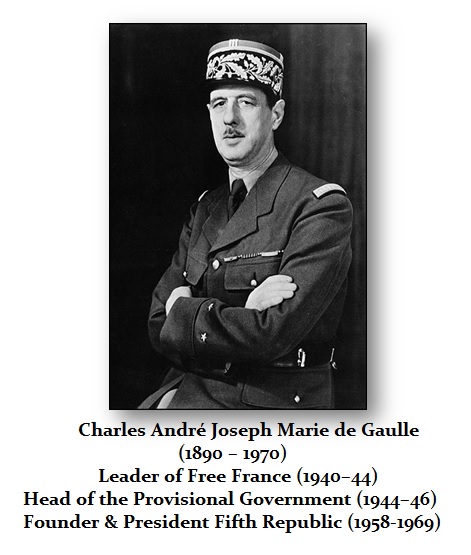
There is much speculation about Germany withdrawing its gold holdings from the United States. We have seen this occur in recent history. In the 1960s, French President Charles de Gaulle began challenging the U.S. dominance in the global monetary system. Gold typically flows where capital feels safe, but in this case, France repatriated its gold from the US due to political tensions.
In 1965, French President Charles de Gaulle withdrew his ministers from the Council of the EU, thereby constituting a de facto veto over all decisions, which became known as the “Empty Chair Crisis.” Several issues regarding European political integration led to the Empty Chair Crisis. There was a push at that time to create the quasi-federalization of Europe. De Gaulle believed that national governments should move towards integration. Still, he did not agree with the Commission’s attempt to create some new super-central state or a federalized Europe, extending powers of the EU beyond national borders as we have today, which Margaret Thatcher also opposed.
President Charles de Gaulle has proposed the Fouchet Plan was a plan back in 1961 to create a new grand design for Europe. Charles de Gaulle wanted to develop a three-power directorate, consisting of France, Britain and the United States. The idea was to form a new ‘Union of States’, as an alternative to the European Communities (EC). De Gaulle feared a loss of French national influence in the EC as there was a drive to federalize Europe back then.
After the failure of the Fouchet Plan and De Gaulle’s veto of the United Kingdom’s application for EC membership, the Commission attempted to move towards integration by proposing an idea that would combine the Common Agricultural Policy (CAP), the European Parliament, and Commission. De Gaulle supported the creation of the CAP and favored its enactment. However, he disagreed with the Parliament’s new role, the Commission’s strength, the shift towards federalization and a central state, and the budget proposals for financing the CAP. De Gaulle made it a condition that majority voting with a right to veto must exist if France was to participate in the EC. When de Gaulle was denied a more intergovernmental Commission or voting and veto rights, the French representative left the Council of Ministers thereby creating the Empty Chair Crisis.
The Luxembourg Accord was an agreement reached in January 1966 to resolve the “Empty Chair Crisis,” which had caused a stalemate within the European Economic Community. Then on June 21, 1966, de Gaulle withdrew France in a shocking move, taking its troops from the North Atlantic Treaty Organization (NATO). This decision, led by French president Charles de Gaulle, complicated relations between the U.S. and Europe amidst clashing American and Communist spheres of influence. Though France remained politically in NATO, its actions cast doubt on the organization’s future as a counter to Soviet military power and control back then.
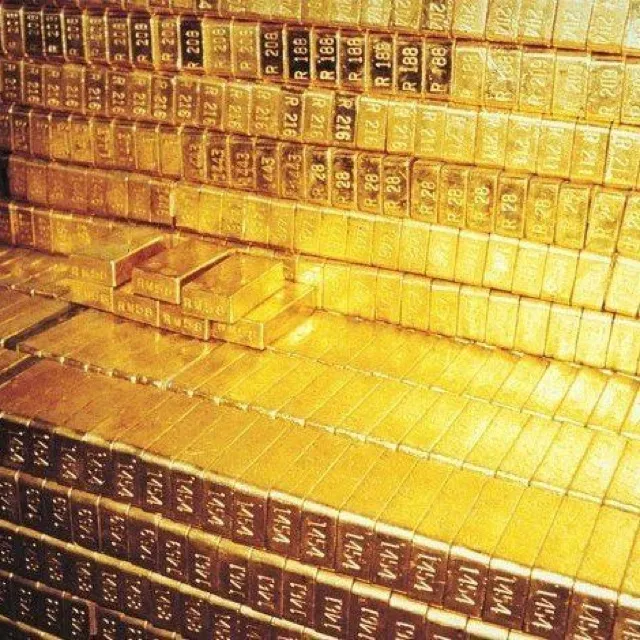
From 1963 to 1966, France secretly implemented Operation Vide-Gousset to repatriate 3,313 tons of gold reserves from the Bank of England and the New York Federal Reserve. It took over 44 boat trips and 129 flights to export the gold back to the Banque de France. Since France converted its dollar holdings into gold, the French made out well when the dollar fell during the Bretton Woods period and lost 96% of its value against gold. France then withdrew from the London Gold Pool in 1966 after recovering its gold holdings to force the US to endure heavier losses.
France’s actions caused a gold run with nations eagerly reducing their holdings at the New York Fed. West Germany reclaimed 1,200 tons of gold. Switzerland increased gold purchases from both the US and UK, but did so more discreetly than France to avoid political upheaval. By 1971, before the gold window closed, the United Kingdom requested $3 billion in gold conversions from the US. This may have been the final move that pushed Nixon to act. The Netherlands and Belgium also began exporting gold holdings from the US at this time.
US gold stock fell from $22.7 billion in 1950 to $12 billion by 1971. On August 15, 1971, President Nixon closed the gold window, ending the convertibility of the dollar into gold. The 1971 closing of the gold window by Nixon cut the link to gold, ending Bretton Woods.
“The speculators have been waging an all-out war on the American dollar,” Nixon declared, and to “protect the dollar from the attacks of the international money speculators” would take “bold action.”
“I have directed [Treasury] Secretary Connolly to suspend temporarily the convertibility of the dollar into gold.”
France’s actions were a catalyst to the inevitable decision to close the gold window, but not the sole cause. Yet, as we are seeing today, the primary reason that nations would like to withdraw their holdings comes down to politics. Charles de Gaulle said that the dollar was “monumentally over-privileged” and moved to hurt the USD. The incoming German government is now looking to withdraw their holdings from the US solely due to their distaste for America.
Posted originally on Apr 15, 2025 by Martin Armstrong
The United States has about 330 million people, and one in every $3 spent in world trade is by American Consumers. Europe has 450 million people, but it still clings to Marxism, is highly regulated, and is very anti-entrepreneurial. Trump fails to grasp here that trade wars will NOT even the score. The global consumer market seems to be ignored. As I have explained, the Current Account, which people call the trade account, also includes all interest and dividends on stocks, bonds, and investments. In theory, if China bought 100% of the US national debt, then the perceived trade deficit from interest of $1 trillion would flow to China, and this has nothing to do with jobs or manufacturing anything.
Let’s clarify trade. The United States has the largest economy in the world, so it’s the top contributor to global consumer spending. China would be next, followed by countries like Japan, Germany, the UK, India, and so on. Note that China is already the #2 consumer-based economy. Europe is far too Marxist, and it still clings to the old theories of Mercantilism. The average German has less net wealth than an Italian, yet they are the biggest economy.
In recent years, the global GDP has been around $100 trillion. Depending on the economy, consumer spending typically makes up about 60-70% of a country’s GDP. So, if we take 65% of $100 trillion, that’s about $65 trillion in global consumer spending annually in theory. Now, breaking this down by country. The US GDP is around $25 trillion. If US consumer spending is about 68% of GDP, that would be roughly $17 trillion. Therefore, the US share would be 17/65, approximately 26%. That means we have a US consumption-driven economy.
China’s GDP is around $18 trillion. However, consumer spending as a percentage of GDP is lower, maybe around 40%, because their economy is more investment—and export-driven. So 40% of $18 trillion is $7.2 trillion. That would be about 11% of the global total ($7.2T / $65T).
Let’s compare this to Japan’s GDP, which is about $4.9 trillion. Consumer spending there is higher as a percentage, maybe around 55%, so $2.7 trillion. That’s roughly 4.15% globally.
Germany’s GDP is around $4.2 trillion. With consumer spending at around 50% of GDP, that’s $2.1 trillion, so 3.2% globally.
India’s GDP is approximately $3.4 trillion. Consumer spending accounts for a larger part, maybe 60%, so the total is $2.04 trillion, which is about 3.14% of the global total.
The UK’s GDP is about $3.1 trillion. Consumer spending at 60% would be $1.86 trillion, so around 2.86%.
France’s GDP is $2.9 trillion. Consumer spending at 55% gives $1.6 trillion, about 2.46%.
Brazil’s GDP is $2.0 trillion. If consumer spending is 60%, that’s $1.2 trillion, so 1.85%.
Italy’s GDP is $2.1 trillion. Consumer spending at 60% would be $1.26 trillion, around 1.94%.
Canada’s GDP is $2.0 trillion. Consumer spending at 57% gives $1.14 trillion, which is 1.75%.
South Korea’s GDP is $1.7 trillion. Consumer spending at 50% is $0.85 trillion, so 1.3%.
Russia’s GDP is around $1.8 trillion. If consumer spending is 50%, that’s $0.9 trillion, about 1.38%.
Australia’s GDP is $1.6 trillion. Consumer spending at 55% would be $0.88 trillion, 1.35%.
Consequently, the total for these top countries is around 59.65%, leaving about 40.35% for the rest of the world. This is all based on rough estimates. Then we also have nominal GDP vs. PPP (Purchasing Power Parity). However, consumer spending in nominal terms is usually what’s used for such global comparisons, further complicating our exercise.
Another consideration: The figures I used for consumer spending as a percentage of GDP might not be accurate for each country. For example, China’s consumer spending as a percentage of GDP has been increasing but was historically lower. According to the World Bank, in 2022, China’s household final consumption expenditure was about 38% of GDP. The US was around 68%, Japan about 55%, Germany 52%, India was around 59%, UK 63%, France 54%, Brazil 64%, Italy 61%, Canada 57%, South Korea 48%. So my initial estimates were somewhat close but may need adjustment.
US: 25T GDP * 68% = 17T
China: 18T * 38% = 6.84T
Japan: 4.9T * 55% = 2.695T
Germany: 4.2T * 52% = 2.184T
India: 3.4T * 59% = 2.006T
UK: 3.1T * 63% = 1.953T
France: 2.9T * 54% = 1.566T
Brazil: 2.0T * 64% = 1.28T
Italy: 2.1T * 61% = 1.281T
Canada: 2.0T * 57% = 1.14T
South Korea: 1.7T * 48% = 0.816T
Russia: 1.8T * 52% = 0.936T (assuming 52%)
Australia: 1.6T * 55% = 0.88T
Spain: 1.4T * 58% = 0.812T
So total consumer spending from these 14 countries is approximately $41.389 trillion out of about $65 trillion globally.
Now, converting each country’s consumer spending to a percentage of global:
US: 17 / 65 = 26.15%
China: 6.84 / 65 ≈ 10.52%
Japan: 2.695 / 65 ≈ 4.15%
Germany: 2.184 / 65 ≈ 3.36%
India: 2.006 / 65 ≈ 3.09%
UK: 1.953 / 65 ≈ 3.00%
France: 1.566 / 65 ≈ 2.41%
Brazil: 1.28 / 65 ≈ 1.97%
Italy: 1.281 / 65 ≈ 1.97%
Canada: 1.14 / 65 ≈ 1.75%
South Korea: 0.816 / 65 ≈ 1.26%
Russia: 0.936 / 65 ≈ 1.44%
Australia: 0.88 / 65 ≈ 1.35%
Spain: 0.812 / 65 ≈ 1.25%
Others: 36.3%
Please remember that these percentages are estimates of global consumer spending by country based on GDP and consumption patterns. The United States is the largest consumer-based economy in the world, and about 26% of total world spending involves the American consumer. China is only 10.5%, and Japan is at 4.1%. Europe comes in at around 12%.
In summary, China is actively trying to build a more consumer-based economy, with policies and trends supporting this shift. However, structural and demographic challenges might slow this transition into 2028. The progress is evident, but it’s a work in progress. After 2032, they hold the potential to surpass the United States as the financial capital of the world. The problem in the United States is that the Democrats keep trying to oppress the economy like Europe, imposing socialistic goals that are not economically efficient.
Key Evidence of China’s Transition:
Rising Consumption Share of GDP:
Household consumption contributed 53% of GDP in 2023, up from ~35% in 2010. While still lower than the U.S. (~68-70%), this marks significant growth.
Services and high-tech industries are expanding, reflecting demand for healthcare, education, and entertainment.
Policy Shifts:
“Dual Circulation” Strategy:
Emphasizes domestic consumption (internal circulation) alongside international trade, reducing reliance on exports.
Social Reforms:
Efforts to strengthen social safety nets (pensions, healthcare) aim to lower household savings rates, freeing income for spending.
Urbanization and Middle-Class Growth:
Over 60% of China’s population now lives in cities, fostering a consumer class with higher disposable income.
E-Commerce and Digital Economy:
China leads globally in e-commerce (e.g., Alibaba, JD.com) and digital payments, facilitating consumer spending. The digital economy accounts for ~40% of GDP.
Challenges to a Consumer-Driven Model:
Structural Imbalances:
Investment and exports still dominate (e.g., state-led infrastructure, real estate). Transition requires rebalancing toward the private sector and services.
Household debt
has risen to ~62% of GDP (2023), potentially constraining spending.
Demographic and Social Factors:
Aging Population: By 2035, 30% of citizens will be over 60, likely increasing savings and reducing consumption.
Income Inequality: Rural-urban gaps and uneven wealth distribution limit broad-based consumption growth.
Geopolitical and Economic Risks:
Trade tensions and global demand volatility (e.g., post-COVID, U.S.-China decoupling) pressure China to prioritize domestic demand.
Real estate sector
Slowdowns could dampen consumer confidence.
China is deliberately building a consumer-based economy through policy reforms, urbanization, and digital innovation, rejecting the European mercantilist economic philosophy. While progress is evident, structural hurdles, such as reliance on investment aging demographics, mean the transition will be gradual but ongoing. The government’s success in addressing these challenges will determine the pace and sustainability of this shift. China’s economy remains a hybrid model, blending consumption growth with traditional drivers like state investment.
The current account is a key component of a country’s balance of payments, recording international transactions in goods, services, income, and transfers. It consists of four main components:
Trade in Goods (Visible Trade):
Exports and imports of tangible products (e.g., machinery, vehicles, electronics).
The balance of trade in goods is often referred to as the “merchandise trade balance.”
Trade in Services (Invisible Trade):
Exports and imports of intangible services (e.g., tourism, financial services, education, consulting, transportation).
Combined with trade in goods, this forms the trade balance (goods and services).
Primary Income (Income Flows):
Cross-border income from investments and employment:
Investment income: Dividends, interest, profits from foreign investments (e.g., dividends from overseas stocks).
Compensation of employees: Wages, salaries, or benefits earned by workers in a foreign country (e.g., remittances from expatriates).
Secondary Income (Current Transfers):
One-way transfers where no goods, services, or assets are exchanged in return:
Remittances: Money sent by migrants to their home country.
Foreign aid/grants: Government transfers (e.g., disaster relief, development aid).
Pensions, gifts, or donations: Transfers between individuals or organizations.
A Trade War based on just the gross of the Current Account does NOT reflect our trade deficit or surplus.
Foreign investors overall own roughly 10-20% of Manhattan’s high-end residential properties (e.g., condos), with Europeans constituting a significant but minority share of this group. For example, if Europeans account for 30-40% of foreign-owned properties, their stake might be 3-8% of Manhattan’s luxury residential market. While exact figures are elusive, Europeans likely own 3-7% of Manhattan’s total real estate, with higher concentrations in luxury residential and prime commercial sectors. This is only an estimate and not definitive. Any income, such as rents, on that property will flow out through the current account and will appear as a trade deficit when it has NOTHING to do with trade.
As of 2023, approximately 23-24% of the total U.S. national debt is held by foreign entities. This calculation is based on foreign holdings of around $7.4 trillion out of $31.4 trillion at the time. Therefore, of about $1 trillion in interest expenditures. Thus, about $230+ billion is flowing out through the current account that has nothing to do with trade. The major holders of US national debt include Japan, China, and the United Kingdom.
Understanding these components is now CRITICAL in the middle of a trade war. The sale of US debt will go through the capital account, but it will reduce the interest paid to foreigners that go through the current account, creating the illusion of a trade deficit. I disagree with Trump’s formulas, and the risk of a permanent trade war with China is now assured unless he gets on a private phone call. You cannot make public demands against China for then they cannot back down based on their culture.
Posted originally on Apr 14, 2025 by Martin Armstrong
The technology coming out of China is quite remarkable. China has unveiled the world’s first pilotless air taxi service. The Civil Aviation Administration of China (CAAC) issued Air Operator Certificates (OCs) to EHang Holdings in Guangdong Province and its subsidiary, Heyi Aviation. The companies believe this will boost China’s tourism sector and pave the way for the normalization of flying vehicles over the next five years.
EHang’s EH216-S is a two-seat electric drone that can travel at a top speed of 80 mph (130 km/h) over a range of 18.6 miles (30 km). Heyi Aviation has a similar model as well that is meant for “low-altitude economy” flights. Initial operations will be restricted to closed-loop routes that land and takeoff at the same location.
Ehang’s Vice President He Tianxing said phase one of pilotless taxis will begin this year into 2026, focusing solely on tourism travel in Zhuhai, Shenzhen, Taiyuan, Wuxi, Wenzhou and Wuhan. Flights will initially vary from three to 10 minutes as phase one is about novelty and the excitement of air travel rather than commuting or transportation. Tianxing said the experience is “just like riding in a car.”
“The human-carrying pilotless aviation and the low-altitude economy, as an emerging industry, is still in its developmental stage and remains a national strategic focus in China’s aviation sector,” EHang said. There are still many challenges to be addressed and improvements to be made, requiring industry-wide collaborations.”
Phase two will occur from 2026 to 2030 to include urban air taxis capable of traveling longer distances. These taxis will be used for actual commuting and transport purposes, creating a new “low-altitude economy.”
The US has attempted to compete with eVTOL aircrafts for “power-left” vehicles, according to the Federal Aviation Administration, and are designed to land and take off vertically to avoid the need for a runway. However, the FAA has not approved of a pilotless aircraft. Estimates stat that this business could grow into a $30 billion opportunity by 2035.
China expects the new low-altitude economy, which also includes drones and air sports, to be worth $205 billion (1.5 trillion yuan) by the end of 2025. The CCP is aggressively pushing this new niche and expects it to double in size by 2035. What was once an idea seen only in science fiction films is now a reality. It will be quite interesting to see how this technology plays out in potentially reshaping travel.
I have created this site to help people have fun in the kitchen. I write about enjoying life both in and out of my kitchen. Life is short! Make the most of it and enjoy!
This is a library of News Events not reported by the Main Stream Media documenting & connecting the dots on How the Obama Marxist Liberal agenda is destroying America
















 Centinel2012