HPSCI ranking member Devin Nunes appears on Fox Business with Jackie deAngelis to discuss the latest developments in the Michael Flynn case and the John Durham investigation. WATCH:
.
Additionally (Hat Tip Techno-fog) who helps connect some dots left during recent comments by DOJ Spokesperson Kerri Kupek about “delays in proceedings” and what might be the most likely cause. Good stuff, that makes buckets of sense.
I cannot (yet) go into details without seriously undermining my own efforts. However, this previous GJ delay completely aligns with my own boots-on-the-ground information; and the previous statements by AG Bill Barr and DOJ Spox Kerri Kupec.
Keep smilin’…
And more importantly, keep living your best life…
I’m back on the road tomorrow… and things are good.
When we originally mapped this out, the mid-August timeline always appeared to be the inflection point. That’s why I made it my own target date to organize massive ‘Phase-2’ sunlight in the event Barr/Durham failed to deliver. Everything is proceeding swimmingly.
We as farmers are paying a price as our pm is bad-mouthing the Chinese. We, Australian farmers, have had a rough deal over the last 30 years because we lost $12 /ton on the Iraq debt, the UN destroyed our AUST WHEAT BOARD SHARE PRICE OVER WHAT SALES TO SADDAM HUSSEIN so the SHARE went FROM $6.5 TO $1 PER SHARE and then it was taken over by a Canadian company for $1.5/share.
Cheers P
REPLY: This coronavirus has been a political coup, and we are heading into a confusing time for markets as well as politics. We have the CEO of Facebook, Mark Zuckerberg, who is now calling for the breakup of the US government and boldly saying that no one government can stand up against Facebook. This political turmoil has reached an absolute toxic level, and the impact of that is the destabilization of confidence in the future. That undermines the markets going forward.
As it now stands, we should see a retest of support in wheat produce going into the fourth quarter of 2020. We still see 2020 as a Directional Change, but the market will routinely create the false move to get everyone on the wrong side in order to create the necessary powerful slingshot. So just understand that it will get worse BEFORE it turns around. This virus has undercut the supply chain, and the rising tensions with China will only add to the confusion. We seem to have the worst possible politicians in key places at the exact wrong time.
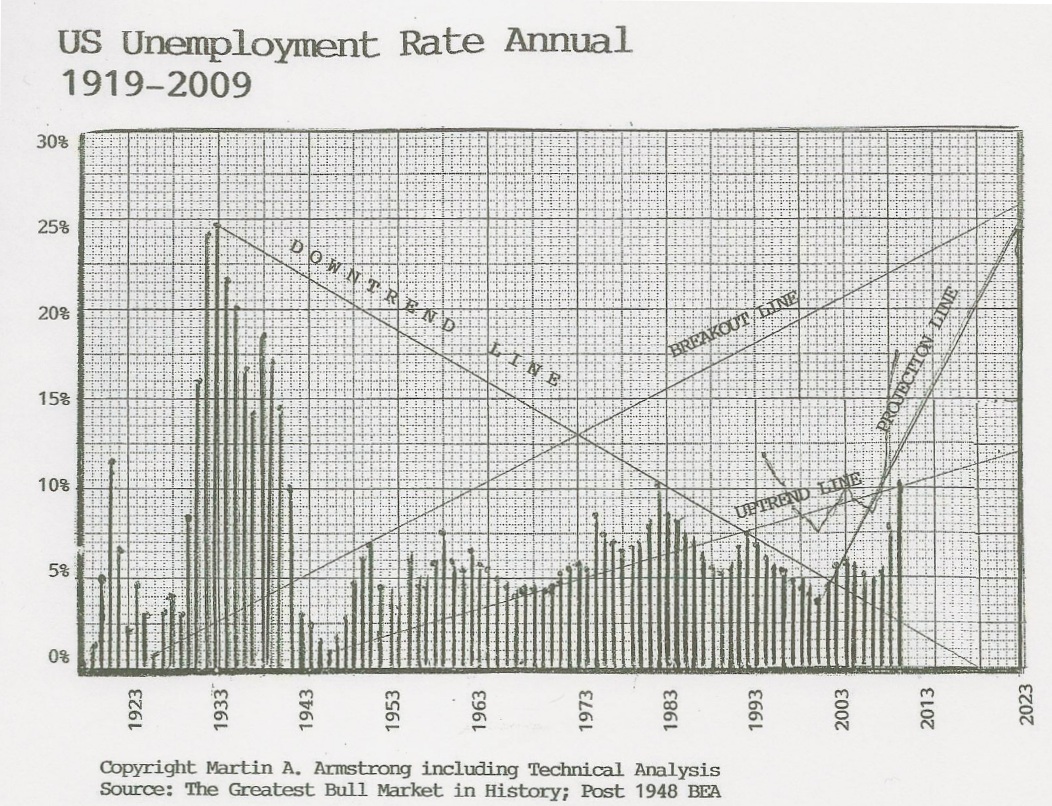
As we head into the fall of 2020, the damage from this coronavirus lockdown will begin to make its full impact felt. While about 25 million unemployed receive $600 a week, there remain arguments to reduce that to $200. Meanwhile, the real impact will be witnessed as the eviction moratorium, which lasted for nearly four months, ends as it will raise the risk of many being put out on the street. Over 12 million renters are already behind on rent payments thanks to these lockdowns. The small businesses that are in trouble cast a very dark cloud over commercial real estate. Virtually every small shopping strip even in Florida has signs out for rent.
The total official unemployment figure for the US stands at more than 31 million who have collected unemployment benefits of some form. However, our model shows the real number is closer to 40 million given all the part-time people who were not entitled to unemployment. At the start of the year, the total civil workforce was about 164,606,000. The official unemployment rate is about 19%, but counting the full scope we have reached the same levels of the Great Depression. Small business always suffers the most during such declines disproportionately. This will impact future economic growth.
During a questioning session by Rep. Jim Jordan, AG Bill Barr outlines a secondary, parallel, investigation ongoing by U.S. Attorney John Bash [@01:40 of video]. In his response AG Barr notes the breakout investigation assigned to Bash to review the unlawful unmasking of Donald Trump campaign officials.
Worth noting AG Barr explains the unmasking investigation is not limited to the post election period, transition and incoming administration. The investigation extends further back in the government surveillance of Trump associates in the 2015/2016 campaign. That unmasking could, likely does, include the use of the FBI-NSA database where ‘unmasking’ is an analogous term with”minimization”. {Go Deep}
.
AGAIN, there is a name -a key person- that is never mentioned within these stories. One person, who no-one knows, whose name has never appeared, who is doing the larger investigative over-watch. The five member USAO team are on a separate, albeit parallel, track. That one key-person fuels my optimism [and please quit trying to guess – it’s futile].
During the time-frame of December 2015 through April 2016 the NSA database was being exploited by contractors within the intelligence community doing unauthorized searches.
On March 9, 2016, oversight personnel doing a review of FBI system access were alerted to thousands of unauthorized search queries of specific U.S. persons within the NSA database.
NSA Director Admiral Mike Rogers was made aware.
Subsequently NSA Director Rogers initiated a full compliance review of the system to identify who was doing the searches; & what searches were being conducted.
On April 18, 2016, following the preliminary audit results, Director Rogers shut down all FBI contractor access to the database after he learned FISA-702 “about”(17) and “to/from”(16) search queries were being done without authorization. Thus begins the first discovery of a much bigger background story.
When you compile the timeline with the people involved; and the specific wording of the resulting review, which was then delivered to the FISA court; and overlay the activity that was taking place in the GOP primary; what we discover is a process where the metadata collected by the NSA was being searched for political opposition research and surveillance.
Additionally, tens-of-thousands of searches were identified by the FISA court as likely extending much further than the compliance review period: “while the government reports it is unable to provide a reliable estimate of the non compliant queries since 2012, there is no apparent reason to believe the November 2015 [to] April 2016 period coincided with an unusually high error rate”.
In short, during the Obama administration the NSA database was continually used to conduct surveillance. This is the critical point that leads to understanding the origin of “Spygate”, as it unfolded in the Spring and Summer of 2016.
It was the discovery of the database exploitation and the removal of access as a surveillance tool that created their initial problem. Here’s how we can tell.
Initially in December 2015 there were 17 GOP candidates and all needed to be researched.
However, when Donald Trump won New Hampshire, Nevada and South Carolina the field was significantly whittled. Trump, Cruz, Rubio, Kasich and Carson remained.
On Super Tuesday, March 2, 2016, Donald Trump won seven states (VT, AR, VA, GA, AL, TN, MA) it was then clear that Trump was the GOP frontrunner with momentum to become the presumptive nominee. On March 5th, Trump won Kentucky and Louisiana; and on March 8th Trump won Michigan, Mississippi and Hawaii.
The next day, March 9th, NSA security alerts warned internal oversight personnel that something sketchy was going on.
This timing is not coincidental. As FISA Judge Rosemary Collyer later wrote in her report, “many of these non-compliant queries involved the use of the same identifiers over different date ranges.” Put another way: attributes belonging to a specific individual(s) were being targeted and queried, unlawfully. Given what was later discovered, it seems obvious the primary search target, over multiple date ranges, was Donald Trump.
There were tens-of-thousands of unauthorized search queries; and as Judge Collyer stated in her report, there is no reason to believe the 85% non compliant rate was any different from the abuse of the NSA database going back to 2012.
As you will see below the NSA database was how political surveillance was being conducted during Obama’s second term in office. However, when the system was flagged, and when NSA Director Mike Rogers shut down “contractor” access to the system, the system users needed to develop another way to get access.
Mike Rogers shuts down access on April 18, 2016. On April 19, 2016, Fusion-GPS founder Glenn Simpson’s wife, Mary Jacoby visits the White House. Immediately thereafter, the DNC and Clinton campaign contract Fusion GPS… who then hire Christopher Steele.
Knowing it was federal “contractors”, outside government with access to the system, doing the unauthorized searches, the question becomes: who were the contractors?
The possibilities are quite vast. Essentially anyone the FBI or intelligence apparatus was using could have participated. Crowdstrike was a known FBI contractor; they were also contracted by the DNC. Shawn Henry was the former head of the FBI office in DC and is now the President of Crowdstrike Services; a rather dubious contractor for the government and a politically connected data security and forensic company. James Comey’s special friend Daniel Richman was an unpaid FBI “special employee” with security access to the database. Nellie Ohr began working for Fusion-GPS on the Trump project in November 2015 and she was a CIA contractor; and it’s entirely likely Glenn Simpson or people within his Fusion-GPS network were also contractors for the intelligence community.
Remember the Sharyl Attkisson computer intrusions? It’s all part of this same network; Attkisson even names Shawn Henry as a defendant in her ongoing lawsuit.
All of the aforementioned names, and so many more, held a political agenda in 2016.
It seems likely if the NSA flags were never triggered then the contracted system users would have continued exploiting the NSA database for political opposition research; which would then be funneled to the Clinton team. However, once the unauthorized flags were triggered, the system users (including those inside the official intelligence apparatus) needed to find another back-door to continue… Again, the timing becomes transparent.
Immediately after NSA flags were raised March 9th; the same intelligence agencies began using confidential human sources (CHS’s) to run into the Trump campaign. By activating intelligence assets like Joseph Mifsud and Stefan Halper the IC (CIA, FBI) and system users had now created an authorized way to continue the same political surveillance operations.
When Donald Trump hired Paul Manafort on March 28, 2016, it was a perfect scenario for those doing the surveillance. Manafort was a known entity to the FBI and was previously under investigation. Paul Manafort’s entry into the Trump orbit was perfect for Glenn Simpson to sell his prior research on Manafort as a Trump-Russia collusion script two weeks later.
The shift from “unauthorized exploitation of the NSA database” to legally authorized exploitation of the NSA database was now in place. This was how they continued the political surveillance. This is the confluence of events that originated “spygate”, or what officially blossomed into the FBI investigation known as “Crossfire Hurricane” on July 31.
If the NSA flags were never raised; and if Director Rogers had never initiated the compliance audit; and if the political contractors were never blocked from access to the database; they would never have needed to create a legal back-door, a justification to retain the surveillance. The political operatives/contractors would have just continued the targeted metadata exploitation.
Once they created the surveillance door, Fusion-GPS was then needed to get the FBI known commodity of Chris Steele activated as a pipeline. Into that pipeline all system users pushed opposition research. However, one mistake from the NSA database extraction during an “about” query shows up as a New Yorker named Michael Cohen in Prague.
That misinterpreted data from a FISA-702 “about query” is then piped to Steele and turns up inside the dossier; it was the wrong Michael Cohen. It wasn’t Trump’s lawyer, it was an art dealer from New York City with the same name; the same “identifier”.
A DEEP DIVE – How Did It Work?
Start by reviewing the established record from the 99-page FISC opinion rendered by Presiding Judge Rosemary Collyer on April 26, 2017. Review the details within the FISC opinion.
I would strongly urge everyone to read the FISC report (full pdf below) because Judge Collyer outlines how the DOJ, which includes the FBI, had an “institutional lack of candor” in responses to the FISA court. In essence, the Obama administration was continually lying to the FISA court about their activity, and the rate of fourth amendment violations for illegal searches and seizures of U.S. persons’ private information for multiple years.
Unfortunately, due to intelligence terminology Judge Collyer’s brief and ruling is not an easy read for anyone unfamiliar with the FISA processes. That complexity also helps the media avoid discussing it; and as a result most Americans have no idea the scale and scope of the Obama-era surveillance issues. So we’ll try to break down the language.
For the sake of brevity and common understanding CTH will highlight the most pertinent segments showing just how systemic and troublesome the unlawful electronic surveillance was.
Early in 2016 NSA Director Admiral Mike Rogers was alerted of a significant uptick in FISA-702(17) “About” queries using the FBI/NSA database that holds all metadata records on every form of electronic communication.
The NSA compliance officer alerted Admiral Mike Rogers who then initiated a full compliance audit on/around March 9th, 2016, for the period of November 1st, 2015, through May 1st, 2016.
While the audit was ongoing, due to the severity of the results that were identified, Admiral Mike Rogers stopped anyone from using the 702(17) “about query” option, and went to the extraordinary step of blocking all FBI contractor access to the database on April 18, 2016 (keep these dates in mind).
Here are some significant segments:
The key takeaway from these first paragraphs is how the search query results were exported from the NSA database to users who were not authorized to see the material. The FBI contractors were conducting searches and then removing, or ‘exporting’, the results. Later on, the FBI said all of the exported material was deleted.
Searching the highly classified NSA database is essentially a function of filling out search boxes to identify the user-initiated search parameter and get a return on the search result.
♦ FISA-702(16) is a search of the system returning a U.S. person (“702”); and the “16” is a check box to initiate a search based on “To and From“. Example, if you put in a date and a phone number and check “16” as the search parameter the user will get the returns on everything “To and From” that identified phone number for the specific date. Calls, texts, contacts etc. Including results for the inbound and outbound contacts.
♦ FISA-702(17) is a search of the system returning a U.S. person (702); and the “17” is a check box to initiate a search based on everything “About” the search qualifier. Example, if you put a date and a phone number and check “17” as the search parameter the user will get the returns of everything about that phone. Calls, texts, contacts, geolocation (or gps results), account information, user, service provider etc. As a result, 702(17) can actually be used to locate where the phone (and user) was located on a specific date or sequentially over a specific period of time which is simply a matter of changing the date parameters.
And that’s just from a phone number.
Search an ip address “about” and read all data into that server; put in an email address and gain everything about that account. Or use the electronic address of a GPS enabled vehicle (about) and you can withdraw more electronic data and monitor in real time. Search a credit card number and get everything about the account including what was purchased, where, when, etc. Search a bank account number, get everything about transactions and electronic records etc. Just about anything and everything can be electronically searched; everything has an electronic ‘identifier’.
The search parameter is only limited by the originating field filled out. Names, places, numbers, addresses, etc. By using the “About” parameter there may be thousands or millions of returns. Imagine if you put “@realdonaldtrump” into the search parameter? You could extract all following accounts who interacted on Twitter, or Facebook etc. You are only limited by your imagination and the scale of the electronic connectivity.
As you can see below, on March 9th, 2016, internal auditors noted the FBI was sharing “raw FISA information, including but not limited to Section 702-acquired information”.
In plain English the raw search returns were being shared with unknown entities without any attempt to “minimize” or redact the results. The person(s) attached to the results were named and obvious. There was no effort to hide their identity or protect their 4th amendment rights of privacy; and database access was from the FBI network:
But what’s the scale here? This is where the story really lies.
Read this next excerpt carefully.
The operators were searching “U.S Persons”. The review of November 1, 2015, to May 1, 2016, showed “eighty-five percent of those queries” were unlawful or “non compliant”.
85% !! “representing [redacted number]”.
We can tell from the space of the redaction the number of searches were between 10,000 and 99,999 [six digits]. If we take the middle number of 50,000 – a non compliant rate of 85 percent means 42,500 unlawful searches out of 50,000.
The [six digit] amount (more than 10,000, less than 99,999), and 85% error rate, was captured in a six month period, November 2015 to April 2016.
Also notice this very important quote: “many of these non-compliant queries involved the use of the same identifiers over different date ranges.” This tells us the system users were searching the same phone number, email address, electronic identifier, repeatedly over different dates.
Specific person(s) were being tracked/monitored.
Additionally, notice the last quote: “while the government reports it is unable to provide a reliable estimate of” these non lawful searches “since 2012, there is no apparent reason to believe the November 2015 [to] April 2016 coincided with an unusually high error rate”.
That means the 85% unlawful FISA-702(16)(17) database abuse has likely been happening since 2012.
2012 is an important date in this database abuse because a network of specific interests is assembled that also shows up in 2016/2017:
Who was 2012 FBI Director? Robert Mueller, who was selected by the FBI group to become special prosecutor in 2017.
Who was Mueller’ chief-of-staff? Aaron Zebley, who became one of the lead lawyers on the Mueller special counsel.
Who was 2012 CIA Director? John Brennan (remember the ouster of Gen Petraeus)
Who was ODNI? James Clapper.
Remember, the NSA is inside the Pentagon (Defense Dept) command structure. Who was Defense Secretary? Ash Carter
Who wanted NSA Director Mike Rogers fired in 2016? Brennan, Clapper and Carter.
And finally, who wrote and signed-off-on the January 2017 Intelligence Community Assessment and then lied about the use of the Steele Dossier? The same John Brennan, and James Clapper along with James Comey.
Tens of thousands of searches over four years (since 2012), and 85% of them are illegal. The results were extracted for?…. (I believe this is all political opposition use; and I’ll explain why momentarily.)
OK, that’s the stunning scale; but who was involved?
Private contractors with access to “raw FISA information that went well beyond what was necessary to respond to FBI’s requests“:
And as noted, the contractor access was finally halted on April 18th, 2016.
[Coincidentally (or likely not), the wife of Fusion-GPS founder Glenn Simpson, Mary Jacoby, goes to the White House the very next day on April 19th, 2016.]
None of this is conspiracy theory.
All of this is laid out inside this 99-page opinion from FISC Presiding Judge Rosemary Collyer who also noted that none of this FISA abuse was accidental in a footnote on page 87: “deliberate decisionmaking“:
This specific footnote, if declassified, could be a key. Note the phrase: “([redacted] access to FBI systems was the subject of an interagency memorandum of understanding entered into [redacted])”, this sentence has the potential to expose an internal decision; withheld from congress and the FISA court by the Obama administration; that outlines a process for access and distribution of surveillance data.
Note: “no notice of this practice was given to the FISC until 2016“, that is important.
Summary: The FISA court identified and quantified tens-of-thousands of search queries of the NSA/FBI database using the FISA-702(16)(17) system. The database was repeatedly used by persons with contractor access who unlawfully searched and extracted the raw results without redacting the information and shared it with an unknown number of entities.
The outlined process certainly points toward a political spying and surveillance operation; and we are not the only one to think that’s what this system is being used for.
Back in 2017 when House Intelligence Committee Chairman Devin Nunes was working to reauthorize the FISA legislation, Nunes wrote a letter to ODNI Dan Coats about this specific issue:
SIDEBAR: To solve the issue, well, actually attempt to ensure it never happened again, NSA Director Admiral Mike Rogers eventually took away the “About” query option permanently in 2017. NSA Director Rogers said the abuse was so inherent there was no way to stop it except to remove the process completely. [SEE HERE] Additionally, the NSA database operates as a function of the Pentagon, so the Trump administration went one step further. On his last day as NSA Director Admiral Mike Rogers -together with ODNI Dan Coats- put U.S. cyber-command, the database steward, fully into the U.S. military as a full combatant command. [SEE HERE] Unfortunately it didn’t work as shown by the 2018 FISC opinion rendered by FISC Judge James Boasberg [SEE HERE]
There is little doubt the FISA-702(16)(17) database system was used by Obama-era officials, from 2012 through April 2016, as a way to spy on their political opposition.
Quite simply there is no other intellectually honest explanation for the scale and volume of database abuse that was taking place; and keep in mind these searches were all ruled to be unlawful. Searches for repeated persons over a period time that were not authorized.
When we reconcile what was taking place and who was involved, then the actions of the exact same principle participants take on a jaw-dropping amount of clarity.
All of the action taken by CIA Director Brennan, FBI Director Comey, ODNI Clapper and Defense Secretary Ashton Carter make sense. Including their effort to get NSA Director Mike Rogers fired.
Everything after March 9th, 2016, had a dual purpose: (1) done to cover up the weaponization of the FISA database. [Explained Here] Spygate, Russia-Gate, the Steele Dossier, and even the 2017 Intelligence Community Assessment (drawn from the dossier and signed by the above) were needed to create a cover-story and protect themselves from discovery of this four year weaponization, political surveillance and unlawful spying. Even the appointment of Robert Mueller as special counsel makes sense; he was FBI Director when this began. And (2) they needed to keep the surveillance going.
The beginning decision to use FISA(702) as a domestic surveillance and political spy mechanism appears to have started in/around 2012. Perhaps sometime shortly before the 2012 presidential election and before John Brennan left the White House and moved to CIA. However, there was an earlier version of data assembly that preceded this effort.
Political spying 1.0 was actually the weaponization of the IRS. This is where the term “Secret Research Project” originated as a description from the Obama team. It involved the U.S. Department of Justice under Eric Holder and the FBI under Robert Mueller. It never made sense why Eric Holder requested over 1 million tax records via CD ROM, until overlaying the timeline of the FISA abuse:
The IRS sent the FBI “21 disks constituting a 1.1 million page database of information from 501(c)(4) tax exempt organizations, to the Federal Bureau of Investigation.” The transaction occurred in October 2010 (link)
Why disks? Why send a stack of DISKS to the DOJ and FBI when there’s a pre-existing financial crimes unit within the IRS. All of the evidence within this sketchy operation came directly to the surface in early spring 2012.
The IRS scandal was never really about the IRS, it was always about the DOJ asking the IRS for the database of information. That is why it was transparently a conflict when the same DOJ was tasked with investigating the DOJ/IRS scandal. Additionally, Obama sent his chief-of-staff Jack Lew to become Treasury Secretary; effectively placing an ally to oversee/cover-up any issues. As Treasury Secretary Lew did just that.
Lesson Learned – It would appear the Obama administration learned a lesson from attempting to gather a large opposition research database operation inside a functioning organization large enough to have some good people that might blow the whistle.
The timeline reflects a few months after realizing the “Secret Research Project” was now worthless (June 2012), they focused more deliberately on a smaller network within the intelligence apparatus and began weaponizing the FBI/NSA database. If our hunch is correct, that is what will be visible in footnote #69:
How this all comes together in 2019/2020
Fusion GPS was not hired in April 2016 just to research Donald Trump. As shown in the evidence provided by the FISC, the intelligence community was already doing surveillance and spy operations. The Obama administration already knew everything about the Trump campaign, and were monitoring everything by exploiting the FISA database.
However, after the NSA alerts in/around March 9th, 2016, and particularly after the April 18th shutdown of contractor access, the Obama intelligence community needed Fusion GPS to create a legal albeit ex post facto justification for the pre-existing surveillance and spy operations. Fusion GPS gave them that justification in the Steele Dossier.
That’s why the FBI small group, which later transitioned into the Mueller team, were so strongly committed to and defending the formation of the Steele Dossier and its dubious content.
The Steele Dossier, an outcome of the Fusion contract, contains three insurance policy purposes: (1) the cover-story and justification for the pre-existing surveillance operation (protect Obama); and (2) facilitate the FBI counterintelligence operation against the Trump campaign (assist Clinton); and (3) continue the operation with a special counsel (protect both).
An insurance policy would be needed. The Steele Dossier becomes the investigative virus the FBI wanted inside the system. To get the virus into official status, they used the FISA application as the delivery method and injected it into Carter Page. The FBI already knew Carter Page; essentially Carter Page was irrelevant, what they needed was the FISA warrant and the Dossier in the system {Go Deep}.
The Obama intelligence community needed Fusion GPS to give them a plausible justification for already existing surveillance and spy operations. Fusion-GPS gave them that justification and evidence for a FISA warrant with the Steele Dossier.
Ultimately that’s why the Steele Dossier was so important; without it, the FBI would not have a tool that Mueller needed to continue the investigation of President Trump. In essence by renewing the FISA application, despite them knowing the underlying dossier was junk, the FBI was keeping the surveillance gateway open for Team Mueller to exploit later on.
Additionally, without the Steele Dossier the DOJ and FBI are naked with their FISA-702 abuse as outlined by John Ratcliffe.
.
.
Thankfully we know U.S. Attorney John Durham has talked to NSA Director Mike Rogers. In this video Rogers explains how he was notified of what was happening and what he did after the notification.
The latest claim running around is that the dollar is overvalued relevant to its trading partners, and it will decline as the economy recovers due to imports. You really have to wonder if these analysts are just working from home and have lost all sense of the world because they are locked down. In that forecast, they are ASSUMING that the world economy will recover as if nothing has taken place.
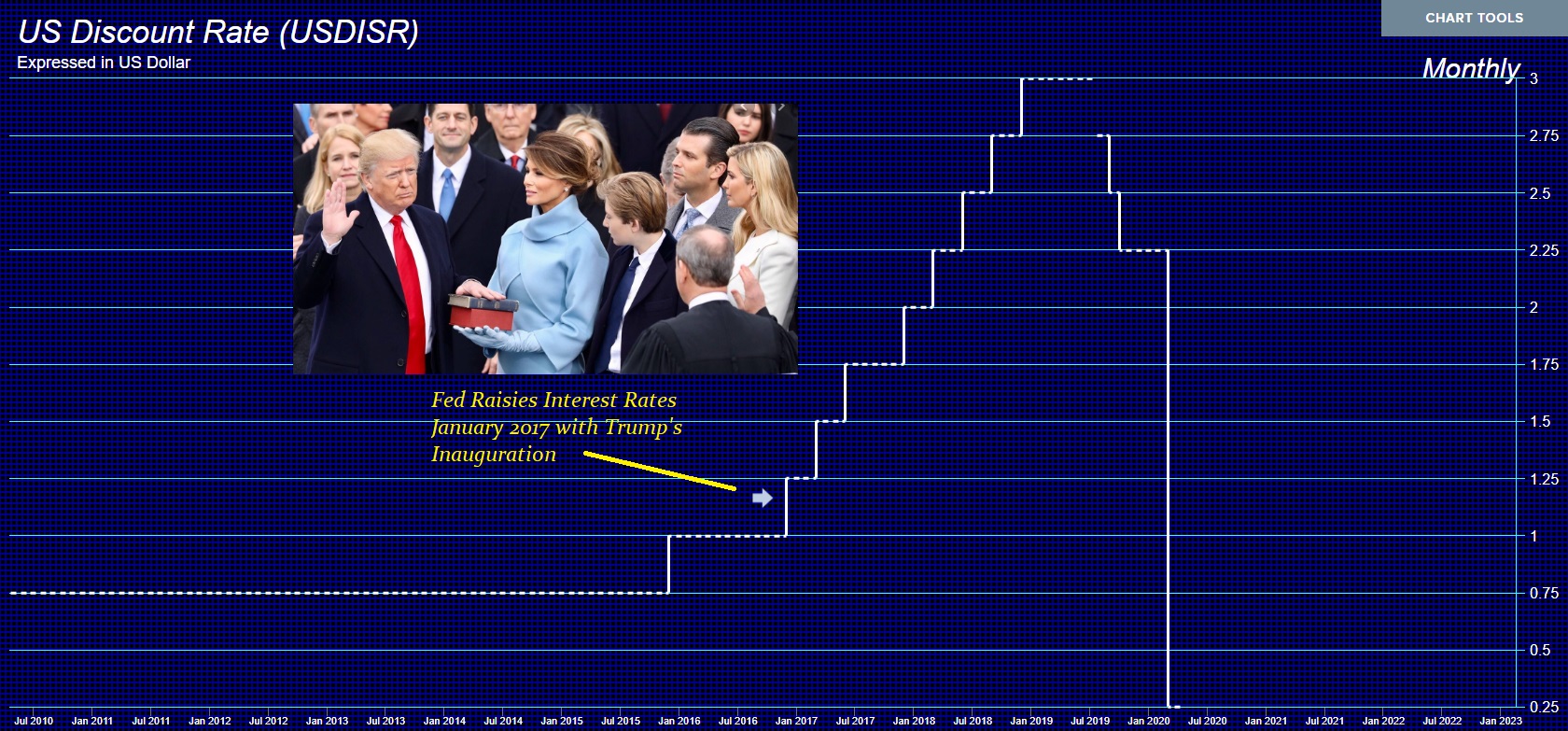
This is the typical analysis that simply focuses on domestic numbers and assumes that if you import more goods, then the dollar must decline. This theory is up there with thinking raising interest rates will be bearish for the economy and the stock market. Interestingly, both the economy and the stock market rallied as long as interest rates were RISING!
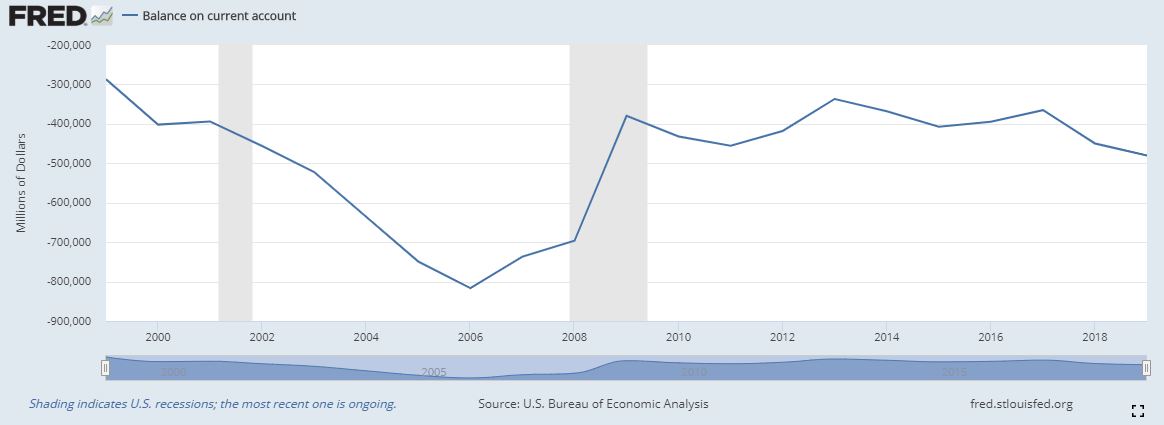
This is not a world that you can judge simply by looking at trade statistics. It is pure sophistry. In 2018, exports of goods and services from the United States made up about 12.22% of its gross domestic product (GDP), while US imports amounted to 15.33%. We have allocated trade according to the flag the company flies, and then you will see that the US has a trade surplus. Moreover, I assisted the Japanese on how to reduce their trade surplus buying gold in New York, taking delivery, and exporting it to London and selling it there. It does not matter what is exported; the statistics only look at dollars — not goods. This theory about trade to claim the dollar will decline is laughable.
All you have to do is real correlation analysis. Here is the US dollar Index, which was wrongly constructed based upon trade rather than capital flows, and the low in the trade deficit took place in 2006. It began to IMPROVE as the world economy turned down, and in 2008, we see an outside reversal with the dollar rising. The dollar peaked in 2001 on this index and that was the crash in the market from the 2000 peak in the Dot.com Bubble.
The true trends that reveal the future are based upon capital flows. The dollar rallied and peaked in 1985 during that recession, but on the US stock market, the Dow performed a rare outside reversal to the upside in 1982, which began the explosion from 1,000 to 6,000. That also attracted capital flows for investment. The dollar peaked in 2001 during that recession as capital contracted.
Now that everyone is familiar with how the Mueller Special Counsel Team took over Main Justice (DOJ and DOJ-NSD) in May 2017, let’s take a look at a critical ten days.
On July 12, 2018, at the apex of the Mueller probe, the DOJ-NSD dispatched a demonstrably manipulative letter to the FISA court informing the FISC that the predicate for the FISA application was still valid. {Go Deep} Nine days later, July 21, 2018, the special counsel released the Carter Page FISA application to fill FOIA requests.
The background context is important. House Judiciary Chairman Bob Goodlatte was asking Presiding Judge Rosemary Collyer for a copy of the FISA application on file in the FISC. Collyer responded saying both Goodlatte and Nunes (Legislative Branch) needed to exhaust all efforts to retrieve from the DOJ (Executive Branch). Congress was questioning the details of the FISA. Unprompted, and needing to keep prop-up the FISA application the special counsel (DOJ-NSD) responded to the FISC saying the predicate was still valid.
Obviously the background of how the FISA application was attained was critical to the special counsel maintaining the validity of their purpose. Hence, despite 18 months of direct FBI evidence that contradicted the primary underpinning document, the Steele Dossier, the special counsel lied to the FISC saying the originating predicate was valid.
The July 12, 2018, letter only surfaced in April 2020 after the FISC reviewed the December 9, 2019, IG report which completely contradicted the July 12, 2018, claims. The FISC responded to the Bill Barr DOJ in 2020 by demanding the 2018 letter be given to congressional oversight via Senator Lindsey Graham. The DOJ submitted the 2018 document and Senator Graham released the letter to the public.
Nine days later, July 21st 2018, the special counsel then released the FISA application to the public under the guise of a FOIA fulfillment. However, what almost everyone missed was that the actual FISA application itself was a very specific version released.
The special counsel released a very specific version of the FISA application. The first two components of the FISA release were from a copy dated March 17, 2017, that was used in an FBI leak investigation. {Go Deep} The special counsel used this version and then added the April 2017 and June 2017 renewals to complete the set.
Take a look at the last page of the first FISA application that was released and there is a much bigger story visible. This page tells us a great deal:
The FISC stamp of 3/17/17 tells us that Robert Mueller’s team released a document that was proprietary to the Washington Field Office FBI, Supervisory Special Agent, Brian Dugan. {Go Deep} FBI Agent Dugan calls this “an FBI equity” in his December 14, 2018, statement under penalty of perjury. The special counsel is releasing Dugan’s evidence.
This release tells us that SSA Brian Dugan turned over his investigative file to the special counsel at the conclusion of his leak investigation; likely because the Mueller probe held primary investigative authority over anything related to Trump-Russia, and the FISA application was a central component to the Mueller probe.
Quite simply: if agent Dugan had not turned over his investigative file; and if the special counsel did not take ownership of his investigative file; then the special counsel would not have this specific copy to release. The DOJ would have, instead, been releasing their own copy of the FISA application from the DOJ-National Security Division.
The simple fact that Mueller released this March 17th stamped version for a FOIA fulfillment meant the special counsel had received Dugan’s investigative file. Hopefully everyone can see that.
When the special counsel released the Dugan copy on July 21st 2018 they redacted the dates. Despite everyone knowing what the dates were from both Senator Ron Johnson and Senator Chuck Grassley releases, the special counsel redacted the dates.
The special counsel redacted the dates because Brian Dugan had changed them in order to track leaks to the media. The unredacted Dugan copy would show origination dates in conflict with actual. The special counsel released the Dugan copy and removed the risk by redacting the dates.
This is one example of how the Special Counsel team controlled, removed and released information that was damaging to their own corrupt intentions. There are many more.
The special counsel needed to remove the evidence that SSCI Security Director James Wolfe leaked the unredacted FISA application to journalist Ali Watkins on March 17, 2017.
By the time Brian Dugan’s investigative file was scrubbed by the Mueller team, it was returned to USAO Jessie Liu with the evidence of the Wolfe FISA leak removed.
This is why the Wolfe grand jury never heard the evidence of “WHAT” James Wolfe released; and this explains why he was only indicted on lying three times to FBI investigators.
On the last sentences (paragraph four); on the last page; on the last court document that SSA Dugan would write; FBI Agent Brian Dugan swore under penalty of perjury that James Wolfe leaked the FISA application….
Long time Treehouse friend Zurich Mike asked some interesting questions earlier. Perhaps there are intervals, metaphors per se’, when we see history repeat.
In June 1945 the Indianapolis received orders to undertake a top-secret mission of the utmost significance to national security. The objective was to proceed to Tinian island carrying the enriched uranium (about half of the world’s supply of uranium-235 at the time) and other parts required for the assembly of the atomic bomb codenamed “Little Boy”, which would be dropped on Hiroshima a few weeks later.
The mission was a success, and the material to assemble the Atomic bomb was delivered in June 1945. However, even the crew of the ship had no idea just how vital their mission was. Due to the sensitivity of the objective, the captain was under strict instructions to keep the mission a total secret. The outcome of their mission was not visible until August 6, 1945 when the atomic bomb was detonated over Hiroshima, Japan.
Given the nature of the toxic tribal environment surrounding current U.S. politics, it is critical for John Durham to protect his mission from even the appearance of impropriety. One can easily imagine how everyone in/around the purposefully tight group would demand utmost confidence and security with any aspect of their investigation.
Certainly, if a special prosecutor like John Durham was to receive critical material to assemble a political “Little Boy”, anyone in/around the delivery process would be required to go completely silent thereafter. It is the only safe way to ensure the objective.
The U.S.S. Indianapolis was vital to the overall mission. However, building “Little Boy” was not the objective; detonating it was.
Re-posted from Uncommon Knowledge by Russell Roberts Thursday, July 23, 2020
A lot of people reject capitalism because they see the market process at the heart of capitalism—the decentralized, bottom-up interactions between buyers and sellers that determine prices and quantities—as fundamentally immoral. After all, say the critics, capitalism unleashes the worst of our possible motivations, and it gets things done by appealing to greed and self-interest rather than to something nobler: caring for others, say. Or love. Adam Smith said it well:
It is not from the benevolence of the butcher, the brewer, or the baker that we expect our dinner, but from their regard to their own self-interest.
Capitalism, say its critics, encourages grasping, exploitation, and materialism. As Wordsworth put it: “Getting and spending, we lay waste our powers.” In this view, capitalism degrades our best selves by encouraging us to compete, to get ahead, to win in business, to have a nicer car and house than our neighbors, and to always look for higher profits and advantages. In the great rat race of the workplace, we all turn into rats. Is it any wonder so many want to kill off capitalism and replace it with something more just, more fair, more humane?
This urge to try something else seems to be on the rise. In a 2019 Gallup poll, 43 percent of respondents said socialism would be good for the country. A self-avowed socialist, Bernie Sanders, came closing to winning the Democratic nomination for president in 2020, finishing a close second as he had four years earlier.
One answer to this increased taste for socialism is that socialism has to be specified in order to compare it to capitalism. I think a lot of people are attracted to socialism because they believe it means capitalism without the parts they don’t like. How to get there from here is left unspecified. A second answer is that the American economic system is, in fact, a hybrid of capitalism and socialism. Some parts of the American economy are pretty free market, or what we might call capitalist: those parts where profit and loss determine success or failure, where prices and wages are mostly free to adjust to what the market will bear, and where subsidies are small or nonexistent. But other parts of the American economy, such as education, health care, and housing, are highly distorted—they are heavily subsidized or regulated in ways that make innovation and competition very difficult. They’re not fully socialist, but you can’t really call them free market, either.
Capitalism, somehow, gets blamed for anything that goes wrong. Consider health care—it is highly subsidized; its prices are distorted by those subsidies along with incredibly complex regulations; the supply and allocation of doctors are highly constrained by regulations; hospital competition is curtailed by certificate of need requirements; and finally, on top of that, a highly regulated private insurance business is tangled up with everything. And when outcomes go sideways, people claim it proves that markets don’t work for health care. One of the essential pillars of capitalism is people spending their own money on themselves. The essence of the health-care market is people spending other people’s money, often on other people.
People decry the high price of housing in New York and San Francisco, and some blame it on the greed of landlords. But greed is as old as humankind. What has changed in recent decades and driven prices upward is ever more restrictive zoning that has made it harder to build new rental units in cities where the demand is highest.
But let’s put aside the question of whether capitalism can fairly be blamed for the ills of health care in America or the high price of housing in certain American cities. Let’s look at the more basic charge of immorality.
Is capitalism good for us? Does it degrade us or does it lift us up? The critics are right that competition is an important component of the capitalist system, but the dog-eat-dog nature of that competition is greatly exaggerated. We call it competition, but it can also be thought of as the availability of alternatives. As Walter Williams likes to point out, I don’t tell the grocery store when I’m coming. I don’t tell them what or how much I want to buy. But if they don’t have what I want when I get there, I “fire” them. The existence of alternatives, choices of where to shop, and competition incentivizes the grocer to stock the shelves with what I want.
My cleaning crew speaks almost no English and has little or no formal education. Yet I pay them about double the legal hourly minimum. It isn’t because I’m a nice person. If I paid them only the minimum, they wouldn’t show up, because many other people are willing to pay much more to have their houses cleaned. Competition, not the minimum wage, is what protects my cleaning crew from the worst side of me and anyone else they work for.
Competition in sports is typically zero sum. The team with the higher score wins and the other team must lose. But economic competition is positive sum. Market share has to sum to 100 percent. When highly reliable Hondas and Toyotas showed up in the United States at very reasonable prices in the 1970s and 1980s, for example, they took market share from American companies. But the total number of cars sold wasn’t fixed. By making better and cheaper cars, the number of cars sold increased. And the quality wasn’t static, either. Spurred by Japanese competition, American car companies improved their products’ quality. And the American consumer was better off.
The essence of commercial life is positive sum. You hire me at a wage that makes it worthwhile for you to do so. I work for you because the wage is high enough to make me better off as well. Without both of us gaining, there’s no deal to be made.
Of course, some people have fewer or less attractive alternatives than other people. Why does Walmart pay what its critics claim are inadequate wages? It’s not because Walmart is especially cruel or greedy. (After all, I could make more on Wall Street than I do in academic life. That’s not because Goldman Sachs is kinder than Stanford University.) Walmart pays what it does because it can. And it can pay what it does because the people who choose to work there have unattractive alternatives. Otherwise, they’d take a job somewhere else.
Similarly, workers in overseas factories make very little relative to their American counterparts because their alternatives are much worse than those available to American factory workers. It’s not the cruelty of greedy international corporations that keeps the wages low. It’s the poor alternatives those workers have available to them. In fact, poor workers in poor countries typically line up for the opportunity to work for an international corporation. Wages there, while low by American standards, are much higher than in other parts of the economy.
Over time, the poorest workers in countries such as China have seen their wages rise dramatically. Again, this is not because of the compassion of corporate employers but because of the competition they face in attracting good workers. There are two positive ways to help both foreign workers and low-wage American workers at places such as Walmart: increase the demand for their services and find ways to help them increase their skills. That makes them more attractive to employers, who can pay them more because the workers are more productive.
Competition in a free-market system is about who does the best job serving the customer. Unlike traditional competition, there isn’t a single winner—multiple firms can survive and thrive as long as they match the performance of their competitors. They can also survive and thrive by providing a product that caters to customers looking for something a little different.
Finally, there is a great deal of cooperation in capitalism. One kind is obvious: investors cooperate with managers, who cooperate with employees to produce a great product or service. Many people find the opportunity to work with others in this way—to produce something of value for the consumer—deeply rewarding in ways that go beyond money. Part of the reason people start businesses is money, of course. But there is a large nonmonetary component: the experience of joining with others to create a great product or service that people value.
In the second Keynes-Hayek rap video I created with filmmaker John Papola, we tried to capture the best of this entrepreneurial side of capitalism:
Give us a chance so we can discover
The most valuable way to serve one another.
When Apple introduced the iPod in 2001, the 10GB model held two thousand songs, the battery lasted ten hours, and its price was $499. By 2007, the best iPod held twenty times that number of songs, the battery lasted three to four times longer, and its price was $299. Apple didn’t improve the quality and lower the price because Steve Jobs was a nice or kind person. Apple improved the iPod because its competitors were, as always, constantly trying to improve their own products. But I don’t think money was the only thing motivating improvement at Apple. Steve Jobs was happy to get rich. But he was also eager to keep his firm afloat in order to employ thousands of people at good wages and to work alongside those workers to create insanely great, ever better products. The money was nice. But it was not all (and maybe hardly at all) about the money.
Steve Jobs wanted to put what he called a dent in the universe. He wanted to make a difference. To do that, he needed to convince people of his vision, and then that vision had to be made real in a way that could profitably sustain an enterprise. Free markets gave Jobs the landscape where he could make his vision a reality.
You do have to pay the bills. The money that comes from consumers who value your product has to be sufficient to cover your costs. That’s the profit-and-loss criterion that underlies capitalism—you have to do as good or better than your competitors at serving your customers. But that’s not enough. You also have to do it at a price and pay a wage to your employees that result in a profit.
The other moral imperative of capitalism comes from repeated interactions between buyers and sellers. When there are repeated interactions, sellers have an incentive to treat their workers and their customers well—otherwise, they would put future interactions at risk. The safety of air travel, for example, is highly regulated. But cutting corners to save money and thereby putting passengers at risk are bad ideas for an airline that wants to exist past tomorrow. Crashes caused by negligence destroy an airline’s reputation. In markets, reputation helps insure honesty and quality. Being decent becomes profitable. Exploitation is punished by future losses.
None of the above rules out a role for government. You can defend free markets and capitalism without being an anarchist. Government plays a central role as the most effective enforcer of property rights and contracts. It administers the legal system. And it can and should restrict opportunities for people to impose costs on others. There’s nothing un-capitalist about making it illegal to dump your garbage into the air or water.
But what about the poor? How can we applaud the morality of capitalism if its gains go only to the richest Americans? Who wants to champion a system that gives the 1 percent the richest of chocolate cake and leaves everyone else with crumbs?
While there is evidence that supports this claim of the poor as bystanders who are left unchanged by decades of economic growth, this evidence typically looks at snapshots of workers at two different points in time, comparing changes in income or wealth of the top 1% to the to the standing of the top 1% decades later. The implicit assumption is that the people who were at the top in the past got much richer over time. This approach ignores economic mobility and falsely assumes that the top 1 percent are a fixed group. The people composing that 1 percent change; the same people do not simply get richer while everyone else treads water. The 1 percent includes people who once were much poorer but, now that they have reached the top, are richer than the people who previously were at the top. Similarly, the bottom twenty percent today are not the same people who were at the bottom in the past. When you follow the same people over time, rather than comparing group snapshots at two different points in time, all groups—poor, middle class, rich become more prosperous over time. A rising tide lifts all boats and not just the yachts. (I’ve explored these issues in videos and essays published elsewhere.)1
I would also point out that the guards in Cuba face south; they prevent Cubans from escaping the egalitarian paradise of Cuba for the unequal American economy. Poor people from all over the world risk their lives to come to the United States. Certainly they come here for opportunity for themselves and for their children. They expect—correctly, in my view—to share in the future growth of the American economy.
But I think poor people come here for more than just the financial opportunities of the American economy. They come for a chance for their children, and for themselves, to flourish, to use their gifts and skills in ways that bring meaning well beyond financial rewards. Money is pleasant, and not starving beats starving. But the real morality of capitalism and of the American system, with all its flaws, is that it gives people the chance to flourish through their work.
Not everyone has this chance in America today. But I believe that many of the challenges that the poorest among us face are not the fault of capitalism but the result of the breakdown of other institutions, which makes it hard for people, especially young people, to acquire the skills that would allow them to thrive. The US school system needs an overhaul. In particular, it could use more competition. The charter school movement is one part of a potential policy improvement. Even more competition—including private school options funded by scholarships—would go a long way toward allowing the poorest among us a chance to share in the American economic system, imperfectly capitalist that it is.
I have created this site to help people have fun in the kitchen. I write about enjoying life both in and out of my kitchen. Life is short! Make the most of it and enjoy!
This is a library of News Events not reported by the Main Stream Media documenting & connecting the dots on How the Obama Marxist Liberal agenda is destroying America