Posted originally on Feb 17, 2026 by Martin Armstrong |
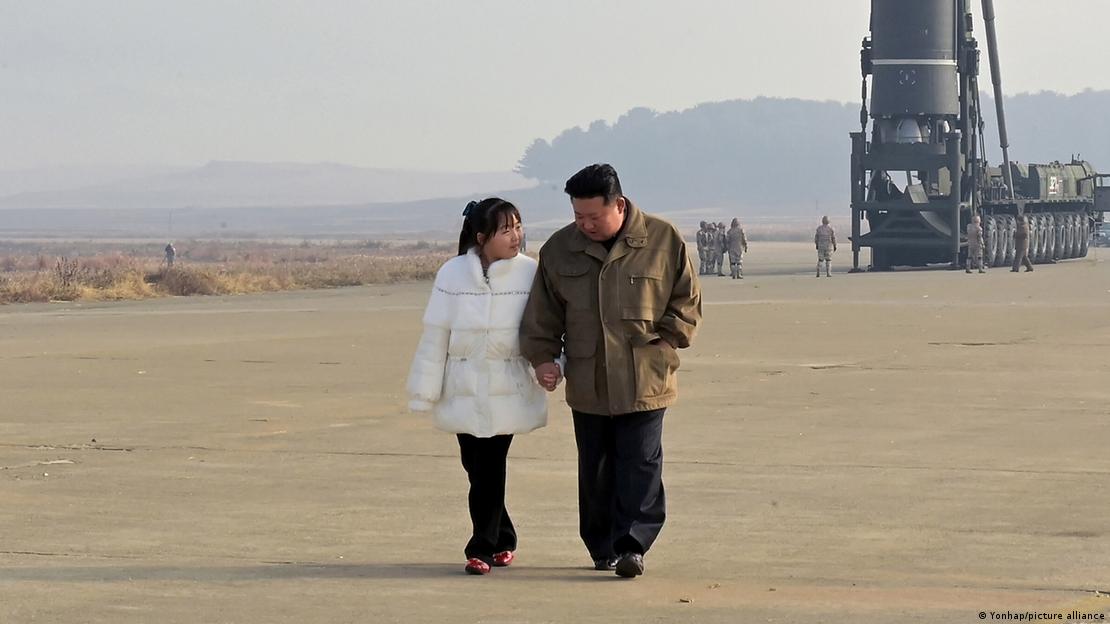
South Korea’s National Intelligence Service has reported that Kim Ju-ae, the daughter of North Korean leader Kim Jong-un, is now in the “successor nomination stage,” a phrase indicating not just symbolic visibility but active internal positioning as the next leader. This marks the clearest signal yet that Pyongyang is preparing for a fourth-generation transfer of power within the Kim dynasty.
Kim Ju-ae first appeared in state media in November 2022, accompanying her father at a missile test, and over the subsequent three years, she has been featured at military parades, significant weapons unveilings, and national ceremonies. The world did not know that the dictator had a daughter until his close friend, American basketball star Dennis Rodman, leaked the information to reporters. Seoul believes Ju-ae will be treated as the de facto second-highest figure in official protocol. There is no official record of her age, but based on the information from Rodham, she is believed to be in her teens.
North Korea has survived isolation, economic contraction, sanctions that exceed anything applied to the Soviet bloc during the Cold War, and ongoing famine. The notion that North Korea will “collapse” because a teenager is at the helm is not a reality. The Kim Dynasty is seen as immortal, and the people have an unwavering, albeit forced, loyalty to the family. The people will accept her as their leader, but the true question is whether there will be a “North Korea” to rule over. The answer largely depends on China.
North Korea’s existence is heavily dependent on Beijing’s strategic tolerance. China acts in its own national interest and will not sacrifice stability lightly. If China weakens internally during the coming sovereign debt cycle or shifts policy direction post-2030, North Korea’s long-term structure could change. Socrates shows heightened geopolitical volatility around the Korean Peninsula into 2026–2028, with another major structural inflection point into 2032. That does not imply disappearance, but it is not out of the question.
Posted originally on Oct 9, 2025 by Martin Armstrong |
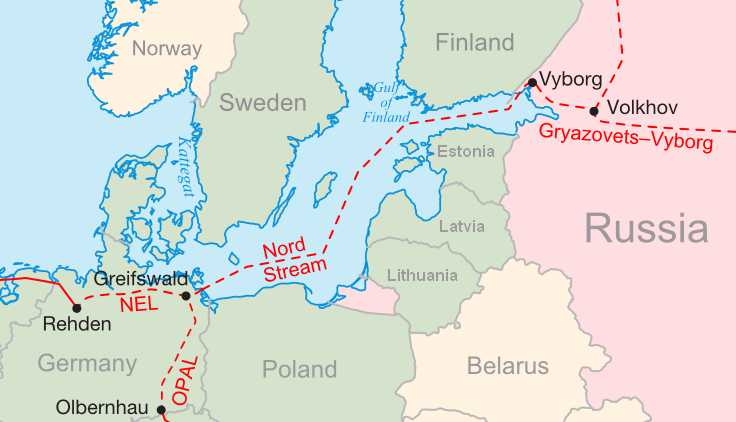
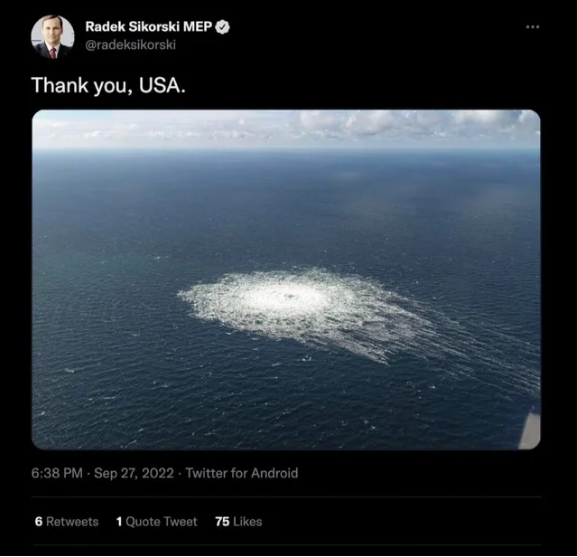
Polish Prime Minister Donald Tusk believes the man who allegedly destroyed the Nord Stream pipeline did his country a great service. Tusk is considering breaking international law by harboring the fugitive who is wanted by the German government. The man, of course, will be the scapegoat for the incident. More telling is Warsaw’s response, rooted in old geopolitical tensions and willful ignorance of how drastically the explosion hurt their own economy.
“The problem of Europe, Ukraine, Lithuania, and Poland is not that Nord Stream 2 was blown up, but that it was built,” Tusk said. “It is certainly not in the interest of Poland to hand over this citizen to a foreign country.” Poland will hold the man in its custody for an additional 40 days, during which it will consider Germany’s demand that he be extradited for prosecution.
“Russia, with money from some European states and German and (Anglo-) Dutch companies, built Nord Stream 2 against the vital interests not only of our states, but of all of Europe, and there can be no ambiguity about that,” Tusk concluded.
Poland has always been caught between Germany and Russia. From the Polish partitions in the 18th century to Soviet domination in the 20th, the Polish political class views any direct German-Russian cooperation as an existential threat. Poland initially protested the pipeline because it felt that Germany was attempting to remove Eastern Europe’s main bargaining chip with Moscow — energy transportation. They invested in LNG terminals, aligned with US energy interests, and positioned themselves as the eastern front against both Russian and EU central control.
The European Union and the euro could never erase generations of geopolitical hatred and scars. Warsaw simply sees Berlin as the lesser of two evils when it comes to Moscow. Tusk’s comments are a deliberate attempt to create friction with Germany and undermine the power they continue to hold over Poland as the economic center of the EU.
One bad apple spoils the bunch, and in the case of Europe, one bad economy will do the trick. Europe was reliant on Russian energy for many years prior to the war. Poland was purchasing 95.5% of its oil from Russia in 2012; the figure declined to 63.1% by 2021 before the war. Yet, Tusk is condemning former German Chancellor Angela Merkel for agreeing to the Nord Stream pipeline. Energy prices spiked by 30% after the pipeline demolition, fueling valid fears of energy shortages across the continent.
The pipeline itself may have been a Russian majority asset, but the infrastructure projects and joint ventures sprouting from the pipeline benefited Europe. European firms, including Wintershall Dea (Germany), E.ON (PEG Infrastruktur, Germany), Gasunie (Netherlands), and ENGIE (France), collectively held 49% of the Nord Stream AG operating company, while Gazprom itself retained 51%.
By now, the world knows that Western intelligence agencies deliberately targeted the pipeline in an act of war. The man detained would be considered a terrorist if these charges were factual. Perhaps they do not want to conduct a fake investigation or trial that would raise suspicions. Tusk needs to look down and realize he’s been shot in the foot with the destruction of this pipeline that ALL of Europe, not merely Germany, benefited from.
Posted originally on Oct 6, 2025 by Martin Armstrong |
Nepal, Morocco, Madagascar, and now South Korea—the youth are not accepting economic hardships quietly. South Korea passed a “public intimidation law” that criminalizes threats or acts of crime against the general public with a penalty of 20 million won ($13,700) or five years imprisonment. New data has found that half of the suspects are in their 20s and 30s, according to ministry data obtained by Representative Song Seok-jun.
The most common motive noted in around one-third of cases is anger or resentment toward society. The law went into effect back in March and there have been over 70 cases of public intimidation. Authorities have arrested over 50 people, mostly men in their 20s. Crimes vary from online hate to bomb threats.
Seoul National University’s School of Public Health reported in May that 55% of adults in South Korea are living in a state of “prolonged emotional frustration,” and 70% reported that society is “fundamentally unfair.”
Youth unemployment in South Korea has reached 15%, with the national average sitting at 5%. Over 1.2 million young people are unemployed, despite South Korea having one of the highest rates of higher education. Working for a family-run conglomerate or a chaebol is seen as prestigious compared to small and medium enterprises (SMEs) where working conditions and pay are less desirable. SK, LG, Samsung, and Hyundai alone accounted for 40.8% of the national GDP in 2023. In fact, 84.3% of all GDP can be traced to 64 companies ,but they compose only 10% of available jobs.
“The figures make clear that the chaebols’ impact on the Korean economy cannot be easily disregarded. But the 64 chaebol’s share of employment is lower than their share of revenue, which means they need to more aggressively expand their hiring,” said Oh Il-seon, director of the Korea CXO Institute.
Over 70% of Koreans between 25 and 34 hold a college degree, which is 20 points higher than the OECD average. Studies show that only 24% of college graduates in South Korea earn more than those with a high school diploma. In contrast, 69% of college graduated in America are employed.
South Korean children begin training for a position at a chaebol. The market is saturated with educated, eligible employees. Housing and the overall cost of living have skyrocketed. The youth followed the playbook and lost the game. South Korea already has a plethora of political turmoil, but no one is more vocal or willing to cause unrest than the youth.
Posted originally on CTH on October 5, 2025 | Sundance
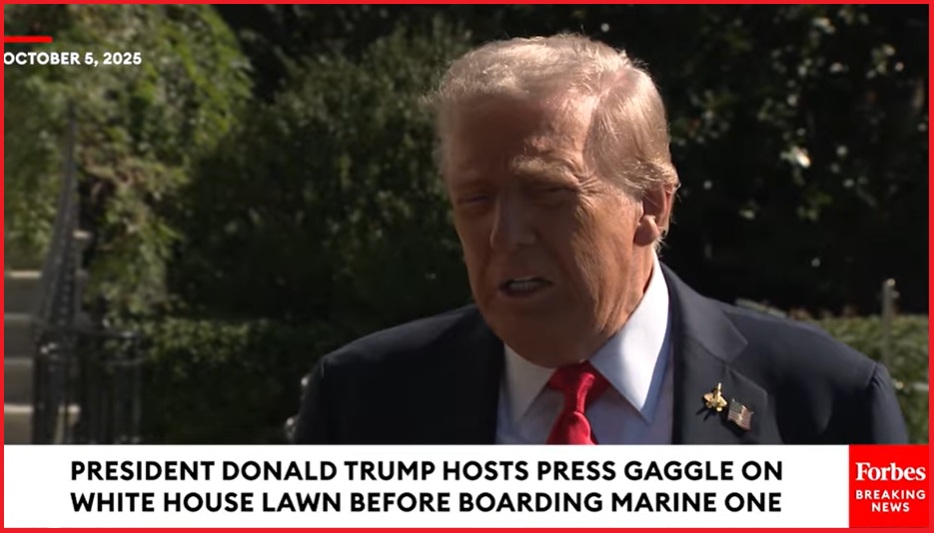
President Trump pauses to answer press pool questions as he departs the White House to attend a Navy celebration event in Virginia.
President Trump took questions on Ukraine, Russia, Gaza, Chicago ICE efforts, Portland Antifa activity, Venezuela drug combat efforts and Israeli hostages getting released. WATCH:
Posted originally on CTH on October 3, 2025 | Sundance
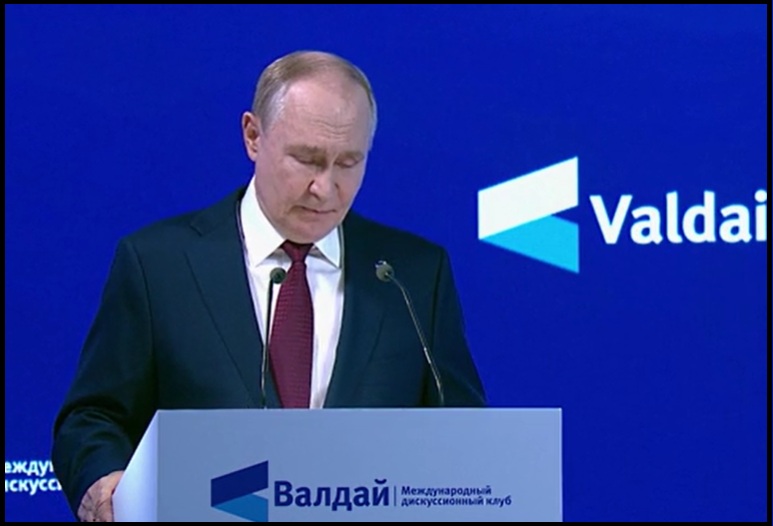
Vladimir Putin delivers a speech during the 22nd annual meeting of the Valdai International Discussion Club. Within his full remarks [Available Here] President Putin notes the ongoing efforts of the EU to provoke expanded conflict.
Russian President Vladimir Putin– […] They’ve made a lot of noise many times, threatening us with a complete blockade. They’ve even said openly, without hesitation, that they want to make the Russian people suffer. That’s the word they chose. They’ve drawn up plans, each more fantastical than the last one. I think the time has come to calm down, to take a look around, to get their bearings, and to start building relations in a completely different way.
We also understand that the polycentric world is highly dynamic. It appears fragile and unstable because it is impossible to permanently fix the state of affairs or determine the balance of power for the long term. After all, there are many participants in these processes, and their forces are asymmetrical and complexly composed. Each has its own advantageous aspects and competitive strengths, which in every case create a unique combination and composition.
Today’s world is an exceptionally complex, multifaceted system. To properly describe and comprehend it, simple laws of logic, cause-and-effect relationships, and the patterns arising from them are insufficient. What is needed here is a philosophy of complexity – something akin to quantum mechanics, which is wiser and, in some ways, more complex than classical physics.
Yet it is precisely due to this complexity of the world that the overall capacity for agreement, in my view, nevertheless tends to increase. After all, linear unilateral solutions are impossible, while nonlinear and multilateral solutions require very serious, professional, impartial, creative, and at times unconventional diplomacy.
Therefore, I am convinced that we will witness a kind of renaissance, a revival of high diplomatic art. Its essence lies in the ability to engage in dialogue and reach agreements – both with neighbours and like-minded partners, and – no less important but more challenging – with opponents.
It is precisely in this spirit – the spirit of 21st century diplomacy – that new institutions are developing. These include the expanding BRICS community, organisations of major regions such as the Shanghai Cooperation Organisation, Eurasian organisations, and more compact yet no less important regional associations. Many such groups are emerging worldwide – I will not list them all, as you are aware of them.
All these new structures are different, but they are united by one crucial quality: they do not operate on the principle of hierarchy or subordination to a single dominant power. They are not against anyone; they are for themselves. Let me reiterate: the modern world needs agreements, not the imposition of anyone’s will. Hegemony – of any kind – simply cannot and will not cope with the scale of the challenges.
Ensuring international security under these circumstances is an extremely urgent issue with many variables. The growing number of players with different goals, political cultures, and distinctive traditions create a complex global environment that makes developing approaches to ensuring security a much more tangled and difficult task to tackle. At the same time, it opens up new opportunities for all of us.
Bloc-based ambitions pre-programmed to exacerbate confrontation have, without a doubt, become a meaningless anachronism. We see, for example, how diligently our European neighbours are trying to patch up and plaster over the cracks running through the building of Europe. Yet, they want to overcome division and shore up the shaky unity they once used to boast of, not by effectively addressing domestic issues, but by inflating the image of an enemy. It is an old trick, but the point is that people in those countries see and understand everything. That is why they take to the streets despite the external escalation and the ongoing search for an enemy, as I mentioned earlier.
They are recreating an image of an old enemy, the one they created centuries ago which is Russia. Most people in Europe find it hard to understand why they should be so afraid of Russia that in order to oppose it they must tighten their belts even more, abandon their own interests, just give them up, and pursue policies that are clearly detrimental to themselves. Yet, the ruling elites of united Europe continue to whip up hysteria. They claim that war with the Russians is almost at the doorstep. They repeat this nonsense, this mantra, over and over again.
Frankly, when I sometimes watch and listen to what they are saying, I think they cannot possibly believe this. They cannot believe when they are saying that Russia is about to attack NATO. It is simply impossible to believe that. And yet they are making their own people believe it. So, what kind of people are they? They are either entirely incompetent, if they genuinely believe it, because believing such nonsense is just inconceivable, or simply dishonest, because they do not believe it themselves but are trying to convince their citizens that this is true. What other options are there?
Frankly, I am tempted to say: calm down, sleep peacefully, and deal with your own problems. Look at what is happening in the streets of European cities, what is going on with the economy, the industry, European culture and identity, massive debts and the growing crisis of social security systems, uncontrolled migration, and rampant violence – including political violence – the radicalisation of leftist, ultra-liberal, racist, and other marginal groups.
Take note of how Europe is sliding to the periphery of global competition. We know perfectly well how groundless are the threats about Russia’s so-called aggressive plans with which Europe frightens itself. I have just mentioned this. But self-suggestion is a dangerous thing. And we simply cannot ignore what is happening; we have no right to do so, for the sake of our own security, to reiterate, for the sake of our defence and safety.
That is why we are closely monitoring the growing militarisation of Europe. Is it just rhetoric, or is it time for us to respond? We hear, and you are aware of this as well, that the Federal Republic of Germany is saying its army must once again become the strongest in Europe. Well, alright, we are listening carefully and following everything to see what exactly is meant by that.
I believe no one has any doubt that Russia’s response will not be long in coming. To put it mildly, the reply to these threats will be highly convincing. And it will indeed be a reply – we ourselves have never initiated military confrontation. It is senseless, unnecessary, and simply absurd; it distracts from real problems and challenges. Sooner or later, societies will inevitably hold their leaders and elites to account for ignoring their hopes, aspirations, and needs.
However, if anyone still feels tempted to challenge us militarily – as we say in Russia, freedom is for the free – let them try. Russia has proven time and again: when threats arise to our security, to the peace and tranquillity of our citizens, to our sovereignty and the very foundations of our statehood, we respond swiftly.
There is no need for provocation. There has not been a single instance where this ultimately ended well for the provocateur. And no exceptions should be expected in the future – there will be none.
Our history has demonstrated that weakness is unacceptable, as it creates temptation – the illusion that force can be used to settle any issue with us. Russia will never show weakness or indecision. Let this be remembered by those who resent the very fact of our existence, those who nurture dreams of inflicting upon us this so-called strategic defeat. By the way, many of those who actively spoke of this, as we say in Russia, “Some are no longer here, and others are far away.” Where are these figures now?
There are so many objective problems in the world – stemming from natural, technological, or social factors – that expending energy and resources on artificial, often fabricated contradictions is impermissible, wasteful, and simply foolish.
International security has now become such a multifaceted and indivisible phenomenon that no geopolitical value-based division can fracture it. Only meticulous, comprehensive work involving diverse partners and grounded in creative approaches can solve the complex equations of 21st-century security. Within this framework, there are no more or less important or crucial elements – everything must be addressed holistically.
Our country has consistently championed – and continues to champion – the principle of indivisible security. I have said it many times: the security of some cannot be ensured at the expense of others. Otherwise, there is no security at all – for anyone. Establishing this principle has proven unsuccessful. The euphoria and unchecked thirst for power among those who saw themselves as victors after the Cold War – as I have repeatedly stated – led to attempts to impose unilateral, subjective notions of security upon everyone.
This, in fact, became the true root cause of not only the Ukrainian conflict but also many other acute crises of the late 20th century and the first decade of the 21st century. As a result – just as we warned – no one today feels truly secure. It is time to return to fundamentals and correct past mistakes.
However, indivisible security today, compared to the late 1980s and early 1990s, is an even more complex phenomenon. It is no longer solely about military and political balance and mutual interest considerations.
The safety of humanity depends on its ability to respond to challenges posed by natural disasters, man-made catastrophes, technological development, and rapid social, demographic, and informational processes.
All this is interconnected and changes occur largely by themselves, frequently, I have already said it, unpredictably, following their own internal logic and rules, and sometimes, I will dare say, even beyond the people’s will and expectations.
[…] Something else is also known well. Those who encouraged, incited, and armed Ukraine, who goaded it into antagonising Russia, who for decades nurtured rampant nationalism and neo-Nazism in that country, frankly – pardon me the bluntness – did not give a hoot about Russia’s or, for that matter, Ukraine’s interests. They do not feel anything for the Ukrainian people. For them – globalists and expansionists in the West and their minions in Kiev – they are expendable material. The results of such reckless adventurism are in plain sight, and there is nothing to discuss.
Another question arises: could it have turned out differently? We also know, and I return to what President Trump once said. He said that if he had been in office back then, this could have been avoided. I agree with that. Indeed, it could have been avoided if our work with the Biden administration had been organised differently; if Ukraine had not been turned into a destructive weapon in someone else’s hands; if NATO had not been used for this purpose as it advanced to our borders; and if Ukraine had ultimately preserved its independence, its genuine sovereignty.
There is one more question. How should bilateral Russian-Ukrainian issues, which were the natural outcome of the breakup of a vast country and of complex geopolitical transformations, have been resolved? By the way, I believe that the dissolution of the Soviet Union was linked to the position of Russia’s then leadership, which sought to rid itself of ideological confrontation in hopes that now, with communism gone, we will be brothers. Nothing of the sort followed. Other factors in the form of geopolitical interests came into play. It turned out that ideological differences were not the real issue.
So, how should such problems be resolved in a polycentric world? How would the situation in Ukraine have been addressed? I think that if there had been multipolarity, different poles would have tried the Ukraine conflict on for size, so to speak. They would measure it against their own potential hotbeds of tension and fractures in their own regions. In that case, a collective solution would have been far more responsible and balanced.
The settlement would have relied on the understanding that all participants in this challenging situation have their own interests grounded in objective and subjective circumstances which simply cannot be ignored. The desire of all countries to ensure security and progress is legitimate. Without a doubt, this applies to Ukraine, Russia, and all our neighbours. The countries of the region should have the leading voice in shaping a regional system. They have the greatest chance of agreeing on a model of interaction that is acceptable to everyone, because the matter concerns them directly. It represents their vital interest.
For other countries, the situation in Ukraine is merely a playing card in a different, much larger, game, a game of their own, which usually has little to do with the actual problems of the countries involved, including this particular one. It is merely an excuse and a means to achieve their own geopolitical goals, to expand their area of control, and to make some money off the war. That is why they brought NATO infrastructure right up to our doorstep, and have for years been looking with a straight face at the tragedy of Donbass, and at what was essentially a genocide and extermination of the Russian people on our own historic land, a process that began in 2014 on the heels of a bloody coup in Ukraine.
In contrast to such conduct demonstrated by Europe and, until recently, by the United States under the previous administration, stand the actions of countries belonging to the global majority. They refuse to take sides and genuinely strive to help establish a just peace. We are grateful to all states that have sincerely exerted efforts in recent years to find a way out of the situation. These include our partners – the BRICS founders: China, India, Brazil and South Africa. This includes Belarus and, incidentally, North Korea. These are our friends in the Arab and Islamic world – above all, Saudi Arabia, the United Arab Emirates, Qatar, Egypt, Turkiye and Iran. In Europe, these include Serbia, Hungary and Slovakia. And there are many such countries across Africa and Latin America.
Regrettably, hostilities have not yet ceased. However, the responsibility for this lies not with the majority for failing to stop them, but with the minority, primarily Europe, which continually escalates the conflict – and in my view, no other objective is even discernible there today. Nevertheless, I believe goodwill will prevail, and in this regard, there is not the slightest doubt: I believe changes are occurring in Ukraine as well, albeit gradually – we see this. However much people’s minds may have been manipulated, shifts are nevertheless taking place in public consciousness, and indeed across the overwhelming majority of nations worldwide. (read more)
Posted originally on Sep 28, 2025 by Martin Armstrong |
The entire English Legal System has abandoned everything that once made Britain the beacon of human rights and liberty in the world. There is absolutely nothing left for Britain even to hold its head upright. This man, pretending to be a judge, ASSUMES what he said is racist, without acknowledging that the immigrants are NOT all of a particular race. Then he PRESUMES that those words instigated someone else to violence with ZERO evidence of that being the case at all. This is NOT the rule of law, and when that crumbles, the ONLY solution becomes revolution and violence, for there is no court of law that can ensure that society remains civilized.
Perhaps this “judge” who is obviously violating the English Bill of Rights should turn to Confusus. His legal doctrines are far better than this nonsense. Even Jesus Christ addressed a gathering of Jews and told them: “And you shall know the truth and the truth shall make you free.” Not in Britain. The truth will get you tax-free living in prison for 7 years.
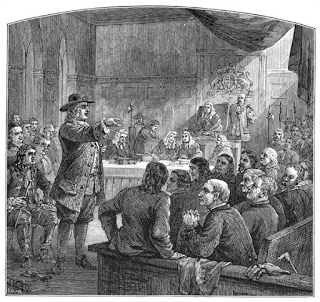
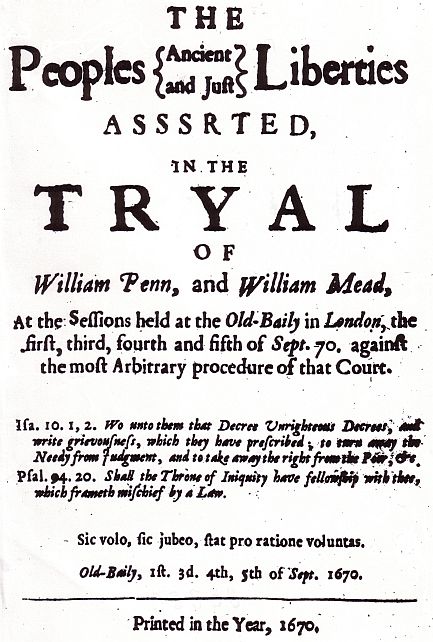
The most famous trial where a jury stood up refusing to find the defendant guilty in the face of a corrupt government was that of William Penn (1644-1718), the founder of Pennsylvania. Penn was the leader of the Quakers in London, and you can see why people fled to America. The sect was not recognized by the government and was forbidden to meet in any building for the purpose of worship. In 1670, William Penn held a worship service on a quiet street, which a peaceful group of fellow Quakers attended. Penn and another Quaker, William Mead, were arrested for disturbing the king’s peace and summoned to stand trial.
As the two men entered the courtroom, a bailiff ordered them to put their hats, which they had removed, back on their heads. When they complied, they were called forward and held in contempt of court for being in the courtroom with their hats on. Penn discovered that contempt of court is a personal prerogative of the judge and an infliction of punishment by a judge who becomes the legislator, jury, and sentencing judge.
Penn demanded to know what crime he was being charged with preaching – the cornerstone of Due Process. The judge refused to supply any information as to his crime and instead referred vaguely to common law. When Penn protested that he was entitled to a specific indictment (NOTICE), he was removed from the presence of the judge and jury and confined in an enclosed corner of the room known as the bale dock.
Penn could neither confront the witnesses who accused him of preaching to the Quakers nor ask them questions about their charges against him. Several witnesses testified that Penn had preached to a gathering, which included Mead, but one showed some hesitancy as to whether Mead had been present. The judge turned to Mead and questioned him directly. In effect, the judge became the prosecutor, as he asked Mead if he was guilty. Mead invoked the common-law privilege against self-incrimination, which provoked hostile comments from the judge. The court then sent Mead to join Penn in the bale dock out of the sight of the jury and witnesses.
Finally, after the testimony, the court concluded that the judge had instructed the jury to find the defendants guilty as charged, dictating what verdict he had expected. Penn tried to protest but was silenced and again sent out of the courtroom. The jury, for its part, proved sympathetic to the two defendants and refused the judge’s command to find the defendants guilty.
At this point, the judge became so enraged, as I would expect from Judge Juan Merchan, and sent the jury back to reconsider their verdict. When they returned with the same verdict, the court criticized the jury’s leader, Bushnell, and demanded “a verdict that the court will accept, and you shall be locked up without meat, drink, fire, and tobacco…We will have a verdict by the help of God or you will starve for it.”
After that, the jury was sent back three more times but returned with the same verdict. Finally, the jury refused to reconsider. The judge then fined each jury member forty marks and ordered them imprisoned until the fine was paid. Penn and Mead went to prison anyway, held in contempt for obeying the bailiff’s order that they put on their hats.
Later, the jury members won a writ of habeas corpus and were released from prison. Penn and Mead left England after their release from prison, having a taste of English justice, and sailed to America. (Earl Warren, “A Republic, If You Can Keep It”, p. 113-115). Thus, Pennsylvania was founded. This was the Bushel’s Case(1670) 124 E.R. 1006, a famous English decision on the role of juries and that they possessed the independence to decide the validity of the law being prosecuted.
Where is the Magna Carta Right to a Trial by Jury of Your Peers?
This guy is forced to plead guilty to a non-crime because if he dares go to trial and the Judge refuses to allow the jury to nullify this insane Starmmer law, then he will be given the maximum time of 7 years+ for demanding a fair trial.
Posted originally on CTH on September 26, 2025 | Sundance
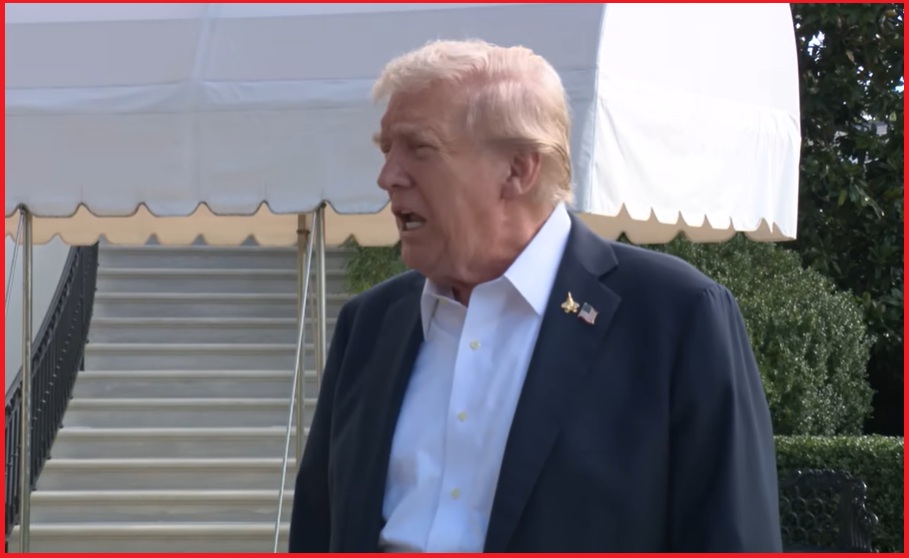
President Donald Trump holds an impromptu press conference as he departs the White House.
President Trump noted a potential deal with the Gaza conflict has been worked out. Additionally, President Trump took questions about the indictment of former FBI Director James Comey, saying he doesn’t doubt the accuracy of the charges as Comey did factually lie to congress. WATCH:
.
President Trump also spoke to the media upon arrival in Farmingdale, New York, where he will attend the Ryder Cup golf tournament.
I have created this site to help people have fun in the kitchen. I write about enjoying life both in and out of my kitchen. Life is short! Make the most of it and enjoy!
This is a library of News Events not reported by the Main Stream Media documenting & connecting the dots on How the Obama Marxist Liberal agenda is destroying America




 Centinel2012