How Erdogan Can Rule Turkey Till 2029


If Obama had that system here we would never be rid of him!

“We’re Players In Several Giant Games Of Chicken…”


Tyler Durden's picture

Submitted by Ben Hunt via Salient Partners’ Epsilon Theory blog,

Sometimes when you fire up an earthquake machine, you get a real earthquake.

There are three questions I’d like to answer in this Epsilon Theory note: what did the Narrative Machine tell us about the market immediately before and immediately after the November 8 election, what am I preparing for now as an investor, and what am I preparing for now as a citizen? I’m giddy about the first, quietly confident about the second, and pretty darn depressed about the third. Could be worse, I suppose.

On the first question, the Narrative Machine gave clear, actionable, and non-consensus signals prior to the U.S. election last week. For readers who aren’t familiar with what I mean by the Narrative Machine, I’ll refer you to this note by the same title. In a nutshell, I’m using a technology called Quid to take Big Data snapshots of large numbers of financial media articles. These snapshots show the connectivity and influence of each article to every other article, constructing a neural network or “star map” of the narratives and meaning clusters that link the articles. By looking at measures of sentiment and connectivity associated with the network, I think that I can get a good sense of market complacency around events like a Trump victory, as well as the likely direction and magnitude of market moves if an event like that comes to pass. Bottom line: I think that the Narrative Machine gives us a good sense of what’s priced into markets.

Here’s the Quid map of Bloomberg articles talking about Trump in weeks T-5 through T-2.

epsilon-theory-american-hustle-november-17-2016-quid-bloomberg-trump-sentiment

The skinny: there was never any complacency in markets about a Trump win. There was negative sentiment, but no complacency. Maybe the Huffington Post thought there was only a 5% chance of a Trump win, but markets were taking it much more seriously than that.

Now here’s the Quid map of Bloomberg articles talking about Trump in the week immediately preceding the election.

epsilon-theory-american-hustle-november-17-2016-quid-bloomberg-trump

Still just as focused (the 7.6 score here is only slightly less attentive and concentrated than the 8.5 score of markets after the Brexit vote), but look at the sentiment score. We’ve moved from highly negative to only slightly negative. More to the point, it’s the change in score that’s really important, so this Narrative map is telling us that not only is a Trump victory priced into current market price levels, but if he were to win, the market wouldn’t go down much, if at all. That’s in sharp contrast to the consensus view (you know who you are), that not only was the market highly complacent about the prospects of a Trump win, but also that a Hillary defeat would be a disaster for markets, with projections for as much as 12% down.

My commitment to the Narrative Machine research project is to make it as public as possible. Mass email is a poor distribution method, so I tweeted about these findings on Monday, November 7 (@EpsilonTheory) and spoke about them on a Salient-hosted conference call on Tuesday, November 8. But I’m also managing portfolios for Salient now as part of the internal reorganization we announced in October, so I have a responsibility there, too. Long story short … follow me on Twitter to stay the most engaged with this project.

So what’s next for markets?

First, the positive market Narrative regarding tax repatriation, regulatory reform, and fiscal stimulus in the form of infrastructure spending is for real. And by “real”, I don’t mean that I have any confidence AT ALL that these policies will have any permanent effect or multiplier effect or anything like that on the real economy. Sorry. Maybe regulatory reform has a long-lasting impact. Maybe. No, by “real”, I mean that this policy “reform” is a highly effective signal in the Common Knowledge Game and that it will make stocks go up regardless of its impact (or not) on the real economy. Ain’t that enough? It’s enough for me. The Trump reform and infrastructure Growth Narrative is a tailwind for stocks and a headwind for bonds for the next four years because we want to Believe. True that.

epsilon-theory-american-hustle-november-17-2016-borg

Second, nothing about the Trump reform and infrastructure Growth Narrative is sufficient, in my view, to undo the overwhelmingly negative constraints that massive global debt places on global growth. The Silver Age of the Central Banker is still in full force,with a shrinking global trade pie and domestic political imperatives that accelerate that decline rather than reverse it. Competitive monetary policy is the Borg. First it swallows up currencies, because that’s what currencies are — a reflection of your country’s monetary policy versus other countries’ monetary policies. Then it swallows up commodities — things that don’t have their own cash flow dynamics. Then it swallows up entire economies and swaths of the markets that are levered to commodities — emerging markets in general and developed market segments like industrials, energy and transports in particular. Ultimately it all comes down to monetary policy, and its primary reflection in currencies. It’s the Borg. Resistance is futile.

Here’s an updated chart showing the massive negative correlation between the dollar and oil. This is the trade-weighted broad dollar index in white, as measured by the vertical axis on the left, and this is the inverted spot price of crude oil in green, as measured by the vertical axis on the right. The chart starts in June 2014, because that’s when competitive monetary policy and the Silver Age of the Central Banker begins, when Mario Draghi doubled down on ECB asset purchases and negative interest rates at the same time that Janet Yellen declared her intentions to raise interest rates and forswore more asset purchases.

epsilon-theory-american-hustle-november-17-2016-quid-bloomberg-commodity

Source: Bloomberg, L.P. as of 11/8/16. For illustrative purposes only.

Yes, you get short-lived divergences in the lockstep negative correlation, first at the end of 2014 when OPEC announces that they’re out of the price-fixing game, and then again a month ago when OPEC announces that they’re back in the price-fixing game. The joke’s on OPEC. And global macro investors who still think that OPEC matters, I suppose, but mostly on OPEC. The half-life of whatever OPEC does or doesn’t do is measured in days … weeks at most. What is persistent, what is irresistible, what is the Borg in this equation is whether the dollar is going up or down.

The Trump reform and infrastructure Growth Narrative makes the dollar go up. If the Fed raises rates in December the dollar will go up still more. If you get a bad vote in Italy in a few weeks the dollar will go up still more. If you get any sort of geopolitical shock or U.S. domestic political craziness the dollar will go up still more. Dollar up is bad. Dollar down is good. I don’t know how to say it more plainly than that, and all the Belief in the world about tax reform and repealing Dodd-Frank and all that doesn’t change this reality. Maybe you see that and maybe you don’t. I can promise you, though, that China sees it.

So that’s where I am as an investor. I’m positive on U.S. equities because we’ve got a four year tailwind from the Trump reform and infrastructure Growth Narrative. That’s not going away no matter what China or Europe does. On the other hand, I’m negative on global risk assets, particularly anything connected to global trade finance, because we’re players in several giant games of Chicken and I think at least one of these is going to break bad. But at least I’m looking at the right things (I think), like what’s happening to the dollar and to European financial credit spreads, and that’s what gives me the hope that I can navigate these risks and these rewards. That and the ability to go short.

So I’m giddy about the potential of the Narrative Machine and I’m hopeful that I can maneuver through the investment storms out there. Why am I so down about American politics?

epsilon-theory-american-hustle-november-17-2016-cutler

Well, you gotta admit that this September Epsilon Theory note, “Virtue Signaling, or Why Clinton is in Trouble”, has aged pretty well. Turns out that Hillary Clinton was, in fact, the Jay Cutler of this election cycle, a highly talented but highly flawed performer whose team refused to sell out for her. I stand by everything I wrote in this piece — each candidate will be remembered in Common Knowledge as the Yoko Ono of their respective party, breaking up an all-time great band to make an album or two of dubious, to be generous, quality.

And that means I also stand by what I wrote about Donald Trump. I think he breaks us. Why? Because everything is a deal to Trump. Everything is a transaction, from a vote to a policy to a personal relationship. We all know people like this, men who — as the old Wall Street saying goes — would sell their mother for an eighth. Donald Trump transforms positive-sum Cooperative Games into zero-sum Competitive Games. It’s his nature … his great gift as a New York real estate developer, but his fatal flaw as a politician. Is he “a fighter”? Can he “get deals done”? Sure, and there’s value in that. But OUR great gift as Americans is that we are blessed with positive-sum Cooperative Games in the form of limited government and the political culture to maintain those limitations. Our political culture has been changed by Trump. The teacup has been broken. Can we glue it back? I suppose. But like a broken marriage or a broken partnership it’s never the same. It’s always a broken teacup.

I’m not saying that this broken political culture is Trump’s fault. Like I said, it’s his nature to transform everything he touches into a competitive strategic interaction. I can’t blame him any more than I can blame my Sheltie for barking at the wind. If you don’t want barking, don’t get a Sheltie. But the FACT is that we’ve got a Game Changer for our political culture as president, and there’s no walking that back.

Example: look at the prevalent Democratic meme today, that Trump voters were either motivated by racism directly, or that they willfully tolerated a racist candidate … which is just a paler shade of racism. Okay. I get the argument, although I would ask why Clinton didn’t get the support of working class white voters in Wisconsin, Michigan, and Pennsylvania who voted for Obama twice. Were they racist all along and just hiding it really well? But leave aside the merits of the argument, because there’s no changing anyone’s mind these days on the merits of anything (which is kinda my point). My question is a different one. If you really believe this … if you believe in your heart of hearts that Trump voters are racists … where do you go with this? Or rather, what does politics mean to you now? Politics is no longer a “marketplace of ideas” if you think the other side is comprised of bad guys. You’re not trying to win them over. You’re trying to beat them. Not because you think you’re right (although you do), but because you think you MUST beat them or else your own survival is at stake. It’s not only a zero-sum Competitive Game; it’s a zero-sum Competitive Game of self-defense, which means that anything — anything! — goes.

I’m not trying to pick on the Democratic memes (although they’re such easy targets). You see exactly the same sort of popular Narratives on the Republican side about Democratic voters. To summarize this vast oeuvre, if you’re willing to vote for the evil Hillary and her coven of soul-devouring, child-stealing, gun-confiscating, tax-raising, war-starting warlocks and witches … well, you must either be a sheep or a thieving Team Elite wannabe. Either way, you’re contemptible. Contemptibles and Deplorables, not Democrats and Republicans. My point is that if you believe that the people on the other side of a political argument are not just wrong, but are basically bad people, then the meaning you ascribe to politics — your political culture — is entirely different than if you think the other side is comprised of basically good people. You don’t cooperate with bad people, and the political institutions you favor if you’re surrounded by bad people are very different — and very un-American, in the de Tocqueville-ian sense of that word — than what the Founders came up with.

Look, Trump is no Hitler — that’s Erdogan’s shtick — and Trump’s preening egomania is actually a good thing because it crowds out ideological fervor. I mean, he’s not building a political machine to instantiate His Hugeness in institutional form. But there will be people around him who will try, and unfortunately, if I were a betting man — and I am — I’d bet on them to succeed. The rewards are too great and the technological tools at their disposal are too powerful and the political culture is too conducive to the effort and if it’s not them it will be the Thermidorean political reaction of the Left, and that depresses the bejeezus out of me. True that, too.

But that’s the World As It Is, a world of incredible technological promise that thrills the puzzle-solver in me, a world of reasonably interesting market patterns that gives hope to the investor in me, and a world of ascendant soft authoritarians that chastens the small-l liberal in me. I don’t think I’m alone. Put it all together, and my attitude is perfectly summed up by the most perfect ending in all of American literature.

So we beat on, boats against the current, borne back ceaselessly into the past.

After Warning US With “Retaliation” Iran Plans Russian Fighter Jet Purchase, Naval Bases In Syria, Yemen


Tyler Durden's picture

As tensions once again grow between Iran and the US, with both countries unsure if Donald Trump will extend Barack Obama’s landmark “nuclear deal” which in January 2016 lifted Iran’s sanctions (imposed previously by the same Obama regime) and allowed Iran to export three times as much crude oil as the country did one year ago, Iran has fallen back to the same diplomacy that marked the darker periods of diplomacy between Tehran and Washington.

As a result, earlier this week Iran explicitly warned the Trump administration, that extending U.S. sanctions on Iran for 10 years would breach the Iranian nuclear agreement, with Iran’s Supreme Leader Ayatollah Khamenei warning that Tehran would retaliate if the sanctions are approved. The U.S. House of Representatives re-authorized last week the Iran Sanctions Act, or ISA, for 10 years. The law was first adopted in 1996 to punish investments in Iran’s energy industry and deter Iran’s pursuit of nuclear weapons. The Iran measure will expire at the end of 2016 if it is not renewed. The House bill must still be passed by the Senate and signed by President Barack Obama to become law.

Iran and world powers concluded the nuclear agreement, also known as JCPOA, last year. It imposed curbs on Iran’s nuclear program in return for easing sanctions that have badly hurt its economy. “The current U.S. government has breached the nuclear deal in many occasions,” Khamenei said, addressing a gathering of members of the Revolutionary Guards, according to his website. “The latest is extension of sanctions for 10 years, that if it happens, would surely be against JCPOA, and the Islamic Republic would definitely react to it.”

As a reminder courtesy of Reuters, the U.S. lawmakers passed the bill one week after Republican Donald Trump was elected U.S. president. Republicans in Congress unanimously opposed the agreement, along with about two dozen Democrats, and Trump has also criticized it.

 So what can Iran do to retaliate against the US? The simplest thing is what many of the other nations in the region have already done: continue their ongoing political, economic and military pivot toward Russia. And sure enough, according to Reuters, earlier today Iran’s Defense Minister said that the country plans to purchase Russian Sukhoi Su-30 fighter planes to modernise its air force. More troubling to the US, the Iranian minister also threatened that Tehran might again allow Russia to use an Iranian air base for its operations in Syria.


Iranian Defence Minister Hossein Dehghan delivers a speech as
he attends the 5th Moscow Conference on International Security

“The purchase of this fighter is on the agenda of the Defence Ministry,” Defence Minister Hossein Dehghan told reporters, according to the Tasneem news agency, without saying how many planes Iran is negotiating to buy. “However, any purchase of the military planes from Russia should include receiving technology and joint investment, he underlined, saying Russia accepted it in the negotiations,” Tasneem reported. The gambit is clear: should the US revert to a regime of sanctions with Iran, Tehran will immediate pledge allegiance to Putin, extending a new “axis” in the middle east that begins in Moscow and stretches to Syria, and in recent weeks, Turkey, Egypt and now Iran.

There was more.

As the semi-official Tasnim news agency also reported on Saturday, Iran’s chief of staff of the armed forces said that Tehran may be interested in setting up naval bases in both Syria and Yemen. The report by Tasnim, close to military, quoted Gen. Mohammad Hossein Bagheri as saying, “Maybe, at some point we will need bases on the shores of Yemen and Syria.”

He said “Having naval bases in remote distances is not less than nuclear power. It is ten times more important and creates deterrence.”

Gen. Bagheri added that setting up naval platforms off the shores of those countries requires “infrastructures there first.” He said Iran is also able to set up permanent platforms for military purposes in the Persian Gulf and roving ones in other places.

As cited by AP, Bagheri did not elaborate but said “When two thirds of the world’s population lives near shores and the world economy depends on the sea, we have to take measures. Though there is a need for the time for these (steps).”

Unlike the previous “threat” that Iran may purchase Russian military equipment. this is the first time that an Iranian military official has spoken of setting up naval bases in another country in the region.

No Middle Eastern country is known to have a formal naval base in another Mideast country, perhaps because alliances in the region tend to be painfully fickle and countries that until recently were allies quickly become foes.  More from AP:

 Iran regularly sends its warships to the Gulf of Aden to fight piracy. It also conducts occasional naval maneuvers in the Persian Gulf and the Sea of Oman. Iran’s warships regularly visit seaports of friendly countries, including a recent visit to the South African port of Durban.

Iran’s Supreme Leader have repeatedly supported increasing the power of the country’s navy, last year describing the sea as the scene of “powerful confrontation with enemies”. saying the future of power is based on powerful presence in the seas. The country has dozens of warships and light and Kilo-class submarines. It has hundreds of speed boats too, four of which harassed a U.S. warship earlier this year.

Iran is currently helping the Shiite Houthi rebels in Yemen and the Syrian government in their fights against the extremist Islamic State group.

The good news for Obama is that the outgoing president is no longer relevant: it will be Trump’s task to difuse the situation, which is somewhat paradoxical. On the one hand, the President-elect is hoping to restore relations with the Kremlin; on the other he is planning to burn the biggest bridge with Iran, one which will unelash a new era of Russian-Iranian cooperation, and an aggressive Iranian military expansion in the region, one which may bring Israel back out of geopolitical hibernation. Ultimately it will be up to Trump’s Secretary of State – whether Romney or Giuliani – to figure out a solution to this dilemma without risking further national interest losses in either Eastern Europe or the Middle East.

Fidel Castro Dead


The tear-filled eulogies from the violent U.S. leftists commence in 3… 2… 1… HAVANA (AP) — Former President Fidel Castro, who led a rebel army to improbable victory in Cuba, embra…

Source: Fidel Castro Dead

Shipbuilding in Japan, Korea, China Collapses in Death Spiral of Orders


A collapse in shipping means there was a collapse in the movement of product and that means that sales have collapsed as well. So the bottom line is that since the governments have taken all the money there is no money to buy things!

’60 Minutes’ goes to Sweden to cover plight of refugees, gets assaulted on camera — Fellowship of the Minds


Bring people of a different culture in means that you are getting rid of the existing culture and if that is what you want what is wrong with that. The problem is that the old culture wasn’t asked why they were bring replaced!

kommonsentsjane's avatarkommonsentsjane

A bleeding-heart CBS 60 Minutes news team went to Sweden, to cover the plight of Muslim refugees there — what the female reporter calls “communities of disaffected migrants who can’t find jobs and have few prospects.” As the reporter intones that “many locals [migrants] are polite and friendly and happy to talk,” police left and […]

via ’60 Minutes’ goes to Sweden to cover plight of refugees, gets assaulted on camera — Fellowship of the Minds

Reblogged on kommonsentsjane/blogkommonsents.

Just what did they expect – a heroes welcome.

Following is a report on Sweden’s immigration and the problems the citizens  are encountering.  From the facts, this government brought in more people then they could handle which was the same for all of Europe and the U.S. – over burdening the systems.

*********************

Sweden –  Death by Immigration

Ingrid Carlqvist

February 4, 2016 at 5:00 am

The atmosphere on Swedish social media…

View original post 2,467 more words

Flying drone smuggles cell-phone, saw blade into Danish prison


Who or What is the “Whore of Babylon”?


THAAD Is Coming to China’s Doorstep (But Beijing Has a Plan to Push Back)


China has always had the option of stopping the North, so they bring this on themselves

French Elections 2017


french-revolution

Trying work out models on the French elections is by no means easy. The parties have changed and combined many times since 1973 alone. The National Front (FN) is a generally regarded as far-right because they are a Euroskeptic party since 1993 from its outset. Primarily, the FN is a socially conservative, nationalist political party in France whose major policies include economic protectionism, a zero tolerance approach to law and order issues, and opposition to immigration. The media portrays them as far-right since the party was founded in 1972 to unify a variety of French nationalist movements of the time. Jean-Marie Le Pen was the party’s first leader and the undisputed center of the party from its start until his resignation in 2011. Marine Le Pen, his daughter, was elected as the current leader. The party was at best a marginal force for its first ten years. However, ever since 1984 as the US dollar surged. FN has been the significant force of French nationalism.

french-presidential-elections-1974-to-2012
The 2002 presidential election was the first in France to include a National Front candidate in the run-off, after Jean-Marie Le Pen beat the Socialist candidate in the first round. In the run-off, he finished a distant second to Jacques Chirac. Due to the French electoral system, the party’s representation in public office has been limited, despite its significant share of the vote. Note that the Socialists were our of the final run in 2002. They made a two election come back, but that was just a reaction reaching 51.63% compared to their peak at 51.76% in 1981. This suggests they will be out of the final run and it may simply be conservatives v FN in 2017.

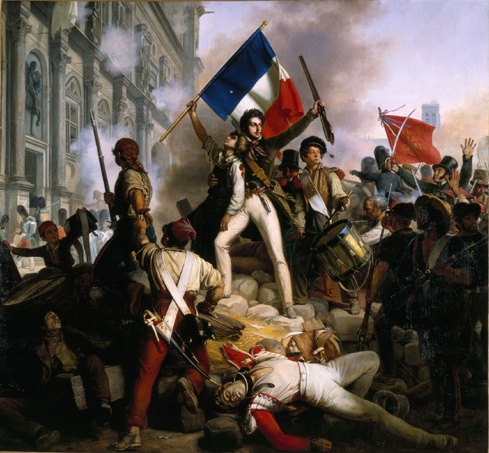
Yet to grasp what is taking place in France, we must step back and look at the broader picture. The French Revolution (May 5th, 1789–November 9th, 1799) basically overthrew the monarchy establishing a republic and was marked by very violent periods of political turmoil. Eventually, the French Revolution culminated in a dictatorship under Napoleon. It was this revolution that rapidly extended its principles to Western Europe and beyond marking the end of monarchy. In that respect, it was bookend to the American Revolution that completed the revolt against monarchy.

The French Revolution was strangely inspired by both liberal and radical ideas. Through the French Revolutionary Wars, what was unleashed set off a wave of global conflicts extending beyond Europe stretching to the Caribbean in the New World down to the Middle East. This was certainly a profound event and Napoleon brought to the doorstep of Europe, a monumental change in the form of government from monarchy to republic. It was certainly inspired philosophically by the publication of the Decline and Fall of the Roman Empire in 1776.

Economically, there is nothing that moves the masses to revolution like taxation. Historically, governments routinely raise taxes and only see things from their perspective. Never do they consider the people they claim to benefit. This is true be it a monarchy or a republic. For all forms of government share one common bond – they act in their self-interest. The French Revolution followed the Seven Years’ War and the American Revolutionary War. These events left the French government was deeply in debt and attempted to restore its financial status through unpopular taxation schemes. The weather was an impact for this was also the low in the energy output of the sun, which resulted in years of bad harvests leading up to the Revolution. This led to the famous rumor where Queen Marie Antoinette was said to have said: “Let them eat cake” which is the traditional translation of the French phrase “Qu’ils mangent de la brioche”. While it is commonly attributed to her, there is no record of this phrase ever having been said by Marie Antoinette. It appears in Jean-Jacques Rousseau’s Confessions  written in 1765, when Marie Antoinette was just nine years old.

Nevertheless, the economic decline, crop failures, and raising taxes inflamed popular resentment of the privileges enjoyed by both the clergy and the aristocracy. The first year of the Revolution saw members of the Third Estate taking control, the assault on the Bastille in July, and the passage of the Declaration of the Rights of Man and of the Citizen in August where there was the abolition of feudalism and the old rules and privileges. There was the women’s march upon Versailles which resulted in the royal court being forced to return to Paris in October that year.

beheading-louisThe economic turmoil led many elite French to flee to Geneva in Switzerland. Over the course of the first few years, there were political struggles and clashes between various liberal assemblies and right-wing supporters of the monarchy who wanted to maintain the status quo just as we saw the press conspire with Hillary in the 2016 elections. France essentially collapsed and was transformed into a democratic and secular society with freedom of religion, legalization of divorce, and civil rights for Jews and black people. The Republic was proclaimed in September 1792 after the French victory at Valmy. In a momentous event that led to international condemnation, Louis XVI was beheaded in January 1793. The king was only one of the thousands of victims of Robespierre.

The beheading of King Louis XVI came 144 years following the English Glorious Revolution and the beheading of Charles I on January 30th, 1649. No doubt, the manner in which the Puritans executed Charles I played some role in the executions carried out during the French Revolution by Robespierre, who himself would be declared an outlaw and he was arrested and was placed in the same cell where he held Marie Antoinette before her execution. Then on July 28th, 1794, Robespierre was guillotined without trial in the Place de la Révolution.

Le Pen Marine

The 224 Year Cycle of Political Change thus targets the beginning as 2013 and the end of this upheaval in France going into the peak of the next 8.6 year wave 2023-2024. Marine Le Pen first reach more than 17% of the vote in 2012. The cycle was starting to turn up, but it was just ahead of the time. Now, Le Pen is polling twice that of the President. Because of the fragmented political parties in France, it is difficult to forecast Le Pen will win. What is clear is that the socialists will lose. That much is certain. Nicolas Sarkozy has been thrown out of the elections by the conservative front runner Francois Fillon. The gap is closing between the conservatives and the right-wing. Clearly, the socialists are finished. However, we are within this 10 year window between 2013 and 2023. This clearly shifts the favor toward a new power. Le Pen can win within this window. However, expect this to be also very divisive as in the United States.

Will attempt to create a simulated election history based upon purely philosophy rather than party labels. We will report when that is completed.