CEA Chairman Kevin Hassett Discusses GDP Growth…


White House Council of Economic Advisers Chair Kevin Hassett discusses the U.S. economy’s 2.6 percent growth in the fourth quarter, and the outlook for the U.S. economy through the rest of 2019.

.

Notice how most of the financial pundits are focusing on what the “global economy” needs; specifically what the EU and China need to do to gain economic growth.  From that position, the U.S. trade reset is adverse to their financial interest; those financial interests are driven by Wall Street not Main Street.

Economic nationalists who understand the concept of ‘America First’ focus on what the USA economy needs, and do not accept a position that the U.S. should acquiesce our position to benefit the economic needs of other nations.  That’s the primary difference.

Few understand the MAGAnomic reset and what was predicted to happen in the space between disconnecting a Wall Street economic engine (globalism and multinationals) and restarting a Main Street economic engine (nationalism/America-First).  In 2016 CTH explained where we would be today.

President Trump’s MAGAnomic trade and foreign policy agenda is jaw-dropping in scale, scope and consequence. There are multiple simultaneous aspects to each policy objective; however, many have been visible for a long time – some even before the election victory in November ’16.

♦ When U.S. banks were allowed to merge their investment divisions with their commercial banking operations (the removal of Glass Stegal) something changed on Wall Street.

Companies who are evaluated based on their financial results, profits and losses, remained in their traditional role as traded stocks on the U.S. Stock Market and were evaluated accordingly. However, over time investment instruments -which are secondary to actual company results- created a sub-set within Wall Street that detached from actual bottom line company results.

The resulting secondary financial market system was essentially ‘investment markets’. Both ordinary company stocks and the investment market stocks operate on the same stock exchanges. But the underlying valuation is tied to entirely different metrics.

Financial products were developed (as investment instruments) that are essentially wagers or bets on the outcomes of actual companies traded on Wall Street. Those bets/wagers form the hedge markets and are [essentially] people trading on expectations of performance. The “derivatives market” is the ‘betting system’.

♦Ford Motor Company (only chosen as a commonly known entity) has a stock valuation based on their actual company performance in the market of manufacturing and consumer purchasing of their product. However, there can be thousands of financial instruments wagering on the actual outcome of their performance.

There are two initial bets on these outcomes that form the basis for Hedge-fund activity. Bet ‘A’ that Ford hits a profit number, or bet ‘B’ that they don’t. There are financial instruments created to place each wager. [The wagers form the derivatives] But it doesn’t stop there.

Additionally, more financial products are created that bet on the outcomes of the A/B bets. A secondary financial product might find two sides betting on both A outcome and B outcome.

Party C bets the “A” bet is accurate, and party D bets against the A bet. Party E bets the “B” bet is accurate, and party F bets against the B. If it stopped there we would only have six total participants. But it doesn’t stop there, it goes on and on and on…

The outcome of the bets forms the basis for the tenuous investment markets. The important part to understand is that the investment funds are not necessarily attached to the original company stock, they are now attached to the outcome of bet(s). Hence an inherent disconnect is created.

Subsequently, if the actual stock doesn’t meet it’s expected P-n-L outcome (if the company actually doesn’t do well), and if the financial investment was betting against the outcome, the value of the investment actually goes up. The company performance and the investment bets on the outcome of that performance are two entirely different aspects of the stock market. [Hence two metrics.]

♦Understanding the disconnect between an actual company on the stock market, and the bets for and against that company stock, helps to understand what can happen when fiscal policy is geared toward the underlying company (Main Street MAGAnomics), and not toward the bets therein (Investment Class).

The U.S. stock markets’ overall value can increase with Main Street policy, and yet the investment class can simultaneously decrease in value even though the company(ies) in the stock market is/are doing better. This detachment is critical to understand because the ‘real economy’ is based on the company, the ‘paper economy’ is based on the financial investment instruments betting on the company.

Trillions can be lost in investment instruments, and yet the overall stock market -as valued by company operations/profits- can increase.

Here’s the critical part – Conversely, there are now classes of companies on the U.S. stock exchange that never make a dime in profit, yet the value of the company increases.

This dynamic is possible because the financial investment bets are not connected to the bottom line profit. (Examples include Tesla Motors, Amazon and a host of internet stocks like Facebook and Twitter.) It is this investment group of companies that stands to lose the most if/when the underlying system of betting on them stops or slows.

Specifically due to most recent U.S. fiscal policy, modern multinational banks, including all of the investment products therein, are more closely attached to this investment system on Wall Street. It stands to reason they are at greater risk of financial losses overall with a shift in economic policy.

That financial and economic risk is the basic reason behind Trump and Mnuchin putting a protective, secondary and parallel, banking system in place for Main Street.

Big multinational banks can suffer big losses from their investments, and yet the Main Street economy can continue growing, and have access to capital, uninterrupted.

Bottom Line: U.S. companies who have actual connection to a growing U.S. economy can succeed; based on the advantages of the new economic environment and MAGA policy, specifically in the areas of manufacturing, trade and the ancillary benefactors.

Meanwhile U.S. investment assets (multinational investment portfolios) that are disconnected from the actual results of those benefiting U.S. companies, and as a consequence also disconnected from the U.S. economic expansion, can simultaneously drop in value even though the U.S. economy is thriving.

NEC Chairman Larry Kudlow Discusses Status of Economy, 4th Quarter GDP Result, China Trade…


National Economic Council Director Larry Kudlow appears on CNBC to discuss the latest releases of economic stats and the on-going trade talks between the U.S. and China.  Kudlow notes the U.S. and China are making progress specifically due to USTR Robert Lighthizer.  Interesting interview.

.

Nuance and team subtlety are important here. Larry Kudlow is a loyal soldier, no question, but his economic leaning is toward trade outcomes that benefit Wall Street… Robert Lighthizer is a fierce battle-hardened trade expert, with an outlook that is multi-generational toward Main Street.

Listen to Lighthizer talk about the economic future for his grandkids in his congressional testimony yesterday and you’ll see what I mean. NO COMPROMISE with China.  Lighthizer is prepared to fight all of Main Street’s enemies, including congress.

GDP Release: 4th Quarter Growth 2.6%, 2018 Annualized 2.9%, 2018 Yearly Real GDP 3.1%…


The Bureau of Economic Analysis, BEA, finally released the fourth quarter growth rate estimate for 2018.  The 4th quarter growth result at 2.6% exceeded expectations, and shows the U.S. economy is growing stronger than almost all economic forecasts.

WASHINGTON DC – In the fourth-quarter, U.S. gross domestic product grew at an annualized rate of 2.6%, according to the latest data from the Bureau of Economic Analysis.

Thursday’s report beat expectations, with consensus economists polled by Bloomberg looking for growth to slow to 2.2% during the final three months of the year. The domestic economy grew at a pace of 3.4% in the third quarter and 4.2% in the second quarter.

Despite the softening in GDP in the fourth quarter, overall growth in 2018 was solid. Real GDP grew at a pace of 3.1% in 2018, measured from the fourth quarter of 2017 to the final quarter of 2018. This represented a stronger pace of annual growth than the 3% targeted by the Trump administration. (read more)

The professional political class and corporate financial media are once again trying to talk down the strength of the U.S. economy.  However, the Main Street economy is powering through despite their efforts.

There is a visible connection between the Wall Street multinationals and the financial media; both are riddled with anxiety over Trump’s economic policies that favor Main Street over Wall Street and it shows in the media coverage.  I digress.

“Consumer spending continued to grow solidly and, most encouragingly, business investment growth recovered sharply after a dip in the third quarter. Despite big external headwinds and financial market volatility in the fourth quarter, U.S. firms are not retrenching sharply on capex. Labor market strength and ongoing fiscal stimulus should see domestic demand expanding by enough to keep GDP growth above potential in 2019, despite a rising drag from net trade.”

— Brian Coulton, Fitch Ratings.

“Business investment was a big positive surprise, with nonresidential spending soaring 6.2% on the back of a 6.7% jump in equipment spending and a honking 13.1% increase in intellectual property products.”

— Sal Guatieri, BMO Capital Markets.

The rate of import goods, a deduction from GDP, slowed down between the third and fourth quarter and consumer spending was higher than anticipated.  That’s good news, but that’s not the whole story….. for Main Street it gets even better.

The current inflation rate (PCE index) was once again measured at 1.6%.  However incomes are rising faster than inflation.  This leads to more “disposable income”:

Disposable personal income increased $218.7 billion, or 5.7 percent, in the fourth quarter, compared with an increase of $160.9 billion, or 4.2 percent, in the third quarter. (TABLE 8)

(pdf – BEA source)

BEA: During 2018 (measured from the fourth quarter of 2017 to the fourth quarter of 2018), real GDP increased 3.1 percent, compared with an increase of 2.5 percent during 2017.

The Full Picture: Business investment into Main Street USA continues to increase.  Manufacturing jobs and durable good employment in Main Street continues to increase.  Wages continue to rise.  Inflation on most consumer goods remains low.  Disposable income is growing, which means more consumer spending.  More consumer spending means higher rates of economic growth and an expanding economy.

MAGAnomics is working.

TheLastRefuge@TheLastRefuge2

U.S. economy grew faster than expected in Q4 https://news.yahoo.com/4q18-gdp-first-and-second-estimate-130025490.html?soc_src=hl-viewer&soc_trk=tw  via @YahooNews

U.S. economy grew faster than expected in Q4

In the fourth-quarter, U.S. gross domestic product grew at an annualized rate of 2.6%, according to the latest data from the Bureau of Economic Analysis.

news.yahoo.com

67 people are talking about this

TheLastRefuge@TheLastRefuge2

GDP surprise chalked up to unexpected consumer spending during shutdown, R&D growth https://on.mktw.net/2TgXj0M 

Consumer spending during shutdown, R&D growth led to GDP surprise, economists say

Here’s what economists are saying about the 2.6% growth in gross domestic product during the fourth quarter, which was faster than consensus expectations.

marketwatch.com

49 people are talking about this

The Decline in Quality is Part of the Cycle


QUESTION: Hi Marty,

Wanted to ask you if you are noticing the same thing as me regarding the ‘quality’ of goods and services these days and if this is history repeating itself again, such as the fall of the Roman empire?

To explain, I am noticing that the quality of the goods and services I buy whether durables or consumables is terrible and only getting worse. Nothing is built to last (such as tools, electronics, even vehicles), and the quality of consumables such as food and services is b-grade at best and it is hard to find alternatives.

I live in Australia and just about everything is made overseas, such as China. I bought a simple axe from a hardware store and it lasted 3 weeks. Had it replaced and it lasted 3 more weeks. Went back to see if I could find one made in Australia and could not find any.

Rents are expensive but landlords treat you like your scum, not to mention insurance companies.

Car registration is expensive and yet the quality of our roads is terrible.

Economists often say competition is good but they don’t seem to recognize how the quality of our produced goods and services is suffering a result.

I delivered some building materials to a client one day and he proceeded to tell me how he had a fancy door made and shipped from China for less than $1700, but that to have the same door made locally, he was quoted $6400. I proceeded to then tell him, that is ok for you as you have saved money, but are you aware that every time we buy stuff from China, China’s mountain of Australian dollars gets bigger and bigger, and the only place they can spend those Australian dollars is back here in Australia, and so is it any wonder that Chinese investors are buying up our real estate? The mans’ face went WHITE!!!

Are you noticing the same thing and are you able to draw a parallel between now and other historical times?

DW

ANSWER: Both the quality of goods and services declined during the 2nd century (post-180 AD), and society began to decline overall even morally. An interesting view is that of an outsider looking in. The author of this interesting quote is the famous 10th-century Arab geographer and historian Abu al-Hasan al-Mas’udi (c. 896–956AD) of Baghdad. He reflected upon what unfolded in Europe, expressing the grim reality in the early Middle Ages through a foreigner’s eyes. In outlining the peoples of the world for his contemporaries, an Arab geographer of the day described Europeans as having “large bodies, gross natures, harsh manners, and dull intellects . . . those who live farthest north are particularly stupid, gross and brutish.” He described the fall of Rome, and in describing western civilization, he effectively used similar concepts that the classical historians like Herodotus and Tacitus had once used to describe the barbarian world outside of European civilization.

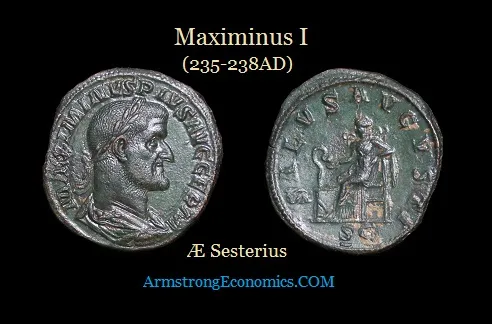
The sequence of events leading up to such drastic changes begins with high taxes and hunting the rich as we are witnessing today. Maximinus I declared all private wealth belonged to the States which was just one more step to the left from Bernie Sanders, Elizabeth Warren, and AOC. Once you do that, the result is the hoarding of wealth and that ends up contracting investment creating an economic death spiral. Education declines and regulation rises as the government seeks more power. The overall trend creates a precipitous drop in quality of life, and all the very reasons for the rise of civilization are then reversed and the trend moves from concentration to separation. This is the overall general scheme as to the reasons why Rome fell.

Keep in mind that the Dark Ages were about 600 years. So we need not worry about this complete collapse in our lifetime. Nevertheless, we are experiencing the early stages of the decline and fall of Western Civilization. The government pensions will create the same trend of fragmentation and turning government employees against the people. We will see the split of the European Union and the same in Canada as well as Australia. The United States will also split as some regions will reject the socialist regions and their attempts to subjugate their beliefs to their own.

If Rome’s sheer size made it difficult to govern because centralized government always fails. This contributed to the ineffective and inconsistent leadership which only served to magnify the problem as we are witnessing today as politics also has become highly polarized. Being the Roman emperor became a highly risky position during the 2nd and 3rd centuries. Civil war became commonplace as people made attempts to take power or to separate. This would thrust the empire into chaos, which we will begin to experience after 2020. The Praetorian Guard—the emperor’s personal bodyguards—assassinated and installed new sovereigns at will, and once even auctioned the spot off to the highest bidder who was Didius Julianus (193AD). There were two rival bidders but Julianus won paying 25,000 sestertii per man, which was the high bid and he was duly declared Emperor. However, the Praetorians were not loyal to him and he was beheaded on June 2nd after a reign of only 66 days.

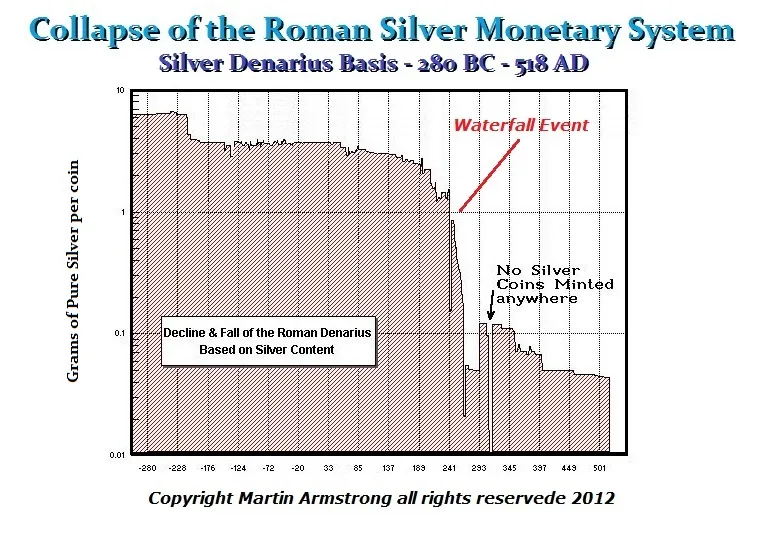
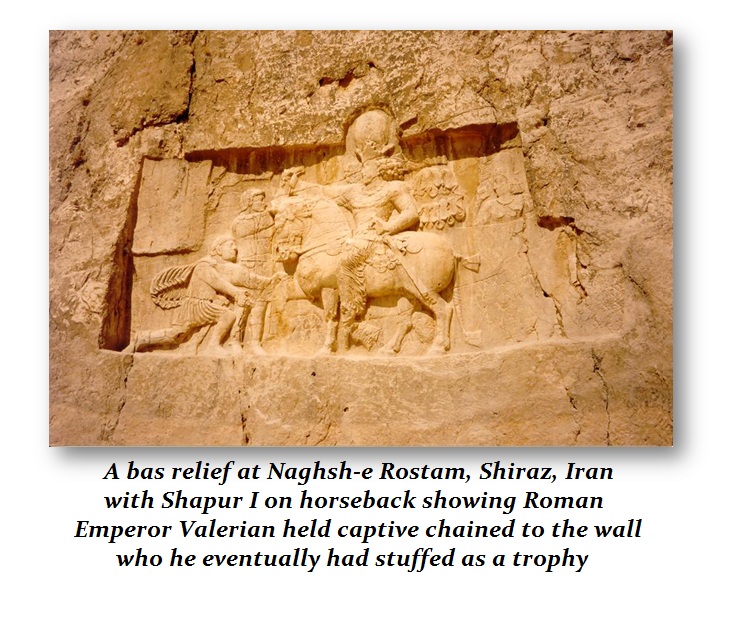
The Praetorian Guard became the same as we have today with the Deep State, illustrated in the FBI, CIA, and NSA all conspiring to overthrow Trump. This political chaos also extended to the Roman Senate as it has currently in modern times. The Senate became a cesspool of corruption that failed to temper the excesses of the emperors due to its own widespread corruption and incompetence (i.e. gridlock). As the situation worsened, civic pride waned and many Roman citizens lost trust in their leadership. Trajan Decius (249-251AD) was the first Roman Emperor to be killed in battle with the Barbarians. That had a great impact on the confidence of the people in government. They suddenly saw themselves as vulnerable. Then, in 260 AD, the Roman Emperor Valerian I (253-260AD) was captured and kept as a slave to the Persian king. That was the final straw, and we see the collapse of the Roman Monetary System within 8.6 years.

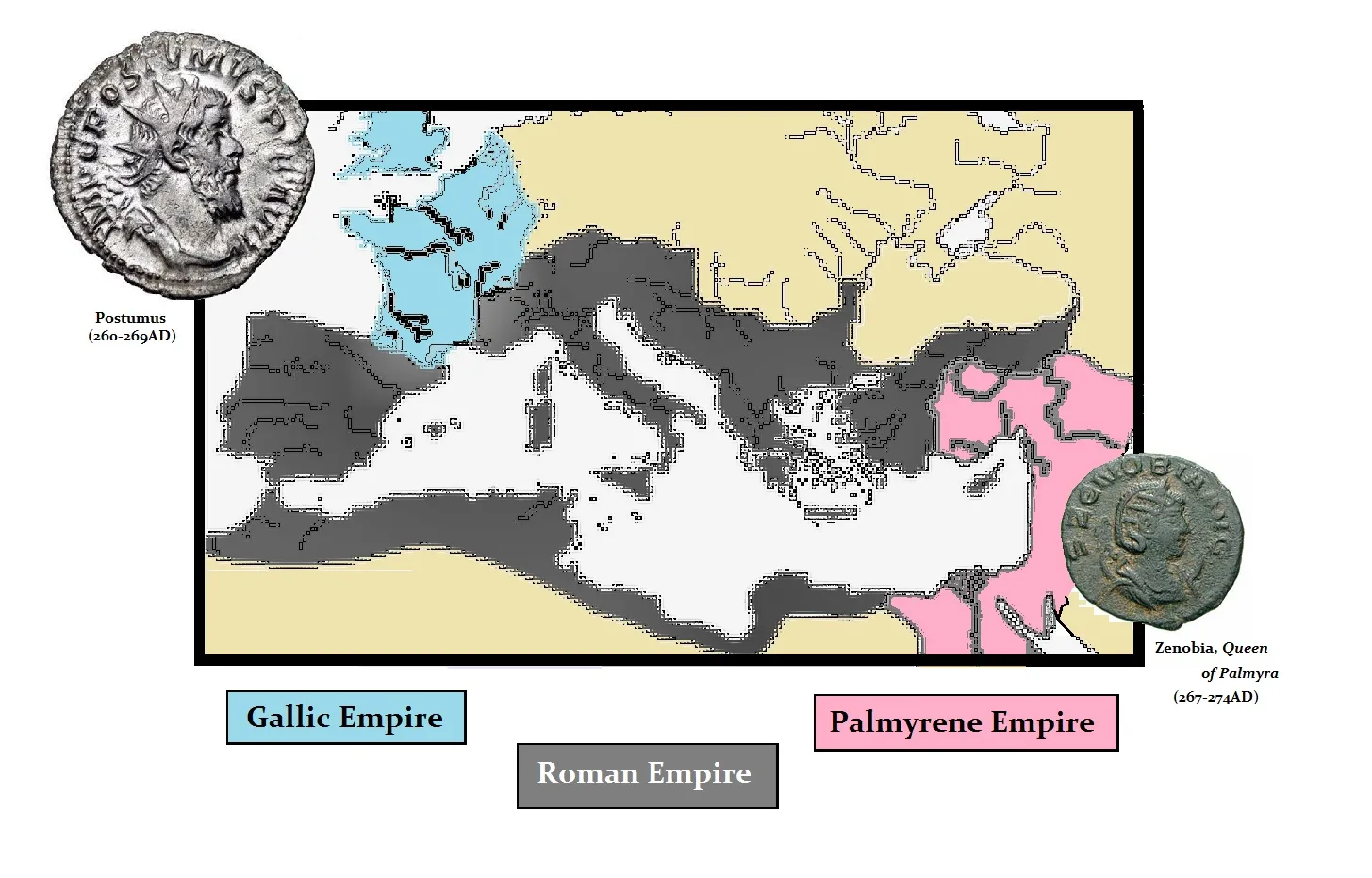
The Barbarian attacks on Rome partially stemmed from a mass migration caused by the Huns’ invasion of Europe in the late fourth century. As the Huns moved West, the barbarians were compelled to invade. Once they saw that Rome was vulnerable following the capture of Valerian, the invasions began in mass. This led to the Roman Empire dividing into three regions. Postumus (260-268 AD) led the rebellion creating the Gaulic Empire (Britain-France-Spain) and in the East Zenobia carved out her Empire based in Syria.

We are simply following the very same pattern in the same order. History repeats simply because human nature never changes. We would always like to think we are smarter and different. That has never proven to be anything more than a preferred delusion.

No Deal – President Trump Holds a Press Conference Prior to Departing Hanoi, Vietnam…


Despite several positive and remarkable comments from Kim Jong-un, President Donald Trump and the North Korean Chairman could not come to a substantive agreement after two days of negotiations on the process to denuclearize the Korean peninsula.

During a press conference prior to departing Hanoi, Vietnam, President Trump cited two issues: (1) A North Korean demand for the immediate removal of all multinational economic sanctions; and (2) The unwillingness of North Korea to be fulsome about their missile and nuclear locations. WATCH:

.

Additional Thoughts:

In the backdrop of the Hanoi summit, and as U.S-China trade negotiations continue, the Trump administration suspended the implementation of the March 1st tariff increase on Chinese goods.  Unfortunately, attaining this goal may have empowered a cunning Chairman Xi Jinping to influence the demands of DPRK Chairman Kim.

A covert influence connection will become clear if President Trump now takes an even more firm trade and tariff position toward China. We’ll keep watching closely.

Chairman Xi may have won this round, but we can expect an angered and strategic President Trump to hit back twice as hard.

In this dance with the dragon President Trump cannot simply reverse the tariff suspension, that approach would be too obvious.  Instead my suggestion would be to look for signs of the U.S. reviewing Chinese violations of the North Korea sanctions.

A key indicator will be if over the next several weeks, we see the U.S. Treasury and/or Commerce Department beginning to point out those who are violating the sanctions against North Korea.

It’s an open secret that China is the largest violator; but President Trump has been giving everyone a pass due to progress on both the China trade and DPRK nuclear talks.

With a set-back in the overall process, and with China playing games, we might just see a renewed focus on U.S. sanction enforcement, specifically targeting China.

What we will not see is President Trump acquiescing to China on trade and economics simply to get Kim Jong-un away from Beijing’s clutches.  That massive ransom payment falls too heavily, and too exclusively, on the United States – while regional allies gain the benefits of peace on the back of a lessened U.S. economy.

That sh!t deal wouldn’t pass the MAGAnomic ‘America First’ test; not even close.

That exact conversation is what President Trump likely will be explaining to South Korean President Moon Jae-in (the Asian Obama), and Japanese Prime Minister Shinzo Abe on the flight home.  THAT EXACT CONVERSATION!

*UPDATE* Talks End With No Deal – Second Half / Day Two: Trump-Kim Summit, Hanoi Vietnam…


Update from the White House:

Statement from the Press Secretary Regarding the Hanoi Summit:

“President Donald J. Trump of the United States and Chairman Kim Jong Un of the State Affairs Commission of the Democratic People’s Republic of Korea had very good and constructive meetings in Hanoi, Vietnam, on February 27-28, 2019. The two leaders discussed various ways to advance denuclearization and economic driven concepts. No agreement was reached at this time, but their respective teams look forward to meeting in the future.”

As the Summit concludes with no agreement, President Trump will be holding a press conference shortly.

WH Livestream Link – Alternate Livestream Link – Alternate Livestream Link

President Donald Trump and Chairman Kim Jong-un held extended one-on-one and small group meetings on day two of their Hanoi summit.  The schedule below may no longer be accurate (but the sequence should be roughly correct, maybe).

Vietnam is 12 hours ahead of U.S. Eastern Time. Most of the substantive public activities,  including a joint signing ceremony and POTUS Trump press conference, will take place early Thursday morning U.S. time.   Again, due to extended substantive Trump-Kim discussions, the schedule is now fluid… adjust expectations accordingly.

ABC Livestream Link – ARIRANG News Livestream

*Tentative* Schedule and Livestream(s) Below:

Sarah Sanders informs media the negotiations are ongoing but will wrap up at Metropole in next 30 to 45 minutes and Potus will return to Marriott. Press conference moved up from 4 p.m. to start at 2 p.m. She declined to say whether there would still be a joint signing ceremony but appears unlikely.

  • 2:40am EST / 2:40pm (local) – President Trump departs Sofitel Legend Metropole Hanoi en route to the JW Marriott Hotel Hanoi. Hanoi, Vietnam
  • 3:00am EST / 3:00pm (local) – President Trump arrives at the JW Marriott Hotel Hanoi. Hanoi, Vietnam
  • 3:50am EST / 3:50 pm (local) – President Trump participates in a press conference. Hanoi, Vietnam
  • 5:15am EST / 5:15 pm (local) – President Trump departs JW Marriott Hotel Hanoi en route to Noi Bai International Airport. Hanoi, Vietnam
  • 5:55am EST / 5:55pm (local) – President Trump arrives at Noi Bai International Airport Hanoi, Vietnam
  • 6:05am EST / 6:05pm (local) – President Trump departs Hanoi, Vietnam, en route to Joint Base Andrews, Noi Bai International Airport

Livestream:

.

  • 1:10am EST Friday Morning – President Donald Trump arrives at Joint Base Andrews
  • 1:20am EST Friday Morning – President Donald Trump departs Joint Base Andrews en route to The White House, Joint Base Andrews
  • 1:30am EST Friday Morning – President Trump arrives at The White House


Epic Bilat Moment During Hanoi Summit – Kim: “If I’m not willing to denuclearize I won’t be here right now”….


We can somewhat throw out the schedule; President Trump and Chairman Kim held a much longer one-on-one, and informal small group discussion….. Culminating in this historic moment with the media present and the formal bilat about to begin.

First, watch Chairman Kim Jong-un take questions from U.S. media.  That’s historic. Second, and more importantly, listen carefully to the answers: MUST WATCH

U.S. Journalist: “Chairman Kim are you willing to denuclearize?”

Chairman Kim Jong-un: “If I’m not willing to do that, I won’t be here right now.”

POTUS Trump injected: “That might be the best answer you’ve ever heard.”

Rough translations of exchanges:

Another U.S. reporter asked if Chairman Kim was willing to take concrete steps to denuclearize?  Chairman Kim replied: “That’s what we are discussing right now.”

President Trump was asked if there would be a political statement to end the war?

Trump response: “No matter what happens we’ll ultimately have a deal that’s really good for Chairman Kim and his country. That’s where it’s all leading. It doesn’t mean we’re doing it in one day, in one meeting. I really believe with this great leadership North Korea, I really believe it’s going to be very successful.”

Chairman Kim was asked if he was ready for the US to have a liaison office in Pyongyang. A north Korean aide appeared to attempt to cut off questions but POTUS Trump interjected: “that’s actually an interesting question. I would like to actually like to hear that answer. “

Chairman Kim replied: “That is something that is welcomeable.”

President Trump said the idea was a “great thing.”

Chairman Kim then seemed to be done with questions: “If you’ll kindly give us more time, one minute.”


Senator Lindsey Graham Discusses President Trump and Chairman Kim Hanoi Summit..


Senator Lindsey Graham discusses his recent conversation with President Trump surrounding the Hanoi summit with DPRK Chairman Kim Jong-un; and the political schemes of Democrats to undercut the peace objectives of the administration.

Breakout: President Trump and Chairman Kim Day #2 Greeting…


President Trump and Chairman Kim initial one-on-one meeting to begin day two. Both leaders appear engaged and cautiously optimistic. Again, President Trump focuses on the economic potential for a denuclearized North Korea.  [Transcript will follow]

.

[Transcript] President Trump: “Well, thank you very much Chairman Kim, and it’s great to be with you again. And, I’m sure over the years we’ll be together a lot, and I think we’ll also be together after the fact, meaning after the deal is made. We had very good discussions last night at dinner, and the pre-dinner was very good. And, there were a lot of great ideas being thrown about. I think very importantly, the relationship is, you know, just very strong, and when you have a good relationship, a lot of good things happen. So, I can’t speak necessarily for today, but I can say that this, a little bit longer term, and over a period of time, I know we’re going to have a fantastic success with respect to Chairman Kim and North Korea. They’re going to have an economic powerhouse. I’ve been writing about it, I’ve been talking about it. I think it’s going to be an economic powerhouse. And it’s something I very much look forward to helping with because with a little bit of help in the right location and the right place, I think it’s going to be something very special.”

(translator for President Trump): “I’ve been saying very much from the beginning that speed is not that important to me. I very much appreciate no testing of nuclear rockets, missiles, any of it. Very much appreciate it. And, Chairman Kim and I had a great talk about that last night. I’ll let him say what he said if he’d like to and if he doesn’t, he doesn’t have to. But, we had a very good talk about that last night. And again, I am in no rush. We don’t want the testing, and we’ve developed something very special with respect to that. But, I just want to say I have great respect for Chairman Kim, and I have great respect for his country, and I believe that it will be something economically that will be almost hard to compete with for many countries. It has such potential.”

Chairman Kim (translated): “Well, it’s too early to tell, but I wouldn’t say that I’m pessimistic. From what I feel right now, I do have a feeling that good results will come out.”

Day #2 Hanoi Summit – President Trump and Chairman Kim in Vietnam (Schedule and Livestream)…


President Donald Trump and Chairman Kim Jong-un begin meetings tonight on day two of their Hanoi summit.  Vietnam is 12 hours ahead of U.S. Eastern Time.  Most of the substantive action, including a joint signing and Trump press conference, will take place overnight Wednesday and early Thursday morning.

ABC Livestream Link – ARIRANG News Livestream

Schedule and Livestream Below:

  • 8:25pm EST / 8:25am (local) – President Trump departs JW Marriott Hanoi en route to the Sofitel Legend Metropole Hanoi, Hanoi, Vietnam
  • 8:45pm EST / 8:45am (local) – President Trump arrives at the Sofitel Legend Metropole Hanoi, Hanoi, Vietnam
  • 9:00pm EST / 9:00am (local) – President Trump participates in a one-on-one bilateral meeting with Chairman Kim Jong-un of the State Affairs Commission of the Democratic People’s Republic of Korea. Hanoi, Vietnam
  • 9:45pm EST / 9:00am (local) – President Trump participates in an expanded bilateral meeting with Chairman Kim Jong-un of the State Affairs Commission of the Democratic People’s Republic of Korea. Hanoi, Vietnam
    • 11:55pm EST / 11:55am (local) – President Trump participates in a working lunch with Chairman Kim Jong-un of the State Affairs Commission of the Democratic People’s Republic of Korea. Hanoi, Vietnam
  • 2:05am EST / 2:05pm (local) – President Trump participates in a Joint Agreement Signing Ceremony with Chairman Kim Jong-un of the State Affairs Commission of the Democratic People’s Republic of Korea. Hanoi, Vietnam
  • 2:40am EST / 2:40pm (local) – President Trump departs Sofitel Legend Metropole Hanoi en route to the JW Marriott Hotel Hanoi. Hanoi, Vietnam
  • 3:00am EST / 3:00pm (local) – President Trump arrives at the JW Marriott Hotel Hanoi. Hanoi, Vietnam
  • 3:50am EST / 3:50 pm (local) – President Trump participates in a press conference. Hanoi, Vietnam
  • 5:15am EST / 5:15 pm (local) – President Trump departs JW Marriott Hotel Hanoi en route to Noi Bai International Airport. Hanoi, Vietnam
  • 5:55am EST / 5:55pm (local) – President Trump arrives at Noi Bai International Airport Hanoi, Vietnam
  • 6:05am EST / 6:05pm (local) – President Trump departs Hanoi, Vietnam, en route to Joint Base Andrews, Noi Bai International Airport

Livestream:

.

  • 1:10am EST Friday Morning – President Donald Trump arrives at Joint Base Andrews
  • 1:20am EST Friday Morning – President Donald Trump departs Joint Base Andrews en route to The White House, Joint Base Andrews
  • 1:30am EST Friday Morning – President Trump arrives at The White House